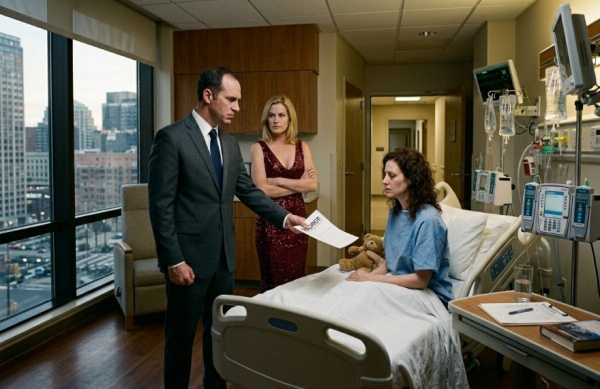
My Husband Left His Dying Wife at the Hospital. He Chose Her Best Friend Over His Family—But Her $20 Billion Secret Destroyed His Plan
He thought he was walking away from a sick wife, a fragile child, and a life that no longer served him. Outside the pediatric intensive care unit, he handed her divorce papers and said their six-year-old son was “a life I don’t want to take with me.” What he didn’t know was that, just minutes earlier, her phone had confirmed a $20 billion deal that would change everything. By the time he realized what he had lost, the woman he abandoned was no longer waiting to be chosen.
Part 1: The Papers Outside the Glass
The hallway outside the pediatric intensive care unit was too quiet for the kind of heartbreak it held. Even the nurses seemed to move softer there, their sneakers whispering over polished floors, their voices lowered out of respect for parents who had already spent all night bargaining with God.
Hannah Miller sat in a blue vinyl chair beside the vending machines, wearing a hospital blanket over her shoulders like a coat. She had not slept in thirty-six hours. Her six-year-old son, Noah, lay behind a glass wall in Room 714, small and pale beneath a quilt printed with astronauts and stars.
The ventilator beside him made a soft, steady sound, not violent or frightening, just persistent. It breathed with him, or maybe for him, Hannah was too exhausted to separate the two anymore. Every few minutes, she looked through the glass and watched his chest rise.
Her own body was failing too. The doctors had called it advanced heart failure caused by a rare autoimmune condition, the kind of phrase people used when they wanted to sound scientific instead of scared. Hannah had learned to smile when people asked how she was doing because the truth made them uncomfortable.
She had spent years building a biotech company from a rented office above a coffee shop in Cambridge. The company, SolaraVive, had started with one impossible idea: a targeted therapy for the rare inflammatory disease that was slowly taking her heart and had nearly taken Noah’s lungs. It had begun as hope, then turned into research, then into patents, then into something powerful enough that billion-dollar corporations started calling.
That morning, at 7:14 a.m., her phone had buzzed with the message her legal team had been chasing for months. The merger agreement was signed. A global health company had agreed to acquire SolaraVive for twenty billion dollars, including cash, stock, and milestone payments tied to FDA approvals.
Hannah had stared at the screen until the words blurred. Twenty billion dollars. A number so large it felt almost vulgar sitting in her palm while her son slept behind glass and her own heart struggled under her ribs.
She did not cheer. She did not cry. She simply locked the phone, pressed it against her chest, and whispered, “Hold on, Noah. Mommy did it.”
That was when her husband walked in.
Mark Miller looked nothing like a man whose child was in intensive care. His navy suit was pressed, his shoes were polished, and his cologne arrived before he did. He carried a leather folder in one hand and a paper coffee cup in the other, though Hannah knew he hated hospital coffee.
For a second, she almost smiled from pure habit. Ten years of marriage had trained her face to soften when he appeared, even when her heart knew better. Then she saw Vanessa behind him.
Vanessa Cole stood a few steps back, wrapped in a camel-colored coat, her blonde hair falling in perfect waves over one shoulder. She had once been Hannah’s closest friend, the kind of friend who knew where the extra key was hidden, who held Noah in the delivery room, who brought soup during chemo infusions and called herself Aunt V.
Now she stood beside Mark like she had already practiced being his wife.
“Hannah,” Mark said, not sitting down. “We need to talk.”
Hannah glanced toward Noah’s room. “Not here.”
“It has to be now.”
“No,” she said, her voice hoarse. “Our son is in the PICU. Whatever this is, it can wait.”
Mark’s jaw tightened. He looked annoyed, as if Noah’s illness had once again inconvenienced his schedule. Then he opened the leather folder and placed a stack of papers on her lap.
The top page said Petition for Dissolution of Marriage.
For a moment, Hannah’s mind refused to understand it. She stared at the words as though they were written in another language. The fluorescent lights hummed overhead, and somewhere down the hall a baby cried.
“You’re serving me divorce papers,” she said slowly, “outside our son’s intensive care room?”
Mark exhaled. “Don’t make this dramatic.”
Hannah let out a small laugh that had no joy in it. “You brought a lawyer’s envelope to the hospital.”
“I brought clarity,” he said.
Vanessa looked at the floor. She had the decency to appear uncomfortable, but not enough decency to leave.
Hannah’s fingers rested on the papers. They were cold, crisp, and official. Ten years of marriage reduced to stapled pages in twelve-point font.
“Why is she here?” Hannah asked, looking at Vanessa.
Mark answered before Vanessa could. “Because she’s part of my future.”
Something inside Hannah went still.
She had known there was distance between them. She had known Mark had grown restless, tired of hospitals, tired of insurance calls, tired of sleeping beside a wife whose chest sometimes rattled when she breathed. She had even suspected Vanessa, though suspicion felt ugly when you were already fighting for your child’s life.
But hearing it there, in that hallway, while Noah’s ventilator breathed softly behind glass, turned suspicion into a wound.
“Our son is fighting to live,” Hannah said. “And you’re announcing your future?”
Mark’s face hardened. “That’s exactly the problem. Everything is always a fight with you. Your illness, Noah’s illness, your company, your doctors, your emergencies. I can’t do it anymore.”
Hannah looked up at him. “Do what? Be a husband? Be a father?”
“Be trapped,” he snapped.
A nurse passing by glanced over, then quickly looked away.
Mark lowered his voice, but the cruelty stayed in it. “I want a normal life. A peaceful life. Vanessa wants children. Healthy children. I deserve that.”
Hannah felt the words land one by one, sharp and deliberate. “Noah is your child.”
Mark looked through the glass at the small boy sleeping under the astronaut blanket. His expression did not change.
“Noah is a life I don’t want to take with me,” he said.
The hallway disappeared.
Hannah heard the ventilator. She heard the monitor. She heard a distant elevator bell and the squeak of a cart wheel somewhere behind her. But for several seconds, she could not hear her own breathing.
Vanessa whispered, “Mark.”
He ignored her.
Hannah stood slowly, clutching the divorce papers in one hand and the hospital blanket with the other. Her knees trembled, but she did not let herself fall. She looked at the man she had married in a little white chapel in Vermont, the man who had cried when Noah was born, the man who had once promised he would never leave.
“You don’t get to erase him because he’s inconvenient,” she said.
Mark’s eyes flickered, not with guilt, but irritation. “I’m not here to argue. My attorney will contact yours. I’ve already moved out. Vanessa and I are leaving for California next week.”
“California,” Hannah repeated.
“Santa Barbara,” Vanessa said softly, as if that detail somehow made the betrayal more tasteful.
Hannah turned to her. “You held my baby when he was born.”
Vanessa’s mouth opened, but nothing came out.
“You brought balloons that said ‘Welcome to the World, Noah,’” Hannah continued. “You cried harder than I did.”
Vanessa’s eyes filled with tears. “I never meant for it to happen like this.”
“That’s what people say when they mean they did it anyway.”
Mark stepped forward. “Enough. Sign the papers, Hannah. Don’t make this ugly.”
She almost laughed again. Ugly had already arrived wearing polished shoes.
Her phone buzzed in her hand. The screen lit up with another message from her general counsel.
Congratulations, Hannah. It’s official. Wire confirmation received. Board call at noon.
Mark glanced at the phone, but only briefly. He had never cared about SolaraVive except when he could complain that it stole her attention from him. He had no idea what had just happened. He had no idea the woman he was abandoning had become one of the most powerful founders in America before breakfast.
Hannah turned the phone face down.
“You should go,” she said.
Mark blinked, surprised by the calmness in her voice. “That’s it?”
“That’s it.”
“You’re not going to beg?”
Hannah looked through the glass at Noah. His fingers were curled around a small stuffed bear, the one Mark had won for him at a county fair three summers ago. She remembered Noah laughing on his father’s shoulders, sticky with cotton candy, innocent enough to believe love could not expire.
“No,” she said. “I’m not going to beg a man to love his child.”
Mark’s face flushed.
Vanessa reached for his arm. “Let’s go.”
Mark picked up the coffee cup he had set on the windowsill. “You’ll hear from my attorney.”
Hannah looked at him one last time. “And you’ll hear from mine.”
He smirked, because he thought she meant divorce.
She didn’t.
Part 2: The Woman He Underestimated
By noon, the hospital conference room had become Hannah’s temporary command center. Her cardiologist had begged her to rest, but Hannah had spent too many years being told to slow down by people who mistook survival for weakness. She sat at the end of the table with an oxygen cannula under her nose, a cardigan over her hospital gown, and a laptop open in front of her.
On the screen were eighteen faces: attorneys, board members, investment bankers, regulatory consultants, and the CEO of the company acquiring SolaraVive. They all looked polished and expensive, framed by glass offices in New York, San Francisco, London, and Zurich. Hannah was the only one calling from a children’s hospital.
“Before we begin,” said Andrew Keene, her general counsel, “I want to confirm that the definitive agreement has been executed by all parties.”
“It has,” said the acquiring company’s CEO. “And Hannah, on behalf of everyone at Meridian Arc Health, congratulations. What you built will change treatment for millions of families.”
Hannah nodded. “Thank you.”
Her voice sounded steadier than she felt. Under the table, her left hand pressed against her ribs, where pain came and went like weather. She had learned to hide discomfort in boardrooms because investors respected confidence more than honesty.
The deal had taken nearly seven years to build. SolaraVive’s platform used precision immune mapping to identify and interrupt the inflammatory cascade behind several rare pediatric and adult conditions. In plain English, it taught the body to stop attacking itself before permanent damage was done.
The first trial had been small, then the second larger, then the third impossible to ignore. Children who had once lived between hospital admissions went months without crisis. Adults who had been told to prepare for decline regained enough function to return to work, to school, to ordinary life.
Noah had not yet qualified for the trial because of complications. Hannah had understood the ethics and the FDA restrictions, but understanding did not make it hurt less. She had built the bridge and still had to wait for permission to carry her own son across it.
“Per the terms,” Andrew continued, “Dr. Miller remains chair of the SolaraVive Foundation and will control the patient access fund.”
That part mattered most to Hannah. The acquisition was not just a payout. It created a foundation with billions set aside for patient assistance, rural clinic access, and expedited pediatric research.
Money was power, but directed money was protection.
“Hannah,” said one board member, “there will be intense media interest. Founder story, mother of a critically ill child, rare disease angle, twenty-billion-dollar valuation. We should prepare for public scrutiny.”
Hannah looked toward the glass wall of the conference room. Down the hall, she could see a nurse walking toward Noah’s room with a small tray.
“I’m used to scrutiny,” she said. “I’m less used to mercy.”
A few people smiled politely. They thought it was a graceful line. They did not know she was thinking about divorce papers sitting in her purse beside a pack of tissues and Noah’s dinosaur stickers.
After the call ended, Andrew remained on the screen.
“Hannah,” he said, “you look like you’re about to collapse.”
“I’m fine.”
“You’re in a hospital gown.”
“I accessorized with cash flow.”
He did not laugh. Andrew had been her lawyer long enough to know humor was where she stored terror. He removed his glasses and rubbed the bridge of his nose.
“What happened?”
She looked at the closed conference room door. “Mark served me divorce papers this morning.”
Andrew went completely still. “Where?”
“Outside Noah’s room.”
His expression changed from concern to something colder. “Please tell me you’re joking.”
“I wish I were.”
“Was anyone present?”
“Vanessa.”
Andrew’s eyebrows rose. “Your friend Vanessa?”
“Apparently now his future.”
For a moment, Andrew said nothing. Then he leaned toward the camera. “Hannah, I need you to listen carefully. Do not sign anything. Do not agree to anything verbally. Do not respond to his attorney without me.”
“I know.”
“No, I mean really listen. The timing of this matters. The acquisition closed before any divorce judgment. Depending on the marital property analysis, his counsel may attempt to claim a significant portion of your equity.”
Hannah stared at him. “He doesn’t even know.”
“He will.”
She thought about Mark’s smirk. Sign the papers, Hannah. Don’t make this ugly.
“What can he get?” she asked.
Andrew hesitated. “Massachusetts is an equitable distribution state. That does not mean fifty-fifty automatically, but the court can consider assets acquired during the marriage. Your company was founded during the marriage.”
Hannah’s stomach tightened.
“But,” Andrew continued, “there are factors. Your premarital research. Your separate intellectual property. Your documented reinvestment. His lack of contribution. His conduct. His attempt to abandon a medically fragile child. The timing. Any dissipation of marital assets. We will build the record.”
Hannah closed her eyes.
She did not care if Mark got money. That was the strange thing. Twenty billion was too large a number for petty revenge. What she cared about was whether Mark could use the law as one more weapon against Noah.
“I don’t want him making medical decisions for Noah,” she said.
“That’s a separate emergency motion.”
“He called him a life he didn’t want to take with him.”
Andrew’s face hardened. “Who heard that?”
“Vanessa. Maybe a nurse.”
“We need names.”
Hannah looked down at her hands. Her wedding ring was still there, loose around her finger because she had lost so much weight. She twisted it once, then pulled it off.
For ten years, she had defended Mark to everyone.
He’s stressed.
He doesn’t handle hospitals well.
He loves us in his own way.
He’s just tired.
Now, sitting beneath fluorescent lights with oxygen in her nose and a twenty-billion-dollar deal in her inbox, Hannah realized she had spent years translating cruelty into exhaustion because she was afraid of what the original language meant.
Mark had not left because she was dying.
He had left because survival required more from him than comfort did.
That evening, Mark called twelve times. Hannah did not answer. By the thirteenth call, he texted.
We need to talk about the company.
She stared at the message for a long time.
Then another came.
Vanessa saw something online. Is it true?
Hannah did not respond.
A third message arrived.
Hannah, don’t be childish. We’re still married.
She almost smiled at that. In the morning, he had wanted out so badly he served her papers beside their child’s hospital room. By sunset, marriage had become useful again.
At 9:08 p.m., a financial news outlet published the story.
Meridian Arc Health to Acquire SolaraVive in Landmark $20 Billion Rare Disease Deal
Hannah’s photo appeared beneath the headline. It was an old one from a conference in Chicago, taken before her diagnosis worsened, before Noah’s last hospitalization, before betrayal had a name. She looked confident, bright-eyed, almost untouched by grief.
The article called her “one of the most influential physician-founders in American biotech.” It mentioned her son only briefly, saying her work was inspired by family experience with rare autoimmune disease. It did not mention Mark.
That omission, she knew, would hurt him more than any insult.
At 10:31 p.m., Mark left a voicemail.
His voice was different now. Softer. Warmer. Manufactured.
“Hannah, hey. I saw the news. I just… I’m proud of you. I know today was emotional, and maybe I handled things badly. Let’s not let attorneys turn us against each other. We’re family.”
Hannah listened once, then saved it for Andrew.
Behind the glass, Noah stirred. His eyelashes fluttered, and for a second his eyes opened, unfocused but blue and alive. Hannah stood so fast the chair scraped behind her.
“Hi, baby,” she whispered through the glass.
A nurse adjusted something gently and smiled at Hannah. “He’s trying.”
Hannah pressed her palm to the window.
“So am I,” she said.
Part 3: Vanessa Learns the Price of Winning
Vanessa Cole had imagined many versions of the future, but none of them included sitting in a Santa Barbara rental house while Mark screamed into his phone about stock vesting schedules. The house overlooked the ocean, though the view was less romantic than she had expected. Fog rolled in most mornings, turning the Pacific gray and cold.
They had arrived two days after Mark served Hannah. Vanessa told herself the timing was unfortunate, not unforgivable. She repeated that sentence often, usually while unpacking expensive dishes Mark had insisted they buy even though he said money was tight.
At first, she believed he wanted a fresh start. He talked about peace, about finally breathing, about building a family without hospital alarms and medication charts. Vanessa wanted to believe she was chosen because she represented love, not escape.
Then the news broke.
Twenty billion dollars changed the air in the room.
Mark spent the first hour denying it. Then he spent the second hour calculating. By the third, he was pacing barefoot across the living room, calling attorneys in Boston, Los Angeles, and New York.
“She started the company while we were married,” he kept saying. “Married. Do you understand what that means?”
Vanessa watched him from the kitchen island. “You said you didn’t care about her company.”
“I didn’t know it was worth twenty billion dollars.”
The honesty of that sentence frightened her.
He did not seem embarrassed by it. He seemed offended that the universe had hidden money from him. Vanessa felt a small, cold crack appear in the story she had told herself about him.
Mark had told her Hannah was controlling. He said Hannah used illness to manipulate everyone around her. He said Noah’s condition had consumed the marriage until he was no longer a husband, only a nurse and an ATM.
Vanessa had believed enough of it to forgive herself.
Now she remembered Hannah sleeping upright in a hospital chair with one hand pressed against Noah’s blanket. She remembered the way Hannah still asked the nurses if they had eaten. She remembered Mark checking sports scores during specialist appointments.
The truth had always been there. Vanessa had simply looked away because love made her vain. She had wanted to be the woman who rescued him.
“Maybe you should give Hannah space,” Vanessa said carefully.
Mark spun around. “Space? Are you insane?”
“No, I just mean Noah is still—”
“Don’t start with Noah.”
Vanessa flinched.
Mark saw it and softened immediately, but the softness no longer comforted her. “I’m sorry. I’m stressed. This is complicated.”
“It’s your son.”
He looked away.
That was when Vanessa understood something terrible. Mark did not hate Noah. Hate required attention. Mark resented Noah because Noah reminded him that love could demand sacrifice.
The next morning, paparazzi found Hannah at the hospital. Not aggressive paparazzi, just two freelance photographers and a local reporter standing across the street near the parking garage. Still, the images went everywhere.
Hannah appeared thinner than Vanessa remembered, wearing black leggings, sneakers, and a gray coat over what looked like a hospital bracelet. She held a paper bag from the cafeteria and walked with one hand on the wall for balance. The headline called her “the $20 billion mother fighting for her son.”
Public sympathy became a wave.
Women posted about husbands who vanished during cancer treatment. Fathers posted about sleeping in NICUs and PICUs and never once considering their children burdens. Nurses wrote careful, professional comments about seeing which parents stayed when machines entered the room.
Then someone leaked that Hannah had been served divorce papers at the hospital.
No one knew who leaked it. Vanessa suspected Andrew Keene, though she could not prove it. The internet did what it always did: it built a courtroom out of fragments.
Mark’s name appeared within hours.
By dinner, his old employer had released a short statement saying he had resigned months earlier and did not represent their values. By midnight, his social media accounts were private. By morning, strangers had found engagement photos of him and Vanessa from a private album one of her cousins had posted by mistake.
Vanessa woke to thousands of messages.
Some were cruel. Some were fair. Some were frightening enough that she reported them. She had done wrong, but the internet had no scale; it poured acid and called it justice.
Mark was furious, not ashamed.
“She’s doing this,” he said, shoving his phone toward Vanessa. “She’s destroying me.”
Vanessa looked at the screen. It showed a comment from a woman in Ohio: A man who abandons his sick child will abandon anyone.
Vanessa handed the phone back. “Maybe people are reacting to what you did.”
His face went blank. “What did you say?”
She swallowed. “You served her at the hospital, Mark.”
“I had a right to end my marriage.”
“You called Noah a life you didn’t want to take with you.”
He stared at her. For a second, she saw calculation move behind his eyes.
“You’re remembering that wrong,” he said.
Vanessa felt the room tilt.
“No,” she whispered. “I’m not.”
“You were emotional.”
“No, Mark. You said it.”
He stepped closer. “You need to be very careful about repeating that.”
There it was. Not love. Not remorse. Control.
Vanessa took one step back.
For the first time since the affair began, she wondered what Hannah had survived before the world started watching.
Two days later, Vanessa received a call from Andrew Keene’s office. They did not threaten her. They did not insult her. They simply asked whether she would provide a truthful statement about what happened outside Room 714.
Vanessa did not answer immediately.
She looked out at the ocean. Mark was on the patio, speaking to another attorney, his voice loud enough to carry through the glass.
“Yes,” he said. “I want everything I’m entitled to. I supported her while she built that company.”
Vanessa nearly laughed. She had known Hannah during those years. Hannah had worked eighty-hour weeks, applied for grants at midnight, handled Noah’s appointments, paid the mortgage, and still remembered Vanessa’s birthday. Mark had supported Hannah the way a shadow supports a tree.
“Ms. Cole?” the woman on the phone asked. “Are you still there?”
Vanessa closed her eyes.
“Yes,” she said. “I’ll tell the truth.”
That evening, Mark found her packing.
At first, he thought she was organizing. Then he saw the suitcase. His expression hardened in a way she had learned to fear.
“Where are you going?”
“Back to Boston.”
“For what?”
“To give a statement.”
He went pale. “Vanessa.”
She zipped the suitcase with shaking hands. “You told me Hannah was the problem. Maybe she had problems. Maybe she was hard to live with. But you made me believe leaving her was self-preservation.”
“It was.”
“No,” Vanessa said. “It was cowardice.”
His face twisted. “After everything I gave up for you?”
She looked at him then, really looked. “You didn’t give up anything for me. You threw away what you thought had no value. Then you found out it was worth twenty billion dollars.”
Mark took a step toward her. She lifted her phone.
“My Uber is outside,” she said. “And my sister knows I’m leaving.”
He stopped.
That was the moment Vanessa realized how many women survive by making sure someone else knows where they are. She had once judged Hannah for being careful. Now she understood caution as intelligence.
At the airport, Vanessa cried in the restroom until her flight boarded. She cried for Hannah, for Noah, and for the version of herself who had wanted to believe betrayal could be made elegant if it wore cashmere and spoke softly. Most of all, she cried because winning Mark had turned out to be the fastest way to lose herself.
When her plane lifted over California, Mark called thirteen times.
She did not answer.
Part 4: The Courtroom and the Child
The family court hearing took place on a Thursday morning in Boston, under a sky the color of wet pavement. Hannah arrived through a side entrance with Andrew on one side and her older brother, Daniel, on the other. She wore a navy dress, a wool coat, and a portable oxygen concentrator tucked discreetly into a black leather bag.
Noah was still hospitalized, though improving in careful inches. He had opened his eyes more often. He had squeezed Hannah’s hand when she sang “You Are My Sunshine,” their old bedtime song. The doctors called it encouraging, which in hospital language meant hope with a helmet on.
Mark arrived ten minutes late.
He looked thinner than before, but not in the way Hannah did. His was the weight loss of anger, sleeplessness, and bad strategy. He wore an expensive gray suit and walked beside a new attorney, a sharp-faced man named Preston Vale who looked like he billed in six-minute increments and enjoyed every one of them.
Hannah did not look at Mark for long.
She had spent years reading his face for weather. Was he irritated? Was he bored? Was he going to sigh through another appointment? That habit had been harder to break than love.
The hearing was not about the entire divorce. That would come later, with financial experts, valuation reports, and arguments over what portion of SolaraVive belonged to whom. This hearing was about emergency custody, medical decision-making, and temporary support.
The judge, a woman in her sixties with silver hair and tired eyes, reviewed the filings in silence. Her nameplate read Hon. Margaret Ellis. She looked like someone who had heard every version of human disappointment and still believed procedure mattered.
Andrew stood first. He spoke calmly, which somehow made the facts sound worse.
“Your Honor, Dr. Miller is requesting temporary sole legal authority over medical decisions for the minor child, Noah Miller, due to the father’s recent conduct and expressed unwillingness to remain responsible for the child’s care.”
Mark’s attorney rose. “Objection to characterization.”
“This is not trial testimony,” Judge Ellis said. “You’ll have your turn.”
Andrew continued. He described the hospital incident without theatrics. He described Mark serving divorce papers outside the pediatric intensive care unit. He described Mark’s statement that Noah was “a life I don’t want to take with me.”
Mark stared at the table.
Hannah watched his hands instead of his face. His fingers tapped once, twice, then stopped. He was angry, but he was also afraid.
Then Andrew submitted Vanessa’s sworn statement.
Hannah had not seen Vanessa since the day in the hallway. Part of her wanted to hate Vanessa cleanly, without complication. But life rarely gave women that luxury. Vanessa had betrayed her, yes, but she had also chosen truth when lying would have been easier.
Judge Ellis read the statement slowly.
Mark’s attorney argued that the comment had been made “in a moment of emotional distress” and did not reflect Mark’s actual feelings as a father. He said Mark loved Noah deeply. He said Mark had merely needed distance from a “high-conflict marital environment.”
Hannah almost laughed at that phrase. High-conflict marital environment. A polished legal way to say a woman objected to being abandoned beside her sick child.
Then Mark stood.
His attorney touched his arm, but Mark ignored him. “Your Honor, I never meant I didn’t love my son. I was overwhelmed. Hannah has controlled the narrative from the beginning. She controls the doctors, the money, the press, everything.”
Judge Ellis looked at him over her glasses. “Mr. Miller, this is not a media hearing.”
“I understand, but she’s using Noah to punish me.”
Hannah’s brother shifted beside her. Hannah put a hand on his sleeve.
Judge Ellis’s voice remained even. “Mr. Miller, when was the last time you visited your son in the hospital?”
Mark hesitated.
The silence answered before he did.
“Eight days ago,” he said finally.
“And when did you leave the state?”
His attorney closed his eyes.
“Three days after that.”
“For California?”
“Yes.”
“With Ms. Cole?”
Mark’s jaw tightened. “Yes.”
The judge wrote something down.
Mark tried to recover. “I was planning to come back.”
“When?”
“As soon as things calmed down.”
Judge Ellis looked at him for a long moment. “Your child is in intensive care, Mr. Miller. Things do not calm down before a parent shows up. A parent shows up while things are difficult.”
The courtroom went silent.
Hannah looked down quickly because tears had filled her eyes. She was tired of crying in public. She was tired of her pain becoming evidence.
The judge granted Hannah temporary sole medical decision-making authority. Mark was granted supervised hospital visitation pending further review, provided his visits did not interfere with Noah’s care. The court also ordered temporary child support and required both parties not to discuss the child publicly in identifying detail.
Then came the money.
Preston Vale stood and argued that Mark should have immediate access to marital funds, including proceeds related to the SolaraVive transaction. He painted Mark as a spouse who had “stood behind” Hannah’s professional ambitions and now risked being cut out of the financial life he helped build.
Andrew responded with documents.
There were calendars showing Mark absent from medical appointments. Bank records showing Hannah funded the company through grants, venture capital, and her own consulting income. Emails where Mark called SolaraVive “your little science gamble.” Text messages where he complained about Hannah missing dinner to meet with investors who later became central to the acquisition.
Then Andrew played the voicemail Mark had left after seeing the news.
“We’re family,” Mark’s recorded voice said through the courtroom speaker. “Let’s not let attorneys turn us against each other.”
Judge Ellis’s expression did not change, but Hannah saw the smallest tightening around her mouth.
Andrew paused the audio. “Your Honor, this was left approximately thirteen hours after Mr. Miller served divorce papers at the hospital.”
Preston objected. The judge allowed the recording for limited purposes.
Mark leaned toward Hannah during a recess. His voice was low enough that only she could hear.
“You’re enjoying this.”
Hannah looked at him.
For years, she might have defended herself. She might have said no, Mark, I’m devastated, Mark, how could you think that, Mark? But pain had burned away her need to be understood by someone committed to misunderstanding her.
“No,” she said. “I’m surviving it.”
His eyes narrowed. “You think money makes you untouchable?”
“No,” Hannah said. “I think truth makes me harder to bury.”
He stared at her, and for the first time, she saw not the man she married, but the man he became when love stopped benefiting him. It was strangely freeing. Monsters were easier to fight once they stopped wearing familiar faces.
After the hearing, reporters waited outside the courthouse. Andrew advised Hannah not to speak, but she paused anyway. She did not mention Mark by name. She did not mention Vanessa. She did not mention the twenty billion dollars.
She simply said, “My priority is my son’s health and privacy. Families facing serious illness deserve support, dignity, and protection. That is all I’m focused on.”
Then she walked away.
That clip went viral because restraint often sounds louder than rage.
That night, Noah came off the ventilator.
It was not a miracle, not exactly. It was medicine, timing, expert care, and a small boy’s stubborn body deciding to try one more time. But when Hannah heard his voice, thin and raspy, whisper “Mommy,” she believed in miracles anyway.
She leaned over his bed, careful with the tubes and wires, and kissed his forehead.
“I’m here,” she said.
Noah blinked slowly. “Daddy?”
The question broke her in a place no court order could reach.
She brushed his hair back from his forehead. “Daddy knows you’re getting better.”
It was not a lie, but it was not the whole truth. Parenthood, Hannah had learned, was sometimes the art of giving children only as much truth as their hearts could carry.
Noah’s small fingers found hers.
“Did I go to space?” he whispered.
Hannah smiled through tears. “Almost.”
“Did you come too?”
“Always,” she said. “I always come with you.”
Part 5: The Future He Could Not Enter
Six months later, spring arrived in Boston with muddy sidewalks, blooming dogwoods, and sunlight that stayed past dinner. Noah came home on a Tuesday afternoon wearing a Red Sox hoodie, a surgical mask decorated with tiny planets, and a grin missing one front tooth. The nurses lined the hallway to clap as he left.
Hannah cried before they reached the elevator.
Noah rolled his eyes with the impatience of a child who had survived too much and still wanted snacks. “Mom, you’re doing the crying thing again.”
“I know,” she said, wiping her cheeks. “It’s my hobby now.”
Daniel drove them home through streets washed clean by morning rain. Their house in Brookline looked the same from the outside: white trim, black shutters, a Japanese maple by the walkway. But inside, everything had changed.
The living room had been rearranged to make room for Noah’s medical equipment and a reading nook shaped like a rocket ship. The refrigerator was covered with appointment schedules, school forms, and drawings Noah had made in occupational therapy. On the mantel, Hannah had placed one framed photo of the two of them in the hospital, both smiling like survivors who did not yet trust the shore beneath their feet.
There were no pictures of Mark.
Hannah had not removed them in anger. She had boxed them carefully and labeled them for Noah, because his memories belonged to him. One day, when he was older, he could decide what to keep.
The divorce was still unfolding. Mark’s legal team fought hard, then harder, then desperately. They wanted a piece of the SolaraVive deal large enough to restore the life he thought he deserved.
But the case had not become the payday he imagined.
Forensic accountants documented the structure of the acquisition. Much of the value was tied to restricted shares, foundation commitments, patient access funds, and long-term regulatory milestones. Hannah’s attorneys argued successfully that Mark’s conduct, absence, and minimal contribution mattered under equitable distribution.
The court did not leave Mark penniless. American divorce courts were not designed to create fairy-tale punishments, no matter how badly the internet wanted them. But they also did not reward abandonment as entrepreneurship.
Mark received far less than he demanded.
The bigger loss was not financial. His reputation had collapsed in circles where reputation was currency. Board seats disappeared. Consulting offers vanished. Investors who once took his calls now routed him to assistants.
Vanessa testified truthfully and then disappeared from public view. Hannah heard through a mutual acquaintance that Vanessa had moved to Portland, Maine, and was working with a nonprofit supporting families dealing with medical crises. Hannah did not know whether that was redemption or guilt, and she decided she did not need to know.
One afternoon, an envelope arrived from Vanessa.
Inside was a handwritten letter.
Hannah read it alone at the kitchen table while Noah napped upstairs. Vanessa did not ask forgiveness. She did not excuse herself. She wrote that she had betrayed a friendship she once treasured and that telling the truth in court did not erase the harm she caused.
The final line stayed with Hannah.
I mistook being chosen for being loved. I am sorry I made you pay for that lesson.
Hannah folded the letter and placed it in a drawer.
She did not forgive Vanessa that day. But she stopped carrying the heaviest version of hatred. There was only so much room in a healing life, and Hannah needed that room for Noah, for breath, for mornings that did not begin with alarms.
As for Mark, he tried to return.
Not all at once. Men like Mark rarely arrive with apology in both hands. They test the door first.
He sent flowers to the house with a card that said, For everything we survived.
Hannah threw away the card and donated the flowers to the nurses’ station at Noah’s outpatient clinic.
He emailed articles about co-parenting and family healing. He said he wanted to “move forward in a spirit of grace.” Andrew responded with the visitation schedule and a reminder that all communication should go through the parenting app.
Then, one Friday evening in May, Mark appeared at the front gate.
Hannah saw him through the window while washing Noah’s plastic dinosaur cup. For a moment, her body remembered fear before her mind remembered freedom. Her hands went cold.
Mark looked different. His hair was longer, his suit less sharp, his confidence worn thin at the edges. He held a stuffed bear in one hand, the same kind he had won for Noah years ago at the county fair.
Hannah stepped onto the porch but did not open the gate.
“You can’t come here without notice,” she said.
“I know,” Mark replied. “I just wanted to see him.”
“He’s resting.”
“Please, Hannah.”
The word please sounded unfamiliar in his mouth.
She crossed her arms against the evening chill. “Your supervised visit is next Wednesday.”
“I’m his father.”
“Yes,” she said. “That’s why there’s a schedule.”
He looked past her toward the house. “I made mistakes.”
Hannah said nothing.
“I was scared,” he continued. “You were sick. Noah was sick. I didn’t know how to live inside all that.”
“You didn’t have to know,” she said. “You only had to stay.”
His face tightened, and for a second she saw the old Mark, offended by the simplicity of accountability.
“I lost everything,” he said.
Hannah tilted her head. “No. You gave things away.”
He looked at the bear in his hand. “Does he ask about me?”
Hannah considered lying. She considered cruelty. Then she chose neither.
“Sometimes,” she said.
Mark’s eyes filled with tears. Whether they were for Noah or for himself, Hannah could not tell. Maybe both. People were rarely only one thing, even when they caused enormous harm.
“I want to fix it,” he said.
“You can’t fix it with one visit.”
“I know.”
“You can’t fix it by being sad.”
“I know.”
“You can’t fix it because the money didn’t come to you the way you hoped.”
He flinched.
There it was. The truth between them, clean and hard.
Mark looked down. “I deserved that.”
“No,” Hannah said. “You earned it.”
For a moment, neither of them spoke. The neighborhood was quiet except for a dog barking somewhere down the block and a car passing over wet pavement. Inside, Hannah could hear the faint sound of Noah’s favorite space documentary playing low in the living room.
Mark held out the stuffed bear.
“Can you give him this?”
Hannah did not move.
“He remembers the old one,” Mark said.
“So do I.”
His hand dropped slightly.
Hannah looked at the bear and thought of Noah behind glass, small fingers curled around a memory of a father who had not deserved the tenderness attached to it. She thought of all the ways adults complicate love and all the ways children keep reaching anyway.
“I’ll tell him you brought it,” she said. “But I won’t promise he’ll want it.”
Mark nodded.
“That’s fair.”
It was the first fair thing he had said in a long time.
Hannah took the bear through the gate without letting him in. Their fingers did not touch. That mattered to her more than she expected.
When she turned to go inside, Mark spoke again.
“Hannah.”
She stopped.
“Did you ever love me?”
The question was so absurd, so late, so small compared to everything that had happened, that she almost laughed. Instead, she looked back at him with the tired kindness of someone who had already buried the answer.
“Yes,” she said. “That was never the problem.”
Then she went inside and locked the door.
Noah was on the couch under a blanket, his tablet propped against a pillow. He looked up when she entered.
“Was that Dad?”
Hannah sat beside him. “Yes.”
Noah’s face became careful. Children of broken homes often become small detectives, studying tone and silence for clues. Hannah hated that he had joined their ranks so young.
“He brought you something,” she said, holding up the bear.
Noah stared at it.
For a long moment, he did not reach out. Then he took it and turned it over in his hands. His expression was not happy or angry, just thoughtful.
“Can I keep it in the closet for now?” he asked.
“Of course.”
“Not throw it away.”
“Never without asking you.”
He nodded, satisfied.
Then he leaned against her side. Hannah wrapped an arm around him, careful not to squeeze too tightly. His body was warmer now, stronger than it had been, though still fragile in ways strangers could not see.
“Mom?”
“Yeah, baby?”
“When I was asleep at the hospital, did you get scared?”
Hannah looked at the television, where astronauts floated above Earth in impossible silence.
“Yes,” she said. “Very.”
“Did you think I was going to die?”
Her throat tightened. She wanted to protect him from the question, but he had already lived inside it. Denying it would only make him lonelier.
“I was afraid of that,” she said softly.
Noah nodded. “I was scared too, but I don’t remember all of it.”
“That might be your brain being kind to you.”
He considered this. “Brains are weird.”
“They are.”
“And hearts?”
Hannah smiled faintly. “Those too.”
Noah looked up at her. “Is your heart still sick?”
The room seemed to hold its breath.
Hannah had started treatment under a compassionate access protocol connected to SolaraVive’s platform. It was too early to call it a cure. Doctors did not like words that big. But her numbers were better, her stamina was improving, and for the first time in years, her future had become something more than a countdown.
“My heart is trying,” she said.
Noah placed his small hand over her chest. “Tell it I said good job.”
Hannah laughed, then cried, then laughed again because Noah groaned dramatically.
“Mom.”
“I know. Crying thing.”
“Big hobby.”
“The biggest.”
That summer, SolaraVive’s foundation opened its first family support center in Chicago. Then Dallas. Then Atlanta. The centers helped parents navigate insurance appeals, travel grants, clinical trial information, and temporary housing near hospitals. Hannah insisted each one include quiet rooms with recliners because she knew what it meant to sleep sitting up beside a child.
At the ribbon-cutting in Chicago, reporters asked about the divorce. They asked about Mark. They asked whether betrayal had fueled her work.
Hannah stood at the podium in a cream blazer, her hair shorter now, her voice stronger. Behind her, a wall displayed photos of children from clinical studies and patient families who had given permission to share their stories.
“I don’t believe pain automatically makes people better,” she said. “Sometimes pain makes people bitter, or afraid, or cruel. What matters is what we build after it.”
A reporter asked what she wanted people to learn from her story.
Hannah paused.
She thought of the hospital hallway. The papers. Vanessa’s face. Mark’s voice calling Noah a life he did not want to take with him. She thought of the phone buzzing in her hand with a deal large enough to change industries, arriving at the exact moment her personal life collapsed.
Then she thought of Noah coming home.
“I want people to understand that someone else’s inability to value you does not determine your worth,” she said. “Not as a spouse. Not as a parent. Not as a child. And not as a human being fighting to survive.”
The room went quiet.
Later, on the flight home, Noah fell asleep with his head in her lap. He was still small enough to curl into half a seat, though he insisted he was “basically grown.” Hannah brushed crumbs from his hoodie and looked out the window at the lights below.
Twenty billion dollars had changed many things. It had hired attorneys, funded research, opened clinics, protected futures, and made people who once dismissed her suddenly eager to shake her hand.
But it had not been the miracle.
The miracle was not the money.
The miracle was the morning Noah asked for pancakes. The afternoon Hannah walked three blocks without stopping. The first night they slept at home without the sound of machines. The moment she realized she no longer waited for Mark’s approval to feel real.
Months later, the divorce became final.
Hannah received the order by email while standing in line at a grocery store. She read it between shelves of cereal and paper towels, surrounded by ordinary people buying ordinary things. There was no thunder, no swelling music, no cinematic justice.
Just an ending.
She paid for apples, milk, and a box of dinosaur-shaped chicken nuggets Noah insisted were medically necessary. Then she sat in her car and let herself breathe.
Mark was no longer her husband.
He was Noah’s father, under terms the court would enforce. He was a man from her past with scheduled access to the future, but no power over her center. He could visit the life he once rejected, but he could not own it.
That evening, Hannah and Noah ate dinner on the back porch. The air smelled like cut grass and summer rain. Fireflies blinked above the lawn like tiny, stubborn stars.
Noah held up a chicken nugget. “This one looks like a T. rex.”
“Terrifying.”
“I’m going to eat it before it eats us.”
“Heroic.”
He grinned, then dipped it in ketchup.
Hannah watched him with a tenderness so fierce it almost hurt. There had been a time when she thought the future was something she needed to win in courtrooms, boardrooms, and hospital rooms. Now she understood the future was also this: ketchup on paper plates, bare feet on porch boards, a child laughing at his own joke.
Her phone buzzed on the table.
For a second, her body tensed out of old habit. Then she saw it was only a message from Andrew.
Congratulations. It’s done.
Hannah typed back, Thank you for helping us get here.
Then she put the phone face down.
Noah looked at her. “Good news?”
Hannah smiled.
“Yeah,” she said. “Very good news.”
“Are we rich-rich now?”
She laughed. “Why?”
“Because I think rich-rich people should have ice cream on weekdays.”
“That is a compelling legal argument.”
“I learned from court.”
“Absolutely not.”
But ten minutes later, they were in the car headed to the ice cream shop down the street. Noah ordered mint chocolate chip in a waffle cone. Hannah ordered vanilla with hot fudge because after everything she had survived, she no longer pretended to prefer sensible choices.
They sat on a bench outside while the sky turned pink over the rooftops. A family walked past with a golden retriever. A teenager rode by on a bike. Somewhere nearby, someone was grilling burgers.
It was painfully ordinary.
It was perfect.
Noah leaned against her shoulder. “Mom?”
“Yeah?”
“When I grow up, can I help sick kids too?”
Hannah looked down at him.
“You can help anyone you want,” she said.
“Even kids who have to sleep behind glass?”
Her eyes filled again, but this time she did not apologize for it.
“Especially them.”
Noah nodded solemnly, then returned to his ice cream with the seriousness of a scientist conducting important research.
Hannah looked at the street, the families, the little shop glowing warm behind them. She thought of Mark, somewhere outside this circle of light, chasing the pieces of a life he had broken because he failed to recognize its worth.
He had believed Hannah was dying.
He had believed Noah was a burden.
He had believed leaving them would free him.
He had been wrong about everything.
Because Hannah did not die in that hallway outside the PICU. She woke up there. She became clear there. She learned that some betrayals are not the end of the story, but the brutal chapter that reveals who was never meant to hold the pen.
And Noah, the life Mark did not want to take with him, became the life Hannah built everything around.
Not because he was fragile.
Because he was precious.
Years later, when people told the story, they always began with the number.
Twenty billion dollars.
They spoke of the deal, the divorce, the courtroom, the headlines, the husband who walked away before he knew what his wife was worth. They called it irony. They called it karma. They called it justice.
But Hannah knew the real story had never been about a man losing access to money.
It was about a woman realizing she did not need to be chosen by someone who could not love without convenience. It was about a child surviving long enough to laugh again under summer skies. It was about the quiet, stubborn dignity of staying when love is hard.
And on the nights when Noah slept safely down the hall, his astronaut blanket pulled to his chin, Hannah would stand in his doorway and listen to him breathe.
No ventilator.
No glass.
No man beside her pretending that leaving was strength.
Just breath.
Soft, steady, miraculous breath.
And every time, Hannah whispered the same words into the dark.
“We made it.”
