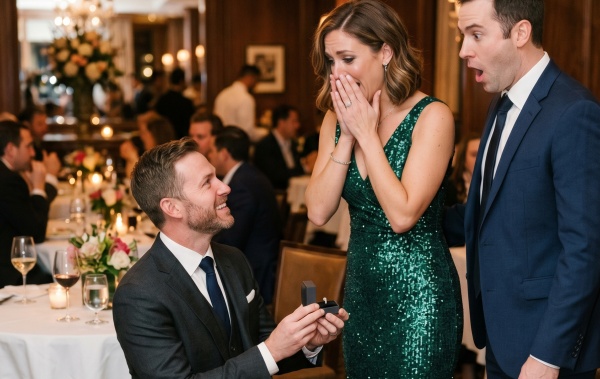
Her Ex-Husband Proposed in Front of Her New Lover — But the Ring Wasn’t the Biggest Shock of the Night
It was supposed to be a simple dinner date in downtown Chicago. Hannah wanted one peaceful night away from her past, her divorce, and the famous last name she was trying to leave behind. Then Ethan Whitmore, her billionaire ex-husband, appeared beside her table and asked for a second chance. But before she could answer, he revealed the real reason he had come.
Part 1: A Dinner That Was Supposed to Be Simple
For the first time in nearly two years, Hannah Whitmore felt like she could breathe without checking over her shoulder. She sat at table seventeen inside The Alder Room, a warm, low-lit restaurant in downtown Chicago where candles flickered inside glass cups and jazz played softly beneath the sound of silverware. Across from her sat Daniel Reed, the man who had made her laugh again after the world had decided she was only interesting as someone’s ex-wife.
Daniel reached across the table and touched her hand. “You okay?”
Hannah smiled, but it took effort. “I’m fine. I just haven’t been here since…”
She stopped before saying his name. She did not need to. Everyone in Chicago knew who her ex-husband was, and most people knew the story they thought was true.
Ethan Whitmore was not just rich. He was billionaire rich, private-jet rich, name-on-a-hospital-wing rich. He had built a technology and logistics empire from a rented office near O’Hare, and by forty-six, he owned more buildings than Hannah owned pairs of shoes.
At least, that was how the magazines described him. They did not mention the nights Hannah had eaten cold pizza beside him while he coded until sunrise. They did not mention the first apartment where the heat barely worked, or how she had sold her grandmother’s bracelet to cover payroll when his company was six days from failing.
They certainly did not mention how he had looked at her across their kitchen table three years ago and said, “I think I became the man everyone wanted me to be, and I forgot how to be your husband.”
That sentence had not been cruel. Somehow, that made it worse. Cruelty gives you something to hate; sadness gives you something to carry.
Their divorce had been quiet, expensive, and painfully polite. No screaming matches were leaked to gossip pages. No accusations were traded through lawyers. Ethan gave Hannah the Lake Forest house, a generous settlement, and the kind of public respect that made everyone assume she had no right to be heartbroken.
But heartbreak does not check bank balances before entering a room. Hannah had spent the first six months after the divorce wandering through her beautiful house like a guest in someone else’s museum. Every hallway held a version of herself she no longer knew how to be.
Then she met Daniel at a charity literacy event in Lincoln Park. He was a nonprofit consultant, charming in a casual way, with rolled-up sleeves, warm brown eyes, and a talent for making conversations feel private even in crowded rooms. He did not seem impressed by the Whitmore name, and that alone had felt like mercy.
Daniel had asked her to coffee, then dinner, then a weekend walk along Lake Michigan when the wind was so cold they ducked into a bookstore just to feel their fingers again. He made her feel normal. After years of being Mrs. Ethan Whitmore, normal felt luxurious.
Tonight was supposed to be simple. No charity gala, no donors, no photographers, no people pretending not to stare while whispering behind menus. Just dinner with a man who liked her laugh, remembered her coffee order, and never once called her “strong” in that pitying tone people use when they don’t know what else to say.
Daniel lifted his wine glass. “To new beginnings.”
Hannah raised hers halfway. “That sounds dangerous.”
“Only if you’re afraid of them.”
She studied him over the rim of her glass. Daniel was handsome, but not polished like Ethan. His suit was nice but not custom, his watch was attractive but not absurd, and his smile carried the easy confidence of a man who had never needed a security detail to walk through a hotel lobby.
“I’m not afraid of beginnings,” Hannah said. “I’m afraid of pretending endings didn’t matter.”
Daniel’s expression softened. “I’m not asking you to pretend.”
That was the right answer. Daniel often had the right answer. Sometimes Hannah found that comforting, and sometimes, in a corner of herself she did not like to examine, she wondered how a man could always know exactly what to say.
The waiter arrived with roasted branzino for Hannah and a dry-aged steak for Daniel. Outside, snow had begun to fall lightly over Wabash Avenue, dusting the parked cars and catching in the glow of streetlights. Hannah looked out the window and felt, for one fragile moment, that life might become gentle again.
Then the room changed.
It was not loud. No one gasped. No glass shattered. But conversation near the front of the restaurant thinned, then faded, as if someone had turned down the volume on the whole evening.
Daniel glanced over his shoulder. Hannah did not. She knew that kind of silence.
A man like Ethan Whitmore did not enter a room unnoticed. He was tall, silver beginning to touch his dark hair at the temples, wearing a charcoal overcoat that looked expensive without trying to announce itself. Behind him stood his driver near the door, and beside the host stand, the manager looked as nervous as if the mayor had arrived without a reservation.
Hannah’s hand tightened around her fork. “No.”
Daniel turned back. “Is that him?”
“Yes.”
Ethan’s eyes found her immediately, because of course they did. For twenty-one years, in crowded fundraisers, airport terminals, school auditoriums, and hotel ballrooms, Ethan had always been able to find Hannah as if every room had been built around where she stood.
He spoke briefly to the manager, then walked toward table seventeen.
Hannah’s face burned. “Please don’t come over,” she whispered, though he was still too far away to hear.
Daniel straightened in his chair. “Do you want to leave?”
Before Hannah could answer, Ethan stopped beside their table. The candlelight caught the tired lines around his eyes, and for one impossible second, he looked less like a billionaire and more like the twenty-eight-year-old man who once brought her gas-station roses because they were all he could afford.
“Hannah,” he said.
She forced herself to breathe. “Ethan.”
His gaze shifted to Daniel. “Mr. Reed.”
Daniel’s smile was calm, but Hannah felt the tension travel through his hand. “Mr. Whitmore.”
Hannah looked between them. “You two know each other?”
“Not personally,” Ethan said.
Daniel’s jaw moved once. “We’ve crossed paths professionally.”
Something about his tone made Hannah cold. She sat back slowly. “Ethan, why are you here?”
Ethan did not answer right away. He looked at her face as if he had rehearsed this moment a hundred times and still found himself unprepared for the real woman in front of him. Then, in the middle of one of the most talked-about restaurants in Chicago, Ethan Whitmore reached into his coat pocket.
Hannah’s stomach dropped.
He lowered himself onto one knee.
The restaurant became perfectly still.
Daniel stood so fast his chair scraped against the floor. “You’ve got to be kidding me.”
Ethan opened a small black velvet box. Inside was not the enormous diamond Hannah expected, not one of those cold, blinding stones billionaires buy when they mistake size for meaning. It was her original engagement ring, the modest oval diamond Ethan had purchased twenty-three years earlier after working eighty-hour weeks and selling his motorcycle.
Hannah stared at it, and the room blurred.
“Hannah Grace Miller,” Ethan said, using the name she had before him, before the money, before the headlines, before the world turned their marriage into a public asset. “I was wrong to let you go. I was wrong to think giving you freedom meant walking away from the woman I still loved. I am asking you, in front of strangers because I was too proud to ask in front of the people who matter, to let me spend the rest of my life earning another chance.”
Hannah could not speak.
Daniel laughed once, sharp and humorless. “This is embarrassing.”
Ethan did not look at him. “Yes,” he said quietly. “It is. But not for the reason you think.”
Part 2: The Man Who Came Back
Hannah wanted to disappear. Every table within sight was watching, some openly, some pretending to study their wine glasses while clearly listening to every word. A woman near the bar had her phone halfway raised before the manager gently asked her to put it down.
“Stand up,” Hannah said to Ethan.
He did, slowly, closing the ring box but keeping it in his hand. “I’m sorry.”
“Are you?” Her voice shook, and she hated that. “Because this looks a lot like something you arranged.”
“I didn’t arrange an audience,” Ethan said. “I found out where you were having dinner, and I made a bad decision quickly.”
Daniel folded his arms. “That sounds convenient.”
Hannah turned to him. “Daniel, please.”
“No, Hannah,” Daniel said. “This is exactly what men like him do. He had you, lost you, saw you happy with someone else, and decided to buy the scene.”
Ethan’s expression changed, not with anger, but with recognition. “You’re very good at that.”
“At what?” Daniel asked.
“Sounding protective.”
Hannah stood now. “Both of you stop.”
The waiter hovered at a respectful distance, looking like he would rather be anywhere else in the state of Illinois. Hannah placed her napkin on the table with hands that trembled only slightly. “Ethan, whatever you came here to say, you should have called.”
“I did,” he said.
She frowned. “No, you didn’t.”
“I called your house. Your assistant said you were unavailable. I texted you twice.”
Hannah reached for her purse and pulled out her phone. No missed calls. No texts. Just a message from Daniel sent earlier that afternoon: Can’t wait to see you tonight. Let’s leave the past outside the door.
A small, strange unease moved through her.
Daniel glanced at her phone. “Maybe he used an old number.”
Ethan shook his head. “I used the same number she’s had since 2011.”
Hannah looked at Daniel. “Did my assistant call you today?”
Daniel’s face barely changed, but she saw it: a flash of calculation, quick as a match struck and blown out. “She mentioned Ethan was trying to reach you. I told her tonight was important and that I’d let you know if it sounded urgent.”
“You what?” Hannah asked.
Daniel lowered his voice. “I didn’t want him ruining our night.”
“Our night?” Hannah repeated. “You screened a message from my ex-husband without telling me?”
“He is not just your ex-husband,” Daniel said. “He is a man with endless money and endless access who clearly thinks boundaries don’t apply to him.”
Ethan’s jaw tightened. “Careful.”
“No,” Hannah said, turning back to Ethan. “You don’t get to warn him. And you don’t get to propose to me in a restaurant like I’m the final scene in one of your investor documentaries.”
A few people nearby looked away, embarrassed by the truth of it.
Ethan accepted the words without defense. “You’re right.”
That stopped her more effectively than an argument would have. Ethan had built an empire by defending his position, outlasting competitors, and turning every challenge into leverage. Hearing him admit fault in public felt almost unnatural.
“I came because I was afraid if I waited until tomorrow, I would lose the chance to tell you before he did,” Ethan said.
Daniel scoffed. “Before I did what?”
Ethan finally looked at him. “Before you asked her for money.”
Daniel went still.
Hannah’s mouth went dry. “What is he talking about?”
Daniel gave a controlled laugh. “This is absurd.”
“Is it?” Ethan asked. “Your nonprofit consulting firm received three large donations in the last eighteen months from shell entities connected to Whitmore suppliers. Two of those entities are under federal review for invoice fraud. Last week, you drafted a proposal asking Hannah to help fund a new literacy initiative in Detroit for $8 million.”
Hannah felt the floor tilt beneath her. Daniel had mentioned the initiative. He had framed it as a chance for her to build something meaningful under her own name, away from Ethan’s shadow.
Daniel’s eyes hardened. “You had me investigated?”
“Yes,” Ethan said. “After Hannah’s foundation director called my office asking whether I knew why a consultant was requesting introductions to my former vendor network.”
Hannah stared at Daniel. “You said that project was already vetted.”
“It is,” Daniel said quickly. “Ethan is twisting this because he wants control.”
Ethan opened his phone and placed it on the table, screen facing Hannah. “I sent the documents to your attorney and your foundation board this afternoon. That is what I tried to call you about.”
Hannah did not touch the phone. She could not. Every instinct told her not to turn this public humiliation into a public investigation.
Instead, she looked at Daniel and asked one question. “Were you going to ask me tonight?”
Daniel’s expression softened instantly. Too instantly. “Hannah, I care about you.”
“That is not an answer.”
He reached for her hand, but she stepped back. Pain crossed his face, though now she could not tell whether it was real or practiced.
“Yes,” Daniel said. “I was going to ask for support. Not for me. For the program.”
“In the amount of eight million dollars?”
“That sounds dramatic when he says it.”
“It is dramatic,” Hannah said. “It’s eight million dollars.”
People had resumed murmuring around them, though the manager had created a discreet barrier by positioning staff near nearby tables. The restaurant was trying to protect the privacy of a woman whose life had once again become a performance.
Hannah looked at Ethan. “And you thought the best solution was to walk in here with a ring?”
“No,” Ethan said. “The best solution would have been to respect your life enough to call your lawyer and wait. I failed at that.”
“Then why did you do it?”
His answer came quietly. “Because when I heard you were with him tonight, I remembered every time I convinced myself there would be another chance to say what mattered. And then years passed.”
Hannah closed her eyes.
She had spent two years telling herself Ethan did not love her enough to fight. Now he stood in front of her, fighting badly, publicly, imperfectly. The problem was that part of her had once wanted exactly this, and another part of her hated him for making her want it now.
Daniel picked up his coat. “I’m not staying for this circus.”
Hannah opened her eyes. “Daniel.”
He paused, maybe expecting her to apologize.
“Did you tell my assistant not to give me Ethan’s messages?”
His silence answered before he did. “I thought I was protecting you.”
“No,” Hannah said. “You were managing me.”
The words landed harder than she expected. Daniel’s face changed, and the warmth vanished from it. “You know, for someone who claims she wants to be seen as more than a billionaire’s ex-wife, you are awfully quick to run back to the billionaire.”
Hannah flinched.
Ethan stepped forward, but Hannah lifted a hand to stop him. She did not need a rescue. Not from Ethan. Not from anyone.
“Good night, Daniel,” she said.
Daniel looked around the restaurant, aware that he had lost the room as much as he had lost her. He buttoned his coat with deliberate dignity and walked out into the snowy Chicago night.
For a moment, Hannah and Ethan stood alone beside the table. The candle between them burned low, reflecting in the wine neither of them had finished.
Ethan picked up the ring box from the table. “I’ll go too.”
Hannah laughed softly, but there was no humor in it. “You propose to me in front of half of downtown Chicago, accuse my date of financial manipulation, and now you’ll go?”
“I don’t want to take more from you tonight.”
That sentence, more than the proposal, nearly broke her. Because taking had not been Ethan’s style. His sin had been absence, distance, the slow starvation of a marriage where love existed but presence did not.
Hannah reached for her coat. “No. You can pay the check. Then you can walk me to my car. And then you can explain everything from the beginning.”
Ethan looked at her, hope flickering across his face before he carefully put it away. “Okay.”
“And Ethan?”
“Yes?”
“The ring stays in your pocket.”
He nodded. “Understood.”
Part 3: The Truth Beneath the Money
They did not go to Hannah’s car right away. The snow had thickened, softening the edges of the city, and Hannah needed air more than shelter. She walked north along the sidewalk with Ethan beside her, both of them silent until the restaurant was behind them.
Chicago in winter had never been gentle. The wind came off Lake Michigan with a personal grudge, slipping under collars and making even wealthy people look human. Hannah pulled her coat tighter, and Ethan, out of habit, moved to the outside of the sidewalk nearest the street.
She noticed. She wished she had not.
“Start talking,” she said.
Ethan exhaled. “Three months ago, your foundation approved a small grant to a reading program Daniel advised. Nothing wrong with that on paper. But when your name appeared in their donor deck, two former Whitmore vendors contacted my CFO asking whether supporting Daniel would help them repair relationships with me.”
Hannah frowned. “Why would they think that?”
“Because Daniel implied you and I were privately aligned.”
She stopped walking. “He used my relationship with you?”
“He used the possibility of reconciliation with me,” Ethan said. “Subtly. Enough to create confusion, not enough to make a clean accusation easy.”
Hannah felt embarrassed, then angry at herself for feeling embarrassed. “I should have seen it.”
“No,” Ethan said. “He was careful.”
She looked at him sharply. “Do not make me smaller by making him sound like a mastermind.”
“That’s not what I meant.”
“Then say what you mean.”
Ethan looked down the street, where headlights moved through falling snow. “I mean lonely people are not foolish for wanting kindness.”
The words struck with painful precision. Hannah turned away because she did not want him to see her face.
Daniel had been kind. Or he had performed kindness well enough that it felt real when Hannah needed it. He had listened when she talked about rebuilding her life, praised her ideas for expanding her foundation, and made her feel seen in the places Ethan had forgotten to look.
“What did you find?” she asked.
“Enough to raise questions. Not enough to ruin him, and I’m not interested in that unless he broke the law.” Ethan paused. “But enough that your attorney needs to review anything he sent you.”
Hannah nodded slowly. “And the proposal?”
Ethan looked at her.
“The marriage proposal,” she clarified. “Was that part of some protective strategy too?”
“No,” he said. “That was me being selfish.”
“At least we’re being honest.”
“I have been in love with you since you were twenty-six years old and arguing with a landlord about a broken radiator,” Ethan said. “I stayed in love with you through IPO meetings, hospital galas, board fights, miscarriages, adoption paperwork, school plays, our son’s first speeding ticket, and every silent breakfast we were too tired to fix.”
Hannah’s throat tightened at the mention of their son. Caleb was nineteen now, a sophomore at Northwestern, old enough to love both parents and be disappointed in both. Their daughter, Sophie, was sixteen, still living with Hannah, still angry at Ethan in the quiet, teenage way that turned every dinner into a weather system.
“If you loved me,” Hannah said, “why did you leave?”
Ethan’s face aged in the streetlight. “Because I thought I had already lost you.”
“That is not an answer.”
“I know.” He rubbed a hand over his face. “I was exhausted, Hannah. Not tired. Exhausted in a way I didn’t know how to admit because everyone depended on me being impossible to break. The company, the board, my employees, my mother, the charities, the press. And when I came home, I saw disappointment in your face.”
“You saw loneliness.”
“I know that now.”
She laughed once, bitterly. “That is the most expensive lesson in America.”
He accepted that too. “I told myself you would be happier without me. I told myself giving you a clean divorce was noble. Really, I was too ashamed to ask whether there was still enough left to save.”
Hannah remembered those final months. Ethan coming home after midnight. Ethan sleeping in the guest room because he did not want to wake her, then staying there because neither of them knew how to close the distance. Ethan buying a vacation house in Aspen when what she wanted was one uninterrupted dinner.
“You didn’t fight for me,” she said.
“No.”
“You wrote checks.”
“Yes.”
“You gave me the house, the money, the foundation expansion, the public statement saying I had been the heart of your life.”
“You were.”
“But you did not give me the one thing I asked for.”
His voice was barely above the wind. “Time.”
Hannah nodded. “Time.”
They reached the bridge over the Chicago River. Snow collected on the railing in a thin white line. Below them, black water moved between buildings whose windows glowed gold.
Ethan took the ring box from his pocket, but he did not open it. “I found this last month in a safe-deposit box downtown. I thought you had sold it.”
“I almost did,” Hannah said.
“Why didn’t you?”
“Because I hated that I still loved the girl who wore it.”
He looked at her, and for once, neither of them hid from the truth.
The ring had been modest by the standards of their later life, almost laughably so. But young Ethan had chosen it himself, nervous and broke, proposing on a cold April morning at Montrose Harbor with coffee in paper cups. Hannah had said yes before he finished asking.
Then came the years. The money. The houses. The magazine covers. The gradual transformation of a love story into a brand neither of them knew how to control.
“My proposal tonight was wrong,” Ethan said. “I know that. I panicked. I saw a man using the kind of access my name created, and I hated myself for leaving you exposed to it.”
“I am not helpless.”
“No,” he said quickly. “You never were.”
“Then don’t confuse regret with love.”
He absorbed the words as if they physically hurt. “I’ve spent two years trying to separate them. I still love you when I’m not guilty. I still love you when I’m not afraid. I still love you on ordinary Tuesdays when nothing is happening and no one is watching.”
Hannah looked down at the river. She wanted that to be manipulation because manipulation would be easier to reject. But Ethan had never been poetic when he lied to himself; he became poetic only when he finally stopped.
“My life is peaceful now,” she said.
“Is it?”
She turned sharply. “Don’t.”
“I’m sorry.”
“No, you don’t get to question my peace because you disrupted it.”
“You’re right.”
She hated how often he was saying that tonight. It left her with nowhere to place her anger except where it belonged.
They walked back toward the parking garage. At the entrance, Hannah stopped under the yellow light, snow melting in her hair. “I’m not answering your proposal.”
“I know.”
“I’m not dating you.”
“I know.”
“And if you ever show up in public like that again, I will personally make sure every gossip blog in the country receives a quote from me calling you emotionally reckless.”
For the first time all night, Ethan smiled. It was small and sad and familiar. “That would be fair.”
Hannah almost smiled back, then caught herself. “Send everything about Daniel to my attorney. Not to me. I don’t want late-night protective emails from you.”
“Done.”
“And tell Caleb and Sophie nothing until I decide what they need to know.”
“Of course.”
She unlocked her car. “One more thing.”
“Yes?”
“Why tonight?”
Ethan looked toward the street, then back at her. “Because Sophie called me this afternoon.”
Hannah froze. “Sophie?”
“She said Daniel asked too many questions about your foundation passwords and whether she knew where you kept old family documents. She thought it was weird. She didn’t want to worry you, so she called me.”
Hannah felt something inside her go cold and sharp. “He questioned my daughter?”
“Indirectly, but yes.”
For a moment, the night lost all romance, all confusion, all old longing. Hannah was no longer an ex-wife standing between two men. She was a mother.
Her voice became quiet. “Send me that information too.”
Ethan nodded.
“And Ethan?”
“Yes?”
“Thank you for telling me.”
He looked as if those four words meant more to him than the answer he had hoped for. “Always.”
Hannah got into her car and closed the door. As she drove away, she saw Ethan standing alone under the garage light, the black ring box still in his hand. For the first time since the divorce, she wondered if the end of their marriage had not been a locked door.
Maybe it had been a room they had both left too soon.
Part 4: The Daughter Who Saw Everything
Sophie Whitmore was sitting at the kitchen island in pajamas when Hannah got home. A half-finished bowl of cereal sat in front of her even though it was nearly midnight. Their golden retriever, Maple, slept at her feet, occasionally lifting one eyebrow as if judging everyone’s life choices.
“You’re awake,” Hannah said.
Sophie looked up from her phone. She had Ethan’s dark hair and Hannah’s direct stare, a combination that made lying to her nearly impossible. “So are you.”
Hannah hung her coat by the back door. “Fair.”
“Dad called me.”
Hannah went still. “When?”
“After you left the restaurant. He said you were safe but having a difficult night.” Sophie rolled her eyes, but her voice was careful. “That is Dad-speak for something dramatic happened and he doesn’t want me to panic.”
Hannah sat beside her. “Something dramatic happened.”
“Did Daniel do something?”
The question hurt because it was so calm. Sophie had not liked Daniel, but Hannah had assumed that was ordinary teenage resistance to a parent dating. Now she wondered what else her daughter had noticed while adults congratulated themselves for being discreet.
“What made you call your father today?” Hannah asked.
Sophie pushed the cereal bowl away. “Daniel came by before you got home from the foundation office. He said he was dropping off some papers for you.”
Hannah’s chest tightened. “You let him in?”
“He had been here before,” Sophie said defensively. “And Maple liked him.”
“Maple likes the UPS guy.”
“Okay, that’s true.”
Despite everything, Hannah almost laughed. Then Sophie’s face changed, and the laugh disappeared.
“He asked if your home office was still upstairs,” Sophie said. “I thought that was weird because he had only been in the living room before. Then he asked whether you kept Dad’s old company papers here or at the foundation.”
Hannah kept her voice steady. “What did you say?”
“I said I didn’t know.” Sophie looked down at her hands. “Then he made this joke about how teenagers always know where parents hide things. It sounded like a joke, but it didn’t feel like one.”
Hannah reached for her daughter’s hand. “You did the right thing calling your dad.”
“I didn’t want you to think I was being dramatic.”
“You were not being dramatic.”
Sophie’s eyes filled suddenly, which startled both of them. “I didn’t like him, Mom.”
“I know.”
“No, I mean I really didn’t like him. He always acted like he understood me, but he didn’t ask normal questions. He asked about Dad, about money, about whether you missed being in big houses with security gates.”
Hannah closed her eyes. She had mistaken Daniel’s interest in her past for emotional attentiveness. Sophie had recognized it as inventory.
“I’m sorry,” Hannah whispered.
Sophie frowned. “Why are you sorry?”
“Because I brought him into our life.”
“You’re allowed to date terrible men,” Sophie said. “I mean, please don’t make it a hobby, but you’re allowed to be human.”
That did make Hannah laugh, though tears came with it. Sophie leaned into her, and Hannah wrapped an arm around her daughter’s shoulders. For two years, Hannah had tried so hard to be the stable parent that she had forgotten stability did not require perfection.
After a while, Sophie asked, “Did Dad really propose to you?”
Hannah pulled back. “How did you know that?”
Sophie held up her phone. “Mom. It’s Chicago. Someone posted a blurry photo before the restaurant made them take it down.”
Hannah groaned. “Wonderful.”
“It’s not that bad,” Sophie said. “You can’t really see your face. Dad looks intense, though. Like a sad CEO in a Christmas movie.”
“That is painfully accurate.”
Sophie studied her. “What did you say?”
“I didn’t answer.”
“Are you going to?”
“I don’t know.”
Sophie nodded in the exaggerated mature way teenagers use when they are trying very hard not to reveal how much they care. “Okay.”
Hannah brushed hair from her daughter’s cheek. “Would that upset you?”
“If you got back together with Dad?”
“Yes.”
Sophie thought for a long time. “I don’t want the old version back.”
“Neither do I.”
“The old version was quiet dinners where nobody said the real thing, and Dad checking his phone under the table, and you pretending you weren’t mad because Caleb and I were there.”
Hannah swallowed. “You noticed that?”
“I noticed everything.”
Of course she had. Children live inside the emotional weather adults create, even when no one tells them the forecast.
Sophie continued, “But I don’t hate Dad. I was mad at him because he left and acted like being generous was the same as being present. But he’s been trying lately.”
Hannah looked at her daughter. “Has he?”
“He came to my school conference last month and didn’t take a single call. He knows my debate topic. He sends me bad dog memes every Tuesday.”
Hannah blinked. “Every Tuesday?”
“I don’t know why Tuesday.”
“That sounds like your father.”
Sophie smiled faintly. “I’m not saying marry him. Please do not make a life decision based on my dog-meme report. I’m just saying maybe people can change if they stop being rewarded for staying the same.”
The sentence was so wise and so teenage that Hannah kissed the top of her head. “When did you become smarter than me?”
“Probably during the divorce,” Sophie said. “Trauma, but make it educational.”
“Sophie.”
“Sorry.”
“No, you’re not.”
“No, I’m not.”
They sat together until the cereal grew soggy and Maple began snoring loudly. Upstairs, Hannah checked the home office. Nothing seemed disturbed, but she locked the door anyway.
The next morning, Hannah’s attorney called at 8:05 a.m. By noon, Daniel’s proposal was under review, her foundation accounts were being audited, and her security system had been updated. By 3 p.m., Daniel had sent four messages, each more wounded than the last.
The first said: I can’t believe you’re letting Ethan poison this.
The second said: You know who I am.
The third said: We need to talk before lawyers turn this into something ugly.
The fourth said only: I loved you.
Hannah stared at that last one for a long time. Then she blocked his number.
Not because Ethan told her to. Not because a lawyer advised her to. Because love does not need secret access to your documents, your money, or your child’s trust.
That evening, Caleb came home from Northwestern after Sophie texted him something dramatic enough to make him take the train from Evanston. He arrived with a backpack, a worried face, and two deep-dish pizzas because, as he put it, “family collapse requires carbs.”
They ate in the kitchen like they used to years ago, before the dining room became a place for silent meals. Sophie told the dog-meme story. Caleb admitted Ethan had been calling him every Sunday night and asking real questions instead of giving business advice disguised as parenting.
Hannah listened, surprised by the life Ethan had been rebuilding quietly outside her view. It did not erase the damage. But it complicated the grief, and grief becomes harder to hold when hope starts touching its edges.
At 9 p.m., her phone buzzed. A message from Ethan appeared.
I sent the documents to your attorney. I also owe Sophie an apology for putting her in the position of calling me. I won’t contact Daniel. I won’t make this worse.
A second message came one minute later.
And I am sorry for proposing like a man who forgot you deserved privacy.
Hannah read it twice.
Then she typed: You did forget.
He replied: I know.
She waited, expecting more. An explanation. A defense. A paragraph about fear and love and regret.
Nothing came.
Hannah set the phone down, unsettled by his restraint. Ethan was finally doing the one thing she had begged him to do during the last year of their marriage.
He was giving her room.
Part 5: The Second Proposal
Three months passed before Hannah agreed to have coffee with Ethan. Not dinner, not a gala, not one of the private clubs where billionaires apologize beneath chandeliers. Coffee, at a small café in Evanston near Caleb’s campus, at 10:30 on a Saturday morning, with no ring and no speeches.
Ethan arrived early. Hannah knew because she watched through the window for a full minute before entering. He sat at a corner table wearing a navy sweater instead of a suit, reading glasses low on his nose, looking less like a headline and more like a man waiting to find out whether he had permanently ruined the best part of his life.
When she walked in, he stood. “Hi.”
“Hi.”
He did not hug her. He did not touch her chair. He did not act entitled to any old intimacy simply because the past had once given it to him.
That, annoyingly, mattered.
They ordered coffee and talked first about the children. Caleb was considering changing his major. Sophie had won a debate tournament and pretended not to care while clearly caring more than anyone. Maple had eaten half a throw pillow and seemed untroubled by consequences.
Then Hannah said, “Daniel is under investigation.”
Ethan’s face remained calm. “Your attorney told me there were developments.”
“He had done similar things before,” Hannah said. “Not exactly illegal every time, but close enough to leave people ashamed and silent. Wealthy divorced women, mostly. Women trying to rebrand their lives through charity.”
Ethan looked down at his coffee. “I’m sorry.”
“I’m not telling you so you can feel guilty.”
“I know.”
“I’m telling you because if Sophie had not called you, I might have signed something I would regret.”
“You would have caught it eventually.”
“Maybe.” Hannah stirred her coffee though she had not added sugar. “Or maybe I would have wanted so badly to prove I could trust someone new that I ignored the part of me whispering not to.”
Ethan said nothing, which somehow made it easier to continue.
“I was lonely,” she said. “That is not your fault alone, but you helped build the loneliness. Daniel walked into a room you left empty.”
Ethan’s eyes lifted to hers. “I know.”
“And if we are ever going to be anything besides polite ex-spouses, you need to understand that money cannot repair absence. A ring cannot erase paperwork. Public gestures cannot replace private consistency.”
“I understand.”
“Do you?”
“Yes,” he said. “But understanding is not proof. Time is.”
Hannah sat back. That was new. The old Ethan would have promised results, timelines, solutions. This Ethan seemed to understand that some things could not be acquired, negotiated, or announced.
For the next year, they did not remarry. They did not even date in the way people expected. They attended Sophie’s debate events, Caleb’s campus concerts, family therapy sessions, and Sunday brunches where no one pretended everything was simple.
Ethan learned to leave his phone in the car. Hannah learned to say when she was angry before anger turned into ice. The children learned slowly that honesty at the table did not mean the table would break.
People talked, of course. Chicago society enjoyed reconciliation rumors almost as much as divorce rumors. One magazine hinted that Ethan Whitmore had “won back” his ex-wife, which made Hannah laugh so hard she nearly spilled tea on her laptop.
“No one won me,” she told Sophie.
Sophie nodded. “Good. Very feminist. Also, Dad’s new haircut helps.”
“Sophie.”
“What? Personal growth can include better grooming.”
By the following spring, The Whitmore Foundation launched a literacy and family-stability program in Detroit, Milwaukee, and South Side Chicago. Hannah led it under her own name, with an independent board and safeguards strong enough to make every consultant sweat. Ethan donated quietly through a matching fund and did not appear at the podium.
At the opening event in Chicago, Hannah stood before teachers, parents, donors, and community leaders, speaking about children needing safe homes, steady adults, and books that told them their lives mattered. Ethan stood in the back beside Caleb and Sophie, clapping when everyone else clapped, not trying to occupy the center of the room.
Afterward, Hannah found him near the exit.
“You didn’t come up front,” she said.
“It was your day.”
She smiled. “You finally learned.”
“I’m a slow student.”
“Expensive education.”
“The most expensive.”
They walked outside together into warm May air. The city looked different without snow, brighter and less dramatic, as if Chicago itself had decided to forgive winter. Ethan asked if she wanted dinner, and she surprised herself by saying yes.
Not at The Alder Room. Never there again. They went instead to a neighborhood Italian place where the tables were too close together and the owner called everyone sweetheart. Ethan ordered pasta. Hannah ordered chicken piccata. They split tiramisu because some traditions deserved revival.
After dinner, they walked along the lakefront. Families pushed strollers, cyclists rang bells, and teenagers sat on the grass pretending not to be cold. The water stretched dark and restless beside them.
Ethan stopped near a bench overlooking the lake. Hannah knew before he spoke. Not because he was dramatic this time, but because the air around them became careful.
He did not kneel. He did not pull out the ring immediately. He simply looked at her.
“I love you,” he said. “I loved you badly before. I loved you with pride in the way, with work in the way, with fear in the way. I am trying to love you now with honesty, patience, and room for you to say no.”
Hannah’s eyes filled, but she did not look away.
Ethan took the old ring box from his jacket pocket. “I’m not asking for the old marriage back. I don’t want it. I’m asking whether you would consider building a new one with me, slowly, legally, privately, with whatever protections make you feel safe and whatever timeline makes you feel free.”
Hannah looked at the ring. The small oval diamond caught the last light of the evening, not blinding, not grand, just steady. She thought about the first proposal at Montrose Harbor, the terrible second proposal in the restaurant, and this third moment beside the lake where no one watched except a passing jogger and a golden retriever that was not Maple.
She thought about Daniel, and how easily loneliness can disguise danger as romance. She thought about Sophie calling her father because some part of the family still trusted him to come when it mattered. She thought about Caleb bringing pizza because love, in their family, had always found strange ways to show up.
Most of all, she thought about herself. The woman she had been before Ethan, the woman she became with him, the woman she survived becoming after him. She was not the abandoned wife, not the billionaire’s ex, not the foolish woman at table seventeen.
She was Hannah Grace Miller, and she had the right to choose a future without needing the world to understand it.
“I have conditions,” she said.
Ethan’s face softened. “I expected that.”
“Therapy continues.”
“Yes.”
“Separate finances stay separate where appropriate.”
“Of course.”
“No public announcement until I decide.”
“Agreed.”
“If you miss Sophie’s graduation for a board meeting, I will not marry you. I may not even speak to you until Thanksgiving.”
“I’ll be there early.”
“And if you ever propose to me in a crowded restaurant again…”
“I will deserve whatever happens.”
Hannah smiled through tears. “Good.”
He opened the box. “Is that a yes?”
She looked at him for a long second, long enough to remember every reason to be afraid and every reason fear did not get the final vote.
“It’s a yes,” she said. “But not because you came back with a ring.”
Ethan’s eyes shone. “Then why?”
“Because you came back willing to become someone I could trust.”
He slid the ring onto her finger with hands that trembled. This time, there was no applause. No stunned restaurant. No phones raised for strangers. Just the lake, the city, and two people old enough to know that love is not proven by spectacle, but by the quiet decision to keep showing up after the music stops.
When Hannah told the children, Sophie cried first and denied it immediately. Caleb hugged both parents and said, “Great, but we are not doing matching holiday pajamas again.” Maple barked at the ring as if personally offended by jewelry.
Six months later, Hannah and Ethan remarried in their backyard at sunset. There were thirty guests, folding chairs on the lawn, barbecue from a local restaurant, and a cake Sophie insisted looked “tastefully divorced and remarried.” Hannah wore a simple cream dress. Ethan wore a navy suit and did not check his phone once.
During the toast, Caleb raised a glass of sparkling cider and said, “To my parents, who taught me that love can fail, people can fail, and sometimes, if everyone does a ridiculous amount of emotional homework, love can come back better than before.”
Everyone laughed. Hannah cried. Ethan kissed her hand under the table.
Later that night, after the guests left and the backyard lights glowed over empty plates and half-finished drinks, Hannah stood alone for a moment near the garden. She heard Sophie arguing with Caleb about music, Maple trying to steal brisket from a trash bag, and Ethan thanking the caterers by name.
It was not a fairy tale. Fairy tales end at the proposal, as if the question is the hard part. Hannah knew better now.
The hard part was the morning after. The calendar reminders. The honest conversations when silence would be easier. The choice to protect love from ego, money, fear, and every charming stranger who arrives when loneliness leaves the door unlocked.
Ethan came up beside her. “You okay?”
Hannah looked at him. Years ago, she might have said fine even if she was not. Tonight, she told the truth.
“I’m happy,” she said. “And a little scared.”
He nodded. “Me too.”
That answer made her smile.
Across the yard, Sophie shouted, “Mom, Dad, come dance before Caleb ruins the playlist!”
Ethan held out his hand. Hannah looked at it, then at the ring, then at the man who had once lost her by assuming love could survive on leftovers. This time, he was asking, not taking for granted.
She took his hand.
And under the string lights in an ordinary backyard in Illinois, Hannah Whitmore stepped into a new life with the same man, a different marriage, and a heart that had finally learned the difference between being chosen in public and being cherished in private.
