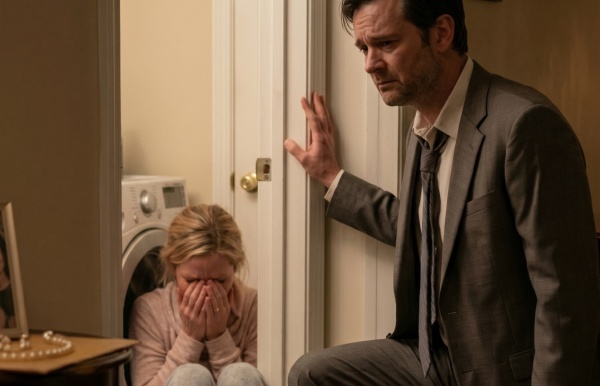
He Came Home With Divorce Papers—Then Heard His Wife Crying Behind the Laundry Room Door
Nathan had spent the whole day preparing to end his marriage. The divorce papers were in his briefcase, and he had already rehearsed the speech he planned to give his wife that night. But when he walked into their quiet Tennessee home, he heard Hannah crying behind a closed door. One sentence from her changed everything he thought he knew about their marriage.
Part 1 — The Papers in His Briefcase
At 6:42 on a Tuesday evening, Nathan Brooks sat in his SUV outside his house in Franklin, Tennessee, with divorce papers in his briefcase and a speech rehearsed in his head. The papers had been drafted by his attorney that afternoon, neatly clipped, marked with yellow tabs, and placed in an envelope that felt heavier than anything paper should weigh. He had told himself the marriage was already over.
The house looked normal from the driveway. Warm porch lights, trimmed boxwoods, two rocking chairs, a fall wreath his wife had made from dried orange slices and eucalyptus. Anyone driving by would have seen an upper-middle-class home on a quiet street and assumed peace lived inside it.
Nathan knew better.
He and his wife, Hannah, had been married for nine years. For the last eight months, they had barely touched each other except by accident in the hallway. They shared bills, a mortgage, a dog named Cooper, and the kind of silence that grows slowly until it becomes the largest thing in the room.
Nathan was thirty-eight, a commercial contractor who built custom homes for people with wine cellars and opinions about marble. Hannah was thirty-six, a former pediatric nurse who had left full-time work after burnout and a difficult pregnancy loss two years earlier. People used to say they balanced each other.
Lately, they only seemed to bruise each other.
Nathan told himself he had tried. He had suggested counseling once, in the middle of an argument, which was the worst possible time to suggest anything. Hannah had said, “You do not want counseling. You want a witness who agrees with you.”
He had walked away from that conversation angry because it sounded unfair.
Later, in quieter moments, he wondered if it had been true.
Still, the decision felt final that morning. His attorney, Mark Ellison, had said, “You do not have to serve her tonight. Take a breath. Make sure you’re not using paperwork to win an argument.” Nathan had almost laughed.
That was exactly what he was doing.
But pride has a way of dressing itself as clarity.
He stepped out of the SUV, took his briefcase, and walked toward the front door. Cooper barked once from inside, then scratched at the entry rug as Nathan unlocked the door. The house smelled faintly like lemon cleaner and something burnt.
“Hannah?” he called.
No answer.
He set his keys in the ceramic bowl by the door and noticed the mail stacked neatly on the console table. His name was on top of a credit card offer. Hers was on a medical bill. He looked away before he could read it.
The kitchen lights were on, but the room was empty. A pot sat in the sink, scorched at the bottom, filled with water like someone had tried to hide a mistake. On the counter was an unopened bottle of prenatal vitamins.
Nathan stared at it.
His chest tightened before his brain caught up.
They had not talked about trying again. Not seriously. Not after the miscarriage. Not after the hospital room, the tiny knitted blanket, and the grief neither of them knew how to survive together.
He picked up the bottle, then set it down as if it might accuse him.
From down the hallway, he heard something.
Not words.
A sound.
Soft, broken, muffled.
Nathan froze.
At first, he thought Hannah might be on the phone. Then he heard it again, a quiet sob coming from behind the closed laundry room door. It was the kind of crying people do when they are trying very hard not to be heard.
He walked toward the hallway slowly.
The divorce papers seemed to burn inside his briefcase.
“Hannah?” he said again, quieter this time.
The crying stopped instantly.
That hurt him more than the crying itself.
He stood outside the laundry room door with one hand raised, not touching it. For months, he had been so sure Hannah was cold, distant, indifferent. Hearing her cry behind a door made him realize there might have been a whole life happening in their house that he had been too angry to see.
“Hannah,” he said, “are you okay?”
Silence.
Then her voice came through the door, small and exhausted.
“Please don’t come in.”
Nathan closed his eyes.
Every version of the speech in his head disappeared.
He could still leave. He could still put the envelope on the kitchen counter, tell himself her tears were not his responsibility, and drive to a hotel. That was the kind of man he had been preparing to become all day.
Instead, he lowered himself to the floor outside the laundry room door.
“Okay,” he said. “I won’t come in.”
There was no response.
Cooper padded down the hallway and lay beside him with a heavy sigh, as if the dog had been waiting months for one of the humans to finally sit still.
Nathan leaned back against the wall.
“I’m right here,” he said.
Behind the door, Hannah made a sound like she was trying not to break.
Then she said one sentence.
“I lost the baby this morning, and I didn’t know how to tell you.”
The house went silent.
And everything Nathan thought he knew about his marriage cracked open.
Part 2 — The Marriage That Went Quiet
Nathan and Hannah had met twelve years earlier at a barbecue in East Nashville, back before half the city seemed to be under construction and everyone had a podcast. He had been helping a friend fix a deck railing. She had been the woman carrying a tray of deviled eggs and laughing because someone’s golden retriever had stolen a hamburger bun.
He liked her immediately.
Not because she was flashy.
Because she was warm in a way that made rooms feel less sharp.
Their first date was at a taco place in 12 South, where Hannah ordered the hottest salsa and pretended not to regret it. Nathan drove her home and sat in her driveway talking until midnight because neither of them wanted the night to end. When he finally left, she texted him before he reached the interstate.
You’re easier to talk to than I expected.
He saved that message for years.
They married two and a half years later in a small church outside Nashville. Hannah cried during her vows, and Nathan forgot half of his, then improvised something about choosing her on ordinary Tuesdays. Everyone laughed.
For a long time, he did choose her on ordinary Tuesdays.
They built a life that was not perfect but felt dependable. Friday pizza nights. Summer trips to the Gulf Coast. Arguments about thermostat settings. Cooper sleeping between them like an unpaid marriage counselor.
They tried for a baby in their sixth year of marriage.
At first, it was fun.
Then it became calendars, ovulation tests, bloodwork, and Hannah smiling too brightly when friends announced pregnancies. Nathan wanted to help, but he did not know what to do with grief that kept arriving in monthly cycles. He started saying practical things because practical things were all he knew.
“We’ll keep trying.”
“The doctor said there are options.”
“At least we know what to ask next time.”
He thought he was being hopeful.
Hannah heard him minimizing what her body was carrying.
When she finally got pregnant, she placed the test in a tiny gift box and gave it to him on their anniversary. Nathan opened it at the dinner table and stared at it for several seconds before understanding. Then he cried, right there beside the mashed potatoes and the roasted chicken.
For twelve weeks, they were careful and happy.
Then, at thirteen weeks and two days, Hannah woke up with cramps and bleeding.
The hospital was cold. The doctor was kind. The words were careful, but the meaning was not.
There was no heartbeat.
Nathan remembered holding Hannah’s hand while she stared at the ceiling tiles without blinking. He remembered wanting to tear the world apart and having nowhere to put his hands. He remembered a nurse placing a box of tissues beside him as if tissues could catch a future.
Afterward, they grieved differently.
Hannah wanted to talk about the baby.
Nathan wanted to protect them both by not saying the word.
She kept the ultrasound photo in her nightstand. He avoided looking at it because when he did, he felt like he had failed at something ancient and impossible. She joined an online support group. He worked longer hours.
The more she reached for him, the more he stiffened.
The more he pulled away, the colder she became.
Neither of them was trying to be cruel. That was the tragic part. They were two wounded people speaking different languages and calling the other person silent.
Then came the arguments.
Small ones first.
Laundry.
Bills.
His late nights.
Her canceled plans.
Then bigger ones.
“You don’t care.”
“You won’t let me help.”
“You act like you’re the only one who lost something.”
“You act like I lost nothing because I don’t cry on schedule.”
That last sentence was Nathan’s.
He regretted it the second it left his mouth, but regret does not erase sound. Hannah’s face changed when he said it. Not dramatically. Quietly.
Like a door closing.
After that, she stopped asking him to come to support group meetings. She stopped telling him when certain dates hurt. She stopped bringing up the nursery they had never finished, the pale green room at the end of the hallway that Nathan now used for boxes of tools and extra paint samples.
He thought the quiet meant she had accepted the distance.
Really, she had stopped believing he would cross it.
By spring, Nathan began sleeping in the guest room during busy work weeks and never quite moved back. Hannah returned to part-time nursing at a pediatric clinic but came home drained and pale. When he asked how work was, she said, “Fine.”
He accepted that answer because it required nothing from him.
That was his worst failure.
Not the arguments.
Not the anger.
The acceptance of answers he knew were not real.
Three months before the Tuesday with the divorce papers, Hannah asked if he still wanted to be married.
They were standing in the kitchen. Rain tapped against the windows. Cooper was whining near the back door.
Nathan did not say yes quickly enough.
Hannah nodded as if she had received information, not a wound.
“I thought so,” she said.
He told himself later that she had given up first.
It was easier than admitting she had asked a final question and he had answered with silence.
Part 3 — Behind the Laundry Room Door
Nathan sat on the hallway floor, staring at the closed laundry room door, while Hannah’s sentence echoed through him.
I lost the baby this morning, and I didn’t know how to tell you.
Not a baby.
The baby.
His brain moved too slowly.
“What baby?” he asked, then hated himself instantly for how stupid and cruel it sounded.
Behind the door, Hannah inhaled shakily. “I found out six weeks ago.”
Six weeks.
Nathan looked toward the kitchen, toward the unopened prenatal vitamins. He thought of the medical bill on the mail stack. He thought of how tired she had looked lately, how she had stopped drinking coffee, how she had skipped wine at their neighbor’s cookout and said she had a headache.
He had noticed all of it.
He just had not cared enough to ask the right questions.
“Why didn’t you tell me?” he whispered.
The moment he said it, he knew.
Hannah laughed once, but it broke halfway through.
“Because the last time I told you I was scared, you told me you were tired of living in grief.”
Nathan closed his eyes.
He remembered that argument.
He remembered the exact room, the exact tone, the way he had meant something narrower and said something unforgivable. He had been exhausted. She had been crying over the due date of the baby they lost. He had said, “I can’t keep living in grief, Hannah.”
She had gone silent then too.
He had thought the sentence was about him needing air.
She had heard that her pain was a house he wanted to leave.
“I’m sorry,” he said.
The words felt too small, almost insulting.
Hannah did not answer.
Nathan placed his palm flat against the door, not pushing, just there. “Did you go to the doctor?”
“Yes.”
“Are you physically okay?”
“I don’t know.”
That terrified him.
“What do you mean you don’t know?”
“I mean they said I should rest and follow up, and they gave me warning signs, and I nodded like I understood everything. Then I came home and burned soup and sat in the laundry room because I didn’t want to bleed on the couch.”
Nathan bent forward like the sentence had struck him.
The laundry room.
She had hidden in the laundry room so she would not make a mess.
He thought of the divorce papers in his briefcase, the careful speech, his plan to explain that they had become too broken to fix. Meanwhile, Hannah had spent the day carrying a private loss in the room where they kept detergent, dog towels, and mismatched socks.
“What can I do?” he asked.
For a long time, there was only quiet.
Then Hannah said, “I don’t know if you can do anything anymore.”
That was not cruel.
It was honest.
Nathan deserved it more than he wanted to admit.
He took a breath. “I have divorce papers in my briefcase.”
The silence behind the door changed.
He hated himself again.
“I was going to talk to you tonight,” he said quickly. “I was angry. I thought we were done. I thought you didn’t care anymore.”
Hannah’s voice came back flat and tired. “I know.”
“You know?”
“You left Mark Ellison’s business card on your dresser last week.”
Nathan leaned his head back against the wall.
Of course she knew.
Women always seem to know the things men think they are hiding in plain sight.
“I wasn’t going to serve you tonight,” he said, though even as he said it, he realized he was not sure that was true. “I don’t know what I was going to do.”
“I do,” Hannah said.
The words carried no anger.
That made them worse.
Nathan looked down at his hands. They were calloused from job sites, steady with tools, useful with wood and stone and concrete. He had built entire houses for strangers while failing to protect the one woman who used to call him home.
“I’m not asking you to forgive me,” he said. “I know I don’t deserve that. But I don’t want you alone in there.”
A small sob escaped her.
Not loud.
Not theatrical.
The sound of a woman too tired to hold herself upright any longer.
Nathan stood slowly. “Can I call someone? Your sister? Your doctor? I won’t come in unless you tell me to.”
“Call my OB’s office,” she said after a moment. “The after-hours number is on the fridge.”
Nathan moved quickly, grateful for a task because tasks are where guilty men often hide from feelings. He found the magnet with the number, called, and explained the situation as carefully as he could. The nurse on the line asked about bleeding, pain, dizziness, fever, and whether Hannah had someone with her.
Nathan looked toward the hallway.
“Yes,” he said. “She has someone.”
He hoped he was not lying.
The nurse advised that Hannah should be evaluated again if symptoms worsened and recommended checking in with the on-call provider. She also encouraged emotional support and gave crisis resources if Hannah felt unsafe or overwhelmed. Nathan wrote every word down on the back of an old grocery receipt because it was the nearest paper he could find.
When he returned to the laundry room door, it was open three inches.
Hannah was sitting on the floor beside the dryer, wrapped in an old gray cardigan, her face blotchy from crying. Her hair was pulled into a loose knot, and she looked so small that Nathan felt something inside him split.
He crouched outside the door.
Not entering.
Waiting.
She looked at him for a long time.
Then she said, “I don’t want to go to the hospital alone.”
“I’ll drive,” he said immediately.
“I don’t want you to make promises.”
He nodded.
“Okay.”
“I don’t want you to turn this into you being a hero.”
“I won’t.”
“I don’t know if I want this marriage.”
His throat tightened.
“I understand.”
She wiped her face with her sleeve.
“But I don’t want to be alone tonight.”
Nathan swallowed.
“Then you won’t be.”
For the first time in months, Hannah reached toward him.
Not for romance.
Not for forgiveness.
For help.
Nathan took her hand carefully, as if trust were something fragile enough to break under the wrong pressure.
Part 4 — The Night That Did Not Fix Them
The hospital in Brentwood was quiet when they arrived just after 8:00 p.m. Nathan parked near the emergency entrance, walked around the car, and opened Hannah’s door without touching her until she nodded. Inside, a nurse checked her in with a gentle voice and the practiced calm of someone who had seen people arrive with every kind of fear.
Nathan gave Hannah’s information but stopped himself from answering questions meant for her.
That mattered.
He used to speak for both of them without realizing it.
Now he noticed the impulse and let it die before it became another small theft.
They waited in a small exam room with beige walls, a blood pressure cuff, and a poster about prenatal warning signs. Hannah sat on the exam table with a blanket over her lap. Nathan sat in the chair by the wall, close enough to help, far enough not to assume.
A doctor came in, kind but direct.
There were tests.
There was an ultrasound.
There were quiet explanations.
The pregnancy had ended early. Hannah was physically stable but needed follow-up care and rest. The doctor spoke about options, warning symptoms, and support services. She also looked directly at Nathan and said, “Pregnancy loss can affect both partners, but the person experiencing it physically needs immediate support without pressure.”
Nathan nodded.
He understood the message beneath the medical language.
Do not make your wife carry your feelings tonight.
So he did not.
He filled out pharmacy information. He got water. He called Hannah’s sister, Beth, when Hannah asked him to. He stepped into the hallway when Hannah needed privacy and came back only when invited.
Beth arrived at 10:34 p.m. wearing sweatpants, a Vanderbilt hoodie, and the expression of a woman ready to hate Nathan professionally. She hugged Hannah first, then turned to him. “What happened?”
Nathan opened his mouth.
Hannah answered before he could.
“I lost the pregnancy. Nathan brought me.”
Beth’s eyes moved to him.
There was judgment there.
Fair.
But also something else.
Surprise.
Nathan accepted both.
Around midnight, Hannah was discharged with instructions and a follow-up appointment. Beth offered to take her home. Nathan expected Hannah to say yes.
Instead, Hannah looked at him.
“You can drive,” she said. “Beth can follow.”
It was not reconciliation.
It was logistics.
He treated it like sacred ground anyway.
At home, the kitchen still smelled faintly burnt. Nathan threw away the ruined soup, wiped the counter, and put the prenatal vitamins in a cabinet because leaving them out felt cruel. Then he stopped and looked at the cabinet door, unsure if hiding them was also wrong.
Hannah saw him from the doorway.
“Leave them,” she said.
He put the bottle back on the counter.
She nodded.
Small things can become enormous when trust is broken.
Beth stayed the night in the guest room. Nathan slept on the living room couch with Cooper pressed against his legs. He did not open the divorce envelope.
At 3:15 a.m., he got up, took it from his briefcase, and sat at the dining table.
The papers looked absurd under the soft kitchen light.
Not because divorce was impossible.
But because the timing revealed something ugly in him.
He had wanted clean lines. Legal language. A way to exit before sitting in the grief he helped create. He had mistaken Hannah’s silence for emptiness when it had really been self-protection.
He did not tear up the papers.
That would have been dramatic and dishonest.
Instead, he placed them in a drawer.
In the morning, Hannah came into the kitchen wrapped in the same gray cardigan. Her eyes were swollen. Beth was still asleep.
Nathan stood too quickly.
“Coffee?” he asked, then winced.
Hannah looked at him.
For a second, he thought she would cry again.
Then she said, “Decaf.”
He made it.
Badly.
She drank half anyway.
They sat across from each other at the table where they had once planned baby names and later argued about property taxes. Between them sat the prenatal vitamins, the unopened mail, and nine years of love damaged by things neither of them could undo.
“I’m not ready to talk about the marriage,” Hannah said.
“Okay.”
“I’m not ready for you to move back into the bedroom.”
“Okay.”
“I want counseling. For me. Maybe for us. I don’t know yet.”
“I’ll go.”
She looked at him carefully.
“Do not say yes just because you’re scared.”
Nathan absorbed that.
“I am scared,” he said. “But that’s not the only reason.”
“What’s the other reason?”
He looked at the table, then at her.
“Because last night I heard you crying behind a door, and I realized I have spent months being angry at a woman I stopped listening to.”
Hannah’s eyes filled.
He did not reach for her.
He waited.
“That sentence does not fix anything,” she said.
“I know.”
“But it’s the first true thing you’ve said in a long time.”
That hurt.
It also helped.
They called a marriage counselor recommended by Hannah’s OB clinic. The first available appointment was the next week. Nathan put it in his calendar and sent Hannah the confirmation, not because she asked, but because follow-through mattered more than apology.
Then he called his attorney.
Mark answered on the second ring.
“I need to pause everything,” Nathan said.
Mark was quiet for a moment. “Pause or cancel?”
“I don’t know.”
“That’s an honest answer.”
Nathan looked toward the kitchen, where Hannah sat with Beth, both women speaking softly.
“I don’t want to use divorce papers as a weapon,” he said.
“Good,” Mark replied. “They make terrible weapons. They are supposed to be tools.”
Nathan closed his eyes.
For the first time in a long time, he understood the difference.
Part 5 — The Sentence That Stayed
Healing did not begin with a kiss in the kitchen or music swelling under a perfect apology. It began with separate counseling appointments, awkward silence, and Nathan learning to ask questions without defending himself against the answers. It began with Hannah saying, “I am angry,” and Nathan not trying to persuade her into being less angry for his comfort.
The marriage counselor’s office was in a converted house near Green Hills. There was a white noise machine outside the door, a faded rug, and a box of tissues placed where everyone could reach it. The counselor, Dr. Elaine Porter, had silver hair and the patience of a woman who had watched hundreds of couples confuse winning with healing.
In the first session, Nathan tried to explain too much.
Dr. Porter stopped him gently.
“Nathan, are you answering the question Hannah asked, or the one that makes you look better?”
Hannah looked down at her hands.
Nathan sat there, embarrassed and grateful.
“The second one,” he admitted.
That became the work.
Not grand speeches.
Not flowers.
Not one terrible night turned into a miracle.
Work.
Nathan moved into the guest room officially instead of drifting there like a punishment. He took over meals twice a week, badly at first, then with YouTube assistance and some humility. He went with Hannah to her follow-up appointment only after she said she wanted him there.
He stopped asking whether they were going to be okay.
That question, he realized, was mostly a request for reassurance he had not earned.
Instead, he asked, “What do you need today?”
Sometimes Hannah answered.
Sometimes she said, “I don’t know.”
Sometimes she said, “Space.”
He learned that space was not rejection.
Sometimes it was oxygen.
Hannah returned to therapy and began attending a local pregnancy loss support group again. This time, Nathan drove her there once when her car was in the shop, then waited at a coffee place nearby instead of asking what everyone talked about. On the drive home, she told him one thing voluntarily.
“There was another woman there whose husband pretends the baby never existed.”
Nathan kept both hands on the wheel.
“I’m sorry.”
Hannah looked out the window.
“I think I used to think that was you.”
He swallowed.
“Was it?”
“For a while.”
“And now?”
She turned toward him.
“I think you were pretending because you were afraid. That doesn’t make it less lonely. But it makes it less simple.”
Less simple was not forgiveness.
But it was movement.
The divorce papers stayed in the drawer for three months. Nathan did not tell Hannah where they were because he did not want the papers to become another shadow. Eventually, during a counseling session, he told her they existed and that he had not destroyed them because he did not want to perform commitment without rebuilding it.
Hannah surprised him by nodding.
“That’s fair,” she said. “I don’t want a dramatic gesture. I want honesty.”
So they kept living honestly.
Some days were ugly.
Some were almost normal.
They went grocery shopping and argued over cereal like ordinary married people. Then a baby shower invitation arrived in the mail, and Hannah cried in the pantry for twenty minutes while Nathan stood outside and said, “I’m here if you want me.”
Sometimes she did.
Sometimes she did not.
Both were allowed.
By Christmas, they were still married but not pretending. They hosted no big holiday gathering. They went to Patricia’s for brunch, Beth’s for dinner, and came home exhausted but not shattered.
That night, Hannah placed a small ornament on the tree.
It was a tiny white angel someone from her support group had given her.
Nathan looked at it and asked, “Do you want me to know who that’s for?”
Hannah’s eyes filled.
“For both of them,” she said.
Both losses.
The baby from two years earlier.
The pregnancy from the laundry room.
Nathan nodded, his throat tight.
“Okay.”
They stood in front of the tree for a long time. Then Hannah reached for his hand. It was not romantic in the old way, not easy or effortless. It was sad, tender, and real.
Nathan held her hand like it was a privilege.
A year later, they were still in counseling, still healing, still imperfect. Nathan had learned that change was not proven by crisis behavior, because anyone can be intense during a crisis. Change was proven on boring mornings when he loaded the dishwasher without being asked, answered honestly when he was ashamed, and stayed present when Hannah’s grief made him uncomfortable.
They did not try for another baby right away.
For once, they let that be okay.
Hannah returned to nursing part-time at a children’s clinic and began training new nurses on burnout and grief-sensitive care. Nathan took fewer weekend jobs, which cost them money but gave them something they needed more. Time.
One Saturday in early spring, they drove to Radnor Lake and walked the trail slowly. The trees were just beginning to green, and the air smelled like mud, rain, and things starting over without making a speech about it. Cooper trotted ahead, stopping every few feet to investigate leaves as if they contained urgent news.
Hannah stopped near the water.
“I don’t know if I would have stayed if you hadn’t sat outside the door,” she said.
Nathan looked at her.
He did not know what to say.
So he told the truth.
“I almost didn’t.”
She nodded.
“I know.”
That was marriage now.
Not pretending the worst version of the story had never existed.
Knowing it did and choosing what to do next.
Nathan eventually removed the divorce papers from the drawer. He did not tear them up in front of Hannah. He shredded them alone, not as a performance, but as a private acknowledgment that he no longer wanted an escape plan hidden inside the house.
Then he told her afterward.
She listened, then said, “Thank you for not making me clap for it.”
He laughed for the first time in a way that did not feel forced.
“I’m learning.”
“I know,” she said.
Years later, Nathan would still remember that Tuesday evening more clearly than any holiday or anniversary. He would remember the briefcase, the porch light, the burnt soup, the unopened prenatal vitamins, and the muffled sound behind the laundry room door. He would remember lowering himself to the hallway floor with divorce papers ten feet away.
Most of all, he would remember the sentence.
“I lost the baby this morning, and I didn’t know how to tell you.”
That sentence did not save their marriage by itself.
Real life is not that simple.
But it broke the lie Nathan had been living inside—the lie that Hannah was cold, that he was the only one suffering, that ending the marriage would be cleaner than facing what grief had turned them into. It forced him to see that silence is not always indifference.
Sometimes silence is someone bleeding quietly behind a closed door because they no longer believe you will come when they call.
Nathan had divorce papers ready.
He had a speech ready.
He had his pride ready.
Then he heard his wife crying behind a door, and one sentence changed everything.
Not because it erased the damage.
But because, for the first time in months, he stopped trying to win the argument.
He sat down outside the door.
And finally listened.
