My Husband Dined in Luxury With His Mistress — Until He Saw His Pregnant Wife Dining With a Took His Mistress to New York’s Most Exclusive Restaurant — Then Saw His Pregnant Wife With the CEO He Feared Most
Ethan thought he was making a statement when he walked into Manhattan’s most exclusive restaurant with his mistress on his arm. He expected whispers, envy, and the thrill of finally showing the world he had moved on. But then he saw his eight-months-pregnant wife sitting across from Alexander Kane, the powerful CEO who knew every secret Ethan had tried to bury. Before dessert arrived, the woman he brought had walked out, his bank accounts were under review, and the empire he built on borrowed power had started to collapse.CEO
Part 1: The Table He Never Expected Me to Have
My husband chose the most expensive restaurant in New York City to betray me in public.
Not a quiet hotel bar in Midtown. Not a private lounge behind some velvet rope where men like him could hide behind dim lighting and overpriced bourbon. He chose Veridian, the kind of Manhattan restaurant where the reservation list was longer than some people’s marriages, where the wine cellar had its own security system, and where the maître d’ knew billionaires by their first names.
I knew because I was already there.
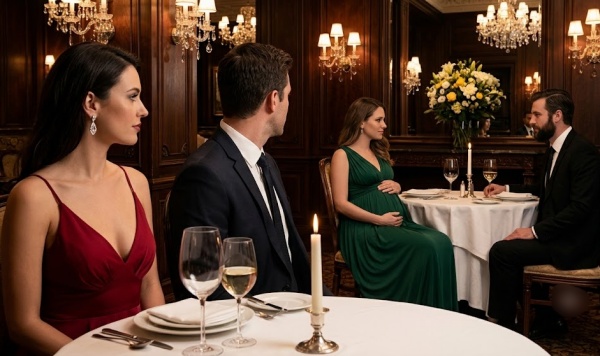
Eight months pregnant, wearing a black silk maternity dress I had ordered online because nothing in my closet fit anymore, I sat at a corner table overlooking Central Park South. Outside, December snow floated past the windows like powdered sugar. Inside, crystal glasses caught the candlelight, silverware rested perfectly aligned beside white plates, and every conversation sounded expensive.
Across from me sat Alexander Kane.
Most people in New York knew his name even if they had never met him. He was the CEO of Kane Meridian Capital, a private investment firm with offices in Manhattan, London, Singapore, and Dubai. Forbes called him “quietly ruthless.” Wall Street called him “the man you don’t want on the other side of the table.”
My husband called him a threat.
Alexander was not handsome in the glossy, artificial way men in finance tried to be. He was calm, controlled, and dangerously observant, with silver at his temples and a voice that made people lower theirs without realizing it. He wore a charcoal suit, no wedding ring, and the expression of a man who never entered a room without knowing where every exit was.
“You’re sure you want to do this tonight?” he asked.
I rested one hand on my stomach. The baby kicked, firm and impatient, like she already had opinions. “If I wait any longer, he’ll finish destroying everything my father built.”
Alexander studied me over the rim of his water glass. “Clara, this will not be gentle.”
I smiled faintly. “Neither was he.”
My name is Clara Whitmore-Hayes, though for the last six years, my husband preferred that I simply be Mrs. Hayes. It sounded cleaner that way. Easier. A woman attached to a man instead of a name attached to a family legacy, a trust, a company, and a signature he had spent years trying to control.
My father, Robert Whitmore, built Whitmore Hospitality Group from one struggling inn in Vermont into a national luxury hotel and resort brand. He was not a Wall Street man. He was a hospitality man. He believed fresh flowers mattered, remembered employees’ children’s names, and said the measure of a business was whether the people cleaning the rooms could afford to sleep safely in one.
When he died, I inherited forty-two percent of the company and voting control through a family trust.
My husband inherited nothing.
That never stopped him from acting like he owned everything.
Ethan Hayes had charm the way some men had blue eyes. Effortless, obvious, and useful. When we met at a charity gala in Boston, he made me laugh during the silent auction and told me he admired women who didn’t need permission to take up space.
I was twenty-eight, grieving my father, and tired of men treating my inheritance like either a prize or a problem. Ethan treated it like background noise. At least, that was what I believed then.
By the time I understood he had been studying me, we were married.
At first, he was patient. He called my pregnancy cravings “adorable,” attended board dinners, kissed my forehead when photographers appeared, and told everyone he was proud to support “Clara’s family vision.” Then slowly, quietly, support became suggestion. Suggestion became pressure. Pressure became control.
He wanted a seat on the board.
Then he wanted access to certain accounts.
Then he wanted me to sign restructuring documents he claimed were “standard.” When my attorneys objected, he accused them of poisoning me against him. When I refused, he stopped coming home before midnight.
Three weeks before that dinner at Veridian, my private investigator sent me the first photo.
Ethan leaving The Lowell Hotel with a woman named Madison Vale.
Madison was twenty-nine, beautiful, ambitious, and fond of posting cropped photos of champagne glasses, designer handbags, and hotel mirrors where she pretended not to show too much. She worked in luxury brand consulting, which in Manhattan could mean anything from marketing strategy to finding rich men who liked being admired.
I did not confront him immediately.
A pregnant woman learns patience differently. People assume pregnancy makes you fragile, emotional, irrational. They forget it can also make you precise. When every step hurts and every breath costs effort, you stop wasting movement.
So I waited.
I hired a forensic accounting firm.
I reviewed every trust document.
I called Alexander Kane.
He had been my father’s closest rival and, strangely, one of the only men my father respected. Years before, Alexander had tried to buy a controlling interest in Whitmore Hospitality. My father refused and later told me, “Kane is dangerous, but he honors the game. Your husband doesn’t even know what game he’s playing.”
I remembered that after Ethan tried to mortgage assets he did not legally control.
Now Alexander sat across from me at Veridian, holding a folder thin enough to be elegant and thick enough to ruin a man.
“His accounts won’t be frozen because of the affair,” Alexander said. “They’ll be frozen because of the transfers.”
“I know.”
“And because he used company-linked credit facilities for personal expenditures.”
“I know.”
“And because at least one attempted pledge of restricted shares appears fraudulent.”
I looked toward the restaurant entrance. “Alexander.”
He stopped.
“I’m not here because he cheated,” I said. “I’m here because he thought betrayal was a business strategy.”
For the first time that evening, Alexander smiled. “That sounds like your father.”
The maître d’ approached our table with the careful expression of someone carrying news that might explode.
“Mrs. Hayes,” he said softly, “Mr. Hayes has arrived.”
My baby kicked again.
I placed my napkin beside my plate, straightened my shoulders, and looked toward the entrance.
Ethan walked in wearing a midnight-blue Tom Ford suit I had bought him for our anniversary. Madison was on his arm in a red dress that looked designed to be noticed from across a room. She laughed at something he said, tilting her head toward him in the practiced way of a woman who believed she had won.
Then Ethan saw me.
His smile died so quickly it almost satisfied me.
For one second, he looked only confused. Then his eyes moved from my face to my stomach, then to Alexander Kane, then to the wineglasses on our table. Fear arrived slowly, like a shadow crossing marble.
Madison noticed the change and followed his gaze.
I lifted my glass of sparkling water.
“Hello, Ethan,” I said.
The restaurant did not go silent. Places like Veridian were too disciplined for that. But the air around us shifted. The maître d’ froze half a step away. A waiter by the service station suddenly became fascinated by a tray of bread.
Ethan recovered quickly. He always did.
“Clara,” he said, forcing a smile. “I didn’t know you were dining here tonight.”
“No,” I said. “I’m sure you didn’t.”
Madison’s hand slipped from his arm.
Alexander remained seated, calm as winter.
Ethan looked at him. “Kane.”
“Hayes.”
No handshake. No warmth. Just two names placed on the table like weapons.
Madison looked from Ethan to me. Her eyes paused on my stomach, and for the first time, something like discomfort crossed her face. Ethan had probably told her many things about me. Men like him always do. Cold wife. Difficult wife. Marriage over in all but name.
They rarely mention eight months pregnant.
Ethan stepped closer, lowering his voice. “Can we speak privately?”
I looked around. “Why? You seemed comfortable being public.”
His jaw tightened.
Madison whispered, “Ethan, what is going on?”
He did not answer her.
That was when I understood something important. Madison was not his partner. She was an accessory. He had dressed her up, brought her to a room full of powerful people, and expected her beauty to announce his freedom.
Instead, he had walked into his own audit.
“Clara,” Ethan said carefully, “this is not what it looks like.”
I smiled.
Every woman in America has heard that sentence at least once, if not for herself, then from a friend sitting at a kitchen table with mascara under her eyes.
“Good,” I said. “Because it looks like you brought your mistress to dinner at a restaurant where your pregnant wife happens to be meeting with the only man in New York you’re afraid of.”
Madison stepped back.
Alexander finally spoke. “Your table is ready, Mr. Hayes. Unless, of course, you’d prefer to leave.”
Ethan’s face flushed.
Leaving would make him look guilty. Staying would make him suffer. Pride chose for him.
“We’re staying,” he said.
Madison looked like she wanted to argue, but Ethan placed a hand lightly at her back and guided her toward a table not far from ours.
He had no idea dessert would be the least of his problems.
Part 2: The Mistress at Table Twelve
Madison tried to sit like a woman in control.
I could see it from across the room. Her spine straight, chin lifted, lips curved in a tiny smile that told the world she was unbothered. But her hand shook when she reached for the menu.
Ethan ordered champagne.
She did not drink it.
I knew then she was smarter than he thought.
Alexander glanced at them once and returned his attention to me. “He’s watching us.”
“Let him.”
“He thinks this is personal.”
“It is personal.”
“Clara.”
I looked at him. “It became personal when he tried to move money out of an employee pension reserve.”
Alexander’s expression hardened. “That transaction was blocked.”
“Because my father built safeguards into the trust.”
“Because your father knew men like Ethan existed.”
That one hurt, but not because it was cruel. Because it was true.
My father had never liked Ethan. He was polite to him, welcomed him to holiday dinners, poured him bourbon in the library, and still watched him like a man watching smoke near dry wood. After our engagement, he asked me one question.
“Does he love you when there’s nothing to gain?”
I had been offended.
Now, five years later, sitting in a restaurant where my husband had brought another woman, I wished I had answered honestly.
A waiter placed seared scallops in front of me and Dover sole in front of Alexander. I could barely eat. My daughter was pressing against my ribs, and every few minutes a tightness moved across my belly like a hand slowly closing.
“Are you in pain?” Alexander asked.
“Pregnant.”
“That wasn’t my question.”
I picked up my fork. “I’m fine.”
He looked unconvinced but did not press me. I appreciated that. So many men believed concern gave them permission to command.
Across the room, Ethan leaned toward Madison, speaking quickly. She listened with narrowed eyes. Whatever explanation he was giving did not satisfy her.
I imagined it.
Clara and I have been separated emotionally for months.
She knew I was moving on.
The pregnancy complicated things.
Alexander is an old family contact.
None of this means anything.
Men like Ethan believed if they used enough smooth words, reality would eventually become embarrassed and leave.
Madison suddenly stood.
She walked toward the restroom, passing close enough to our table that her perfume reached me before she did. Expensive, floral, too young for the room. She paused beside me.
“Mrs. Hayes,” she said.
Ethan froze.
I looked up. “Madison.”
Her eyes widened slightly. He had not told her I knew her name.
Alexander leaned back in his chair, watching.
Madison swallowed. “I didn’t know you would be here.”
“I believe that.”
Her face changed. Not much. Just enough.
“I also didn’t know you were…” Her voice faded as she glanced at my stomach.
“Pregnant?” I offered.
“Yes.”
“Eight months.”
Color rose in her cheeks.
Behind her, Ethan stood halfway from his chair. “Madison.”
She ignored him.
“He told me you were separated,” she said quietly.
I looked at Ethan over her shoulder. “Did he?”
Madison’s mouth tightened.
“He said the marriage was over.”
I folded my hands over my belly. “He slept in our bed last night.”
That sentence landed harder than any slap could have.
Madison closed her eyes for a moment. When she opened them, the glamour had cracked. What remained was a young woman realizing she had not been chosen over a wife. She had been lied into a role.
“I’m sorry,” she said.
I believed her more than I expected to.
Ethan reached us then, smiling with his teeth. “Madison, don’t make a scene.”
She turned to him. “You brought me here knowing your wife could be in the city?”
“I didn’t know she’d be here.”
“That’s not an answer.”
He lowered his voice. “We’ll talk at the table.”
“No.”
A few nearby diners pretended not to listen. In New York, pretending not to listen is an art form, especially when the scandal is better than dessert.
Ethan’s hand closed around Madison’s elbow. Not hard enough to be dramatic. Just enough to remind her he expected obedience.
Alexander stood.
He did not raise his voice. He did not move aggressively. He simply stood, and somehow the space around him rearranged itself.
“Take your hand off her,” he said.
Ethan released Madison immediately.
That was the thing about powerful men. Some shouted because they needed to prove it. Others spoke softly because everyone already knew.
Madison stepped away from Ethan.
“I’m leaving,” she said.
“Don’t be ridiculous,” Ethan snapped.
She laughed once, sharp and small. “Ridiculous was believing you.”
She pulled a small clutch from the table and walked toward the exit. Ethan watched her go, stunned, as if a painting had stepped out of its frame.
By the time she reached the maître d’, she had tears in her eyes but her back was straight.
I would later learn Madison returned every gift Ethan had given her through her attorney. Jewelry, a watch, even the apartment lease he had quietly guaranteed. She made no public statement. She simply disappeared from his life with more dignity than he deserved.
But at that moment, Ethan did not care about dignity.
He cared that the room had seen him lose control.
He turned to me with eyes full of polished rage.
“This is what you wanted?” he asked.
“No,” I said. “I wanted a faithful husband.”
His face hardened.
Alexander sat down again, as if the interruption had been a minor inconvenience.
Ethan leaned toward me. “You think sitting with him makes you untouchable?”
“No,” I said. “Being careful did.”
A faint sound came from Alexander’s phone. He glanced at the screen, then placed it face down beside his plate.
Ethan noticed.
“What did you do?” he asked.
I did not answer.
His phone buzzed next.
Once.
Then again.
Then again.
Ethan pulled it from his jacket pocket. I watched his face as he read the first message. Confusion. Irritation. Disbelief. Then fear.
“What is this?” he said.
Alexander unfolded his napkin and placed it beside his plate. “Most likely a notice from your bank.”
Ethan stared at him.
“Temporary restrictions,” Alexander continued. “Pending review of irregular transfers connected to Whitmore Hospitality assets.”
Ethan’s lips parted.
My voice was calm when I spoke. I had practiced. “The board held an emergency session at six o’clock.”
“That’s impossible,” he said.
“No. It was inconvenient. There’s a difference.”
“You don’t have the votes.”
“I do now.”
He looked at Alexander.
There it was. The fear I had been waiting for.
Alexander had not bought my company. He had bought out three minority investors who had grown tired of Ethan’s games. He did it legally, cleanly, and with devastating timing. My voting control remained intact. His support ensured the board could act quickly.
Ethan whispered, “You went to him?”
“I went to someone who understood the threat.”
“I’m your husband.”
“You were.”
He flinched, but only for a second.
Then came anger.
“You think you can cut me out? After everything I did for you?”
I looked at him, truly looked at him. The suit I paid for. The watch I gave him. The confidence he built from rooms my family name opened. The arrogance of a man who mistook access for ownership.
“What did you do for me, Ethan?”
His mouth opened.
Nothing came out.
Because charming men rely on fog. Specifics are their enemy.
The waiter arrived with dessert menus, then sensed the weather at the table and retreated without a word.
Ethan’s phone buzzed again. This time, he answered.
“What?” he snapped.
I could hear only pieces.
Compliance review.
Corporate card suspension.
Legal hold.
Executive access revoked.
His empire had not collapsed yet. That would take longer. But it had begun to bleed.
And everyone at Veridian saw the first drop.
Part 3: The Empire Built on Borrowed Keys
Ethan Hayes loved the word empire.
He used it in interviews, investor calls, and late-night speeches after three glasses of Scotch. He said he was building an empire across hospitality, real estate, lifestyle branding, and “experience-driven luxury,” which was a phrase that meant everything and nothing depending on who was writing the check.
But the truth was simpler.
Ethan built his empire with borrowed keys.
My father’s name opened the first door. My trust documents opened the second. My board introductions opened the third. When people hesitated, Ethan smiled and said, “Clara and I are aligned,” which sounded professional and meant, “My wife’s assets are behind me.”
They never were.
Not legally.
But in America, perception can buy you time. And Ethan was very good at buying time with other people’s assumptions.
For years, he lived in the space between what was true and what people wanted to believe. He leased offices in Hudson Yards, hosted dinners during Art Basel, sponsored charity galas, and convinced lenders that Whitmore Hospitality’s shadow stretched over every deal he touched.
I signed nothing without my attorneys.
That saved me.
But it did not save everyone.
The next morning, the story did not make Page Six. Not yet. To outsiders, nothing had happened except a tense dinner between wealthy people in Manhattan. But in private banking circles, in boardrooms, in law offices from New York to Delaware, Ethan’s name began moving differently.
By 9:00 a.m., his corporate cards were suspended.
By 10:30, two lenders requested documentation he could not provide.
By noon, his CFO resigned by email.
At 2:15 p.m., the board of Hayes Ascend Group voted to place Ethan on administrative leave pending investigation. He called me eleven times during that meeting.
I did not answer.
I was at my obstetrician’s office on the Upper East Side, listening to my daughter’s heartbeat through a fetal monitor. It galloped fast and strong, filling the small exam room with the only sound that mattered.
“Beautiful heartbeat,” the nurse said.
I turned my face away because tears had come without permission.
For months, Ethan had made me feel like the pregnancy was an inconvenience to his schedule. He complained about appointments, about nursery furniture, about my swollen ankles, about the way I fell asleep before he came home. He once joked at dinner that our unborn daughter already had “terrible timing.”
I laughed then because everyone else did.
That is one of the small ways women betray themselves. We laugh so no one has to acknowledge the cruelty.
My doctor told me to avoid stress.
I almost laughed again.
Outside the clinic, Alexander’s driver waited beside a black Mercedes SUV. Alexander had insisted. I had refused twice. He ignored me the third time and sent the car anyway.
When I slid into the back seat, my phone lit up with a message from Ethan.
You are making a mistake.
Then another.
We need to present a united front.
Then another.
Think about our daughter.
That one made me cold.
For months, he had treated her like a complication. Now she was a bargaining chip.
I typed one sentence.
All communication should go through counsel.
Then I blocked his number.
Not forever. Just long enough to breathe.
By evening, he showed up at our penthouse.
I was not there.
My attorney, Rachel Meyers, had advised me to stay at a secure apartment owned by the family trust until temporary orders were in place. Under New York law, divorce and asset protection could become complicated quickly, especially when business interests, trusts, and disputed financial conduct were involved. Rachel did not dramatize things. She simply made lists, filed motions, and scared men by being prepared.
Ethan had keys to the penthouse, but they no longer worked.
Security called Rachel.
Rachel called me.
I was sitting in a cashmere robe on a couch in a quiet apartment overlooking the East River, eating saltine crackers from a paper towel because my daughter had decided gourmet food was unacceptable. Pregnancy strips luxury down to its truth. You can have Italian marble in the bathroom and still cry because your hips hurt.
“He’s downstairs,” Rachel said.
“Is he angry?”
“He’s charming.”
“That’s worse.”
“He’s asking to see you.”
“No.”
“He says he wants to apologize.”
“No.”
“He says Alexander Kane is manipulating you.”
I looked out at the river. “Of course he does.”
Men like Ethan always believed a woman’s resistance must belong to another man. It never occurred to them that she might have found her own spine.
“Security won’t let him up,” Rachel said. “Do you want to file for an order limiting contact?”
“Yes.”
“Good.”
I heard typing in the background.
“Clara,” Rachel said after a moment, softer now, “are you okay?”
I placed a hand on my stomach. “I don’t know.”
“That’s an honest answer.”
“I keep thinking about how long I stayed.”
“That’s common.”
“I’m embarrassed.”
“Don’t be. Deception works because it’s designed to.”
I closed my eyes.
That night, I dreamed of my father.
He was standing in the lobby of the first Whitmore Inn, wearing his old green sweater with the hole near the cuff. Snow fell outside, and he was arranging white roses in a vase the way he used to before Christmas guests arrived.
“You saw it, didn’t you?” I asked him in the dream.
He didn’t answer.
He only looked at me with that gentle sadness parents have when they know their children must learn pain in their own time.
When I woke up, my pillow was wet.
At 6:40 a.m., my water broke.
Not dramatically, not like in movies. Just a warm rush, then a silence so complete I forgot how to move. For five seconds, I sat there in the guest bed, one hand on my stomach, thinking, Not now.
Then another contraction seized me.
I called Rachel first by accident.
She answered immediately. “What happened?”
“I think I’m in labor.”
There was a pause.
Then Rachel, who had negotiated nine-figure settlements without raising her voice, said, “Okay. We’re going to the hospital.”
“We?”
“I’m calling the driver. I’m calling your doctor. I’m calling your medical proxy. Do not call Ethan.”
“I blocked him.”
“Excellent. Keep it that way.”
The drive to Mount Sinai felt both too fast and too slow. Manhattan blurred outside the window: yellow cabs, delivery bikes, steam rising from grates, people walking dogs as if my entire world had not just narrowed to breath and pain.
At the hospital, nurses moved around me with efficient kindness. Someone tied my hair back. Someone placed monitors on my belly. Someone asked if my husband was coming.
I opened my mouth.
No sound came out.
Rachel answered for me. “Her support person is on the way.”
I looked at her. “Who?”
She gave me a look. “Your mother.”
I almost cried from relief.
My mother, Evelyn Whitmore, arrived twenty minutes later wearing no makeup, a camel coat over pajamas, and the expression of a woman prepared to fight God personally if necessary. She took my hand and kissed my forehead.
“Oh, sweetheart,” she whispered.
“I was stupid,” I sobbed.
“No,” she said firmly. “You were hopeful. There’s a difference.”
Labor is not elegant.
No matter how wealthy you are, no matter how many people know your name, birth reduces you to blood pressure cuffs, ice chips, shaking legs, and sounds you do not recognize as your own. I had built board decks, negotiated hotel acquisitions, and stared down lenders in glass conference rooms.
None of it prepared me for bringing my daughter into the world while my marriage burned outside the delivery room.
At 4:18 p.m., she arrived.
Five pounds, thirteen ounces. Early, but strong. Furious lungs. Tiny fists. A full head of dark hair.
They placed her on my chest, and everything else disappeared.
Not Ethan.
Not Madison.
Not Alexander.
Not the frozen accounts or emergency board votes or legal filings.
Just my daughter, warm and alive against my skin.
I named her Lily Robert Hayes-Whitmore.
Robert, for my father.
Whitmore, because she would never have to borrow a name to belong.
Part 4: The Man Who Wanted Back In
Ethan found out about Lily’s birth from his attorney.
I know because he shouted it in a voicemail Rachel saved for the case file.
“You let me find out from a lawyer?” he said, voice shaking with fury. “That is my child, Clara. You don’t get to erase me.”
Erase him.
The irony was almost unbearable.
He had erased himself from appointments, from nursery decisions, from quiet nights when I lay awake timing contractions and wondering whether my marriage could survive long enough for my daughter to have a father under the same roof. He had erased himself every time he came home smelling like Madison’s perfume and told me I was paranoid.
But men like Ethan do not experience consequences as consequences.
They experience them as attacks.
Two days after Lily was born, he arrived at the hospital with flowers, a stuffed rabbit, and a photographer waiting downstairs.
Security stopped him.
Rachel had already filed the necessary paperwork. Given the financial investigation, the attempted unauthorized transactions, and his behavior, access was limited until a temporary parenting agreement could be established. He could request visitation through counsel.
He did not take it well.
By then, the story had leaked.
Not the whole truth, but enough.
A luxury CEO. A pregnant wife. A mistress at Veridian. Frozen accounts. Emergency board action. A baby born days later. The internet did what it always does: it took facts, added fire, and built a theater.
Some people defended Ethan.
They said marriages were complicated. They said women used pregnancy to trap men. They said wealthy wives could be controlling. They said nobody knew the whole story.
They were right about one thing.
Nobody knew the whole story.
They did not know about the unsigned documents he left on my desk.
They did not know about the private dinners where he claimed my father had “promised” him future control.
They did not know about the employee reserve account.
They did not know about the night I found him in the nursery, not admiring the crib, but measuring the room for a private office because, as he put it, “the baby won’t need all this space at first.”
But the board knew enough.
The auditors knew more.
And Rachel knew everything.
Alexander visited the hospital on the third day.
He did not bring flowers. He brought coffee for my mother, legal documents for Rachel, and a small white blanket from Bergdorf Goodman for Lily. Practical, expensive, slightly intimidating. Very Alexander.
He stood near the bassinet and looked down at my daughter with surprising uncertainty.
“She’s small,” he said.
“She’s a baby.”
“I’m aware.”
“You look nervous.”
“I own companies in seventeen countries. I am not nervous.”
Lily yawned.
Alexander took one step back.
I laughed for the first time in days.
He looked at me then, and something in his expression softened. Not romance. Not yet. Something quieter, more dangerous because it asked for nothing.
“She looks like you,” he said.
“She looks like a potato.”
“A very determined potato.”
My mother, sitting in the corner, pretended not to smile.
Alexander’s public reputation was built on steel, but my father had once told me steel was useful only because someone had survived the fire first. I wondered what fire had made him.
“You don’t have to keep helping me,” I said.
He looked at me as if I had said something foolish. “I’m not helping Ethan’s wife. I’m protecting Robert Whitmore’s daughter and the company he built.”
“That sounds very noble.”
“It’s also good business.”
“There it is.”
He smiled slightly. “Your father appreciated honesty.”
“He also warned me about you.”
“Good. He should have.”
I studied him. “Are you dangerous, Alexander?”
“Yes.”
The answer came without hesitation.
“But not to you,” he added.
That was the difference between him and Ethan. Ethan needed to be seen as harmless while doing harm. Alexander had no interest in pretending he was harmless. He simply chose where to aim.
The divorce filing became public the following week.
Rachel filed in New York County Supreme Court, citing irretrievable breakdown of the marriage and requesting appropriate temporary orders regarding custody, support, residence, and preservation of assets. The financial language was dry, professional, and devastating.
Ethan countersued with fury disguised as injury.
He claimed I had conspired with Alexander to humiliate him. He claimed I had denied him access to his child. He claimed Whitmore Hospitality had always been “a marital enterprise in spirit,” which Rachel described as “legally poetic and factually useless.”
The judge did not freeze all of Ethan’s personal assets forever. That was not how things worked. But accounts tied to disputed transfers, business credit lines, and certain corporate entities remained restricted while investigators reviewed the trail.
His empire kept bleeding.
A hotel project in Miami paused financing.
A lifestyle brand collaboration canceled its launch.
Two partners in a Nashville development demanded independent audits.
Then Madison spoke.
Not publicly, not in a dramatic interview, not on social media. She provided a sworn statement through her attorney. In it, she confirmed Ethan told her he was separated, claimed the marriage was effectively over, and described himself as “financially independent from the Whitmore family.”
That last phrase mattered.
Because he had told lenders the opposite.
Rachel read the statement in her office while I nursed Lily under a gray wrap and tried not to fall asleep.
“Well,” she said, “Madison may have done more damage with three pages than gossip sites did with three million comments.”
“Is she okay?” I asked.
Rachel glanced at me. “You care?”
“I don’t know.”
“That’s allowed.”
I looked down at Lily. Her tiny hand rested against my chest, fingers opening and closing like she was trying to hold the air.
“I don’t want to become cruel,” I said.
Rachel’s face softened. “Setting boundaries is not cruelty.”
I wanted to believe that.
A week later, Ethan was granted a supervised visit with Lily in a neutral family center.
I did not attend. My mother did.
Ethan cried when he saw the baby, according to her. Real tears, she said. He held Lily awkwardly, as if afraid she might break or accuse him. He told my mother he had made mistakes.
My mother did not comfort him.
She was polite. That was worse.
After the visit, Ethan sent a message through the parenting app.
She’s beautiful. I want to be better.
I stared at the message for a long time.
Then I wrote back:
Lily deserves consistency, safety, and honesty. Start there.
He did not respond for two days.
When he did, the message was shorter.
I miss you.
I did not answer.
Because missing me was not the same as loving me. Missing access was not regret. Missing comfort was not accountability.
And I had a daughter now.
I could not afford to confuse those things anymore.
Part 5: Dessert Was Only the Beginning
Six months later, Veridian called to confirm a reservation under my name.
I almost canceled.
The idea of returning to that restaurant felt theatrical, and I had no interest in becoming a woman who staged her healing for symbolism. But my mother insisted we needed to celebrate the final board vote. Rachel said celebration was legally advisable for morale. Alexander simply said he would be there at eight.
So I went.
This time, I wore emerald green.
Not maternity. Not black. Not armor. Just a dress that fit the body I had now, softer in some places, stronger in others, still mine after everything it had carried.
Lily stayed home with my mother and a night nurse. I checked the baby monitor app three times in the car, twice in the elevator, and once at the table before Alexander gently turned my phone face down.
“She’s asleep,” he said.
“She could wake up.”
“Babies do that.”
“You’re very knowledgeable now.”
“I read two books.”
I laughed. “Two?”
“And half of a third. It was repetitive.”
The same maître d’ greeted me with extraordinary care. He led us to a different table, one near the fireplace. Not the scene of the crime. Not the window where Ethan first saw me. Something warmer.
Alexander ordered champagne for himself and sparkling water for me, though I was no longer pregnant. I raised an eyebrow.
“You’re nursing,” he said.
“You remember that?”
“I remember details.”
That was true. He remembered everything. Dates, names, vulnerabilities, promises. It made him formidable in business and unexpectedly gentle in friendship.
The board vote had been unanimous.
Ethan was permanently removed from any advisory or executive role connected to Whitmore Hospitality and barred from representing himself as affiliated with the company. The investigation had uncovered enough misconduct to trigger civil claims, though Rachel advised patience before filing everything at once.
“Let him run out of borrowed oxygen,” she said.
Ethan had sold his apartment.
His Miami project collapsed.
His Nashville partners sued.
His social world, once polished and loud, narrowed to a handful of men who still invited him to golf because scandal was only offensive when it stopped being useful.
But he was not destroyed.
Life rarely gives clean endings.
He was still Lily’s father. He still had supervised visits that might one day become unsupervised if he proved stable and consistent. He still sent polite messages through the parenting app. He still existed at the edge of my life, not as a husband, but as a responsibility I had to manage with maturity.
That was the hardest part of betrayal.
The world wanted revenge.
Parenthood required structure.
During dinner, Alexander and I spoke of business first. A potential acquisition in Charleston. Renovations to the Vermont property. A new employee housing initiative my father would have loved.
Only after dessert arrived did he mention Ethan.
“His attorney approached mine.”
I placed my spoon beside the crème brûlée. “About what?”
“He believes I influenced you against reconciliation.”
I stared at him.
Alexander looked almost amused. “Apparently, I am responsible for his affair, his financial misrepresentations, his frozen accounts, and his inability to read trust documents.”
“That is an impressive résumé.”
“I’ve had worse.”
I shook my head. “He still thinks every decision I make belongs to a man.”
Alexander’s expression grew serious. “Many men find a woman’s independence less believable than another man’s control.”
I looked at him across the candlelit table.
“And you?”
“I find your independence inconvenient at times,” he said. “But never unbelievable.”
That stayed with me.
After dinner, we stepped outside into the cold. Manhattan glittered around us, all glass towers, headlights, and ambition. A carriage moved slowly near the park, more for tourists than New Yorkers, its wheels whispering over wet pavement.
Alexander’s driver waited at the curb.
I paused under the awning.
“Six months ago,” I said, “I sat in there thinking my life was ending.”
Alexander looked toward the restaurant windows. “It was.”
I turned to him.
“The version built around him,” he said.
The truth of that settled over me.
Ethan had not only betrayed our marriage. He had betrayed the woman I had been trying to be for him: smaller, quieter, easier to explain, easier to manage. That woman had ended at Veridian before dessert.
The woman who walked out was tired, pregnant, terrified, and finally awake.
My phone buzzed.
A message from my mother.
Lily is awake and offended that you are not here.
A photo followed. Lily in striped pajamas, cheeks round, fist near her mouth, staring at the camera with deep suspicion.
I smiled so hard my face hurt.
Alexander looked at the photo. “She has your expression.”
“She looks judgmental.”
“She comes by it honestly.”
The driver opened the door. Before I got in, Alexander touched my arm lightly.
“Clara.”
I looked up.
“I know people are already writing stories about us.”
“They started months ago.”
“They’re wrong.”
“About which part?”
He paused.
For once, Alexander Kane seemed careful not because he was calculating, but because he was trying not to take what had not been offered.
“I did not help you because I expected a place in your life.”
“I know.”
“If I ever have one, it will be because you choose it freely.”
The city noise moved around us. Horns, footsteps, laughter from a group leaving the restaurant behind us. Ordinary sounds from a world that kept going no matter whose heart had been broken.
I thought of Ethan, who had treated choice like something he could corner.
Then I thought of Alexander, dangerous enough to destroy companies, standing in the cold and asking for nothing.
“You have a place,” I said. “I’m still deciding what kind.”
He nodded once. “Fair.”
No pressure. No performance. Just patience.
That was new to me.
The divorce became final eleven months after the night at Veridian.
There was no dramatic courtroom collapse. Ethan did not confess everything on the stand. Madison did not burst through the doors with one final revelation. Real life, even wealthy dramatic life, contains more paperwork than thunder.
The settlement protected Whitmore Hospitality, preserved Lily’s trust interests, and resolved marital property under New York law in a way Rachel called “reasonable but not generous.” Ethan received enough to live well if he stopped pretending to be richer than he was. He did not receive the company. He did not receive control. He did not receive me.
The civil matters took longer.
Some settled quietly.
Some remained pending.
One lender pursued him aggressively enough that his name appeared in business news again, though the article was less scandalous than it was surgical. Numbers. Dates. Entities. Allegations. The kind of public record that cannot be charmed over cocktails.
Ethan sent me one personal message after the divorce.
Not through the parenting app. Through email.
I loved you in my way.
I read it while sitting in Lily’s nursery at 2:00 a.m., rocking her after a feeding. Moonlight spilled across the rug. Her tiny socks lay mismatched near the changing table. A half-empty bottle sat on the dresser.
In my way.
It was the most honest thing he had ever written.
His way had loved proximity, access, admiration, convenience, and victory. His way had loved the version of me that made him look powerful. His way had loved my family name more easily than my body when it swelled with his child.
I did not reply.
Instead, I kissed Lily’s forehead and whispered, “You will never have to shrink to be loved.”
One year after that first dinner, I returned to Veridian again.
This time, it was for the Whitmore Foundation’s annual benefit. We had raised millions for employee housing, maternal health access, and emergency support for hospitality workers facing medical crises. My father’s portrait stood near the entrance, surrounded by white roses.
Lily was at home, asleep under my mother’s watchful eye. I wore midnight blue. Alexander stood beside me, not as a rescuer, not as a rumor, but as a partner in a new acquisition fund we had launched to protect family-owned hotels from predatory buyers.
People watched us. Of course they did.
New York always watches.
But I no longer cared the same way.
Halfway through the evening, I saw Ethan across the room.
He had not been invited by me. He came as the guest of a donor who either did not know or did not care about the history. He looked thinner, quieter, his suit still expensive but no longer effortless.
For a moment, our eyes met.
The room seemed to fold inward, pulling me back to the night of the red dress, the frozen accounts, the mistress walking away, the phone buzzing in his hand as his empire began to bleed.
Then Lily’s photo lit up my phone.
My mother had sent a picture of her standing with both hands on the coffee table, grinning like she had personally conquered gravity.
And just like that, Ethan became background.
Not erased.
Not forgiven completely.
Just smaller than the life that had grown beyond him.
Alexander appeared beside me. “Are you all right?”
I looked at the photo again.
“Yes,” I said. “I really am.”
Across the room, Ethan started toward me.
Alexander noticed. “Do you want me to stay?”
I thought about it.
Once, I would have wanted a powerful man beside me so Ethan would behave. Once, I would have needed a witness to feel safe in my own certainty.
Not anymore.
“No,” I said. “I can handle him.”
Alexander inclined his head and stepped away, close enough to see, far enough to trust me.
Ethan stopped in front of me.
“Clara.”
“Ethan.”
He looked around the room. “Your father would be proud.”
The words hurt because they were true and because he had no right to use them. But I let them pass through me without giving them a home.
“Yes,” I said. “He would.”
“How is Lily?”
“Happy. Healthy. Very opinionated.”
A real smile touched his face, small and sad. “That sounds like you.”
“It sounds like her.”
He nodded.
For once, he did not argue.
“I heard about the new fund,” he said. “Smart move.”
“Thank you.”
Another silence.
Then he looked at me with the expression of a man finally seeing the door he had closed from the wrong side.
“I didn’t understand what I had,” he said.
I held his gaze.
“No,” I said. “You understood what you could use. That was the problem.”
He flinched.
But he did not deny it.
That was new.
“I’m trying to be better,” he said.
“For Lily’s sake, I hope you are.”
“And for yours?”
I almost smiled.
There it was again, that old instinct to center himself in a room where he no longer belonged.
“For mine,” I said gently, “you no longer need to be anything.”
His eyes lowered.
I expected anger. Instead, he looked tired.
Maybe that was growth. Maybe it was defeat. Maybe men like Ethan only learned humility when every other strategy failed. I did not need to know.
“I’m sorry,” he said.
Not beautifully. Not dramatically. Just two words, late and insufficient.
I accepted them with a nod, not because they repaired the damage, but because refusing to acknowledge them would have tied me to the moment longer than I wished.
Then I walked away.
Not quickly.
Not angrily.
Just away.
On the terrace, cold air touched my face. Below, New York moved in rivers of light. Taxis, black cars, people with somewhere to be. A city full of ambition, heartbreak, reinvention, and second chances that rarely arrived the way people expected.
Alexander joined me after a few minutes.
“You handled that well,” he said.
“I didn’t do it for him.”
“I know.”
Inside, applause began as the foundation director took the stage. Through the glass, I saw my father’s portrait, the white roses, the crowded tables, the company still standing. My company now. My daughter’s legacy someday, if she wanted it.
The first time Ethan brought Madison to Veridian, he thought he was announcing his freedom.
He did not understand that he had walked into the room where mine would begin.
By dessert, his mistress had left him.
By midnight, his accounts were frozen.
By morning, his empire was bleeding.
But the real ending was not his downfall.
The real ending was Lily laughing in the sunlight months later. It was my name on documents I signed without fear. It was walking through my father’s hotels and seeing employees look at me not as a widow of a legacy or wife of a charming man, but as the woman in charge.
It was learning that betrayal can break your heart without breaking your future.
It was understanding that the most powerful seat at any table is not beside the man everyone fears.
It is the seat you no longer need permission to claim.
And when I finally went home that night, Lily was asleep in her crib, one tiny fist curled beside her cheek. I stood in the doorway and listened to her breathe.
Soft.
Steady.
Unbothered by empires.
I thought about the woman I had been one year earlier, eight months pregnant in a black dress, laughing across from Alexander Kane while waiting for my husband to walk in with another woman. I wanted to reach back through time and take her hand.
I wanted to tell her that humiliation was not the end.
I wanted to tell her that the body she felt trapped inside was building the person who would save her.
I wanted to tell her that one day, the man who made her feel replaceable would stand across a crowded room and realize he had been the temporary one all along.
But maybe she already knew.
Maybe that was why she lifted her glass that night.
Maybe that was why she smiled when Ethan saw her.
Maybe some part of her understood that the life he thought he was leaving behind was not collapsing.
It was preparing to rise without him.
