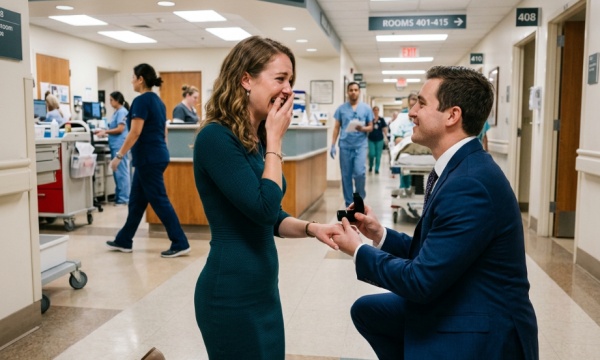
My Husband Thought Proposing to His Mistress While I Was Being Wheeled Into Surgery Would Humiliate Me—But the Ring Exposed the Fraud That Took Everything From Him.
I was being rushed toward emergency surgery when my husband decided to turn my worst day into his grand performance. In the middle of a hospital hallway, he got down on one knee, opened a velvet ring box, and proposed to the woman he had been hiding from me for months. He thought the moment would humiliate me so badly I would have no strength left to fight….
Part 1: The Hallway Proposal
I was being wheeled toward emergency surgery when my husband decided my life was not already painful enough.
The hospital hallway smelled like antiseptic, burnt coffee, and the sharp plastic scent of medical equipment. Fluorescent lights passed over me one by one as the nurse pushed my bed toward the operating wing at St. Catherine’s Medical Center in Raleigh, North Carolina. My appendix had ruptured less than an hour earlier, and every breath felt like a knife twisting somewhere deep in my right side.
My name is Natalie Harper, and until that morning, I had been married to Andrew Harper for eighteen years.
We had two children, a brick house in Cary, a mortgage, two aging SUVs, and the kind of life people described as “stable” because they never saw what happened after the front door closed. Andrew was a financial consultant with a charming smile and expensive watches. I was an elementary school reading specialist who spent my days helping second graders sound out words and my evenings pretending not to notice my husband becoming a stranger.
For months, I had known something was wrong.
Not one big thing. Small things. Andrew’s phone face-down at dinner. Late meetings that ran until midnight. New passwords. A sudden interest in designer shirts. Credit card charges he explained too quickly.
Then there was Vanessa.
Vanessa Lane was twenty-nine, elegant, and always just close enough to Andrew to make me feel foolish for noticing. She worked at his firm as a client relations manager. At company events, she called me “so sweet” in a tone that made the words feel like a small slap wrapped in perfume.
I never imagined Andrew would choose a hospital hallway to confirm what my heart already knew.
The nurse pushing my bed was named Marisol. She had kind eyes above her blue surgical mask and kept telling me, “We’re almost there, honey. Just keep breathing.”
My father walked beside me, his hand resting lightly on the rail. Thomas Whitaker was seventy years old, a retired forensic accountant who still balanced his checkbook with a fountain pen and mistrusted anyone who described themselves as “visionary” in business. He had driven me to the ER after I collapsed in my classroom during morning reading groups.
Andrew had arrived twenty minutes later.
He had not rushed in panicked or breathless. He had walked in wearing a navy suit, no tie, his hair perfect, smelling faintly of cedar cologne. He asked the doctor three questions, checked his phone twice, and then told me he needed to “step out for a minute.”
Now, as Marisol pushed me past the waiting area, I saw him.
Andrew stood in the middle of the hallway near the vending machines, surrounded by hospital visitors, two nurses, my father, and several people who had turned their heads because they sensed drama before they understood it. Beside him stood Vanessa in a cream coat, her blonde hair curled over one shoulder, her eyes bright with the kind of excitement no one should bring into an emergency department.
At first, I thought pain was making me hallucinate.
Then Andrew dropped to one knee.
Marisol stopped pushing the bed so abruptly the wheels squeaked.
“Andrew?” I whispered.
He looked directly at me.
Not with shame. Not with panic. With performance.
“Natalie,” he said, loud enough for people nearby to hear, “I know this is difficult, but we’ve been over for a long time.”
My father went still beside me.
I tried to lift myself on one elbow, but the pain shot through me so hard I gasped.
Marisol placed a hand on my shoulder. “Ma’am, please don’t move.”
Andrew opened a black velvet ring box.
Inside was a diamond ring so large it looked unreal under the fluorescent lights. A round center stone, halo setting, platinum band. The kind of ring that would make strangers gasp and wives ask quiet questions.
Vanessa covered her mouth with both hands.
Andrew turned toward her.
“Vanessa,” he said, “you showed me what love is supposed to feel like. You reminded me that I deserve a life filled with joy, not obligation.”
Someone in the hallway murmured, “Oh my God.”
I stared at the ring.
Not at Andrew. Not at Vanessa. The ring.
Because I had seen it before.
Not physically. Not on her finger. But in numbers.
Three weeks earlier, my father had sat at my kitchen table with a yellow legal pad, my laptop, and a stack of financial records I had printed after discovering a missing $42,000 from our home equity line of credit. He had not accused Andrew of anything at first. He simply adjusted his glasses and said, “Money tells the truth when people won’t.”
Now the truth was shining from a velvet box in a hospital hallway.
Andrew looked back at me.
“This marriage is over in every way that mattered,” he announced.
The words should have broken me.
Maybe they would have, if my body had not been fighting infection. Maybe they would have, if I had not spent weeks watching my father quietly follow the money. Maybe they would have, if I still believed Andrew’s cruelty was accidental.
Instead, I felt a strange, cold clarity.
He had chosen the hallway because he wanted witnesses. He wanted the story to be that he finally chose love while I was too weak, too sick, too pathetic to fight back. He wanted Vanessa to feel chosen and me to feel discarded.
But Andrew had always misunderstood weakness.
He thought pain made people powerless.
My father stepped forward.
“Andrew,” he said.
His voice was calm, but I had heard that tone before. It was the tone he used when an audit had stopped being routine and started becoming evidence.
Andrew barely glanced at him. “Tom, please. This is between Natalie and me.”
“No,” my father said. “It became more than that when you bought that ring with money you had no legal right to use.”
Vanessa’s hands dropped from her mouth.
Andrew’s face changed for half a second before he recovered.
“I don’t know what you’re talking about.”
My father reached into the inside pocket of his jacket and pulled out a folded document.
“I believe you do.”
Marisol leaned closer to me. “Mrs. Harper, we need to keep moving.”
She was right. My life was not a courtroom. My appendix did not care about betrayal, diamonds, or timing.
But before they pushed me through the double doors, I looked at Andrew one last time.
He was still on one knee, ring box open, Vanessa frozen beside him, my father standing over him with a single sheet of paper that had already begun dismantling the fantasy.
I did not yell.
I did not beg.
I did not ask him why.
I only said, “Dad, call Elaine.”
Elaine Brooks was my attorney.
My father nodded once.
Then the double doors opened, and Marisol pushed me into surgery.
The last thing I heard before the hallway disappeared was Vanessa whispering, “Andrew, what does he mean?”
By sunrise, she would know.
So would his company.
So would the bank.
And so would I.
Part 2: The Money Trail
Three weeks before the hospital hallway, I found the statement in the recycling bin.
That sounds dramatic, but the truth is embarrassingly ordinary. I was taking out pizza boxes, junk mail, and an empty carton of orange juice when I noticed the corner of a bank envelope tucked under a grocery flyer. It was from Piedmont Federal Credit Union, where Andrew and I had our mortgage and a home equity line of credit.
I almost ignored it.
Andrew handled most of the finances. That had been our arrangement for years. He was the financial professional; I was the teacher who bought classroom supplies with her own money and considered it a victory if I remembered to submit receipts before June.
But something made me pull the envelope out.
The statement was for our home equity line.
Balance: $42,000 drawn.
I stood in the garage staring at the number while rain tapped against the open door.
We had taken out the line of credit two years earlier after a storm damaged part of our roof. Andrew said it would be good to have “for emergencies.” As far as I knew, we had used $6,800 for repairs and paid most of it back.
Forty-two thousand dollars was not an emergency.
It was a decision.
When I asked Andrew about it that night, he barely looked up from his laptop.
“Business bridge expense,” he said.
“What business?”
“A client investment opportunity.”
“We used money tied to our house for a client investment opportunity?”
He sighed as if I had asked whether numbers were real.
“Natalie, you wouldn’t understand the structure.”
There are sentences in a marriage that reveal more than they intend.
That one revealed the whole room.
I stood there in my kitchen wearing old sweatpants, holding a bank statement, listening to my husband tell me that I was too ignorant to question debt attached to the house where our children slept.
Our daughter, Emma, was sixteen. Our son, Jack, was thirteen. Their bedrooms were upstairs, their school pictures lined the hallway, and their lives were built on the assumption that the adults responsible for them were honest.
I folded the statement.
“Then explain it,” I said.
Andrew closed the laptop slowly.
“I just did.”
“No,” I said. “You dismissed me. That’s different.”
His eyes hardened.
Andrew had many versions of himself. Charming Andrew. Generous Andrew. Professional Andrew. Church fundraiser Andrew. The version he gave me lately was the cold one, the one who spoke to me like I was an employee who had missed a deadline.
“You’re stressed,” he said. “You’ve been emotional lately.”
There it was.
Emotional.
A useful word for men who want women to doubt the evidence in their hands.
I did not argue further. I had learned something from years of teaching children to read: when someone keeps skipping the same word, it usually means they do not want to say what it is.
The next morning, I called my father.
He arrived that afternoon with a legal pad, a calculator, and two turkey sandwiches from Harris Teeter because he believed financial distress should never be analyzed on an empty stomach.
“Show me everything,” he said.
So I did.
Bank statements. Credit cards. Mortgage documents. Tax returns. Andrew’s business expense reimbursements that I could access through our shared files. Random receipts I had found in jacket pockets and drawers. A jewelry store charge I had dismissed months earlier because Andrew told me it was for a client appreciation gift.
My father did not react dramatically.
He simply read, wrote notes, and occasionally said, “Hmm.”
That was how I knew it was bad.
When I was a child, my father’s “hmm” could mean anything from “this math homework has a mistake” to “someone is about to be indicted.” I sat across from him at the kitchen table, hands wrapped around a mug of tea gone cold, and watched his eyebrows pull together.
At 6:12 p.m., he circled three transactions.
“This one,” he said, tapping the page. “This one. And this one.”
“What are they?”
“Transfers from the home equity line into an account ending in 7714.”
“I don’t know that account.”
“I didn’t think you did.”
My stomach tightened.
He continued. “From there, funds appear to have been used for jewelry, hotel stays, restaurant charges, and payments to a private travel service.”
I stared at the words.
Jewelry.
Hotels.
Restaurants.
Travel.
The shape of betrayal formed itself out of receipts.
“Vanessa?” I asked.
My father looked at me gently.
“I don’t know yet.”
Yet.
That word did something to me.
It turned suspicion into investigation.
For the next three weeks, my father quietly followed the trail. He did not hack anything. He did not break laws. He used records I had legal access to, public filings, credit card statements, and information provided by an attorney after I finally admitted I might need one.
Elaine Brooks was a family law attorney in downtown Raleigh. She had silver hair, red reading glasses, and the ability to make panic feel organized.
“Do not confront him without a plan,” she told me during our first consultation. “Do not move money unless advised. Do not make threats. Gather information, protect yourself, and keep communication calm.”
Calm became my full-time job.
I went to work. I helped children read. I packed lunches. I drove Jack to basketball practice and Emma to SAT tutoring. I smiled at Andrew across the dinner table while he texted under the edge of his napkin.
At night, I lay awake beside him and wondered how many lies could fit in a king-size bed.
Sometimes I wanted to scream. Sometimes I wanted to shake him awake and demand the truth. Sometimes I wanted to call Vanessa and ask if she knew the ring he was probably buying her was financed by the woman whose life she was helping destroy.
But my father’s voice stayed in my head.
Money tells the truth when people won’t.
And Elaine’s voice followed it.
Do not confront him without a plan.
The plan was simple: collect documents, confirm marital assets, determine whether funds had been misused, and protect the children’s home.
Then my appendix ruptured.
Pain began at 5:30 on a Wednesday evening. At first, I thought it was food poisoning. By midnight, I was sweating through my T-shirt and curled on the bathroom floor while Andrew slept in the guest room because, according to him, my “restlessness” had been keeping him awake.
At 6:00 a.m., Emma found me.
“Mom?” she said from the doorway. “You look really bad.”
That was teenage tenderness in its purest form.
My father arrived ten minutes after Emma called him. Andrew was already gone, supposedly to an early client meeting. Dad took one look at me and said, “Hospital. Now.”
By 9:40, the doctor said surgery could not wait.
By 10:15, Andrew arrived.
By 10:42, he proposed to Vanessa in the hallway.
And by 10:44, my father had already called Elaine.
Andrew thought he had chosen the perfect moment because I was physically helpless.
He did not know the paperwork was already awake.
Part 3: Surgery, Silence, and the First Domino
When I woke up after surgery, the room was dim, and my throat felt dry.
For a few seconds, I did not remember anything except pain. Then the ceiling tiles came into focus. The IV line. The monitor. The muted voices outside the door.
Then I remembered Andrew on one knee.
I turned my head and saw my father sitting in the chair beside the bed, his coat folded over his lap, his legal pad resting on one knee.
“Hi, sweetheart,” he said softly.
I tried to speak, but my voice came out rough. “Did I die?”
His mouth twitched. “No.”
“Shame.”
“Natalie.”
“I’m kidding.”
“Not well.”
I closed my eyes.
The ache in my abdomen was dull now, controlled by medication, but the ache in my chest had sharpened. There is something uniquely humiliating about being betrayed in public while wearing a hospital gown. It makes you feel less like a person and more like evidence of someone else’s cruelty.
“Where are the kids?” I asked.
“With your mother,” Dad said. “Emma knows you’re out of surgery and okay. Jack thinks appendixes are disgusting and wants to know if he can see pictures.”
Despite everything, I smiled faintly.
“And Andrew?”
My father’s expression changed.
“He left the hospital.”
“With her?”
“Yes.”
I stared at the wall.
Of course he had.
There are moments when someone’s absence becomes more honest than anything they ever said.
“What happened after I went in?” I asked.
Dad adjusted his glasses.
“Vanessa asked him what I meant. Andrew denied everything. Then hospital security asked them to move because they were blocking the hallway and upsetting patients.”
“Good.”
“He tried to call me dramatic.”
“You?”
“Yes.”
I almost laughed, but it hurt.
My father continued. “I told him Elaine had already been notified, and that any marital funds used for personal gifts, including the engagement ring, would be addressed through legal channels.”
“Did he panic?”
“For a second.”
That was enough.
My father handed me my phone.
“Elaine wants you to rest. She’ll file for temporary financial protections first thing in the morning if you approve.”
“What kind?”
“Freezing certain accounts. Requesting records. Preventing further borrowing against the house. Preserving assets until a court can review them.”
The words sounded far away, but their meaning reached me.
Protection.
Not revenge.
Not chaos.
Protection.
“Yes,” I whispered.
Dad nodded.
Then he hesitated.
“What?” I asked.
He looked older than he had that morning. Smaller somehow, as if seeing his daughter hurt had taken inches from him.
“The ring appears to have been purchased for $31,600.”
I blinked.
I thought I had heard wrong.
“Thirty-one thousand?”
“Yes.”
“For Vanessa?”
“Yes.”
“With money from our house?”
“Based on the timing and account flow, that is what it appears.”
I turned my face toward the window.
Outside, Raleigh traffic moved beyond the hospital glass. Cars, buses, people going to work, people getting coffee, people living lives where thirty-one thousand dollars was still a shocking amount of money to spend on a ring for someone else while your wife was being rushed into surgery.
The anger came then.
Not loud. Not explosive.
Deep.
An underground fire.
I thought about Emma’s college applications, the way she worried about tuition even though we told her not to. I thought about Jack needing braces. I thought about our roof, our mortgage, our future. I thought about Andrew kneeling with a ring bought from the walls around our children.
“He used the house,” I said.
My father’s jaw tightened.
“Yes.”
That was the moment my grief changed shape.
Until then, Andrew’s affair had felt like a wound to my heart. Painful, humiliating, personal. But the money made it bigger.
He had not just betrayed me emotionally.
He had risked our children’s stability to finance his fantasy.
The next morning, Elaine filed.
She moved quickly, professionally, and without drama. Temporary restraining orders in family law do not always sound like movie scenes; sometimes they are simply documents that say one spouse cannot drain accounts, sell property, hide assets, or create new debt while the divorce process begins.
By 9:00 a.m., Andrew’s access to several accounts was restricted.
By 10:30, the bank had flagged the home equity line for review.
By noon, Andrew’s employer had received a formal document request related to reimbursements, client accounts, and possible conflicts involving Vanessa Lane.
That last part was the domino Andrew had not seen coming.
Because the ring was not the only problem.
As my father and Elaine’s financial consultant reviewed more records, they noticed payments that did not make sense. Client entertainment expenses that matched weekends Andrew had claimed to be at conferences. Travel reimbursements submitted twice. “Consulting referral fees” connected to an LLC registered to Vanessa’s cousin in Wilmington.
My father explained it to me in the hospital the way he used to explain algebra.
“Not every unusual transaction is fraud,” he said. “But patterns matter.”
“What pattern do you see?”
He tapped his pen against the legal pad.
“A man using other people’s money to support a life he could not afford honestly.”
That sentence stayed with me.
A life he could not afford honestly.
Andrew had always wanted a bigger life. Bigger house, bigger watch, bigger vacations, bigger admiration. He wanted to be seen as generous without sacrificing comfort, successful without enduring limits, romantic without paying the bill himself.
Vanessa was not the cause of that.
She was the audience.
By the second day after surgery, Andrew called me nineteen times.
I did not answer.
He texted instead.
Natalie, this is out of control.
You’re letting your father poison you.
The money is complicated.
You don’t understand business expenses.
Vanessa and I didn’t mean to hurt you.
That one made me stare at the screen for a long time.
They did not mean to hurt me.
What a strange defense.
As if public humiliation in a hospital hallway was an unfortunate weather event. As if a diamond ring financed by our home equity line had slipped and fallen into a velvet box. As if love, real love, required a spectator section outside an operating room.
I typed one reply.
Communicate through Elaine.
Then I blocked him for the night.
My mother stayed with me in the hospital, knitting badly and criticizing every nurse’s blood pressure cuff technique under her breath. My father slept in the chair for two nights, though I told him to go home.
On the third morning, Emma and Jack visited.
Emma walked in first, tall and serious, trying too hard not to cry. Jack followed with a grocery bag full of snacks because he said hospital food “looked like a crime.”
I held out my arms carefully.
Emma hugged me like I might disappear.
Jack stood awkwardly near the bed and asked, “Are you going to be okay?”
“Yes,” I said.
He nodded, then looked at the floor. “Is Dad coming home?”
The room went still.
I had prepared for that question. I had rehearsed gentle answers with Elaine, my mother, and my own terrified heart.
But preparation is not the same as hearing your child ask if their family still exists.
“No,” I said softly. “Not right now.”
Jack swallowed.
Emma’s eyes filled.
“Did he really propose to her at the hospital?” she asked.
I closed my eyes briefly.
Teenagers find out everything. Faster than adults want. Faster than adults deserve.
“Yes,” I said.
Emma’s face hardened in a way that reminded me of myself and frightened me.
“That’s disgusting.”
“It was wrong,” I said. “But I don’t want either of you carrying adult anger for me.”
Jack laughed bitterly. “Too late.”
My heart cracked.
My father, who had been silent near the window, spoke gently.
“You’re allowed to be angry,” he said. “But don’t let anger become the only room you live in.”
Emma looked at him.
“Grandpa, what does that even mean?”
“It means we handle the truth without letting it turn us into people we don’t want to become.”
She looked away, but I could tell she heard him.
So did I.
Part 4: The Downfall He Didn’t Expect
Andrew’s downfall did not happen like it does in movies.
No police stormed into a boardroom. No one screamed in a marble lobby. Vanessa did not throw the ring into a fountain while dramatic music played.
Real consequences are usually quieter.
They arrive through emails, certified letters, suspended logins, canceled meetings, and people suddenly becoming unavailable for lunch.
Andrew worked for Bellamy & Cross, a respected financial advisory firm that managed investments for physicians, small business owners, and family trusts across North Carolina. His whole career depended on trust. Clients trusted him with retirement accounts, college savings, inheritances, and tax-sensitive planning.
Trust is hard to build.
It is easy to contaminate.
When Elaine’s document request reached the firm, it raised questions. When the bank flagged the home equity transfer, it raised more. When my father’s preliminary report connected Andrew’s personal spending, questionable reimbursements, and Vanessa’s related-party LLC, the firm opened an internal review.
Andrew called my father the next day.
Dad put the call on speaker because Elaine had advised that any direct communication about finances be documented.
“Tom,” Andrew said, his voice tight, “you need to stop.”
My father sat at my kitchen table, where he had brought me after I was discharged from the hospital. I was on the couch with a pillow against my abdomen, half-asleep but alert enough to listen.
“Stop what?” Dad asked.
“Digging through my life.”
“I’m reviewing financial records that affect my daughter and grandchildren.”
“You’re making things look worse than they are.”
“No,” Dad said. “I’m making them visible.”
Andrew was silent for a moment.
Then he tried a different tone.
“Look, I know I handled the hospital badly.”
My mother, standing at the sink, whispered, “Handled badly?”
Dad raised one finger for silence.
Andrew continued. “But Natalie and I were over. You know that. You saw how unhappy we were.”
I closed my eyes.
That was his new story.
Not betrayal. Not fraud. Not cruelty.
Unhappiness.
Men like Andrew loved vague words because vague words softened sharp facts. Unhappy sounded mutual. Complicated sounded mature. Mistakes sounded human.
My father’s voice remained steady.
“Your marriage is not my audit subject. The money is.”
Andrew exhaled sharply. “The ring was personal.”
“Then you should have purchased it with personal funds that were clearly yours to spend.”
“You don’t know what you’re talking about.”
My father looked at the spreadsheet in front of him.
“I usually do.”
Andrew hung up.
Two days later, Bellamy & Cross placed him on administrative leave.
That same afternoon, Vanessa resigned.
Not officially because of the affair. Companies rarely write scandal into public statements. Her resignation email said she was “pursuing new opportunities.” But by then, enough people knew enough pieces that nobody believed the sentence.
The ring became evidence in more than one conversation.
Elaine asked the court to consider it a dissipation of marital assets, which meant Andrew may have used shared resources for purposes unrelated to the marriage. The bank wanted clarification on the home equity draw. Bellamy & Cross wanted to know whether any client funds, company reimbursements, or outside referral payments had been improperly handled.
Andrew insisted everything was explainable.
Some of it probably was.
That is another thing real life teaches you: not every wrong thing becomes a crime. Not every betrayal becomes a headline. Sometimes people do unethical things that live in the gray space between bad judgment, policy violations, civil liability, and personal ruin.
But Andrew’s career did not require a criminal conviction to suffer.
It required trust.
And trust was leaving him faster than Vanessa had accepted that ring.
By the end of the week, three major clients requested account transfers away from him. One local physician group paused a planned investment strategy. His professional association opened an ethics inquiry after Bellamy & Cross reported internal concerns.
Andrew’s face disappeared from the firm website.
That was when Emma showed me he had deleted his social media.
“He’s hiding,” she said.
I was sitting at the kitchen table signing medical leave paperwork with my left hand because the right side of my body still pulled when I moved too quickly.
“He may be listening to legal advice,” I said.
“Why are you being fair?”
I looked at my daughter.
Because I had to be. Because if I let myself become only rage, Jack and Emma would lose both parents to Andrew’s choices. Because fairness was not for him; it was for me.
“I’m not protecting him,” I said. “I’m protecting my peace.”
Emma shook her head. “I don’t know how you can say that.”
“Neither do I sometimes.”
The divorce moved forward.
Temporary orders gave me primary use of the house while finances were reviewed. Andrew was required to contribute to household expenses and child support according to the temporary agreement. The court ordered both of us not to dispose of assets, hide records, or harass each other.
It was strangely comforting, the plainness of legal language.
After the chaos of the hospital, the law felt like furniture in a room that had been spinning.
Andrew asked to come by the house to “talk.”
Elaine said no.
He asked to see the kids.
I said yes, under clear conditions, because children are not bargaining chips. But Emma refused at first, and Jack agreed only to meet him for lunch in a public place with my father driving him there and waiting outside.
Andrew did not like that.
“He’s my son,” he snapped during one phone call with Elaine.
“And your son is thirteen,” Elaine replied. “He is allowed to need emotional safety.”
Emotional safety.
I had never heard those words applied to my children before.
I wrote them down.
The first time Jack met Andrew after the hospital, he came home with a milkshake he had not finished and a face too serious for his age.
“How was it?” I asked.
He shrugged. “We talked about basketball.”
“That’s okay.”
“He said things are complicated.”
I closed my eyes.
“What did you say?”
Jack looked at me.
“I said proposing to someone else while your wife is going into surgery doesn’t seem that complicated.”
Out of the mouths of children.
I did not smile because Jack did not need me to celebrate his pain.
Instead, I said, “I’m sorry you had to say that.”
He nodded.
Then he asked if he could play Xbox.
Life kept doing that.
One minute, heartbreak. The next, laundry.
By the time I returned to work six weeks later, Andrew had officially separated from Bellamy & Cross. The announcement was brief. “We thank Mr. Harper for his years of service and wish him well.” Everyone in Raleigh business circles understood what that meant.
Vanessa moved to Charlotte.
The ring was returned, though not by her.
Andrew’s attorney delivered it to Elaine’s office in a small sealed box. The jeweler later confirmed it could be resold, though at a loss, because diamonds do not hold value the way men in midlife crises seem to believe they do.
My father found that darkly satisfying.
“Poor investment,” he said.
“Dad.”
“I’m just saying.”
Eventually, the court accounted for the ring, the home equity draw, and other questionable spending in the financial settlement. Andrew did not lose everything in the literal sense. That is not how equitable distribution works. But he lost enough.
The house stayed with me and the children.
His professional license remained under review for months. He found work eventually, but not at the level he once had. The reputation he had spent years polishing became a cautionary whisper.
And the woman he had proposed to in a hospital hallway did not marry him.
That part surprised people.
It did not surprise me.
Vanessa wanted the man Andrew had pretended to be: successful, admired, generous, untouchable. She did not want the man answering attorney letters in a rented apartment while his bank records were reviewed.
Fantasy rarely survives paperwork.
Part 5: What He Really Lost
One year after the hallway proposal, I stood in my kitchen making pancakes.
It was a Saturday morning in April, and sunlight came through the windows in soft yellow squares. Jack was at the table building a playlist for his basketball team. Emma was upstairs getting ready for a campus tour at UNC Chapel Hill, pretending she was not nervous.
The house was quieter now.
Not empty.
Quieter.
Andrew’s absence had changed the sound of everything. No more garage door at 8:00 p.m. No more phone calls taken in the pantry. No more tense dinners where the children watched my face to understand whether the evening was safe.
At first, the quiet had frightened me.
Then it began to feel like oxygen.
The divorce was finalized that winter.
I kept my name, my house, and more of my dignity than I expected. Andrew got structured parenting time, though Emma chose limited contact as she approached eighteen. Jack saw him twice a month and texted him about sports, which was more than I thought Andrew deserved but exactly as much as Jack could handle.
I did not interfere.
That was harder than anger.
Anger wanted speeches. Healing wanted boundaries.
My father framed nothing, celebrated nothing, and never once said “I told you so.” He simply kept showing up with practical help. He changed the air filters. He helped Emma compare financial aid packages. He taught Jack how to check tire pressure.
One evening, months after everything settled, I found Dad in the garage labeling plastic storage bins.
“Do you ever get tired of rescuing me?” I asked.
He looked offended.
“I’m not rescuing you.”
“You audited my marriage.”
“I audited suspicious financial activity.”
“Dad.”
He smiled faintly.
“Fine. I helped.”
I sat on the step from the kitchen to the garage.
“I should have known sooner.”
He put down the label maker.
“No.”
“I signed things I didn’t understand. I trusted him with money. I let him make me feel stupid.”
My father sat beside me slowly, his knees cracking.
“Natalie, trust is not stupidity. Deception is not your failure. The person who abuses trust is responsible for the abuse.”
I looked at the concrete floor and tried to believe him.
Healing, I discovered, is not one decision.
It is hearing the truth over and over until the shame finally gets tired.
Andrew tried to apologize properly once.
It happened in the parking lot outside Jack’s basketball game. The air was cold, and parents were carrying folding chairs and water bottles to their cars. Andrew waited near my SUV, hands in his coat pockets, looking thinner than he had a year earlier.
“Natalie,” he said.
I stopped a few feet away.
“Jack’s waiting,” I said.
“I know. Just one minute.”
I could have walked past him. A year earlier, I might have. But something in his face looked less like manipulation and more like exhaustion.
“One minute,” I said.
He nodded.
“I’m sorry,” he said. “For the hospital. For Vanessa. For the money. For making you feel like you were less than you were.”
I watched him carefully.
There was a time when those words would have saved me. I would have taken them like medicine. I would have mistaken his regret for repair.
Now they were just words arriving after the bill had already been paid.
“Thank you for saying that,” I said.
His eyes searched my face.
That was when I understood: some apologies come with a hook hidden inside. They are offered not only to heal the injured person, but to see if the door is still unlocked.
I kept my hand on the car key.
“I hope you keep becoming someone the kids can trust,” I said.
His face fell slightly.
Not because I was cruel.
Because I was free.
“I miss our life,” he said.
I looked toward the gym doors, where Jack was laughing with two teammates.
“You miss the life that protected your image,” I said softly. “I miss the life I thought we had.”
He had no answer.
Maybe there was none.
By summer, Emma graduated high school.
She wore a blue dress under her cap and gown and red lipstick my mother said was too mature, which guaranteed Emma would wear it twice as confidently. Jack cheered so loudly during her name announcement that three people turned around.
Andrew attended.
He sat two rows behind us and behaved perfectly. He brought flowers, took pictures when Emma allowed it, and left after a polite hug that was more mercy than affection. I was proud of her for giving only what she could give.
After the ceremony, my father took us all to dinner at a small Italian restaurant in downtown Cary.
Emma ordered chicken parmesan. Jack ordered the largest plate of fettuccine on the menu. My mother cried into her napkin before the appetizers arrived.
Dad raised a glass of iced tea.
“To Emma,” he said. “And to homes that stand after storms.”
Emma rolled her eyes but smiled.
I looked around the table.
My children. My parents. The life that remained. The life that, somehow, was still beautiful.
For a long time, I believed Andrew had taken everything from me in that hallway.
He had taken privacy. He had taken trust. He had taken the version of my marriage I had been trying to save. He had taken my ability to walk into a hospital without remembering fluorescent lights and a velvet ring box.
But a year later, I understood something.
Andrew had exposed himself, not me.
He had stood in that hallway believing my hospital bed made me small. He thought Vanessa’s ring made her chosen and me discarded. He thought public cruelty would rewrite the story before I had the strength to speak.
But truth does not need perfect timing.
It only needs one opening.
The proposal became that opening.
The ring led to the money. The money led to the accounts. The accounts led to the firm. The firm led to the consequences he had spent years believing his charm could outrun.
People sometimes ask whether I felt vindicated.
The honest answer is complicated.
I felt relief that the truth came out. I felt gratitude that my father had followed the numbers. I felt satisfaction that Andrew could no longer make me sound unstable, jealous, or confused.
But I did not feel joy watching my children’s father fall.
That is the part stories often leave out.
When someone you loved destroys their own life, it does not always feel like victory. Sometimes it feels like standing outside a burned house holding the deed. You are safe, yes. You survived. But you still remember when the place had lights in the windows.
Two years after the divorce, I bought myself a ring.
Not a diamond.
A simple gold band with a small blue sapphire set in the center. I found it at a local jewelry shop while Christmas shopping for Emma. It cost $480, which was still more than I usually spent on myself, but I paid from my own checking account with money I had earned.
The jeweler asked if it was for a special occasion.
I thought about saying no.
Then I smiled.
“Yes,” I said. “It’s for a promise.”
“What kind?”
I looked at the ring under the glass.
“The kind you make to yourself.”
I wear it on my right hand.
Sometimes people compliment it, and I say thank you. They do not need to know its history. They do not need to know it replaced a story where rings meant debt, lies, and humiliation.
To me, it means something else.
It means I will never again confuse being chosen with being valued.
It means I will read what I sign.
It means I will trust love, but not use love as an excuse to ignore numbers, patterns, or my own discomfort.
It means my children saw me hurt, but they also saw me stand.
One spring afternoon, I visited my father and found him in his home office surrounded by tax documents.
He looked up over his glasses. “If this is about your return, I already filed the extension.”
“It’s not.”
He leaned back.
I sat across from him, suddenly nervous.
“I don’t think I ever thanked you properly.”
He frowned. “For what?”
“For believing me before I had proof. For following the money. For not letting him make me feel crazy.”
My father was quiet for a long moment.
Then he took off his glasses and rubbed his eyes.
“You’re my daughter,” he said simply.
As if that explained everything.
Maybe it did.
I reached across the desk and squeezed his hand.
“Still,” I said. “Thank you.”
He cleared his throat.
“You’re welcome.”
Then, because emotion made him uncomfortable, he added, “Also, your ex-husband was terrible at hiding transactions.”
I laughed so hard I cried.
And this time, the tears did not feel like breaking.
They felt like release.
I still drive past St. Catherine’s sometimes.
For a while, I avoided that whole part of Raleigh. Then one day, I had an appointment nearby and realized I could not let one hallway own an entire section of the city. So I drove past the hospital, looked at the entrance, and kept going.
Nothing happened.
No panic. No tears. No ghost of Andrew on one knee.
Just a building.
Just a memory that had lost its teeth.
The last I heard, Andrew was working for a smaller consulting company outside Greensboro. Vanessa married someone else, a dentist according to Emma’s social media detective work, though I told her not to update me again unless Vanessa became governor or joined a cult.
Emma laughed at that.
Jack still sees Andrew. Their relationship is cautious but alive. I hope Andrew keeps doing the work, not because he deserves an easy ending, but because my son deserves a father who tries without asking to be praised for it.
As for me, I am not the woman in the hospital bed anymore.
I am not the wife staring at a diamond bought with borrowed money.
I am not the person Andrew tried to humiliate.
I am a teacher. A mother. A daughter. A woman who learned that dignity is not the same as silence and love is not the same as surrender.
Andrew thought proposing to his mistress in a hospital hallway would prove I had already lost.
Instead, it proved exactly who he was.
And once the truth had witnesses, it did what truth always does.
It moved.
It moved through bank statements, legal filings, boardrooms, and quiet conversations. It moved through my children’s grief and my father’s careful notes. It moved through the life Andrew built on lies until the foundation could no longer hold.
By sunrise, his performance had become evidence.
By the end of the year, his fantasy had become a cautionary tale.
And me?
I walked out of that hospital with stitches, paperwork, and a broken heart.
But I also walked out with the one thing Andrew never expected me to have.
The truth.
And that was enough to start over.
