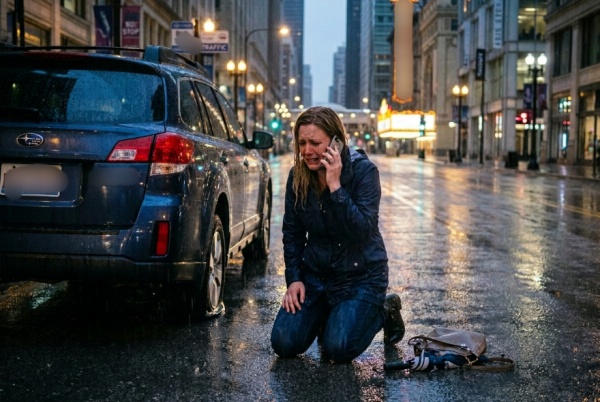
30 Missed Calls on My Wife’s Birthday — And the Last Message Said, “Husband… I…”
I told my wife I had to fly to Denver for a work emergency on her birthday, but the truth was waiting for me in a hotel room downtown. She called me 30 times while driving through a Chicago storm, carrying news I should have been there to hear in person. When I finally read her last message, I realized I had not just betrayed my wife — I had abandoned the family we had prayed for.
Part 1: July 12 Was Supposed to Be a Celebration
The first thing I saw when I finally looked at my phone was the number.
30 missed calls.
All from my wife.
The second thing I saw was a message preview, broken off in the middle of a sentence, as if the phone itself had been too afraid to show me the rest.
“Husband… I am…”
That was all the lock screen gave me.
At 11:48 p.m. on July 12, I stood outside a boutique hotel in downtown Chicago with another woman’s perfume on my shirt, my wedding ring in my pocket, and my wife’s birthday dinner going cold twenty miles away in the suburbs. The city pavement still steamed from a summer storm, and somewhere behind me, traffic hissed along Michigan Avenue like nothing terrible had happened.
But something terrible had happened.
It had been happening for six months.
My name is Tom Bennett. At the time, I was thirty-five years old, a regional sales director for a medical equipment company, and the kind of man people described as “hardworking” because they didn’t see what work had become a hiding place for. I lived with my wife, Hannah, in a townhouse in Naperville, Illinois, the kind of suburb where people waved while walking golden retrievers and pretended not to notice when marriages started cracking behind drawn curtains.
Hannah turned thirty-one that day.
July 12.
I remembered the date. That was the worst part. I had not forgotten her birthday. I had not been trapped at an airport, stuck in a client meeting, or pulled into some impossible emergency that left me no choice.
I chose not to come home.
That morning, Hannah had kissed my cheek in the kitchen while I poured coffee into a travel mug. She smelled like vanilla lotion and the lemon dish soap she always bought from Target because she said it made the kitchen feel clean even when life didn’t. Her hair was pulled into a messy bun, and she was wearing my old Northwestern sweatshirt even though she had gone to DePaul and liked reminding me my school was “too expensive for that much purple.”
“Don’t be late tonight,” she said.
I was scrolling through emails, pretending to be busier than I was. “I won’t.”
“You promise?”
I looked up then. She was trying to sound playful, but there was something fragile behind it. For two years, I had been coming home later, talking less, staying on my phone more, and blaming it all on work.
“I promise,” I said.
She smiled like she wanted to believe me.
That smile should have saved me.
It didn’t.
By noon, she had already started cooking. I know that now because later, when I returned to the townhouse, everything was still there like evidence in a house no longer willing to protect me. The red velvet cake sat under a glass dome on the dining table, frosted by hand, with one candle pressed into the center because Hannah said birthdays after thirty didn’t need a forest fire.
Beside it was the pot roast she had slow-cooked for hours, the one my mother used to make when I was a kid in Rockford. Hannah had learned the recipe from my mother during our second year of marriage, writing notes in the margins of an old church cookbook. She used to joke that love was mostly seasoning and patience.
There was also a bottle of Cabernet on the counter.
My favorite vintage.
Not hers.
Hannah preferred Riesling, cheap sparkling rosé, or the kind of sweet wine people pretend to outgrow but secretly still like. She had bought the Cabernet for me because even on her birthday, she was still trying to create a night I would want to come home to.
That was Hannah.
That was who I betrayed.
For the past two years, our marriage had become quiet in the worst way. Not peaceful. Not comfortable. Quiet like a house after someone has stopped answering from the other room. We paid bills, visited my parents for Thanksgiving, sent Christmas cards, and stood beside each other in photos with smiles that looked convincing if you didn’t know where to look.
The distance started after our first miscarriage.
Then came another.
Then the doctor appointments, the bloodwork, the fertility specialist in Oak Brook, the insurance calls, and the monthly cycle of hope and grief that slowly turned our bedroom into a place of math and silence.
Hannah did not become bitter.
That would have been easier to blame.
She became careful.
Careful with her voice. Careful with expectations. Careful not to ask too much from a husband who kept acting like her sadness was a room he could not breathe in.
And I, being weak in the polished way cowardly men often are, began spending time with someone who did not know the grieving version of me.
Her name was Valerie Cross.
She was twenty-four, a marketing coordinator at our firm, and she looked at me like I was still impressive. She laughed when I complained about travel. She said things like, “You deserve to have fun,” and “You’re too young to feel trapped.” She never asked about mortgage payments, doctor bills, or the empty nursery Hannah refused to turn into a guest room.
With Valerie, I was not a husband failing quietly.
I was interesting.
That felt like oxygen until I realized it was poison.
On Hannah’s birthday, I told her there was a crisis at the firm. I told her I had to fly to Denver for a client emergency. I even added details because lies feel safer when they wear a uniform.
At 7:00 p.m., I sent the text.
“I’m so sorry, babe. Crisis at the firm. They need me to fly to Denver tonight for a client emergency. I’ll make it up to you next week. Happy Birthday.”
I remember staring at the message before sending it.
For one second, I almost stopped.
Then Valerie texted me a mirror selfie from the hotel downtown and wrote, “Don’t be late.”
So I sent the lie to my wife.
Hannah replied four minutes later.
“Drive safe. We’ll be waiting for you. Love you.”
We’ll be waiting.
I didn’t understand that line then.
I thought she meant herself and the dinner.
Later, I learned she meant something else.
Something small, new, and hidden inside a gift box beside my plate.
Something I was supposed to find after dessert.
Something that would have changed everything if I had been the man I promised to be.
Part 2: The Text That Went to the Wrong Woman
At 9:30 p.m., I was standing in front of a hotel mirror adjusting the tie Hannah had bought me for Christmas.
That detail still makes me sick.
It was dark blue with a subtle silver pattern, expensive but not flashy, the kind of tie Hannah said made me look “like a man who remembered to read the room.” I wore it that night while lying to her.
Valerie sat on the edge of the bed behind me, scrolling through her phone. She had changed twice already and finally settled on a black dress that looked like it had been designed for low lighting and bad decisions. She was humming along to a song playing softly from her speaker.
“Are we still on for dinner?” she asked.
“Absolutely,” I said.
“The Obsidian?”
I smiled. “Reservation at ten.”
The Obsidian was one of those downtown Chicago restaurants built for people who wanted to feel richer than they were. Black marble bar, dim lights, servers in fitted jackets, steaks that cost more than a grocery trip, and cocktails with smoked rosemary because apparently regular ice was no longer enough. I had taken Hannah there once for our fifth anniversary, back when we still made each other laugh without trying.
She loved the view of the river.
I hated remembering that.
Valerie stood and came behind me, resting her chin on my shoulder. “You okay?”
“Yeah.”
“You seem distracted.”
I looked at myself in the mirror and saw exactly what I wanted to see then: successful, controlled, desired. Not the man who had promised his wife he would be home early. Not the husband who had abandoned a birthday dinner made from scratch.
Just a man escaping consequences for another hour.
“I’m fine,” I said.
Valerie smiled. “Good. Because tonight is supposed to be fun.”
Fun.
That word had become the hook in my mouth.
I had spent months telling myself I deserved fun. I deserved lightness. I deserved to feel wanted without grief attached to it. Men like me call that self-care when it is really selfishness wearing cologne.
Valerie said she wanted to freshen up before dinner and asked me to send her the restaurant address. She went into the bathroom, leaving the door open just enough for me to hear the faucet running.
I pulled out my phone.
There were already three missed calls from Hannah.
I stared at them.
A better man would have called back.
A decent man would have remembered it was his wife’s birthday and felt the weight of those calls in his bones.
I silenced the phone.
Then I opened a text thread and typed quickly.
“Meet me at The Obsidian. I’m waiting. Just you and me tonight.”
I hit send.
I did not check the recipient.
I thought I had sent it to Valerie.
I had sent it to Hannah.
Twenty miles away, Hannah was sitting on the living room floor in the dark, holding our wedding album in her lap. I know because she told me months later, in a lawyer’s office, without looking at me. She had turned off the dining room light after putting the roast in the fridge, but the cake remained on the table because she couldn’t bring herself to move it.
She had poured the Cabernet down the sink.
Not angrily.
Quietly.
She said drinking alone on her birthday felt too pathetic, and she did not want the wine to become one more witness to her humiliation.
When my message arrived, she thought maybe I was coming home.
For one foolish second, her heart lifted.
That is the part I still cannot forgive myself for.
I had disappointed her so often that even a random text from me at 9:34 p.m. could still make her hope.
Then she read it.
“Meet me at The Obsidian. I’m waiting. Just you and me tonight.”
The world stopped for her in that living room.
She did not scream.
Hannah was not dramatic in the way people expect betrayed women to be. She became very still when hurt, as if her soul stepped back from the body to keep it standing. She read the message twice, then checked the thread to make sure it was from me.
It was.
Tom.
Her husband.
The man who was supposed to be on his way to Denver.
The man who had promised he would be home early.
The man whose favorite meal was cooling in the fridge.
At first, she called me.
Once.
Twice.
Five times.
I watched the phone buzz on the hotel nightstand and did not answer.
Valerie came out of the bathroom, saw my phone lighting up, and raised an eyebrow.
“Everything okay?”
“It’s Hannah,” I said.
“On your birthday night with me?” she teased, then corrected herself with a little laugh. “Sorry. Her birthday.”
I should have hated that.
I should have heard the cruelty in how easy it was for her to reduce my wife to an inconvenience.
Instead, I flipped the phone face down.
“She’ll stop,” I said.
But Hannah did not stop.
She called six times, then seven, then eight.
She texted: “Tom, did you mean to send this to me?”
I did not answer.
She texted again: “Please tell me this is a mistake.”
I did not answer.
Then: “I need you to answer the phone.”
By then, Valerie was irritated.
“You said tonight was just us.”
“It is.”
“Then turn it off.”
And because I was weak, because I was selfish, because I had mistaken being wanted for being loved, I turned off my phone.
That is the moment I became unforgivable in Hannah’s eyes.
Not because of the affair alone.
Because she reached for me after discovering the betrayal, and I made myself unreachable.
At 9:58 p.m., Hannah put on jeans, a raincoat, and the small pearl earrings she had worn to our courthouse wedding six years earlier. She picked up the gift box from the dining table and placed it in her purse. Inside were two things: a positive pregnancy test and a tiny pair of white baby socks.
She had found out that morning.
On her birthday.
After years of loss, after months of telling herself not to hope, after standing alone in the pharmacy bathroom with shaking hands, Hannah had learned she was pregnant again.
She had planned to tell me after dinner.
She imagined I would cry.
She imagined I would hold her.
She imagined we would cut the red velvet cake, laugh through fear, and talk about due dates, doctors, and whether we were brave enough to paint the nursery.
Instead, she drove toward downtown Chicago in a storm, following the address of the restaurant where I waited for another woman.
Part 3: The Calls I Chose Not to Answer
By 10:20 p.m., rain was coming down hard over Chicago.
Summer storms in Illinois can arrive like a verdict. One moment the sky is bruised purple, the next the whole world is headlights, wet pavement, and thunder rolling between buildings. Hannah hated driving in heavy rain, especially on the expressway, but that night she kept going.
Not because she wanted a public scene.
That was one of the lies I told myself later.
I imagined her storming into The Obsidian, throwing wine, shouting, embarrassing me in front of strangers. It was easier to picture her as hysterical than to accept the truth: she drove there because she needed the final piece of reality.
Betrayal makes people doubt their own eyes.
Even my accidental text was not enough. Some part of her still needed to see my face, my hand on Valerie’s back, my body present in the lie.
She parked two blocks from the restaurant because valet felt ridiculous when her hands were trembling. The rain had slowed to a mist by then, and downtown lights reflected in the puddles like broken neon. She walked with her purse clutched against her chest.
Inside The Obsidian, I sat across from Valerie in a corner booth.
The reservation had been made under a fake work excuse and paid with a credit card Hannah helped me choose because it had better travel points. Valerie ordered a French 75. I ordered bourbon. We shared oysters because that is what people do when they are trying to feel expensive and temporary.
At some point, Valerie reached across the table and touched my hand.
Hannah saw that.
She stood just inside the entrance, rain darkening the shoulders of her coat, her face pale under the low restaurant lighting. A hostess asked if she had a reservation. Hannah did not answer. She was looking at me.
I did not see her.
Not at first.
I was laughing at something Valerie said.
That laugh did more damage than any kiss could have.
Hannah turned and walked out.
No scene.
No confrontation.
No broken glass.
Just my wife leaving a restaurant alone on her birthday after seeing that the man she married had chosen someone else.
Outside, she called me again.
By then, my phone was still off.
She called twenty-two times over the next hour.
Some calls were made from the sidewalk near the restaurant. Some from her car. Some after she pulled into a gas station because her breathing became strange and she felt dizzy.
She left one voicemail at 10:47 p.m.
I did not hear it until much later.
“Tom, I saw you. I saw both of you. I don’t know what I’m supposed to do with this. I was going to tell you tonight. I was going to tell you over cake because I thought maybe we finally got our miracle.”
Her voice cracked on the word miracle.
Then the message ended.
At 11:03 p.m., she called again.
At 11:04.
11:06.
11:08.
She later told me she was not calling to beg.
She was scared.
By the time she reached the Eisenhower Expressway, her vision was blurring. Whether it was shock, panic, exhaustion, dehydration, or the early pregnancy complications the doctor later mentioned, I still don’t know. What I know is that she pulled onto the shoulder near Oak Park because she knew she should not keep driving.
That decision may have saved her life.
She called me again.
Nothing.
She called her sister, Rebecca, who lived in Evanston, but Rebecca was working a night shift at Northwestern Memorial and did not answer immediately.
Then Hannah called 911.
A state trooper found her car with the hazard lights flashing. She was conscious but shaking, soaked from the rain that came in when she opened the door, one hand pressed protectively over her lower stomach. She kept saying my name.
Not because she forgave me.
Because even in terror, the body sometimes reaches for the person it has been trained to call home.
At 11:31 p.m., Rebecca called her back and got a paramedic instead.
By 11:42, Hannah was in an ambulance headed to the hospital.
At 11:48, I finally turned my phone back on outside the hotel.
Valerie had gone upstairs ahead of me. Dinner was over. The rain had left the city shining, and I remember feeling irritated before I felt afraid. My phone lit up with notifications so fast it froze for a second.
30 missed calls.
Hannah.
Hannah.
Hannah.
Then the broken message preview.
“Husband… I am…”
I opened it with my thumb shaking.
It was a voice-to-text message, imperfectly transcribed from something Hannah had tried to say while in the ambulance.
“Husband… I am pregnant. I am scared. Please come.”
The phone nearly slipped from my hand.
Pregnant.
For a moment, I did not understand the word.
Not because it was complicated, but because it belonged to the life I had abandoned that night. It belonged to doctor appointments, whispered prayers, and Hannah crying over negative tests while I stood useless in bathroom doorways. It belonged to the woman whose birthday I had left empty.
I called her.
No answer.
I called again.
A nurse answered on the third try.
“Is this Thomas Bennett?”
“Yes. Is Hannah okay? Where is she?”
“This is Northwestern Memorial Hospital. Your wife is being evaluated. Are you able to come in?”
My knees weakened.
“What happened?”
The nurse paused, careful. “Sir, I can’t discuss details over the phone. You should come to the emergency department.”
I ran.
I did not say goodbye to Valerie.
I did not explain.
I drove through downtown Chicago with both hands locked on the wheel, every red light feeling like punishment. I called Rebecca, and when she answered, her voice was ice.
“Where were you?”
“Rebecca, please—”
“Where were you while my sister called you thirty times?”
I had no answer.
She gave me one anyway.
“With her?”
I said nothing.
That silence convicted me more completely than any confession.
When I reached the hospital, the fluorescent lights made everything feel exposed. Rebecca stood near the emergency department entrance in scrubs, arms crossed, eyes red. She had always been kind to me before that night. Almost sisterly.
That version of her was gone.
“She’s stable,” Rebecca said before I could ask. “The baby has a heartbeat.”
I leaned against the wall.
Baby.
Heartbeat.
Two words I did not deserve.
“Can I see her?”
Rebecca stared at me like I had asked for applause.
“She doesn’t want you in there.”
“She’s my wife.”
“And tonight she needed her husband,” Rebecca said. “You were busy.”
That sentence followed me into every year after.
Part 4: What Was Waiting at Home
I spent the rest of that night in the hospital waiting room.
No one invited me back.
A security guard looked over twice because I kept standing, sitting, pacing, and pressing my palms against my eyes like I could squeeze time backward. Around 2:00 a.m., Rebecca came out and told me Hannah had been admitted for observation. She was physically stable. The pregnancy was early. The doctors wanted rest, follow-up care, and reduced stress.
Reduced stress.
The phrase almost made me laugh in the ugliest way.
I had turned my wife’s birthday into a medical emergency and a marriage funeral.
At 3:15 a.m., Hannah agreed to let me stand in the doorway for one minute.
Not come in.
Not sit.
Stand in the doorway.
She was in a hospital bed, pale and exhausted, with an IV taped to her hand. Her hair was damp from rain and sweat, and her eyes looked bigger than usual in her face. Rebecca sat beside her like a guard dog in nursing clogs.
Hannah did not cry when she saw me.
That hurt more than crying would have.
Tears would have meant something inside her was still reaching.
Her calm meant the reaching had stopped.
“Hannah,” I said.
My voice broke on her name.
She looked at me for a long moment.
Then she said, “I cooked your favorite dinner.”
I closed my eyes.
“I know.”
“No, you don’t,” she said quietly. “You don’t know anything about what I did today.”
I wanted to say I was sorry. I wanted to say it was a mistake. I wanted to explain the affair in the cowardly language of weak men: it got complicated, I was confused, I never meant to hurt you.
Instead, I said, “I’m sorry.”
Her face did not change.
“I found out this morning,” she said. “I bought the test at Walgreens after my doctor’s office called about the bloodwork. I sat in the parking lot for twenty minutes because I was scared to believe it.”
I gripped the doorframe.
“I was going to tell you after dinner,” she continued. “I put the test in a box. Baby socks too. The tiny ones. White.”
I could see them.
I could see the dining table, the cake, the roast, the gift box near my plate.
I could see the entire life I had failed to walk into.
“I came to the restaurant because I needed to know if I was losing my mind,” she said. “And then I saw you laughing with her.”
“Hannah, I—”
She lifted one hand.
Not dramatically.
Just enough to stop me.
“No.”
I shut my mouth.
“I called you thirty times,” she said. “Not because I wanted to fight. Because I was scared. Because I was pregnant. Because I was on the side of the road in a storm and I still thought maybe my husband would answer.”
There are sentences that do not merely hurt.
They rearrange your understanding of yourself.
That sentence did.
Rebecca looked away, jaw tight.
Hannah turned her face toward the window, where Chicago was dark beyond the glass.
“I need you to leave,” she said.
“Hannah, please.”
“Leave.”
So I did.
Not because I was noble.
Because hospital security was already watching, and because for once, everyone in the room understood that my wants no longer mattered.
I drove home at dawn.
The townhouse was exactly as she had left it.
That was the punishment.
The dining room still smelled faintly of roast beef and cocoa. The red velvet cake sat untouched under the glass dome, the single candle bent slightly from where she had blown it out alone. The fridge light revealed the pot roast covered in foil, mashed potatoes in a bowl, green beans in a casserole dish, all prepared by a woman who still hoped I would come home.
On the table, beside my empty plate, sat a small white gift box tied with blue ribbon.
I stared at it for several minutes before touching it.
Inside were the baby socks.
Folded beneath them was the pregnancy test wrapped in tissue paper, and a small card in Hannah’s handwriting.
“Happy birthday to me. Happy beginning to us.”
I sat on the floor and made a sound I had never heard come from my own body.
Grief, when it is deserved, has nowhere clean to go.
I cried until the morning light filled the kitchen.
Then my phone buzzed.
Valerie.
“Are you okay? You left without saying anything.”
I looked at the message.
For six months, I had treated Valerie like evidence that I still mattered. I had confused desire with escape, escape with freedom, and freedom with happiness. But sitting on the kitchen floor with baby socks in my hand, she became what she had always been: a choice I made because I did not want to face the pain in my own house.
I texted back one sentence.
“My wife is pregnant and in the hospital. It’s over.”
She called immediately.
I did not answer.
Maybe that sounds too late to be meaningful.
It was.
But some doors still need to be closed even after the house has burned.
Hannah stayed with Rebecca after leaving the hospital. She did not come home for two weeks. When she did, it was with her sister and a list written on legal paper.
She wanted her clothes.
Her medical records.
Her grandmother’s quilt.
The framed photo from our wedding that used to hang in the hallway.
And the baby socks.
I asked if we could talk.
She said, “Not without a therapist or an attorney.”
That was when I understood she was not punishing me.
She was protecting herself.
In Illinois, divorce is no-fault, but that does not mean betrayal carries no consequences. It just means the law does not care about your heartbreak the way your kitchen does at 5:00 a.m. The law cared about property, health insurance, future child support, parenting time, and whether two adults could behave responsibly around an unborn child.
Hannah hired a lawyer in DuPage County.
I hired one too, though at first I hated myself for it. It felt like preparing for war against a woman I still loved. My attorney, a calm man named David Kaplan, corrected me in our first meeting.
“You’re not preparing for war,” he said. “You’re preparing for reality.”
Reality was ugly.
Hannah filed for divorce in September.
She also requested temporary support related to pregnancy medical expenses and future child-related planning. I did not fight her. I had enough shame left to know that arguing over ultrasound bills after missing thirty calls would make me something even smaller than I already was.
We sold the townhouse.
Hannah could not sleep there anymore, and I did not blame her. The dining room had become a museum of one ruined night. Every corner held evidence of the man I had been and the family I had almost thrown away before meeting.
The red velvet cake stayed in my memory longer than anything.
Not the restaurant.
Not Valerie.
The cake.
Because Hannah had made it by hand while believing I might still choose her.
Part 5: The Birthday I Finally Showed Up For
Our daughter was born on March 3 at 2:12 in the morning.
Hannah named her Lily Grace Bennett.
Bennett because she said a child did not have to lose a name just because her father lost his way. Grace because Hannah’s grandmother had been named Grace, and because Hannah said she needed to believe grace could exist even when marriage did not survive.
I was in the hospital.
Not in the delivery room at first.
That was Hannah’s boundary, and I respected it. Rebecca was with her, just as she had been the night everything broke. I sat in the waiting area holding a paper cup of coffee that had gone cold, staring at the doors like a man waiting for a verdict.
At 3:05 a.m., Rebecca came out.
For a moment, I thought she would simply give me information and leave.
Instead, she said, “You can come see your daughter. Ten minutes. Don’t make Hannah comfort you.”
That was the most generous cruelty I had ever received.
Lily was tiny, pink, and furious about being alive.
She had Hannah’s mouth and my dark hair. Her fists were clenched like she had arrived ready to negotiate terms. When the nurse placed her in my arms, I felt something in me break open—not cleanly, not magically, but honestly.
I had thought becoming a father might redeem me.
It did not.
A baby is not a medal given to a guilty man for feeling remorse.
Lily did not erase what I had done to Hannah. She did not repair the birthday, the thirty calls, the restaurant, or the message that began with “Husband… I am…” She simply existed, innocent and warm, demanding that from that day forward, I become someone safer than the man who made her mother cry alone.
Hannah watched me hold her.
Her face was tired, but peaceful in a way I had not seen in years.
“She’s beautiful,” I whispered.
“I know,” Hannah said.
There was no bitterness in it.
Just truth.
The divorce was finalized when Lily was five months old.
We agreed on shared legal decision-making and a parenting schedule that began carefully and expanded over time. I paid child support. I contributed to medical insurance. I attended co-parenting classes, individual therapy, and every pediatric appointment Hannah allowed me to attend.
At first, she allowed very little.
I deserved that.
Trust, once destroyed, does not return because the guilty person becomes lonely.
It returns, if it returns at all, through boring consistency.
I learned that fatherhood was not dramatic speeches. It was showing up at 7:30 a.m. with diapers. It was knowing which formula upset Lily’s stomach. It was texting Hannah before changing pickup plans, not after. It was paying daycare tuition on time without acting like that made me heroic.
Valerie left the company that fall.
I heard she moved to Austin. I hope she built a better life than the one we built out of lies. I do not blame her more than I blame myself. She did not make vows to Hannah.
I did.
My parents struggled with the divorce.
My mother adored Hannah and cried the first time she held Lily. My father, a quiet man who had stayed married to my mother for forty years, took me into the garage after Thanksgiving and said, “You don’t get to be sad about consequences like they’re accidents.”
That sentence stayed with me.
Consequences are not accidents.
They are arrivals.
The first July 12 after everything happened, I sent Hannah a short message.
“Happy birthday. I know last year was painful because of me. I hope today is gentle.”
She did not reply.
That was okay.
The second July 12, Lily was a toddler with curls, sticky hands, and a dangerous attachment to blueberries. Hannah invited me to drop off a gift at noon, not stay. I brought a small wrapped package for Hannah—not jewelry, not perfume, nothing romantic. Just a signed first edition of a novel she loved, found at a used bookstore in Evanston.
She opened it while Lily tried to eat the wrapping paper.
“Thank you,” Hannah said.
Her voice was polite.
That was progress.
The third July 12, Lily was old enough to sing “Happy Birthday” with most of the words wrong. Hannah invited me to stop by for cake at 4:00 p.m. Her mother was there. Rebecca was there too, still watching me like a parole officer in lipstick, but with slightly less hatred.
The cake was red velvet.
Store-bought this time.
When I saw it, my chest tightened.
Hannah noticed.
“Lily picked it,” she said. “She liked the sprinkles.”
I nodded.
“Good choice.”
We ate cake on paper plates in Hannah’s apartment in Evanston, near a window that looked out toward a maple tree. There was no romance in the room. No reunion music. No secret promise that the family would become what it had once been.
But there was peace.
That was more than I deserved.
After cake, Lily climbed into my lap with frosting on her chin and asked, “Daddy, why is Mommy’s birthday in summer?”
“Because she was born in July,” I said.
“Was I there?”
Hannah laughed softly from the kitchen.
“No, bug,” she called. “You were not there.”
Lily frowned. “Where was I?”
I looked at Hannah.
For a second, the room filled with the memory of where Lily had been that night: hidden in a birthday gift box, inside a fragile hope, in the body of a woman driving through a storm while calling a husband who would not answer.
Hannah’s eyes met mine.
Not lovingly.
Not angrily.
Just knowingly.
“You were a wish,” I told Lily.
She seemed satisfied with that.
Later, after I helped clean up, Hannah walked me to the door.
Lily was in the living room stacking blocks with Rebecca. The hallway smelled like cake and coffee. Outside, the July air was warm and heavy, the kind of Chicago-area summer evening that always feels one thunderstorm away from confession.
“Thank you for coming on time,” Hannah said.
Such a small sentence.
Such a devastating one.
“I’ll always come on time for her,” I said.
Hannah looked at me.
“And for commitments,” I added. “Not just for Lily.”
She nodded once.
Then she said something I had waited years to hear, though not in the way I once imagined.
“I don’t hate you anymore.”
My throat tightened.
“I’m glad.”
“That doesn’t mean I trust you the way I did.”
“I know.”
“It doesn’t mean we go backward.”
“I know that too.”
She leaned against the doorframe, arms folded.
“But Lily loves you. And you’ve been consistent.”
Consistent.
Not forgiven.
Not redeemed.
Consistent.
It was the highest praise I had earned.
I drove home that evening with the windows down, letting the warm air move through the car. My life was not the one I had tried to steal for myself. It was harder, smaller in some ways, and far more honest.
I had an apartment instead of a townhouse.
A parenting schedule instead of a family dinner every night.
A daughter who loved me and an ex-wife who had survived me.
Some nights, I still think about the thirty missed calls.
Not as a number.
As thirty doors.
Thirty chances to become someone else before the damage deepened.
At call one, I could have answered.
At call five, I could have told Valerie to leave.
At call ten, I could have remembered the woman who made me pot roast and cake.
At call twenty, I could have understood that nobody calls that many times unless something is breaking.
At call thirty, I could have still been a husband.
But I turned my phone off.
That is the truth I carry.
The last message began, “Husband… I am…”
For years, I thought the most important word in that message was pregnant.
It wasn’t.
The most important word was husband.
Because Hannah was still calling me that while I was busy proving I did not deserve the title.
I lost the marriage.
I lost the house.
I lost the right to be the person Hannah called first when she was afraid.
But I did not lose the responsibility that came after.
Every birthday now, I remember July 12 not as the night I was exposed, but as the night Hannah stopped waiting for a man who kept choosing absence and began protecting the life inside her.
And every time my daughter calls me Dad, I hear the echo of the word I once failed.
Husband.
I am.
I am scared.
I am pregnant.
I am done waiting.
That message destroyed the lie I was living.
And in the wreckage, it left me one instruction I have tried to follow ever since:
Answer when the people you love are calling.
Before silence becomes the thing they remember most about you.
