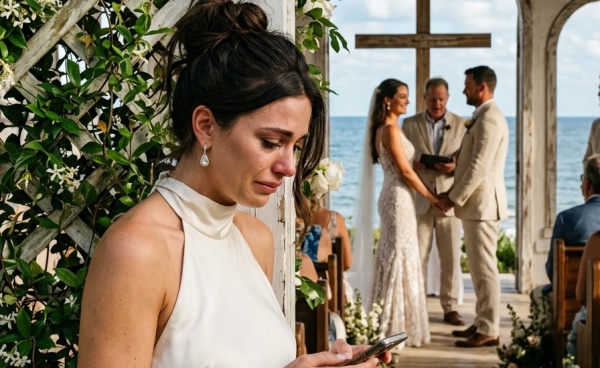
My Husband Said He Needed a Walk on the Beach—Then I Found Him Marrying My Sister in a Hidden Hawaiian Chapel
Part 1: The Walk He Said Would Clear His Head
My husband told me he needed a peaceful walk on a Hawaiian beach.
That was how he said it, too. Peaceful. As if our marriage had become too loud for him, as if the sound of waves on Maui could wash away whatever tension he refused to name.
We had been married for nine years, and I had learned by then that when Andrew Pierce said he needed “space,” what he really meant was that I was supposed to stop asking questions.
My name is Caroline Pierce, though my mother always called me Callie. I was thirty-seven years old, a corporate event planner from Seattle, and for most of my adult life, I believed being organized could save almost anything.
A messy wedding timeline. A missing keynote speaker. A delayed flight. A hotel ballroom with the wrong linens and three hundred guests arriving in an hour.
But marriage is not an event.
You cannot fix betrayal with a clipboard and a backup plan.
Andrew and I had flown to Maui for what he called “a reset trip.” We were staying at a resort in Wailea, the kind with orchid garlands at check-in, infinity pools, and staff who remembered your name after one conversation. The ocean was so blue it looked edited.
It should have felt like paradise.
Instead, it felt like a stage.
For months before the trip, Andrew had been distant. He came home late, kept his phone face down, and gave explanations so polished they sounded rehearsed. He said work had been brutal. He said he was burned out. He said I was reading into things because I had been grieving.
That last part was true.
My mother, Elaine, had died eleven months earlier.
She had been my anchor, my best friend, and the only person who could tell me the truth without making me feel small. She raised my younger sister, Brooke, and me after our father left when I was twelve, working double shifts at a pharmacy and still somehow finding time to make pancakes on Saturday mornings.
When she died, she left me one thing that mattered more than money.
Her pearls.
They were not the kind of pearls you see locked in museum cases. They were simple, cream-colored, slightly uneven, and strung on a clasp shaped like a tiny gold flower. My grandmother had worn them at her wedding in 1964, my mother had worn them at hers, and I had worn them when I married Andrew.
In her will, my mother left them specifically to me.
Not because she loved Brooke less. At least, that was what I told myself. She left Brooke her emerald ring, her recipe books, and a small savings account that was supposed to help her finish a master’s degree she never finished.
But the pearls came to me.
Brooke never forgave that.
She said she did, of course. She smiled at the reading of the will, hugged me in the attorney’s office, and whispered, “Mom wanted you to have them.” But the hug was stiff, and her eyes stayed dry.
Brooke had always been beautiful in a way that changed the temperature of a room. I was practical, brown-haired, usually in flats, the sister who booked flights and remembered insurance forms. Brooke was blonde, dramatic, and somehow fragile in a way that made people rush to protect her even when she was the one holding the knife.
Andrew liked protecting her.
That should have bothered me sooner.
When Brooke lost another job, Andrew helped her rewrite her résumé. When her landlord raised the rent, Andrew said we should let her stay in our guest room “just for a few weeks.” When she cried during family dinners because she felt “left behind,” Andrew would pour her wine and tell her she deserved more than life had given her.
I thought he was being kind.
I thought my husband cared about my sister because he cared about me.
That is one of the most painful things about betrayal. It uses your best assumptions as hiding places.
Brooke came to Maui with us.
That was not the original plan.
Two weeks before the trip, Andrew said Brooke was “in a dark place” and needed support. I did not love the idea of bringing my sister on a marriage reset vacation, but guilt is a powerful thing when you have been raised to keep family together at all costs.
So Brooke joined us.
She arrived at Sea-Tac Airport wearing a white linen dress, oversized sunglasses, and my mother’s emerald ring on her right hand. She kissed my cheek, then Andrew’s, lingering half a second too long.
I noticed.
Then I told myself not to be paranoid.
For the first two days in Maui, everything was almost normal. We had breakfast overlooking the ocean, drove the Road to Hana, and took photos beside waterfalls where tourists lined up like pilgrims. Andrew laughed at Brooke’s jokes more than mine, but he had always done that.
On the third morning, I opened the hotel safe to get my passport.
The pearls were gone.
I stared at the empty velvet pouch for a full minute before my mind accepted what my eyes already knew. I had placed them in the safe myself the night we arrived. Andrew knew the code. Brooke did not, or at least she was not supposed to.
When I asked Andrew, he barely looked up from his phone.
“Maybe you moved them.”
“I didn’t.”
“Callie, you’ve been scattered lately.”
Scattered.
Grieving had made me scattered. Exhaustion made me emotional. Questions made me suspicious. Every word he used placed the problem gently back into my hands.
Brooke was by the balcony, pretending to read a magazine.
Her expression did not change, but her thumb stopped moving along the page.
I asked her if she had seen the pearls.
She looked up slowly. “Why would I have Mom’s pearls?”
The way she said Mom’s pearls, not your pearls, made something cold settle in my chest.
Andrew stood. “I can’t do this right now.”
“Do what?”
“This.” He waved a hand between us. “The tension. The accusations. We came here to heal, and you’re turning everything into an investigation.”
“My mother’s pearls are missing.”
“And I’m sorry,” he said, sounding anything but sorry. “But I need air.”
Then he walked toward the door.
“Where are you going?” I asked.
“For a walk.”
Brooke looked down at her magazine.
Andrew opened the door, paused, and said, “Just along the beach. I need twenty minutes.”
Twenty minutes.
That was all he asked for.
The old me would have let him go. The old me would have sat on the edge of the bed blaming myself for ruining another morning. The old me would have apologized when he came back.
But grief had changed something in me.
My mother’s death had made me softer in some places and sharper in others. I had lost the person who taught me how to doubt myself kindly. Without her, Andrew’s little corrections no longer sounded like concern.
They sounded like control.
So I waited until the hotel door clicked shut.
Then I picked up my phone, slipped on sandals, and followed him.
I expected to find him walking near the shoreline, maybe calling someone, maybe meeting Brooke behind a palm tree like some cheap soap opera scene.
I did not expect him to leave the resort property.
I did not expect him to cut behind the garden path, past the spa, and down a narrow stone walkway marked STAFF AND EVENTS ONLY.
And I definitely did not expect to find a hidden chapel tucked behind hibiscus bushes, whitewashed and open to the ocean breeze, with candles lit inside and my younger sister standing under an arch of orchids wearing my mother’s pearls.
Andrew was holding her hands.
A man in a linen suit stood before them with a small book.
Two resort employees waited near the back, one holding a bouquet, the other holding a tablet.
Brooke was smiling.
Not nervously.
Triumphantly.
And around her neck, glowing against her skin like a second betrayal, were the pearls my mother left to me.
I stood outside the side entrance, half-hidden by a carved wooden screen, my heart hammering so hard I thought they would hear it.
Then Andrew said, “I’m ready.”
The officiant looked down at his book.
Brooke squeezed my husband’s hands.
They thought they were stealing my future.
What they did not realize was that my phone was already recording.
Part 2: The Chapel Behind the Hibiscus
I need to explain something before I go further.
I did not start recording because I wanted revenge footage. I was not planning to post it online, humiliate anyone, or turn my family pain into entertainment. I started recording because I had spent months being told I was imagining things, misplacing things, overreacting, grieving wrong, remembering wrong, and accusing innocent people.
I needed reality to stay still long enough for someone else to see it.
In Hawaii, like in many states, there are laws about recording conversations and privacy. I knew enough from planning corporate events to understand that hidden recordings can become complicated fast, especially in private spaces. But I was standing outside an open event chapel, visible through a side entrance, recording a ceremony taking place in a venue with staff present.
Still, I did not want to make legal assumptions.
So I kept the phone low, captured what I could see, and said nothing.
Later, my attorney would tell me that the video was useful mostly because it showed visible conduct: Andrew with Brooke, the pearls around her neck, the date and location, the resort staff, and the apparent attempt to conduct vows while he was still legally married to me. She also told me not to post it publicly.
I never did.
That mattered.
At the time, all I knew was that my hand shook so badly the screen blurred.
The officiant began.
“We are gathered here in this sacred place, surrounded by the beauty of the island and the spirit of aloha…”
I almost laughed.
Aloha.
People use that word in Hawaii like a decoration, but locals know it means something deeper than hello and goodbye. Love, compassion, presence, respect. Everything happening in that chapel was the opposite of aloha.
Brooke closed her eyes like she was praying.
Andrew looked at her with an expression I had begged for during the worst months of my grief. Tender. Present. Completely unguarded.
He had not looked at me that way in years.
The officiant continued, “Andrew and Brooke have chosen to honor their commitment privately today before taking the next steps in their life together.”
Privately.
That word struck me.
Not legally, maybe. Not officially. Not yet. But privately, they were making something real enough to them that they had flowers, an officiant, staff, and my mother’s pearls.
Brooke’s voice trembled when she began her vows.
“Andrew, from the beginning, you saw me when everyone else saw Caroline.”
My stomach turned.
Everyone else saw Caroline.
As if I were not her sister. As if my existence had been an obstacle she had endured her entire life. As if love were a spotlight and she had finally shoved me out from under it.
“You made me feel chosen,” Brooke said. “You made me feel like I wasn’t second.”
Andrew’s thumbs moved over her hands.
I had seen him do that to me once, years earlier, when we were signing our mortgage documents and he whispered that we were building our forever home.
Brooke continued. “I know the timing is complicated.”
Complicated.
That is the word people use when the truth is too ugly to fit in polite conversation.
“But I believe love that is meant to be shouldn’t have to apologize forever,” she said.
My phone captured every word.
Andrew smiled.
Then he began his vows.
“Brooke, you came into my life like light when everything around me felt heavy.”
Heavy.
That was me.
My grief. My questions. My body sitting beside him on the couch after my mother died, unable to explain the emptiness that opened under me every morning. I had been heavy, and Brooke had been light.
“I tried to do the right thing for years,” he said. “I tried to stay.”
Tried to stay.
As if marriage were a prison sentence he had served nobly.
“But with you, I feel brave enough to choose the life I actually want.”
The life I actually want.
That sentence did not break me.
It clarified me.
For months, I had wondered what I could do to win Andrew back. Lose weight. Cry less. Laugh more. Ask fewer questions. Be less suspicious, less sad, less inconvenient.
Standing outside that chapel, listening to him promise my sister a future under my mother’s pearls, I understood something clean and brutal.
There was no version of me that could fix a man who wanted to become someone else’s hero by making me the burden.
The officiant asked for the rings.
A resort employee stepped forward with a small wooden tray.
Two rings rested on it.
Brooke’s was a thin gold band curved around a diamond that looked painfully familiar. I knew that diamond. It had belonged to my mother’s engagement ring before she reset it after my father left, saying she refused to wear a symbol of abandonment on her hand.
She had left that ring to Brooke.
That part was fair.
But Andrew’s ring was my husband’s actual wedding band.
The one I had placed on his finger nine years earlier in front of my mother, my sister, and eighty guests in a vineyard outside Woodinville.
He had told me he lost it at the gym.
I zoomed in without thinking.
The gold band caught the candlelight. There was a tiny scratch near the edge from when Andrew dropped it on our kitchen tile during our third year of marriage. I knew because I had teased him that our love had survived worse than granite.
Brooke slid my husband’s own wedding ring back onto his finger.
As if rewriting history required only enough nerve.
Then the officiant said, “By the commitment you have expressed today…”
No.
Something in me moved before thought did.
I stepped through the side entrance.
The chapel fell silent.
Andrew turned first.
His face went through three expressions in less than a second: confusion, fear, and then anger. Not shame. Anger. As if I had committed the violation by witnessing what he was doing.
Brooke’s hand flew to the pearls.
My pearls.
My mother’s pearls.
I held up my phone.
The recording timer was still running.
“Please continue,” I said, my voice surprisingly calm. “I want to make sure my attorney gets the whole ceremony.”
The resort employee with the bouquet gasped.
The officiant looked at Andrew. “Sir?”
Andrew took one step toward me. “Caroline, turn that off.”
“No.”
“This is not what it looks like.”
I looked at the arch, the candles, the rings, my sister in white linen, and my mother’s pearls around her neck.
“It looks very organized,” I said.
Brooke’s eyes filled with tears instantly. She had always been able to cry on command when consequences arrived. It was one of her gifts.
“Callie,” she whispered. “Please don’t make this ugly.”
I looked at my sister, really looked at her.
She was thirty-three, not a child. Not a wounded little girl. Not my responsibility to save from every bad choice. She was a grown woman standing in a chapel with my husband, wearing stolen jewelry from our dead mother.
“I didn’t make this,” I said. “I found it.”
Andrew’s jaw tightened. “Give me the phone.”
“No.”
“Caroline.”
The way he said my name had once made me shrink.
Not that day.
I stepped back toward the door and raised my voice just enough for the resort staff to hear clearly. “Do not touch me. Do not touch my phone. I am leaving now.”
That sentence mattered.
Not because I thought Andrew would hurt me physically. He had never been that kind of man. But I wanted witnesses to understand boundaries. I wanted the recording to show I was leaving peacefully and that any escalation would not come from me.
The officiant closed his book.
The bouquet employee stepped away from Brooke.
Andrew stood frozen.
Brooke began to cry harder.
I looked at the pearls one last time and said, “Mom would be ashamed of you.”
Then I walked out of the chapel.
Behind me, Andrew shouted my name.
I did not turn around.
I walked down the stone path, past the hibiscus, past the spa, past guests drinking pineapple cocktails by the pool, and back into the resort lobby where everything smelled like coconut sunscreen and fresh flowers.
By the time I reached the elevator, I was shaking so violently I could barely press the button.
Inside our hotel room, I locked the door, opened the safe, and took photos of the empty velvet pouch.
Then I called the one person I should have called months earlier.
My mother’s attorney.
Part 3: The Pearls, the Will, and the Paper Trail
Her name was Diane Mercer, and she had handled my mother’s estate with a kind of brisk kindness I trusted immediately.
Diane was in her sixties, based in Seattle, and had the voice of someone who had spent decades telling grieving families things they did not want to hear. When she answered, I forgot time zones existed and apologized because it was still early back home.
Then I told her everything.
The missing pearls. The chapel. Brooke. Andrew. The recording. The fact that my mother’s pearls were currently around my sister’s neck in Maui.
Diane did not gasp.
Good attorneys rarely do.
She asked precise questions.
Were the pearls specifically listed in the will? Yes.
Had they been distributed to me? Yes.
Did I have documentation? Yes.
Were they insured? Yes, under my personal property policy, because Diane had told me to do it after probate closed.
Did I know how Brooke accessed them? Not yet.
Had Andrew known the hotel safe code? Yes.
Diane paused there.
“Caroline,” she said, “do not confront them further tonight. Do not make threats. Do not post anything. Preserve the video, back it up, and send me copies of the will language and the insurance documents.”
“What about the pearls?”
“We will address that through proper channels.”
“I want them back.”
“I know. And we will start there.”
After hanging up, I sent the video to Diane through a secure link, then to myself in three different ways because panic turns everyone into an amateur archivist. I photographed the safe, the velvet pouch, our room key packet, and the hotel information sheet showing the date.
Then I sat on the edge of the bed and finally cried.
Not gracefully.
Not quietly.
I cried the way you cry when reality catches up with your nervous system. Ugly, breathless, bent over, one hand pressed to my chest as if I could hold my ribs together.
Andrew knocked ten minutes later.
“Callie.”
I did not answer.
He knocked again, harder. “Open the door.”
“No.”
“We need to talk.”
“You can email my attorney.”
A silence.
Then, softer, “You don’t mean that.”
I almost laughed.
He still thought he knew which parts of me were serious.
“I mean every word.”
Brooke’s voice came from the hallway. “Callie, please. You’re my sister.”
That did something to me.
Not because it softened me.
Because it revealed the cruelty of timing. She had remembered I was her sister only after I caught her trying to replace me.
I walked to the door but did not open it.
“You were my sister when you put on Mom’s pearls.”
The hallway went quiet.
Andrew said, “Those pearls are not the issue.”
I stared at the door.
There it was.
Men like Andrew always decide what the issue is. The affair is not the issue. The lies are not the issue. The stolen heirloom is not the issue. The issue becomes your reaction, your tone, your timing, your refusal to protect their reputation.
“The pearls are property,” he said. “This is emotional.”
“No,” I said. “This is documented.”
Another silence.
Then Andrew lowered his voice. “If you try to use that video, you’ll embarrass yourself.”
That was the sentence that cured the last of my hesitation.
Because I realized he was afraid.
Not of losing me. Not of hurting me. Not of my grief or my mother’s memory.
He was afraid of documentation.
That night, I moved rooms.
The resort manager, a woman named Leilani, handled it with extraordinary professionalism after I explained that I had discovered a serious marital situation and needed privacy. I did not give her all the details, but I did show her enough of the chapel footage to explain why I did not feel safe sharing a room.
She upgraded me to a room on a different floor and changed my key access.
Then she said, carefully, “Would you like hotel security to be aware that you do not want visitors?”
“Yes,” I said.
That was the first peaceful moment of the day.
A woman I had known for ten minutes offered me more practical protection than my husband had offered in months.
The next morning, Andrew sent flowers.
White orchids.
The card said: We need to talk like adults.
I left them in the hallway.
Then he texted.
Callie, this went too far. Brooke is devastated.
I stared at the message for a long time.
Brooke is devastated.
Not you are devastated. Not I am sorry. Not I stole your mother’s pearls and tried to have a symbolic wedding with your sister while you were upstairs wondering if grief had made you forget where you put them.
Brooke.
I forwarded the text to Diane and then called a divorce attorney in Seattle recommended by a friend from work.
Her name was Rachel Kim.
By the end of our first call, Rachel had told me three things that became my foundation.
First, Washington is a community property state, which meant Andrew could not simply decide what belonged to whom after nine years of marriage.
Second, my inherited property, including the pearls, was separate property as long as I had not converted it into marital property.
Third, if Andrew had taken the pearls from the hotel safe and given them to Brooke, that was not just “family drama.” It could become a serious civil matter, possibly more depending on the facts.
“Do not argue with him,” Rachel said. “Do not negotiate with your sister. Let us work through documentation and formal demands.”
I asked about the chapel.
Rachel was quiet for a moment.
“Was it a legal wedding ceremony?”
“I don’t know.”
“Are you legally married to Andrew?”
“Yes.”
“Then he cannot legally marry your sister while still married to you. If it was symbolic, it still matters. If they attempted anything official, it matters more. Either way, it shows intent, misconduct, and possibly misuse of property.”
I looked out at the ocean from my new balcony.
Below me, couples walked hand in hand along the beach. A little girl chased a red sand bucket. Somewhere, a ukulele played softly from the pool deck.
“I feel stupid,” I said.
Rachel’s voice softened. “You are not stupid. You trusted people who used your trust as cover.”
I wrote that sentence down.
You trusted people who used your trust as cover.
For the next forty-eight hours, I did nothing dramatic.
That may disappoint people who like revenge stories, but real consequences require patience. I did not throw clothes off the balcony. I did not scream in the lobby. I did not slap anyone by the pool.
I documented.
I requested an itemized room access log from the resort, through the proper process. I asked Diane to send certified copies of the will language regarding the pearls. I asked Rachel to prepare for divorce filing. I saved every message Andrew and Brooke sent.
Brooke sent eleven.
The first three were tearful.
The next four were defensive.
The last ones were angry.
You always got everything.
Mom loved you more.
Andrew and I didn’t plan to hurt you.
The pearls should have been mine too.
That last text mattered.
I took a screenshot and sent it to Diane.
Diane responded within four minutes.
Do not reply.
Attorneys love that sentence.
By the time I flew back to Seattle alone, Andrew and Brooke had stopped trying to talk to me.
That silence did not mean they were sorry.
It meant they were planning.
Unfortunately for them, so was I.
Part 4: The Family Meeting That Became a Legal Problem
Andrew came home three days after I did.
He looked tired, sunburned, and irritated in the way people look when they expected forgiveness to be waiting at baggage claim. I was not at the house when he arrived.
I had already moved into a short-term rental downtown.
Rachel advised me not to abandon the marital home permanently without a plan, but she also understood that sleeping under the same roof as Andrew was not reasonable. We documented everything. We photographed the house. We secured my personal records, family documents, and remaining inherited items.
My mother’s recipe box came with me.
So did her letters.
The pearls, of course, were still missing.
Andrew’s first email through his attorney was almost impressive in its dishonesty.
He claimed the Maui incident had been “a private commitment ceremony” with no legal force. He claimed the pearls had been “borrowed with assumed family permission” because Brooke believed their mother intended both daughters to share sentimental items. He claimed my recording was invasive and emotionally abusive.
Rachel read the email aloud, then removed her glasses.
“I have been practicing family law for twenty-two years,” she said. “And somehow men still think calling evidence ‘emotional’ makes it disappear.”
I almost smiled.
Then came the family meeting.
I did not ask for it.
Brooke did.
She texted my aunt Linda, who texted me, saying we should all sit down “before lawyers destroy the family.” Aunt Linda was my mother’s older sister, a retired school principal with strong opinions and a weakness for pretending both sides were equally messy.
I told Rachel.
Rachel said, “If you go, I go.”
So we went.
The meeting took place at Aunt Linda’s house in Tacoma on a rainy Saturday afternoon. The living room smelled like coffee, cinnamon, and the lemon furniture polish my aunt used on every surface she could reach. Family photos covered the mantel, including one of my mother holding Brooke and me in matching Christmas dresses.
Brooke arrived wearing a black sweater, no makeup, and the pearls.
My vision narrowed.
Rachel touched my arm once, not to restrain me, but to remind me that witnesses were present and cameras were not necessary today.
Andrew came in behind Brooke.
That told me everything.
My sister and my husband entered my aunt’s house together.
Aunt Linda folded her hands. “We’re here to talk calmly.”
I looked at the pearls. “Then she can start by taking off my property.”
Brooke’s eyes filled immediately.
Aunt Linda sighed. “Callie—”
“No,” Rachel said.
Everyone turned to her.
Rachel placed a folder on the coffee table. “Before anyone reframes this as a misunderstanding, I want to clarify that the pearl necklace was specifically bequeathed to Caroline under Elaine Morrison’s will. It was distributed to Caroline after probate. It is insured under Caroline’s personal policy. Any unauthorized taking, possession, or transfer is a legal issue.”
Brooke’s tears paused.
Andrew leaned back. “This is ridiculous.”
Rachel looked at him. “Mr. Pierce, did you remove the pearls from the hotel safe?”
He said nothing.
Brooke whispered, “Andrew.”
Rachel continued. “Did you give them to Ms. Morrison for the ceremony in Maui?”
Aunt Linda looked sharply at Brooke.
Brooke put one hand on the pearls. “Mom wanted me to have something too.”
“She left you her emerald ring,” I said.
“You don’t understand,” Brooke snapped. “You never understood what it was like being second to you.”
I stared at her.
“Second?” I repeated. “Brooke, I paid your rent twice. I wrote your graduate school application essay because you missed the deadline. I held your hand when Ryan left you. I let you live in my house for four months.”
“You let me,” she said bitterly. “Exactly. You always got to be the stable one. The good one. Mom trusted you with everything.”
I felt something inside me loosen.
For years, I had carried guilt for being the older daughter, the responsible daughter, the one my mother leaned on when life became too much. I had mistaken Brooke’s resentment for pain I needed to soothe.
Now I saw it clearly.
Brooke did not want fairness.
She wanted reversal.
She wanted my husband, my place, my inheritance, my mother’s blessing. She wanted to wear the pearls not because they reminded her of Mom, but because they had been given to me.
Andrew reached for her hand.
That small movement changed the room.
Aunt Linda saw it. My cousin Mark saw it. Even my aunt’s neighbor, who had stopped by to drop off banana bread and was now trapped in the doorway, saw it.
Rachel definitely saw it.
“Ms. Morrison,” Rachel said to Brooke, “please remove the necklace and place it on the table.”
Brooke laughed through tears. “You can’t order me to do anything.”
“No,” Rachel said. “But I can advise you that keeping disputed property after formal notice may worsen your position.”
Andrew stood. “This meeting is over.”
“It can be,” Rachel said. “But the demand for return remains.”
He looked at me then. “You’re enjoying this.”
“No,” I said.
And I meant it.
There was no joy in watching my family turn into exhibits. No joy in seeing my sister cling to stolen pearls like a child clinging to a toy. No joy in realizing my marriage had ended long before Maui, and I had simply been the last person notified.
“I’m not enjoying this,” I said. “I’m done absorbing it.”
Brooke’s face twisted. “You think a necklace makes you Mom’s favorite?”
“No,” I said. “I think Mom left me those pearls because she knew I would protect them.”
That landed.
Brooke unclasped the necklace with shaking hands.
For one second, I thought she might throw it.
Rachel must have thought so too, because she placed a soft cloth on the table and said, “Gently.”
Brooke placed the pearls down.
I did not touch them immediately.
Rachel did. She documented the return, photographed them, and placed them in a protective pouch she had brought because good lawyers are prepared for both paperwork and drama.
Andrew looked disgusted.
“You brought evidence bags to a family meeting?”
Rachel smiled politely. “I brought a pouch.”
That was the first time I almost laughed.
The divorce filing happened the following Monday.
Rachel filed for dissolution of marriage, temporary orders regarding finances, preservation of assets, and exclusive use of the marital home pending further agreement. The Maui video was not blasted publicly, but it was referenced appropriately in legal communications.
Diane handled the pearls separately.
Once Brooke returned them, we did not pursue further action immediately. Diane sent a formal letter documenting their return, their ownership, and a warning against future interference with estate property.
Brooke responded with silence.
Andrew responded with anger.
His attorney sent a letter claiming I had “ambushed” him in Maui, “weaponized a private spiritual ceremony,” and “mischaracterized a personal relationship that developed after the marriage had emotionally ended.”
Rachel read that line twice.
Then she said, “I would like every spouse who cheats to retire the phrase ‘emotionally ended.’ It is doing too much work.”
The legal process stretched for months.
Andrew wanted to keep the house. Then he wanted to sell it. Then he wanted to argue that my event planning business had hidden value, while ignoring the fact that he had spent marital funds flying my sister to Hawaii for a ceremony behind my back.
Financial discovery revealed things I had not known.
Hotel charges. Jewelry insurance inquiries. Payments to the chapel vendor. A reservation for two under Andrew and Brooke’s names at an adults-only resort on Kauai scheduled for the week after our Maui trip.
He had planned a honeymoon with my sister while still sharing a hotel room with me.
That fact did not break me either.
By then, breaking had become boring.
I wanted signatures.
I wanted inventory lists.
I wanted my separate property confirmed, my share of community assets protected, and my name removed from joint obligations as cleanly as possible.
At one mediation session, Andrew tried one last emotional performance.
He said he had been lonely.
He said my grief after my mother’s death had created distance.
He said Brooke understood him during a hard time.
He said he never meant to hurt me.
I listened.
Then I said, “You wore our wedding ring to make vows to my sister under my mother’s pearls.”
His mediator looked down at the table.
Andrew had no answer.
Because some sentences do not require argument.
They simply sit in the room and tell the truth.
Part 5: What They Thought They Were Stealing
The divorce was finalized eleven months after Maui.
I kept my business, my inherited property, my retirement account, and a fair share of the marital assets. Andrew bought out my interest in the house because I did not want to walk through rooms haunted by the version of myself who kept apologizing for being lied to.
He eventually sold it anyway.
That made me laugh, but only once.
Brooke moved to Oregon for a while, according to Aunt Linda, then came back to Washington after her relationship with Andrew collapsed. I was not surprised. Relationships born from betrayal often struggle once secrecy is no longer available to make them feel special.
Without me as the obstacle, they had to face each other.
That was punishment enough.
Andrew did not marry Brooke.
He could not legally marry anyone until our divorce was final, and by then the fantasy had curdled. The hidden chapel, the orchids, the vows, the pearls—it had all depended on the thrill of taking something forbidden.
Reality is less flattering.
Rent, attorneys’ fees, family disapproval, and two people who betrayed the same woman do not make a stable foundation.
Six months after the divorce, Brooke wrote me an email.
The subject line was simply: Mom.
I almost deleted it unread.
Instead, I opened it while sitting in my office between client calls, surrounded by fabric swatches and floor plans for a nonprofit gala.
Brooke wrote that she had been angry our whole lives. Angry that Mom trusted me. Angry that I seemed to know what to do. Angry that people compared her to me, even when I never asked them to. She said Andrew made her feel chosen, and she confused that feeling with love.
Then she wrote one sentence that stayed with me.
“I wore the pearls because I wanted to know what it felt like to be you.”
I stared at that line for a long time.
Then I closed the laptop.
I did not respond.
Forgiveness is not a performance you owe on someone else’s timeline. Sometimes the healthiest answer is silence, not because you hate the person, but because you finally understand that access to you is not their birthright.
Aunt Linda thought I was being harsh.
My cousin Mark thought I was being generous by not filing a police report.
Families are funny that way.
They will ask the wounded person to be calm because the guilty person is uncomfortable.
I took my mother’s pearls to a jeweler in downtown Seattle. The clasp had been strained, probably from Brooke grabbing it in the chapel or at the family meeting. I had it repaired and restrung, bead by bead, on stronger silk.
The jeweler asked if they were for a wedding.
I said, “No. They’re for me.”
I wore them the next month to a charity event I planned at the Seattle Art Museum. Not with a wedding dress. Not with tears. With a black jumpsuit, red lipstick, and my hair pinned up the way my mother used to wear hers when she wanted to look taller.
For the first time, the pearls did not feel like inheritance.
They felt like armor.
People sometimes ask what happened to the video.
Not directly, of course. They ask through curiosity dressed as concern. Did I still have it? Did Andrew know I kept it? Did I ever think about sending it to Brooke when she sent dramatic emails?
Yes, I kept it.
No, I never posted it.
No, I did not use it to ruin anyone online.
The video served its purpose. It proved what I saw. It stopped Andrew from convincing me, our family, and maybe even himself that the chapel had been a misunderstanding. It gave my attorney leverage, but more importantly, it gave me back my trust in my own perception.
That was the real evidence.
Not just of his betrayal.
Of my sanity.
For years, Andrew had made me feel difficult for noticing discomfort. Suspicious for asking reasonable questions. Emotional for remembering facts he wanted blurred.
The recording did not destroy him.
His choices did that.
The recording simply refused to let him rename those choices.
A year after the divorce, I returned to Hawaii.
Not Maui.
Kauai.
I went alone at first, though my best friend, Tessa, joined me halfway through because she said healing was beautiful but she refused to let me hike without someone who knew how to call for help. We stayed in a modest hotel near Poipu, ate fish tacos from a food truck, and watched sea turtles rest on the sand at sunset.
One morning, I walked along the beach before breakfast.
The air smelled like salt and rain. The waves rolled in silver under a cloudy sky, and a rooster screamed somewhere behind the parking lot like it had personal complaints.
I thought about Andrew saying he needed a peaceful walk.
I thought about following him.
I thought about how close I had come to staying in that hotel room, folding myself around doubt, letting him return with sandy feet and another lie.
Then I thought of my mother.
Elaine Morrison, who worked double shifts and still danced barefoot in the kitchen. Who wore those pearls not because they made her fancy, but because they reminded her she came from women who survived. Who once told me, “Callie, love should make you more yourself, not less.”
I had forgotten that for a while.
Grief does that.
Bad marriage does that too.
It makes you shrink your instincts until they fit inside someone else’s comfort.
On the beach in Kauai, I touched the pearls at my throat. I had brought them with me, not because I needed to reclaim Hawaii dramatically, but because I wanted a new memory attached to them.
Not a hidden chapel.
Not Brooke’s hands on the clasp.
Not Andrew’s vows.
Just me, the ocean, and the sound of waves arriving honestly.
When Tessa found me later, she handed me coffee and said, “You okay?”
I looked out at the water.
“Yes,” I said. “I think I finally am.”
She studied me. “You know what your problem is?”
I laughed. “Please diagnose me before breakfast.”
“You keep saying they tried to steal your future,” she said. “But they couldn’t. They only stole the version that still included them.”
That sentence stayed with me.
Because she was right.
Andrew and Brooke thought they were taking my life. My marriage, my family story, my mother’s blessing, my place in my own future. But all they really did was remove themselves from a life they no longer deserved to enter.
My future did not disappear.
It got quieter.
Then clearer.
Then better.
I sold the old house with Andrew and bought a condo in Queen Anne with a view of the Space Needle if you stood at the kitchen window and leaned slightly left. I expanded my business. I started sleeping through the night. I learned how peaceful a Sunday morning could feel when no one in the room was lying to me.
I dated eventually.
Carefully.
Slowly.
With standards that would have terrified my younger self.
If a man said I was “too much,” I believed him and left. If he joked about women being dramatic, I paid attention. If he avoided accountability, I did not wait nine years for him to learn it.
My life did not become perfect.
No life does.
But it became mine again.
Two years after Maui, I received a small package from Aunt Linda.
Inside was a photograph I had never seen before. My mother, age twenty-four, standing in front of a courthouse in Spokane wearing the pearls and laughing at something outside the frame. On the back, in her handwriting, were the words: For my girls, always choose the truth.
I sat at my kitchen table and cried softly.
Not from pain this time.
From recognition.
My mother had not left me the pearls because I was better than Brooke. She left them because she knew I would understand what they meant. Not status. Not victory. Not being chosen over someone else.
Memory.
Integrity.
The kind of love that does not ask you to disappear so someone else can shine.
I framed the photo and placed it on my bookshelf.
The pearls live in a small velvet case now, insured, documented, and occasionally worn when I need to remember who I am. I no longer think of Brooke when I fasten them. I no longer think of Andrew.
I think of my mother’s hands.
I think of the hidden chapel.
I think of my own voice saying, “No.”
Not loudly. Not violently. Not for the world to clap.
Just enough.
Enough to stop a ceremony. Enough to start a divorce. Enough to return what belonged to me. Enough to remind myself that being calm does not mean being weak.
People imagine dramatic moments as explosions.
But sometimes the most powerful moment of your life is quiet.
A woman standing behind a wooden screen.
A phone recording in her trembling hand.
A stolen necklace catching candlelight.
A husband and a sister realizing, too late, that the person they dismissed as fragile had learned how to preserve evidence.
Andrew told me he needed a peaceful walk on a Hawaiian beach.
Twenty minutes later, I found the truth.
And the truth did what the ocean always does.
It pulled everything false out with the tide.
