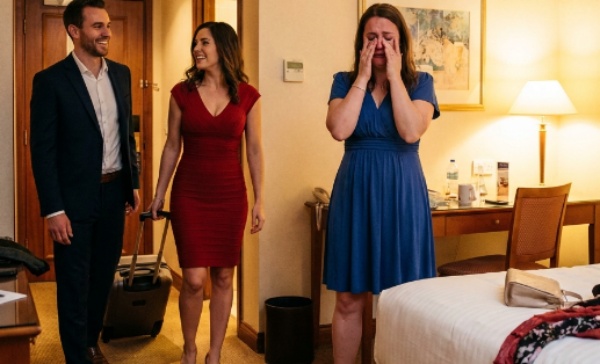
My Husband Left With His 22-Year-Old Girlfriend and Refused to Divorce Me—Ten Days Later, His Card Declined at the Worst Possible Moment
Preston thought he could walk out on his wife, spend family money on a beach getaway, and come home whenever his little fantasy got boring. He even told Meredith he would never “agree” to a divorce, as if marriage were a contract only he could control. But while he was busy choosing happiness with another woman, Meredith was quietly saving receipts, calling an attorney, and protecting her children. Ten days later, during a lunch meeting he thought would save his career, everything he had been hiding finally caught up with him.
Part 1: The Man Who Wanted a Wife and a Girlfriend
My husband cheated on me with a twenty-two-year-old woman and still had the nerve to tell me divorce was “too extreme.”
His name was Preston Hale, and for twelve years, I believed he was the kind of man who understood loyalty. We lived in Charlotte, North Carolina, in a brick house with white columns, a screened porch, and a mortgage that made us both nervous when we first signed it. We had two children, a rescue dog named Biscuit, and the kind of suburban life that looked peaceful from the sidewalk.
I was thirty-eight, a senior operations manager for a healthcare software company. Preston was forty-two, a regional sales director for a medical equipment distributor, which meant he spent half his life in airports, hotel bars, and conference rooms with bad coffee. He wore navy suits, drove a leased BMW, and spoke in motivational phrases that sounded impressive until you realized he used the same voice to sell ultrasound machines and apologize for missing family dinner.
For years, I made excuses for him.
He was tired. He was under pressure. His team depended on him. His clients were demanding. His boss expected too much. His father had never taught him how to rest.
That was the dangerous part of loving Preston. He always had a reason, and I was always willing to turn that reason into forgiveness.
The woman was named Kayla.
She was twenty-two, recently hired as a junior account coordinator at Preston’s company, and young enough to believe being chosen by a married man made her powerful. She posted gym selfies, iced coffee videos, and quotes about “protecting your peace” while apparently helping my husband destroy mine. I first saw her in a company picnic photo on Facebook, standing beside Preston with her head tilted toward him like gravity had a preference.
When I asked about her, he laughed.
“Kayla?” he said, loosening his tie in our bathroom mirror. “She’s a kid, Meredith.”
I remember that clearly because I wanted to believe him. I wanted to believe my husband would not be foolish enough to risk his marriage, his children, and his career for someone who still used glitter phone cases. But wanting to believe a thing does not make it true.
The first real sign came from our joint credit card.
A $438 dinner at a rooftop restaurant in Uptown Charlotte on a Wednesday night when Preston said he was stuck in Raleigh. Then came a boutique hotel charge in Asheville, a jewelry store purchase for $1,900, and a rental car upgrade during a “sales leadership retreat” that his company later confirmed had been virtual. Each charge was like a small window opening into a house I had not known he was building.
I did not confront him right away.
That surprises people when I tell the story. They expect a screaming scene, a wineglass thrown, a driveway showdown with headlights and tears. But I had spent fifteen years managing operations teams, budgets, audits, and vendor contracts. One suspicious charge is an emotion; a documented pattern is leverage.
So I documented.
I downloaded statements. I saved screenshots. I checked calendars, travel confirmations, hotel rewards points, and the family banking app Preston forgot I also had access to. I watched the story write itself in numbers.
By the time I found the beach house reservation, I already knew.
Preston had booked a ten-day stay at a luxury rental in Hilton Head, South Carolina. Oceanfront. Three bedrooms. Private pool. Paid deposit from an account that should have been used for our children’s summer camp and property taxes.
I confronted him on a Sunday evening after the kids went to bed.
Our daughter, Hannah, was ten and had left a half-finished friendship bracelet on the kitchen island. Our son, Caleb, was seven and still slept with a dinosaur night-light. The house was quiet except for the dishwasher humming and Biscuit snoring under the table.
I placed the printed charges in front of Preston.
He looked down, then back up at me with the expression of a man annoyed that paperwork had interrupted his version of reality.
“What is this?” he asked.
“You tell me.”
He flipped through the pages slowly. Dinner. Hotel. Jewelry. Hilton Head. Kayla’s name appeared in a screenshot from a reservation note because she had apparently requested “extra towels and champagne on arrival.”
His jaw tightened.
“Meredith,” he said, “you’ve been spying on me?”
That was when I knew he was guilty.
Innocent people ask what happened. Guilty people ask how you found out.
“I’ve been reviewing our finances,” I said.
He stood and walked to the sink, as if distance could make the evidence less real. “You don’t understand. Things between us have been bad for a long time.”
“No,” I said. “You have been dishonest for a long time. Those are not the same thing.”
He turned around. “I love you.”
I almost laughed.
“You bought another woman jewelry with our money.”
“It was complicated.”
“It was a bracelet, Preston. Not Middle East diplomacy.”
His face hardened. “Don’t talk down to me.”
The audacity of that sentence nearly knocked the breath out of me. For months, he had lied, spent, snuck around, and used our family money to impress a woman barely older than some of the interns at my company. But somehow, my tone was the problem.
“I want a divorce,” I said.
He stared at me.
Then he smiled.
Not happily. Not kindly. It was the small, smug smile of a man who thought he still controlled the board.
“No,” he said.
I blinked. “Excuse me?”
“I’m not agreeing to that.”
“You don’t get to refuse reality.”
“I’m not leaving my house, I’m not splitting my retirement, and I’m not letting you turn the kids against me because you’re upset.”
I felt my body go cold.
“Because I’m upset?”
“You’re emotional.”
There it was.
The oldest trick.
A man breaks the marriage, then calls the woman emotional for noticing the wreckage.
I folded the papers neatly and placed them back in the folder. “You should talk to an attorney.”
He laughed. “You always go straight to paperwork.”
“Yes,” I said. “That’s why you should be worried.”
Two days later, Preston left.
Not for a hotel. Not for his brother’s house. Not to give us space.
He packed two suitcases, took the BMW, and drove to Hilton Head with Kayla.
Before he left, he stood in our foyer while the kids were at school and told me he needed “clarity.”
“Clarity has a name and a beach rental?” I asked.
He looked ashamed for half a second, then covered it with irritation. “I’ll be back when you calm down.”
I stared at him.
“You are leaving your family to vacation with your girlfriend, and you think I’m the one who needs to calm down?”
He picked up his suitcase.
“I’m still not giving you a divorce,” he said. “You need me more than you think.”
Then he walked out.
I watched his car disappear down our quiet street, past trimmed lawns and basketball hoops and neighbors who had no idea a marriage had just bled out behind white curtains.
For five minutes, I stood perfectly still.
Then I called a lawyer.
Part 2: Ten Days of Receipts
Her name was Denise Whitman, and she had an office in SouthPark above a bank and a boutique that sold $300 candles.
Denise was in her late fifties, with silver hair, navy glasses, and the calmest voice I had ever heard. She had been recommended by a coworker who once described her as “sweet until the paperwork starts, then terrifying.” I liked her immediately.
I brought everything.
Credit card statements. Bank records. Hotel reservations. Screenshots. The Hilton Head rental confirmation. Text messages where Preston said he was “not agreeing” to a divorce. A copy of our mortgage, retirement accounts, insurance documents, car lease, and college savings plans.
Denise read quietly for almost twenty minutes.
Then she looked up and said, “Your husband believes delay benefits him.”
“Yes.”
“He is wrong.”
That was the first time I smiled in days.
She explained North Carolina divorce law in practical terms. We would need to separate before filing for absolute divorce, but we could immediately pursue legal separation agreements, child custody arrangements, support, equitable distribution, and court orders to prevent either spouse from wasting or hiding marital assets. The affair itself was not a magic button, but spending marital money on it mattered.
“Can he refuse a divorce forever?” I asked.
“No,” Denise said. “He can make things unpleasant. He cannot hold you hostage.”
That sentence became my oxygen.
“He took money from the household account for the rental,” I said.
Denise made a note. “How much?”
“$8,600 deposit. Another $4,200 due this week. Plus meals, gifts, travel, maybe more.”
“Then we preserve the record.”
She told me not to drain accounts, not to threaten him, not to post anything online, and not to contact Kayla directly. That last one annoyed me, but I understood. The goal was not satisfaction; the goal was protection.
I wanted revenge.
Denise wanted results.
Results were better.
That night, after the kids went to bed, I sat at the kitchen table with my laptop and built a spreadsheet. Date, merchant, amount, account, suspected purpose, supporting document. It looked almost boring, which made it more powerful. Betrayal is dramatic in the heart, but in court, it becomes rows and columns.
Hannah came downstairs around ten.
She stood in the kitchen doorway wearing oversized pajamas and holding her friendship bracelet kit.
“Mom?” she said. “Is Dad mad at us?”
My heart broke so quietly that I almost missed the sound.
“No, baby,” I said, closing the laptop. “Dad’s choices are grown-up choices. They are not because of you or Caleb.”
“Then why did he leave?”
I wanted to tell her the truth in adult words. Your father chose a woman barely old enough to rent a car over bedtime stories and soccer practice. Your father is pretending confusion because selfishness sounds ugly when named properly.
But children should not be handed adult pain like homework.
“Dad and I are having serious problems,” I said. “But both of us love you.”
She looked unconvinced.
Children often know when adults are using careful language.
“Are you getting divorced?” she asked.
I took a breath.
“I don’t know exactly what will happen yet,” I said. “But I promise you and Caleb will be taken care of.”
Hannah sat beside me and rested her head against my arm. She did not cry. That made it worse.
The next ten days became a study in controlled collapse.
Preston called twice, mostly to complain that I had frozen his access to the household budgeting app. I had not frozen anything; I had changed passwords on accounts that belonged solely to me and removed his ability to move money without alerts. He called that “hostile.”
I called it Monday.
He sent pictures to the family group chat by accident once. A beach view. Two wineglasses. Kayla’s pink acrylic nails visible on the edge of the frame. He deleted it thirty seconds later, but Hannah had already seen it.
“Who is that?” she asked.
I took the phone gently. “That was sent by mistake.”
Her face changed.
At ten years old, she was too young for the details and old enough for the truth to cast shadows.
That night, Caleb asked if Dad was on a work trip.
Hannah said, “No, he’s at the beach.”
The room went silent.
Caleb looked at me. “Can we go to the beach too?”
I smiled because if I did not, I would scream.
“Not this week, buddy.”
Preston spent those ten days acting like a man on borrowed money and borrowed youth. Steakhouse dinners in Savannah. Designer sunglasses. Jet ski rental. A $2,700 charge at a resort boutique. Kayla posted carefully cropped Instagram stories: ocean waves, champagne, his hand on a steering wheel, a caption that read, “Finally choosing happiness.”
Choosing happiness.
I saved every screenshot.
Not because I cared about her filtered version of freedom.
Because she was documenting marital waste better than any private investigator could.
On day six, Denise filed for temporary relief and preservation of assets.
On day seven, she sent formal notices to our banks, Preston’s attorney, his employer’s HR department regarding benefit preservation, and the leasing company for the BMW. Everything was precise and legal. No accusations blasted online. No dramatic threats. Just language that made adults sit up straighter.
On day eight, Preston finally hired a lawyer.
His lawyer sent a letter calling my actions “premature, inflammatory, and financially aggressive.”
Denise read it aloud over the phone and sighed.
“I do enjoy when men on vacation with girlfriends call wives aggressive for paying attention,” she said.
I laughed for the first time in almost two weeks.
On day nine, I discovered the business lunch.
It was on Preston’s calendar because he had forgotten that years ago, he shared his work calendar with our family calendar so I could schedule around his travel. He was meeting Martin Bell, the chief operating officer of his company, at a private club in Uptown Charlotte the next day. The calendar title was simple: “Lunch — MB / pipeline review.”
Denise asked if I knew Martin.
“I’ve met him twice,” I said. “Company Christmas party and one fundraiser.”
“Do not contact him,” she said.
“I wasn’t going to.”
“Good.”
But Denise was interested in the timing.
Preston had returned from Hilton Head that morning, probably sunburned, overconfident, and ready to pretend ten days of public foolishness had no consequences. He had a lunch meeting before going back to the office. He thought he was walking into business as usual.
He did not know that business had already read the room.
That evening, Denise called me again.
“Tomorrow may be eventful,” she said.
“What does that mean?”
“It means temporary orders were reviewed. Given the documentation, the court is granting immediate restrictions on extraordinary transfers and dissipation of marital assets pending further hearing. Certain accounts will require dual authorization or be frozen for review.”
I sat down slowly.
“Frozen?”
“Protected,” she corrected. “There is a difference.”
“What about his personal account?”
“Separate accounts are more complicated. But the joint accounts, certain investment movements, and any questionable transfers connected to marital funds are now under restriction.”
My hands started shaking.
“Meredith,” Denise said gently, “this is not revenge. This is preservation.”
“I know.”
But some part of me also knew that Preston’s favorite word was about to meet mine.
He liked control.
I liked documentation.
Documentation was about to win.
Part 3: The Lunch Where Everything Stopped
I was not at the lunch meeting.
That matters.
I did not hide behind a plant at the private club. I did not burst through the door with printed screenshots. I did not throw iced tea on my husband while wealthy men pretended not to watch.
I was at home, packing Caleb’s lunch for school, when Preston’s life froze.
The first sign came at 12:43 p.m.
A text from Preston.
“What did you do?”
I stared at it while spreading peanut butter on whole wheat bread.
Then another.
“My card declined.”
Then another.
“Meredith, answer your phone.”
I did not answer.
I forwarded the screenshots to Denise.
She replied: “Do not engage.”
So I did not.
Later, through attorneys and one very talkative former coworker who still adored me from company holiday parties, I learned exactly what happened.
Preston had walked into the club at noon wearing a tan sport coat he bought in Hilton Head. He was sunburned along the nose, overly relaxed, and apparently making jokes about “needing a vacation from vacation.” Martin Bell was already at the table, along with a woman from corporate HR and another man Preston did not recognize at first.
The man was outside counsel.
That should have been his warning.
Preston ordered a ribeye salad, sparkling water, and an appetizer for the table. He made small talk about sales pipeline, regional targets, and a potential hospital contract in Raleigh. He thought the meeting was about promotion.
In a way, it was.
A promotion from arrogance to consequence.
When the waiter brought the check for the appetizer and drinks before lunch had fully arrived, Preston handed over his corporate card without looking. A minute later, the waiter returned, discreet and uncomfortable.
“I’m sorry, Mr. Hale,” he said. “This card isn’t going through.”
Preston laughed.
“That’s impossible.”
He gave him another card.
His personal American Express.
Declined.
Then his debit card.
Declined.
That was when his phone started buzzing.
Bank alert.
Account restriction.
Fraud review.
Legal hold.
Corporate expense account suspended.
HR investigation opened.
Temporary marital asset preservation order received.
Martin Bell folded his hands on the table.
“Preston,” he said, “we need to talk.”
According to the coworker who heard from someone who heard from the server, Preston went pale so fast the HR woman asked if he needed water. The outside counsel slid a folder across the table. Inside were documents related to an internal expense review, corporate card misuse, inaccurate travel reports, and conflicts involving a subordinate employee.
Kayla.
Of course.
Preston had not just used our money.
He had used company resources too.
Hotel upgrades expensed as client lodging. Meals labeled as prospect entertainment. A rental car connected to a sales trip Kayla had no business attending. Reimbursements approved by Preston for Kayla’s “training travel” that overlapped with the Hilton Head vacation.
He had mistaken charm for invisibility.
Martin spoke quietly.
“You are being placed on administrative leave pending investigation.”
Preston tried to stand.
The waiter, still holding the unpaid check, hovered nearby like the ghost of every bad decision.
“This is a misunderstanding,” Preston said.
The HR woman said, “Then the review will clarify that.”
But her tone suggested it already had.
Preston texted me again at 12:58.
“Call me NOW.”
At 1:04:
“You froze my accounts?”
At 1:09:
“Do you understand what you’re doing to me?”
I looked at that message for a long time.
What I was doing to him.
Not what he had done to our marriage. Not what he had done to our children. Not what he had done to our finances, our home, or his career. His first full thought was still that consequences were something I had done.
At 1:12, Denise called.
“Do not respond to him,” she said.
“I haven’t.”
“Good. His attorney has contacted me. There appears to be an employment issue as well.”
“I know.”
“How?”
“He is texting like a man whose lunch just became a documentary.”
Denise actually laughed.
Then her voice softened. “How are you feeling?”
I looked toward the living room where Caleb’s dinosaur toys were scattered across the rug. Hannah’s backpack sat by the front door. Biscuit slept in a patch of sunlight like nothing had changed.
“I thought I’d feel happy,” I said.
“And?”
“I feel tired.”
“That’s normal.”
I sat down at the kitchen table.
“I also feel safe for the first time in weeks.”
“That,” Denise said, “is the point.”
Preston’s final text came at 1:37.
“Kayla left.”
I almost replied, Of course she did.
But I didn’t.
When a man’s whole life freezes, the first person to slip away is usually the one who was only there for the warm weather.
Part 4: The Man Outside the Door
Preston came home that evening.
Not to move back in. Not officially. He arrived at 7:18 p.m., after the kids had finished dinner but before bedtime. I know the exact time because I had started documenting arrivals, departures, messages, and calls like Denise told me to.
The doorbell rang.
Biscuit barked.
Hannah looked up from her homework. Caleb ran toward the hallway, but I stopped him gently.
“I’ll get it.”
Preston stood on the porch in the same tan sport coat from lunch, but the confidence had drained out of it. His hair was messy, his face gray, and the man who had left ten days earlier declaring that I needed him now looked like he needed a chair. Behind him, the BMW was not in the driveway.
“Where’s your car?” I asked.
His jaw tightened. “Company took it.”
Of course they did.
He looked past me into the house. “I need to talk to the kids.”
“You can say goodnight from the porch tonight.”
His eyes flashed. “Don’t start.”
I smiled slightly.
Not because anything was funny.
Because that tone used to work.
“You are not coming in angry,” I said. “Not around them.”
“This is my house.”
“It is our marital residence, and temporary arrangements are being handled through counsel. You chose to leave. Do not rewrite that because the beach trip ended badly.”
He stared at me.
“You did this,” he said.
I stepped onto the porch and closed the door behind me so the kids would not hear.
“No, Preston. You did things. I kept records.”
He paced once, then turned back. “My accounts are frozen. My job is under review. Kayla won’t answer my calls.”
There it was.
The holy trinity of his suffering: money, status, girlfriend.
Not once did he say Hannah’s name.
Not once did he ask how Caleb had slept.
I crossed my arms. “What do you want?”
“I want you to undo it.”
“Undo what?”
“The legal hold. The complaints. Whatever you sent my company.”
“I did not send your company a complaint.”
“Then how did they know?”
I looked at him for a long moment.
“Maybe you should ask your expense reports.”
His face twisted. “You’re enjoying this.”
“No,” I said. “I’m surviving this. Don’t confuse the two.”
For a second, his anger collapsed and I saw fear underneath.
“Meredith,” he said softly. “I made a mistake.”
The sentence was so familiar by then that it sounded rehearsed by men everywhere.
“No,” I said. “A mistake is forgetting milk. You built a vacation out of lies.”
He rubbed his face. “I don’t know what I was thinking.”
“Yes, you do. You were thinking I would cry, threaten divorce, and then fold when you refused. You were thinking I needed you more than I respected myself.”
He looked down.
For the first time, he had no answer.
The door opened behind me.
Hannah stood there in pajama pants and a sweatshirt, her face pale but steady.
“Dad?” she said.
Preston straightened quickly, trying to become her father again in one breath.
“Hey, sweetheart.”
“Did you leave because of that girl from the beach picture?”
The porch went silent.
Preston looked at me like I had handed her the question.
I had not.
Children collect fragments adults think they have hidden. A deleted photo. A tense kitchen. A father absent at bedtime. A mother crying quietly while loading the dishwasher.
“Hannah,” Preston said, “it’s complicated.”
She shook her head.
“No, it isn’t.”
My ten-year-old daughter said it with the exhaustion of someone who had grown too much in ten days.
Preston’s eyes filled.
“I’m sorry,” he whispered.
Hannah looked at him for a long time. “Are you sorry because you hurt us or because you got in trouble?”
That question landed harder than any legal order.
Preston covered his mouth.
I wanted to hug her. I wanted to send her upstairs. I wanted to rewind the last two weeks and give her a childhood where fathers did not make daughters ask adult questions on porches.
Instead, I put a hand on her shoulder.
“That’s enough for tonight,” I said gently.
She nodded and went back inside.
Preston sat down on the porch step like his legs had given out.
“She hates me,” he said.
“She’s hurt.”
“She looked at me like—”
“Like she sees you?” I asked.
He flinched.
I did not apologize.
The next morning, temporary arrangements began moving quickly.
Preston was ordered not to dissipate assets, not to remove property from the home without agreement, and not to make large transfers. Parenting time would be structured until we had a full custody arrangement. Financial disclosures were required. Receipts mattered.
Receipts always matter.
Kayla resigned from the company before HR finished the review. She sent Preston one text, according to a message he later included in discovery because men like him always overestimate how sympathetic their heartbreak sounds.
“I didn’t sign up for legal drama or a broke married man.”
That was Kayla’s goodbye.
I read it in Denise’s office and laughed so hard I had to cover my face.
Then I cried.
Not because I felt sorry for Preston.
Because I realized my marriage had been traded for someone whose loyalty lasted exactly as long as his cards worked.
Preston was officially terminated three weeks later.
The company described it as a violation of expense policies and conflict-of-interest standards. Quiet language. Devastating effect. In sales, reputation is currency, and Preston had spent his badly.
He moved into a furnished apartment near the airport.
The kids visited him every other weekend at first. Caleb liked the vending machine in the lobby. Hannah said the apartment smelled like “sad hotel,” which was rude and accurate.
Preston began therapy because his attorney told him it would help.
Then, surprisingly, he kept going after it stopped being strategic.
That annoyed me.
I had wanted him to remain the villain long enough for my heart to get comfortable. But real life is rarely generous enough to keep people simple.
He started showing up on time.
He learned Caleb’s spelling list.
He asked Hannah if she wanted space before hugging her.
He still irritated me. He still blamed stress too often. But he was trying, and for the children’s sake, I had to let trying matter without pretending it erased what he had done.
One night, months later, he came to pick up the kids and stood in the doorway with a backpack over one shoulder.
“I found a job,” he said.
“Good.”
“Smaller company. Less money.”
“Still good.”
He nodded. “I deserved that.”
I looked at him. “Which part?”
“The smaller life.”
I did not answer.
He looked past me at the family room where Caleb was looking for his shoes and Hannah was pretending not to listen.
“I thought being wanted made me valuable,” he said quietly. “Turns out it just made me stupid.”
It was the most honest thing he had said in years.
I almost softened.
Almost.
Then I remembered him saying, “I’m still not giving you a divorce.”
And I held my boundary.
“I’m glad you’re figuring that out,” I said.
Nothing more.
Part 5: The Life That Unfroze
The divorce took fourteen months.
North Carolina requires time, paperwork, patience, and a tolerance for phrases like “equitable distribution” and “custodial schedule.” I learned more about retirement accounts, appraisals, and support calculations than I ever wanted to know. Denise said I was her most organized client that year, which I took as both a compliment and proof that grief can become administrative.
I kept the house.
Not because Preston gave it to me out of kindness. Because the numbers, support, refinancing, and settlement made it possible. Because I fought for stability for Hannah and Caleb, and because Denise had the legal personality of a locked vault.
Preston kept some retirement assets, his personal belongings, and a reputation that would take years to rebuild.
The marital waste connected to the affair was accounted for in the settlement. Not perfectly. Courts do not give you back every sleepless night or every child’s question you had to answer with a steady voice. But the money he spent pretending I was naive did not simply vanish into the ocean air of Hilton Head.
Kayla disappeared from our story faster than she entered it.
Last I heard, she moved to Atlanta and started posting about “new beginnings.” I did not follow her. I did not care. A woman who helps a married man burn down a house should not be surprised when smoke follows her, but I had my own rebuilding to do.
The kids healed in uneven ways.
Caleb became clingy for a while. He asked every night if I would be home in the morning. So I made him a calendar with stickers for school days, mom days, dad days, and family dinner days. Predictability became medicine.
Hannah became quiet.
That scared me more.
She watched everything, absorbed everything, and asked questions that made adults look away. I found her once sitting on the porch steps, staring at the driveway.
“Do people always stop loving each other?” she asked.
I sat beside her.
“No,” I said. “But sometimes people stop acting with love, and that changes what the relationship can be.”
She thought about that.
“Dad stopped acting with love.”
“Yes.”
“Did you?”
The question hurt because it was honest.
“I got angry,” I said. “I got hurt. But I tried very hard not to stop acting with love toward you and Caleb.”
She leaned her head on my shoulder.
“You did okay,” she said.
From a ten-year-old, that felt like a medal.
A year after the lunch meeting, I took the kids to Hilton Head.
People thought I was crazy.
Even Denise raised an eyebrow when I told her.
But I did not want that place to belong to Preston and Kayla forever. I did not want the beach to remain a symbol of the week my husband chose someone else. So I booked a modest condo two blocks from the water, packed sunscreen, snacks, and too many towels, and drove the kids south.
We built sandcastles.
We ate shrimp tacos.
Caleb got sunburn on one ear despite my best efforts.
Hannah laughed in the waves, real laughter, the kind I had been waiting to hear again.
On the third evening, I walked alone near the shoreline while the kids watched a movie in the condo with my sister, who had come with us for backup and margaritas. The sky was pink and gold, and the water rolled in gently around my ankles.
I thought about Preston and Kayla in their luxury rental.
The wine.
The pictures.
The caption.
Finally choosing happiness.
I looked at the ocean and realized something.
Happiness is not chosen in one dramatic escape. It is built in ordinary acts of courage. Calling the lawyer. Paying the bills. Making breakfast when your heart is broken. Telling your children the truth without making them carry the whole weight of it.
My phone buzzed.
A message from Preston on the parenting app.
“Hope the kids are having fun. Caleb asked me to remind you he wants a shark tooth necklace.”
I smiled.
“Already purchased. He negotiated down from three.”
Preston replied with a laughing emoji.
That was our relationship now.
Not love.
Not war.
Logistics with occasional grace.
The divorce was finalized in a quiet courtroom on a rainy Tuesday.
Preston wore a gray suit and looked older than he had before the affair. I wore a navy dress and the pearl earrings my mother gave me when I got promoted. Denise sat beside me, calm as always.
The judge asked questions.
We answered.
The marriage ended legally in less than twenty minutes.
Afterward, Preston approached me in the hallway.
“Meredith,” he said.
I stopped.
“I’m sorry,” he said. “Not because my life froze. Not because I lost the job or the money or Kayla. I’m sorry because I made you protect the kids from pain I created.”
That was the first apology that sounded like it had found the right address.
I nodded.
“Thank you.”
He looked like he wanted more.
Forgiveness, maybe.
A hug.
A sentence that would let him leave the courthouse as a redeemed man.
I did not give it.
Not because I wanted to be cruel.
Because I had learned that women are not required to hand peace to the people who made them earn it the hard way.
“Take care of yourself,” I said.
Then I walked away.
Two years later, our lives are not perfect, but they are honest.
Preston works for a smaller company and lives in a townhouse about fifteen minutes away. He is a better father now than he was when he was busy performing success. That is both comforting and infuriating, but I have made peace with the contradiction.
Hannah is twelve and plays volleyball with the intensity of a trial lawyer.
Caleb is nine and wants to become either a marine biologist or a YouTuber who reviews pancakes.
Biscuit is still alive, still dramatic, and still convinced thunder is a personal attack.
As for me, I got promoted, refinanced the house, and painted the front door a deep blue Preston never liked. I bought new sheets, changed the locks, and replaced the dining room table where I had first laid out the evidence of his affair. Not because furniture holds sin, but because I wanted a table where no one had ever lied to me.
Sometimes women message me after hearing pieces of the story.
They ask if I regret not screaming.
If I regret not confronting Kayla.
If I regret letting the law move slowly instead of chasing the instant satisfaction of revenge.
The answer is no.
Screaming would have given Preston a story about my anger.
Documentation gave me a future.
The day his life froze at that lunch meeting, he learned something I had already learned ten days earlier: comfort built on lies is fragile. One declined card, one legal order, one HR folder, one woman who finally stops covering for you—and the whole illusion stops moving.
He thought he could cheat, refuse divorce, leave with his twenty-two-year-old girlfriend, and come home when the fantasy got expensive.
He thought I needed him more than I needed peace.
He thought wrong.
I did not destroy his life.
I simply stopped warming it with mine.
And when everything around him froze, I finally began to thaw.
