My Husband Called Me Fat and Useless at Dinner. He Mocked My Body in Front of His Colleagues—The Next Morning, He Watched Me Close the $540 Million Deal His Firm Couldn’t Win”
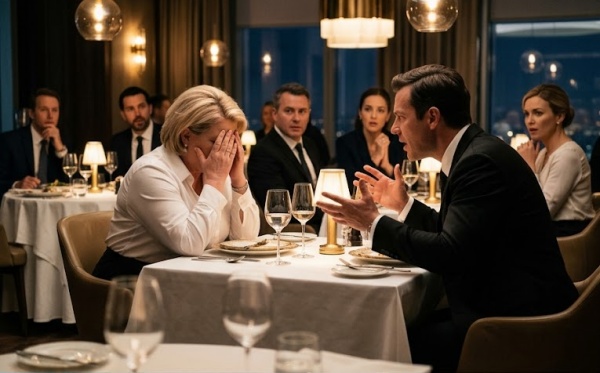
He said it over dessert, in a private dining room full of investors, partners, and the younger woman he was trying to impress. He smiled when he called me useless, as if my illness, my weight, and my quieter life had erased everything I used to be. I didn’t argue, cry, or defend myself in front of that table. I simply stood up, walked out, and let him walk into the conference the next morning — where my name was on the screen, my deal was on the table, and his firm was already too late.
Part 1: The Dinner Table
At 7:18 on a Thursday night in downtown Boston, my husband called me fat and useless in front of twelve people.
Not loudly. Not with the kind of rage that makes a room gasp and intervene. He said it with a smile, over a $190 bottle of Cabernet at a private dining room inside a steakhouse where men in navy suits spoke too casually about money they had never personally risked.
His name was Preston Hale, and he had built his entire personality around being the smartest man at any table.
He was a managing director at a private equity firm in Boston, the kind of man who measured human value in titles, billable hours, closing dinners, and whether your last name appeared on the right invitation lists. He wore European suits, collected watches, and spoke about “discipline” as if discipline were something he had invented between a Peloton session and a cold plunge.
I was his wife, Marissa.
At least, that was how people at that dinner knew me. Preston’s wife. The woman who smiled at the right moments, remembered everyone’s spouse’s name, and knew how to make rich men feel more interesting than they actually were. The woman in the black dress, size fourteen, sitting two seats down from her husband while he flirted with the junior partner from New York who laughed too hard at everything he said.
Her name was Kendall.
She was twenty-nine, blond, sharp-jawed, and ambitious in the hungry way I recognized because I had been hungry once too. She worked in investor relations at Preston’s firm and had the kind of confidence that came from being praised for having potential by men who confused youth with insight.
I had not planned to attend that dinner.
Preston insisted.
“You need to show your face,” he said that afternoon, standing in our Beacon Hill townhouse bedroom while I tried to decide whether I had the energy to go. “Partners are flying in. Investors will be there. It looks better if you come.”
“It looks better for who?”
He looked up from fastening his cufflinks.
“For us.”
There was no us in the way he said it.
There had not been an us for a long time.
We had been married for nine years. In the beginning, Preston used to tell people I was brilliant. He said it proudly, almost possessively, when I was still working in infrastructure finance and leading municipal bond restructurings that most people at cocktail parties pretended to understand.
Then I got sick.
Not dramatically sick. Not movie sick. Just the kind of chronic autoimmune condition that arrives slowly and steals your stamina in pieces until one day you realize your body has become an unreliable business partner. I gained weight from medication, inflammation, exhaustion, and the slow grief of watching a version of myself disappear from mirrors and conference rooms.
Preston did not handle it well.
At first, he called it concern.
Then he called it discipline.
Then, when my career slowed and I moved into independent advisory work from home, he started calling it failure.
He never said that word directly. Men like Preston rarely use blunt words when polished cruelty will do. He said I had “lost my edge.” He said I was “not built for pressure anymore.” He said the market had moved on while I was “figuring myself out.”
What he did not know was that while he was dismissing me, I was quietly building something bigger than anything he had ever closed.
The dinner began politely enough.
There were oysters, dry-aged ribeyes, creamed spinach, investment jokes, and the usual performance of people pretending not to compete while doing absolutely nothing else. Preston sat at the center of the table, exactly where he liked to be. Kendall sat beside him.
I sat across from a pension fund consultant from Chicago who asked me, with the harmless condescension of someone who had not bothered to Google me, what I did “these days.”
“I consult,” I said.
Preston laughed before I could add more.
“She means she reads reports in yoga pants and tells people what they already know.”
The table chuckled.
Not everyone. Enough.
I looked at him.
He did not look back.
Kendall smiled into her wine glass.
The pension consultant shifted uncomfortably, sensing something under the joke but not brave enough to name it.
I could have corrected him. I could have said that my “reports in yoga pants” had just saved a three-state hospital network from a disastrous debt refinancing. I could have said that two governors’ offices had my personal cell number and used it. I could have said that the only reason I was at dinner instead of finalizing term sheets was because Preston still believed my silence meant there was nothing to hear.
But I said nothing.
I had learned that some people only understand volume when it comes from consequences.
The insult came during dessert.
Someone asked Preston about the upcoming Atlantic Infrastructure Summit, a major conference being held the next morning at the Seaport Convention Center. Preston’s firm was expected to announce interest in a regional energy logistics platform called Northline Grid Partners. Everyone in that room knew Northline was the kind of deal that could define a quarter.
Preston leaned back in his chair, pleased to have an audience.
“We’ll see what happens,” he said. “Some of these companies get sentimental about legacy ownership. You have to separate emotion from value.”
Kendall said, “That’s what Preston is best at.”
He smiled at her.
Then he turned toward me, as if remembering I existed.
“Marissa used to understand that,” he said. “Back when she was still useful.”
The room went still for half a second.
He should have stopped there.
He did not.
“But now?” He laughed softly. “Now she gets winded walking up the stairs and thinks reading one municipal report makes her strategic. Honestly, the only thing she’s scaled in the last few years is her dress size.”
No one laughed that time.
Not even Kendall.
The waiter froze near the sideboard holding a silver coffee pot.
I felt every eye at the table try not to look at me.
My face did not burn. My hands did not shake. The shame did not land where he intended it to land, because sometime in the last two years I had stopped believing his opinion was evidence.
I set my spoon down beside the untouched chocolate torte.
Then I looked at Preston.
“Are you finished?”
He blinked.
“What?”
“Are you finished?”
He gave a small, irritated smile.
“Don’t be dramatic, Marissa.”
“I’m not.”
I folded my napkin, placed it on the table, and stood.
The room remained silent.
Preston’s expression hardened.
“Sit down.”
I looked at him for a long moment.
“No.”
Then I picked up my coat and walked out of the private dining room with twelve people watching, including the woman he wanted to impress and the men he needed to respect him.
Behind me, Preston said my name once.
I did not turn around.
Outside, Boston was cold and sharp, the kind of March night that makes your lungs remember they have work to do. I stood on the sidewalk under the restaurant awning, breathed once, and pulled out my phone.
There was a message waiting from an unknown number.
Ms. Vale, confirming your arrival at 8:30 tomorrow. Final Northline board vote is scheduled for 10:00. We are ready when you are.
I smiled for the first time all evening.
Preston had no idea.
Part 2: What He Didn’t Know
Before I became Preston Hale’s disappointing wife, I was Marissa Vale.
That name still meant something in certain rooms.
Not loud rooms. Not rooms full of men performing dominance over steak and bourbon. The rooms where my name mattered were quieter — conference calls before dawn, closed-door restructuring sessions, state authority briefings, hospital board emergency meetings, infrastructure funds trying not to admit they were exposed.
I specialized in complex public-private infrastructure deals.
Energy grids. Hospital systems. Port logistics. Transit bonds. The kind of work that sits beneath everyday life, invisible unless it fails. I loved it because it was complicated, consequential, and resistant to bluffing.
Numbers did not care how charming you were.
Contracts did not care who laughed at dinner.
Debt did not care whether a man believed his own press release.
When my health changed, I did step back from the old pace. I stopped flying three times a week. I stopped taking every crisis call. I stopped saying yes to people who admired my output but ignored the body producing it.
But I did not stop working.
I adapted.
I built a boutique advisory practice under my maiden name: Vale Strategic Infrastructure. At first, I took small projects from people who remembered me before I became socially folded into Preston’s life. Then the projects got bigger. A distressed port refinancing in Maryland. A rural hospital rescue in Pennsylvania. A clean-energy transmission dispute in upstate New York.
By the time Preston began calling me useless, I had a six-person team, a secured client list, and enough confidential work that I could not have told him the truth even if I had wanted to.
The Northline deal began eight months before that dinner.
Northline Grid Partners controlled regional energy storage, emergency distribution corridors, and fuel logistics sites across New England. It was not flashy, but it was essential. Whoever acquired it would have significant influence over backup energy reliability for hospitals, data centers, municipal utilities, and emergency response systems across five states.
Preston’s firm wanted it badly.
So did three other firms.
But the Northline board did not want a pure financial buyer. They wanted someone who understood public obligations, regulatory sensitivity, labor contracts, and what happens when spreadsheet people underestimate communities that actually live beside infrastructure.
That was why they called me.
The first conversation happened on a Tuesday morning while Preston was at a golf outing in Palm Beach.
I was at our kitchen table in Beacon Hill wearing sweatpants, compression socks, and one of Preston’s old Harvard sweatshirts. My hands hurt that day. My knees did too. I had almost canceled the call.
Then Northline’s board chair, Evelyn Rowe, came on the screen.
She was sixty-one, direct, and looked like she had been unimpressed by more men than I had ever met.
“Ms. Vale,” she said, “we’ve been told you understand how to structure a sale without letting vultures gut the company.”
I liked her immediately.
“I understand vultures,” I said. “And I understand covenants.”
She smiled.
We built the deal slowly.
It was not a simple acquisition. It required union protections, state regulatory approvals, environmental liabilities, emergency service continuity guarantees, and a complicated financing structure that kept Northline’s public obligations intact while allowing private capital to enter without stripping assets. It also required keeping the process quiet, because if the wrong bidders understood the structure too early, they would either sabotage it or copy it badly.
Preston’s firm was one of the bidders.
That was the problem.
Legally, I could not share confidential information with him. Ethically, I could not warn him that his firm’s approach was misaligned with what Northline actually needed. Personally, I had no desire to help a man who had spent two years mistaking my restraint for incompetence.
So I said nothing.
Preston, of course, talked constantly.
He complained that Northline was “overly emotional.” He said their board was “paralyzed by legacy thinking.” He mocked their concerns about workers, rural communities, and hospital backup systems.
One night, while I was reviewing Northline’s emergency continuity language at the kitchen island, Preston walked in and asked what I was reading.
“Regulatory material,” I said.
He glanced at the pages.
“Still pretending you’re in the game?”
I turned one page.
“Something like that.”
He opened the fridge.
“You know, if you ever want to be useful again, I can ask around. Maybe someone needs part-time diligence work.”
I did not look up.
“That’s generous.”
He missed the tone.
He missed many things.
The final structure of the Northline deal came together five days before the conference.
A consortium led by a pension-backed infrastructure fund would acquire majority ownership for $540 million, with strict operational covenants, labor guarantees, community energy reserves, and an independent oversight board for emergency service commitments. Vale Strategic Infrastructure would remain as post-closing transition advisor for eighteen months. My team had built the structure, negotiated the stakeholder protections, and neutralized three financing issues that could have killed the deal.
All that remained was the public announcement.
The closing presentation was scheduled at the Atlantic Infrastructure Summit.
Preston was attending.
He thought he was going there to pressure Northline into reconsidering his firm’s bid.
He did not know he was about to watch his wife close the deal from the stage.
Part 3: The Conference
The Seaport Convention Center looked like every major business conference in America: glass walls, branded banners, coffee stations, name badges, bad lighting, and hundreds of people pretending not to check who else was in the room.
I arrived at 8:22 a.m. wearing a navy suit, low heels, and a silk blouse in the exact shade of green my mother used to say made me look awake even when I was exhausted. My body hurt from the night before. Stress always did that. But pain and fear are not the same thing, and I was not afraid.
At registration, the woman behind the desk looked at my badge and smiled.
“Good morning, Ms. Vale. Speaker check-in is to your left.”
I took the badge.
Marissa Vale
Founder & Managing Partner
Vale Strategic Infrastructure
I stood there for a moment, looking at my own name.
Then I put it on.
At 8:45, I met Evelyn Rowe backstage.
She took one look at my face and said, “Bad night?”
“Clarifying night.”
“That kind can be useful.”
“It was.”
She handed me a folder.
“Final board vote passed unanimously at 7:30. The buyer group signed at 8:05. We announce at ten.”
I exhaled.
Eight months of work reduced to three sentences.
That is how deals work. The labor disappears into the announcement. The sleepless nights, the redlines, the risk calls, the revisions, the pressure — all of it becomes a clean number and a polite round of applause.
$540 million.
I thought of Preston calling me useless over dessert.
Then I thought of my team, my body, my discipline, my name.
I was ready.
At 9:15, Preston saw me.
He was walking through the main lobby with Kendall and two partners from his firm. He looked polished, confident, mildly bored. Then his eyes landed on my badge.
He stopped so abruptly that Kendall nearly bumped into him.
“Marissa?”
I turned.
“Preston.”
His gaze moved from my suit to my badge to the speaker ribbon attached beneath it.
“What are you doing here?”
“Working.”
He frowned.
“For who?”
I looked at him.
“You’ll hear shortly.”
One of his partners, a tall man named Alan Mercer, stepped forward.
“Marissa Vale?” he said. “Wait. Vale Strategic?”
I offered my hand.
“Yes.”
His face changed with recognition.
“We reviewed your Maryland port model last year. Brilliant work.”
“Thank you.”
Preston looked from Alan to me.
Kendall’s expression had gone still.
Alan continued, unaware that he was standing in the middle of a marriage collapsing in business casual.
“You’re speaking on the Northline panel?”
“I am.”
Preston laughed once, but there was no humor in it.
“That can’t be right.”
I tilted my head.
“Why not?”
He opened his mouth, then closed it.
There were too many people around. Too many badges. Too many witnesses. He could not say what he meant, which was: because last night I told everyone you were useless, and I need the universe to support that version of you.
Instead, he said, “You didn’t mention it.”
“No.”
“Why?”
I looked at him for one long, quiet second.
“Because you never asked what I was building.”
Then I walked away.
The Northline session began at 10:00 in the Harbor Ballroom.
Three hundred people filled the room — investors, infrastructure executives, regulators, municipal advisors, union representatives, reporters, and consultants who understood that the announcement had become the conference’s biggest rumor. Preston sat in the third row with his firm. Kendall was beside him, rigid and pale.
I saw him see my name on the screen.
Closing Keynote: Structuring the Future of Regional Energy Resilience
Marissa Vale, Vale Strategic Infrastructure
Evelyn Rowe, Northline Grid Partners
Jonathan Pierce, Atlantic Public Infrastructure Fund
Preston’s face did something small and satisfying.
Not dramatic.
Just a quick loss of certainty.
I stepped onto the stage.
The lights were bright, but not as bright as the private dining room had felt when Preston tried to shrink me in front of people he wanted to impress. This light belonged to the work. This room was not asking me to be smaller.
I began.
“Regional infrastructure is not just an asset class. It is a public promise with a balance sheet attached.”
The room quieted.
I walked them through the problem: aging energy storage, emergency supply vulnerabilities, private capital pressures, public service obligations, and why conventional acquisition models fail when they treat essential systems like ordinary holdings. I explained the financing structure without overcomplicating it. I named the labor protections, community reserves, regulatory commitments, and capital stack.
Then Evelyn stood and announced the deal.
“Northline Grid Partners has entered into a definitive agreement for a $540 million acquisition led by Atlantic Public Infrastructure Fund, structured in partnership with Vale Strategic Infrastructure.”
The room erupted in applause.
I did not look at Preston immediately.
I let the applause land first.
Then, when the moderator opened for questions, Alan Mercer from Preston’s firm raised his hand.
He did not look at Preston.
He looked at me.
“Ms. Vale, would you say the winning structure succeeded because it prioritized continuity protections over a higher headline bid?”
“Yes,” I said. “The highest number is not always the best offer. Sometimes the strongest bid is the one that understands what cannot be broken.”
I looked at Preston then.
Only briefly.
Enough.
His jaw was locked.
Kendall was staring at the floor.
The moderator asked another question. Then another. For forty minutes, I answered with the calm precision Preston used to mock as “overthinking.” By the end of the session, three reporters were waiting near the stage, Evelyn was shaking my hand, and Jonathan Pierce was confirming the post-closing transition schedule.
Preston stayed seated until most of the room had cleared.
For once, he had no table to dominate.
Part 4: The Man Who Finally Understood
Preston found me near the speaker lounge twenty minutes later.
He came alone.
That was interesting.
No Kendall. No partners. No audience. Just Preston in his tailored suit, carrying the expression of a man trying to decide whether apology or control would serve him better.
He chose control first.
“You humiliated me,” he said.
I almost laughed.
“Did I?”
“You knew I was pursuing Northline.”
“Yes.”
“And you didn’t tell me you were advising them?”
“I was under confidentiality obligations.”
“I’m your husband.”
“You were also a competing bidder.”
His face tightened.
“That’s different.”
“No, Preston. That is exactly the point.”
He looked past me, toward the lobby, where people were still talking about the announcement.
“How long?”
“Eight months.”
His eyes snapped back to mine.
“Eight months?”
“Yes.”
“You lied to me for eight months?”
I took a breath.
There it was.
The moral injury of a man who had no problem humiliating his wife at dinner but considered her professional confidentiality a betrayal.
“I protected my client for eight months,” I said. “You ignored your wife for years.”
He flinched.
Good.
Not because I wanted to hurt him, but because truth sometimes has to hit bone before someone admits it exists.
He lowered his voice.
“Marissa, last night was wrong.”
“Yes.”
“I was drinking. I was showing off. I didn’t mean—”
“You meant every word.”
He looked down.
For the first time, he seemed uncertain.
That might have moved me once.
Not anymore.
“I heard you,” I said. “Not just last night. Every time you commented on my body like it was a failed investment. Every time you treated my illness like laziness. Every time you made my work sound small because you needed me to be smaller than you.”
His eyes reddened.
“Don’t do this here.”
“I’m not doing anything here. I’m working.”
He looked at my badge again.
I watched him process the title.
Founder.
Managing Partner.
Not wife.
Not accessory.
Not failure.
“How big is your firm?” he asked.
I smiled faintly.
“Big enough.”
His phone buzzed.
Then mine.
Then his again.
He checked the screen and went still.
I knew what it was before he said anything. News travels fast at conferences. Faster when a firm loses a major deal it expected to win and then discovers the winning advisor is the managing director’s wife.
His partner Alan had sent a message.
I saw the first line when Preston’s hand dropped slightly.
We need to discuss your conflict disclosure. Immediately.
Preston looked at me.
“What did you tell them?”
“Nothing.”
“That’s not possible.”
“I didn’t have to.”
He stared.
I continued, “You brought your wife to a firm dinner last night and publicly insulted her in front of partners, investors, and staff. Less than sixteen hours later, your wife closed the deal your firm wanted. People are capable of drawing their own conclusions.”
His breathing changed.
“And Kendall?” I asked.
His face gave him away.
There had been rumors for months. I had not needed proof. I had lived with enough silence to know when another woman had moved into the pauses.
“She has nothing to do with this,” he said.
“That’s what men always say when women become inconvenient evidence.”
He stepped closer.
“Marissa, please. Let’s go home and talk.”
Home.
The word did not land.
Home had been a place where I learned to be quiet so he could feel large.
“I’m not going home with you.”
His expression shifted.
“Don’t be dramatic.”
I looked at him.
“You said that last night too.”
He closed his eyes.
I reached into my bag and pulled out an envelope.
He looked at it.
“What is that?”
“A referral.”
“For what?”
“A divorce attorney.”
His eyes opened.
“Marissa.”
“I already have one. That one is for you. She’s excellent, discreet, and unlikely to tolerate your theatrics.”
He did not take it.
So I placed it on the small table between us.
“You can call her or choose someone else. But do not come back to the townhouse tonight. I’ve arranged to stay elsewhere, and my attorney will contact yours regarding temporary arrangements.”
He looked like he had been struck.
“You’re leaving me over one comment?”
I stared at him.
“One comment?”
His silence answered.
“No, Preston. I’m leaving you because last night you finally said in public what you had been teaching me in private for years. And this morning, I remembered who I was before I believed you.”
He swallowed.
“What about us?”
“There hasn’t been an us for a long time.”
I walked away.
Behind me, he said, “You’ll regret this.”
I stopped, but I did not turn around.
“No,” I said. “You will.”
And for once, he believed me.
Part 5: The Deal After the Deal
The divorce did not happen overnight.
Real endings rarely do.
There were lawyers, financial disclosures, temporary orders, property negotiations, and the slow legal unbraiding of a life that had looked simple from the outside because I had kept the knots hidden. Massachusetts is an equitable distribution state, which meant the court looked at the whole picture — income, assets, contributions, health, career sacrifices, length of marriage, and future earning capacity.
Preston assumed he had the advantage.
He earned more on paper.
At least, he thought he did.
Then my attorney produced the valuation for Vale Strategic Infrastructure.
Preston’s lawyer went quiet.
My firm was not a hobby. It was not a side project. It was not “consulting in yoga pants.” It was a profitable advisory practice with signed contracts, retained clients, and a post-closing role on a $540 million infrastructure transaction.
Preston had spent years undervaluing me.
The court did not.
He also had to explain the dinner.
Not as a moral issue alone, but because several people at that table had submitted statements confirming that he publicly demeaned my health, body, and professional value in front of colleagues and potential business contacts. That mattered because Preston later tried to argue that I had intentionally embarrassed him at the conference. The timeline proved otherwise.
He had lit the match.
I had simply walked into the room already on fire for my own work.
Kendall disappeared from his life faster than I expected.
Not because she developed sudden respect for marriage. Because Preston’s professional standing became less useful once his firm opened an internal review into conflict disclosures, conduct, and whether his behavior had damaged the Northline pursuit. She requested a transfer to the New York office within three weeks.
Preston called her disloyal.
I found that funny.
Not loudly.
Just enough.
The review did not end his career, but it dented it badly.
He was removed from the infrastructure vertical. His bonus was reduced. Two partners stopped bringing him into client pitches. In private equity, not being invited into rooms is how power begins to die.
At home, the townhouse became too quiet.
So I sold it.
I bought a smaller place in Cambridge, near the river, with wide windows and a kitchen that did not feel like a stage for someone else’s life. I kept the dining table but replaced the chairs, because the old ones reminded me too much of sitting through conversations where my silence had been expected.
My health did not magically improve.
That is important.
This is not a story where a woman leaves a cruel man and suddenly becomes thin, tireless, and shiny in a way that makes everyone comfortable. My body remained my body. Some mornings, my joints still hurt. Some weeks, inflammation made my face rounder than I wanted. Some days, I had to cancel plans and rest.
But something did change.
I stopped treating my body like evidence against me.
This body had carried me through hostile rooms, hospital appointments, late-night negotiations, medication side effects, and a conference stage where I closed the biggest deal of my career. It had not failed me. It had fought for me while I kept apologizing for it.
So I stopped apologizing.
Six months after the Northline announcement, I spoke at another conference in Washington, D.C.
This time, the panel was about ethical infrastructure investment and stakeholder protections in public-private transactions. I wore a burgundy suit. I stood under bright lights. I spoke for twenty-five minutes without once wondering whether Preston would approve of how I looked from the audience.
He was not there.
Good.
Afterward, a young woman approached me near the coffee station.
She said, “I saw you in Boston. I was working registration. I heard people talking about what happened.”
I braced myself.
Then she said, “My mom has lupus. She stopped working because people made her feel like needing rest meant she wasn’t ambitious anymore. I sent her your article.”
I did not know what to say.
So I said, “Tell her rest is not failure.”
The young woman nodded.
“I will.”
That moment stayed with me longer than the applause.
Preston and I finalized the divorce eleven months after the dinner.
At the final hearing, he looked tired. Not ruined. Not destroyed. Life rarely gives people consequences that poetic. But he looked diminished in the specific way that arrogant people do when the world stops editing itself to flatter them.
Outside the courthouse, he asked if we could talk.
I agreed.
We stood near the courthouse steps while traffic moved along Tremont Street and office workers passed with paper coffee cups.
“I’ve been thinking about what I said,” he told me.
I waited.
“It was cruel.”
“Yes.”
“And not true.”
I looked at him.
“No,” I said. “It was true to you when you said it. That’s why it mattered.”
He flinched.
“I’m sorry.”
I believed that he was sorry in that moment.
But apology is not a time machine. It does not unmake the dinner table, the years of comments, the way I learned to brace myself before entering rooms with him. It does not return the softer version of me that tried so hard to be loved by becoming less inconvenient.
“Thank you,” I said.
He looked surprised.
“That’s it?”
“That’s it.”
No dramatic speech.
No final insult.
No performance.
Just two words, because I had already given him enough of my voice.
A year later, Vale Strategic Infrastructure had sixteen employees.
We opened an office in Boston and a small satellite team in D.C. Northline’s transition became a case study in stakeholder-centered acquisition strategy. I was invited to join the board of a national infrastructure resilience nonprofit.
Preston sent one email after the article came out.
Congratulations. You earned it.
I read it twice.
Then I archived it.
Not deleted.
Archived.
Some things are not wounds anymore, but they are still records.
Last month, I had dinner at the same steakhouse where Preston insulted me.
Not in the private room.
In the main dining room, at a corner table with Evelyn Rowe, two women from my team, and a client from Oregon who was trying to save a regional hospital system from being stripped by a predatory buyer. We ordered the oysters. We ordered the expensive Cabernet. We talked about debt covenants, labor protections, and whether the dessert menu was worth the calories.
It was.
At one point, I looked toward the hallway that led to the private rooms.
I thought I would feel something sharp.
I did not.
The place had become just a restaurant again.
That is when I knew I was free.
Not when I closed the $540 million deal.
Not when Preston’s face went pale at the conference.
Not when the divorce decree was signed.
Freedom came when the room where he tried to make me small no longer had the power to shrink me.
People sometimes call what happened a revenge story.
I understand why.
It has the dinner insult, the conference reveal, the powerful deal, the husband forced to watch his wife become visible in the exact world where he dismissed her. But revenge was never the point.
The point was return.
Return to my name.
Return to my work.
Return to a body I no longer allowed anyone to use as a punchline.
Return to the part of me that knew value was not determined by a cruel husband, a dress size, a dinner table, or a man who mistook volume for authority.
Preston called me fat and useless at dinner.
The next morning, he walked into a conference and watched me close a $540 million deal.
But the real victory was not that he saw me.
It was that I finally did.
