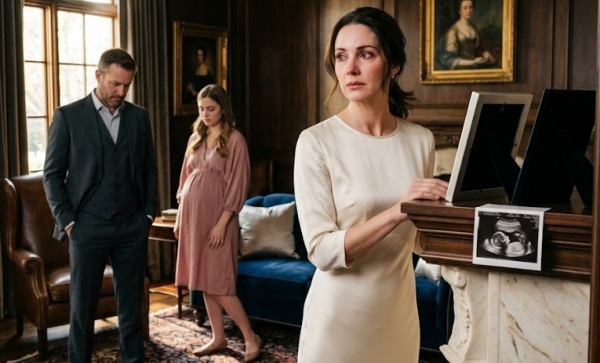
My Husband’s Mistress Put Her Ultrasound in My Dead Daughter’s Frame… I had survived the loss of my daughter, but I was not prepared to watch another woman place her ultrasound in the frame meant for my maternity photo. She did it in my living room, in front of our guests, while my husband stood there and called it “healing.” They thought grief had made me weak enough to sign away my home and my father’s company. They were wrong—grief had taught me to read every contract before trusting anyone again.
Part 1: The Empty Silver Frame
The silver frame had been empty for eleven months.
It sat on the mantel in our house in Highland Park, Dallas, polished every Friday by our housekeeper but never touched by me. It had been meant for my maternity portrait, the one my husband insisted we schedule when I was thirty-two weeks pregnant with our daughter. I had bought a cream silk dress for it, and he had promised he would leave work early that day.
But the portrait was never taken.
Our daughter, Caroline Grace, died before she ever opened her eyes. One morning, I woke up and realized the little kicks I had been counting every night had stopped. By sunset, I was in a hospital room listening to a doctor explain grief in a voice too gentle to survive inside my memory.
After that, the silver frame remained empty.
I could not put Caroline’s ultrasound in it. I could not put a hospital bracelet there either. I could not fill it with a photo of myself smiling over a belly that had become a grave before it became a cradle.
So I left it blank.
My husband, Preston Caldwell, hated that frame. He said it made the room feel “unfinished.” He said guests noticed it, even when no one said anything. He said I needed to stop building a shrine to pain.
I told him it was not a shrine.
It was a space.
A space for the life we almost had.
That Sunday, we hosted brunch because Preston believed grief should be scheduled around social obligations. He had invited two investors from Houston, one city councilman, his sister Vivian, and a woman named Lacey Monroe, whom he introduced as a “brand consultant” helping with the expansion of our company. I knew who she was before she crossed the threshold.
Women always know.
Lacey was twenty-nine, with honey-blonde hair, a pale pink dress, and the kind of careful softness some women use as a weapon. She touched Preston’s arm when she laughed. She looked around my house as if she were measuring curtains in her head.
I watched her from the kitchen doorway while the caterers arranged smoked salmon, mini quiches, fruit, and mimosas on the dining room sideboard. Preston stood too close to her near the French doors, smiling in a way he had not smiled at me in over a year. His hand brushed her lower back once, quickly, but not quickly enough.
My stomach turned cold.
Still, I did not confront him.
That was one thing grief had taught me: silence could hold more power than screaming, if you knew when to use it.
By noon, everyone was seated. The men talked about real estate development, tax incentives, and the new logistics contracts our company had been pursuing across Texas and Oklahoma. Vivian complimented the floral arrangement and avoided my eyes, which told me she knew more than she wanted to admit.
Lacey barely ate.
She kept one hand folded over her stomach.
At first, I thought it was performance. Then I saw Preston glance down at her hand with a pride he had not worn since the day we learned Caroline was a girl. My fork paused halfway to my plate.
No.
I looked at Lacey’s face. She noticed me noticing, and her lips curved into something almost sweet.
After brunch, while the guests carried coffee into the living room, Lacey disappeared down the hallway. Preston was trapped in conversation with the councilman, laughing too loudly. I followed her because there was a feeling in my chest I could not name.
I found her at the mantel.
She had opened her small white purse and taken out a glossy black-and-white ultrasound photo. Before I could speak, she slipped it into the silver frame. Then she tilted it slightly, stepped back, and smiled.
My hands went numb.
The empty frame was not empty anymore.
Inside it was her baby.
Not mine. Not Caroline. Hers.
Lacey turned when she heard me behind her.
“Oh,” she said softly. “I hope you don’t mind.”
For several seconds, I could not answer. My eyes moved from the ultrasound to her face, then back again. The baby in the image was curled in pale shadow, tiny and unreal.
“That frame was not yours to fill,” I said.
Her smile trembled, but only at the edges. “Preston said it might help everyone move forward.”
Everyone.
As if my daughter had been a traffic delay.
Preston appeared behind me, his expression tight with warning. “Margot.”
I did not look away from Lacey. “Take it out.”
He stepped closer. “Don’t make a scene.”
“A scene?” I repeated.
The living room grew quiet behind us. I could feel the guests turning, the air sharpening, the room preparing to pretend it had not heard anything. Lacey lowered her eyes and placed one hand over her stomach again.
Preston sighed like I was embarrassing him.
“Margot, it’s healing,” he said.
That word broke something clean inside me.
Healing.
He had called another woman’s ultrasound in our dead daughter’s frame healing.
I turned to him slowly. “Who is she to you?”
He looked over my shoulder at the guests. “Not now.”
“Yes,” I said. “Now.”
Lacey whispered, “Preston, maybe we should—”
“No,” I said, my voice still calm. “You were comfortable enough to put your ultrasound on my mantel during Sunday brunch. You can be comfortable enough to stand there while he answers.”
Preston’s jaw tightened.
He was handsome in the way men with money learn to be handsome: tailored, controlled, expensive. At forty-one, he still had the polished Southern charm that made older women call him a gentleman and younger men want his approval. But his eyes had gone flat.
Finally, he said, “Lacey is pregnant.”
Vivian made a small sound from the sofa.
The councilman suddenly became fascinated by his coffee cup.
I looked at Preston. “And the baby?”
He did not say anything.
He did not have to.
The room blurred for one second, but I did not fall apart. I had already lost a child. There were very few things left in the world with the power to destroy me in public.
Lacey lifted her chin. “I never wanted to hurt you.”
I almost laughed.
People who say that usually mean they wanted the prize without the guilt.
I walked to the mantel, opened the frame, and removed the ultrasound. I held it by the edge, careful not to crumple it, because the baby in that picture had done nothing wrong. Then I handed it back to her.
“This child deserves better than being used as a weapon,” I said.
Lacey’s face flushed.
Preston stepped between us. “That’s enough.”
“No,” I said. “It was enough when our daughter died and you stopped coming home before midnight. It was enough when you told people I was fragile instead of admitting you were absent. It was enough when you brought your pregnant mistress into my home.”
His eyes flashed. “This is my home too.”
That was the moment I nearly smiled.
Because that was the first mistake he made out loud.
The second came five seconds later.
“And Caldwell Development is my company,” he added, lowering his voice. “Do not forget that.”
I looked at him for a long time.
Then I glanced at the silver frame, empty again.
Preston thought he had brought Lacey into my house to replace me. He thought grief had made me weak. He thought the home, the company, the contracts, the board, the bank accounts, and the future all belonged to him because people called him the face of Caldwell Development.
But Preston had never read the original documents carefully enough.
The house was mine.
The company was mine.
And the contracts he planned to use to push me out had my signature buried in every controlling clause.
I turned away from him and faced our guests.
“Brunch is over,” I said.
No one argued.
By the time the last car pulled out of the driveway, Lacey’s ultrasound was back in her purse, Preston was pacing in the library, and the silver frame on my mantel was empty once again.
But I was not.
Inside me, something had awakened.
Not grief.
Not rage.
Power.
Part 2: What Preston Forgot
Preston did not apologize after the guests left.
Men like Preston rarely apologize when they still believe they have leverage. Instead, he poured bourbon into a crystal glass at two in the afternoon and stood by the library window overlooking the lawn my grandfather had planted with live oaks. He looked less like a guilty husband and more like a CEO preparing to renegotiate a bad deal.
I sat across from him in a leather chair that had belonged to my father.
Lacey had left in a rideshare, though not before crying in the powder room loudly enough for Vivian to comfort her. Vivian left soon after, squeezing my shoulder as if she wanted to say something but had spent too many years choosing family peace over truth. By the time the house grew quiet, the air felt scorched.
Preston turned from the window. “You humiliated her.”
I blinked. “Her?”
“She’s pregnant, Margot.”
“I know. She placed evidence of that in my dead daughter’s frame.”
He flinched, but only slightly. “Don’t say it like that.”
“How would you prefer I say it?”
He took a drink. “Like a woman with some compassion.”
That was when I laughed.
It came out softer than I expected, almost elegant, and Preston hated it immediately. He had expected tears. He had expected accusations. He had expected me to ask how long, where, whether he loved her, whether he had ever loved me.
I did not ask any of those questions.
The answers no longer mattered.
“Did you tell her the frame was meant for Caroline’s portrait?” I asked.
He looked away.
“Preston.”
“She knew some of it.”
“Some of it?”
He set his glass down hard enough for the bourbon to tremble. “She knew we lost the baby. She knew you had trouble moving forward.”
There it was again.
My grief, repackaged as inconvenience.
I leaned back in my chair. “And the company?”
His expression sharpened. “What about it?”
“Is she helping with the expansion, or is that the story you created so she could sit at my dining table?”
“She is helping.”
“With what qualifications?”
“She understands branding.”
“She worked at a boutique PR agency for eight months.”
His mouth tightened. “You checked?”
“I own the company, Preston. I check everyone.”
He stared at me.
For years, people had treated Caldwell Development as Preston’s empire. He gave the interviews, shook hands with governors, stood in front of construction sites wearing clean boots and a hard hat. His face appeared in business magazines beside headlines about growth, innovation, and Southern ambition.
But Caldwell Development had started with my father.
When he died, he left the controlling interest to me through a trust he had structured long before I married Preston. I was twenty-seven then, newly engaged and grieving a different loss, so Preston stepped in to “help.” He was good at speeches, good with bankers, good at making men in expensive suits feel understood.
I let him become the face.
That was my mistake.
But ownership and performance are not the same thing.
The company’s voting shares were mine before marriage. The Highland Park house had been inherited from my grandmother and transferred into my separate trust. The biggest contracts, including the municipal development agreements Preston loved bragging about, required approval from the controlling shareholder for any executive restructuring, sale, or transfer.
Me.
Preston knew some of that. But he had spent years pretending signatures were formalities and that my quietness meant ignorance. Recently, I had begun to suspect he was preparing to test that fantasy.
The signs were small at first.
A new attorney copied on internal emails.
Draft operating agreements I had not requested.
Bankers calling him “principal owner” in meetings while he failed to correct them.
Then, three weeks earlier, my assistant sent me a document by mistake. It was a proposed restructuring plan that would dilute my voting control through a new holding entity. Preston’s name appeared at the top.
Lacey’s name appeared in the consulting budget.
That was when I called my own attorney.
Not the company’s attorney.
Mine.
Preston folded his arms. “You’ve been distant for months. You barely come to the office.”
“Our daughter died.”
“And I suffered too,” he snapped.
I held his gaze. “Yes. You did. Then you punished me for surviving differently.”
His face changed, but he recovered quickly. “This marriage has been broken for a long time.”
“I agree.”
He seemed surprised by that.
He had expected resistance. Maybe he had rehearsed a speech about how life was complicated, how love changed, how Lacey made him feel alive again. He had always liked emotional language when it protected him from practical consequences.
“So we should discuss what happens next,” he said carefully.
“Yes,” I said. “We should.”
He sat down across from me, finally believing we had reached the part he understood.
“I don’t want a war,” he said.
“Neither do I.”
“Lacey and I are having a child.”
“You mentioned that.”
“I intend to provide for that child.”
“You should.”
“And I need stability.”
I almost admired the audacity.
He meant my house. My company. My contracts. My inheritance. My silence.
Preston leaned forward. “We can handle this privately. You keep the house for now. I’ll remain CEO. We’ll issue a statement about separating amicably after a difficult year.”
“For now?” I asked.
His eyes flickered.
“You said I keep the house for now.”
He exhaled. “Margot, you don’t need a property this size alone. It’s ten thousand square feet.”
“It was my grandmother’s.”
“It’s a family home.”
“Yes,” I said. “My family.”
He looked toward the mantel, where the silver frame sat empty again. “Don’t be cruel.”
I studied him.
That was his gift. He could wound you and call your reaction cruelty. He could bring betrayal into your living room, then ask you to be civilized about the furniture.
“What exactly are you asking for?” I said.
He hesitated just long enough to confirm what I already knew.
“I want an orderly transition,” he said. “The company cannot afford instability. Investors trust me.”
“Investors trust the contracts.”
“They trust my leadership.”
“They trust my father’s name.”
His expression hardened. “Your father is dead.”
The room went cold.
Preston realized too late that he had said it.
I stood.
He rose too, softer now. “Margot—”
“No.”
“I didn’t mean—”
“Yes, you did.”
He ran a hand through his hair. “I’m under pressure.”
“From your pregnant mistress?”
“From reality.”
I walked to the mantel and picked up the silver frame. Its back was still loose from when Lacey opened it. I pressed the tabs back into place slowly, one by one.
Then I turned to Preston.
“Here is reality,” I said. “You will leave this house tonight.”
His face flushed. “You can’t throw me out of my home.”
“It is not your home.”
“We’re married.”
“And my attorney will explain the trust structure to yours.”
He stepped closer. “You are making a mistake.”
“No, Preston. I made the mistake years ago when I confused your ambition with devotion.”
His jaw tightened. “If you do this, I will fight.”
“I know.”
“You’ll lose.”
“No,” I said quietly. “I won’t.”
For the first time all day, uncertainty crossed his face.
It was small, but I saw it.
He had expected grief.
He had expected shame.
He had expected a wife begging not to be replaced.
What he had not expected was a woman who had already spent the last three weeks reading every contract he planned to steal.
Part 3: The Contracts With My Name
Preston moved into the Ritz-Carlton that night and told people I was unstable.
By Monday morning, three board members had called “to check on me.” One of them, a retired banker named Martin Ellis, used a voice so gentle it made my skin crawl. He said Preston was worried about my emotional state after “the incident at brunch.”
“The incident,” I repeated.
“I understand it was a difficult personal moment.”
“Martin, a consultant placed her ultrasound in the frame meant for my stillborn daughter’s maternity portrait.”
Silence.
Then he cleared his throat. “I wasn’t aware of that detail.”
“Now you are.”
By noon, I had spoken with all five voting board members. By two, my attorney, Dana Whitcomb, had sent formal notice requesting preservation of communications involving Preston, Lacey Monroe, executive restructuring, consulting agreements, and any proposed change in ownership or control. By four, the company’s general counsel stopped answering Preston’s direct calls.
That was the first day he understood I was not grieving too much to act.
Dana arrived at my house that evening with two bankers’ boxes and a calm expression. She was sixty, silver-haired, and wore navy suits that looked like they had ended men’s careers before lunch. My father had hired her twenty-five years earlier, and she had treated me like a serious person long before I felt like one.
She placed the boxes on my dining table.
“You were right,” she said.
I sat down slowly. “About which part?”
“All of it.”
Inside the boxes were copies of emails, drafts, and internal notes. Preston had been working with outside counsel to create a new expansion subsidiary. The plan was to move major upcoming contracts into that subsidiary, issue preferred management units, and make himself controlling executive authority.
In plain English, he was trying to build a second company inside my company and walk away with the future.
Lacey was not just a mistress.
She was part of the plan.
Her “brand consulting” agreement included a bonus tied to the successful launch of the new entity. She had been copied on confidential strategy emails from a personal Gmail account Preston thought no one would notice. In one message, she wrote, Once Margot signs, she won’t even understand what she gave up until it’s done.
I read that sentence three times.
My hands did not shake.
That almost frightened me more than shaking would have.
Dana watched my face. “Do you need a minute?”
“No.”
“Margot.”
“I said no.”
She nodded once and continued.
The strongest protection was not emotional. It was contractual. The municipal contracts Preston wanted to move contained key-person and ownership-continuity clauses. Any transfer without written approval from the controlling shareholder could trigger default, penalties, and loss of future bidding eligibility.
Again, the controlling shareholder was me.
Preston had built his trap around the assumption that I would sign whatever he placed in front of me. Maybe in the early years, I would have. Back then, I believed marriage meant trust, and trust meant not counting every knife on the table.
But Caroline’s death had changed the light inside my life.
After the funeral, when Preston returned to work with terrifying speed, I began reading at night because sleep would not come. At first, I read medical articles, grief forums, stories from other mothers who had walked out of hospitals with empty arms. Then, slowly, I began reading company documents.
It gave my mind somewhere to stand.
I read bylaws while Preston slept in another room. I read contracts at three in the morning with Caroline’s blanket folded beside me. I learned the difference between ceremonial power and legal authority.
By the time Lacey put her ultrasound in my frame, I already knew exactly where Preston’s plan would break.
Two days later, Preston came to the office.
I was waiting in the main conference room on the twenty-fourth floor of our building downtown. From the windows, Dallas stretched beneath us in glass, concrete, and July heat. The city looked sharp enough to cut.
Preston walked in with his attorney, a man named Russell Crane who smiled like every conversation came with a billable hour.
He stopped when he saw me at the head of the table.
That had always been his seat.
“Margot,” he said.
“Preston.”
His eyes moved to Dana, then to the board members seated along the table. Lacey was not there. For once, he had not brought her as decoration.
Russell began with a polished statement about personal matters, business continuity, reputational risk, and the need for calm leadership. He spoke for seven minutes without saying anything true. Then Dana opened a folder.
“We are here,” she said, “because Mr. Caldwell attempted to divert company opportunities into an entity designed to bypass the controlling shareholder.”
Russell’s smile thinned. “That characterization is inflammatory.”
Dana slid copies of the emails across the table. “It is documented.”
Preston did not touch them.
Martin Ellis put on his reading glasses and reviewed the first page. His face changed before he reached the bottom. Another board member, Anita Brooks, looked from the email to Preston with open disgust.
I said nothing.
That was the hardest part.
Not because I had nothing to say, but because I had learned that when the documents speak clearly, anger can become a distraction.
Dana continued. “The consulting agreement with Ms. Monroe also raises confidentiality and conflict concerns.”
Preston finally spoke. “Lacey had no decision-making authority.”
“No,” I said. “She only had access to confidential plans, private strategy discussions, and my mantel.”
His face flushed.
Russell leaned forward. “My client’s personal relationship is not relevant to corporate governance.”
“It is relevant,” Dana said, “when the personal relationship is connected to unauthorized compensation, confidential information, and attempted restructuring.”
Preston looked at the board. “This is a power play. She’s angry because I’m having a child with someone else.”
For one second, the room disappeared.
A child with someone else.
He said it like a headline, like a fact too strong for me to challenge.
I thought of Caroline, of the silence where her heartbeat should have been, of the tiny white blanket folded in the cedar chest at home. I thought of Lacey placing that ultrasound in the silver frame as if motherhood were a promotion she had won.
Then I looked at Preston.
“I am angry,” I said. “But I am not wrong.”
No one spoke.
Preston looked away first.
The board voted to begin an independent review and suspend Preston’s authority over restructuring, contract transfers, and new consulting agreements pending investigation. He remained CEO in title for the moment, but every meaningful lever had been removed from his hands. His office key card still opened the elevator, but his signature no longer opened doors.
After the meeting, he followed me into the hallway.
“You planned this,” he said.
“I prepared for it.”
“You’re destroying me.”
“No,” I said. “I’m stopping you from stealing from me.”
His mouth twisted. “You think you can run the company?”
I looked at him, almost curious. “Who do you think has been protecting it while you performed for cameras?”
He stepped closer, lowering his voice. “You were nothing before me.”
That one should have hurt.
Maybe years earlier, it would have.
Instead, I smiled.
“Preston,” I said, “I owned everything before you learned how to pronounce fiduciary.”
His face went pale with rage.
I walked away before he could answer.
That night, I returned home and placed the silver frame inside a drawer.
For the first time in nearly a year, the mantel was empty.
Not unfinished.
Waiting.
Part 4: Lacey’s Invitation
Lacey came to see me on a Thursday afternoon.
She arrived without Preston, driving a white Mercedes SUV with temporary plates. The security camera showed her standing at the front door in a blue maternity dress, holding a beige designer handbag and looking smaller than she had at brunch. I almost did not let her in.
But I wanted to hear what she believed she had won.
I opened the door myself.
Her eyes widened, as if she expected staff. “Margot.”
“Lacey.”
“May I come in?”
“No.”
She swallowed. “Please. I’m pregnant.”
“I can see that from the porch.”
Her face tightened. “I just want to talk.”
I considered closing the door. Then I stepped outside instead, leaving the door behind me open but not inviting. The Texas heat wrapped around us immediately, heavy and bright.
Lacey glanced toward the driveway. “Preston doesn’t know I’m here.”
“That sounds like a problem between you and Preston.”
“I know you hate me.”
“I don’t know you well enough to hate you.”
That seemed to wound her more than an insult would have.
She shifted her handbag from one arm to the other. “I didn’t understand the frame. Not really.”
“You understood enough to put your ultrasound inside it.”
“He told me it would help.”
“Did he also tell you I was unstable?”
Her silence answered.
I nodded. “Of course he did.”
Lacey looked toward the live oaks. For the first time, I noticed how young she seemed beneath the styling. Not innocent, not harmless, but young in the way people are young when they think being chosen by a powerful man is the same as being safe.
“He said you couldn’t let go,” she whispered. “He said the house was full of grief. He said it would be better once the baby came.”
“The baby?”
Her hand moved to her stomach. “Our baby.”
I did not look at her stomach. I would not punish a child for the cruelty of adults.
“He told you my house would be better once your baby came?”
Tears filled her eyes. “He said we’d all find peace.”
I almost admired Preston’s ability to dress greed as therapy.
“Lacey,” I said carefully, “what did he promise you?”
She looked at me then, really looked, and I saw fear.
“A home,” she said. “Stability. A future. He said after the separation, the company would shift, and there would be enough money for everyone. He said you didn’t care about the business anymore.”
“He lied.”
“I know that now.”
“No,” I said. “You know he miscalculated. That is not the same as knowing he lied.”
Her face reddened. “I’m trying to apologize.”
“Are you?”
“Yes.”
“Then apologize for what you did. Not for what did not work.”
She began crying then, quietly at first, then harder. Part of me wanted to soften. Another part remembered the way she had smiled at the mantel, how deliberate her fingers had been when she opened that frame.
“I’m sorry,” she said. “I’m sorry I put the picture there. I’m sorry I came to brunch. I’m sorry I let him make me believe your pain was something I could fix by replacing it.”
That was the first honest thing she had said.
I let the silence sit between us.
Then she reached into her handbag and pulled out a folded document. “You need to see this.”
I did not take it.
“What is it?”
“An agreement Preston asked me to sign.”
That got my attention.
She held it out, and this time I accepted it. The document was a private arrangement between Lacey Monroe and Preston Caldwell, promising her a lump-sum payment, housing allowance, and future equity participation in the new expansion entity after “marital asset reorganization.” It also required confidentiality and cooperation.
Cooperation.
That word appeared three times.
I looked up. “Did you sign this?”
“No.”
“Why not?”
She wiped her face. “Because the payment was tied to you signing your restructuring papers. And after the board meeting, he got angry. He said I needed to be patient and stop asking questions.”
I folded the document carefully.
“Why bring this to me?”
“Because I realized something.”
“What?”
Her voice shook. “If he could use your dead daughter to move me into your house, he can use my child to move someone else in later.”
For the first time since I opened the door, I felt something close to pity.
Not forgiveness.
Pity.
“What do you want from me?” I asked.
“I don’t know.”
“Yes, you do.”
She looked down. “I need a lawyer.”
“You do.”
“Will you help me?”
There it was.
The second woman asking the first wife for rescue from the man she helped betray.
Life has a cruel sense of symmetry.
I thought about sending her away. I thought about telling her to call one of the friends who had probably liked her brunch photo on Instagram. I thought about reminding her that she entered my house willingly, sat at my table, and placed her ultrasound where my daughter’s portrait should have been.
Instead, I said, “I will give you the name of an attorney. That is all.”
She nodded quickly. “Thank you.”
“I am not doing it for you.”
“I know.”
“I am doing it because your baby did not choose Preston.”
She began crying again, but I had no comfort to offer.
Before she left, she looked past me into the house. Her eyes went to the mantel, now bare except for two candlesticks and a small ceramic bowl Caroline’s hospital bracelet rested inside. She seemed to understand, finally, that the space she had tried to occupy was never available.
“I really am sorry,” she said.
“I hope you become the kind of mother who never lets a man use your child as a key to someone else’s life.”
Her lips trembled. “I hope so too.”
After she drove away, I called Dana.
By the next morning, Lacey’s unsigned agreement was part of the independent review.
Preston resigned as CEO eleven days later.
The public announcement was clean and professional. It cited leadership transition, strategic refocusing, and the board’s commitment to governance. It did not mention brunch, the frame, the mistress, the emails, or the attempt to restructure control.
That was not mercy.
That was strategy.
Public revenge feels satisfying for five minutes. Legal protection lasts longer.
Preston did not understand that.
He called me after the announcement from an unknown number. I answered because I knew it was him, and for once, I wanted to hear his voice when he realized the door had closed.
“You took everything,” he said.
I stood in my father’s old office, looking at the Dallas skyline. “No, Preston. I kept what was mine.”
“You turned the board against me.”
“You wrote the emails.”
“You poisoned Lacey.”
“You chose Lacey.”
“She came to you?”
“Yes.”
His breathing changed. “What did she give you?”
“Enough.”
He cursed under his breath.
There he was, finally. Not the charming husband. Not the grieving father. Not the visionary CEO. Just a man angry that the people he underestimated had spoken to each other.
“You think you’ve won,” he said.
“No,” I said. “I think I survived.”
He laughed bitterly. “You’re going to run that company into the ground.”
“Maybe,” I said. “But it will be my mistake to make.”
Silence.
Then he said the cruelest thing he had left.
“Caroline would still be alive if you had stopped working so hard.”
For one second, the world went white.
I gripped the edge of the desk.
There are sentences a person says not because they believe them, but because they want to leave a wound that cannot be cross-examined. Preston knew no doctor had blamed me. He knew I had followed every instruction, attended every appointment, counted every movement, prayed every night.
He knew.
That was why he said it.
I took a breath.
Then another.
“My attorney will contact yours about this call,” I said.
“Margot—”
I hung up.
Then I sat on the floor of my father’s office and cried for the first time since brunch.
Not because Preston was right.
Because he was not.
And I was finally done letting cruel people decide which griefs belonged to me.
Part 5: The Portrait I Chose
Six months after Preston resigned, I reopened the top floor of Caldwell Development under a new name.
Caldwell Hayes.
My maiden name returned to the glass wall behind reception in brushed brass letters. Some people called it symbolic. For me, it was practical. My father built the foundation, but I was the one who had kept it from being stolen.
The company did not collapse.
That surprised people who had mistaken Preston’s confidence for competence. We lost two contracts at first, gained one larger one in Austin, and stabilized by the end of the fiscal year. The investors who once asked whether I was “emotionally ready” began asking whether I had time for lunch.
I did not always say yes.
Power, I discovered, was not about making every man who doubted me regret it. That would have required too much attention. Real power was deciding which rooms deserved my presence.
Lacey had a son in December.
She named him Owen. I knew this because her attorney informed mine that she had filed for child support and a formal custody arrangement with Preston. She did not return to my house, and I did not ask about her life.
But once, a small envelope arrived with no return address.
Inside was a handwritten note.
I kept the frame story out of everything. Not to protect him. To protect your daughter. I am sorry. — Lacey
I read it twice, then placed it in a drawer.
That was the closest thing to closure we would ever have.
Preston moved to Houston after selling the condo he bought during our separation. He fought the divorce harder than he needed to, mostly over money he had no legal right to claim. The judge did not reward performance.
The house remained mine.
The company remained mine.
The contracts remained mine.
And the grief, finally, became mine too—not his weapon, not Lacey’s misunderstanding, not society’s awkward silence, but mine to carry how I chose.
One year after Caroline died, I took the silver frame from the drawer.
For a long time, I sat with it in my lap. The metal was cool beneath my fingers, and the glass reflected a woman I recognized and did not recognize. I had thinner cheeks now, sharper eyes, and a streak of gray near my temple I had stopped coloring.
I did not look broken.
I looked awake.
I called a photographer named June Adler, a woman known in Dallas for portraits that looked more like truth than beauty. She came to the house on a cloudy Saturday morning with two cameras and no assistant. I told her I wanted a portrait in the living room.
“Family portrait?” she asked gently.
“Yes,” I said. “But not the usual kind.”
I wore the cream silk dress I had bought for the maternity portrait. It no longer fit the same way, of course. It hung loose at the waist, empty where Caroline had once lived.
For a moment, I almost changed.
Then I decided not to.
I sat beside the mantel, holding Caroline’s tiny hospital blanket folded in my hands. I did not smile. I did not pose like a woman healed neatly for other people’s comfort. I looked into the camera and let the truth remain visible.
June lowered the camera after the first few shots.
“Are you sure?” she asked softly.
“Yes.”
A week later, the finished portrait arrived.
I stood in the living room with the package unopened for nearly an hour. Outside, rain tapped against the windows, soft and steady. The house felt different now, not happier exactly, but honest.
When I finally opened it, I cried.
In the photograph, I looked like a mother.
Not because there was a baby in my arms.
Because there was love.
I placed the portrait inside the silver frame.
Then I set it on the mantel.
Not to replace Caroline.
To remember that I had been her mother, even if the world never saw her grow.
Two weeks later, Preston came to the house for the final walk-through of personal belongings he had been allowed to collect. His attorney waited outside. Mine stood in the foyer, checking her watch.
Preston looked thinner, less polished, though still handsome in that practiced way. He avoided the dining room. He avoided the library. But when he stepped into the living room, he saw the frame.
He stopped.
For a long time, he said nothing.
The portrait reflected in his eyes, and I saw memory strike him with no place to hide. Not Lacey’s ultrasound. Not his future son. Not a business plan, a strategy, or a legal argument.
Me.
Caroline.
The life he had called unfinished because it made him uncomfortable.
His voice came out low. “That’s new.”
“Yes.”
He swallowed. “It’s beautiful.”
I did not thank him.
He looked at me. “Margot, I said terrible things.”
“Yes.”
“I was angry.”
“Yes.”
“I was grieving.”
“So was I.”
His face tightened.
For once, he did not argue.
“I don’t know how to live with what happened,” he said.
That might have moved me once.
Now, I understood it as his work, not mine.
“You learn,” I said.
He nodded slowly, staring at the frame. “And us?”
“There is no us.”
The words were not cruel. They were clean.
Preston closed his eyes briefly.
Then he gathered the last of his things: two boxes of books, a watch case, golf clubs, and a framed award from a business magazine that had named him “Visionary of the Year.” He carried them out one by one, leaving the house lighter each time.
At the door, he turned back.
“I really thought I built this life,” he said.
I looked past him at the oak trees, the brick walkway, the rooms my grandmother loved and my father protected. Then I looked at the man who had mistaken access for ownership.
“No,” I said. “You were invited into it.”
He had no answer.
When the door closed behind him, the silence felt different from the silence after Caroline died. That silence had been a wound. This one was space.
A space I could fill when I was ready.
That evening, I lit the fireplace for the first time in months. The silver frame glowed softly on the mantel, holding the portrait I had chosen. I poured tea into one of my grandmother’s china cups and sat alone without feeling abandoned.
For a long time, I watched the flames.
I thought about the Sunday brunch, Lacey’s hand on her belly, the ultrasound slipping into the frame like a declaration of victory. I thought about Preston calling it healing, as if healing meant replacing the woman who hurt with someone easier to celebrate. I thought about how close they had come to confusing my silence with surrender.
But they had not known the truth.
They did not know the house was protected before Preston ever crossed its threshold.
They did not know the company carried my father’s trust, my voting shares, my quiet midnight work.
They did not know the contracts had my name woven through them like steel thread.
And they did not know that a woman who has buried a future can still rise to defend the one she has left.
People often think betrayal is loud.
Sometimes it is.
Sometimes betrayal arrives at Sunday brunch in a pale pink dress, holding an ultrasound photo and smiling at your mantel. Sometimes it sits across from you with a bourbon glass and tells you your grief is inconvenient. Sometimes it uses words like healing when it really means replacement.
But survival can be quiet too.
Survival can be reading contracts at 3 a.m. because sleep will not come.
Survival can be calling the right lawyer before the wrong man knows you are ready.
Survival can be taking the empty frame off the mantel and deciding that no one else gets to define what belongs inside it.
I did not get the life I planned.
I did not get the portrait with my hands folded over a full belly, Preston standing behind me, both of us smiling toward a future that never arrived.
But I got the truth.
I got my name back.
I got my house, my company, my contracts, and my daughter’s memory unclaimed by anyone else’s ambition.
The silver frame was no longer empty.
Neither was I.
