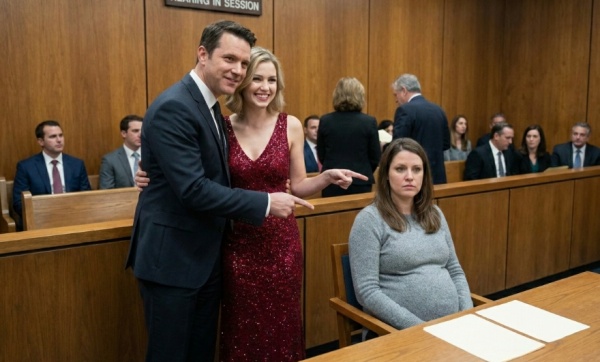
My Husband Divorced His Pregnant Wife in the Morning and Planned to Marry His Mistress at Night. I Smiled Through the Divorce—Because My Husband Had No Idea What He Was About to Lose…
Eight months pregnant, Grace sat quietly in court while her husband divorced her and prepared to marry his mistress that same evening. Everyone thought she was the humiliated wife being replaced before the baby was even born. But Grace wasn’t broken—she was prepared….
PART 1 — The Smile Nobody Understood
Eight months pregnant, Grace Whitaker sat in the Clark County courthouse in Las Vegas with both hands folded gently over her belly.
Across the room, her husband, Preston Hale, could not stop checking his watch.
He wore a tailored charcoal suit, polished black shoes, and the impatient expression of a man who believed he was standing at the finish line of an unpleasant race. Beside him sat Vanessa Monroe, his mistress, dressed in ivory even though she was not yet the bride.
Grace noticed the dress immediately.
It was not white enough to be obvious, but it was close enough to be cruel.
Vanessa wanted Grace to see it. She wanted Grace to understand that the divorce hearing was only the morning event. By sunset, Preston and Vanessa planned to stand inside a luxury chapel on the Strip and exchange vows under crystal chandeliers while Grace went home alone, unmarried and heavily pregnant.
At least, that was what they thought.
The courtroom smelled like old paper, stale coffee, and floor cleaner. A young couple whispered nervously near the back row. An older man in a cowboy hat scrolled through his phone while his attorney reviewed a stack of forms.
Grace sat still.
She had learned stillness from pain.
For months, everyone around her had expected her to break. Preston expected tears. Vanessa expected humiliation. Even Grace’s own friends expected her to fall apart after discovering that her husband of five years had been having an affair with the woman he called his “brand consultant.”
But Grace did not cry in court.
She smiled.
Not widely. Not dramatically. Just a small, calm smile that irritated Preston more than screaming ever could have.
He leaned toward his attorney and whispered something. His attorney glanced at Grace, then quickly looked away. Vanessa saw the smile too, and her lips tightened.
Grace knew what they were thinking.
Poor Grace.
Abandoned at eight months pregnant.
Divorced before lunch.
Replaced before dinner.
They thought she was smiling because she was in denial. They thought pregnancy had made her emotional, fragile, maybe even confused. They had always mistaken her quietness for weakness, which was the first mistake foolish people make around quiet women.
The judge entered, and everyone stood.
Grace rose slowly, one hand pressing against the small of her back. The baby shifted beneath her ribs, a firm little roll that made her inhale carefully. Her attorney, Diane Porter, touched her elbow.
“Are you okay?” Diane whispered.
Grace nodded.
“I’m fine.”
Preston heard her and almost laughed.
Fine.
He used to hate that word when Grace said it. To him, “fine” meant passive aggression. To Grace, it meant she had already decided not to waste energy explaining herself to someone committed to misunderstanding her.
The hearing began.
It was supposed to be simple. Nevada allowed the divorce to finalize quickly because both parties had agreed to the terms. Preston had pushed for speed, claiming he wanted “closure” before the baby arrived.
Grace knew the real reason.
Vanessa was pregnant too.
At least, that was what she had told Preston.
She was three months along, or so she claimed, and she had convinced him that marrying before the baby was born would “make things respectable.” Preston, always obsessed with image, had agreed immediately.
That was his second mistake.
He believed the appearance of respectability could replace the reality of character.
The judge reviewed the agreement. Preston kept his personal investment accounts, his sports car, and his position as CEO of Whitaker Hospitality Group, the company originally founded by Grace’s late father. Grace kept the Henderson house, her personal savings, and certain separate assets listed under the Whitaker family trust.
On paper, it looked like Preston had won.
That was the illusion he needed.
For five years, he had called himself the man who saved the Whitaker business. He told investors he had modernized a sleepy family company. He told Vanessa he had built everything Grace inherited and that Grace was “sweet but not strategic.”
Grace had let him talk.
She had let him sit in boardrooms, accept awards, attend charity galas, and introduce himself as the future of the company her father had built from a single roadside motel outside Reno.
She had let him believe he was holding the keys.
But what nobody in that courtroom knew—except Grace, Diane, and one elderly man sitting silently in the back row—was that Preston had never owned the lock.
That elderly man was Arthur Bell, trustee of the Whitaker Family Trust and her father’s oldest friend.
He sat with a cane across his lap, silver hair combed neatly back, looking harmless enough to be ignored. Preston had ignored him for years. Vanessa did not know who he was at all.
Grace felt the baby move again.
Her son.
The son Preston had dismissed as “bad timing” when Grace first told him she was pregnant. The son he later tried to use as leverage, pretending he cared about custody while privately telling Vanessa he hoped Grace would “make it easy.”
Grace remembered that conversation because she had heard the recording.
Legally obtained.
Properly preserved.
One of many.
Diane had advised her to document, not react. So Grace documented. She saved emails, credit card statements, calendar entries, hotel invoices, corporate expense reports, text messages, and voice notes Preston sent in careless moments when he thought she was too heartbroken to think clearly.
Heartbreak had not made Grace careless.
It had made her precise.
The judge looked up.
“Mrs. Hale, you have reviewed and signed the settlement agreement voluntarily?”
Grace stood.
“Yes, Your Honor.”
“And you understand that once entered, this decree dissolves the marriage?”
“Yes, Your Honor.”
Preston looked at her then.
For one brief second, their eyes met.
Grace remembered the man he had pretended to be when they first met at a hospitality conference in San Diego. Charming. Ambitious. Attentive. He had listened when she spoke about her father’s company, or at least he had seemed to.
Later, she realized he had not been listening to her.
He had been studying the door she could open.
The judge turned to Preston.
“Mr. Hale?”
Preston straightened.
“Yes, Your Honor. I understand.”
The judge signed.
Just like that, the marriage ended.
No thunder. No dramatic music. No gasp from the audience. Just a pen moving across paper and five years of vows becoming a legal record.
Vanessa squeezed Preston’s hand.
Grace saw it.
Then Vanessa looked directly at her and smiled.
It was a sharp smile, polished and mean. A smile that said, He chose me. A smile that said, You lost. A smile that said, By tonight, I’ll have his name, his bed, and his future.
Grace smiled back.
That made Vanessa’s smile falter.
Because Grace knew something Vanessa didn’t.
The divorce decree did not free Preston.
It triggered him.
And by the time he stood at the altar that evening, the world he thought he had won would already be cracking beneath his feet.
PART 2 — The Man Who Mistook Access for Ownership
Preston Hale had always loved rooms that made him feel important.
Hotel lobbies with marble floors. Private dining rooms with leather chairs. Boardrooms high enough above the city to make ordinary people look like dots on the sidewalk.
He had not grown up poor, exactly. His father sold insurance in Phoenix, and his mother taught elementary school. They had a decent house, two used cars, and summer vacations in San Diego if money was good that year.
But Preston grew up angry at “decent.”
He wanted more.
More money. More status. More attention from people who checked the labels on suits and the watches on wrists before deciding how much respect to offer.
Grace’s world had given him that.
When he married her, he stepped into the Whitaker name like a man putting on a custom-made coat. Suddenly, bankers answered his calls. Investors invited him to golf weekends. Local magazines described him as a “visionary young executive revitalizing a beloved Nevada hospitality brand.”
Grace stood beside him in the photos.
Quiet. Elegant. Supportive.
Exactly where he preferred her.
At first, Grace believed partnership meant letting him lead where he was strong. Preston had charisma, energy, and a hunger for growth. She had history, relationships, and a careful understanding of the company’s culture.
Her father, Samuel Whitaker, had trusted her judgment.
Before he died, he told her something she did not understand until much later.
“Baby girl,” he said from his hospital bed, voice thin but steady, “never confuse a man who loves your light with a man who loves standing in it.”
Grace had cried then because she thought he was simply being protective.
Now she knew he had seen Preston clearly.
The Whitaker Family Trust held the majority voting shares of Whitaker Hospitality Group. Grace was the primary beneficiary, but there were conditions, protections, and delayed control provisions written long before Preston entered her life.
Samuel Whitaker had been kind, not naive.
He had known that family businesses attracted people who smiled at daughters while measuring balance sheets.
Under the trust terms, Preston could serve as CEO only as long as he remained married to Grace or maintained board confidence after review. He did not personally own controlling shares. He had performance incentives, compensation, and limited equity options subject to conduct clauses.
Most importantly, the trust included a succession provision.
Upon the birth of Grace’s first child, Grace would become the controlling voting beneficiary, and the child would become the next-generation beneficiary of a protected share class. If Grace was divorced at the time of birth due to documented marital misconduct by the spouse, the former spouse would be permanently barred from managerial control or trust-related claims.
Preston had signed acknowledgments years ago.
He had not read them carefully.
Men like Preston rarely read documents when they believe charm is stronger than ink.
Grace did not discover the affair all at once.
It began with small insults to reality.
A receipt from a restaurant at the Wynn on a night Preston said he had dinner with investors in Dallas. A perfume scent in his car, floral and expensive. A second phone he claimed was for “international vendors.”
Then came Vanessa Monroe.
She arrived as a consultant during the rebranding of three boutique properties near the Strip. She was beautiful in a deliberate way, all smooth hair, confident posture, and Instagram-ready opinions. She called Preston “a natural empire builder” in meetings and laughed when he interrupted other people.
Grace noticed.
Women always notice.
At first, she asked Preston directly.
“Is something going on with Vanessa?”
He looked offended before he looked guilty.
“That is insulting,” he said.
Grace apologized.
That apology embarrassed her now.
By the time she was five months pregnant, the affair had become open enough that employees whispered when she walked into headquarters. Preston began staying late at the office. Vanessa’s invoices doubled. Corporate expenses became sloppy.
Grace hired a forensic accountant before she hired a divorce attorney.
That was not because she was cold.
It was because she was her father’s daughter.
The accountant found hotel stays, gifts, first-class upgrades, luxury spa charges, and consulting payments routed through departments Vanessa had no reason to bill. The total reached six figures before the review even touched vendor contracts.
Diane Porter, Grace’s attorney, did not smile when she saw the file.
“This is not just adultery,” she said. “This is financial exposure.”
Grace sat across from her, one hand on her belly.
“What can we do?”
Diane leaned forward.
“We do it cleanly. No social media. No threats. No emotional confrontations. We preserve records, notify the trustee, prepare the board, and let Preston continue believing he is smarter than everyone until the timing is right.”
The timing mattered.
If Grace confronted Preston too early, he might bury documents, pressure employees, or drag the divorce into an ugly public fight. If she waited until the decree was entered, the trust provisions became cleaner. His own rush to remarry would make his misconduct harder to minimize.
So Grace waited.
She attended prenatal appointments alone. She assembled the crib alone. She stood in the nursery at midnight, feeling her son kick while Preston texted Vanessa from the driveway.
Some nights, she hated him.
Some nights, she hated herself for ever loving him.
But every morning, she opened the documentation folder and reminded herself that truth did not need to be loud to be powerful.
Preston filed for divorce when Grace was seven months pregnant.
He called it “the kindest option.”
She almost laughed in his face.
Instead, she said, “If that’s what you want, I won’t fight you.”
His relief was insulting.
He thought she was surrendering because she still loved him. He thought she would accept less because pregnancy had made her afraid. He thought the Henderson house and a quiet settlement were enough to keep her from looking deeper.
Then Vanessa pushed him to schedule their wedding for the same day the divorce finalized.
That, Grace suspected, was Vanessa’s idea of victory.
A courthouse in the morning.
A chapel at night.
One woman erased.
Another woman installed.
When Diane heard the wedding date, she removed her glasses and said, “Well, that is useful.”
Grace raised an eyebrow.
“Useful?”
Diane nodded.
“Judges, boards, and trustees dislike cruelty when it comes with timestamps.”
So Grace signed the settlement.
She let Preston believe he had walked away clean.
She let Vanessa book flowers, a photographer, and a private dinner at a rooftop restaurant overlooking the Bellagio fountains.
She even let Vanessa post a vague caption that morning: New beginnings look good on people who are brave enough to choose happiness.
Grace saved that too.
Not because it mattered legally.
Because one day, when her son asked why his parents’ marriage ended, she wanted to remember that she had not imagined the cruelty.
By noon, Preston and Vanessa were celebrating.
By 1:30 p.m., Arthur Bell delivered the signed divorce decree to the trust attorneys.
By 2:15 p.m., the Whitaker board received notice of an emergency meeting.
By 3:00 p.m., Preston’s company email stopped syncing.
And at 4:07 p.m., while Vanessa was getting her makeup done for her wedding, Preston received a call from the board chair.
Grace was in her kitchen when Diane called with the update.
“It’s begun,” Diane said.
Grace closed her eyes.
Her son kicked once, firm and steady.
“Good,” she whispered.
PART 3 — The Wedding That Started Falling Apart Before the Vows
Vanessa had chosen a chapel inside one of the newer luxury hotels south of the Strip.
Not one of the cheesy neon chapels tourists used after too many margaritas. This one had white orchids, champagne service, a violinist, and a private terrace where the couple could take sunset photos with Las Vegas glowing behind them.
She wanted elegance.
She wanted proof that she had not been a mistress.
She wanted the world to see her as the woman Preston chose publicly.
At 5:12 p.m., she stood in the bridal suite while a makeup artist blended highlighter along her cheekbones. Her mother fussed with the back of her dress. Two friends from Los Angeles took videos for social media and whispered that Preston was “such an upgrade.”
Vanessa smiled at herself in the mirror.
She looked beautiful.
That mattered to her more than it should have.
Her phone buzzed with a text from Preston.
Need 20 minutes. Business issue. Don’t panic.
Vanessa frowned.
Business issue?
On their wedding day?
She typed back immediately.
Preston, the ceremony is at 6. Handle it later.
No response.
She waited three minutes.
Then five.
Then ten.
By 5:31, annoyance had become anxiety.
She called him.
He declined.
That was new.
Preston always answered her, especially when she was upset. That was one of the ways she convinced herself she had won. Grace might have been the wife, but Vanessa was the woman he interrupted meetings to call.
At 5:44, Preston finally entered the bridal suite.
He looked pale.
Not nervous-groom pale.
Ruined pale.
Vanessa stood quickly, ignoring the makeup artist’s protest.
“What happened?”
Preston shut the door behind him.
“We need to delay the ceremony.”
Her mother gasped softly.
Vanessa stared at him.
“Absolutely not.”
“Vanessa—”
“No. We are not delaying anything because your ex-wife made you feel guilty.”
His expression sharpened.
“This has nothing to do with guilt.”
“What, then?”
He looked at the other women in the room.
“Everyone out.”
Vanessa’s mother bristled, but Vanessa nodded. The makeup artist packed quickly. Her friends slipped out with wide eyes and phones clutched in their hands.
When the door closed, Vanessa crossed her arms.
“Talk.”
Preston loosened his tie.
“The board suspended me.”
Vanessa blinked.
“What board?”
He stared at her.
“My board, Vanessa.”
“The Whitaker board?”
“Yes.”
“But you run the company.”
“I ran the company.”
Her face changed.
“What does suspended mean?”
“It means they’re reviewing expense reports, vendor contracts, and my conduct.”
Vanessa’s mouth opened slightly.
“Because of Grace?”
“Because Grace has apparently been collecting documents for months.”
Vanessa stepped back as if the floor shifted.
“What documents?”
Preston did not answer.
He did not need to.
They both knew.
Hotel stays. Trips. Jewelry. Consulting invoices. The Scottsdale weekend. The Miami suite. The private dinner charged as investor relations. The “content strategy retreat” that included two spa treatments and no actual strategy.
Vanessa’s voice dropped.
“You told me she didn’t check financials.”
“I thought she didn’t.”
“You thought?”
Preston flinched.
That was not the tone he was used to from her.
For months, Vanessa had looked at him like he was a king. Now she was looking at him like a bad investment.
His phone buzzed again.
He read the message and swore under his breath.
“What now?” Vanessa demanded.
“My corporate card has been frozen.”
Her eyes widened.
“The card tied to tonight?”
Preston looked away.
Vanessa grabbed her phone and opened the hotel app.
The bridal suite deposit had cleared, but the remaining balance for the ceremony package, dinner, champagne, and terrace rental was pending authorization. She refreshed.
Declined.
She refreshed again.
Declined.
For a moment, neither of them spoke.
Downstairs, guests were arriving.
Preston’s college friends. Vanessa’s coworkers. A handful of investors who liked being near expensive celebrations. People who believed they were attending a triumphant love story, not a financial collapse with floral arrangements.
Vanessa whispered, “Fix it.”
“I’m trying.”
“With what money?”
Preston looked at her sharply.
“My personal account.”
“Use it.”
“It’s temporarily restricted pending legal review.”
Her face drained.
“Restricted?”
“My attorney says not to move funds until we understand the claims.”
Vanessa laughed once, high and brittle.
“Your attorney? Preston, I am standing here in a wedding dress.”
“I know.”
“No, I don’t think you do.” She pointed toward the hallway. “There are seventy people downstairs. My mother is downstairs. The photographer is downstairs. The officiant is downstairs. Do you understand how humiliating this is?”
Preston stared at her.
Something about that word—humiliating—made him think of Grace sitting in court that morning, eight months pregnant, smiling quietly while Vanessa wore ivory beside him.
For the first time all day, he wondered if Grace had known exactly what the evening would become.
His phone rang again.
This time, it was Arthur Bell.
Preston hesitated, then answered.
“Arthur,” he said, forcing his voice steady. “This is a bad time.”
Arthur’s voice came through dry and calm.
“I imagine it is.”
Preston stepped away from Vanessa.
“What do you want?”
“To inform you formally that pursuant to the trust’s governing documents and today’s finalized divorce decree, your eligibility for executive authority connected to Whitaker Hospitality Group is under immediate review.”
Preston closed his eyes.
“You can’t remove me like this.”
“We can,” Arthur said. “The board can. The trust can. Your employment agreement can. Your signature appears on all relevant documents.”
“I built that company.”
“No,” Arthur replied. “You managed what Samuel Whitaker built and Grace protected.”
Preston’s jaw tightened.
“You’re making a mistake.”
Arthur’s voice hardened.
“The mistake was yours. You mistook access for ownership.”
The line went dead.
Preston lowered the phone.
Vanessa stared at him, breathing fast.
“What did he say?”
Preston did not answer.
Because suddenly, he understood the structure of the trap.
No, not a trap.
A consequence.
Grace had not lied. She had not framed him. She had not tricked him into betraying her, misusing company funds, humiliating her publicly, or rushing into a same-day wedding while she carried his child.
She had simply stopped protecting him from the results.
A knock came at the door.
The wedding coordinator entered with a tight professional smile.
“Mr. Hale, Ms. Monroe, I’m sorry, but we need an updated payment method before proceeding.”
Vanessa looked at Preston.
Preston looked at the floor.
And just like that, the wedding began collapsing before the first vow could be spoken.
PART 4 — The Secret in the Trust
Grace did not watch the wedding fall apart in person.
She was home in Henderson, wearing soft maternity pants, eating toast with peanut butter, and sitting beside a folder that had taken months to build.
Her best friend, Amelia, sat across from her at the kitchen table.
Amelia was a nurse, a single mother of two, and the only person besides Grace’s legal team who had known almost everything from the beginning. She had wanted to throw Preston’s clothes into the pool months ago. Grace had asked her not to.
Now Amelia watched Grace calmly sip chamomile tea.
“You are terrifying,” Amelia said.
Grace smiled faintly.
“I’m tired.”
“No. Tired is when I fall asleep standing up after a twelve-hour shift. You are eight months pregnant, freshly divorced, and somehow more composed than a Supreme Court justice.”
Grace looked down at her belly.
“I had time to practice.”
Amelia’s expression softened.
That was true.
Grace had practiced not reacting when Preston came home smelling like Vanessa’s perfume. She had practiced breathing through contractions of fear when he stayed out overnight. She had practiced smiling politely at company dinners while employees avoided her eyes.
But the hardest practice had been imagining her son.
Not as a weapon.
Not as proof.
Not as the heir Preston did not know he was losing.
As a child.
An innocent baby who deserved a mother strong enough not to confuse revenge with protection.
That was why the secret had stayed secret.
The public secret was the trust provision. The business secret was the documentation of misconduct. The emotional secret was that Grace still had moments when she missed the man Preston had pretended to be.
But the most powerful secret was her son’s legal position.
Preston had assumed that divorcing Grace before the birth would separate him from the Whitaker family’s future while allowing him to negotiate custody later on his terms. He thought he could remarry, present Vanessa’s pregnancy as his new family, and treat Grace’s baby as an inconvenient obligation.
He was wrong.
Under state law, because the child had been conceived during the marriage, Preston would be presumed the father unless legally disproven. Under the trust, Grace’s child would activate the next stage of beneficiary control upon birth. Under the divorce documentation, Preston’s misconduct and financial behavior were now part of the record.
He could not erase the baby by divorcing the mother.
And he could not access the child’s trust rights by claiming fatherhood only when profitable.
Grace had made sure of that.
At 7:03 p.m., Diane called again.
“Are you sitting down?” she asked.
Grace glanced at Amelia.
“Yes.”
“The wedding did not proceed.”
Amelia slapped both hands over her mouth.
Grace closed her eyes.
Diane continued, “The venue required payment. Preston’s corporate card was frozen, personal liquidity appears restricted, and Vanessa’s family refused to cover the full balance. Guests left after about an hour.”
Amelia whispered, “Oh my God.”
Grace did not cheer.
She expected to feel satisfaction. Maybe triumph. Maybe the sharp sweetness people imagine when karma arrives wearing perfect timing.
Instead, she felt a strange heaviness.
Preston had destroyed their marriage, but there had been a time when she loved him deeply. She had once imagined him holding their baby in the nursery, sleepy and amazed. She had once believed they would grow old in a house full of family photos and holiday noise.
Watching consequences arrive did not erase the grief of what should have been.
“Anything else?” Grace asked.
Diane paused.
“Yes. Vanessa’s attorney contacted Preston’s attorney.”
Grace opened her eyes.
“Her attorney?”
“It appears Vanessa may be reconsidering the relationship.”
Amelia burst out laughing, then apologized immediately.
Grace did not laugh.
Vanessa had wanted Preston’s power, not Preston stripped of it. That did not make Vanessa unique. It made her predictable. People who fall in love with someone else’s throne rarely stay when the throne disappears.
Later that night, Preston came to the house.
Grace saw his headlights sweep across the front windows at 10:18 p.m.
Amelia stood immediately.
“Nope.”
Grace placed a hand on the table and pushed herself up carefully.
“It’s okay.”
“It is absolutely not okay.”
“He won’t come in.”
“How do you know?”
Grace looked toward the door.
“Because the locks were changed this afternoon.”
Amelia blinked, then smiled slowly.
“I love you.”
The doorbell rang.
Grace checked the security camera.
Preston stood on the porch, tie gone, hair disheveled, suit wrinkled. He looked like a man who had started the day as a groom and ended it as a defendant.
Grace answered through the speaker.
“What do you need, Preston?”
He looked up at the camera.
“Grace, please. Open the door.”
“No.”
His face tightened.
“This is still my house.”
“No,” she said calmly. “The divorce decree awarded me exclusive possession. Your belongings were delivered to the storage unit listed by your attorney.”
He stared at the camera.
“Grace.”
She heard exhaustion in his voice.
Good.
Exhaustion made people honest.
“I need to talk to you,” he said.
“You can email Diane.”
“I don’t want to talk to your lawyer. I want to talk to my wife.”
Grace was silent for a moment.
Then she said, “You divorced your wife this morning.”
He looked down.
The porch light cast harsh shadows across his face.
“I made a mistake.”
Grace almost closed her eyes.
There it was.
The sentence that always arrived late.
Preston continued quickly, “Vanessa pushed me. She made me think—”
“No.”
He stopped.
“Do not stand on my porch and blame her for choices you made repeatedly.”
His jaw worked.
“I lost everything today.”
Grace looked at him through the small screen.
“No. You lost what was never yours.”
He flinched.
Arthur’s words had found him twice.
“I built that company,” he said, but even he sounded less convinced now.
Grace’s voice remained steady.
“My father built that company. I protected it. You used it.”
Preston pressed a hand against his forehead.
“What happens now?”
“Now you cooperate with the audit. You communicate through attorneys. You prepare for a paternity and parenting process after the baby is born. And you stay away from this house unless invited.”
His eyes lifted.
“The baby.”
Grace’s hand moved instinctively to her belly.
For the first time all day, Preston looked at her pregnancy not as an inconvenience or embarrassment, but as something powerful.
Something he could not control.
“Grace,” he whispered, “is it a boy?”
She felt pain then, sharp and unexpected.
He had known the answer. She had told him at the anatomy scan months ago. He had been on his phone when the technician said it.
“Yes,” she said.
His face crumpled slightly.
“I forgot.”
“I know.”
Those two words were quieter than anger and more devastating than accusation.
He took one step closer to the door.
“Can I—can I be there when he’s born?”
Grace swallowed.
The question hurt because once, the answer would have been yes without hesitation. Once, she would have wanted his hand in hers, his voice beside her, his tears when their son cried for the first time.
Now she pictured herself in labor, vulnerable and afraid, with Preston in the room turning her pain into another opportunity to center himself.
“No,” she said.
He closed his eyes.
“That’s my son.”
“He is a child,” Grace replied. “Not a key back into my life.”
Preston stood there in the porch light, finally understanding that some doors do not reopen simply because regret knocks.
After a long silence, he said, “Did you know this would happen today?”
Grace looked through the camera at the man who had mistaken her silence for surrender.
“Yes,” she said.
He let out a broken laugh.
“You smiled in court.”
“I did.”
“Why?”
Grace’s voice softened, but not with forgiveness.
“Because I knew the truth was already moving.”
Then she ended the call.
Preston remained on the porch for almost five minutes.
Then he walked back to his car alone.
PART 5 — The Child Who Changed the Balance
Grace’s son was born three weeks later, just after sunrise.
She named him Samuel James Whitaker.
Samuel for her father.
James because she had always loved the name.
Whitaker because Diane confirmed she had every legal right to give her child her family name, and because Grace wanted her son’s first paperwork on earth to carry the name of the people who had stayed.
Labor lasted seventeen hours.
Amelia was on one side. Grace’s mother was on the other. Diane was not in the delivery room, of course, but she texted once during early labor: You are allowed to protect your peace today. Nothing else matters.
Preston was not there.
He found out through his attorney after Samuel was born.
Grace allowed a formal notice. She allowed confirmation that the baby was healthy. She allowed the legal process to begin.
She did not allow him into the hospital room.
That was not punishment.
That was recovery.
Samuel was seven pounds, two ounces, with dark hair, a strong cry, and one tiny fist that opened and closed against Grace’s chest as if he had arrived ready to negotiate with the world.
When the nurse placed him in her arms, Grace cried for the first time in months.
Not quiet tears.
Real tears.
The kind that came from a place deeper than betrayal.
Her mother kissed her forehead.
“He’s beautiful,” she whispered.
Grace looked down at her son.
“Yes,” she said. “He is.”
Two days later, while Grace was still in the hospital learning how to feed, swaddle, and survive on twenty minutes of sleep, the Whitaker board completed its emergency action.
Preston was terminated for cause.
The public statement was brief.
Whitaker Hospitality Group has appointed Grace Whitaker as Executive Chair and interim CEO, effective immediately. The company thanks former CEO Preston Hale for his service and wishes him well.
Wishes him well.
Corporate language could bury an earthquake under a napkin.
The private consequences were less polite.
The audit identified improper expense classifications, unauthorized vendor payments, and conflicts of interest related to Vanessa’s consulting contracts. The company referred certain findings to outside counsel. Preston’s bonuses were frozen pending review. His equity options were canceled under the conduct clause.
Vanessa disappeared from social media for eleven days.
When she returned, her profile had been scrubbed of Preston.
No wedding photos.
No chapel posts.
No captions about choosing happiness.
Grace noticed only because Amelia showed her while sitting beside the hospital bed eating vending machine pretzels.
“Want to see something petty but satisfying?” Amelia asked.
Grace shook her head.
“No.”
Amelia put the phone away.
“Healthy choice. Annoying, but healthy.”
Preston requested to meet Samuel when the baby was two weeks old.
Grace’s attorney arranged the first visit at a family visitation center, with clear boundaries and a neutral professional present. Preston arrived early, wearing a plain blue shirt instead of a suit. He looked thinner, older, and far less certain of himself.
Grace brought Samuel in a gray car seat.
For a moment, Preston could only stare.
“He looks like your father,” he said softly.
Grace did not answer.
The supervisor explained the guidelines. Preston nodded through all of them. No arguments. No entitlement. No dramatic speeches.
When he held Samuel for the first time, his hands shook.
Grace watched carefully.
Part of her wanted to feel nothing.
She did not get that luxury.
Watching the man who broke her heart hold their son was painful in a way no legal victory could soften. Samuel was innocent. Preston was flawed. Grace was human. There was no clean emotional category for any of it.
Preston looked down at the baby and whispered, “Hi, Samuel.”
The baby yawned.
Preston’s eyes filled.
“I’m sorry,” he said.
Grace stiffened.
The supervisor glanced at him.
Preston looked at Grace, then back at the baby.
“I know that doesn’t fix anything,” he said. “I just needed to say it without asking you to make me feel better.”
Grace said nothing.
But she heard the difference.
Months passed.
Preston’s life did not magically repair itself. Vanessa did not come back. The audit did not vanish. His reputation in Las Vegas business circles became complicated, which is a polite way Americans describe someone powerful becoming inconvenient to invite.
He sold his sports car.
Moved into a two-bedroom apartment in Summerlin.
Started consulting for smaller hospitality groups that did not put his face on magazine covers.
The first time Grace saw the apartment during a custody evaluation, she was surprised by how ordinary it was. Beige walls. Rental carpet. A small crib in the second bedroom. A shelf with baby books still in plastic wrap.
It was not punishment.
It was reality.
Preston attended parenting classes. He paid court-ordered support on time. He communicated through the parenting app. He stopped asking Grace for emotional conversations she did not owe him.
That did not make him redeemed.
It made him consistent.
And consistency, Grace learned, was the only apology a child could actually use.
At Whitaker Hospitality, Grace stepped into leadership with a newborn at home and exhaustion in her bones.
People expected her to be a figurehead.
They were wrong.
She restructured the executive team, settled vendor issues, stabilized the company, and restored employee confidence by doing something Preston had never understood: listening before speaking. She visited properties in Reno, Henderson, and Lake Tahoe with Samuel sometimes sleeping in a carrier against her chest while managers briefed her on operations.
A business magazine eventually ran a profile titled: Grace Whitaker Reclaims Her Family Legacy.
She hated the word reclaims.
It implied she had lost it.
She had not.
She had simply waited until the truth could stand without needing her to shout.
One year after the courthouse divorce, Grace stood in the ballroom of the flagship Whitaker hotel in Las Vegas for the company’s anniversary gala.
She wore a midnight blue dress, simple diamond earrings that had belonged to her grandmother, and no wedding ring. Samuel was at home with Amelia, probably refusing bedtime with the determination of a future attorney.
Across the room, Arthur Bell raised a glass to her.
Grace smiled.
Not the courthouse smile.
This one was real.
During the reception, Preston arrived.
He had been invited only because the board agreed that as Samuel’s father and a former executive, his presence at a public event would be acceptable if he behaved appropriately. Grace had approved it after thinking for three days.
He approached slowly, holding a glass of sparkling water.
“Grace,” he said.
“Preston.”
He looked around the ballroom.
“You did well.”
She raised an eyebrow.
“I know.”
A small, sad smile crossed his face.
“I deserved that.”
“Yes.”
He nodded.
There was a time when Grace would have softened the moment for him. She would have made a joke, eased the tension, protected his ego from the sharp edge of her truth.
She did not do that anymore.
Preston looked toward the stage, where a photo of Samuel Whitaker, the company founder, appeared as part of a tribute slideshow.
“Your father would be proud,” he said.
Grace followed his gaze.
“Yes,” she said quietly. “I think he would.”
Preston swallowed.
“I used to think he never trusted me because he was old-fashioned.”
Grace looked back at him.
“He didn’t trust you because he was observant.”
The words landed.
Preston accepted them.
That was new.
After a moment, he said, “Samuel took three steps yesterday.”
Grace’s expression changed despite herself.
“He did?”
Preston nodded. “At my apartment. From the couch to the coffee table. I recorded it and sent it through the app.”
Grace checked her phone.
There it was.
A video from Preston.
Samuel wobbling forward, arms raised, laughing before falling onto the rug.
Grace watched it twice.
Her chest ached, but not from betrayal this time. From motherhood. From the strange generosity required to let a child have joy in places where the mother once found pain.
“Thank you for sending it,” she said.
Preston nodded.
“I know I missed the beginning,” he said. “I’m trying not to miss what I’m allowed to be here for.”
Grace studied him.
That was not enough to rewrite history.
But it was enough for the moment.
Across the ballroom, a reporter approached, and Preston stepped back.
“I won’t keep you.”
Grace nodded.
“Good night, Preston.”
“Good night, Grace.”
He walked away without asking for more.
That mattered.
Later, when Grace stood on the terrace overlooking the Strip, the city shimmered below her in gold, red, and electric blue. Las Vegas was loud even from above, all motion and appetite, a place where people came to reinvent themselves, lose themselves, marry too quickly, gamble too much, and wake up to consequences wrapped in sunlight.
Grace placed one hand on the railing.
One year ago, she had sat in court eight months pregnant while her husband divorced her and prepared to marry his mistress the same day.
People thought she had lost.
They saw the belly, the quiet smile, the other woman in ivory, the husband checking his watch. They saw a discarded wife and assumed the story had ended.
But Grace had been carrying more than a child.
She had been carrying evidence.
She had been carrying her father’s legacy.
She had been carrying the legal key to a company Preston thought he owned.
Most of all, she had been carrying the one future he could not control.
Her son.
The secret was never revenge.
It was truth.
And truth, when documented carefully and delivered at the right time, does not need to scream.
It simply arrives.
It signs the papers.
It freezes the cards.
It opens the trust.
It removes the man who mistook betrayal for victory.
And sometimes, it is born at sunrise, weighing seven pounds and two ounces, with dark hair, a strong cry, and a mother’s last name.
Grace looked out over the city and smiled again.
This time, nobody misunderstood.
Because she was not smiling through defeat.
She was standing inside everything they thought they had taken from her.
And it was still hers.
