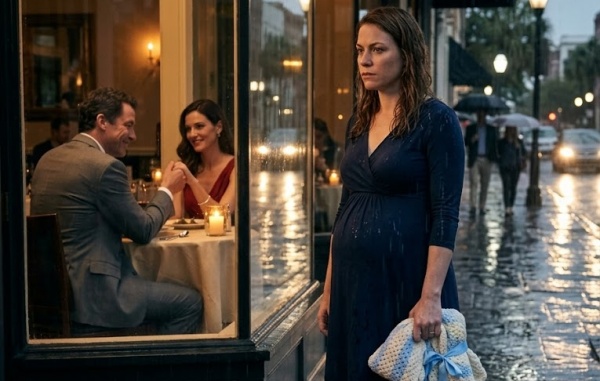
Seven Months Pregnant, My Husband Said He Was at a Business Dinner anh he texted me, “Don’t wait up”—But I Found Him on a Date… Daniel told me he was meeting investors, so I brought a baby blanket to surprise him and remind him what was waiting at home. Then I saw the truth through the restaurant window: candlelight, wine, another woman’s hand in his. I didn’t scream, didn’t walk in, and didn’t make a scene. I simply went home, packed a bag, and by morning, my silence had become the one thing he couldn’t control.
Part 1: The Blanket in My Hands
At seven months pregnant, I still believed my marriage could be saved.
That sentence sounds foolish now, but hope has a way of making smart women ignore obvious doors closing in front of them. I was thirty-two, swollen in the ankles, tired in the bones, and still folding tiny onesies in a nursery painted pale green because I thought love could come home if I made the house warm enough. My husband, Daniel Brooks, had been distant for months, but I kept telling myself he was scared.
Men got scared before babies, people said.
They worked late. They went quiet. They stared at ultrasound photos like they were looking at a future too big to hold.
So I forgave the missed appointments. I forgave the dinners gone cold. I forgave the way he rolled over at night when our son kicked hard enough for the mattress to move.
That Friday evening in late October, I wrapped a handmade baby blanket in white tissue paper and tied it with a blue ribbon. My mother had crocheted it before she died, back when I was nineteen and nowhere near motherhood. She had made it “for someday,” because my mother believed in someday the way other people believed in weather forecasts.
The blanket was soft cream cotton, edged in navy, with one tiny crooked star in the corner where she had lost count of the stitches.
I had found it in a cedar chest two weeks earlier and cried so hard I had to sit on the nursery floor. Daniel had not been home that night, of course. He had texted that a client dinner ran late, and I had replied with a heart emoji because pregnant women sometimes become experts at pretending not to know.
But that Friday, I decided to surprise him.
Daniel had told me he would be at a business dinner at Harbor & Ash, an upscale restaurant in downtown Charleston, South Carolina. He worked in commercial real estate and claimed the dinner was with two investors from Atlanta. I imagined walking in, placing the blanket in his hands, and reminding him that somewhere beyond contracts and square footage, a family was waiting.
I wore a navy maternity dress, low black flats, and the pearl earrings Daniel had given me on our first anniversary. My back hurt before I even left the house, and the baby pressed under my ribs like he objected to the plan. Still, I drove twenty-five minutes from our neighborhood in Mount Pleasant, rehearsing a soft little speech at every red light.
I wanted to say, “I know things have been hard, but we can still choose each other.”
I wanted to say, “Our son deserves parents who tried.”
Mostly, I wanted Daniel to look at me the way he had at our wedding, like I was the only person in the room.
Harbor & Ash sat on a corner near King Street, all dark windows, warm brass lights, and valet parking. The kind of restaurant where the hostess remembered names and the menu did not list prices for market seafood. Rain had started by the time I pulled up across the street, soft at first, then steady enough to blur the windshield.
I held the wrapped blanket against my chest and waited for a break in traffic.
Then I saw him.
Daniel sat by the front window at a table for two.
Not with investors from Atlanta.
With a woman in a red dress.
She was beautiful in a sharp, polished way, with dark hair swept over one shoulder and gold hoops catching the candlelight. Daniel leaned toward her, laughing with his whole face. Not the tired smile he gave me at home, not the polite one he used with clients, but the easy laugh of a man who felt free.
Then he reached across the table and took her hand.
The world did not shatter loudly.
It narrowed.
The rain, the traffic, the music from a passing car, the ache in my lower back—all of it seemed to move far away. I stood on the sidewalk with my mother’s baby blanket in my hands and watched my husband trace his thumb over another woman’s fingers while I carried his child.
He looked happy.
That was the part that cut deepest.
Not guilty. Not conflicted. Not trapped.
Happy.
A waiter brought them wine. Daniel lifted his glass, said something, and the woman laughed. Then she touched her stomach, not pregnant, just laughing, relaxed, careless, as if her body had not become a battlefield of stretch marks, nausea, heartburn, and fear.
I looked down at my own belly.
Our son moved once, a slow roll beneath my ribs.
For a moment, I thought about walking inside. I imagined the hostess greeting me, Daniel’s face draining of color, the woman pulling her hand back. I imagined placing the blanket on the table between them and saying, “This is what you forgot.”
But I did not move.
My mother used to say silence was not weakness if you chose it on purpose.
So I stood there in the rain and made myself watch for one full minute. I wanted my heart to understand what my mind had been trying to explain for months. Daniel was not lost, overworked, or afraid.
He had chosen somewhere else to be gentle.
When I finally turned away, I did not cry.
Not yet.
I walked back to my car, set the blanket carefully on the passenger seat, and sat behind the wheel until my hands stopped trembling. My phone buzzed in my purse.
A text from Daniel.
Dinner running late. Don’t wait up. Love you.
I stared at the words until they looked like a language I no longer spoke.
Then I typed back:
Okay. Drive safe.
I did not add a heart.
By the time I got home, the rain had soaked the hem of my dress. The house was quiet, warmly lit, and painfully ready for a family. There were baby bottles drying beside the sink, a half-assembled stroller in the foyer, and a stack of parenting books Daniel had never opened.
I carried the blanket upstairs to the nursery.
The room smelled like fresh paint, baby detergent, and hope that had not yet learned to protect itself. I sat in the rocking chair, placed the wrapped blanket in my lap, and finally let myself cry. Not loudly, not dramatically, but with one hand over my mouth so the sound would not fill the room meant for my son.
At 11:43 p.m., Daniel came home.
I heard the garage door open, then his keys, then his shoes crossing the kitchen tile. He paused at the bottom of the stairs, probably seeing the hall light still on. For one wild second, I thought he might come upstairs and confess.
Instead, he called softly, “Em?”
I wiped my face with the sleeve of my dress. “In the nursery.”
He appeared in the doorway wearing the same gray suit I had seen through the restaurant window. His tie was loose, and his hair was damp from rain. He smelled faintly of expensive wine and another woman’s perfume.
His eyes went to my wet dress.
“Why are you still dressed?” he asked.
I looked down at the blanket in my lap. “I was going to surprise you.”
“With what?”
I untied the blue ribbon and unfolded the tissue paper. The blanket lay between my hands, soft and small, the crooked star in the corner visible beneath the nursery lamp. Daniel stared at it like he was trying to decide what expression belonged on his face.
“My mom made it,” I said. “For someday.”
His face softened, but not enough.
“That’s beautiful,” he said.
I waited.
He did not ask why I had been outside in the rain. He did not ask what time I went. He did not ask where I had planned to bring it.
He just stood there, hoping the moment would pass without a cost.
I folded the blanket again. “How was dinner?”
His eyes flickered. “Fine. Long.”
“With the Atlanta investors?”
“Yeah.”
“Just the investors?”
The room changed.
Daniel looked at me carefully, the way people do when they are trying to find the leak before the ship goes down. “What do you mean?”
I looked at my husband, at the man whose child pressed against my ribs, at the father-to-be who had laughed under candlelight while I stood outside holding my mother’s last gift.
“I mean,” I said quietly, “did they like the wine?”
His face lost color.
That was how I knew.
He did not confess because he was sorry. He confessed because he had been caught.
“Emily,” he said.
I held up one hand. “Not tonight.”
“We need to talk.”
“No. Tonight, I need to sleep. Our son needs me calm. You can sleep in the guest room.”
His jaw tightened. “Don’t do that.”
“Do what?”
“Act like I’m a stranger.”
I looked at him for a long time.
“You made yourself one.”
He flinched.
Then, because Daniel was Daniel, pain quickly became irritation. “It’s complicated.”
“No,” I said. “Pregnancy is complicated. Marriage is complicated. Lying is simple.”
He looked toward the crib, then back at me. “Her name is Vanessa.”
I almost laughed at the absurdity of learning her name while sitting in my son’s nursery.
“I didn’t ask.”
“She’s a client.”
“I didn’t ask that either.”
He rubbed his face. “I didn’t mean for it to happen.”
“No one ever does,” I said. “They just make a hundred little choices and call the result an accident.”
Daniel stepped into the room. “Emily, please.”
I stood carefully, one hand braced on the rocking chair. At seven months pregnant, even heartbreak had to wait for me to get my balance.
“Leave the room,” I said.
His eyes hardened. “This is my house too.”
I looked around the nursery. The crib I had chosen. The dresser I had painted with my sister. The tiny socks I had washed and folded. The books I had placed on the shelf with Daniel’s childhood baseball glove because I wanted our son to know every soft version of his father.
“Then go stand in another part of it,” I said.
For once, he had no answer.
He left, and I closed the nursery door.
At 12:18 a.m., I called my older sister, Rachel.
She answered on the second ring, voice thick with sleep. “Em? Is the baby okay?”
“The baby is okay.”
“What happened?”
I looked at the blanket in my hands.
“I saw Daniel with another woman.”
There was a silence so sharp it almost sounded like breaking glass.
Then Rachel said, “Pack a bag. I’m coming.”
Part 2: The Quietest Woman in the Room
Rachel arrived at 1:07 a.m. in sweatpants, rain boots, and the kind of fury only an older sister can carry safely through a storm.
She lived twenty minutes away in West Ashley with her husband and two children, but she drove like every traffic law had personally offended her. When I opened the front door, she wrapped me in her arms before saying a word. I did not realize how badly I needed to be held until I started shaking.
Daniel came out of the guest room wearing a T-shirt and gray sweatpants.
Rachel looked at him once.
“Go back in there,” she said.
Daniel blinked. “This is between me and Emily.”
Rachel smiled without warmth. “Then you should have kept it between you and Emily.”
He looked at me. “Are we really doing this?”
I stared at him.
It was strange how quickly a person could become unfamiliar. Twelve hours earlier, I had still been imagining a repaired marriage. Now Daniel looked like a man standing in a house he had already chosen to leave, angry that someone noticed before he could control the story.
“I’m going to Rachel’s,” I said.
His expression changed. “You can’t just leave.”
“I can.”
“You’re seven months pregnant.”
“I know. I was there when it happened.”
Rachel snorted, then covered it poorly.
Daniel stepped closer. “Emily, I made a mistake. I’ll end it.”
The words should have meant something.
Instead, they sounded like a man trying to cancel a dinner reservation.
“How long?” I asked.
He looked down.
That answer was enough, but I waited.
“Four months,” he said.
Four months.
That meant he had started seeing Vanessa around the time I began feeling the baby kick regularly. While I was lying in bed placing his hand on my stomach, hoping he would feel connected, he was building a secret life with another woman. While I was reading reviews for car seats, he was reading messages that made him smile in the bathroom.
Rachel’s face went pale with rage.
I stayed calm.
That frightened Daniel more.
“Four months,” I repeated.
“It wasn’t like that at first.”
“It never is.”
“She understood what I was going through.”
I placed one hand over my belly. “And what exactly were you going through, Daniel?”
He swallowed. “Pressure.”
The word hung there, pathetic and small.
Pressure.
I wanted to ask if he knew what it felt like to wake up at 3 a.m. because your hips hurt and your baby had not moved in an hour. I wanted to ask if he knew what it felt like to pee every twenty minutes, cry over insurance forms, work full-time while nauseous, and still thank your husband for bringing home takeout once a week like he had performed a miracle.
But I did not.
Because women waste years trying to make careless men understand pain they already chose to ignore.
Instead, I went upstairs with Rachel and packed.
I packed maternity leggings, underwear, prenatal vitamins, my laptop, the hospital folder, two nursing bras, and the handmade blanket. Rachel packed faster than I did, yanking drawers open and muttering things she would never say in front of her children. Daniel stayed downstairs, probably calling someone or pacing like a man trapped in consequences.
When we came down, he stood in the foyer.
“Please don’t do this tonight,” he said.
I looked at the clock on the wall.
2:03 a.m.
“Tonight was already chosen for me.”
He reached for my suitcase, but Rachel stepped between us.
“Don’t touch her things,” she said.
Daniel’s face reddened. “I’m her husband.”
“Then act like one from a distance.”
I almost smiled.
Rachel loaded my suitcase into her SUV while I stood under the porch light. Rain still fell over the neighborhood, silver in the dark. Daniel came to the doorway but did not step outside.
“Emily,” he said quietly. “What are you going to do?”
That was the question.
He thought I would scream, call his mother, post something online, throw his clothes on the lawn, or send Vanessa a message full of pain. Maybe he wanted that. If I behaved badly, he could make my reaction the story instead of his betrayal.
I looked at him through the rain.
“I’m going to make sure our son is born into peace,” I said.
Then I got into Rachel’s car.
I did not look back as we drove away.
At Rachel’s house, she made chamomile tea and set me up in the guest room. Her husband, Mark, appeared briefly in the hallway, looked at my face, and said, “I’ll take the kids to breakfast in the morning.” That was Mark’s way of offering kindness without making me explain my humiliation twice.
I slept for ninety minutes.
At 5:12 a.m., I woke with the baby pushing hard against my right side and my phone glowing on the nightstand. Daniel had called fourteen times. There were nine text messages, each more desperate than the last.
Please come home.
We need to talk before you tell people.
Don’t involve your sister.
I love you.
It was a mistake.
Then one that made everything inside me go still:
Don’t make this ugly. Think about custody.
Custody.
There it was.
Not concern. Not remorse. Not “Are you safe?” or “Is our son okay?”
A warning.
I took a screenshot.
Then another.
By sunrise, I had done three things.
First, I emailed my doctor and asked for a note documenting that I was safe, staying with family, and continuing prenatal care. Second, I moved half of the money from our joint checking account into a separate account in my name, leaving more than enough for household bills because I was angry, not reckless. Third, I called a family law attorney Rachel trusted.
Her name was Denise Walker.
She answered at 6:41 a.m., which told me Rachel had already warned her.
“Emily,” Denise said, voice calm and professional. “I’m sorry you’re going through this. Are you physically safe?”
“Yes.”
“Is the baby okay?”
“Yes.”
“Good. Then we proceed carefully.”
Carefully became the word that saved me.
Denise explained what not to do. Do not post publicly. Do not threaten Vanessa. Do not empty accounts. Do not block Daniel from medical information without legal guidance. Do not let him lure me into a private argument that could be twisted later.
“Document, don’t dramatize,” she said.
So I documented.
I saved the messages. I wrote down dates. I listed missed appointments, late nights, and the restaurant name. I photographed the blanket, not because it was evidence in a legal sense, but because I wanted to remember the exact object I carried when my last illusion ended.
At 7:18 a.m., Daniel received the first mark I left.
It was not a screaming voicemail.
It was an email from my attorney.
Denise wrote that all communication should go through counsel for the time being, that I was safe with family, that I would continue receiving medical care, and that no decisions about the baby, finances, or residence would be made under pressure or threats. It was polite, short, and devastatingly calm.
Daniel called me thirty seconds after reading it.
I did not answer.
Then he texted:
You got a lawyer? Seriously?
I looked at the message and felt something settle inside me.
Yes.
Seriously.
The quietest woman in the room had spoken.
She had just used letterhead.
Part 3: The Woman in the Red Dress
For three days, Daniel tried to become the victim of his own affair.
He sent long messages about stress, fear, fatherhood, and how I had “shut him out emotionally.” He said Vanessa made him feel seen during a time when everything at home had become about the baby. He said he never stopped loving me, which was apparently supposed to matter after four months of lying.
Denise told me not to respond.
So I did not.
Silence has a way of making guilty people louder.
By Monday, Daniel’s mother called Rachel’s house. I watched the phone ring from the kitchen table while Rachel buttered toast with unnecessary aggression. Linda Brooks had always been polite to me, but she believed her son’s version of events before she heard anyone else’s.
Rachel answered on speaker.
“Rachel, I need to speak with Emily,” Linda said.
“She’s resting.”
“My son is devastated.”
Rachel looked at me.
I shook my head once.
Rachel said, “Emily is seven months pregnant and found Daniel on a date with another woman. Devastation is not exclusive to your son.”
Linda went quiet.
Then she said, “Marriage is complicated.”
Rachel’s expression hardened. “So is pregnancy.”
I had to cover my mouth not to laugh, which felt wrong and wonderful at the same time.
Linda lowered her voice. “I don’t want this to become a legal mess.”
“That’s up to Daniel,” Rachel said.
“Emily should come home.”
“Emily should do whatever keeps her and the baby healthy.”
Linda sighed. “Daniel said she moved money.”
“Emily followed legal advice regarding marital funds.”
Another pause.
Then Linda asked the question everyone had been circling.
“Is she planning to keep him from his son?”
I took the phone from Rachel.
“No,” I said.
Linda inhaled sharply. “Emily.”
“I’m not keeping Daniel from his child. But I will not let anyone use this baby to threaten me back into a marriage built on lies.”
“That’s not fair.”
“Neither was Friday night.”
I hung up before my voice could break.
Later that afternoon, Vanessa emailed me.
I do not know how she got my address. Maybe Daniel gave it to her by accident, or maybe she found it through my freelance design website. The subject line was simple: I’m sorry.
I stared at it for ten minutes before opening it.
The message was four paragraphs long.
Vanessa wrote that she had been told Daniel’s marriage was “functionally over.” She wrote that he slept in a separate room, that I was emotionally distant, that we were waiting until after the baby was born to separate. She wrote that she never wanted to hurt another woman, especially a pregnant one.
I believed about half of it.
Not because Vanessa was innocent, but because Daniel had always been skilled at giving people just enough truth to make the lie comfortable.
At the end, she wrote:
I didn’t know you were still trying. I didn’t know you were going to surprise him. When he came back from the restroom and saw you outside, he panicked. That’s how I found out he had lied to me too.
I froze.
He had seen me.
Through the restaurant window, through the rain, while I stood there with the blanket in my hands, Daniel had seen me.
And he stayed.
I read the sentence again until my eyes burned.
He had seen his seven-months-pregnant wife standing outside in the rain, holding something wrapped in blue ribbon, and he had chosen to return to the table. He had chosen to finish dinner. He had chosen to come home hours later and pretend nothing had happened.
That was the moment my heart stopped negotiating.
A marriage can sometimes survive betrayal.
It cannot survive cruelty delivered with eye contact.
I forwarded Vanessa’s email to Denise.
Then, against legal advice but not against common sense, I replied with one sentence:
Thank you for telling me the truth. Please do not contact me again.
She did not.
On Tuesday, I went to my prenatal appointment with Rachel beside me. The nurse weighed me, checked my blood pressure, and asked if I felt safe at home. I almost said yes out of habit.
Then I remembered I was not at home anymore.
“I’m staying with my sister,” I said. “My husband and I are separating.”
The nurse did not flinch. She simply nodded and asked if I needed resources. That kindness nearly undid me.
The doctor said the baby looked healthy. He weighed about three pounds, kicked the Doppler twice, and refused to cooperate for a clear ultrasound profile. Rachel said he already had my stubbornness, which was reassuring since Daniel’s genes had been disappointing lately.
After the appointment, I sat in the parking lot with the new ultrasound photo in my hand.
This one was mine.
No restaurant window. No other woman. No lie waiting at home.
Just my son, grainy and curled, alive beneath my heart.
I drove past our house that evening because I needed to see it without entering. The porch light was on. Daniel’s truck sat in the driveway. The nursery window glowed upstairs.
For a second, grief hit me so hard I nearly pulled over.
That was my home.
My rocking chair. My baby’s crib. My mother’s blanket folded in Rachel’s guest room instead of the nursery where it belonged. My life had not moved because I wanted it to; it had been knocked off the table.
Then I saw Daniel step onto the porch with his phone to his ear.
He looked tired.
Good, I thought.
Then I hated myself for thinking it.
I did not want revenge. Not really. Revenge required keeping Daniel at the center of my life, and he had already taken up too much space. What I wanted was stability, dignity, and a birth plan that did not include wondering whether my husband was texting another woman between contractions.
The next morning, Denise filed for legal separation.
She also requested temporary orders regarding finances, residence access, medical communication, and a plan for the baby’s arrival. Everything was done through the proper channels. No drama online, no screaming in driveways, no public humiliation.
Daniel called it cold.
I called it adult.
At the temporary hearing two weeks later, I saw him for the first time since I left.
He wore a navy suit and the wounded expression of a man hoping a judge would mistake regret for reliability. His attorney described him as a devoted father-to-be who wanted to support his wife and unborn child. Denise calmly presented messages, timelines, and Daniel’s threat about custody.
The judge looked over her glasses at him.
“Mr. Brooks,” she said, “your unborn child is not leverage.”
Daniel’s face reddened.
I looked down at my hands so he would not see the satisfaction in my eyes.
By the end of the hearing, I was granted temporary exclusive use of the house until delivery and recovery, with Daniel allowed scheduled times to collect personal belongings. Financial arrangements were set clearly. Communication about the pregnancy would happen through a co-parenting app or attorneys, not midnight emotional ambushes.
When we stepped into the hallway afterward, Daniel approached me.
Denise shifted closer, but I held up a hand.
Daniel stopped three feet away. He looked at my belly, then my face. His eyes were wet.
“Emily,” he said. “I’m sorry.”
I wanted that apology to matter.
I wanted the woman I had been on Friday afternoon to receive it, clutch it to her chest, and believe that sorrow could turn time backward.
But apologies do not erase a restaurant window.
“You saw me outside,” I said.
His face collapsed.
That was all the answer I needed.
I walked away.
Part 4: The Night Before Christmas
By December, I was back in the house.
It felt different without Daniel’s things. His golf clubs were gone from the garage. His shoes no longer crowded the mudroom. The framed photo from our honeymoon in Napa had been placed face down in a drawer because I was not ready to throw it away and not willing to look at it.
The nursery, though, stayed exactly as I had prepared it.
Rachel helped me wash everything again because she said betrayal had germs. Mark installed the car seat and pretended not to cry while tightening the straps. My nieces drew pictures for the baby, most of which included dinosaurs, rainbows, and one alarming shark.
I taped them above the changing table.
Daniel attended parenting classes because the temporary order encouraged it and because his attorney probably told him it looked good. He sent polite updates through the app. Sometimes he asked about the baby’s movement, and I answered with the facts.
He is active today.
Appointment went well.
Doctor says growth is normal.
No emojis.
No comfort.
Daniel tried sending flowers once.
I donated them to the nurses’ station at my OB office.
The hardest part was not missing him.
It was missing who I had been before I knew.
I missed the version of myself who still bought him his favorite coffee creamer, who texted him ultrasound photos with little captions, who believed a quiet marriage was simply tired, not hollow. I missed trusting the sound of the garage door opening at night. I missed not flinching when my phone buzzed.
But I did not miss begging for scraps of attention.
That realization came slowly, then all at once.
On Christmas Eve, Charleston turned cold enough for everyone to complain dramatically. It was forty-one degrees, windy, and clear, with holiday lights glowing along the streets. Rachel wanted me at her house for dinner, but I was thirty-five weeks pregnant and exhausted, so she brought dinner to me instead.
We ate baked ham, mashed potatoes, green beans, and store-bought pie in my kitchen.
Afterward, Rachel’s kids hung stockings by my fireplace for the baby, “just in case he came early and needed presents.” My nephew placed a tiny stuffed alligator inside one and announced it was from Santa. For the first time in weeks, I laughed without feeling guilty.
At 8:30 p.m., Daniel messaged through the app.
Can I drop off a gift for the baby? I won’t come in.
Rachel read it over my shoulder. “Absolutely not.”
But something in me paused.
Maybe it was Christmas. Maybe it was the baby shifting under my ribs. Maybe I needed to prove to myself that seeing Daniel would not turn me back into the woman who stood outside Harbor & Ash.
I replied:
You may leave it on the porch. Please do not ring the bell.
At 9:12, headlights swept across the front windows.
I stood in the hallway, one hand on the wall, listening. Footsteps crossed the porch. Something was set down gently. Then silence.
No knock.
No bell.
No plea.
After his truck pulled away, Rachel opened the door.
On the porch was a brown paper bag from a children’s boutique downtown. Inside was a tiny navy sweater, a board book about Charleston, and an envelope with my name on it. Rachel made a face.
“Do we burn it before or after pie?”
I took the envelope.
The letter was handwritten.
Daniel wrote that he had started therapy. He wrote that he did not expect forgiveness. He wrote that he had lied to Vanessa, lied to me, and lied to himself because he was terrified of becoming a father and not being good enough. He wrote that none of that excused what he did.
Then he wrote:
The worst thing I did was not the affair. It was seeing you outside that restaurant and choosing my own cowardice over your pain. I will live with that. I hope our son never learns to be that kind of man from me.
I sat down on the stairs.
Rachel’s face softened despite herself.
“Are you okay?” she asked.
“I don’t know.”
The letter did not fix anything. It did not make me want him back. It did not erase the red dress, the wine, the hand-holding, the lie about investors, or the custody text that followed.
But it was the first thing he had said that sounded less like strategy and more like truth.
I placed it in a folder with the legal papers.
Not as a keepsake.
As part of the record of who we were becoming.
That night, after Rachel’s family left, I sat in the nursery alone. The handmade blanket lay across the back of the rocking chair, waiting. My hospital bag sat by the door, packed with snacks, socks, paperwork, and a going-home outfit small enough to make my chest ache.
I picked up the blanket and pressed it to my face.
It smelled faintly of cedar and baby detergent.
“I’m sorry,” I whispered to my son.
Not because I had failed him.
Because he would enter a world messier than the one I had planned.
But maybe that was true for every child. Parents make nurseries with perfect lighting and matching baskets, then life walks in wearing muddy shoes. The promise is not that nothing breaks.
The promise is that someone safe will remain.
Two weeks later, my water broke at 3:26 a.m.
I was in bed, half asleep, when the first contraction rolled through me like a wave that did not ask permission. I called Rachel first, then my doctor. Then, after staring at the phone for almost a full minute, I sent Daniel a message through the app.
I am in labor. Rachel is taking me to the hospital. Updates will be sent when medically appropriate.
He replied within seconds.
I’m coming.
I did not answer.
At the hospital, everything moved fast and slow at once. Nurses checked monitors, Rachel braided my hair badly, and the doctor confirmed that my son had decided the world needed him before sunrise. Daniel arrived at 4:40 a.m., pale, breathless, and stopped at the doorway like he finally understood doors were not his to open anymore.
I looked at him between contractions.
“You can stay,” I said. “But if you make this about you, Denise will hear about it before the epidural wears off.”
The nurse’s mouth twitched.
Daniel nodded. “I understand.”
To his credit, he did.
He stayed quiet. He held ice chips when Rachel told him to. He stepped back when I needed space. He cried once in the corner and tried to hide it, which I pretended not to see.
At 6:03 a.m., our son was born.
Eight pounds, two ounces.
Twenty inches long.
Angry at the lights.
The nurse placed him on my chest, warm and furious, and the room changed shape around him. Every betrayal, every court document, every sleepless night became smaller than the weight of his tiny body against mine. Not gone, but smaller.
“Hello, Caleb,” I whispered.
Caleb James Brooks.
Daniel stood beside the bed, tears running down his face.
“He’s perfect,” he said.
I looked at our son, then at Daniel.
“Yes,” I said. “He is.”
Daniel reached out, then stopped.
For the first time, he asked.
“May I touch him?”
That nearly broke me more than anything else.
I nodded.
He placed one finger gently against Caleb’s tiny hand. Caleb wrapped his fingers around it with the unfair grace of newborns, making adults believe in redemption before they have earned it.
Daniel cried harder.
I did not comfort him.
But I did not take the moment away either.
By sunrise, Daniel had learned something he should have known all along.
The quietest woman in the room can leave the loudest mark.
Not by destroying a man.
By refusing to let him destroy her.
Part 5: The Mark I Left
Motherhood did not arrive like a movie ending.
It arrived with cracked nipples, hospital mesh underwear, three-hour sleep stretches, and crying in the shower because I could not remember the last time I felt like a person instead of a feeding station. Rachel stayed for the first week and ran my house like a military operation with casseroles. Mark assembled a bassinet in the living room and said nothing when I cried over a diaper commercial.
Daniel came by under the temporary schedule.
At first, his visits were stiff and supervised by the boundaries we had built. He washed his hands before touching Caleb, asked before picking him up, and left when the time ended. Sometimes I could see him wanting to say more, but he did not.
Good.
Words had done enough damage.
Vanessa sent one card after Caleb was born. It came to Denise’s office, not my house, which I appreciated. Inside, she wrote only: Wishing you and your son peace.
I did not respond.
Some doors can close without being slammed.
By spring, Daniel and I had a formal co-parenting plan in progress. The divorce filing came later, after I had healed enough to sit in an attorney’s office without feeling like my body might split open from grief and exhaustion. We divided property, accounts, furniture, and future responsibilities with far less drama than people expected.
Daniel wanted reconciliation once.
He said it during a mediation break, standing near a vending machine in a courthouse hallway downtown. He looked thinner, older, and more human than the man I had seen through the restaurant window. For a moment, I remembered loving him.
“I know I don’t deserve it,” he said. “But if there’s any chance—”
“No,” I said.
He closed his eyes.
I was not cruel about it. I did not list his failures like charges in court. I did not mention the red dress, the wine, or the way he held Vanessa’s hand while our son turned inside me.
I simply said, “I can forgive you one day and still never be your wife again.”
He nodded slowly.
That was the beginning of our real separation.
Not the night I left. Not the attorney’s letter. Not the hearing.
That moment.
Because Daniel finally understood that consequences were not punishments I invented. They were the shape of the world after trust had been broken.
Caleb grew fast.
By six months, he had Daniel’s dark eyes and my serious expression, which made him look like a tiny judge whenever someone interrupted his bottle. He loved ceiling fans, bath time, and sleeping only when I had something urgent to do. He hated peas with a moral conviction I respected.
Daniel became a better father than he had been a husband.
That was painful to admit, but true.
He showed up. He learned Caleb’s routines. He kept diapers in his truck and sent photos during visits without turning every message into a plea. He stopped asking me to soften the past so he could feel better about the present.
One afternoon in August, he brought Caleb home after a supervised visit with his parents. Linda waited in the car, probably because Rachel had once scared her into permanent caution. Daniel carried Caleb to the porch in a little blue romper, his diaper bag slung awkwardly over one shoulder.
“He ate four ounces,” Daniel said. “Napped forty minutes. Spit up on my shirt, but I’m choosing to see that as bonding.”
I almost smiled.
“Sounds accurate.”
He looked past me into the house. “How are you?”
There was no hidden meaning in it.
Just a question.
“Tired,” I said.
“Yeah.”
Caleb reached for me, and I took him. His warm weight settled against my chest, and for a second, Daniel watched us with an expression I could not name. Not ownership. Not resentment.
Regret, maybe.
But quieter than before.
“I found the blanket,” he said.
My body went still.
“What?”
“The one you brought that night. It was in a photo Rachel sent of Caleb. Cream with a blue edge.”
I looked down at my son.
“Yes.”
Daniel swallowed. “I didn’t know what it was when you showed me.”
“It was my mother’s.”
His face changed.
“Oh, Emily.”
I shifted Caleb higher on my hip. “Don’t.”
“I’m sorry.”
“I know.”
“No, I mean—”
“I know,” I said again.
This time, he stopped.
That was another mark I had left. Daniel had learned that apology was not a key. It did not automatically open the door he wanted. Sometimes apology was only a thing you placed on the porch and left there.
That night, after Caleb fell asleep, I unfolded my mother’s blanket across the rocking chair. The crooked star in the corner looked like a small, stubborn miracle. I thought of the version of myself who had carried it through the rain, hoping it would remind Daniel of home.
It had reminded me instead.
Home was not Daniel.
Home was not a ring, a mortgage, or a story other people recognized.
Home was wherever I could breathe without shrinking.
A year after the restaurant night, Harbor & Ash closed for renovations. I learned this because Rachel sent me a photo of the papered windows with the message, Even the restaurant needed to rethink its choices. I laughed so hard Caleb laughed too, though he had no idea why.
By then, I no longer drove around that block to test whether it still hurt.
Some wounds do not disappear. They become landmarks. You learn the route around them until one day you pass by and realize your hands are steady on the wheel.
On Caleb’s first birthday, we had a small party in Rachel’s backyard.
There were blue balloons, barbecue from a local place Mark loved, a smash cake, and children running barefoot through the grass. Daniel came for two hours with his parents and behaved like a guest, not a man expecting the room to rearrange around him. He brought Caleb a wooden train set and asked where to put the gift.
That simple question nearly made Rachel faint from shock.
At the end of the party, Daniel found me near the fence while Caleb smeared frosting into his hair.
“I wanted to say something,” he said.
I braced myself.
He looked toward our son. “You were right to leave.”
I said nothing.
“I hated you for it at first,” he admitted. “I told myself you were cold, dramatic, influenced by Rachel, whatever made me feel less ashamed. But you were right.”
The late afternoon sun sat low over the yard. Kids screamed near the sprinkler. Someone opened another cooler of soda.
Life continued around us, ordinary and miraculous.
Daniel looked at me. “If you had stayed, I would have kept becoming worse.”
I believed him.
That was the saddest part.
“I didn’t leave to teach you a lesson,” I said.
“I know.”
“I left because our son needed at least one parent who was honest about reality.”
He nodded.
For a moment, we watched Caleb together. He sat in the grass, sticky, happy, banging a plastic spoon against a paper plate like he had discovered music. He was not a symbol of our failed marriage. He was not proof of Daniel’s redemption or my strength.
He was simply Caleb.
That was enough.
When the party ended, Daniel helped carry folding chairs to Mark’s garage. Rachel watched him suspiciously, as if he might steal a lawn chair and use it to rebuild patriarchy. I told her to stop glaring before her face froze that way.
She said, “I’ll risk it.”
Later, after everyone left, I sat alone in Rachel’s yard with Caleb asleep against my chest. The evening smelled like cut grass, sunscreen, and birthday cake. My phone buzzed with photos from friends and family, dozens of images of my son laughing under blue balloons.
One photo stopped me.
Rachel had taken it without me noticing.
I was holding Caleb near the cake table, my hair loose, my face turned toward him, laughing. Across my shoulder was the cream blanket with the navy edge, the crooked star visible in the corner. I looked tired, softer than before, but not broken.
I looked like a woman who had walked through fire quietly and come out carrying what mattered.
I saved the photo.
Not for Daniel.
Not for court.
Not for proof.
For myself.
Because one day Caleb would ask about his parents, and I would tell him the truth in pieces gentle enough for his age. I would tell him we both loved him. I would tell him adults make choices, and choices have consequences. I would never make him responsible for healing what his father broke.
But I would also tell him this:
His mother was seven months pregnant when she learned the truth.
She could have screamed. She could have begged. She could have stayed because leaving was frightening, expensive, embarrassing, and hard. Instead, she chose peace before peace felt possible.
She carried a handmade blanket through the rain and came home with a broken heart.
Then she packed a bag.
She called her sister.
She called a lawyer.
She protected her child.
And by sunrise, Daniel learned that quiet women are only quiet until they decide the next chapter will be written without permission.
The mark I left was not destruction.
It was a boundary.
It was a nursery kept safe.
It was a court order instead of chaos.
It was a son born into truth instead of performance.
It was the sound of my own voice, calm and clear, saying no.
For years, I thought love meant holding a family together no matter how much it hurt. Now I know love sometimes means letting the wrong version of a family fall apart so the child can grow inside something honest. It means choosing dignity when drama would be easier, choosing paperwork when revenge would be louder, choosing silence when silence is strength.
Daniel laughed with another woman while I carried his child.
But he did not get the final laugh.
Because the life he treated carelessly became the life I guarded fiercely.
And the blanket I carried to save my marriage became the blanket that wrapped my son when I brought him home without it.
