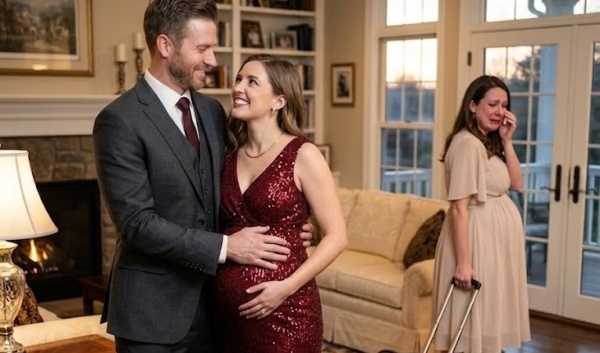
My Husband Chose His Pregnant Mistress Over Me. He Offered Me $50 Million to Leave—Until the Truth About Her Twins Came Out the Day My Son Was Born
For years, my husband made me feel broken because I couldn’t give him a child. Then his mistress got pregnant with twins, and he offered me $50 million to disappear quietly. What he didn’t know was that I was carrying his son when I signed those papers. And on the very day I gave birth, the truth about his mistress’s twins finally came crashing down.
Part 1: The Pearl Brooch
I knew something was wrong the moment I saw my pearl brooch pinned to another woman’s dress.
It was a late September afternoon in Greenwich, Connecticut, the kind of day when the maple trees looked like they were on fire and every mansion on the street seemed to be hiding a different kind of sorrow behind its iron gates. My husband, Grant Whitmore, had asked me to meet him in his attorney’s private conference room in Manhattan. He said it was “urgent” and “best handled like adults.”
I arrived ten minutes early because that was who I had always been: punctual, polished, controlled. I wore a cream wool coat, nude heels, and my mother’s diamond studs. My hands were steady when I stepped out of the black car, but my stomach had been twisting since morning.
The receptionist looked at me with the kind of pity people try to hide behind professionalism. She offered me sparkling water, then regular water, then coffee, as if caffeine could soften betrayal. I declined all of it and sat beneath a framed black-and-white photograph of the New York skyline.
When the conference room door opened, Grant came out first. He was tall, silver at the temples, and dressed in a navy Tom Ford suit that probably cost more than some people’s monthly rent. At forty-two, he still had the confidence of a man who believed money could clean up anything.
Behind him walked Savannah Bell.
She was twenty-seven, visibly pregnant, and wearing my pearl brooch.
For a moment, the entire office went silent in my head. I heard nothing but my own heartbeat, slow and heavy, like someone knocking from inside a locked room. The brooch rested just above her left breast, pinned to a pale blue maternity dress that hugged her round belly.
That brooch had belonged to my grandmother.
It was not expensive compared to the diamonds Grant had bought me over the years. It was not rare enough to be auctioned at Sotheby’s or written about in a luxury magazine. But my grandmother had worn it at her courthouse wedding in Boston in 1958, and my mother had worn it on the day she became an American citizen.
I had worn it the night Grant proposed.
Savannah touched it with two fingers and smiled at me.
“Hi, Eleanor,” she said softly, as if we were neighbors meeting at a charity luncheon.
I looked at Grant. “Why is she wearing that?”
His jaw tightened. “Let’s not start this way.”
“This way?” I repeated. “You brought your pregnant mistress to my divorce meeting wearing my family heirloom, and you’re concerned about my tone?”
Savannah’s smile faltered, but only for a second. She placed a protective hand over her belly, a gesture clearly meant to remind me of what she had and what I supposedly did not.
Grant sighed. “Eleanor, we need to be practical.”
That was Grant’s favorite word when he wanted to do something cruel without calling it cruel. Practical meant firing employees before Christmas. Practical meant canceling dinner with my parents because a senator invited him to golf. Practical meant asking his wife to endure humiliation quietly because public conflict could affect stock prices.
His attorney, Mr. Holloway, appeared behind him and cleared his throat. “Mrs. Whitmore, if you’re ready, we can begin.”
I walked into the conference room without answering.
The room had glass walls overlooking Midtown, a long walnut table, and chairs upholstered in gray leather. A folder sat at the seat across from Grant. My name was typed on the front in bold letters: ELEANOR WHITMORE — DISSOLUTION AGREEMENT.
Savannah sat beside Grant, not across from him, not at the far end of the table, but beside him. She leaned toward him in a way that suggested ownership. Her belly brushed the edge of the table.
I sat across from them and placed my purse on the floor.
Grant folded his hands. “I want to keep this civil.”
I almost laughed. Civil would have been telling me the truth before the newspapers began hinting at it. Civil would have been not letting me discover hotel receipts, burner phone messages, and a sonogram photo tucked inside the glove compartment of his Range Rover. Civil would have been not bringing her here.
But I said nothing.
Mr. Holloway slid the folder toward me. “The offer is extremely generous.”
Grant watched my face carefully, waiting for the tears, the begging, the collapse. He had always liked knowing what effect he had on people.
I opened the folder.
The number was printed on the second page.
$50,000,000.
Fifty million dollars.
Even in our world, it was a stunning number. Grant had built Whitmore Capital into a private equity empire, and his net worth had crossed into billionaire territory three years earlier. Still, fifty million dollars was not pocket change, even for him.
He leaned back in his chair. “That amount gives you freedom. A house anywhere you want. Security. Privacy.”
Savannah glanced at me, waiting for my reaction.
I looked at the number again. Then I turned the page.
There were conditions, of course. Grant never gave without taking twice as much back. I would vacate the Greenwich estate within thirty days. I would sign a strict nondisclosure agreement. I would make no public statements about the affair, the divorce, or Savannah’s pregnancy.
Most importantly, I would waive any future claim against Whitmore Capital, several properties, and the trust structures he had spent years protecting.
Grant’s voice softened into something almost insulting. “Eleanor, you and I both know this marriage hasn’t been what either of us hoped.”
I kept reading.
He continued, “Savannah is due soon. Twins. A boy and a girl.”
The words landed like stones, but not for the reason he thought.
Twins.
Savannah’s hand moved over her stomach again, slow and theatrical.
Grant said, “They deserve stability.”
I lifted my eyes. “And I don’t?”
His expression hardened. “You deserve a dignified exit.”
“A dignified exit,” I repeated.
Savannah looked down, pretending discomfort, but I saw the satisfaction tucked into the corner of her mouth. She wanted me to break. She wanted the scene, the screaming wife, the proof that Grant had chosen youth and fertility over bitterness and grief.
Grant leaned forward. “Fifty million dollars is generous compensation for a wife who couldn’t bear me children.”
The room went still.
Even Mr. Holloway looked at the table.
For nine years, Grant and I had been married. For six of those years, we had tried to have a child. I had endured hormone injections, blood tests, failed IVF cycles, procedures with names that still made my hands go cold. I had cried in bathrooms at baby showers, smiled through pregnancy announcements, and buried two early miscarriages in silence because Grant hated “public sadness.”
And now he had turned my pain into a negotiation point.
Savannah whispered, “Grant…”
But she did not sound horrified. She sounded pleased that he had said the quiet part out loud.
I closed the folder.
Grant’s eyes narrowed. “Eleanor?”
I looked at his attorney. “Where do I sign?”
For the first time that day, Grant looked surprised.
He had prepared for tears. He had prepared for anger. He had prepared for my lawyer to fight, for months of discovery, for headlines, for social circles splitting into camps.
He had not prepared for obedience.
Mr. Holloway blinked. “You may want independent counsel to review—”
“My attorney has already reviewed the preliminary terms,” I said.
Grant frowned. “What?”
I reached into my purse and removed a slim folder of my own. “I received the draft last week.”
His face changed.
Savannah sat up straighter.
I smiled politely. “You’re not the only one with lawyers, Grant.”
In truth, I had known for weeks that this moment was coming. A woman does not survive nine years beside a man like Grant Whitmore without learning to read silence. The sudden password changes. The late-night calls on the terrace. The housekeeper avoiding my eyes. The bank statements moved to a different accountant.
I had prepared quietly.
And I had prepared for one more reason.
A reason neither of them knew.
I was ten weeks pregnant.
Not through a clinic. Not through a donor. Not through hope measured in vials and appointments. Naturally, impossibly, after years of hearing words like “unlikely” and “diminished odds,” I was carrying Grant’s child.
I had found out two days after discovering Savannah’s pregnancy.
At first, I thought the universe had made a cruel joke. I sat on the bathroom floor holding three positive pregnancy tests, shaking so hard I could barely breathe. Then I realized something else.
This baby had come to me in the middle of betrayal.
Not as a bargaining chip. Not as proof of worth. Not as a way to save a marriage already rotting from the inside. This child was mine to protect.
Grant would never know until I decided he could.
If I decided he could.
I signed every page.
My signature looked elegant and calm, as if my heart had not been burning behind my ribs.
Grant stared at me. “That’s it?”
“That’s it.”
“You’re not going to fight?”
I capped the pen. “You wanted a dignified exit.”
Savannah looked unsettled now. Victory is less satisfying when the defeated refuse to bleed.
Grant leaned forward. “Where will you go?”
I picked up my purse. “Away.”
His voice sharpened. “Eleanor.”
I stood. “Congratulations on the twins.”
Savannah touched the brooch again. I stepped closer, and for a second, she looked nervous.
“That belongs to my family,” I said.
Grant exhaled. “Eleanor, it’s just a pin.”
I held out my hand.
Savannah looked at Grant. He gave a barely visible nod. Her fingers trembled as she unclasped it and dropped it into my palm.
The pearl was warm from her body.
I closed my fist around it.
Then I walked out of that conference room with fifty million dollars on paper, my grandmother’s brooch in my hand, and Grant Whitmore’s unborn son beneath my heart.
By midnight, I was on a flight to California.
And by morning, Grant learned I had not simply left him.
I had disappeared from the life he thought he controlled.
Part 2: The Woman Who Flew West
I landed in San Francisco just after sunrise, when the sky over the bay was pale pink and the city looked soft enough to forgive anyone. My best friend, Marisol Vega, met me outside baggage claim wearing leggings, a Stanford hoodie, and the expression of a woman prepared to commit crimes on my behalf.
She took one look at me and pulled me into her arms.
“You did it,” she whispered.
“I signed.”
“Good.”
“I didn’t cry.”
“Even better.”
Then she leaned back and looked at my face. “Did he suffer?”
I thought of Grant’s stunned expression, Savannah’s fingers fumbling with the brooch, the silence after he called fifty million dollars compensation. “Not yet.”
Marisol smiled. “Then we have something to look forward to.”
Marisol had been my college roommate at Northwestern, long before Grant, before private jets and gala committees and charity boards. She was now a family law attorney in California, sharp enough to cut glass and loyal enough to make enemies nervous. When I called her from the bathroom floor with the pregnancy tests beside me, she did not gasp or ask if I was sure.
She said, “Pack what matters. Call your doctor. And do not tell Grant.”
So I packed my grandmother’s brooch, my passport, my mother’s citizenship certificate, three cashmere sweaters, and a small silver baby rattle I had bought years ago during my first pregnancy. I left behind closets full of designer clothes and a mansion full of curated emptiness.
Marisol drove me south in her black Subaru, across the Golden Gate Bridge and into Marin County. The ocean appeared in flashes between green hills. Everything smelled like eucalyptus and salt.
“You’re staying in Mill Valley,” she said. “Quiet neighborhood. Good doctors. People mind their business if you look like you belong.”
“Do I look like I belong?”
“You look like a woman who just got paid fifty million dollars to stop pretending.”
For the first time in weeks, I laughed.
The house she had arranged was small compared to the Greenwich estate, but it felt alive. White walls, wide windows, a lemon tree in the backyard, and a kitchen that did not look designed for a magazine spread no one ever cooked in. There was a narrow deck overlooking redwoods.
I stood there with my hand on my stomach and breathed.
No staff. No cameras at the gate. No Grant pacing through rooms while shouting into his phone. No Savannah appearing in society photos wearing borrowed jewels and a smug smile.
Just quiet.
For three weeks, I lived like someone recovering from a storm. I went to appointments under my maiden name, Eleanor Hayes. I ate sourdough toast with avocado because the baby seemed to demand it. I walked slowly through neighborhoods where Halloween decorations appeared on porches and children rode scooters down sidewalks.
At night, I read books about pregnancy and tried not to panic.
Grant called every day for the first week.
I did not answer.
His messages began controlled.
“Eleanor, I understand you need space. Call me when you land.”
Then irritated.
“This disappearing act is unnecessary.”
Then suspicious.
“My office needs your forwarding address.”
Then angry.
“You signed an agreement. Do not make this difficult.”
Marisol listened to each voicemail and saved them.
“Do I have to respond?” I asked.
“No,” she said. “Your attorney will respond when necessary.”
“What if he finds me?”
“He may. Wealthy men are not wizards. They just hire expensive people to do ordinary things. We’ll be ready.”
The divorce moved quickly because Grant wanted it quickly. Savannah’s due date was approaching, and he wanted everything sanitized before the twins arrived. He wanted the public version to be simple: marriage ended amicably, no children, generous settlement, new family beginning.
He wanted me erased.
I let him think he had succeeded.
In November, news of Savannah’s baby shower appeared in a lifestyle magazine. The headline called her “the radiant partner of financier Grant Whitmore.” Partner. As if I had been a decade-long administrative error.
She wore pale pink and diamonds. Grant stood beside her with his hand on her back. Behind them was a wall of white roses and gold balloons spelling BABY WHITMORE.
I zoomed in on her face, then turned off my phone.
Marisol found me sitting on the deck.
“Don’t look,” she said.
“I know.”
“You’re pregnant. Your blood pressure matters more than that woman’s balloon budget.”
“She looked happy.”
“She looked temporary.”
I smiled despite myself.
My pregnancy progressed quietly. The first ultrasound showed one strong heartbeat. Not twins. One child. A boy, though I waited weeks before letting myself buy anything blue. The doctor said he was healthy, active, stubborn.
“Like his mother,” Marisol said.
“Hopefully only the good parts.”
“All your parts are good. Some are just underused.”
By Christmas, my divorce was final.
Grant sent one last message through his attorney requesting confirmation that I would not attend certain holiday charity events in New York, Palm Beach, or Aspen.
I stared at the email for several minutes.
“He thinks I’m hiding because I’m ashamed,” I said.
Marisol poured coffee into a mug and slid herbal tea toward me. “Let him.”
In January, I bought the Mill Valley house through a trust.
It was the first home I had ever chosen for myself.
I painted the nursery a soft green. I assembled a crib badly, then hired someone to fix it. I learned which grocery store had the best strawberries and which neighbor’s golden retriever liked to nap under my lemon tree. A retired teacher named Linda from two doors down brought me banana bread and never asked why my left ring finger was bare.
For a while, I almost believed peace could be built quietly enough that the past would not hear.
Then Savannah gave birth.
The twins arrived in late February at a private hospital in Manhattan. Grant announced it with a tasteful black-and-white photo: two tiny hands wrapped around his finger. The caption read, Welcome to the world, Henry Grant Whitmore and Clara Rose Whitmore. My heart is full.
I looked at the photo while sitting in my nursery, one hand on my belly, my son kicking hard beneath my ribs.
Henry and Clara.
Whitmore heirs.
Grant’s perfect ending.
Except the universe was not finished.
Two weeks later, Marisol arrived at my house with a printed email in her hand and the expression she wore when court was about to get interesting.
“You need to sit down,” she said.
I froze. “Is it Grant?”
“Indirectly.”
I sat.
She handed me the paper.
The message came from someone named Daniel Price. He was a former personal trainer at an elite gym on the Upper East Side. He claimed Savannah’s twins were his children. He claimed he had proof: messages, photos, travel records, and a private prenatal paternity test Savannah had hidden.
My hands went cold.
“Is this real?” I asked.
“I don’t know yet,” Marisol said. “But he sent it to three people. You, Grant, and a reporter at the Post.”
I read the email again.
Daniel wrote that Savannah had promised to leave Grant after securing money. He wrote that she laughed about the Whitmore name being “the safest crib in America.” He wrote that the twins were conceived during a weekend in Miami when Grant believed Savannah was visiting her aunt.
At the bottom was a screenshot of a text message.
Savannah: If G thinks they’re his, we’re set for life. Don’t ruin this.
I placed the paper on the table.
For a long time, neither of us spoke.
Then my son kicked.
Hard.
Marisol looked at my stomach, then at me. “Eleanor.”
I swallowed. “When is this going public?”
“If the reporter verifies enough, soon.”
I stood and walked to the window. Outside, rain had started falling through the redwoods, soft and silver. My reflection looked pale in the glass.
Grant’s empire had survived recessions, lawsuits, and congressional hearings. But his pride had always been more fragile than his money.
And now the children he had used to humiliate me might not be his.
“What do we do?” Marisol asked.
I pressed my hand over my belly.
“Nothing,” I said.
“Nothing?”
“I’m not part of their story anymore.”
Marisol studied me. “You know he’ll come for yours when he finds out.”
I looked at the nursery down the hall, the green walls, the tiny socks folded in a drawer, the life I had built in silence.
“Then he’ll learn,” I said, “that money can buy a divorce, but it can’t buy back a woman’s fear once she’s outgrown it.”
Part 3: The Day My Son Was Born
My son was born on April 18 at 4:12 in the morning, while a scandal exploded three thousand miles away.
Labor began during a spring storm. Rain lashed against the windows, and the power flickered twice while I stood in the kitchen gripping the counter. For a ridiculous moment, I tried to time contractions with an app, as if motherhood would respect technology.
Then my water broke.
Marisol drove me to the hospital in her Subaru, cursing at every red light in both English and Spanish. I sat in the passenger seat, breathing like the childbirth instructor had taught me, though nothing about real pain resembled a classroom demonstration with yoga balls.
“You’re doing great,” Marisol said.
“I am not.”
“You are. You’re terrifying and great.”
At the hospital, nurses moved around me with calm efficiency. Someone asked for my emergency contact. Someone placed a monitor around my belly. Someone told me my son’s heartbeat was strong.
My son.
Even through the pain, those words steadied me.
Outside my hospital room, the storm rolled over Marin County. Inside, I became less like the woman who had once hosted charity dinners in silk gowns and more like something ancient, fierce, and raw. I gripped Marisol’s hand so hard she later joked I had ruined her law career.
Hours blurred.
At 4:12 a.m., my son entered the world screaming.
He had dark hair, a furious little face, and lungs that announced he had no intention of being ignored. The nurse placed him on my chest, warm and slippery and real, and I began sobbing before I even knew I was crying.
“Hello, Noah,” I whispered.
Noah James Hayes.
Not Whitmore.
Hayes.
My maiden name. My mother’s name before marriage. The name my grandparents carried through rent-controlled apartments, union jobs, night classes, and every ordinary sacrifice that had made my life possible.
Noah blinked against my skin.
Marisol stood beside the bed crying openly.
“He’s perfect,” she said.
For several hours, the world narrowed to his tiny fingers, his soft sounds, the weight of him sleeping against me. Nurses came and went. The sky lightened. The rain stopped.
Then Marisol checked her phone.
Her face changed.
I knew before she spoke.
“What happened?” I asked.
She looked at Noah, then back at me. “It’s out.”
Grant Whitmore’s scandal had broken at dawn Eastern time.
A tabloid published Daniel Price’s claims, then a larger outlet picked it up. By breakfast in New York, financial reporters were asking whether Whitmore Capital’s succession plans had been based on fraudulent assumptions. Social media filled with photos of Savannah, Grant, the twins, and Daniel leaving a gym together months earlier.
The headline was brutal:
BILLIONAIRE’S BABY JOY ROCKED BY PATERNITY CLAIM FROM FORMER TRAINER
By noon, Grant’s carefully managed world was on fire.
I should have felt satisfaction.
Instead, I looked at Noah and felt only exhaustion.
Scandal is loud, but newborns are louder in the ways that matter. Noah needed feeding, changing, warmth, patience. He did not care that his father had become a trending topic. He did not care that Savannah’s perfect gold balloons had burst in public.
He needed me.
So I turned off my phone.
For two days, I lived inside the hospital room like it was a small country where only nurses, Marisol, and Noah had citizenship. I learned to swaddle. I learned that sleep could arrive in nine-minute fragments. I learned that love could be so overwhelming it felt almost like fear.
On the third day, Grant found out.
I was sitting in bed with Noah sleeping against my shoulder when Marisol entered holding her phone.
“Don’t panic,” she said, which of course made me panic.
“What?”
“Grant knows.”
My body went cold beneath the hospital blanket. “How?”
“We’re not sure. Could be medical billing, could be someone from Connecticut, could be a private investigator. But he left a voicemail.”
She played it on speaker.
Grant’s voice filled the room, low and shaking with fury.
“Eleanor. I know. I know you had a baby. My baby. You need to call me immediately. Do you understand me? Immediately.”
Noah stirred against my shoulder.
Grant continued, “You had no right to hide this from me. After everything—after what you did—you had no right.”
I almost laughed at that.
After what I did.
Not after the affair. Not after the mistress wearing my brooch. Not after the fifty-million-dollar insult in a conference room. In Grant’s mind, the crime was never cruelty. The crime was loss of control.
The voicemail ended.
Marisol watched me carefully. “We respond through counsel only.”
I nodded.
“There are legal ways he can proceed,” she said. “But there are also legal ways to protect Noah. No direct calls. No threats. No private arrangements.”
“I don’t want him near my son.”
“I know.”
“Can he take him?”
“No. Not like that.”
Her certainty steadied me.
That afternoon, Grant called seventeen times. Then his attorney called. Then a second attorney called, one from a prestigious family law firm in Los Angeles. By evening, a courier delivered a letter requesting immediate acknowledgment of paternity and access to the child.
Marisol read it while eating vending machine pretzels.
“Absolutely not,” she said.
“Can we ignore it?”
“No. We answer professionally. We do not give him informal access, we do not agree to anything outside court, and we do not let him turn your postpartum hospital room into a boardroom.”
I looked down at Noah. His fingers curled around mine.
Grant’s messages grew more desperate over the next week.
At first, he tried outrage.
“You kept my son from me.”
Then bargaining.
“We can resolve this privately. I’ll increase support. I’ll set up a trust.”
Then nostalgia.
“Eleanor, we wanted this for years.”
That one nearly broke me.
Because it was true.
There had been a time when Grant and I sat in a nursery designer’s showroom in Tribeca choosing wallpaper for a baby who never came. There had been a time when he kissed my forehead after an embryo transfer and promised we would be okay no matter what. There had been a time before disappointment turned him cold and ambition swallowed whatever tenderness remained.
But grief does not excuse betrayal.
And history does not grant ownership.
When Noah was six days old, Grant showed up in California.
He did not come to my house because he did not know exactly where it was, but he came to Marisol’s office in San Francisco with two attorneys and a face carved from sleeplessness. She called me afterward.
“He looks terrible,” she said.
“Good.”
“Eleanor.”
“I’m sorry.”
“No, you’re not.”
“No, I’m not.”
She sighed. “He wants a meeting.”
“No.”
“He wants DNA testing.”
I closed my eyes. “And?”
“We’ll handle it properly. If the court orders it, we comply. But we are not giving him a private test he can manipulate for publicity.”
“What does he really want?”
Marisol was quiet for a moment. “He wants redemption.”
I looked at Noah sleeping in the bassinet beside me.
Grant had lost the twins as symbols before he lost them as children. Daniel Price’s claim had forced a court-ordered DNA test in New York, and preliminary leaks suggested Grant was not their biological father. Savannah had moved out of his Fifth Avenue apartment under a swarm of photographers. Whitmore Capital had issued a statement about “private family matters.”
Private.
That word again.
Grant had made my infertility public inside a conference room when he used it to price my dignity. Now he wanted privacy because the humiliation belonged to him.
“No,” I said.
“No to what?”
“No to redemption.”
Marisol exhaled. “That’s not a legal answer.”
“It’s my answer.”
That night, after feeding Noah, I opened the small jewelry box on my dresser. My grandmother’s pearl brooch lay inside on blue velvet. I pinned it to the curtain near Noah’s crib, not as decoration, but as a witness.
My grandmother had crossed an ocean with nothing but two suitcases and a stubborn belief that a woman could begin again.
My mother had rebuilt her life after my father died when I was twelve.
And I had signed away a marriage for fifty million dollars because the man who thought he was discarding me never imagined I was already carrying the future he would beg to enter.
Noah sighed in his sleep.
I touched his cheek.
“Your life will not be someone else’s punishment,” I whispered. “Not his. Not mine.”
And for the first time, I understood the difference between revenge and freedom.
Revenge would have been calling Grant from the delivery room and letting him hear his son cry while his empire burned.
Freedom was not calling at all.
Part 4: The Fall of Grant Whitmore
The first time I saw Grant after Noah’s birth, he was sitting across from me in a conference room that looked nothing like the one where our marriage ended.
This room was in San Francisco, modest and sunlit, with a view of traffic moving along Van Ness Avenue. No marble lobby. No skyline meant to intimidate. No mistress wearing stolen pearls.
Just lawyers, papers, and the quiet machinery of consequences.
Grant looked older.
His navy suit still fit perfectly, but his face had changed. There were shadows beneath his eyes, and the confidence he usually wore like armor had cracked at the edges. He stared at me as if searching for the woman who used to smooth his tie before fundraisers and forgive him before he apologized.
She was gone.
I wore a black dress, low heels, and my grandmother’s brooch.
His eyes dropped to it immediately.
For a second, something like shame crossed his face.
“Eleanor,” he said.
“Grant.”
His attorney began speaking, but Grant interrupted.
“I want to see my son.”
The words hung there.
My son.
Not our son. Not Noah. My son.
Even in desperation, Grant still spoke in possession.
Marisol’s pen paused above her notebook. “Mr. Whitmore, we’re here to discuss appropriate legal process, not emotional demands.”
Grant looked at her sharply. “This is between me and my wife.”
“Ex-wife,” I said.
His mouth tightened.
The DNA test, conducted through proper legal channels, confirmed what I already knew: Grant was Noah’s biological father. The result gave him certain legal options, but not the power he expected. Parenthood in a courtroom was not the same as ownership in a boardroom.
He could request visitation. He could seek to establish legal paternity. He could ask for a custody plan.
But he could not erase what he had done.
He could not rewrite the divorce as a misunderstanding. He could not claim he had been robbed of fatherhood when he had discarded me for a false version of it. He could not demand instant access to a newborn he had never considered possible because he was too busy celebrating another woman’s children.
Grant leaned forward. “I was lied to.”
“Yes,” I said. “You were.”
His eyes flashed. “Savannah lied to me.”
“She did.”
“She told me they were mine.”
“I’m aware.”
His voice broke slightly. “Do you have any idea what that was like?”
For a moment, I simply looked at him.
Then I said, “Yes.”
The room fell silent.
Grant looked away first.
Savannah’s downfall had been swift. Daniel Price filed to establish paternity. The twins, Henry and Clara, became the center of a legal mess that none of them deserved. Savannah’s image as the glowing mother of Whitmore heirs collapsed into tabloid chaos.
But the cruelest part, from what I heard, was not public embarrassment. It was private rejection.
Grant had bonded with the twins for six weeks. He had held them, named them, introduced them to his mother over FaceTime. Then the DNA results came back, and everyone expected him to make a noble statement about love being more than biology.
Instead, he vanished from their lives.
That was when I knew he had not changed.
A man who could abandon infants because they no longer reflected his bloodline was not ready to love my son.
He was only ready to possess him.
In the months that followed, Grant tried every door money could open. He hired attorneys in California and New York. He requested emergency hearings that were denied because there was no emergency except his wounded pride. He sent proposals for a trust fund, private security, a full-time nanny, a Manhattan apartment, a summer house in the Hamptons.
Every offer sounded generous until you read the conditions.
He wanted scheduled visits at properties he controlled. He wanted nondisclosure clauses around Noah’s existence. He wanted approval over schooling, medical care, travel, photographs, even my household staff.
Marisol read one proposal and laughed so hard she had to remove her glasses.
“He thinks custody is a merger agreement.”
“What do we say?”
“We say no.”
So we said no.
Not to lawful process. Not to Noah’s rights. But to Grant’s fantasy that fatherhood could be purchased in clauses and enforced with private security.
He did not take it well.
One evening in June, he called from an unknown number. I answered because I was half-asleep and thought it was the pediatrician.
“Eleanor,” he said.
I froze.
Noah was asleep in the next room, the baby monitor glowing on my nightstand.
“You shouldn’t call me directly,” I said.
“You won’t speak to me otherwise.”
“That is correct.”
His breathing was uneven. “I need to explain.”
“No, Grant. You need to speak to your attorney.”
“I loved you.”
The words were so unexpected that for a moment I said nothing.
He continued quickly, as if afraid I would hang up. “I know I failed you. I know I was angry about the treatments, about the losses. I know I blamed you when I shouldn’t have.”
I sat up slowly.
“You humiliated me,” I said.
“I know.”
“You brought her into that room.”
“I know.”
“You let her wear my brooch.”
His voice dropped. “I didn’t know it was yours.”
That was a lie. Maybe a small lie compared to the others, but I heard it clearly.
“Yes, you did.”
Silence.
Then he whispered, “I lost everything.”
I looked around my dark bedroom. The house was quiet except for the hum of the monitor and the distant rustle of trees.
“No,” I said. “You lost the story you wanted people to believe.”
“I lost my children.”
My grip tightened on the phone. “You walked away from two babies who knew your voice.”
“They weren’t mine.”
“They were innocent.”
He said nothing.
That silence answered every question I still had.
“You will not do that to Noah,” I said.
“I would never.”
“You already showed me what you do when a child stops serving your image.”
His voice hardened. “You can’t keep him from me forever.”
“I’m not trying to break the law, Grant. I’m trying to protect my son.”
“Our son.”
I closed my eyes.
There it was. Our son, finally, when the word could help him.
“You can work through the court,” I said. “That is the only conversation we are having.”
Then I hung up.
The next morning, Marisol filed notice of the unauthorized contact.
Grant’s attorneys apologized.
Grant sent flowers.
I donated them to the nurses’ station at the hospital where Noah was born.
By late summer, the court established a cautious plan. Grant could not sweep in and claim the role he had abandoned before knowing it existed. He had to begin slowly, with supervised visits, parenting classes, and strict boundaries. He hated every part of it.
He especially hated that I did not need his money.
The fifty million dollars sat in accounts managed by advisors I chose. I used some of it to buy my home outright, some to set up charitable funds for women leaving controlling marriages, and some to secure Noah’s future. Grant had intended the settlement to be hush money.
Instead, it became escape money.
Savannah, meanwhile, moved back to Florida with the twins after a settlement with Daniel. Once, late at night, she sent me a message on Instagram from a new account.
I’m sorry. I didn’t understand what he was really like.
I stared at it for a long time.
There was a younger version of me who would have written back with something elegant and devastating. There was an angrier version who would have told her she understood enough when she pinned on my brooch. There was a crueler version who would have reminded her that she had wanted my life and got Grant’s love instead, which was worse.
But Noah was sleeping beside me, his tiny fist resting under his cheek.
So I typed only one sentence.
I hope your children are safe and loved.
Then I blocked her.
Not because I forgave her completely.
Because I was tired of letting the past rent rooms in my mind.
Part 5: The Life He Couldn’t Buy Back
Noah turned one on a clear April morning in our backyard beneath the lemon tree.
There were no society photographers, no imported floral walls, no gold balloons spelling a billionaire’s last name. Just neighbors, Marisol, a few friends from my new mothers’ group, and a cake shaped badly like a bear because I had insisted on baking it myself.
Noah smashed frosting into his hair and laughed with his whole body.
I wore jeans, a white blouse, and my grandmother’s pearl brooch pinned near my collar. Linda from two doors down brought lemonade. Marisol gave Noah a tiny denim jacket and gave me a look when I cried opening it.
“You cry at socks now,” she said.
“I gave birth. I’m allowed.”
“You gave birth a year ago.”
“I’m still allowed.”
We laughed in the sunlight while Noah clapped at nothing.
Grant sent a gift.
It arrived by courier in a white box tied with navy ribbon. Inside was a miniature Cartier bracelet, a handwritten card, and documents for a trust contribution large enough to fund several lifetimes. The card read:
For my son. I hope one day you’ll let me be the father he deserves. — Grant
I read it twice.
Then I placed the bracelet back in the box.
Marisol watched me from across the kitchen. “What do you want to do?”
I looked through the window at Noah sitting in the grass, Linda helping him stack wooden blocks.
“Return the bracelet,” I said. “The trust can go through the court-approved structure.”
Marisol nodded. “Good.”
“And the card?”
“That’s up to you.”
I folded it and placed it in a file.
Not because I wanted to treasure it.
Because one day Noah might ask questions, and I had promised myself I would never build his life on lies. I would tell him the truth carefully, age by age, with no poison poured into his ears. I would not make him responsible for my pain.
Grant could be part of Noah’s life only in the ways he earned and the law allowed. Not as a king returning to claim an heir. Not as a wounded man searching for redemption through a child. Not as someone who mistook biology for love.
In time, supervised visits became brief daytime visits. Then longer ones. Grant showed up dressed down in sweaters that still cost too much, holding age-appropriate toys his assistant probably researched. He was awkward with diapers, stiff with lullabies, and visibly uncomfortable when Noah cried.
But sometimes, I saw flashes of something real.
A softness when Noah grabbed his finger. A startled smile when Noah said “Da” at a passing dog and Grant thought, for one impossible second, it was meant for him. A quietness when the visit ended and Noah reached back toward me without hesitation.
Those moments did not erase anything.
They simply reminded me that people are rarely only monsters or victims. Grant had been cruel. Savannah had been dishonest. I had been wounded. Daniel had been reckless. And three children had been born into the wreckage adults created.
The difference was what we did afterward.
I chose peace like a discipline.
Not every day. Some days I failed. Some days I saw Grant’s name in an email and felt the old rage rise hot in my throat. Some days I remembered Savannah touching my brooch and wanted to throw every pearl I owned into the Pacific.
But then Noah would laugh from the bathtub or fall asleep with one hand tangled in my sweater, and the present would pull me back.
Two years after the divorce, Whitmore Capital announced Grant was stepping down as CEO after “a period of personal reflection and restructuring.” The business press speculated about investor pressure. Society blogs speculated about scandal fatigue. People who once adored him began speaking of him in past tense.
He moved from New York to a smaller house in Palo Alto to be closer to Noah.
Smaller, of course, still meant seven bedrooms and a pool.
But for Grant, it was practically a cabin.
One afternoon, after a court-approved visit at a children’s museum in San Jose, he walked me to my car. Noah was asleep in the stroller, cheeks flushed, one sneaker missing.
Grant held the missing sneaker in his hand.
“He likes the dinosaur exhibit,” he said.
“Yes.”
“He roared at a plastic fern for five minutes.”
“That sounds like him.”
Grant smiled faintly, then looked at me. “Eleanor.”
I waited.
“I’m sorry.”
It was not the first time he had said it. But it was the first time he said it without sounding like an investor trying to repair damage. No explanation followed. No request. No mention of being misled by Savannah or destroyed by scandal. No attempt to compare wounds.
Just those two words.
I looked at the man I had once loved, the man who had broken me, the man who had offered me fifty million dollars as if it were a receipt for my failure.
“I know,” I said.
His eyes searched mine. “Do you forgive me?”
The old Eleanor would have answered quickly, elegantly, generously. She would have understood forgiveness as a social skill, something women were praised for performing on schedule.
The woman I had become took her time.
“No,” I said softly. “Not completely.”
He flinched.
“But I don’t live inside what you did anymore.”
He looked down at the tiny sneaker.
“That may be all I deserve,” he said.
I lifted Noah from the stroller and settled him against my shoulder. He stirred but did not wake.
“Deserve has nothing to do with it,” I said. “Noah deserves peace. That’s what I care about.”
Grant nodded.
As I buckled Noah into his car seat, Grant stood a few feet away, careful not to step too close. That was new. He had learned boundaries not because he naturally respected them, but because life had finally refused to bend around him.
When I drove away, I saw him in the rearview mirror standing alone in the parking lot, holding the stroller.
For once, I did not feel triumphant.
I felt free.
That night, after Noah fell asleep, I opened the jewelry box where I kept the pearl brooch. The clasp had loosened slightly with age, and one pearl had a tiny scratch Savannah probably never noticed when she wore it like a trophy.
I pinned it to the fabric lampshade in my bedroom and sat beside the window.
Outside, the redwoods moved in the dark.
I thought about the woman I had been in that Manhattan conference room. A wife facing her husband, his pregnant mistress, and a number large enough to make the world call her lucky. A woman told she had failed because her body had not produced a child on command.
If I could speak to her now, I would tell her this:
Sign the papers.
Take the money.
Take the brooch.
Take the flight west.
Let them think they have won.
Because sometimes a woman’s silence is not surrender. Sometimes it is strategy. Sometimes leaving is not the end of the story, but the first honest sentence.
Grant thought fifty million dollars bought my disappearance.
Savannah thought a pearl brooch made her the chosen woman.
The world thought I had been replaced.
None of them knew that beneath my calm signature, behind my steady hands and dry eyes, there was a heartbeat inside me that would change everything.
My son did not arrive as revenge.
He arrived as proof.
Proof that my worth had never depended on Grant’s love, Savannah’s youth, society’s approval, or a doctor’s prediction. Proof that a woman can be humiliated in public and still rebuild in private. Proof that the life meant for you may begin the moment someone else decides you are no longer useful.
And when Grant finally learned the truth, he was stunned.
Not because I had hidden a child.
But because I had become a woman he could no longer command.
I signed.
I flew away.
I gave birth to my son.
And I never again mistook being chosen for being free.
