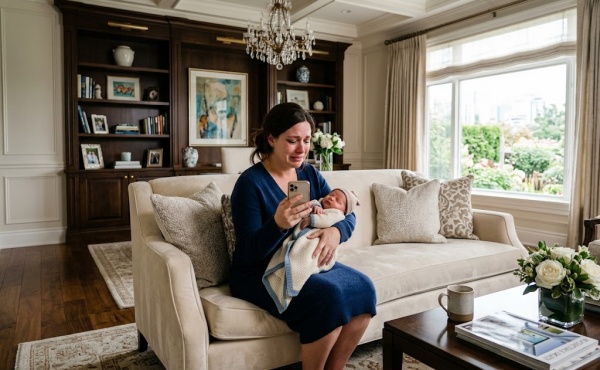
My Best Friend Stole My Husband After I Had His Baby. She held my hand in the delivery room, cried when my son was born, and promised she would always be my family. 8 weeks later, she was living with my husband while he demanded half of the business I had built from nothing. I thought I was walking into court with only my baby, my grief, and a tired body that had not yet healed. What I didn’t know was….
Part 1 — The Woman Who Held My Hand
When my son was born, the first person to cry was not my husband.
It was my best friend, Madison.
She stood beside my hospital bed at St. Luke’s in Kansas City, holding my left hand while my right hand gripped the bed rail so hard my knuckles turned white. Her mascara had run under her eyes, and she kept whispering, “You’re doing amazing, Hannah. You’re so close. I’m right here.”
My husband, Tyler, stood near the window, pale and quiet, looking at his phone between contractions.
At the time, I made excuses for him. I told myself some men froze during childbirth. I told myself he was scared, overwhelmed, maybe even emotional in a way he did not know how to show. I told myself all the things women tell themselves when the truth is standing in the room wearing their husband’s face.
Madison never left my side.
She fed me ice chips, tied my hair back, argued with the nurse when my epidural wore off too quickly, and pressed a cold cloth to my forehead when I thought I could not push anymore. When my son finally came into the world screaming, red-faced and furious, Madison covered her mouth and sobbed.
Tyler smiled then.
Not a big smile. Not the kind I had imagined for years when I pictured him becoming a father. Just a careful smile, like someone trying to remember the appropriate reaction.
“He’s here,” I whispered.
The nurse placed my baby on my chest, and the whole world narrowed to the warm, slippery weight of him. His tiny fist opened against my collarbone as if he had been searching for me in the dark and finally found me. I cried so hard I could barely breathe.
Madison bent over us and kissed my hair. “He’s perfect,” she said. “He’s absolutely perfect.”
Tyler came closer and touched our son’s foot with one finger.
“We should name him Grant,” he said.
I looked up at him through tears. “After my dad?”
He nodded. “Yeah. Your dad would’ve liked that.”
That was the moment I forgave Tyler for every cold word he had said during my pregnancy. Every night he came home late. Every missed appointment. Every time he told me I was being “too sensitive” when I cried over nothing and everything.
My father, Grant Miller, had died four months before my son was born. A heart attack at sixty-four, sudden and brutal and unfair. One day he was sending me photos of paint samples for the nursery, and the next I was standing in a funeral home choosing between oak and walnut caskets while my ankles were swollen and my baby kicked under my black dress.
My dad had been my person.
He raised me alone after my mother left when I was ten. He owned a small hardware store in Independence, Missouri, and somehow made a childhood out of pancake Saturdays, softball games, and lectures about changing my own tire. He was not rich, but he was steady in a way that made the world feel less dangerous.
When I started my business, he was my first investor.
Not a big investor. Just $15,000 from a savings account he called his “rainy day money,” even though he had been saving it for a fishing boat. I cried when he handed me the check, and he only shrugged.
“Boats sink,” he said. “My daughter won’t.”
That business became Miller Home Organizing, a company that helped families, seniors, and small businesses declutter, downsize, and create functional living spaces. I started with one used van, a borrowed label maker, and my dad’s old folding ladder. By the time I married Tyler, I had three employees and a waiting list.
By the time Grant was born, I had eleven employees, corporate clients, and annual revenue just under $800,000.
Tyler liked to say “we built it.”
But he had never packed a moving box at 7 a.m., negotiated with storage facilities, or stood in a grieving widow’s basement helping her decide which of her husband’s shirts to keep. He had not built the business. He had married the woman who had.
Still, when I came home from the hospital, I believed we were a family.
Madison stayed with us the first week. She cooked chicken noodle soup, washed bottles, folded tiny onesies, and sat beside me during the strange blue hours when I nursed Grant and cried from exhaustion. She told me I was beautiful when I looked like a ghost in maternity leggings.
Tyler said he had to go back to work.
He sold commercial insurance and liked reminding people that his job was “high pressure,” though he seemed to find time for golf, happy hour, and long lunches with clients. He held Grant when people were watching, took pictures for Instagram, and captioned one: My whole world.
Madison commented first.
Love you three so much. Family forever.
I liked the comment with one hand while holding my sleeping baby with the other.
For eight weeks, I believed her.
Eight weeks is not long enough for a body to heal from birth. It is not long enough to sleep normally, think clearly, or feel like your organs have forgiven you. It is not long enough to understand the difference between postpartum sadness and the grief of being quietly abandoned.
But it was long enough for my husband to move my best friend into an apartment across town.
I found out on a Tuesday.
Grant had been crying for three hours. Not fussing. Crying like something inside him hurt and I was too new at motherhood to know how to fix it. I had spit-up on my shirt, unwashed hair, and a C-section incision that still ached when I stood too fast.
Tyler said he had a late client meeting.
His phone buzzed on the kitchen counter while he was in the shower.
I was not looking for anything. That is what people never believe, but it is true. I picked up his phone because I thought it might be his office, and I saw Madison’s name on the screen.
Did you tell her yet? I can’t keep pretending I’m just helping. I want to wake up with you every day, not wait for you to sneak over.
The kitchen tilted.
For a moment, I did not move. Grant screamed in his swing. The shower ran upstairs. The microwave clock glowed 7:42 p.m. like an ordinary minute in an ordinary house.
Then another message appeared.
Tyler, I love you. But if you don’t leave now, I’m done.
I read the words again and again, waiting for them to become something else.
They did not.
When Tyler came downstairs, toweling his hair, I was standing at the counter with his phone in my hand.
He stopped.
The look on his face was not guilt.
It was irritation.
“You went through my phone?”
That was the first thing he said.
Not “I’m sorry.” Not “Let me explain.” Not even my name.
I looked at him and realized some truths arrive so violently that the body goes quiet to survive them.
“How long?” I asked.
He sighed like I was asking about a credit card charge, not my best friend and my marriage. “Hannah, don’t do this right now.”
“How long?”
Grant cried harder.
Tyler glanced toward him. “Can you pick him up?”
I laughed once. It sounded nothing like me.
“How long have you been sleeping with Madison?”
His jaw tightened. “It wasn’t like that at first.”
People say that when it was exactly like that.
I waited.
He rubbed both hands over his face. “Since before Grant was born.”
The room went white around the edges.
Before Grant was born.
Madison had held my hand in the delivery room while carrying the secret that she had already taken my husband. She had cried when my son was born while knowing she had helped destroy the home he was coming into. She had promised to be my family while building a new one behind my back.
I walked to the swing and lifted Grant carefully against my chest. He rooted against my shirt, still crying, trusting me with his whole tiny body because he had no one else.
Tyler said, “I didn’t plan for this.”
I looked at him over our son’s head.
“No,” I said. “You just planned around it.”
That night, Tyler packed a duffel bag. He said he needed space. He said we had been unhappy for a long time. He said Madison understood him in a way I had stopped trying to.
I stood in the hallway holding Grant and listened as my husband explained my betrayal to me like it was an inconvenience I had caused.
When he reached the front door, he turned back.
“I’ll always take care of Grant,” he said. “But we need to be practical about the business.”
I stared at him.
“The business?”
His expression changed. It became sharper, more familiar. “It grew during the marriage, Hannah. Missouri is an equitable distribution state. I’m entitled to my share.”
Grant hiccupped against my shoulder.
My husband had not asked if I would be okay. He had not asked if I had eaten, slept, or healed. He had not apologized for leaving me with a newborn and a broken heart.
He wanted half of my company.
When the door closed behind him, I sank to the floor.
I cried quietly because I did not want to scare the baby.
Part 2 — The Apartment Across Town
The first picture appeared two days later.
Not on Tyler’s page. He was smarter than that.
Madison posted it.
It was a photo of two coffee mugs on a balcony with the Kansas City skyline blurred in the background. One mug said MAMA BEAR, which I had bought Madison as a joke years earlier because she always claimed she mothered everyone. The other mug was Tyler’s, from a barbecue restaurant in Texas.
The caption read: Choosing peace.
I stared at it at 3:18 in the morning while Grant slept on my chest, his small breaths warm against my skin.
Choosing peace.
That was what she called moving in with my husband while I was still bleeding from childbirth.
By the end of the week, everyone knew.
Not because I told them. I was too humiliated to speak. But Madison had always been the kind of woman who could turn a mess into a mood board. She told mutual friends that Tyler and I had been “emotionally separated” for months. She said she had not meant to fall in love. She said she was helping him through an impossible transition.
Helping him.
I had once helped Madison through a broken engagement, a DUI charge her father paid to make smaller, and a year of unemployment when she “needed to find herself.” I had paid her rent for two months when she claimed she was too embarrassed to ask her parents. I had given her a part-time admin job at Miller Home Organizing when she needed income.
She repaid me by learning my schedule, my fears, my marital weak spots, and the layout of my life.
Then she stepped into it.
Tyler filed for divorce before I did.
His petition asked for joint legal and physical custody of Grant, temporary access to marital funds, and an ownership interest in Miller Home Organizing. His attorney claimed Tyler had “provided strategic support and business development guidance” during the marriage, contributing to the company’s growth.
Strategic support.
That was apparently what we were calling three client referrals, one badly designed spreadsheet, and years of telling me I worked too much.
I hired a lawyer named Rebecca Lawson, whose office smelled like black coffee and old paper. She was in her fifties, wore no-nonsense navy suits, and looked at legal documents the way a surgeon looks at an X-ray.
She read Tyler’s filing while I bounced Grant in a carrier against my chest.
When she reached the business claim, her eyebrows rose slightly.
“Did he work for the company?” she asked.
“No.”
“Was he listed as an owner?”
“No.”
“Did marital funds contribute to its growth?”
I hesitated. “Some. I mean, my income supported our household. I reinvested business profits too. My dad helped me start it before I got married.”
Rebecca made notes. “Do you have records of that initial investment?”
“I think so. My dad kept everything.”
At the mention of my father, my throat closed.
Rebecca noticed but did not soften in a way that made me feel pitied. “Hannah, I’m going to be direct. The company may have separate property components and marital property components. We’ll need valuation, tax records, formation documents, operating agreements, bank statements, and any proof of your father’s contribution.”
I nodded as if I understood.
I did not understand anything except that my husband had taken my best friend, left me with a newborn, and now wanted to cut my business open like a cake.
Rebecca looked at Grant. “How old is he?”
“Eight weeks.”
Her face changed then, just slightly. “Are you sleeping?”
“No.”
“Eating?”
“Sometimes.”
“Do you have help?”
I almost said Madison.
The sound that came out of me was half laugh, half sob.
Rebecca slid a tissue box across the desk. “We’re going to handle the legal side. But you need support outside this office. Family? Friends?”
“My dad died in November. My mom’s in Arizona and we’re not close.”
“Employees?”
That made me pause.
There was Linda, my operations supervisor, who had been with me from year two. There was Andre, who could organize a garage like a military supply unit. There was Kelly, who knew every client’s dog’s name. But they were employees. I was supposed to lead them, not collapse in front of them.
Rebecca seemed to read my face. “People who care about you are not weaker because they see you struggling.”
I looked down at Grant’s sleeping face.
“I don’t want to lose my business,” I whispered.
Rebecca leaned forward. “Then we won’t assume you will.”
The next month became a blur of paperwork and pain.
Tyler came by the house twice a week to see Grant. He always arrived freshly showered, rested, and faintly smelling of Madison’s vanilla perfume. He took pictures with the baby, posted none of them, and handed him back the moment Grant cried.
Once, when Grant spit up on his shirt, Tyler grimaced.
“He does that a lot,” he said.
“He’s a baby.”
“I know, but this shirt was expensive.”
I stared at him, and for one second I saw the future clearly. Tyler wanted the image of fatherhood, the leverage of custody, and the praise of being involved. He did not want the work that came with a child who needed to be fed every three hours and comforted at 2 a.m.
Madison waited in his car sometimes.
The first time I saw her, she looked away. The second time, she waved weakly, as if we were acquaintances who had drifted apart after college. The third time, she got out.
“Hannah,” she said from the driveway. “Can we please talk?”
I stood on the porch holding Grant.
Madison looked beautiful. That hurt too. Her hair was curled, her jeans fit perfectly, and she had the rested glow of a woman sleeping beside someone else’s husband while someone else cared for the baby.
“I never wanted to hurt you,” she said.
I laughed before I could stop myself. “Then what was the plan?”
Her eyes filled with tears. Madison cried easily. It had once made me protective of her. Now it felt like watching an actor find good lighting.
“It just happened,” she said.
“No, Madison. Rain just happens. Traffic just happens. You made choices.”
She hugged herself. “You and Tyler were already broken.”
I shifted Grant higher against my chest. “That’s what he told you?”
“It’s what I saw.”
“What you saw was a pregnant woman grieving her father while running a company and trying to keep a marriage alive.”
Madison’s face tightened. “You always do that.”
“Do what?”
“Make yourself the martyr.”
The words landed harder than I wanted them to.
Because Madison knew exactly where to hit. She knew my fear of becoming bitter, needy, dramatic. She knew I hated asking for help. She knew I would rather bleed quietly than be accused of making a scene.
Tyler came around from the driver’s side. “Madison, get in the car.”
I looked at him. “You brought her to my house.”
“It’s not just your house,” he said.
That sentence told me everything court documents had not.
The house. The business. The baby. My life.
He was already dividing it in his head.
That night, after Grant finally fell asleep, I went into the garage and opened the plastic storage bins I had brought from my dad’s house after the funeral. I had not been able to face them before. They smelled like dust, motor oil, and him.
Inside were tax returns, store receipts, old birthday cards, insurance papers, and file folders labeled in my father’s blocky handwriting.
I found one marked HANNAH BUSINESS — IMPORTANT.
My hands shook as I opened it.
There was the photocopy of the $15,000 cashier’s check he had given me. There were receipts for the van down payment, the ladder, the first website invoice, and the LLC filing fee. There was a handwritten note from Dad:
For Hannah’s company. Not a loan. Not a gift to any man she marries. Hers.
I laughed through tears.
“Dad,” I whispered. “You always had to make a point.”
But beneath the note was something else.
A sealed envelope.
On the front, in my father’s handwriting, were four words:
If Tyler ever asks.
Part 3 — My Father’s Final Gift
I sat on the garage floor for ten minutes before opening the envelope.
The baby monitor glowed beside me. Grant was asleep in his bassinet upstairs, making soft little noises every few minutes. The house was dark except for the overhead garage bulb, and the concrete felt cold through my sweatpants.
I ran my finger under the flap carefully, as if the paper itself might break my heart.
Inside was a letter.
Hannah Banana,
I had not seen that nickname written in years.
My father had called me that when I was small enough to sit on the counter while he made pancakes. I used to roll my eyes at it when I got older. Now I would have given anything to hear it once more from his mouth.
I kept reading.
If you’re reading this, it probably means Tyler has decided he helped build what you built. I hope I’m wrong. I hope he turns out to be better than I suspect. But a father notices things a daughter in love tries not to see.
My breath caught.
I noticed how he says “our company” when people compliment you, but “your stress” when the work gets hard. I noticed how he smiles when your success makes him look good, then complains when it makes him feel small. I noticed he asks what the business can do for your marriage, not what he can do for you.
Tears dropped onto the page.
So I did what I could. I spoke with Mr. Ellison before I died. He helped me create a trust and transfer certain assets properly. The money I gave you before your marriage, and the additional funds I left for the company, were documented as separate gifts to you and to the business entity. There are records. There are signed statements. There is also a buy-sell provision and operating agreement update that Tyler may not know exists.
I stopped reading and pressed the letter against my chest.
Mr. Ellison.
Charles Ellison had been my father’s attorney for years. I remembered him as a tall man with silver hair who sent Christmas cards with pictures of golden retrievers. He had handled Dad’s will, but after the funeral, I had been too pregnant and numb to ask many questions.
The letter continued.
I also wrote down what I witnessed. Not because I wanted to interfere in your marriage, but because love should never require you to hand someone a knife and hope they remember not to use it. If Tyler is good to you, burn this letter and laugh at your suspicious old man. If he is not, take this folder to Rebecca Lawson. I picked her because she does not scare easily.
I actually laughed then.
Dad had picked my divorce lawyer before I knew I needed one.
The last paragraph broke me.
You are not hard to love, Hannah. You are not too ambitious. You are not too stubborn. You are not too much. You are my daughter, and you built something honest with tired hands and a brave heart. If I cannot stand beside you when the storm comes, let this be me standing there anyway.
I could not see the page anymore.
I cried in the garage until my whole body hurt, the kind of crying that comes from grief, relief, rage, and being loved more carefully than you knew. Upstairs, Grant stirred on the monitor, and I wiped my face.
“Okay, Dad,” I whispered. “Let’s go.”
The next morning, I called Rebecca.
When I arrived at her office with Grant, the folder, and my father’s letter, she read everything without speaking. Her face remained composed, but I saw her eyes sharpen line by line.
“This is significant,” she said at last.
“How significant?”
She tapped the operating agreement. “Very.”
My father had helped me restructure the business two years before my marriage, when Tyler and I were engaged. I remembered signing documents, but Dad had framed it as boring legal housekeeping. The updated operating agreement stated clearly that Miller Home Organizing was my separate business interest, with restrictions on transfer, ownership claims, and spousal involvement unless approved in writing.
There was also a clause showing that my father’s later contribution, a $100,000 inheritance allocation made through his estate plan, was restricted for business development and protected from being treated as a marital gift.
“I didn’t even know about the hundred thousand,” I said.
Rebecca nodded. “It looks like the funds were held in trust and distributed after his death. Did they go into a separate business account?”
“I think so. Linda mentioned an account transfer, but I was eight months pregnant and planning a funeral. I just signed what Mr. Ellison sent.”
Rebecca’s mouth tightened. “We’ll verify everything. But your father was careful.”
Careful.
That was one word for it.
Loving was another.
Rebecca contacted Charles Ellison that afternoon. By the end of the week, we had certified copies of the trust documents, business records, signed affidavits, and a memo my father had written after a dinner at our house two years earlier.
In the memo, Dad described Tyler making several comments about “eventually cashing out” if my business kept growing. He wrote that Tyler seemed “overly interested in future valuation despite having no operational role.” He also documented Tyler’s joking remark that marrying a business owner was “better than a 401(k).”
I remembered that joke.
Everyone had laughed.
I had laughed too.
My father had not.
The legal case changed after that.
Tyler’s attorney still pushed for a business valuation, claiming any increase in value during the marriage might be divisible. Rebecca did not dismiss that possibility entirely, because law is rarely as simple as people want it to be. But Tyler’s claim to ownership, control, or half the company became much weaker.
Then Tyler made his biggest mistake.
He sent an email.
Not to me. To Linda.
It said:
I need access to the client database, current contracts, vendor accounts, and financial projections. As Hannah’s husband and future co-owner, I have a right to review company materials. Please send everything by Friday or I’ll consider it obstruction.
Linda forwarded it to me with one sentence:
Absolutely not.
Rebecca’s response was immediate. She filed for a protective order regarding confidential business information and attached Tyler’s email as evidence that he was attempting to interfere with company operations. She also warned his attorney that unauthorized access to client records could violate privacy obligations and contractual confidentiality terms.
Tyler called me that night from a blocked number.
“You’re making this ugly,” he said.
I was in the nursery, rocking Grant in the dark.
“No,” I said. “I’m making it documented.”
He scoffed. “That lawyer is putting ideas in your head.”
“My father put documents in a folder. There’s a difference.”
Silence.
Then his voice changed. “What documents?”
I closed my eyes.
For the first time since he left, I felt something like power. Not loud power. Not revenge. Just the solid ground of knowing he did not know everything.
“You’ll find out in court,” I said.
“Hannah, don’t be stupid. If you fight me, there’ll be less for Grant.”
There it was again. The baby as a shield. The baby as a bargaining chip. The baby as a way to make me feel selfish for protecting the very thing that would support him.
“Grant is exactly why I’m fighting,” I said.
Then I hung up.
Madison sent me a message an hour later.
Tyler is really stressed. I know you’re hurt, but please don’t punish him financially. That’s still Grant’s father.
I stared at the message so long the screen dimmed.
Then I replied:
You don’t get to help burn down my house and ask me to keep the smoke away from him.
She did not respond.
The temporary custody hearing happened two weeks later.
I walked into the Jackson County courthouse wearing a black dress that still did not fit the way my pre-pregnancy clothes used to. My body felt unfamiliar, tender, and tired. Grant was with Linda in the hallway because I had pumped milk in a courthouse bathroom twenty minutes earlier and tried not to cry when my dress zipper stuck.
Tyler arrived with Madison.
That was his second-biggest mistake.
She wore a cream coat and looked nervous, but not ashamed enough. Tyler put his hand on her lower back as they walked past me. It was a small gesture, but Rebecca saw the judge’s clerk see it.
In court, Tyler’s attorney painted him as a devoted father who wanted equal time. Rebecca did not attack him personally. She simply presented facts.
Grant was ten weeks old. I was breastfeeding. Tyler had moved out. Tyler had attended two pediatric appointments before separation and none after. Tyler had returned Grant early during two visits because the baby was “too fussy.” Tyler’s current living arrangement involved Madison, who had been my close friend and had recently entered into a romantic relationship with him.
The judge looked over her glasses.
“Mr. Carter,” she said to Tyler, “the court encourages meaningful involvement by both parents. But newborns require consistency, and decisions will be made based on the child’s best interests, not adult conflict.”
Tyler nodded solemnly, as if he had not created the adult conflict.
The judge granted him scheduled parenting time that increased gradually, but primary physical care remained with me for the temporary period. Legal custody decisions were to be shared, but day-to-day care stayed stable. Tyler did not look pleased.
Outside the courtroom, Madison approached me while Tyler spoke with his attorney.
“I know you hate me,” she said.
I looked at her. “I don’t have the energy to hate you.”
That seemed to hurt her more.
She glanced toward Grant sleeping in Linda’s arms. “I miss him.”
I stared at her.
She had no right to say that. She had held him in the hospital. She had rocked him in my living room. She had kissed his forehead while carrying a secret that would tear his home apart.
“You don’t miss him,” I said quietly. “You miss feeling like a good person around him.”
Her eyes filled. “That’s cruel.”
“No,” I said. “Cruel is holding my hand while betraying me.”
For once, Madison had no answer.
Part 4 — The Truth Has Receipts
Divorce has a way of turning love into paperwork.
Text messages become exhibits. Bank statements become timelines. Casual jokes become evidence of intent. The private language of a marriage gets translated into legal arguments under fluorescent lights.
I hated it.
I hated that strangers now knew when Tyler stopped depositing money into our joint account. I hated that Rebecca had to ask when we last slept in the same bedroom. I hated that my father’s protective love had to be stamped, copied, and submitted like a parking permit.
But I learned something important.
Documentation is not cold.
Sometimes documentation is the only thing standing between a woman and the story a man tells after he betrays her.
Tyler’s story was simple: I was emotional, controlling, and vindictive. He and Madison had “fallen in love” after my marriage to him had already ended “in every meaningful way.” He only wanted fairness. He only wanted to be a father. He only wanted his rightful share.
The documents told another story.
They showed Tyler had texted Madison from the hospital while I was in labor.
They showed he had signed a lease with her three days before telling me he was leaving.
They showed he had researched business valuation firms before Grant was born.
They showed he had emailed a friend six months earlier:
If Hannah ever leaves, I’m not walking away from that company. She built it while we were married. That’s my retirement plan.
When Rebecca showed me that email, I felt something inside me go still.
Not numb.
Focused.
“He was planning this,” I said.
Rebecca nodded. “It appears he was considering financial strategy before separation.”
“He let me name our son after my father while he was planning to take what my father helped me build.”
Rebecca did not answer, because there was no legal response for that kind of cruelty.
There was only consequence.
The business valuation process began in May. Tyler’s expert valued Miller Home Organizing aggressively, using growth projections that assumed expansion into three states within five years. Rebecca’s expert used more conservative numbers, noting that the company depended heavily on my personal reputation and leadership, and that recent disruption had affected operations.
My employees saved me more than they knew.
Linda produced years of payroll records, client contracts, training manuals, and proof that Tyler had no management role. Andre wrote a sworn statement that Tyler had visited the office only three times, once to pick up lunch, once to borrow the van for a tailgate, and once to complain that my staff “acted like Hannah was the boss.”
Kelly submitted emails showing Madison had accessed client scheduling software while working part-time admin, then stopped working for the company before the affair became known. That became important when we discovered Madison had downloaded several client lists two weeks before Tyler left.
Rebecca’s expression when she saw the download logs was the closest I ever saw her come to smiling.
“Interesting,” she said.
“Is that bad?”
“For them? Potentially.”
Madison claimed she downloaded the files to help with remote scheduling. But she had not been scheduled for admin work that week. Worse, two clients later received promotional emails from a new organizing service Madison had quietly registered with the Missouri Secretary of State.
The name was Peaceful Nest Solutions.
Choosing peace, apparently, had a business plan.
Rebecca sent a cease-and-desist letter regarding misuse of confidential business information. My stomach twisted when I read it. Not because Madison did not deserve it, but because I still had memories of us eating tacos in my car, dancing at my wedding, and lying on my living room floor making lists of baby names.
Betrayal is not clean because love does not vanish on command.
Some nights, I still reached for my phone to send Madison a picture of Grant.
Then I remembered she was sleeping next to his father.
The final hearing on the business issue was scheduled for late June. By then, Grant was four months old and had learned to smile with his whole face. His joy was unreasonable and generous. He smiled at ceiling fans, burp cloths, my exhausted face, and once, very dramatically, at Rebecca during a Zoom call.
“You have a charming client,” she said.
“He gets that from my dad,” I replied.
The night before court, I opened my father’s letter again.
I had read it so many times the folds were soft. I knew every sentence, every slant of his handwriting. Still, the last paragraph undid me.
If I cannot stand beside you when the storm comes, let this be me standing there anyway.
I placed the letter in my bag.
Not because the judge needed it.
Because I did.
Court started at 9 a.m.
Tyler wore a gray suit I had bought him for a conference in Chicago. Madison waited outside the courtroom this time, perhaps because someone had finally advised him that bringing your affair partner to a property hearing was not the picture of stability he thought it was.
The hearing lasted hours.
Experts testified. Attorneys questioned. Financial records were projected on a screen. I answered questions about company formation, cash flow, marital expenses, client acquisition, and my father’s contributions.
Tyler’s attorney tried to make me sound selfish.
“Mrs. Carter, isn’t it true that your husband attended networking events with you?”
“Yes,” I said. “He attended two.”
“And at those events, he spoke with potential clients?”
“He spoke with people near the bar.”
A few people in the courtroom shifted.
Rebecca did not smile, but I felt her satisfaction.
Tyler’s attorney tried again. “Isn’t it true Mr. Carter supported your long work hours by allowing you to pursue the business?”
Allowing.
The word sat in the air like a bad smell.
I looked at Tyler. Then I looked back at the attorney.
“No,” I said. “He did not allow me. I was an adult woman running a company.”
The judge wrote something down.
Rebecca presented my father’s documents near the end. The trust records. The operating agreement. The cashier’s check. The signed memo. The separate business account. The ownership restrictions.
Then she presented Tyler’s emails.
His face changed when the retirement plan email appeared on the screen.
For the first time, the man who had accused me of being emotional looked genuinely afraid.
Rebecca’s voice stayed calm. “Mr. Carter, when you wrote, ‘That’s my retirement plan,’ were you referring to Miller Home Organizing?”
Tyler swallowed. “It was a joke.”
“You also researched business valuation firms within twenty-four hours of that email. Was that part of the joke?”
“No.”
“What was it part of?”
His attorney objected. The judge allowed a limited answer.
Tyler shifted. “I was trying to understand my rights.”
“Before your son was born?”
He said nothing.
Rebecca waited.
“Yes,” he said finally.
The silence in the courtroom felt heavy enough to touch.
By the time the hearing ended, I was shaking from exhaustion. Linda brought Grant to me in the hallway, and I held him so tightly he squeaked in protest. I kissed his head and whispered, “Sorry, baby. Mommy’s just tired.”
Tyler walked past us without stopping.
Madison followed him a moment later.
She paused.
For a second, I saw the woman I used to know. The one who had cried during sad movies, remembered my coffee order, and helped me choose my wedding dress. Then she looked away, and the stranger returned.
Two weeks later, the ruling came.
The judge found that Miller Home Organizing was primarily my separate business interest, protected by pre-marital formation, documented separate contributions, the operating agreement, and my father’s trust planning. Tyler was awarded a limited marital interest based on a narrow portion of growth during the marriage, far less than half and payable over time to avoid harming the business.
He did not get ownership.
He did not get control.
He did not get client records.
He did not get to walk into the company my father and I built and call it his retirement plan.
When Rebecca told me, I sat down on the floor of Grant’s nursery.
“Are you okay?” she asked over the phone.
I looked at my son, who was lying on his play mat trying to eat a stuffed giraffe.
“Yes,” I said, crying. “I think this is what okay feels like when it’s exhausted.”
Part 5 — What He Could Not Take
The divorce was finalized in September.
It was not a victory in the way people imagine victory. My marriage was still over. My best friend was still gone. My son would still grow up with parents in two homes because adults had made choices he never asked for.
But I walked out of the courthouse with my business, my home, and my name intact.
Tyler got scheduled parenting time, shared legal custody, and a financial settlement smaller than he wanted but larger than I liked. That was law, not revenge. Rebecca reminded me more than once that family court is not designed to heal betrayal.
It is designed to divide what can be divided and protect what must be protected.
My heart was not on the list.
Outside the courthouse, Tyler asked to speak with me.
Rebecca stayed close, but I nodded. Grant was with Linda again, because courthouses and babies both required more patience than one person had.
Tyler looked tired. Not destroyed. Not humbled in some dramatic movie way. Just smaller. Madison was not there.
“I heard you’re opening another office,” he said.
“Overland Park,” I replied.
He gave a short laugh. “Of course you are.”
I waited.
He looked down at his shoes. “I didn’t think your dad would do all that.”
“No,” I said. “You counted on him being gone.”
His face tightened. “That’s not fair.”
“Neither was leaving me eight weeks postpartum and asking for half my company.”
He looked away.
For a moment, I thought he might apologize. Truly apologize. Not for getting caught. Not for the timing. Not for the legal strategy. For the human wreckage.
Instead, he said, “Madison and I are having problems.”
I almost laughed.
Not because it was funny, but because it was predictable in the saddest possible way.
“That has nothing to do with me,” I said.
“She thinks I’m still too involved with you.”
“You mean with your son.”
He flinched. “That’s what I said.”
“No,” I replied. “It isn’t.”
He rubbed his forehead. “I made mistakes, Hannah.”
“Yes.”
“I just felt like I didn’t matter next to you.”
There it was. The confession beneath everything. Not love, not passion, not fate. Resentment. He had not left because I was small. He had left because I was growing, and Madison had made him feel tall again.
I felt sad for him then.
But not responsible.
“You mattered,” I said. “You just didn’t want to stand beside me unless you could stand above me.”
His eyes shone, but I no longer knew what his tears meant. Maybe regret. Maybe self-pity. Maybe calculation. I had spent too many years trying to translate him.
“I miss our family,” he said.
I thought of the hospital room. Madison crying. Tyler standing by the window. My baby on my chest. My father’s name entering the world through a child who would never know his grandfather’s voice.
Then I thought of the garage floor, the letter, the folder, the way my father had loved me with paperwork and foresight.
“You miss the family you could use,” I said gently. “I’m building the one Grant deserves.”
I walked away before he could answer.
The first year after the divorce was hard in ordinary and extraordinary ways.
Grant got ear infections. The water heater broke. One employee quit without notice. A client left a three-star review because we refused to organize a garage full of unsafe chemicals without proper disposal. I cried in the Target parking lot once because they were out of the only baby formula Grant tolerated.
But slowly, life began to belong to me again.
Miller Home Organizing grew, not explosively, but honestly. We opened the Overland Park office with six employees, a used company van, and a ribbon-cutting ceremony where Grant tried to eat the ribbon. Linda became director of operations. Andre trained new staff. Kelly ran client experience and made everyone label storage bins in the same font because “brand consistency matters.”
I started offering free quarterly workshops for single parents rebuilding after divorce. Not legal advice. Not therapy. Just practical systems: budgeting, downsizing, custody calendar organization, document storage, emergency contacts, meal planning, and how to make a home feel peaceful when life had not been.
The first workshop had twelve people.
The second had thirty-four.
At the third, a woman stayed afterward and said, “I thought I was the only one who didn’t know where to put all the papers from court.”
I hugged her because sometimes the papers are not just papers.
Sometimes they are the proof that you survived something someone else still wants to rename.
Madison’s organizing business closed within eight months.
I did not celebrate.
I heard through mutual friends that clients had questioned her ethics after the cease-and-desist became known in our professional circle. She and Tyler broke up before Christmas. Apparently, trust was difficult to build in a relationship that began by destroying it.
She emailed me once.
I know I don’t deserve forgiveness, but I am sorry. I was jealous of you. Not just Tyler. Your business, your confidence, your dad, the way people trusted you. I told myself you had everything and I had nothing, so taking one thing didn’t feel as bad as it should have. I know that sounds awful. It is awful. I’m sorry for what I did in the delivery room most of all.
I read the email three times.
Then I closed my laptop.
Maybe one day I would forgive her in a way that released me completely. But forgiveness did not require access. It did not require lunch, conversation, or pretending she had not turned my most vulnerable moment into a hiding place for betrayal.
Some doors close quietly.
That one did.
On Grant’s first birthday, I threw a party in my backyard.
There were blue balloons, grocery store cupcakes, folding chairs, and a smash cake shaped badly like a baseball because my decorating skills had limits. Tyler came for an hour. He brought a gift, took pictures, and behaved politely. That was enough.
After he left, Linda helped clean up while Grant slept inside.
She found me standing near the garage, looking at the storage bins that still held some of Dad’s things.
“You okay?” she asked.
I nodded. “I wish my dad could see him.”
“He can,” she said.
I smiled sadly.
Linda shrugged. “Maybe not how we want. But that man is all over this place.”
She was right.
Dad was in the business name, the operating agreement, the old ladder we still used for office displays, and the way I now checked every contract twice. He was in Grant’s middle name, in pancake Saturdays, in the envelope that saved my future, and in the voice I heard whenever fear told me I was not strong enough.
Boats sink.
My daughter won’t.
That night, after everyone left, I put Grant to bed and sat at my kitchen table with my father’s letter. I had framed a copy, but I kept the original in a fireproof safe with my business documents, birth certificates, insurance policies, and the court order.
It belonged with the things that protected us.
I read the last line again.
If I cannot stand beside you when the storm comes, let this be me standing there anyway.
For months, I had thought my father’s final gift was the trust, the legal documents, the operating agreement, the protection that kept Tyler from taking what he had not earned.
But I was wrong.
Those things saved the business.
My father’s final gift was the reminder that I had been loved before I was betrayed. Loved by someone who saw me clearly. Loved by someone who did not need me smaller, quieter, poorer, or easier to control. Loved by someone who prepared for a storm without making me afraid of the sky.
Tyler could take my illusion of marriage.
Madison could take my illusion of friendship.
Court could take my privacy, my savings, and months of my peace.
But none of them could take the foundation my father had built under me long before I knew I was standing on it.
A year and a half after the divorce, Miller Home Organizing moved into a larger office.
On opening day, I hung a framed photo of my dad near the front desk. In it, he was standing outside his hardware store in a flannel shirt, holding a cup of coffee and squinting at the sun. Beneath the photo, I placed a small brass plaque.
Grant Miller
First Investor. Best Father.
“Boats sink. My daughter won’t.”
Clients asked about it often.
I told them the short version.
“My dad believed in me before I knew how to believe in myself.”
One afternoon, while I was labeling supply shelves, Grant toddled over to the photo and pointed.
“Papa?” he asked.
My heart stopped.
I had shown him pictures, of course, but he was still so little that I never knew what he understood. I picked him up and held him close.
“Yes,” I whispered. “That’s Papa Grant.”
Grant patted the frame with his sticky hand.
For the first time, thinking of my father did not feel only like loss.
It felt like inheritance.
Not money, though he had left what he could. Not the business, though he helped protect it. Something deeper. A way of standing. A way of refusing to confuse someone else’s betrayal with your own worth.
People love dramatic endings. They want the cheating husband ruined, the best friend exposed, the woman in a red dress walking away while everyone claps. Real life is messier and quieter than that.
Tyler was not ruined. He was simply no longer allowed to profit from my pain.
Madison was not destroyed. She was simply no longer welcome in the life she helped fracture.
And I was not magically healed. I was healing in the small American ways women heal every day: answering emails, packing lunches, paying invoices, singing to a baby in traffic, signing court forms, building new routines, laughing again without asking permission.
Sometimes, late at night, I still think about the delivery room.
Madison holding my hand.
Tyler by the window.
Grant arriving innocent into a room full of secrets.
For a long time, that memory hurt so much I could barely breathe. Now I see something different in it. I see myself surviving before I even knew I would have to. I see my son choosing life loudly and without apology. I see my father’s name being given to the one person who would make me fight harder than grief.
Eight weeks after Grant was born, I thought I had lost everything.
My husband.
My best friend.
My future.
But my father had known something I had forgotten in the fog of love and betrayal.
A woman who builds her life from nothing does not become nothing because someone walks away.
She becomes dangerous in the best way.
Not cruel.
Not bitter.
Not broken.
Just awake.
And when Tyler demanded half of the business I built from nothing, he walked into court thinking I had only a baby, a tired body, and a broken heart.
He did not know I had my father standing beside me.
He did not know love could be notarized, filed, witnessed, and waiting in a folder.
He did not know the final gift of a good father could reach past death, past betrayal, past every lie a selfish man tells himself.
And he definitely did not know that the woman he left behind would walk out with the baby, the business, and the future he thought he could take.
