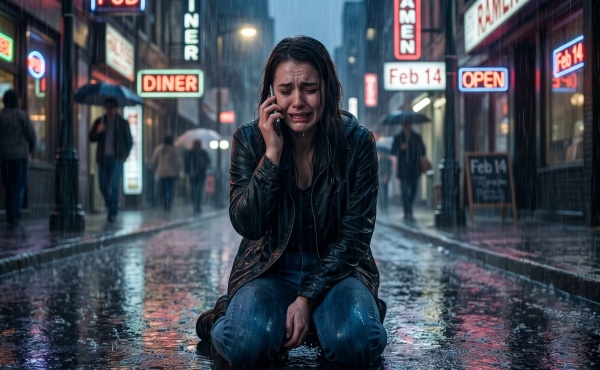
70 Missed Calls on Valentine’s Night — and His Wife’s Last Text: “Honey… Our Son…” He turned off his phone to spend Valentine’s with his mistress. 70 missed calls later, he realized he didn’t just lose his marriage—he lost his soul…
Part 1: The Morning After Valentine’s Day
February 15th, 7:04 a.m.
The cold wind coming off the Hudson River sliced through Midtown Manhattan like a warning no one wanted to hear. On Broadway, delivery trucks idled near the curb, commuters hurried toward subway entrances with paper coffee cups in their hands, and half-wilted Valentine’s roses leaned sadly from trash cans outside hotel lobbies. The city had already moved on from romance.
Inside Suite 1408 at the Marriott Marquis, Tyler Davis had not.
He stretched across the expensive hotel sheets with the slow satisfaction of a man who believed he had gotten away with something. The room smelled faintly of bourbon, perfume, room service fries, and the stale air of a place where selfish people had spent hours calling selfishness freedom. For a few seconds after waking, Tyler felt almost victorious.
Next to him, Tiffany was still asleep.
She was twenty-three, a marketing intern at a partner firm, and for four months Tyler had convinced himself she made him feel alive. She was young, admiring, uncomplicated, and uninterested in the ordinary parts of his life. She never asked about daycare pickups, pediatric appointments, mortgage payments, or why his wife looked so tired by 9 p.m.
Tyler was thirty-six.
Senior Vice President at a mid-size financial consulting firm in the Flatiron District. Husband of seven years to Sarah Davis. Father to Leo, a four-year-old boy who loved dinosaurs, red crayons, pancakes, and telling strangers on the subway that the T. rex had “tiny arms but big feelings.”
Tyler had once loved that about him.
Or at least, he told himself he had.
On Valentine’s Day evening, Sarah had tried to make their apartment feel special. They lived on the Upper West Side in a two-bedroom rental with tall windows, old hardwood floors, and a view of a brick wall that Sarah insisted looked beautiful when it snowed. She had set the table with candles, bought a small chocolate cake from Zabar’s, and helped Leo make a Valentine’s card for his father.
The card had been made from red construction paper folded unevenly in half.
On the front, Leo had drawn a giant heart and several tiny dinosaurs holding balloons. Inside, in shaky four-year-old handwriting, he had written: DADY I LUV YOU. Sarah had corrected nothing because she said misspelled love from a child was better than perfect spelling from anyone else.
Tyler had seen the card on the kitchen table while putting on his coat.
“Daddy, look!” Leo shouted, waving it with both hands. “I made the biggest heart because you’re my favorite daddy!”
Tyler had smiled without really looking.
“That’s great, buddy.”
He ruffled Leo’s hair, kissed Sarah on the cheek, and told them both the lie he had rehearsed in the elevator at work.
“Emergency board call,” he said, loosening his tie as if exhausted by responsibility. “I’m sorry, honey. It could run late. There’s a client issue and an audit problem they need me on.”
Sarah had stood very still.
On some level, Tyler knew she did not believe him.
But Sarah was the kind of woman who gave people one more chance long after they had already used up the last one. She looked at him, then at Leo, then back at Tyler. Her face was calm, but her eyes were already sad.
“On Valentine’s Day?” she asked.
“I know,” he said. “I hate it too.”
That was the easiest kind of lie.
Not the lie that denied the truth completely, but the lie that borrowed sympathy from the person being deceived.
Leo ran over and wrapped his little arms around Tyler’s leg.
“Come back before bedtime?”
Tyler looked down at his son’s small hands clutching his pant leg.
“I’ll try.”
He did not try.
He walked out of the apartment, took the elevator downstairs, stepped onto West 86th Street, and got into a cab heading toward Times Square. By 8:00 p.m., he had powered off his iPhone. Not silenced it. Not put it on Do Not Disturb. Powered it off completely.
He wanted no interruptions.
No guilt buzzing against the nightstand.
No texts from Sarah asking when he would be home.
No photos of Leo asleep beside a Valentine’s card.
He told himself he deserved one night without responsibility.
That was how selfishness worked. It never introduced itself as cruelty. It arrived dressed as exhaustion, entitlement, and the quiet belief that your desires were somehow more urgent than everyone else’s needs.
Now, the morning after, Tyler reached toward the nightstand.
He found his phone beside an empty rocks glass and a room service receipt he did not want to read. His mind was already building the excuse. Dead battery. Crisis ran late. Slept on the office couch. Merger negotiations. Board pressure. Something believable enough to buy him one more day.
He pressed the power button.
The Apple logo appeared.
Tyler yawned.
Tiffany shifted under the sheets. “What time is it?”
“Early,” Tyler said.
He waited for the phone to finish restarting.
Then it began vibrating.
Once.
Twice.
Again.
Again.
Again.
The sound became continuous, violent, almost mechanical. Notifications flooded the lock screen so quickly the phone froze for several seconds, as if the device itself could not process the weight of what had happened while Tyler was unreachable.
Tyler sat up.
The first thing he saw was the number.
Bright red.
Unforgiving.
70 Missed Calls.
Every one of them from the same contact.
Sarah.
For one impossible second, Tyler could not move.
The bourbon warmth, the hotel sheets, the smug satisfaction — all of it vanished. A cold, primitive fear moved through his chest. His fingers went numb as he unlocked the screen and opened the messages.
The first text was from 10:03 p.m.
Sarah: Tyler, pick up. Where are you? I’ve been calling for almost an hour. This isn’t funny.
His heart started pounding.
The next message was at 10:28 p.m.
Sarah: There was an accident. Leo fell from the loft bed. He hit his head. The ambulance is here. Please call me back.
Tyler stopped breathing.
The room seemed to tilt.
He scrolled.
10:51 p.m. — Sarah: We’re at NewYork-Presbyterian Emergency. They’re checking him now. He keeps asking for you. Tyler, where are you?
11:23 p.m. — Sarah: The doctors are saying he may need surgery. I need you here. I need you to answer me.
11:58 p.m. — Sarah: They’re taking him in. I’m signing everything alone. I don’t understand where you are. Please. Please answer.
12:36 a.m. — Sarah: He’s in surgery. They said it could take hours. He’s only four, Tyler. He’s four.
Tyler’s hand began shaking.
Tiffany sat up behind him. “Tyler?”
He did not answer.
He kept reading.
1:19 a.m. — Sarah: I called your office. The building is closed. There was no board meeting. No one knows where you are.
1:58 a.m. — Sarah: Your mom is here now. My dad is driving in from Westchester. Everyone is here except you.
2:31 a.m. — Sarah: They needed blood. Your type could have helped, but we couldn’t find you. The hospital found a donor. No thanks to you.
Tyler felt something inside him collapse.
The final text was from 3:17 a.m.
Sarah: Tyler… our son made it through surgery. But I need you to understand something. I called you seventy times tonight. Seventy. I was scared something happened to you while our son was fighting for his life. Then I checked the Tesla app. I saw the GPS. I know where you were. Don’t come to this hospital. I don’t want to see your face. I’m done.
The phone slipped from his hand and hit the hardwood floor.
The crack sounded enormous in the quiet suite.
Tiffany pulled the sheet around herself. “What happened?”
Tyler stood so quickly he nearly fell.
He grabbed his pants from the floor, his shirt from the chair, his jacket from the door handle. His movements were frantic and clumsy, the movements of a man whose body had understood before his mind could form a sentence. He had not merely missed calls.
He had missed the worst night of his son’s life.
And he had missed it by choice.
Part 2: The Cab Ride Uptown
Tyler ran out of the Marriott Marquis with one shoe untied and his shirt misbuttoned.
The revolving door pushed him into the sharp February air of Times Square at 7:18 a.m. Digital billboards flashed above him, bright and meaningless. Tourists took photos near the red steps. A man in a puffer jacket sold discounted Broadway tickets like the world had not ended overnight.
Tyler raised his hand for a cab.
Three passed him.
The fourth stopped.
“NewYork-Presbyterian,” Tyler said, sliding into the back seat. “168th Street. Fast as you can.”
The driver glanced at him in the mirror. “Traffic’s bad.”
“Please.”
That one word came out broken enough that the driver stopped arguing.
As the cab moved uptown, Tyler stared through the rain-streaked window while Manhattan blurred around him. Columbus Circle. Broadway. The gray morning. People walking dogs, buying coffee, carrying flowers that had survived the night better than his marriage had.
His phone sat in his lap.
He kept opening the message thread, reading the texts again, as if another reading might change them.
It did not.
Every timestamp was an indictment.
10:03.
10:28.
10:51.
11:23.
11:58.
12:36.
1:19.
1:58.
2:31.
3:17.
Seventy missed calls.
Seventy chances to pick up.
Seventy moments when Sarah had stood somewhere under fluorescent hospital lights, holding their son’s life in trembling hands, and he had been unreachable because he wanted to pretend he was free.
Memory came at him violently.
Leo in the kitchen the previous afternoon, hunched over the Valentine’s card with his tongue pressed between his teeth. Sarah standing by the stove, stirring tomato sauce, wearing the soft yellow sweater she always wore when she wanted the apartment to feel warm. The small chocolate cake on the counter. The red paper hearts Leo had taped unevenly to the cabinets.
Tyler had looked at all of it and felt annoyed.
Annoyed.
That was the word that filled him with shame now.
He had been annoyed by love because it interrupted his lie.
His phone buzzed.
Tiffany.
What is going on? You just left. Are you okay?
Tyler stared at the text.
For four months, Tiffany had been the center of his private fantasy. She made him feel admired. She laughed when he complained that Sarah had become “too serious.” She called him successful, powerful, misunderstood.
Now her message looked like spam.
He did not reply.
Instead, he opened the photo Sarah had sent him two days earlier.
Leo at the American Museum of Natural History, standing under the giant blue whale, wearing a dinosaur hoodie and grinning with his whole face. Tyler had responded with a thumbs-up emoji while sitting in a restaurant across from Tiffany. At the time, it had seemed efficient.
Now it looked unforgivable.
The cab stopped hard near a red light.
Tyler lurched forward.
The driver muttered something under his breath.
Tyler barely heard him.
He was thinking about blood.
Sarah’s text said they needed blood. Tyler had O-negative, the universal donor type, something he used to mention casually like an interesting fact about himself. Sarah used to joke that even his blood was arrogant.
Leo had inherited it.
And Tyler had been two subway rides away, asleep in a hotel bed, phone turned off.
The hospital had found a donor.
Leo survived.
Those words should have comforted him.
Instead, they hollowed him out.
Because survival did not erase absence.
The cab pulled up outside NewYork-Presbyterian on 168th Street just after 7:50 a.m. Tyler threw cash at the driver without counting it and ran toward the entrance. His dress shoes slapped against the wet sidewalk.
Inside, the hospital smelled like antiseptic, coffee, winter coats, and fear.
People sat in plastic chairs with blankets around their shoulders. Nurses moved quickly behind desks. A child cried somewhere down the corridor. The world inside the hospital had no interest in Tyler’s panic because it had seen panic all night and would see more before lunch.
He approached the information desk.
“My son,” he said, breathless. “Leo Davis. He was brought in last night. Head injury. He had surgery.”
The woman behind the desk looked up.
Her eyes moved over him.
Wrinkled suit. Open collar. One untied shoe. Bourbon still faint on his breath. A pale pink lipstick mark near his collar that he had not noticed.
Her expression changed with professional restraint.
“Are you a parent or guardian?”
“I’m his father.”
“Please wait here.”
She picked up the phone.
Tyler stepped back.
That was when he saw his mother.
Margaret Davis stood from a chair near the wall. She was sixty-four, small, gray-haired, and usually gentle in a way that made strangers tell her their problems in grocery store lines. This morning, she looked like she had aged ten years.
“Mom,” Tyler said.
She walked toward him.
For one irrational second, he thought she might hug him.
She did not.
She stopped two feet away and looked at him with an expression he had never seen on her face before.
Disgust.
Not anger.
Not disappointment.
Disgust.
“He made it,” she said quietly.
Tyler closed his eyes.
Air rushed out of him.
“Thank God.”
“Do not say that like you were praying,” she said.
His eyes opened.
Margaret’s voice remained low, which somehow made it worse.
“Your son had emergency surgery at two in the morning. Your wife signed the papers alone. Your father-in-law drove down from Westchester in freezing rain. I sat with Sarah while she shook so hard she could barely hold a cup of water.”
Tyler’s mouth opened.
“Don’t,” she said.
One word.
He shut it.
“She thought something had happened to you,” Margaret continued. “For hours, she was worried about you too. Can you imagine that? Her son was being taken into surgery, and she was still afraid her husband was dead in a ditch somewhere.”
Tyler looked down.
“Then she found out where you were.”
His mother’s voice broke on the last word.
That hurt more than if she had screamed.
Across the waiting area, Frank Whitaker stood near the window.
Sarah’s father.
Retired NYPD detective. Large, broad-shouldered, gray mustache, the kind of man who did not waste words because he had spent thirty years listening to people talk themselves into worse trouble. Frank looked at Tyler once.
Just once.
Then he looked away.
That was all.
No shouting.
No threat.
No dramatic confrontation.
Just dismissal.
Tyler sank into a chair because his legs would not hold him anymore.
For the first time since waking, he understood there was no explanation coming.
There was no sentence that could begin with “I can explain” and end with anything a decent person would accept.
He had turned off his phone.
Everything else was noise.
Part 3: Sarah at the ICU Door
At 8:31 a.m., the ICU doors opened.
Sarah walked out.
Tyler stood automatically, like his body still believed he had the right to approach her.
The woman who emerged from those doors did not look like the woman he had left in their apartment the evening before. The yellow sweater she wore was wrinkled, stretched at the cuffs, and marked faintly from a night spent in emergency rooms and waiting areas. Her hair was pulled back roughly, and her eyes were swollen in a way that had nothing to do with ordinary crying.
She looked exhausted.
But she did not look broken.
That frightened him.
“Sarah,” Tyler said.
She stopped several feet away.
Her face did not twist with rage. She did not raise her voice. She did not cry when she saw him. She looked at him with something colder and more final than anger.
Recognition.
Like she had finally identified the stranger living inside her marriage.
“You came,” she said.
“I got here as fast as I could.”
The words sounded pathetic the second they left his mouth.
Sarah’s eyes sharpened.
“No,” she said. “You came when you turned your phone back on.”
Tyler flinched.
Margaret turned away, one hand over her mouth.
Frank remained by the window.
Sarah stepped closer, but not close enough for Tyler to touch her.
“Leo is stable,” she said. “The doctors are cautiously optimistic. He woke up for a little while.”
Tyler’s throat tightened.
“He woke up?”
“Yes.”
“Can I see him?”
Sarah looked at him for a long moment.
“No.”
The word landed with quiet force.
Tyler stared at her. “Sarah, please. He’s my son.”
“He is also my son,” she said. “The son I carried through a hospital hallway last night while you were unreachable. The son who cried for you until they gave him medicine. The son who asked me why Daddy wasn’t answering.”
Tyler put a hand over his mouth.
“What did you tell him?”
“I told him Daddy wasn’t here yet.”
Yet.
Such a small word.
Such undeserved mercy.
Sarah reached into the tote bag hanging from her shoulder. It was the same canvas tote she used for groceries, library books, and Leo’s preschool art projects. From it, she pulled a folded stack of papers.
“I called Dana,” she said.
Tyler frowned.
“Dana?”
“My friend from law school. She practices family law in Brooklyn.”
Tyler stared at the papers.
“She drove here at 4:00 a.m.,” Sarah continued. “She sat with me in the family consultation room while Leo was in recovery. We talked through what happens next.”
She handed him the papers.
His fingers closed around them before his mind caught up.
Divorce petition.
New York State.
Irreconcilable breakdown.
Temporary custody request pending court review.
Attorney contact information.
Tyler felt the floor disappear beneath him.
“Sarah,” he whispered. “Please don’t do this right now.”
“Right now?” she repeated.
Her voice remained calm, but something dangerous moved beneath it.
“When would be better, Tyler? After another lie? After another hotel room? After another night where I find out my husband turned off his phone while our child needed him?”
He shook his head. “It was a mistake.”
Sarah’s face changed then.
For the first time, anger flashed through.
“A mistake is missing a subway stop,” she said. “A mistake is forgetting milk. You made a plan. You booked a room. You invented a crisis. You looked at your son’s Valentine’s card and walked out anyway.”
Tyler had no answer.
Because she was right.
The cruelty of consequences is that they often use your own choices as evidence.
“I called you seventy times,” Sarah said.
“I know.”
“No, you don’t.” Her voice cracked slightly, then steadied again. “The first ten calls, I was scared for Leo. The next twenty, I was scared for you. By the fortieth, I started to understand. By the seventieth, I already knew my marriage was over.”
Tyler looked at the papers in his hand.
“I love you,” he said.
The sentence sounded small in the fluorescent hallway.
Sarah closed her eyes.
When she opened them, they were wet but steady.
“I believe that you think you do.”
That was worse than if she had called him a liar.
“I do,” he said. “Sarah, I do. I messed up. I know I messed up. I’ll end it with Tiffany. I’ll go to therapy. I’ll do anything.”
Sarah nodded once, as if he had given the answer she expected.
“You should go to therapy,” she said. “You should end it with her. You should become the kind of father Leo deserves.”
Hope sparked painfully in Tyler’s chest.
“But not as my husband,” she finished.
He stared at her.
The hallway noise seemed to fade.
A nurse walked by. A monitor beeped somewhere behind the ICU doors. Someone laughed softly near the vending machines, an ordinary human sound that felt obscene in that moment.
“Please,” Tyler said.
Sarah looked toward the ICU doors.
“When Leo woke up, the first thing he asked was, ‘Is Daddy here now?’”
Tyler’s face crumpled.
Sarah’s voice became softer.
“I wanted to lie. I wanted to tell him yes. I wanted to give him the father he thought he had.”
She looked back at Tyler.
“But I won’t spend the rest of his childhood teaching him that love means waiting beside a door for someone who chooses not to come.”
That sentence ended the marriage more completely than the papers did.
Tyler reached for her hand.
She stepped back.
“Don’t.”
He froze.
“If you want to see Leo, Dana’s number is on the last page,” she said. “We’ll do this through attorneys until there’s a temporary order. I am not keeping him from you, but I am protecting him from chaos.”
“I would never hurt him.”
Sarah’s eyes filled.
“You already did,” she whispered. “You just weren’t there to see it.”
Then she turned and walked back through the ICU doors.
They closed behind her with a soft hydraulic click.
Ordinary.
Final.
Devastating.
Part 4: The Longest Winter
Tyler sat on a bench outside the hospital for almost two hours.
The rain had stopped, leaving the sidewalk shining under a flat gray sky. Across the street, a bodega had a bucket of leftover Valentine’s roses marked down to six dollars a bunch. Their heads drooped beneath the plastic wrapping, red petals darkened at the edges.
He stared at them until they blurred.
His phone buzzed again.
Tiffany.
Then again.
Then again.
He finally opened the thread.
Tiffany: Are you seriously ignoring me?
Tiffany: What happened?
Tiffany: You left me at the hotel with the bill.
Tyler almost laughed.
Not because it was funny.
Because the absurdity was unbearable.
Four months ago, he had believed Tiffany represented freedom. She was the bright exit sign above a door he thought led away from responsibility, routine, and the quiet demands of domestic life. He had built an entire fantasy around her.
In that fantasy, Sarah became smaller.
Boring.
Tired.
Needy.
Controlling.
A woman who had “lost herself” in motherhood.
Tyler needed that version of Sarah because the real Sarah made his affair indefensible. The real Sarah packed Leo’s lunches, remembered his allergies, worked part-time from home, cared for Tyler’s mother after knee surgery, handled preschool applications, paid bills on time, and still somehow asked Tyler how his day was.
The real Sarah was not boring.
She was carrying the life he had stopped helping with.
He typed one message to Tiffany.
It’s over. Do not contact me again.
She replied immediately.
Are you kidding me?
Then:
You said you were leaving her.
Then:
You’re a coward.
Tyler stared at that last word.
For once, Tiffany was right.
He blocked her.
It did not feel noble.
It felt late.
Leo spent eleven days at NewYork-Presbyterian.
Tyler did not see him the first three days because Sarah’s attorney filed for temporary boundaries while Leo recovered, and Tyler’s own attorney advised him not to make the hospital a battleground. The court did not erase him as a father, but it did make one thing clear: Tyler’s access would be structured, documented, and centered on Leo’s well-being, not Tyler’s guilt.
On the fourth day, Sarah allowed a brief visit with a hospital social worker present.
Tyler walked into Leo’s room holding a stuffed stegosaurus from the gift shop.
Leo looked smaller in the hospital bed than Tyler remembered. There was a bandage near his head, an IV in his hand, and a cartoon playing softly on the wall-mounted television. His cheeks were pale, but his eyes lit up when he saw Tyler.
“Daddy?”
Tyler nearly collapsed.
“Hey, buddy.”
Leo smiled.
Not with accusation.
Not with memory.
With love.
That was the cruelest mercy children give. They do not understand adult failure the way adults do. They simply reach again, trusting the hand that was missing last time.
Tyler sat beside him.
“I brought you a dinosaur.”
Leo touched the stuffed toy with careful fingers.
“Stegosaurus,” he said. “He has plates.”
“That’s right.”
“Mommy said you got lost.”
Tyler looked up.
Sarah stood near the window, arms folded, face unreadable.
The social worker sat quietly by the door.
Tyler swallowed.
“I did,” he said.
Leo frowned. “Like in the subway?”
“Kind of.”
“Next time use maps.”
Tyler broke.
He covered his face with one hand and cried silently, shoulders shaking. Leo watched him with concern and reached out with his small uninjured hand.
“Don’t cry, Daddy.”
Tyler took the tiny hand gently.
“I’m sorry, Leo.”
“For getting lost?”
Tyler looked at Sarah.
Her eyes were shining, but she said nothing.
“Yes,” Tyler whispered. “For getting lost.”
The divorce moved forward.
Sarah did not dramatize it. That almost made it worse. She did not rage on social media. She did not call his office and destroy his reputation. She did not send Tiffany screenshots or write long public posts about betrayal.
She simply became efficient.
Attorney emails.
Temporary custody orders.
Financial disclosures.
Apartment arrangements.
Parenting schedules.
Tyler signed what needed signing because fighting would have required a moral position he no longer had. He moved out of their Upper West Side apartment and into a one-bedroom in Astoria, not far from the kind of apartment where his adult life had begun before he ruined it.
The first night there, he sat on the floor surrounded by boxes and found Leo’s Valentine’s card in his briefcase.
He did not know Sarah had packed it.
Maybe she had not.
Maybe he had shoved it in there without thinking on Valentine’s Day.
The red paper was bent at one corner. The dinosaurs still smiled. The giant heart filled almost the entire front.
DADY I LUV YOU.
Tyler held it until the paper softened under his fingers.
Then he placed it in a frame.
He ended the lease on the secret apartment he had sometimes used to meet Tiffany. He deleted hidden apps, shared his phone records with his attorney when asked, and began therapy on Tuesday evenings with a man named Dr. Kaplan who did not let him hide behind shame.
“Shame can become another form of selfishness,” Dr. Kaplan said during their third session.
Tyler frowned. “How?”
“If you spend all your energy hating yourself, you still make yourself the center of the story.”
Tyler hated that.
Then he realized it was true.
So he started doing the harder thing.
He stopped asking how to get Sarah back and started asking how to become safe for Leo.
He attended parenting classes recommended by the court. He showed up early for every scheduled visit. He paid child support on time. He learned Leo’s medication instructions, emergency contacts, preschool schedule, favorite snacks, and the name of the stuffed dinosaur Leo needed to sleep.
The dinosaur’s name was Pickle.
Tyler wrote it down because he knew he deserved no credit for remembering something he should have known already.
Sarah remained polite.
Not warm.
Not cruel.
Polite.
She handed Leo off in the lobby of her building with a backpack, instructions, and the calm expression of a woman who had learned not to expect emotional reliability from the man in front of her.
Sometimes Tyler wanted to beg.
Sometimes he wanted to tell her therapy was helping, that he was changing, that he understood everything now.
But understanding after destruction is not the same as repair.
So he said what mattered.
“What time should I bring him back?”
“Six.”
“I’ll be here at six.”
And he was.
Every time.
Part 5: The Next Valentine’s Day
A year later, Valentine’s Day returned.
New York did what it always did.
Florists doubled their prices. Restaurants packed their reservations. Men in suits carried roses through subway stations with the tense focus of people trying not to look cliché. Drugstores displayed heart-shaped candy beside discounted winter gloves.
Tyler noticed everything.
He noticed because the previous Valentine’s Day had become the border between the man he had been and the man he was trying to become.
That morning, he woke in his Astoria apartment before his alarm. The place was small but clean, with a kitchen table by the window and a framed red construction paper card on the wall beside it. Outside, snow flurries moved past the fire escape.
His phone was charging on the nightstand.
Powered on.
Volume up.
Emergency bypass enabled for Sarah, Leo’s school, the pediatrician, and both sets of grandparents.
He checked it anyway.
No missed calls.
At 3:00 p.m., he picked Leo up from preschool.
Leo was five now, taller, louder, fully recovered, and even more committed to dinosaurs than before. A small scar near his hairline remained, pale and thin, mostly hidden unless the light caught it. Tyler noticed it every time and never mentioned it unless Leo did.
“Daddy,” Leo said, climbing into the booster seat, “we have to make cards.”
“For who?”
“For Mommy. For Grandma. For Pickle. Maybe for the doorman because he gives me stickers.”
Tyler smiled.
“That’s a lot of cards.”
Leo nodded seriously. “Love is a lot.”
Tyler closed his eyes for one second.
Kids said things without knowing they had just rearranged your soul.
At the apartment, Tyler covered the kitchen table with newspaper and set out construction paper, crayons, stickers, safety scissors, and washable markers. Leo worked with the same intense concentration Tyler remembered from the year before. His tongue pressed between his teeth. His eyebrows pulled together.
Tyler did not look at his laptop.
He did not check email.
He did not place his phone face-down.
He sat beside his son and drew crooked hearts.
Leo looked over. “Your dinosaur looks like a potato.”
“It’s a brontosaurus.”
“It’s a potato-saurus.”
Tyler laughed.
A real laugh.
The kind he used to think required escape but actually required presence.
They made six cards.
One for Sarah had a purple heart, three dinosaurs, and a rainbow. Leo wrote most of his name by himself. Tyler helped only when asked, and even then, carefully.
At 5:45, they packed everything into Leo’s backpack and headed to Sarah’s building.
She lived in a smaller apartment now in Morningside Heights, close to Leo’s school and the hospital where he still had occasional follow-up appointments. The building was not fancy, but it was warm, safe, and full of plants Sarah somehow kept alive through winter.
Sarah came downstairs wearing jeans, boots, and a gray coat.
Her hair was shorter now.
She looked beautiful in a way that no longer felt available to Tyler.
That was part of the consequence too.
Leo ran to her.
“Mommy! We made you a card!”
Sarah crouched to hug him.
“You did?”
“It has dinosaurs because dinosaurs also celebrate love.”
“Obviously,” she said.
Tyler stood a few feet away, hands in his coat pockets.
Sarah opened the card and smiled.
Not at Tyler.
At Leo.
That was enough.
Leo chattered about school, stickers, and how Daddy made a potato-saurus. Sarah listened, laughing softly. For one brief second, Tyler saw the family they might have been if he had been less selfish, less hungry for admiration, less willing to trade ordinary love for borrowed excitement.
The grief came.
He let it.
Dr. Kaplan had taught him not to run from it.
After Leo went upstairs with Sarah’s neighbor for a moment to show off another card, Sarah remained in the lobby with Tyler.
There was an awkward silence.
Then she said, “He seemed happy today.”
Tyler nodded. “He was. We had a good afternoon.”
“Good.”
Another silence.
Tyler took a breath.
“I won’t keep you. I just…” He stopped, then chose the simpler truth. “Thank you for letting me be consistent with him.”
Sarah studied him.
“You don’t have to thank me for letting you be his father,” she said. “You have to keep earning his trust.”
“I know.”
“I mean it, Tyler.”
“I know.”
She looked toward the elevator.
“He loves you.”
Tyler’s throat tightened.
“I love him.”
“I believe you,” she said.
Those three words nearly undid him.
Not because they meant forgiveness.
They did not.
But they meant she had seen enough change to say them without lying.
“I’m sorry,” Tyler said.
Sarah looked back at him.
“I know.”
“I know that doesn’t fix anything.”
“No,” she said. “It doesn’t.”
“I just need to say it when I can.”
Sarah nodded slowly.
“Then keep saying it by showing up.”
The elevator opened.
Leo ran out, backpack bouncing.
“Daddy! Mommy said she likes the purple dinosaur best!”
“Good choice,” Tyler said.
Leo hugged him goodbye.
Tyler held him carefully, fully, not rushing, not thinking of the next thing. He felt Leo’s small hands against his coat and closed his eyes.
“See you Wednesday?” Leo asked.
“I’ll be here.”
“Phone on?”
Tyler opened his eyes.
Sarah looked away.
The question was innocent, but it carried history.
Tyler kissed the top of Leo’s head.
“Always.”
Leo nodded, satisfied.
Then he ran back to Sarah.
Tyler watched them step into the elevator together. Sarah gave him one small nod before the doors closed. Not love. Not reunion. Not restoration.
Something quieter.
A boundary respected.
A father trying.
A mother protecting.
A child still willing to wave.
Tyler stepped out into the February evening.
The city was cold, bright, alive. Couples walked past holding flowers. A man sold roses on the corner. Somewhere down the block, a little girl laughed so loudly several people turned to smile.
Tyler reached into his coat pocket and touched his phone.
Still on.
Battery full.
Ringer loud.
He walked toward the subway, alone but not empty in the same way he had once been. The loneliness now was honest. It did not require a hotel room, a lie, or a young woman’s admiration to disguise it.
He had lost his marriage.
He had lost Sarah.
He had lost the version of fatherhood where Leo believed he was automatically safe simply because he was Daddy.
But he had not lost every chance to become better.
That was not redemption.
Not yet.
Maybe not ever in the clean, storybook way people prefer.
It was responsibility.
It was Wednesday evenings and every other weekend. It was child support paid on time. It was therapy even when he wanted to quit. It was answering every call. It was never again treating presence like an inconvenience.
A year earlier, Tyler had turned off his phone because he did not want to be reminded of the life waiting for him.
Now he understood the truth.
That life had been the gift.
The ordinary apartment. The Valentine’s cake. The dinosaur card. Sarah in her yellow sweater. Leo shouting that he had made the biggest heart.
He had thought those things were small.
They were everything.
And sometimes a man does not understand the value of everything until the night he chooses nothing and wakes up to seventy missed calls.
Tyler would carry that number for the rest of his life.
Not as punishment from Sarah.
Not as gossip.
Not as a dramatic story to tell strangers.
As a private monument to the cost of absence.
Seventy missed calls.
Seventy chances.
One child asking, “Is Daddy here yet?”
One wife finally understanding that love without presence is just a word people use while walking away.
That Valentine’s Day did not teach Tyler how to win his family back.
It taught him something harder.
Some doors close because they should.
Some consequences are not cruelty.
And some love stories do not end with forgiveness.
They end with a man sitting at a kitchen table one year later, red crayon in hand, phone turned on, finally learning how to stay.
