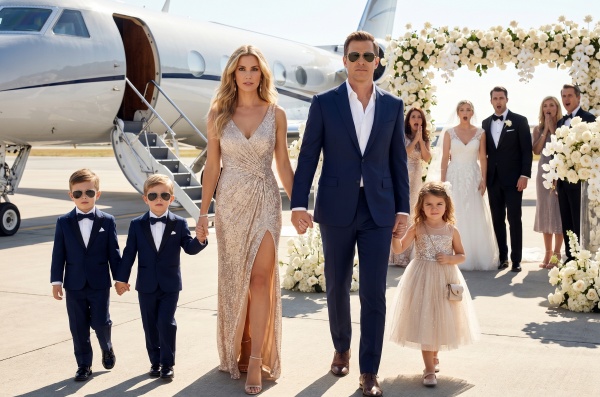
My Ex-Husband Blamed Me for Being Childless for 11 Years and Threw Me Out of Our Home—Then My Three Children Walked Into His Wedding and Exposed His Biggest Lie.
For eleven years, my husband made me believe I was the reason we never had children. He called me a failure, divorced me for a younger woman, and invited me to their wedding like I was supposed to sit quietly and bless the life he stole from me. But he didn’t know I had rebuilt everything he tried to destroy. And when I walked into that chapel with my husband and three children, the look on his face told the whole room the truth.
Part 1: Eleven Years of Being Called Empty
For eleven years, my husband told the world we were childless because of me.
Not in loud, obvious ways at first. Nathan Whitmore was too polished for that, too respected, too careful with his image in our little corner of suburban Atlanta. He said it with sighs at family dinners, with pitying smiles at church brunches, with a hand pressed to my lower back while telling people, “We’re still praying for a miracle.”
A miracle.
That was what he called a child, as if my body had personally refused heaven.
My name is Hannah Whitmore now only on old paperwork. Back then, I was Hannah Lawson Whitmore, thirty-four when the marriage finally ended, a middle school English teacher with a classroom full of seventh graders who called me “Mrs. W” and left sticky notes on my desk that said things like, “You make books less boring.”
At school, I felt useful.
At home, I felt defective.
Nathan and I had started trying for a baby two years after our wedding. At first, it was sweet in the way hopeful things are sweet. We bought a pale yellow blanket from Target before there was any baby to wrap in it, and Nathan painted the spare room a soft gray because he said it would work for a boy or a girl.
By year three, the blanket was still folded in the closet.
By year five, the spare room had become Nathan’s home office.
By year eight, I could not walk past the baby aisle in Publix without feeling like someone had pressed a thumb into a bruise.
I went to every appointment. I took every test my OB-GYN recommended. I had blood drawn, ultrasounds done, hormones checked, procedures scheduled, and calendars marked with little red circles that began to feel like accusations.
Every result said the same thing.
Nothing obvious was wrong with me.
That did not matter to Nathan.
He sat beside me in doctors’ offices with his phone in his hand, jaw tight, answering work emails while physicians explained that infertility could involve either partner. When one specialist suggested Nathan complete a full male fertility evaluation, he laughed like the doctor had made a rude joke.
“I’m fine,” he said. “My family has never had that kind of problem.”
That kind of problem.
As if fertility were a badge handed down with the Whitmore last name.
Nathan’s family owned three car dealerships around Georgia, and he had grown up believing his name itself was a form of proof. Proof of success. Proof of masculinity. Proof that people like him did not fail at ordinary human things like making babies.
So when we failed, the failure had to be mine.
His mother, Patricia, never said it directly either. She was a Southern woman who could insult you with a casserole dish in her hands and make it sound like concern.
“Hannah, sweetheart,” she said one Thanksgiving, placing a bowl of green bean casserole on the table, “have you thought about cutting back at work? Stress can be terrible for a woman’s body.”
Nathan’s younger brother, Mark, already had four children by then. His wife posted monthly milestone photos, back-to-school photos, Christmas pajama photos, beach vacation photos, every single one of them liked by Nathan within minutes.
He never liked my posts.
Not the classroom projects. Not the photos of our dog, Maple. Not even the anniversary picture I posted in year ten, where we were standing on the porch smiling like two people who still recognized each other.
That night, he looked at the post and said, “You always make us look happier than we are.”
I deleted it before bed.
The truth was, our marriage had become a house where every room had the same ghost in it. A baby who never came. A nursery that never existed. A version of me Nathan had created in his mind: cold, broken, disappointing.
When he was angry, he called me selfish.
When he was drunk, he called me barren.
When he was cruelest, he called me “half a wife.”
I did not tell anyone that part for years.
Not my sister. Not my best friend. Not even my father, who had raised me alone after my mother died and could read pain on my face before I understood it myself.
I thought if I admitted what Nathan said to me behind closed doors, people would ask why I stayed.
And I did not have an answer that sounded strong.
I stayed because I had loved him. I stayed because marriage vows felt sacred to me. I stayed because every month I thought, maybe this will be the month, maybe a baby will fix what grief has twisted, maybe Nathan will become the man he was before disappointment turned him mean.
But disappointment does not create cruelty.
It only reveals it.
The night he threw me out, rain was falling hard enough to blur the kitchen windows. I had come home late from parent-teacher conferences and found a woman’s red coat hanging over one of our dining chairs.
Her name was Madison Cole.
She was twenty-six, worked in marketing for Nathan’s dealership group, and had teeth so white they looked expensive. I had met her once at a holiday party, where she shook my hand and told me she admired teachers because she “could never have that kind of patience.”
That night, she was barefoot in my kitchen, drinking wine from the glass my father had given me for my thirtieth birthday.
Nathan stood beside her like they were the homeowners and I was the interruption.
I looked at the coat first.
Then the wineglass.
Then Nathan.
“How long?” I asked.
Madison lowered her eyes, but not before I saw the corner of her mouth move. It was not guilt. It was satisfaction trying to look like regret.
Nathan sighed. “Don’t do this.”
“Do what?”
“Make it ugly.”
I remember laughing once, not because anything was funny, but because the insult was so enormous my body did not know where to put it.
“You brought her into our house.”
He looked around the kitchen as if checking whether I had broken something. “This hasn’t been a real marriage in years, Hannah.”
The rain hit the windows harder.
Madison set down the wineglass. “Maybe I should go.”
“No,” Nathan said.
That single word told me everything.
Not just that he chose her. That he wanted me to understand he chose her. That my humiliation was not an accident of the moment, but part of the message.
“I want a divorce,” he said.
My hands went cold.
He continued, his voice calm and rehearsed. “I’ve already spoken to an attorney. Since the house is in my name and I paid the mortgage, I think it’s better if you stay somewhere else tonight.”
I stared at him. “This is my home.”
“It was supposed to be our family home,” he said.
Then he looked at my stomach.
Not quickly. Not subtly.
Directly.
“But you couldn’t give me that.”
Madison whispered, “Nathan,” as if he had gone too far, but she did not leave. She did not hand me my glass, or my coat, or my dignity. She simply stood there in my kitchen and watched the man I had loved cut me open without raising his voice.
I packed one suitcase.
Nathan followed me down the hall and told me not to take anything “valuable” until lawyers sorted it out. I wanted to ask him if eleven years counted as valuable. I wanted to ask him if the yellow baby blanket in the closet belonged to him or to the woman he had decided was too broken to keep.
Instead, I took my clothes, my mother’s jewelry box, and Maple’s leash.
He stopped me at the front door.
“You can’t take the dog.”
That was when I finally looked at him and saw, with terrible clarity, that I was not leaving a marriage.
I was escaping a verdict.
“You blamed me for an empty house,” I said quietly. “Now you can live in one.”
Then I walked into the rain with one suitcase, my mother’s jewelry box, and the last small piece of myself I still believed could survive.
Part 2: The Divorce and the Lie Everyone Believed
My father opened his door before I knocked.
He lived in a small brick house in Decatur, the same house where I grew up after my mother’s funeral turned him from a husband into a widower overnight. He was sixty-eight, retired from the postal service, and still the kind of man who ironed his jeans on Sunday evenings.
When he saw me soaked from the rain, suitcase in one hand and Maple’s leash in the other, his face changed.
Not with surprise.
With recognition.
As if some part of him had been waiting for the night I finally came home.
He did not ask questions at first. He took the suitcase, wrapped a towel around my shoulders, and made tea the way he used to when I had the flu as a child. Maple jumped onto his couch despite never being allowed on furniture, and my father said nothing.
Only after I had changed into dry clothes did he sit across from me and ask, “Did he hurt you?”
I knew what he meant.
“No,” I said. “Not like that.”
My father’s jaw tightened. “There are many ways to hurt a person.”
Then I cried.
I cried so hard I could not speak. Eleven years of swallowed shame came out of me in ugly, breathless pieces: the failed treatments, the comments, the humiliation, Madison in my kitchen, Nathan telling me I could not give him a family.
My father listened without interrupting.
When I finished, he stood, walked into his bedroom, and came back with an old cardboard box. Inside were folders, receipts, papers, and things he had saved from my childhood because he believed documentation mattered even when life felt emotional.
He placed an empty folder on the table.
On the tab, he wrote one word.
Nathan.
“From now on,” he said, “we keep records.”
That was the most American sentence my father ever spoke.
Not because Americans are cold, but because in this country, when a marriage becomes a legal fight, memories are not enough. You need bank statements, text messages, mortgage records, insurance documents, medical files, emails, dates, screenshots, and a lawyer who understands the difference between being hurt and being protected.
My lawyer’s name was Denise Carter.
She worked out of a small office near downtown Atlanta with a receptionist who called everyone “honey” and a conference room that smelled faintly of coffee and printer ink. Denise wore navy suits, asked direct questions, and did not blink when I told her my husband had thrown me out for a younger woman.
But when I told her he planned to claim the house was his alone, she looked over her glasses.
“Did you contribute to the household?”
“Yes. I paid utilities, groceries, insurance, some renovations.”
“Do you have records?”
“My father says we will.”
Denise smiled slightly. “I like your father.”
Nathan’s first offer was insulting.
He wanted to keep the house, the savings account, both cars, and most of the furniture. He offered me what he called “a clean break,” which meant enough money for a few months’ rent and nothing else.
He also wanted Maple.
Denise read the proposal and said, “He is not asking for a divorce. He is asking you to disappear.”
That was exactly what Nathan wanted.
He wanted me gone quietly so he could move Madison into the house, repaint the spare room, and tell people our marriage had ended because I could not handle the pain of infertility. He wanted sympathy without accountability. He wanted to be both the wounded husband and the romantic hero starting over.
For a while, he got away with it.
At church, women who used to hug me began speaking to me with careful pity. Men shook Nathan’s hand and told him they were praying for him. Patricia told everyone the divorce was “devastating for Nathan” because he had “wanted children so badly.”
No one asked what I had wanted.
No one asked what had been said to me in that house.
One Sunday, three months after I moved out, I went to the early service because I missed the choir and thought I could sit quietly in the back. I had barely stepped into the lobby when I heard Patricia speaking near the coffee table.
“Hannah is a sweet girl,” she said, “but some women just aren’t built for family life.”
I stopped walking.
A woman beside her murmured, “Poor Nathan.”
Poor Nathan.
Those two words did something to me.
I turned around, walked back to my car, and sat behind the wheel until my hands stopped shaking. Then I drove straight to Denise’s office even though it was closed, parked outside, and sent her an email with the subject line: I am done being polite.
The divorce changed after that.
Not because I became cruel, but because I stopped confusing silence with dignity.
We requested full financial disclosure. We documented my contributions to the home. We gathered medical records showing I had undergone years of testing and treatment while Nathan had avoided his own evaluation. We preserved text messages where he called me a failure, a burden, and once, in writing, “the reason I will die without a son.”
Denise told me not to post online.
She told me not to confront Madison.
She told me not to defend myself to every gossiping neighbor because legal strategy and emotional satisfaction rarely travel in the same car.
So I stayed quiet publicly.
Privately, I rebuilt.
I rented a one-bedroom apartment near my school. Maple slept at the foot of my bed because Denise argued successfully that I had been the primary caregiver, and Nathan eventually decided a dog was less important than punishing me. My father came every Saturday to fix things that did not need fixing.
A loose cabinet hinge.
A squeaky closet door.
A porch light that worked perfectly until he needed an excuse to check on me.
The divorce was finalized nine months after Nathan threw me out.
He kept the house but had to buy out my share. I kept my retirement account, my car, Maple, my mother’s jewelry, and enough settlement money to breathe. There were no children to discuss, no custody schedule, no school holidays to divide.
That was the part that hurt most.
At the final hearing, Nathan sat across the aisle from me in a gray suit, looking annoyed rather than sad. Madison waited outside the courtroom, scrolling on her phone, a diamond bracelet on her wrist that looked very much like something a man buys when he is trying to make a younger woman believe a messy divorce is romantic.
When it was over, Nathan approached me in the hallway.
“I hope you find peace,” he said.
It sounded kind until he added, “Some women are meant to be mothers. Some aren’t.”
I looked at him for a long moment.
Then I said, “You should get tested.”
His face hardened.
“Still blaming me?” he asked.
“No,” I said. “I finally stopped blaming myself.”
I walked away before he could answer.
I did not know then that those four words — “You should get tested” — would one day echo through a wedding chapel full of white roses, stunned relatives, and three children who had no idea they were about to reveal the truth simply by existing.
Part 3: The Life I Built After He Threw Me Away
Healing did not look like a movie montage.
There was no sudden haircut, no dramatic new wardrobe, no smiling date under string lights two weeks after my divorce. For months, healing looked like paying bills on time, eating dinner that was not cereal, and sleeping through the night without waking at 3 a.m. to wonder whether Nathan had been right about me.
Maybe I was not meant to be a mother.
That thought followed me everywhere.
It sat beside me at baby showers. It waited in the greeting card aisle before Mother’s Day. It stood in the doorway of my classroom when students wrote essays about their families and I pretended not to cry over the ones that began, “My mom is my hero.”
Then one afternoon, my doctor called about old records.
During the divorce, Denise had requested copies of every fertility-related document from our former clinic. Most had already been sent, but one file had been delayed because it required additional authorization.
I picked it up after work on a Thursday.
I expected nothing.
More bloodwork. More notes. More medical language describing my body as if it were a machine that had refused to start.
Instead, I found a report with Nathan’s name on it.
I sat in my car outside the clinic and read it three times.
The test had been done six years into our marriage.
I remembered that month. Nathan had finally agreed to provide a sample after our doctor insisted we could not keep treating only me. He had gone to the appointment alone and returned home furious, saying the clinic had been disorganized and the test had been “inconclusive.”
Then he told me there was no point in wasting more money.
The report in my hands did not say inconclusive.
It showed severe male-factor infertility.
Not impossible, according to the doctor’s notes, but serious enough that natural conception would have been highly unlikely. The recommendation had been further evaluation, possible treatment, and a joint consultation.
Nathan had known.
He had known for five years before he threw me out.
He had known while I cried in bathrooms, while I apologized to him after every failed month, while I let doctors prescribe medications that made me sick, while his mother implied my career had ruined my body.
He had known while calling me half a wife.
My hands shook so badly I dropped the papers.
For a few minutes, I could not breathe normally. Then I called my father.
He answered on the second ring. “Hey, baby.”
I tried to speak, but nothing came out.
“Hannah?”
“He knew,” I whispered.
My father was silent for one second.
Then his voice changed. “Come home.”
I drove to Decatur with the report on the passenger seat like a bomb.
My father read it at the kitchen table, his face still except for a small movement in his jaw. He had never been a man who cursed often, but that day he said one word so quietly it frightened me more than shouting would have.
Then he placed the papers back in the folder.
“You are not broken,” he said.
I started crying again, but this time the tears felt different.
They were grief, yes.
But also rage.
And under the rage, something small and bright began to move.
Relief.
Denise reviewed the report and explained that reopening parts of the divorce would be complicated and might not be worth the emotional cost unless there was direct financial fraud tied to medical expenses. Legally, Nathan’s cruelty was real, but not every cruelty can be repaired by a judge.
That was one of the hardest lessons of my life.
The law can divide property. It can enforce support. It can protect rights, preserve records, and punish certain forms of misconduct. But it cannot give back the years you spent believing a lie someone told because the truth threatened their pride.
So I did not sue Nathan.
I did something more dangerous to the life he had built on my shame.
I started living.
I changed schools and accepted a position at a private academy in Marietta, where class sizes were smaller and my salary was better. I bought a townhouse with a red front door and enough sunlight for houseplants I did not immediately kill. I adopted a second dog, a ridiculous beagle mix named Biscuit, because Maple looked lonely and my father claimed two dogs made a woman “less likely to tolerate nonsense.”
Then I met Eli.
His full name was Elijah Brooks, but everyone called him Eli. He taught U.S. history down the hall from me and had the kind of quiet confidence that did not require an audience. He was divorced, kind, and raising a daughter part-time with an ex-wife he spoke about respectfully, which impressed me more than any flashy date ever could.
For six months, we were just colleagues.
He brought extra coffee on testing days. I proofread a grant proposal for his Civil Rights field trip. He once spent twenty minutes helping a student fix a broken backpack zipper because the boy looked like he might cry.
Kindness, I learned, is most trustworthy when no one important is watching.
Our first date was at a taco place in Roswell where the salsa was too spicy and Eli laughed when I tried to pretend I was fine. I told him about my divorce on the third date, including the infertility, the blame, and the report.
He did not flinch.
He did not say, “Everything happens for a reason,” which is what people say when they cannot bear the weight of someone else’s pain.
Instead, he said, “You deserved better information, better care, and better love.”
That was when I knew I was in trouble.
We married two years later in my father’s backyard under a rented white tent. It was small, ordinary, and perfect. My dress came from a boutique in Savannah, my bouquet had blue hydrangeas because my mother had loved them, and Eli cried before I even reached the little aisle between the folding chairs.
We did not rush into trying for children.
I was forty by then, and I had made peace with the possibility that motherhood might come differently for me or not at all. Eli told me he loved me whether our family grew through pregnancy, adoption, fostering, step-parenting, or Sunday dinners with too many dogs under the table.
Then, six months after our wedding, I got pregnant.
I thought the test was wrong.
I took another one.
Then another.
Then I sat on the bathroom floor surrounded by three positive pregnancy tests while Biscuit licked my elbow and Maple looked deeply concerned.
When the ultrasound technician turned the screen toward us, she smiled strangely.
Eli squeezed my hand. “Is everything okay?”
She said, “Well, there are three heartbeats.”
Three.
Not one miracle.
Three.
I laughed so hard I started crying, and Eli laughed too, though he looked like a man who had just realized college tuition could arrive in triplicate.
My pregnancy was closely monitored because of my age and because triplets make doctors use serious voices. But our babies arrived early and loud, two boys and a girl, all tiny, all furious, all alive.
We named them Noah, Caleb, and Lily.
My father stood outside the NICU window with one hand pressed against the glass.
“Three,” he whispered.
I stood beside him in a hospital gown, sore and exhausted and happier than I had ever known a person could be.
He looked at me and said, “That house was never empty because of you.”
I thought of Nathan then.
Not with longing.
Not even with hate.
Just with a strange, distant sadness for the woman I had been, the woman who had believed his shame belonged to her.
She was gone now.
In her place stood a mother of three with spit-up on her shoulder, a husband asleep in a vinyl hospital chair, and a father who carried printed photos of the babies in his wallet like government-issued identification.
For five years, Nathan knew nothing.
Our circles no longer overlapped. I had left the church we once attended. I blocked Madison after she sent one message asking if I had “found closure,” which I decided did not deserve the dignity of a response.
But secrets have a way of traveling in family systems.
Especially when people mistake silence for weakness.
Part 4: The Invitation That Was Meant to Humiliate Me
The wedding invitation arrived in a thick cream envelope with gold lettering.
At first, I assumed it was a mistake. The return address was Nathan’s mother’s house in Buckhead, and my name was written in Patricia Whitmore’s elegant handwriting.
Mrs. Hannah Brooks.
Not Whitmore.
Brooks.
I opened it at the kitchen counter while the triplets ate peanut butter sandwiches and argued over whether dinosaurs could swim. Eli was grading essays at the table, red pen in hand, wearing reading glasses that made him look older and somehow more handsome.
I read the invitation twice.
Nathan Whitmore and Madison Cole requested the honor of my presence at their wedding ceremony.
Seven years after our divorce.
Seven years after he threw me into the rain.
Seven years after Madison stood barefoot in my kitchen with my wineglass in her hand.
Eli looked up. “What is it?”
I handed him the card.
His expression hardened in a way I rarely saw. Eli was not a jealous man, but he was protective in a steady, serious way that reminded me of old trees and locked doors.
“Why would they invite you?” he asked.
I turned the card over.
A small handwritten note slipped out.
Hannah, time has healed many wounds. Nathan and Madison would like to begin their marriage with grace, forgiveness, and family unity. We hope you will come and show that the past is behind us.
Patricia.
I laughed once.
It sounded exactly like the laugh I had made years ago in the kitchen when Nathan said he wanted a divorce.
“Family unity,” I said.
Eli placed the invitation down gently. “You don’t have to go.”
“I know.”
“You don’t owe them grace.”
“I know that too.”
The smart choice was to throw the invitation away.
Denise, who was still my friend by then, told me the same thing when I texted her a photo. “This is bait,” she wrote. “Do not give them a scene.”
I had no intention of making a scene.
But something about that note stayed under my skin.
Not because I wanted Nathan back. The thought was almost absurd now. My life was full of lunchboxes, school projects, bedtime stories, dogs barking at delivery trucks, and Eli singing off-key while making pancakes on Saturdays.
No, what bothered me was the assumption.
Patricia assumed I was still the same woman who would swallow humiliation to make others comfortable. She assumed I would sit in a pew, smile politely, and help Nathan rewrite history by proving even his ex-wife approved of his new beginning.
Then Madison called.
I almost did not answer the unknown number, but I was waiting for the pediatrician to call back about Caleb’s ear infection. Instead, her voice came through the phone, bright and soft.
“Hannah? It’s Madison.”
I stood in my laundry room, surrounded by tiny socks and towels.
“What do you want?”
There was a pause, just long enough for her to be offended.
“I know this is awkward,” she said. “But I wanted to personally say I hope you’ll come. Nathan and I have grown a lot, and we want peace.”
“Peace doesn’t usually require invitations printed in gold.”
She laughed lightly. “You always had a sharp sense of humor.”
I said nothing.
Then her voice changed.
“Nathan told me everything, you know. About how hard the marriage was. About the baby situation. I can’t imagine how painful that must have been for both of you.”
The baby situation.
My fingers tightened around the phone.
Madison continued, “I think seeing us move forward might help everyone. It might help you too.”
There it was.
Not peace.
Performance.
She wanted me in the room as proof that she had won completely. The young bride, the patient groom, the barren ex-wife forgiving them from the pews.
For one second, the old Hannah rose inside me.
The one who would have hung up and cried.
But she was no longer alone in my body.
A mother stood there now. A wife loved properly. A woman who had seen three heartbeats flickering on a screen after being told for years she was empty.
“Madison,” I said, “does Nathan know you invited me?”
“Of course.”
“Does he know I have children?”
Silence.
Not a pause.
A collapse.
Finally, she said, “What?”
I looked through the laundry room doorway into the kitchen, where Noah was wearing a spaghetti strainer as a helmet and Lily was telling Caleb that sharing was “required by law,” which was not true but sounded like something she had heard from Eli.
“I have three children,” I said.
Madison’s voice went thin. “I didn’t know that.”
“I assumed he told you everything.”
She hung up.
That should have been the end of it.
But two days later, Patricia called.
Her voice was tight with the kind of politeness that means a Southern woman is holding a match near a curtain.
“Hannah,” she said, “I hear congratulations are in order.”
“For what?”
“Your children.”
I could hear the effort it cost her to say the word.
“Thank you.”
“Nathan was surprised.”
“I imagine he was.”
Another silence.
Then Patricia said, “Are they adopted?”
I smiled, though she could not see it. “No.”
“Oh.”
One syllable.
A whole family myth cracking through it.
I did not give her details. She did not deserve my medical history, my babies’ birth story, or the sacred information Nathan had once weaponized against me. But I could hear her breathing change.
For eleven years, the Whitmores had treated me like the reason their bloodline had paused.
Now they had to ask a question they had avoided because the answer threatened Nathan more than me.
If Hannah had three biological children, maybe Hannah was never the problem.
I decided not to attend the wedding.
Then my father found out.
Not from me. From Eli, who mentioned it while helping him install shelves in our garage. My father appeared at my house the next morning carrying donuts for the kids and wearing the expression of a man who had been patient long enough.
“You should go,” he said.
I nearly choked on my coffee. “Absolutely not.”
“Hear me out.”
“No.”
“Hannah.”
“Dad, I am not dragging my children into Nathan’s wedding like some reality TV reveal.”
“Good,” he said. “Don’t drag them. Walk in with them.”
I stared at him.
He sat at my kitchen table while Lily offered him a sprinkle donut with one bite already taken out of it. He accepted it solemnly.
“You don’t go to cause trouble,” he said. “You go because they invited you. You go because you have nothing to hide. You go because for years that family made you carry shame that did not belong to you.”
Eli leaned against the counter, quiet.
My father looked at him. “You’ll be there?”
“If Hannah wants me there,” Eli said.
“I don’t know what I want,” I admitted.
My father’s face softened. “Then ask yourself this. If you stay home, is it peace? Or is it fear wearing peace’s clothes?”
That question bothered me for a week.
In the end, I went.
Not for revenge.
Not to ruin a wedding.
Not because I wanted Nathan to suffer.
I went because they had invited Mrs. Hannah Brooks, and Mrs. Hannah Brooks was not a secret. She was a teacher, a wife, a daughter, and a mother of three children who had every right to exist in any room where her name had been spoken like a curse.
The wedding was held at a historic chapel outside Savannah, with white roses, live violin music, and enough money spent on flowers to cover a teacher’s salary for a year. Guests arrived in linen suits and pastel dresses, fanning themselves in the Georgia heat.
Eli wore a navy suit.
I wore a simple blue dress.
The triplets wore matching outfits because Lily insisted they were “a team.” Noah and Caleb complained about their bow ties all morning. Lily wore white sandals and carried a little purse full of crayons, two Band-Aids, and a plastic dinosaur she said was for emotional support.
We arrived five minutes before the ceremony.
Not late.
Not dramatic.
Just late enough that most people were already seated.
An usher opened the chapel doors.
And three children walked into Nathan Whitmore’s wedding.
Part 5: The Look on His Face
The first person to see us was Patricia.
She was seated in the front row wearing lavender silk and pearls, her hair sprayed into a shape that could have survived a hurricane. When she turned at the sound of the doors opening, her polite smile froze so completely it looked painted on.
Then she saw the children.
Noah walked beside me, serious and curious, holding my hand. Caleb held Eli’s hand and whispered too loudly, “Is this the quiet place?” Lily walked between her brothers with her chin lifted, carrying the plastic dinosaur in one hand and waving with the other because Lily believed every room improved when she entered it.
A few guests turned.
Then more.
Whispers moved through the chapel like wind through dry leaves.
I kept my eyes forward.
Nathan stood near the altar in a black tuxedo, speaking quietly to his best man. Madison stood at the back of the chapel in her wedding dress, waiting for her cue, hidden partly behind a floral arrangement and two bridesmaids.
Then Nathan looked up.
I had imagined that moment more times than I would ever admit.
Sometimes, in my angriest thoughts, he looked ashamed. Sometimes he looked jealous. Sometimes he looked devastated in the exact measure I once had been.
But the real expression was stranger.
At first, he did not understand what he was seeing.
His eyes moved from my face to Eli’s, then to the children. He counted them without meaning to. One, two, three.
Then recognition came.
Not recognition of them, of course. He had never met them.
Recognition of the truth.
His face lost color so fast that the best man reached toward him as if Nathan might faint. His mouth opened slightly, but no sound came out.
I saw the question hit him.
If Hannah has three children, then what did that mean about eleven years of blame?
What did it mean about every Thanksgiving comment, every whispered prayer request, every cruel word he had said in the dark? What did it mean about the medical report he had hidden and the wife he had thrown away because her existence reminded him of his own secret?
Madison saw his face before she saw us.
That was the detail I will never forget.
She was standing in her wedding dress, radiant and ready, watching the groom watch someone else. Her smile faltered first. Then she followed his gaze.
Her eyes landed on me.
Then Eli.
Then the triplets.
For one long second, the chapel held its breath.
We were not loud. We did not announce anything. We did not bring signs, accusations, screenshots, or medical files.
We simply existed.
That was enough.
An usher led us to a pew near the middle. I sat between Eli and Lily, with Noah and Caleb on Eli’s other side. My father sat behind us because he had driven separately, apparently unwilling to miss “the end of a long sentence,” as he called it.
Lily leaned against me and whispered, “Mommy, why is that man staring?”
I kissed the top of her head. “Because grown-ups are confusing.”
“That’s true,” she whispered back.
The violinist began playing again, uncertainly.
The ceremony continued because expensive weddings have momentum. People can be stunned, furious, heartbroken, or unraveling inside, but if a coordinator with a headset says walk, someone usually walks.
Madison walked down the aisle.
She was beautiful. I will give her that. Her dress was fitted lace, her veil long, her bouquet perfect.
But her eyes were not on the flowers or the guests.
They were on Nathan.
And Nathan looked like a man standing in front of a locked door, hearing every lie he had ever told moving behind it.
The officiant began.
“Dearly beloved, we are gathered here today…”
I barely heard the rest.
I was not there to object. I had no legal reason, no romantic claim, no desire to rescue Madison from the man she had chosen after stepping into my marriage. She was an adult. She had ignored enough warning signs to decorate a highway.
But halfway through the vows, something happened.
Madison did not repeat her line.
The officiant paused.
Nathan turned toward her, confused.
She looked at him and whispered, not softly enough, “You told me she couldn’t have children.”
The chapel went completely still.
Nathan’s eyes flicked to me.
That was his mistake.
If he had looked only at Madison, maybe he could have lied again. If he had smiled, squeezed her hand, postponed the conversation, maybe he could have controlled the room a little longer.
But he looked at me with panic.
Madison saw it.
Everyone saw it.
My father leaned forward behind me and murmured, “There it is.”
The officiant cleared his throat. “Would you like a moment?”
Madison pulled her hands from Nathan’s.
The bouquet trembled in her grip.
“Did you lie to me?” she asked.
Nathan’s voice was low. “Not here.”
That was answer enough.
Madison stepped back.
The first bridesmaid reached for her, but Madison shook her head. Patricia stood so quickly her pearl necklace swung forward.
“Madison, sweetheart,” Patricia said, “let’s not—”
Madison turned on her. “You knew too?”
Patricia’s face changed.
There are some silences that confess.
This was one of them.
A murmur rippled through the chapel. Someone in the back said, “Oh my God.” Someone else whispered my name.
I held Lily’s hand and stared straight ahead.
I did not smile.
That surprised me most.
For years, I thought if Nathan were ever exposed, I would feel triumph. I imagined justice would taste sweet, like cold lemonade on a hot day. But watching him stand there, pale and cornered, did not make me happy.
It made me tired.
Tired for the woman I had been. Tired for Madison, even though she had once stood in my kitchen. Tired of families that protect men’s pride by handing women the blame.
Madison walked out of the chapel.
Not running.
Walking.
Her veil trailed behind her over the polished floor, and the bridesmaids scrambled after her in a cloud of blush pink. Nathan started to follow, but his best man grabbed his arm and whispered something urgent.
Patricia turned toward me.
For one wild second, I thought she might blame me out loud.
Maybe she wanted to.
But my father stood.
He did not raise his voice. He did not point. He simply looked at Patricia and said, “Don’t.”
One word.
It was enough.
Patricia sat back down.
The wedding dissolved in pieces after that. Guests stood awkwardly, checking phones, whispering, pretending not to stare while staring constantly. The violinist packed up. The coordinator cried behind a flower arrangement.
Eli leaned close to me. “Do you want to leave?”
“Yes,” I said.
We stood, gathered the children, and stepped into the aisle.
Nathan was still near the altar.
As we passed, he said my name.
“Hannah.”
I stopped because once, years ago, that name in his mouth could have moved my whole heart.
Now it was just sound.
He looked at the children again. “Are they…?”
“No,” I said.
He flinched.
I knew what he was asking. He wanted some impossible loophole, some timeline that made the children connected to him, some way to turn my motherhood into his story.
“They are mine,” I said. “And Eli’s.”
His jaw tightened. “You never told me.”
I almost laughed.
“You threw me out of our house, Nathan. You lost the right to updates.”
His eyes filled with something like anger, but underneath it was fear.
“Did you know?” he asked.
“Know what?”
He swallowed. “About me.”
I thought of the report. The one he had hidden. The one that had turned my grief into his shield.
“Yes,” I said. “I found the file.”
He closed his eyes.
Behind him, Patricia made a soft, wounded sound, but I did not look at her.
Nathan opened his eyes again. “Why didn’t you say anything?”
That was the first question he had asked me in years that sounded almost honest.
I stepped closer, not enough for drama, just enough that he could hear me without the whole chapel listening.
“Because I spent eleven years begging you for the truth,” I said. “Once I finally had it, I decided not to waste it on you.”
His face crumpled for half a second before pride pulled it back into place.
Then Noah tugged my hand.
“Mom,” he whispered, “can we go now? My bow tie is hurting my neck.”
“Yes,” I said. “We can go.”
Outside, the Savannah heat wrapped around us. Spanish moss hung from the oak trees, and guests had left half-empty glasses of sweet tea sweating on white-clothed tables. Somewhere behind the chapel, a woman was crying.
Maybe Madison.
Maybe Patricia.
Maybe both.
My father walked out behind us and put on his sunglasses.
“Well,” he said, “that was shorter than I expected.”
Eli laughed first.
Then I did.
Not loudly. Not cruelly. Just enough to let the tension leave my body.
The children had no idea what had happened. To them, it was just a strange adult event where no cake had been served, which they considered a serious failure. We stopped at a Dairy Queen on the way home because Lily announced weddings were “supposed to have treats,” and none of us could argue with that.
The triplets ate ice cream in the back seat, getting chocolate on their church clothes.
My father followed us in his truck.
Eli drove with one hand on the wheel and the other resting on mine.
“You okay?” he asked.
I watched the Georgia highway roll past, green and gold in the late afternoon sun.
“I think so.”
“You regret going?”
I thought about it.
Nathan’s face at the altar. Madison’s whispered question. Patricia’s silence. The old lie finally collapsing under the simple weight of three living, breathing children walking into a room.
“No,” I said. “But not for the reason I expected.”
Eli glanced at me.
“I thought I needed him to see them,” I said. “But I think I needed to see myself walking in.”
He squeezed my hand.
That night, after the kids were asleep and the dogs had finally stopped barking at shadows, I sat on our back porch with my father. The air smelled like cut grass and summer rain. Crickets sang from somewhere near the fence.
My father handed me a glass of iced tea.
“You did well today,” he said.
“I didn’t do anything.”
“You walked in.”
I smiled faintly. “That counts?”
“For some women,” he said, “that counts as crossing an ocean.”
We sat quietly for a while.
Then I said, “Do you think I was wrong to bring the kids?”
My father took a long breath.
“I think they were invited into a lie long before they walked into that chapel,” he said. “You just let the truth come with you.”
I looked through the kitchen window at Eli loading the dishwasher while Lily stood beside him in pajamas, apparently supervising. Noah and Caleb were supposed to be brushing their teeth, which meant they were probably flooding the bathroom sink.
My life was loud now.
Messy. Expensive. Exhausting. Full of permission slips, pediatrician appointments, soccer cleats, grocery bills, bedtime negotiations, and tiny socks that vanished as if our dryer had a personal grudge.
It was not the perfect life Nathan used to describe when he blamed me for our empty house.
It was better.
Because it was real.
A month after the wedding, Madison sent me a letter.
Not a text. Not an email. A real letter in careful handwriting.
She apologized.
Not perfectly. Not without excuses. But enough. She said Nathan had told her our marriage was over long before she entered it. She said he told her I had refused adoption, refused treatment, refused to “give him a family.” She said she believed him because believing him made her feel chosen instead of guilty.
Then she wrote one sentence that stayed with me.
“I am sorry I helped him punish you for something he knew was not your fault.”
I sat with that letter for a long time.
Then I put it in the Nathan folder my father had started years ago. The folder was thick now, not because I needed it, but because sometimes proof is not for court. Sometimes proof is for the part of you that still wakes up wondering if you imagined how bad it was.
Nathan never married Madison.
From what I heard, she moved to Nashville and started over. Nathan stayed in Atlanta for a while, then sold the house after Patricia’s health declined. The dealerships continued, though his role became smaller and quieter.
I did not celebrate that.
I had children to raise.
That is the thing about surviving someone’s cruelty. Eventually, if you are lucky, their downfall becomes less interesting than your own breakfast table. Their regret becomes background noise. Their name becomes something you see on old documents and feel almost nothing.
Almost.
Sometimes, when Lily climbs into my lap and asks if she grew in my belly with her brothers, I tell her yes, all three of you at once, and she laughs like she pulled off a prank before birth.
Sometimes, when Noah reads quietly beside Maple, I remember the yellow blanket I left in the closet of Nathan’s house and hope someone donated it to a baby who needed warmth.
Sometimes, when Caleb wraps his arms around Eli’s neck and calls him the best dad in the world, I think of Nathan asking if the children were his and feel a strange sadness for a man who wanted a legacy more than he wanted love.
But most days, I do not think of Nathan at all.
I think about spelling tests, dinner, library books, and whether three children can survive on chicken nuggets and strawberries alone. I think about Eli’s hand finding mine in the dark. I think about my father wearing a paper crown at the triplets’ birthday party because Lily declared him king of the cupcakes.
And sometimes, when I catch my reflection in the hallway mirror, I see the woman Nathan called a failure.
Then I look behind her.
Three backpacks by the door.
Three pairs of muddy sneakers.
Three drawings taped to the refrigerator.
Three voices calling, “Mom!”
For eleven years, Nathan made me believe silence meant emptiness.
He was wrong.
Silence was just the space before my real life began.
And on the day he stood in a chapel to marry the woman he chose over me, the truth did not arrive with shouting, revenge, or scandal.
It arrived holding my hands.
Three children walking down the aisle.
Three heartbeats he could not explain.
Three living answers to a lie that had never belonged to me.
