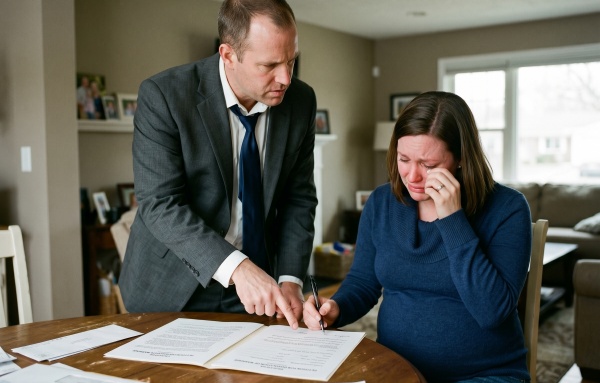
My Husband Left Me for His “Soulmate”—When Nathan asked for a divorce after eight years of marriage, I didn’t cry, beg, or try to change his mind. He was already rushing toward another woman, convinced he had found the love he was always meant to have. What he didn’t know was that I was carrying the one miracle we had spent years praying for. And by the time he found out the baby was his, the perfect life he ran toward had already started falling apart.
Part 1 — The Day He Thought He Was Free
The morning my divorce was finalized, I was fourteen weeks pregnant and wearing the same navy dress I had worn to Nathan’s promotion dinner three years earlier. It still fit because my stomach had not really rounded yet, just softened in a way only I could notice. I sat in the family courthouse in Denver with my hands folded over my purse, where the ultrasound photo was tucked inside a white envelope. Nathan stood twelve feet away, smiling at his phone like the best part of his life was waiting outside the building.
He did not know about the baby. No one in that courtroom did except me and my attorney, Marissa Cole. My doctor knew, of course, and so did the nurse who had called me “sweetheart” when I started crying during the first ultrasound. But Nathan, the man who had spent years whispering baby names into the dark with me, had no idea that the child we once prayed for was already growing inside me.
I had not hidden it because I wanted revenge. Revenge is loud, and I had become very quiet by then. I kept the pregnancy to myself because Nathan had already shown me what he did when life got hard. He did not stay, he did not fight, and he did not hold my hand through the grief of another failed fertility cycle. He packed two suitcases, rented a condo downtown, and told me he “needed to be honest about where his heart was.”
His heart, apparently, was with a woman named Olivia Harper. She was his college girlfriend from Boulder, the one he used to describe as “a chapter from before I became an adult.” For years, I believed that meant she was part of the past. Then one Sunday afternoon, I found her name lighting up his phone while he was in the shower. The message said, “I hate that we wasted so much time.”
When I confronted him, Nathan looked almost relieved. He did not apologize in the way a person apologizes when they are ashamed. He explained, which was worse. He said Olivia understood him in a way I no longer did. He said we had become “roommates with a mortgage.” He said grief had changed me, as if losing pregnancy after pregnancy had been a personality flaw instead of a wound.
We had been married for eight years. We owned a three-bedroom house in Lakewood with a maple tree in the front yard and a nursery that had never become a nursery. We had spent more than $22,000 on fertility treatments, lab work, medications, and one IVF cycle that ended with me sitting on the bathroom floor, staring at a negative test while Nathan stood in the hallway, unable to look at me. I thought that kind of pain either broke a marriage or welded it together. I did not know it could do both, one person at a time.
Nathan asked for the divorce in March, standing in our kitchen with the refrigerator humming behind him. He had already spoken to an attorney. He had already moved half his clothes to the downtown condo. He had already told Olivia that he was “finally choosing happiness.” I remember that phrase because it sounded so clean, so inspirational, like something printed on a coffee mug by someone who had never destroyed a life before breakfast.
By June, he was rushing everything. He wanted the settlement signed, the house handled, the retirement accounts separated, and the final hearing scheduled as soon as the court allowed it. He acted like the divorce was a gate he had to run through before it closed. Whenever my attorney asked for documents, he sighed. Whenever I asked for clarification, he called me difficult. Whenever Marissa slowed the process down, he accused me of trying to punish him.
But I was not trying to punish him. I was trying to survive him.
Eight days before the hearing, I found out I was pregnant in the parking lot of a Target on Wadsworth Boulevard. I had gone in for laundry detergent and saltine crackers because I had been nauseated every morning for two weeks. Stress, I told myself. The divorce, I told myself. The fact that my husband had replaced me with a woman who posted sunrise photos and captions about second chances, I told myself.
Still, I bought a pregnancy test. Then I bought two more because hope had made a fool of me before, and I did not trust it unless it came in triplicate. I took the first test in the Target bathroom because I could not bear to do it in our house, not in the bathroom where I had cried over so many blank little windows. When the second line appeared, I stopped breathing. When the second test said pregnant, I sat on the closed toilet seat and pressed my hand over my mouth.
The clinic confirmed it the next morning. I was further along than I expected, far enough that the doctor smiled gently and said the heartbeat looked strong. I stared at the screen where a tiny flicker pulsed in black and white, and my whole body filled with a grief so complicated it almost felt like joy. This was the miracle Nathan and I had begged for. This was the life that had arrived after he left.
“Do you want to call anyone?” the nurse asked me.
I thought of Nathan in his downtown condo. I thought of Olivia’s name appearing beneath his Instagram posts. I thought of the way he had told me, “Please don’t make this harder than it has to be,” as if I were an obstacle in his love story. Then I folded the ultrasound photo into my purse and said, “Not yet.”
Marissa was the first person I told. She did not gasp or clap or tell me everything happened for a reason. She listened, took off her glasses, and asked me one question. “Do you feel safe telling him before the agreement is signed?”
I sat across from her in her office, surrounded by framed degrees and a window view of downtown Denver. Outside, traffic crawled along Speer Boulevard, everyone going somewhere they believed mattered. I thought about Nathan’s impatience, his new life, his need to control the story. Then I said, “No.”
Marissa nodded. “Then we protect you first.”
That was why, on the morning of the final hearing, there was a clause in the settlement Nathan had barely read. It mentioned undisclosed material circumstances, continuing parental obligations, medical expenses, and post-decree responsibilities that could be addressed separately under Colorado law. It did not say baby. It did not need to say baby. It simply left the door open for the truth, whenever the truth became impossible to ignore.
Nathan signed it like he was signing for a package. He flipped to the last page, uncapped his pen, and wrote his name with the confidence of a man who thought paperwork could erase consequences. His attorney whispered something to him, but Nathan shook his head. He was done waiting. He wanted to be free.
When the judge asked if we both understood the agreement, Nathan said yes before the question was fully finished. I said yes too, though what I understood was very different from what he understood. He understood that he was getting out. I understood that he was walking away from a life he had not bothered to look closely enough to see.
Afterward, in the hallway, Nathan approached me with a strange softness, the kind people use when they want to believe they have behaved well. “I’m glad we handled this maturely,” he said.
I looked at him, really looked at him. His charcoal suit was new. His hair was trimmed. His phone buzzed twice in his hand, and he glanced down like he could not help himself. Olivia was waiting.
“I hope you got what you wanted,” I said.
He smiled, almost embarrassed. “I think we both deserve a fresh start.”
I placed one hand over my purse, over the envelope, over the tiny black-and-white proof of the start he did not know existed. “Yes,” I said. “We do.”
He walked out first, shoulders loose, steps quick, already calling someone before he reached the doors. I watched him through the glass as he stepped into the bright June afternoon. He looked like a man who believed the hard part was over.
He had no idea the hard part had not even begun.
Part 2 — The Secret I Carried Alone
Pregnancy after infertility does not feel like the movies. It does not arrive with soft music and happy tears and hands pressed lovingly against a stomach. At least, mine did not. Mine arrived like a storm cloud breaking open over a house already on fire.
For two years, Nathan and I had lived by calendars. Ovulation windows, injection schedules, blood tests, specialist appointments, insurance calls, pharmacy pickups, follow-up scans. Our refrigerator had once been covered with ultrasound appointment cards, vitamin reminders, and sticky notes with hopeful little phrases Nathan wrote when he still knew how to be tender. “This is our year,” one of them said. I threw it away after he moved out because I could not stand being mocked by my own refrigerator.
The month I conceived, Nathan and I were not happy, but we were still married in every practical and legal sense. He had not yet admitted Olivia was more than a rekindled friendship. He was coming home late, sleeping badly, and touching me with the distracted guilt of someone already halfway gone. We had one weekend in February when he seemed like himself again, when snow fell over the backyard and we made pancakes at noon because neither of us wanted to leave the house. I remembered that weekend later with a kind of stunned horror.
That was the weekend.
By the time I learned I was pregnant, Nathan had rewritten our marriage in his head. According to him, we had been over for a long time. According to him, Olivia had not caused the divorce; she had simply “helped him realize the truth.” According to him, I was strong, independent, and better off without someone who could not love me properly. People say things like that when they want abandonment to sound like generosity.
I spent the first week after the test moving through my days like I was carrying glass inside my body. I drove carefully. I drank water constantly. I stopped lifting heavy boxes in the garage and started reading ingredient labels like they were legal contracts. At night, I lay on the left side of the bed and listened to the quiet rooms of the house. Every creak sounded louder without Nathan there.
The nursery door stayed closed. We had painted it pale green two years earlier, before the first fertility treatment failed. Nathan had assembled a white crib we bought during an optimistic Black Friday sale, then taken it apart and put it in the basement after the third miscarriage scare that became nothing, because there had been no pregnancy to lose. I had not gone into that room for months. The day after my ultrasound, I opened the door and stood there for almost ten minutes.
Dust had gathered on the windowsill. A cardboard box of baby books sat in the corner, still sealed with packing tape. There was a small stuffed bear on the floor, left behind from a version of us that had believed love could survive waiting. I picked it up and held it to my chest until my breathing slowed.
I wanted to tell someone. Not Nathan, not yet, but someone who would not turn my miracle into a legal strategy or a moral debate. My sister, Claire, lived in Portland and had never liked Nathan as much as I wanted her to. When I called, she answered on the second ring and said, “Tell me you’re not taking him back.”
“I’m pregnant,” I said.
There was silence. Then a chair scraped. “Are you serious?”
“Yes.”
“Oh my God,” she whispered. “Is it—”
“It’s Nathan’s.”
Claire exhaled slowly, and I could hear her trying not to say the first ten things that came to mind. That was why I loved her. She had the gift of anger, but also the discipline to hold it back when I was already drowning. “What do you need?” she asked.
“I don’t know.”
“Yes, you do,” she said gently. “You need a plan.”
She was right. Love had made me hopeful, grief had made me tired, and pregnancy made me practical. I called Marissa again. I made copies of medical records. I saved every text Nathan sent about rushing the settlement. I printed bank statements, mortgage documents, insurance information, and receipts for fertility treatments we had paid from our joint account.
It sounds cold when I write it that way. It was not cold. It was survival wearing sensible shoes.
Nathan kept texting during that time, but never about me. He asked whether I had signed the updated deed paperwork. He asked if I could leave the patio furniture because Olivia loved the set from West Elm. He asked if I had found his ski jacket in the hall closet. Once, at 11:38 p.m., he texted, “I hope someday you understand this wasn’t meant to hurt you.”
I stared at that message for a long time.
Then I typed, “Impact matters more than intention.”
He did not respond.
Olivia, meanwhile, had begun appearing more boldly online. Her posts were public because some people mistake visibility for victory. She posted a photo of two coffee cups on a balcony with the caption, “Peace feels like coming home.” She posted a picture of Nathan’s hand on the steering wheel during a drive through the mountains. She posted a quote about choosing the love that chooses you back.
I never commented. I never reacted. I never sent screenshots to mutual friends. I learned that silence has weight when people expect you to collapse loudly.
Still, I was human. One night, I sat on the bathroom floor with my phone in my hand and cried so hard I scared myself. I was not crying because Nathan loved Olivia. I was crying because he had taken our years of trying, our needles and prayers and whispered names, and stepped out of the story right before the page turned. I was carrying the child we had wanted, and he was shopping for honeymoon cabins in Aspen.
At my next appointment, the doctor asked if I had support at home. I smiled automatically because women learn early how to make discomfort easier for other people. “I have my sister,” I said. “And an attorney.”
The doctor’s expression softened. “That’s a start.”
It was. It was not enough, but it was a start.
By the time the final hearing arrived, I had stopped imagining Nathan’s reaction. That was new for me. For most of our marriage, I had measured my choices against his mood. Would Nathan be disappointed? Would Nathan be stressed? Would Nathan shut down? Pregnancy taught me that someone else’s feelings could not be the center of every room.
The baby became real in small, private ways. A wave of nausea before sunrise. A sudden hatred for chicken. A craving for lemonade so specific I drove four miles to a Chick-fil-A just to get one with extra ice. I began talking to the baby in the car because that was where I felt safest being ridiculous.
“Your father is complicated,” I said once at a red light. Then I laughed because complicated was too generous. “Your father is a man who thinks running away changes where he came from.”
I did not know then whether Nathan would be a father in any meaningful sense. Biology is simple compared to character. A test can prove paternity, but it cannot prove tenderness, patience, or courage. Those things have to be chosen daily, and Nathan had become very skilled at choosing himself.
So I chose too. I chose to keep the house if I could. I chose to ask for enough money to prepare for the baby’s arrival. I chose to protect my health, my peace, and my future. I chose not to beg a man to stay beside a life he had already abandoned.
And when Nathan signed the settlement without reading it, I did not feel guilty.
I felt awake.
Part 3 — The Woman He Married Too Fast
Nathan married Olivia twenty-three days after our divorce became final. I found out from a tagged photo posted by one of his cousins, because family loyalty becomes flexible when there is an open bar and a mountain view. The wedding was at a vineyard outside Boulder, with white chairs, string lights, and the Flatirons rising in the background like witnesses who had seen better decisions. Olivia wore ivory lace and a smile so sharp it looked rehearsed.
The caption under her post said, “After all these years, I finally married my soulmate.”
I stared at the word finally until it stopped looking like English.
Finally, as if eight years of my life had been a delay. Finally, as if my marriage had been a locked door keeping two tragic lovers apart. Finally, as if Nathan had not stood in front of my parents and promised forever while Olivia was somewhere else living her own life. It takes a special kind of confidence to turn betrayal into destiny.
Claire called me before I could call her. “Do not look at the comments,” she said.
“I already did.”
“I said don’t.”
There were hearts, champagne emojis, and people writing things like “true love always finds its way.” One woman commented, “Sometimes the first love is the real love.” I wanted to reply, “Sometimes the first love is just available and willing to ignore a marriage,” but I did not. Facebook may invite drama, but not every invitation deserves an RSVP.
That same afternoon, I had an appointment for another ultrasound. I almost canceled because the humiliation of seeing their wedding photos had settled in my chest like wet cement. But the baby did not deserve to be postponed because Nathan had turned his affair into a celebration. So I washed my face, drove to the clinic, and sat in the waiting room between a couple discussing stroller brands and a woman reading a magazine from 2021.
When the technician moved the wand across my stomach, the screen filled with motion. A hand. A spine. A tiny profile that made my throat close. The baby kicked, too small for me to feel yet, but visible in that flickering gray world. I laughed once, then covered my mouth because the sound came out broken.
“Active little one,” the technician said.
“Yes,” I whispered. “Very active.”
I took the ultrasound photo home and placed it on the kitchen counter. For the first time, I did not hide it in an envelope. I stood there in the afternoon light and let myself look. Nathan had a wedding album; I had proof of a heartbeat. Only one of those things felt permanent.
The next few weeks were strangely peaceful. Not easy, but peaceful. I painted the nursery a warmer shade of green and ordered a crib online with my own credit card. I changed the locks after the paperwork allowed it. I moved Nathan’s remaining boxes into the garage and labeled them with thick black marker: SKI GEAR, BOOKS, MISCELLANEOUS, THINGS HE FORGOT HE OWNED.
Marissa filed the necessary notices once I was ready. She explained that because the child had been conceived during the marriage, Nathan’s legal responsibility would be addressed after birth, with paternity confirmed if he challenged it. She was careful, factual, and unsentimental. “He can be shocked,” she said, “but shock is not a legal defense.”
I appreciated that sentence so much I wrote it down.
Still, I did not tell Nathan right away. I wanted the pregnancy to be stable. I wanted medical documentation. I wanted to reach a point where the news would not feel like a fragile flame someone could blow out with cruelty. Mostly, I wanted one stretch of time when the baby belonged only to me and not to Nathan’s panic.
Then Olivia sent me a message.
It came through Facebook on a Thursday night while I was eating cereal for dinner because everything else smelled terrible. Her profile picture was from the wedding, of course. She and Nathan stood forehead to forehead beneath string lights, looking like an advertisement for poor judgment. The message said, “I hope someday you can let go. Nathan deserves peace.”
I read it three times, not because it hurt, but because it was so perfectly absurd.
Nathan deserved peace. Nathan, who had left tire marks across my life in his hurry to get to her. Nathan, who had rushed legal documents, divided furniture, and asked for the espresso machine because Olivia “really loved cappuccinos.” Nathan, who had once cried with me in a fertility clinic parking lot and later told another woman she was his true beginning. Peace, apparently, was something he deserved from the wreckage he created.
I did not answer Olivia. I took a screenshot and sent it to Claire.
Claire replied, “Please let me respond.”
“No.”
“I can be classy.”
“You cannot.”
“I can be legally vague.”
That made me laugh for the first time all day.
But Olivia’s message changed something. It reminded me that they had built their happiness partly on my silence. They mistook my restraint for defeat. They believed that because I had not publicly collapsed, I had accepted the role they gave me: the bitter ex-wife, the obstacle, the chapter Nathan had outgrown.
I decided then that Nathan needed to know before Olivia got too comfortable calling herself the only future he had chosen.
Not publicly. Not dramatically. Not through a social media post or a family group chat. I would not use my child as a weapon for an audience. I would tell him in a way that protected me, documented the facts, and gave him no room to claim I had ambushed him without proof.
Marissa drafted a letter. It stated that I was pregnant, that the estimated conception date fell during the marriage, and that medical documentation was available. It explained that child-related matters would be addressed separately and that paternity testing could be arranged through proper legal channels after the birth if Nathan requested it. It was calm, precise, and devastating in the way only calm things can be.
I asked Nathan to meet me at a coffee shop in Cherry Creek on a Saturday morning. It was public enough to discourage shouting but private enough for a serious conversation. He replied, “Is this about the patio furniture?”
I looked at the message and laughed out loud.
“No,” I typed. “It is not about the patio furniture.”
He arrived twelve minutes late wearing sunglasses on his head and irritation on his face. Olivia came with him. I had not invited her, but there she was, in white jeans and a beige sweater, holding Nathan’s hand like the room might steal him back. She gave me a small smile that contained no warmth at all.
“I hope this is okay,” Nathan said. “We don’t really keep secrets.”
I almost admired the sentence for its bravery.
“That’s fine,” I said.
We sat at a small table near the window. Outside, people walked dogs, carried iced coffees, and lived ordinary Saturday lives. Inside, Nathan glanced at his watch. Olivia placed her hand over his on the table, a little performance of unity. I reached into my bag and removed the envelope.
“This is for you,” I said.
Nathan opened it quickly, carelessly, the way he opened everything he believed he already understood. First he saw the attorney letter. Then the ultrasound photo slipped onto the table.
His face changed before he spoke. Color drained from his cheeks. His mouth opened slightly, then closed. Olivia leaned forward, read the first paragraph, and went completely still.
“What is this?” Nathan asked.
I looked him in the eye. “I’m pregnant.”
The coffee shop seemed to lower its volume around us.
Nathan stared at the ultrasound photo. “Pregnant?”
“Yes.”
Olivia’s voice cut in, thin and sharp. “How far along?”
“Seventeen weeks.”
Her eyes moved quickly, calculating dates. Nathan did the same, but slower. I watched the math arrive. February. Marriage. Snowstorm. Pancakes. The weekend he could not erase without erasing himself.
Nathan whispered, “Is it mine?”
There it was. The question he asked not because he did not know, but because he needed the answer to be something else.
“Yes,” I said. “It is yours.”
Olivia pulled her hand away from his.
Part 4 — The Truth He Could Not Control
Nathan did not react the way people do in dramatic movies. He did not knock over a chair or beg for forgiveness or shout that he had made a terrible mistake. At first, he simply stared at the ultrasound photo as if the image might rearrange itself if he looked long enough. Then his face hardened, because denial is easier when it can dress itself as anger.
“Why didn’t you tell me?” he asked.
I had imagined that question many times. In my imagination, I always gave a speech. I listed every lonely appointment, every rushed document, every cruel little request disguised as logistics. But when the moment came, I found I did not need a speech.
“Because you were in a hurry to leave,” I said.
Olivia made a sound under her breath. “That is unbelievable.”
I turned to her calmly. “No, Olivia. What’s unbelievable is sitting beside another woman’s husband in a coffee shop and acting surprised that his marriage had a timeline before you.”
Her face flushed. Nathan looked between us like a man realizing too late that two versions of the same story could not survive in the same room.
He picked up the attorney letter and scanned it again. “You’re saying I’m legally responsible?”
“I’m saying you are the father,” I replied. “The legal part will be handled properly.”
“This feels like a setup.”
That almost made me smile. “Nathan, you signed the settlement. You had an attorney. You chose not to read carefully because you wanted to marry Olivia before July.”
Olivia looked at him quickly. “What settlement clause?”
Nathan did not answer.
I watched her expression shift from defensive to uncertain. That was the first crack. Until then, I think Olivia had believed I was simply bitter, jealous, and unable to move on. Now she was seeing something else: Nathan had not just left me for her. He had rushed through a divorce with unknown consequences because he cared more about getting to the wedding than understanding what he was leaving behind.
Nathan folded the letter and shoved it back into the envelope. His hands were shaking. “I want a test.”
“That’s your right,” I said. “Marissa included the process in the letter.”
He looked angry that I had not argued. Some people count on your emotion to make them feel powerful. When you stay calm, they have to stand alone with their own behavior.
Olivia stood first. “I need air.”
Nathan followed her outside, leaving the envelope on the table. Through the window, I saw them arguing near a parking meter. Olivia’s arms moved sharply. Nathan kept rubbing the back of his neck. At one point, she stepped away from him and stared down the sidewalk, as if the mountains might offer an exit.
I sat inside and finished my tea.
That night, Nathan called six times. I let every call go to voicemail. He texted that we needed to talk “like adults,” which was a phrase he seemed to use whenever he wanted me to become more convenient. He texted that Olivia was devastated. He texted that I should have told him before the wedding. Finally, at 1:12 a.m., he wrote, “You knew exactly what this would do.”
I replied in the morning.
“Yes. I knew the truth would matter.”
His new attorney contacted Marissa two days later. The message was aggressive in tone but weak in substance. Nathan claimed I had intentionally concealed the pregnancy to influence the settlement. He claimed he would not have agreed to certain terms if he had known. He claimed I had acted in bad faith.
Marissa read me the letter over the phone and sighed. “He is confusing regret with legal injury.”
“Is that common?”
“Extremely.”
The process moved forward slowly, as legal things usually do. Nathan requested paternity testing after the baby’s birth, which was his right. He also tried to revisit parts of the settlement, which Marissa said was unlikely to succeed because he had signed voluntarily with counsel present. I learned that the legal system is not as dramatic as people think. It does not care about captions, soulmates, or who cried in a coffee shop. It cares about documents, dates, signatures, and facts.
Facts became my favorite language.
Olivia did not contact me again, but she posted plenty. Vague quotes about manipulation. A photo of a rainy window with the caption, “Not everyone who looks innocent is innocent.” A reposted video about toxic people ruining happiness. Her friends commented with little flames and broken hearts, and strangers called me names without knowing my name.
I wanted to respond once. I even typed a post that began, “Since people seem confused about timelines…” Then I deleted it. My child deserved a mother who protected their dignity before birth, not one who fought for approval in a comment section.
Instead, I made soup. I folded tiny onesies. I toured daycare centers that cost more per month than my first apartment. I compared car seats, chose a pediatrician, and learned that American baby products have more warning labels than power tools. Life kept asking me practical questions while Nathan and Olivia staged emotional ones.
By November, I was visibly pregnant. The first time Nathan saw me after the coffee shop meeting, he stared at my stomach like it accused him. We met at Marissa’s office to discuss preliminary arrangements, though most child-related orders would wait until after birth. He arrived alone. No Olivia, no wedding ring visible, no confident smile.
“You look healthy,” he said awkwardly.
“I am.”
“That’s good.”
“Yes.”
He sat across from me, and for a moment I saw the man I had married. Not the cheater, not the coward, not the man who had turned our marriage into a steppingstone. Just Nathan, tired and frightened and younger-looking than he had any right to be. He glanced at my stomach again and swallowed.
“Do you know what you’re having?” he asked.
“A boy.”
His eyes filled before he could stop them. That surprised me. It also annoyed me, because I had learned not to trust tears that arrived after consequences.
“A boy,” he repeated.
I said nothing.
He looked down at his hands. “We always talked about a boy.”
“Yes,” I said. “We did.”
That was all I gave him.
After the meeting, he walked me to the elevator. The hallway smelled like printer paper and burnt coffee. He stood beside me in silence until the doors opened. Then he said, “I made a mess of everything.”
I stepped into the elevator and turned around. “Yes, Nathan. You did.”
The doors closed before he could say more.
For the first time in months, I did not cry on the drive home.
Part 5 — The Baby Who Changed Everything
My son was born on a cold morning in February, during a snowstorm that turned Denver quiet. I named him Henry James Ellis, using my last name because I had carried him through heartbreak, paperwork, swollen ankles, and every appointment Nathan had missed. He weighed seven pounds, four ounces, and had a full head of dark hair. When the nurse placed him on my chest, he opened one eye like he was suspicious of the whole world.
I laughed and cried at the same time. Claire stood beside the bed, sobbing openly into a hospital tissue that had no chance of surviving the moment. My mother kept saying, “Look at him, look at him,” as if any of us could possibly look away. For several minutes, there was no Nathan, no Olivia, no settlement, no court filings, no betrayal. There was only my son, warm and real and furious about being born.
Nathan came to the hospital that evening after I gave permission. He entered the room slowly, holding a small blue gift bag that looked ridiculous in his hand. He had shaved badly and looked like he had not slept. When he saw Henry in the bassinet, he stopped moving.
“That’s him?” he whispered.
“That’s Henry.”
He walked closer but did not touch him. Henry made a tiny sound in his sleep, and Nathan’s face crumpled before he turned away. I watched him fight for control, and I felt nothing as simple as satisfaction. Pain changes shape when a baby enters the room. It becomes less about winning and more about what kind of world this child will inherit from the adults who failed each other.
“He looks like my dad,” Nathan said.
“He looks like himself,” I replied.
The paternity test happened weeks later, though by then even Nathan seemed to know. The result came back with clinical certainty: he was Henry’s biological father. Legal orders followed. Child support, medical expense sharing, parenting time to be introduced gradually, communication through a parenting app. Clean, boring, necessary details. The kind of structure adults create when trust is gone but responsibility remains.
Olivia lasted four months after Henry was born.
I heard about it from Nathan, not social media. He called one evening while I was sterilizing bottles and said Olivia had left. His voice had the hollow quality of an empty apartment. He said she told him she could not build a marriage around another woman’s baby. I almost corrected him, but I did not need to. Henry was not “another woman’s baby.” Henry was his son.
“I guess she didn’t sign up for this,” Nathan said.
“No,” I replied. “She signed up for the version of you that came without consequences.”
He was silent for a long time.
“I deserve that,” he said.
I did not comfort him.
Co-parenting with Nathan was not magical. People like to imagine a baby softens everyone, but babies are not spells. Nathan was awkward at first, nervous around diapers, too quick to hand Henry back when he cried. He sent messages asking what size diapers to buy and whether babies could drink water at two months old. I answered only what needed answering.
Slowly, he improved. Not enough to rewrite the past, but enough to show up on time. He learned how to buckle the car seat correctly. He learned Henry liked being bounced gently while someone hummed. He learned that babies do not care about adult regret; they care about warmth, food, sleep, and the familiar voice that comes back when they cry.
When Henry was six months old, Nathan asked if we could talk after pickup. He stood on my porch holding the diaper bag, with Henry asleep against his shoulder. The maple tree in the yard had turned gold. For a second, the scene looked like something from the life we were supposed to have. That was the danger of memory: it could make wreckage look like home if the light hit it right.
“I owe you an apology,” Nathan said.
“Yes,” I replied.
He nodded, accepting that I was not going to make it easy. “I was selfish. I told myself our marriage was already over because it made what I was doing feel less cruel. I rushed the divorce because I wanted my new life before I had to feel the damage from the old one.” He looked down at Henry. “And I left you alone with something that should have been ours to face.”
I felt the words land, but not deeply enough to undo anything.
“Thank you for saying that,” I said.
He looked hopeful then, and I hated that I recognized the look before he spoke. “Do you ever think—”
“No,” I said.
He closed his mouth.
I took Henry from his arms carefully. My son stirred, sighed, and pressed his cheek against my shoulder. I kissed the top of his head and looked at Nathan over the soft dark hair of the child he had almost turned into an inconvenience.
“That door is closed,” I said. “You can be Henry’s father. You cannot come back to being my husband.”
Nathan’s eyes reddened. “I know.”
But I could tell he had not truly known until that moment.
After he left, I carried Henry inside and sat with him in the nursery. The room was warm and quiet, painted the green I had chosen after Nathan moved out. On the shelf were the baby books I had unpacked myself, the stuffed bear from the old box, and a framed photo of Henry at two weeks old, wrapped in a blue blanket with one tiny fist raised like he was ready to argue with the universe.
Sometimes people ask whether I regret not telling Nathan sooner. The answer is no, though not for the reason they expect. I did not keep the secret to hurt him. I kept it because I needed one piece of my life that Nathan could not rush, negotiate, explain away, or use to make himself feel noble. I needed time to become a mother before I had to manage his reaction to fatherhood.
If I had told him the day I found out, he would have delayed the divorce and called it responsibility. He would have asked me to reconsider and called it love. He would have brought Olivia’s feelings into the room and called it fairness. He would have turned my pregnancy into a committee meeting where everyone’s comfort mattered except mine.
Instead, I let him choose freely. He chose to leave. He chose to rush. He chose to sign without reading. He chose to marry a woman who believed she was getting a man without unfinished business.
But life is almost never finished just because someone wants a clean ending.
Nathan’s world did not implode in one dramatic explosion. It cracked slowly, then all at once. His new marriage collapsed under the weight of the truth. His public love story became quieter. His certainty disappeared. And the child he had not known existed became the one responsibility he could not outrun.
As for me, I did not become bitter. I became careful. I became steady. I became the woman who pays the mortgage, schedules the pediatrician appointments, keeps extra wipes in the car, and knows exactly where every legal document is filed. I became the mother of a little boy who smiles with his whole face when I walk into the room.
Nathan is part of Henry’s life now, in a limited and structured way. He pays child support. He shows up for his scheduled weekends. He sends photos from the park and asks before making changes. Some people would call that the bare minimum, and maybe it is. But bare minimum is still better than absence, and Henry deserves every safe piece of love available to him.
I do not hate Nathan anymore. Hate takes energy, and motherhood has better uses for mine. I do not check Olivia’s page. I do not wonder if Nathan misses me when his apartment gets quiet. I do not replay the wedding photos or the coffee shop or the courthouse hallway as often as I used to.
Most nights, I sit in the rocking chair with Henry asleep against me, the house dim except for the hallway light. Outside, cars pass on the street, dogs bark, neighbors take out trash, and ordinary life continues with all its small, stubborn mercy. I look at my son and think about how close I came to mistaking abandonment for an ending.
Nathan thought he was leaving me with nothing but a broken marriage and a house full of ghosts.
He was wrong.
He left me with silence, and in that silence, I heard myself clearly for the first time in years. He left me with consequences, and I turned them into boundaries. He left me while I was carrying the one miracle we had begged for together.
And when he finally learned who the baby’s father really was, his world fell apart.
Mine finally began.
