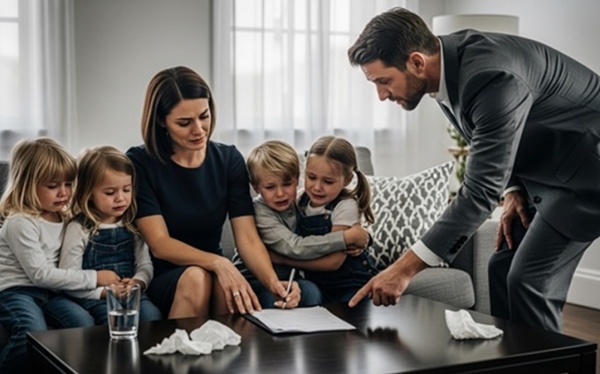
My Husband Left Me With 4 Kids to “Save” His Ex. Mark said his ex needed him more than his own wife and children did. He called me “strong” as if that made abandoning four kids somehow acceptable. Three years later, I walked into a beachside bistro for a business meeting—and there he was behind the counter, wearing an apron, realizing the life he threw away had moved on without him.
Part 1: The Man Who Chose Someone Else’s Tragedy
My life before that college reunion could be summed up in one word: platinum. Not because everything was perfect, but because from the outside, it shined. We had the kind of life people in Southern California like to photograph from the right angle and call blessed.
We lived in a five-bedroom house in Irvine, with white stucco walls, lemon trees in the backyard, and two SUVs in the driveway. Our neighborhood had wide sidewalks, clean parks, and neighbors who waved while walking golden retrievers at sunset. It was the kind of place where people assumed pain had to make an appointment before entering.
My husband, Mark, was a sales director for a medical software company in Orange County. He wore fitted polos on weekends, tailored suits during the week, and the kind of confidence that made people believe every word before checking the numbers. He made around $250,000 a year, and he never let me forget that he was “the engine” of our family.
I was the engine no one saw. I handled the school emails, the pediatric appointments, the grocery runs, the soccer practices, the birthday gifts, the car registrations, and every small emergency that kept our house from catching fire emotionally or literally. We had four children, ages three to nine, and there were days I felt less like a wife and more like air traffic control.
Our oldest, Hannah, was nine, sensitive and smart, with a habit of reading books under the covers after bedtime. Caleb was seven, all elbows and questions, always building forts out of couch cushions. Sophie was five, dramatic in the way only kindergarten girls can be, and our youngest, Ben, was three, still sticky-faced and soft-cheeked, with a laugh that could save a terrible day.
Mark called himself a family man. He said it at barbecues, company picnics, and holiday dinners with my parents. He loved the title because it sounded noble, and I loved him enough to pretend I did not notice how often I was the one doing the actual family part.
Then came his tenth-year university reunion.
He had graduated from USC, and his alumni group was hosting a weekend event in Los Angeles. At first, I was happy for him. He had been stressed at work, and I thought seeing old friends might remind him who he was before mortgage payments, car seats, and conference calls turned him into a man who checked his email during dinner.
He bought a new blazer for that reunion. He got a haircut two days before. He even asked me if the navy shirt made him look “too suburban,” and I laughed because I thought we were still the kind of couple who could tease each other without danger underneath.
That night, he came home after midnight smelling like expensive bourbon and valet parking. His smile was strange. Not guilty exactly, but distant, like part of him had come back to Irvine and part of him was still standing under soft hotel ballroom lights with someone else.
I asked if he had fun. He said, “Yeah. It was good.” Then he went upstairs, took a shower, and sat on the edge of the bed for almost ten minutes staring at his phone.
That was when Mark began disappearing while still living in the house.
At first, it was small. He started taking calls on the patio, closing the sliding glass door behind him even when the kids were shouting for him to come inside. He laughed quietly at messages in the middle of the night, then turned the screen away when I shifted beside him.
Then it became impossible to ignore. He missed Caleb’s baseball game because of a “client crisis” that somehow required cologne and a freshly ironed shirt. He forgot Sophie’s preschool fundraiser, then snapped at me for making him feel guilty. He started smoking again, standing outside under the patio lights like a teenager hiding from his own life.
For three months, I watched the man I married become a ghost with a phone plan. He was present in the legal sense only. His body still slept in our bed, but his attention belonged somewhere else.
I found out her name by accident.
It was a Saturday morning, and Ben had poured orange juice into a cereal bowl while Sophie cried because Hannah looked at her “in a mean way.” Mark’s phone buzzed on the kitchen island, face up, while he was in the garage pretending to organize tools.
The message preview said: Lily.
“I keep thinking about what you said. Maybe we were always supposed to find our way back.”
My hand froze on the paper towel roll. The kitchen smelled like syrup, coffee, and the beginning of disaster.
I did not open the phone. I did not scream. I did not throw it across the room, though I imagined the sound it would make against the tile.
When Mark came back inside, I watched him see the phone, see my face, and understand in one second that something had shifted. He grabbed it too quickly and shoved it into his pocket. Then he kissed Ben on the head like acting normal could make a lie less visible.
Exactly three months after that reunion, Mark called me into his home office.
I was in the kitchen, holding a wooden spoon in one hand and Ben on my hip with the other. Dinner had burned because Sophie had spilled milk in the hallway and Caleb was yelling that Hannah had hidden his Pokémon cards. I remember thinking Mark was finally going to help.
Instead, he sat behind his desk with his hands folded like a man preparing to fire an employee.
“Sarah,” he said, “I want a divorce.”
The wooden spoon hit the floor with a hollow sound I still remember. Ben stopped fussing and looked at me. Somewhere in the kitchen, the smoke alarm started chirping softly, as if even the house knew something was wrong.
“What?” I said. “Are you joking?”
“I’m not joking,” Mark said. His voice was flat and rehearsed. “I reconnected with Lily at the reunion. She’s struggling, Sarah. She’s a single mom, she has a son, her health hasn’t been good, and she’s drowning financially.”
I stared at him, waiting for the part where this became a bad dream.
“She needs a protector,” he continued. “I realized I never stopped loving her. Our breakup in college was a misunderstanding.”
The room tilted. Not literally, but enough that I reached for the back of a chair. I looked at the man I had built twelve years of life with, the father of my four children, and he felt like a stranger wearing my husband’s face.
“You feel bad for a woman raising one child alone,” I said slowly, “so your solution is to make your wife a single mom of four?”
Mark looked away.
“You’re strong,” he said. “You’re capable. You’ve always been the boss around here. You’ll be fine without me. Lily is fragile. She’s lonely. She needs me more.”
I almost laughed. Not because anything was funny, but because the absurdity was so large my brain could not process it any other way. He was treating my strength like a spare tire, something useful but unworthy of tenderness.
“You’re playing hero for your college ex,” I said, “while abandoning your actual children.”
His jaw tightened. “Don’t make this ugly.”
That sentence did something to me. It burned through the shock, through the heartbreak, through the tiny part of me that still wanted to ask what I had done wrong. He had set our house on fire and was asking me not to complain about the smoke.
I looked toward the hallway where our children were still arguing, still safe for the last few seconds before their family changed forever.
Then I wiped my eyes and said, “Fine. You want to be her hero? Go. But heroes pay for the damage they leave behind.”
Part 2: The Price of Being a Hero
Mark’s eyes flickered when I said that. For the first time since he started his speech, he looked uncertain. Men like Mark love grand emotional declarations until someone brings up paperwork.
“I don’t want a fight,” he said.
“Neither do I,” I replied. “I want terms.”
He leaned back in his chair. “Terms?”
“Yes. You want an uncontested divorce so you can run to Lily without months of legal bills and court hearings. Then you are going to make sure your four children do not suffer because you decided someone else’s tragedy was more romantic than your responsibility.”
He stared at me like I had become a different woman in front of him. Maybe I had. Maybe the version of me who still wanted his approval died somewhere between “I want a divorce” and “Lily needs me more.”
I knew enough about California to know divorce was not as simple as throwing a man out with a duffel bag. California is a community property state, child support follows guidelines, and a judge would care about fairness, not my broken heart. But I also knew Mark wanted speed more than he wanted justice.
So I named what I needed.
“The house stays with me and the kids,” I said. “Both SUVs stay here because I’m the one transporting four children. The $150,000 in savings stays in an account for household expenses, legal costs, and the children. You sign a settlement agreement through attorneys, and you do not drain a dollar before we file.”
Mark blinked. “That’s almost everything.”
“That’s almost everything the kids need.”
“I make the money,” he snapped.
“And I made the life that allowed you to make it.”
The room went quiet.
Outside the office door, I heard Sophie giggle, then Ben squeal. The sound nearly broke me. They still thought their father was just in another room, not already packing his heart for another family.
Mark rubbed his face. “Sarah, be reasonable. I can make that money back.”
“Then make it back.”
He looked at me. I could see him calculating. His salary. His bonuses. His belief in his own charm. Lily waiting somewhere, probably telling him he was brave for choosing love.
In his arrogance, Mark thought losing assets was temporary. He thought I was temporary too, just an obstacle between him and the beautiful story he had written about himself. He thought leaving with less money was noble because he could always earn more.
“Fine,” he said finally. “Money is just paper. Love is once in a lifetime.”
That sentence was so ridiculous I almost wanted it printed on the divorce papers.
The next morning, I called an attorney named Denise Alvarez, a family lawyer in Newport Beach recommended by a woman from my moms’ group who had once survived a divorce from a surgeon with a God complex. Denise had a calm voice and zero interest in emotional theater. I liked her immediately.
“Do not sign anything without counsel,” she told me. “Do not block him from the children unless there is a safety issue. Do not empty accounts. Do document everything. And Sarah, listen carefully: child support is for the children. He does not get to trade that away because he feels guilty.”
I met Denise the following day with Ben asleep in a stroller beside me and a folder full of bank statements, mortgage records, insurance policies, tax returns, school schedules, and every piece of paper that proved I had kept our household running. She reviewed everything while I sat there feeling like I had brought my marriage in for an autopsy.
“He wants out quickly?” Denise asked.
“Desperately.”
“That can be useful.”
She explained what could and could not happen. Mark could agree to transfer his interest in the house as part of the settlement, though we would need proper documents and court approval. The vehicles could be assigned. Savings could be divided in a way that supported the children’s immediate needs, especially if he agreed.
“But he will still owe guideline child support,” she said. “And possibly spousal support, depending on income and other factors.”
I nodded, numb and grateful at the same time.
Denise looked at me over her glasses. “Do you want revenge or stability?”
I thought of Lily. I thought of Mark describing her as fragile while using my strength as permission to leave. I thought of four small faces around a dinner table.
“Stability,” I said.
“Good,” Denise replied. “Revenge is expensive. Stability compounds.”
Mark moved out ten days later.
He packed two suitcases, a garment bag, his golf clubs, and a framed photo of himself receiving a sales award. He did not take the framed picture of our family from the hallway. He did not take the Father’s Day mug Caleb painted for him. He did not take the bedtime books he used to read before he became too busy saving Lily.
The kids watched from the stairs.
Hannah understood the most and said the least. Caleb asked if Dad was going on a work trip. Sophie cried because she thought she had done something bad. Ben kept repeating, “Daddy car?” as Mark carried his bags out the front door.
Mark hugged them one by one with the stiff sadness of a man who wanted to feel tragic but not responsible. When he got to me, he said quietly, “Please don’t make them hate me.”
I looked at our children.
“I won’t have to,” I said.
His face hardened. Then he left.
The first month was survival. There is no graceful way to become a single mother of four overnight. People like to say women are strong, but strength does not fold laundry at midnight or soothe two crying children at once while a third has a fever and the fourth forgot a science project.
I cried in the pantry because it was the only place with a door that locked. I answered emails from teachers with one hand while stirring mac and cheese with the other. I learned how to unclog a garbage disposal from a YouTube video while Ben sat on the floor feeding Goldfish crackers to the dog.
Mark sent texts about Lily’s medical appointments and her son’s adjustment issues, as if I were supposed to admire his new responsibilities. He missed his first scheduled Wednesday dinner with the kids because Lily “had a bad day.” He missed Caleb’s baseball game because Lily’s car needed to be taken to the shop.
Each time, I wrote it down.
Denise told me documentation was not bitterness. It was memory with a spine.
The divorce moved faster than most because Mark kept saying yes to anything that made him feel like a romantic martyr. He signed the settlement after his own attorney warned him twice to slow down. He transferred his share of the house, agreed to support payments based on his income, and accepted a parenting schedule he barely followed.
In court, the judge asked whether he understood the agreement.
Mark said yes.
I watched him sign away the life we built, his face full of impatience, as if freedom were waiting in the parking lot with Lily’s name on it.
When it was over, Denise touched my arm and said, “Now we rebuild.”
I went home that day, sat in my SUV in the driveway, and sobbed so hard I could not get out for twenty minutes. Not because I wanted Mark back. Because the war had ended, and I finally had permission to feel the wound.
Inside the house, my children needed dinner.
So I wiped my face, walked in, and made spaghetti.
Part 3: The Life He Thought Would Be Easy
Mark’s new life looked glamorous for about six months.
At least that was how it appeared from the pieces I heard through mutual friends and the occasional careless photo Lily posted online. They moved into a luxury apartment in Costa Mesa with a rooftop pool, string lights, and a view that looked better at sunset than it probably felt on rent day. Lily’s captions were full of words like “healing,” “chosen,” and “finally loved right.”
I did not comment. I did not stalk. I did not send screenshots to friends, though some friends sent them to me anyway with messages like, “Can you believe this?”
Yes, I could believe it. People who build love on someone else’s broken home often decorate quickly. It helps cover the smell of smoke.
The children struggled.
Hannah stopped inviting friends over for a while because she hated explaining where her dad was. Caleb got in trouble at school for shoving a boy who said divorce meant his dad did not love him. Sophie started sleeping with every stuffed animal she owned, surrounding herself with plush witnesses that would not leave.
Ben forgot Mark first, which hurt in a different way. He still loved him, but he stopped expecting him. When Mark canceled, Ben shrugged and asked for juice. That was when I realized absence becomes normal faster than love should allow.
I got the kids into counseling. Mark complained about the cost until Denise reminded his attorney that he had agreed to contribute to medical and therapeutic expenses. After that, he stopped complaining in writing.
Meanwhile, I learned the strange math of single motherhood. Four school schedules. Four emotional weather systems. One adult at home. Zero margin for collapse.
I became brutally organized. Sunday nights were meal prep, laundry sorting, backpack checks, and calendar review. I color-coded everything because chaos loves ambiguity, and I no longer had the luxury of forgetting.
I also went back to work.
Before the kids, I had worked in operations for a healthcare consulting firm. I was good at it, too good to disappear forever, but after Sophie was born, Mark and I agreed I would stay home because childcare for four children cost almost as much as a mortgage. He called it a joint decision when it benefited him and “your choice” when he wanted to minimize my contribution.
A former colleague named Priya reached out after hearing about the divorce. She had started a boutique operations consulting company in Laguna Beach, helping small medical practices streamline billing and scheduling systems. She needed someone part-time at first, mostly remote.
I said yes before fear could talk me out of it.
The first months were humbling. I took calls from my laundry room. I reviewed spreadsheets while Ben watched cartoons beside me. I once presented a workflow audit to a clinic administrator with a child’s sock stuck to my sweater from static cling.
But slowly, my brain came back online.
I remembered that I was not only a mother. I was good with systems, people, timelines, and the quiet mess behind polished businesses. I could see where things were leaking, where processes were weak, where money slipped through cracks because no one wanted to look closely.
By the end of the first year, Priya offered me full-time work with flexibility. By the end of the second, I was managing major clients. By the third, I had equity in the firm.
Mark did not notice at first.
He was too busy trying to be Lily’s savior.
The problem with playing hero is that eventually someone expects you to keep rescuing. Lily’s emergencies did not end when Mark arrived. Her health problems were real enough to require appointments, but vague enough to become a reason for everything. Her finances were worse than he admitted. Her son resented Mark and made sure everyone knew it.
At first, Mark performed devotion beautifully. He drove to pharmacies, paid overdue bills, covered rent, bought groceries, and posted carefully angled photos of farmers markets and beach walks. He liked looking needed.
But need is romantic only when it is optional.
By the second year, Mark’s work performance had slipped. He missed travel, lost accounts, and argued with managers who were tired of hearing about personal drama. His company restructured, and his high-paying sales director role disappeared in a wave of layoffs that hit people who were expensive and distracted.
He told the kids it was temporary.
I heard the panic under the word.
His support payments became late. Then partial. Then accompanied by long explanations about severance, job searches, Lily’s medical bills, and “cash flow.” Denise handled it through proper channels. I did not argue with him by text because I had learned that peace is sometimes a legal strategy.
The court did not care that Lily was overwhelmed. The court cared that Mark had four children.
That was the first time I saw reality catch up to his romance.
Mark sold his car. Then he moved from the Costa Mesa apartment into a smaller place in Anaheim. Lily stopped posting sunsets. The captions about healing disappeared.
The children noticed his stress. Hannah came home from a weekend visit and said, “Dad and Lily fight all the time.” Caleb said Lily’s son called him “extra baggage.” Sophie said Dad slept on the couch.
I documented all of it, but I did not celebrate.
People think vindication feels like fireworks. Mostly, it feels like exhaustion. I did not want Mark destroyed. I wanted him consistent, stable, and capable of showing up for the children he helped create.
But Mark had spent too long confusing attention with love and sacrifice with identity. Without the big salary, the luxury apartment, and the fantasy of being Lily’s rescuer, he did not know who he was.
Near the end of the third year, Lily left him.
I found out from Hannah, who came home quiet from a weekend visit and said, “Dad said Lily needs space.”
I was making grilled cheese at the stove. My hand paused on the spatula.
“Are you okay?” I asked.
Hannah shrugged in the careful way teenagers do when they are trying not to care. “I just think it’s weird. He left us because she needed him, and now she doesn’t.”
There was nothing I could say that would make that less brutal.
So I said the only true thing I had.
“Sometimes people build their whole life around being wanted, and they forget to ask whether they are respected.”
Hannah looked at me for a long moment. Then she nodded like she was filing that sentence somewhere for later.
A month after Lily left, Mark lost his apartment.
He did not tell me. He told the kids he was “between places” and stayed with a friend in Tustin for a while. His pride remained intact long after his life did not.
By then, my life looked nothing like the one he had abandoned.
The house was still ours, but it felt different. We repainted the kitchen a warm cream color, planted tomatoes in the backyard, and turned Mark’s old home office into a homework room with shelves, beanbags, and a big whiteboard calendar. The children called it “mission control.”
I bought myself flowers every Friday. Not expensive ones, just grocery store tulips or daisies, something bright for the kitchen island. At first it felt silly, then it felt necessary, then it became a ritual.
A person can rebuild a life through very small acts.
Part 4: The Bistro
The morning I saw Mark again, I was not thinking about him at all.
That may be the greatest victory after heartbreak. Not anger. Not revenge. Indifference with errands.
It was a Thursday in late September, warm but not brutal, the kind of Southern California morning that makes people from other states question their life choices. I had driven to Laguna Beach for a client meeting with Priya and two physicians who wanted our firm to help expand their practice management systems across three locations.
The meeting went better than expected. By 10:30 a.m., Priya and I had walked out with a signed contract worth more than my first annual salary after college. She hugged me in the parking lot and said, “You know what this means, right?”
“What?”
“We need espresso and something with almond flour that costs too much.”
We walked to a small bistro a few blocks from the beach, tucked between a florist and a boutique that sold linen shirts for people who never spill coffee. It had blue chairs outside, brass lights inside, and a chalkboard menu with words like “seasonal,” “locally sourced,” and “market price.”
I was laughing at something Priya said when we stepped to the counter.
Then I saw him.
Mark was behind the register wearing a black apron.
For a second, my mind refused to make the connection. The man standing there had Mark’s face but not Mark’s presence. His hair was thinner, his shoulders slightly rounded, and his eyes carried a tiredness I had never seen when he was telling me I would be fine without him.
He looked up.
Recognition hit him like a slap.
“Sarah,” he said.
Priya glanced between us, her smile fading. She knew enough of my story to understand immediately. Her hand brushed my elbow, a silent question.
I kept my voice steady. “Hi, Mark.”
The air between us filled with three years of court orders, missed birthdays, late payments, and children learning disappointment by repetition.
He swallowed. “What can I get you?”
There it was. The sentence.
The man who once told me money was just paper while signing away our life was now asking what size coffee I wanted.
I do not say that cruelly. Work is work, and there is dignity in honest labor. But Mark had built his identity on being above ordinary struggle, above domestic labor, above the small repetitive tasks that make other people’s days possible.
Now he was standing behind a counter, serving coffee to the woman he thought would collapse without him.
Priya ordered first because she is a saint. “Two oat milk lattes, please. And whatever pastry has the most chocolate.”
Mark entered it into the register with shaking fingers.
“And for you?” he asked me, though Priya had already ordered both drinks.
I looked at him. “That’s all.”
He nodded too quickly. “Right.”
We stepped aside to wait. I could feel him glancing over. Priya leaned close and whispered, “We can leave.”
“No,” I said. “I’m okay.”
And I was surprised to realize I meant it.
A younger employee made the drinks while Mark wiped the counter even though it was already clean. He looked like a man trying to become invisible inside an apron. When the lattes were ready, he placed them on the counter himself.
“Sarah,” he said quietly, “can I talk to you for a minute?”
Priya’s eyes narrowed.
I picked up my cup. “If it’s about the kids, you can text me.”
“It’s not just about the kids.”
“Then no.”
He flinched.
I turned to leave, but he said, “Please. I know I don’t deserve it.”
That stopped me, not because he sounded pitiful, but because it was the first accurate thing he had said in years.
I looked at Priya. She lifted both hands and said, “I’ll be outside. Within sight.”
Mark asked a coworker to cover the counter and stepped to the side near a narrow hallway leading to the restrooms. It was not private, which I preferred. I had no interest in intimate conversations with a man who had mistaken my patience for permission.
“You look good,” he said.
“Thank you.”
“I heard your company is doing well.”
“It is.”
He nodded. “I’m glad.”
I waited. Silence is useful when someone has spent years filling rooms with excuses.
He rubbed his hands together. “Lily left.”
“I heard.”
His eyes dropped. “Of course.”
I said nothing.
“She took everything she could,” he continued. “I don’t mean legally. I mean… I poured everything into that relationship. Money, time, energy. I thought I was saving her.”
“You were saving yourself from feeling ordinary,” I said.
His face tightened, but he did not argue.
That surprised me.
“I know,” he said finally. “Maybe I know that now.”
Behind him, the espresso machine hissed. A woman near the window laughed into her phone. Life continued around us with complete disrespect for dramatic timing.
Mark looked older than forty-one. Not physically ruined, just worn down by the consequences he once thought were temporary. His apron had a smear of milk foam near the pocket.
“I lost my job,” he said. “Then I took contract work. Then that dried up. I’m trying to get back into sales, but the gap and the references…” He exhaled. “This place belongs to a friend. He gave me shifts.”
“There’s nothing wrong with working in a bistro,” I said.
“I know.”
But we both knew that for Mark, there had been something wrong with it once. He had looked down on service workers, assistants, cashiers, stay-at-home mothers, anyone whose labor made life run without applause. Now he was learning humility by the hour.
“I’m behind,” he said quietly. “On everything.”
“I know.”
“I’m trying to catch up.”
“You need to work that out through the proper channels.”
He nodded, ashamed. “Denise already filed.”
“Yes.”
There was a time when his shame would have made me soften. I would have rushed to comfort him, to reassure him he was still a good man, to protect him from the full weight of what he had done. That woman had four children to raise and no time left for rescuing the person who abandoned them.
Mark looked toward the front window. Priya was outside pretending not to watch while very obviously watching.
“I thought you’d fall apart,” he said.
I almost smiled. “I did.”
His eyes came back to mine.
“I fell apart in ways you never saw,” I said. “I cried in the pantry. I slept three hours a night. I held children who were hurting because of choices you made. I learned to fix things, earn differently, parent alone, and keep going when I wanted to disappear.”
His face crumpled slightly.
“But falling apart is not the same as staying broken,” I finished.
He looked away.
“I told myself you didn’t need me,” he said. “That you were stronger than Lily. That the kids would be okay because you were okay.”
“That was convenient for you.”
“I know.”
“No,” I said. “You know it now. Back then, you chose to believe it because it made leaving easier.”
He took that like a man who no longer had the energy to dodge.
For the first time in years, I did not see a villain in front of me. I saw a weak man who had mistaken drama for destiny and called it love. That did not make what he did less damaging. It only made it less mysterious.
“I’m sorry, Sarah,” he said. “For all of it. For leaving. For missing things. For making you the strong one so I could be selfish.”
The apology landed somewhere near me but not inside me. Maybe because it was too late. Maybe because I had already built a life that did not require it.
“Thank you for saying that,” I replied.
He looked hopeful, and I hated that I recognized it.
“I don’t hate you, Mark,” I said. “But I don’t have space in my life for your regret.”
His hope dimmed.
“I understand,” he said.
I believed he did, which was new.
Before I left, he said, “Do the kids hate me?”
The question was soft, scared, and finally honest.
“They’re hurt,” I said. “They love you, but they don’t trust you to show up. If you want that to change, don’t make speeches. Make a calendar. Keep it.”
He nodded slowly, like I had handed him instructions to a machine he had spent years refusing to learn.
I walked outside with my latte.
Priya studied my face. “You okay?”
I looked back through the window. Mark had returned to the counter. A customer was asking about gluten-free options, and he was listening carefully, almost humbly.
“Yes,” I said. “I think I am.”
Part 5: How the Tables Turned
The story could end there, with Mark behind the counter and me walking away into the Laguna sunshine with a signed contract and a latte. That would be neat. People like neat endings because they make pain feel organized.
Real life is messier, but sometimes better.
After that day, Mark changed in small ways. Not magically, not perfectly, and not enough to erase what happened. But enough that the children noticed.
He stopped canceling weekends. He took extra shifts to catch up on support. He showed up to Caleb’s soccer game in his bistro uniform because he did not have time to change, and for once, he did not act embarrassed.
Caleb saw him standing by the fence and ran over after the game. For a moment, I watched my son decide whether to trust joy. Then he hugged Mark anyway, because children’s hearts are generous even when they have every reason not to be.
Hannah was slower. She made Mark earn every conversation. She answered with sarcasm, watched his face for disappointment, and tested him with the quiet precision of a girl who had once adored her father and did not know where to put that love now.
One evening, after he dropped them off, Hannah came into the kitchen while I was chopping onions.
“Dad apologized,” she said.
I kept chopping. “For what?”
“For missing stuff. For Lily. For making everything weird.”
I nodded carefully. “How did that feel?”
She leaned against the counter. “Annoying.”
I smiled a little. “That’s fair.”
“Also good,” she admitted.
I put the knife down and looked at her. “You’re allowed to feel both.”
She nodded, then stole a slice of cucumber from the cutting board and left like the conversation had cost her more than she wanted to admit.
By then, our house had become something new. Not the platinum dream people admired from the curb, but something warmer and more honest. There were scuff marks on the floor, fingerprints on the fridge, and a rescue dog named Murphy who believed every Amazon package was a personal threat.
I still worked too much sometimes. I still forgot permission slips. I still cried occasionally in the shower when the pressure of being the dependable parent became too heavy.
But I was no longer living inside someone else’s story.
My business card had my name on it. My bank account had money I earned. My bedroom had blue curtains I chose without asking anyone if they looked “too feminine.” Every part of my life, even the hard parts, belonged to me.
Mark asked me once, months after the bistro, if I ever thought we could have made it if Lily had never appeared.
We were standing on the sidewalk outside Sophie’s school after a spring concert. Sophie had sung off-key with great confidence, and Ben had waved at me from the audience like I was returning from war. Mark had coffee in one hand and a program folded in the other.
I thought about lying to make the moment easier.
“No,” I said.
He looked down.
“Lily did not create what was broken in you,” I continued. “She just gave you a reason to stop hiding it.”
He nodded, painful but accepting.
“I loved you,” he said.
“I know.”
“I loved the kids.”
“I know that too.”
“But I still left.”
“Yes,” I said. “You did.”
There was no cruelty in it. Just the truth, standing between us like a fence neither of us needed to climb anymore.
He looked toward the school doors where parents were gathering children and teachers were stacking chairs. “I thought being needed was the same as being loved.”
“That’s something you should probably work on,” I said.
He laughed once, softly. “I am.”
Maybe he was. Maybe he wasn’t. The difference was that his growth was no longer my assignment.
Three years earlier, Mark had sat behind his expensive desk and told me another woman needed him more than I did. He had mistaken my competence for invincibility. He had looked at four children and decided they would survive the blast because their mother knew how to hold walls up with her bare hands.
He was right about one thing.
We survived.
But he was wrong about the cost.
He thought he was trading one life for another. He thought he could leave the house, the savings, the SUVs, the bedtime stories, the school drop-offs, the birthday mornings, and the little hands reaching for him, then build a better version somewhere else. He thought love was a dramatic rescue.
What he learned, too late, was that love is not who makes you feel like a hero.
Love is who you show up for when there is no applause.
It is paying the mortgage and reading the bedtime story when you are tired. It is remembering which child hates peas, which one needs a night-light, and which one pretends not to care but listens for your footsteps anyway. It is choosing your family when nobody is watching.
Lily had needed a rescuer. I had needed a partner. Mark chose the role that made him feel important.
Then the role ended.
The tables did not turn because I became rich overnight or because Mark became poor. That would be too simple. The tables turned because I stopped sitting at the one he built for himself.
I built my own.
I built it with court documents, therapy appointments, grocery budgets, work calls, school lunches, late nights, early mornings, and children who slowly learned that a home can crack and still become safe again. I built it with friends who showed up with casseroles, attorneys who translated panic into plans, and a version of myself I had not met until I had no choice.
The day Mark served me coffee, he finally saw what he had lost.
Not just a wife.
Not just a house.
Not just money, status, or the easy admiration of people who once called him a family man.
He lost the future where his children looked at him without hesitation. He lost the woman who would have stood beside him through almost anything, if he had not turned her strength into his excuse. He lost the quiet, ordinary, priceless life he thought would wait forever while he chased a tragedy dressed up as destiny.
As for me, I did not get the life I planned.
I got the life I fought for.
And if you had told the woman crying in the pantry three years ago that one day she would stand in a beachside bistro, look at the man who abandoned her, and feel nothing but calm, she would not have believed you.
But that woman did not know what I know now.
Being left is not always the end of your story.
Sometimes, it is the first honest chapter.
