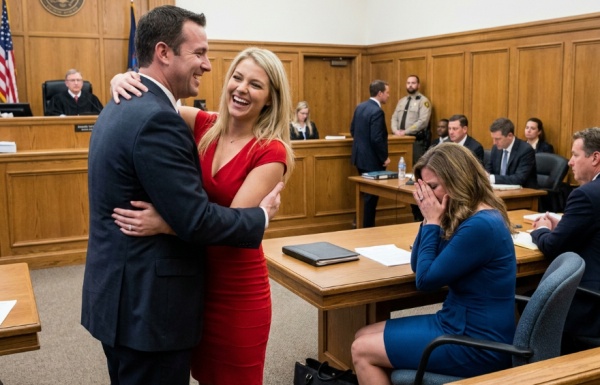
My Ex-Husband Proposed to His Mistress With a $400,000 Ring Hours After Our Divorce — The Next Day, I Brought One Folder to His Parents’ House and Ended Their Celebration…
Part 1: The Ring He Couldn’t Wait to Show the World
My divorce from Grant Whitaker became final at 10:17 on a Thursday morning.
By 6:42 that evening, he was on one knee in the middle of a rooftop restaurant in Dallas, proposing to the woman he had sworn under oath was “only a colleague.” The video hit Instagram before my attorney had even finished emailing me the final stamped decree.
I know the exact time because my younger sister, Marcie, sent me the clip with no caption.
Just the video.
At first, I didn’t understand what I was seeing. Grant was wearing the navy suit I had bought him for our tenth anniversary, the one I saved for because he said it made him feel like a man people listened to. He was kneeling in front of a woman in a white silk dress while a violinist played behind them and strangers clapped like they were witnessing a love story.
The woman was Sienna Vale.
Grant’s mistress.
Although for almost a year, he insisted I was cruel for calling her that.
According to him, Sienna was his “executive consultant,” then his “strategic partner,” then his “friend during a difficult season.” She worked with him at Whitaker Development Group, the commercial real estate company his father started in the 1980s and Grant inherited in everything but name.
She was thirty-two, polished, and always photographed from the side like she knew exactly where the best light was. She had honey-blonde hair, expensive cheekbones, and the kind of smile that looked warm until you realized it never reached her eyes.
In the video, she covered her mouth with both hands.
Then Grant opened the ring box.
Even through my cracked phone screen, the diamond looked unreal.
It caught the restaurant lights like a small captured star. People gasped. Someone shouted, “Oh my God!” Sienna started crying, or at least performing the version of crying meant for cameras.
Then Grant slid the ring onto her finger.
Later, the caption would tell everyone what he had done.
“After the hardest chapter of my life, I finally get to choose happiness. She said yes.”
He tagged Sienna.
He tagged the restaurant.
He even tagged the jeweler.
That was Grant. Even his betrayals had to be branded.
I sat alone at my kitchen table in the house I almost lost during the divorce, watching my ex-husband celebrate his new beginning less than nine hours after our marriage legally ended. My coffee had gone cold. The AC kicked on with a hum. Outside, a neighbor’s sprinkler ticked across the lawn like nothing in the world had changed.
But something in me went very still.
Not sad.
Not shocked.
Still.
There is a special kind of silence that arrives when you realize a person did not merely hurt you. They underestimated you.
The ring was beautiful. Too beautiful. Too large. Too public. Too expensive for a man who had spent the last six months in mediation claiming his company was “cash strained,” his income was “unpredictable,” and his lifestyle had been “artificially inflated by debt.”
During our divorce, Grant said he could not afford to buy me out fairly from our marital home.
He said the business had slowed.
He said several projects had stalled.
He said the private school tuition we once discussed for future children had been “a fantasy from a different life.”
He said many things.
But now he had found enough money for a diamond ring later valued at approximately $400,000.
And he had done it on camera.
My phone buzzed again.
This time, it was my mother.
“Don’t watch it,” she wrote.
Too late.
Then came messages from friends, cousins, former neighbors, women from the charity board where Grant’s mother still pretended our divorce was “amicable.” Some were kind. Some were furious for me. Some were only pretending not to be curious.
I turned my phone face down.
For ten years, I had been Mrs. Grant Whitaker.
Before that, I was Allison Paige Monroe, a CPA from Plano who believed numbers because numbers did not flirt, lie, or rewrite history at dinner parties. I met Grant when I was twenty-eight and auditing a construction supplier his company used. He was charming in the way men with money often are when they have never been told no long enough to believe it.
He took me to dinner at a steakhouse where the waiter knew his name. He sent flowers to my office. He told me I was the first woman who had ever made him want to be better instead of just admired.
I believed him.
That is the embarrassing part.
Not because believing in love is foolish, but because I mistook attention for honesty.
For the first few years, our marriage looked like something people envied. We had a brick house in Highland Park, season tickets to the Cowboys, a golden retriever named Duke, and holiday cards printed on thick paper my mother said was “too nice to throw away.” Grant’s parents, Beverly and Thomas Whitaker, welcomed me into their family like I had been selected, approved, and polished to fit.
Beverly called me “our practical girl.”
At first, I thought it was affection.
Later, I understood it was placement.
In the Whitaker family, everyone had a role. Thomas was the founder. Beverly was the social architect. Grant was the golden son. His younger brother, Neil, was the cautionary tale who moved to Colorado and opened a brewery instead of joining the business.
And I was the sensible wife.
The one who kept receipts, remembered birthdays, sat beside Grant at fundraisers, and never embarrassed the family by saying what everyone already knew.
Until the divorce.
Until the ring.
Until the folder.
The folder was already in my home office when Grant proposed.
It sat in the bottom drawer of my filing cabinet, beneath tax returns, insurance documents, and a copy of our marriage certificate I had not yet thrown away. It was thick, labeled with a plain white sticker.
“W.D.G. — Undisclosed Assets.”
I had not planned to use it that week.
My attorney wanted to wait. My forensic accountant wanted one more bank confirmation. I wanted, foolishly, to believe that once the divorce was final, I could put Grant behind me without dragging his entire family into the wreckage.
Then I watched Sienna hold up that ring.
And I saw Beverly Whitaker comment beneath the post.
“Welcome to the family, darling. Real love always finds its way.”
Real love.
I laughed once.
It sounded nothing like me.
Then I opened the drawer, took out the folder, and placed it on the kitchen table.
By noon the next day, nobody at the Whitaker house would be smiling anymore.
Part 2: What Grant Thought I Didn’t Know
Grant’s affair did not begin with lipstick on a collar or some dramatic hotel receipt falling out of his pocket.
It began with a calendar invite.
Sienna Vale was hired as an outside consultant for Whitaker Development Group eighteen months before our divorce was final. She specialized in branding luxury mixed-use projects, which sounded important enough that nobody questioned why she suddenly appeared at every meeting, dinner, and charity event tied to the company.
At first, I liked her.
That is another detail I hate admitting.
She was easy to like if you did not know better. She complimented my dress at a gala. She remembered that I took my coffee black. She told me once in the ladies’ room at the Crescent Club that Grant was lucky to have a wife who understood business.
I smiled and said, “Some days he remembers that.”
She laughed.
Now I wonder if she was already sleeping with him then.
By the time I suspected anything, Grant had become a master of offended innocence.
If I asked why Sienna texted him at midnight, he said I was punishing him for being successful. If I asked why she joined him on a work trip to Miami when no other consultants went, he said I did not understand client expectations. If I asked why he smelled like her perfume, he said I was becoming paranoid.
The word “paranoid” is useful to guilty people.
It makes evidence sound like illness.
For months, I tried to be reasonable. I told myself marriage required trust. I told myself I was tired, insecure, maybe threatened by a younger woman who seemed to speak Grant’s professional language better than I did.
Then, one Sunday afternoon, I found the first receipt.
It was not for a hotel.
It was for a private jeweler in Dallas.
$38,000 deposit.
I found it because Grant had left his business AmEx statement on the printer in his home office, mixed with invoices he wanted me to scan before Monday. Old habits are dangerous. For years, I handled enough of our household paperwork that Grant forgot I knew how to read a financial trail.
When I asked him about it, he barely looked up from his phone.
“Client gift,” he said.
“What client gets a $38,000 gift?”
“A very valuable one.”
“That’s not an answer.”
He sighed, irritated. “Allison, please don’t start.”
There it was.
The tone.
The one that made me sound exhausting for noticing things.
So I stopped asking him directly.
Instead, I began making copies.
Quietly.
Legally.
Only documents I had access to as his wife, household financial manager, or through accounts bearing my name. I did not hack. I did not break into anything. I did not steal passwords.
I simply stopped ignoring what was already in front of me.
There were transfers from Whitaker Development Group to a newly formed LLC called Marigold Strategy Partners. Sienna’s middle name was Marigold. There were consulting invoices with vague descriptions like “market positioning” and “client hospitality.” There were reimbursements for travel that did not match any project schedule I could find.
Then came the jewelry.
A second deposit.
Then a wire.
Then an insurance quote for a ring described as a “6.8 carat cushion-cut diamond with tapered baguette side stones.”
Estimated replacement value: $400,000.
The date on the quote was six weeks before Grant filed updated financial disclosures in our divorce case swearing he had made no major personal purchases and transferred no assets outside the ordinary course of business.
That mattered.
In Texas, divorce can be complicated, especially when separate property, business interests, and community property get tangled together. I knew enough from my work as a CPA to understand that not every ugly marital act was illegal. People cheat. People lie emotionally. People move on too quickly.
But sworn financial disclosures are different.
Court orders are different.
Community assets are different.
And using company money to buy a diamond for your mistress while claiming reduced income in a divorce?
That was not romance.
That was evidence.
My attorney, Denise Hargrove, told me to be careful.
Denise was in her late fifties, wore reading glasses on a chain, and had the calm voice of a woman who had watched too many wealthy men confuse arrogance with strategy. When I brought her the first stack of documents, she did not gasp. She did not promise revenge.
She simply put on her glasses and said, “Well. That was unwise of him.”
Coming from Denise, that was a battle cry.
She referred me to a forensic accountant named Martin Keller, a compact man with silver hair, three phones, and the emotional range of a printer. Martin loved spreadsheets the way some people love music. He could look at a bank statement for thirty seconds and find the one number that did not belong.
For weeks, he traced transfers.
Marigold Strategy Partners had received $612,000 from Whitaker Development Group over eleven months. Some payments might have been legitimate consulting income. Many were not properly documented. Several were routed through accounts connected to Grant’s discretionary project funds.
The ring payment came through one of those routes.
But the folder contained more than bank records.
It contained emails Grant had forwarded to our shared household printer by mistake.
One discussed “keeping the engagement purchase off personal disclosures until after finalization.” Another from the jeweler’s office referenced “Mr. Whitaker’s request to hold delivery until divorce is complete.” A third message, from Sienna to Grant, included one sentence that made my attorney go completely quiet.
“Once Allison signs, your parents can stop pretending they’re worried and we can finally celebrate.”
Your parents.
That was how I learned Beverly and Thomas knew.
Not suspected.
Knew.
They had sat across from me at Thanksgiving dinner while I was still trying to save my marriage. Beverly had squeezed my hand and told me, “Men under pressure sometimes lose themselves, dear.” Thomas had looked me in the eye and said Grant was just “working through business strain.”
All the while, they were waiting for me to sign.
The divorce settlement was signed three weeks before the final decree.
I agreed to less than Denise wanted me to fight for because I was tired. That is the truth. Divorce is not one wound; it is a thousand paper cuts while strangers assign dollar amounts to the life you built.
Grant kept most of his business interest.
I kept the house only because I gave up claims to certain investment accounts he insisted had lost value. He paid a lump sum that looked fair on paper if you believed his disclosures.
I no longer believed them.
But believing and proving are different things.
So we waited.
Denise filed certain requests and preserved my options. Martin continued collecting records. A former Whitaker Development bookkeeper, who had been laid off two months earlier, quietly sent documentation to Denise after receiving her subpoena.
The final piece arrived the morning after Grant’s proposal.
It came by courier.
A sworn affidavit from the jeweler.
The jeweler confirmed the ring had been selected, ordered, and substantially paid for while Grant and I were still married, using funds wired from an entity connected to Whitaker Development Group. The affidavit also included copies of communications showing delivery had been delayed specifically to avoid disclosure before the divorce was finalized.
That was the final document.
That was the one I would lay on the table at Beverly and Thomas Whitaker’s house.
But before I did, I gave Grant one chance.
Not because he deserved it.
Because I wanted the record clean.
At 9:03 that morning, I texted him.
“Before you continue posting about your engagement, you should call Denise. There are financial issues from the divorce that need to be addressed immediately.”
He replied seven minutes later.
“Allison, don’t embarrass yourself. The divorce is final. Move on.”
I stared at the message.
Then I placed it in the folder too.
Part 3: The Celebration at His Parents’ House
The Whitaker house sat behind black iron gates in Preston Hollow.
It was the kind of home that did not look lived in so much as curated. Cream stone exterior, circular driveway, gas lanterns, magnolia trees, and windows so tall they made ordinary people feel underdressed. Beverly once told me the house was “classic Southern elegance,” though we were in Dallas and she was originally from Ohio.
Grant grew up there.
I spent ten Christmas mornings there.
I knew which hallway bathroom had the good hand soap, which pantry cabinet Beverly used to hide emergency cigarettes, and which family portraits had been retouched to make Thomas look less tired.
When I pulled into the driveway that Friday afternoon, there were already several cars parked outside. Grant’s black Range Rover. Sienna’s white Mercedes. Thomas’s vintage Porsche that he drove only when he wanted people to ask about it. Beverly’s friends had arrived too, judging by the champagne-colored Lexus near the fountain.
Of course they were celebrating.
Grant’s proposal had become the family event of the weekend.
I parked my car behind the catering van.
For a moment, I sat with both hands on the steering wheel and let myself breathe.
I was wearing a simple black dress, low heels, and the pearl earrings my mother gave me when I graduated college. Not revenge clothes. Not widow clothes. Just something calm enough to remind me I was not there to perform.
The folder sat on the passenger seat.
Plain manila.
No drama.
That was almost funny.
A $400,000 diamond had started this public celebration, but a $2 office folder was about to end it.
I rang the doorbell.
A housekeeper named Rosa opened the door. She had worked for the Whitakers for years and had always been kind to me in small ways Beverly never noticed. When she saw me, her eyes widened.
“Mrs. Whitaker,” she said, then corrected herself softly. “Allison.”
“Hi, Rosa.”
Her gaze dropped to the folder.
I could tell she knew enough not to ask.
“They’re in the back,” she said.
The back meant the sunroom, where Beverly hosted brunches, baby showers, and any conversation she wanted to appear casual while controlling completely. I walked through the foyer, past the curved staircase, past the oil painting of the Whitaker ranch nobody actually visited, and toward the sound of laughter.
Sienna’s laugh reached me first.
Light, sparkling, practiced.
Then Beverly’s voice: “Let me see it again, darling. I still can’t believe the size.”
I stepped into the sunroom.
The room went quiet so fast it felt choreographed.
Grant stood near the fireplace with a champagne flute in his hand. Sienna sat on the white sofa beside Beverly, her left hand lifted slightly, diamond catching the afternoon sun. Thomas stood behind them, one hand in his pocket, wearing the expression of a man annoyed by interruptions he had not authorized.
There were eight other people in the room.
Beverly’s sister. Two family friends. Grant’s cousin. A couple from the country club. Neil, Grant’s younger brother, who looked like he would rather be anywhere else.
Sienna saw me and instinctively lowered her hand.
Smart.
Grant recovered first.
“Allison,” he said, voice tight. “This is inappropriate.”
I looked around the room.
Champagne. Flowers. A cake on the sideboard with white frosting and gold script.
Congratulations Grant & Sienna.
That was when I almost laughed.
They had ordered a cake less than twenty-four hours after my divorce.
“Don’t worry,” I said. “I won’t stay long.”
Beverly stood, smoothing the front of her pale blue dress.
“Sweetheart, I understand this must be painful,” she said.
Sweetheart.
She had always used soft words as weapons.
“But this is a private family gathering,” she continued. “Perhaps another time would be more appropriate.”
“I agree,” I said. “A private family gathering is exactly the right place for this.”
Grant set down his glass.
“If this is about the Instagram post, you need to leave.”
“It’s not about the post.”
Sienna’s face had gone carefully blank.
Thomas stepped forward. “Allison, whatever you think you’re doing, I suggest you speak with your attorney before making accusations in my home.”
“I did,” I said.
Then I lifted the folder.
“Denise says hello.”
Neil made a sound that might have been a cough or the beginning of a laugh.
Grant’s eyes narrowed.
The room had shifted now. Curiosity had replaced celebration. Beverly’s friends looked at the folder the way people look at a siren in the distance—concerned, but not yet sure whether the emergency belongs to them.
I walked to the large glass coffee table in the center of the room.
For years, I had served coffee on that table after holiday dinners while Grant and Thomas discussed deals as if I were decorative furniture. Beverly had once told me to use coasters because “water rings are forever.”
Now I placed the folder directly on the polished surface.
No coaster.
Beverly noticed.
Even then.
“Allison,” Grant said warningly.
I opened the folder.
“I’m not here to argue about your engagement,” I said. “You’re free to marry whoever you want. But you were not free to lie under oath about marital assets, hide business transfers, and purchase a $400,000 diamond ring with funds that should have been disclosed during our divorce.”
The silence after that was different.
Heavier.
Sienna stopped breathing for a second.
Thomas’s jaw tightened.
Beverly said, “That is a very serious allegation.”
“Yes,” I said. “That’s why I brought copies.”
Grant laughed.
It was the wrong laugh.
Too loud. Too quick. Too desperate.
“This is insane,” he said. “You’re angry because I moved on.”
“No,” I said. “I’m angry because you stole from the marital estate and expected me to be too humiliated to check the math.”
His face changed at the word stole.
Good.
I laid the first document on the table.
“Invoice from Langford & Pierce Jewelers. Initial deposit: $38,000. Date: March 14. We were still married.”
Grant said nothing.
I laid down the second.
“Insurance quote for the ring. Replacement value: $400,000. Date: April 2. We were still negotiating property division.”
The third.
“Wire transfer from Marigold Strategy Partners to Langford & Pierce. Marigold received funds from Whitaker Development Group three days earlier.”
Sienna whispered, “Grant.”
He shot her a look.
That look said shut up.
Unfortunately for him, everyone saw it.
Beverly reached for the papers, but I placed my hand lightly on top of them.
“These are copies,” I said. “You can keep them.”
Thomas’s voice was low. “This proves nothing without context.”
“I thought you might say that.”
I laid down the email.
The one referencing Grant’s request to delay delivery until after divorce finalization.
A woman near the window murmured, “Oh my.”
Grant’s cousin suddenly became very interested in the floor.
Neil crossed his arms and looked at his brother with something like disgust.
Sienna stood. The ring flashed again, obscene in the sunlight.
“You told me this was handled,” she said to Grant.
That sentence did more damage than she realized.
Thomas closed his eyes.
Beverly turned sharply. “Sienna.”
But Sienna was no longer smiling.
I almost felt sorry for her.
Almost.
Not because she had been innocent. She wasn’t. She knew enough to wait, enough to celebrate, enough to wear the ring proudly hours after my divorce. But I suspected she had believed Grant’s money was clean because women like Sienna often assume they are too special to be funded by fraud.
Grant pointed at me.
“You’re bitter,” he said. “That’s all this is. Bitter ex-wife nonsense.”
I nodded slowly.
Then I laid down the text he had sent me that morning.
“Allison, don’t embarrass yourself. The divorce is final. Move on.”
I looked at Beverly.
“Your son is right about one thing. The divorce is final. Which means every sworn disclosure he filed is now part of the record.”
Then I removed the final document from the folder.
The affidavit.
I held it for one extra second, not for drama, but because I knew once it touched the table, the room would never return to what it had been.
Grant knew too.
His face had gone pale.
“Allison,” he said quietly.
Not angry now.
Afraid.
I laid the affidavit on top of the stack.
“Sworn statement from the jeweler,” I said. “Confirming the ring was ordered, paid for, and intentionally held until after the divorce to avoid disclosure.”
Nobody moved.
Nobody spoke.
Nobody smiled.
Part 4: When the Whitakers Turned on Each Other
Beverly sat down slowly, as if her knees had forgotten their purpose.
For once, she looked her age.
Not because of wrinkles or silver at her temples, but because control had left her face. Beverly Whitaker without control was just a frightened woman in a blue dress sitting beside a cake that suddenly looked ridiculous.
Thomas picked up the affidavit.
His eyes moved across the page quickly.
Then again, slower.
“Grant,” he said.
One word.
A father’s name for his son, but not a father’s tone.
Grant tried to take the paper, but Thomas pulled it back.
“Did you use company funds?”
Grant’s mouth opened.
Closed.
“That’s not exactly—”
Thomas slammed the paper onto the table.
Several people jumped.
“Did you use company funds?”
Sienna took a step away from Grant.
That was the first time I saw what their love looked like without lighting, music, or applause. It had no roots. Only performance. The moment consequences entered the room, she moved like someone trying to avoid spilled wine.
Grant looked at me with hatred.
“You have no idea what you’ve done.”
“I know exactly what I’ve done,” I said. “I gave you a chance to call my attorney. You told me to move on.”
Neil laughed once from the corner.
Grant turned on him. “You think this is funny?”
“No,” Neil said. “I think it’s predictable.”
Beverly whispered, “Not now.”
But Neil stepped forward.
“No, Mom. Now is perfect. You all spent years acting like Grant was some business genius because Dad handed him a company with his name already on the building. Now he buys his mistress a ring with money he hid during a divorce, and everyone’s shocked?”
Thomas pointed at him. “Stay out of this.”
“I’ve been out of it,” Neil said. “That’s why I can still sleep.”
The room was no longer a celebration.
It was a family audit.
Grant’s country club friends began making excuses. One woman claimed she had a call. Another said something about traffic. Within minutes, half the room had quietly disappeared, taking their curiosity and champagne breath with them.
Only family remained.
And Sienna.
Though she looked like she wanted to vanish too.
Beverly picked up the insurance quote with trembling fingers.
“Grant, tell me this is explainable.”
He ran a hand through his hair.
“It was a timing issue.”
I nearly admired the phrase.
A timing issue.
Not deception. Not concealment. Not perjury. A timing issue.
Denise once told me wealthy men love passive language because it turns decisions into weather.
Mistakes were made.
Funds were moved.
Documents were delayed.
No one ever simply says, “I lied.”
Thomas looked at me. “What do you want?”
There it was.
The Whitaker family motto.
Every moral crisis eventually became a transaction.
“I want the settlement reopened,” I said. “I want full financial discovery. I want reimbursement for undisclosed community assets, attorney fees, forensic accounting costs, and any other relief the court finds appropriate.”
Beverly flinched at the word court.
Good.
“I also want all documents preserved,” I continued. “Emails, texts, bank records, company ledgers, invoices, internal communications. Denise has already sent notice.”
Thomas’s face darkened.
“You’re threatening the company.”
“No,” I said. “Grant did that.”
For the first time, Thomas looked at his son not as a golden boy, not as an heir, but as a liability.
Grant saw it too.
That hurt him more than anything I had said.
Sienna finally spoke.
“I didn’t know the money came from anything improper.”
I looked at her.
“Maybe not.”
Her shoulders relaxed slightly.
Then I added, “But you knew he was married when this started.”
The room went still again.
Sienna’s eyes hardened. “Your marriage was over.”
“That’s what men say to make women wait quietly in the hallway of their lives.”
She looked away.
Beverly whispered, “Allison, please. There is no need to be cruel.”
I turned to her.
For ten years, I had swallowed replies because I wanted peace.
Not anymore.
“Cruel was inviting me to Thanksgiving while knowing your son was planning a proposal to another woman. Cruel was calling me family while helping him hide assets. Cruel was commenting ‘real love always finds its way’ under a post paid for with money he lied about in court.”
Color rose in Beverly’s face.
“I did not help hide assets.”
I opened the folder again.
Grant said, “Don’t.”
I removed one more page.
Not the final document. That had already landed. This one was an email chain printed in black and white, but it might as well have been gasoline.
It was from Beverly to Grant.
Subject: Timing.
“Your father thinks you should wait until after the decree before making anything public. Allison may be practical, but even practical women get emotional when humiliated. Don’t give her a reason to look harder.”
I placed it in front of her.
Beverly stared at it.
Then she looked at me.
For once, she had no soft weapon ready.
Thomas snatched up the email.
His face turned a dangerous shade of red.
“You knew about this?”
Beverly’s mouth trembled. “I knew about Sienna. Not the financial details.”
“You told him not to give Allison a reason to look harder.”
“I was trying to prevent a scene.”
Neil muttered, “Congratulations.”
Grant snapped, “Shut up, Neil.”
“No,” Neil said. “I don’t think I will.”
Sienna removed the ring.
Everyone noticed.
She held it between two fingers like it had become contaminated.
“Grant,” she said, voice shaking, “tell me this isn’t going to involve me.”
Grant stared at her.
“Involve you? You’re my fiancée.”
“I’m not going down for your divorce problem.”
There it was.
The romance of the century.
I picked up my now-empty folder and tucked it under my arm.
Thomas looked at me again. “If we resolve this privately—”
“You can speak with Denise.”
“I’m speaking to you.”
“No,” I said. “You’re speaking at me. There’s a difference.”
He was not used to women refusing the private room.
That had been the Whitaker way for decades. Problems were handled quietly. Checks were written. Reputations were protected. Women smiled in photographs and signed nondisclosure agreements before lunch.
But I had already signed enough.
Grant moved toward me.
His voice dropped low, mean enough that the old Allison would have taken a step back.
“You think this makes you powerful?”
I looked at him.
Really looked.
At the man I had once loved. At the husband who let me sit beside him in mediation while he pretended poverty. At the son who had mistaken inheritance for achievement. At the fiancé whose new engagement was collapsing before the champagne went flat.
“No,” I said. “It makes me finished.”
Then I walked out.
No one followed me.
Not Grant.
Not Beverly.
Not Sienna.
But as I reached the foyer, Neil caught up.
“Allison.”
I turned.
He stood beneath the chandelier, hands in his pockets, looking tired and decent in a family that punished both traits.
“I’m sorry,” he said.
I believed him.
Not because apologies fix anything.
Because he did not add a but.
“Thank you,” I said.
He nodded toward the sunroom.
“Dad’s going to protect the company first.”
“I know.”
“And Grant will try to make you look vindictive.”
“I know that too.”
Neil hesitated.
Then he said, “If Denise needs someone to confirm certain family conversations, she can call me.”
That surprised me.
“Are you sure?”
He looked back toward the room where his family was beginning to turn on itself.
“I should’ve said something sooner.”
Maybe he should have.
Maybe many people should have.
But late truth is still better than polished silence.
I gave him Denise’s card.
Then I left the Whitaker house for the last time.
Part 5: The Price of Public Happiness
Grant deleted the engagement video that night.
Sienna deleted her post too.
Unfortunately for them, the internet has a better memory than guilty people prefer. Screenshots had already spread through Dallas social circles, along with whispers that something had happened at the Whitaker house involving “legal papers” and “the ring.”
For once, I did not help the gossip.
I did not post.
I did not comment.
I did not write a dramatic caption about betrayal, karma, or knowing your worth. I let the legal process do what Instagram never could.
Denise filed a motion seeking relief related to undisclosed assets and misrepresentations in the divorce proceedings. The court did not immediately hand me justice on a silver tray, because real law does not work like television. There were hearings, responses, objections, subpoenas, and more invoices from attorneys than I care to remember.
But the documents mattered.
The jeweler’s affidavit mattered.
The bank records mattered.
Grant’s text telling me to move on mattered more than he probably expected, not legally in the biggest sense, but symbolically. It showed exactly who he believed he was: a man who could close a courthouse door in the morning and rewrite reality by dinner.
He was wrong.
Whitaker Development Group also had problems.
Thomas moved quickly to contain the damage. Grant was “temporarily stepping back from certain financial responsibilities,” according to a bland statement that sounded like it had been written by five lawyers and a nervous accountant. Sienna’s consulting contract ended within two weeks.
The engagement ended before Christmas.
I learned that from Marcie, who learned it from a woman who knew a woman who did Pilates with Beverly’s sister. Normally, I would not trust such a chain of intelligence, but Sienna confirmed it herself by appearing online without the ring and posting a quote about “choosing peace over chaos.”
Peace.
That word does a lot of work for people escaping consequences.
Grant tried to call me once.
I did not answer.
He left a voicemail.
“Allison, this has gotten out of hand. I know you’re hurt, but you’re punishing everyone now. My parents, the company, people who had nothing to do with us. We loved each other once. Can we please handle this like adults?”
I saved the voicemail and sent it to Denise.
Not because it contained some legal bombshell.
Because I needed someone else to hear the absurdity.
Handle this like adults.
From the man who proposed to his mistress with a hidden-asset diamond hours after our divorce.
Denise replied with one sentence.
“Do not respond.”
So I didn’t.
That was harder than people think.
There is a deep temptation, after being lied about, to explain yourself to everyone. To lay out the timeline. To show the receipts. To prove you were not crazy, bitter, insecure, dramatic, or greedy.
But peace sometimes means not attending every argument you are invited to.
Months passed.
The court eventually approved a financial resolution that compensated me for undisclosed assets, fees, and related claims. I will not list the exact amount, because that part is not the heart of the story. It was significant enough that Grant stopped pretending the folder had been “nothing.”
The ring was returned.
Or sold.
Or locked in evidence for a while.
I honestly don’t know which version is true, and I don’t care.
People assume I wanted the diamond.
I didn’t.
That ring was never beautiful to me. It was a receipt with sparkle. A monument to the kind of arrogance that believes a woman will mistake humiliation for closure if you hand her a stamped divorce decree and tell her to move on.
I used part of the settlement to pay my legal bills.
Part went into retirement.
Part went toward repainting the house.
That may sound small after everything, but it mattered. During my marriage, Grant insisted on choosing the colors because he had “an eye for design,” which meant every room was beige, cream, or some shade Beverly called “timeless.” After the case ended, I painted my office a deep green and my bedroom a soft blue.
The first night I slept in that blue room, I cried.
Not because I missed Grant.
Because the room felt like mine.
Duke, our golden retriever, slept at the foot of the bed, snoring like a broken lawn mower. Grant had not fought me for him because Duke shed too much for Sienna’s white furniture. That alone should have told me everything.
A year after the divorce, I ran into Beverly at a charity luncheon.
Dallas is large until you are trying to avoid people with money.
She saw me near the silent auction table, examining a weekend spa package I had no intention of bidding on. For a moment, I thought she would pretend not to notice me. Instead, she walked over.
She looked thinner.
Less polished.
Or maybe I had stopped seeing polish as power.
“Allison,” she said.
“Beverly.”
She glanced around, aware of eyes nearby. Old habits.
“I hope you’re well.”
“I am.”
She touched the pearls at her throat.
“I want you to know,” she said quietly, “I did not understand how far Grant had gone.”
I looked at her for a long moment.
There had been a time when I wanted an apology from her almost as much as I wanted one from Grant. Beverly’s betrayal had been quieter, but in some ways it cut deeper. She knew what it meant to be a wife in that family. She knew how men like Thomas and Grant protected themselves with charm and paperwork.
And still, she had chosen the family image over the woman sitting across from her at Thanksgiving.
“I believe you didn’t know all of it,” I said.
Her eyes softened with relief.
Then I added, “But you knew enough.”
The relief vanished.
She nodded slowly.
For the first time, Beverly Whitaker accepted a sentence she could not decorate.
“You’re right,” she said.
That was the closest thing to an honest apology she had ever given me.
I accepted it by not arguing.
Then I walked away.
Grant remarried eventually, but not to Sienna.
I heard she moved to Scottsdale and started a consulting firm under a different name. Grant married a woman from Fort Worth whose family owned car dealerships. The wedding was tasteful, private, and, according to Marcie, “aggressively normal.”
I wish her luck.
Truly.
Women entering powerful families often think they are being chosen, when sometimes they are only being assigned a role.
As for me, I did not become some triumphant divorce influencer with perfect hair and inspirational quotes. I became quieter. Stronger in boring ways. I learned to change my own air filters, negotiate contractor estimates, and sit alone in restaurants without feeling abandoned.
I also learned that closure is not one grand moment.
It is not walking into a rich family’s sunroom with a folder.
That was justice, maybe.
But closure came later.
Closure came when I stopped checking whether Grant looked miserable. Closure came when I no longer rehearsed speeches in the shower. Closure came when I could say “my ex-husband” without tasting metal in my mouth.
One Saturday morning, I found the old navy suit in the back of a storage closet.
The anniversary suit.
The one he wore in the proposal video.
Somehow, it had ended up in a garment bag with winter coats and forgotten things. I stood there holding it, remembering the day I bought it. I remembered smoothing the lapels with my hands while Grant admired himself in the mirror.
“You make me look respectable,” he had joked.
At the time, I laughed.
Now I understood that some people borrow respectability from those who love them.
Then they act shocked when the loan comes due.
I donated the suit that afternoon.
Not dramatically.
No fire pit.
No symbolic scissors.
Just a clear plastic donation bag dropped at a Goodwill near Lovers Lane.
On the way home, I stopped at a garden center and bought two rose bushes, a bag of soil, and a pair of gloves. I planted the roses along the side fence where the afternoon sun hit strongest. By the time I finished, my knees were muddy, my back hurt, and Duke had tried to eat the plant tag twice.
It was ordinary.
It was perfect.
That night, Marcie came over with takeout tacos and a bottle of grocery store wine. We sat on the patio under string lights I had hung myself. She raised her plastic cup and said, “To the folder.”
I shook my head.
“No,” I said. “Not to the folder.”
She tilted her head. “Then to what?”
I looked at my house, my dog, my muddy hands, the new roses barely visible in the dark.
“To the woman who finally trusted what she knew.”
Marcie smiled.
“To Allison,” she said.
For a long time, I thought Grant’s greatest betrayal was choosing Sienna.
It wasn’t.
His greatest betrayal was believing I would stop being intelligent just because I was heartbroken. He thought pain would make me quiet. He thought humiliation would make me disappear. He thought a public proposal could rewrite a private fraud.
But numbers remember.
Documents remember.
And eventually, so do women who have been told for too long that noticing the truth makes them bitter.
My ex-husband got down on one knee with a $400,000 ring just hours after our divorce and called it happiness.
Less than twenty-four hours later, I walked into his parents’ house with a folder and called it accountability.
By the time I laid the final document on the table, nobody was smiling anymore.
Not because I ruined their celebration.
Because I revealed what it had been built on.
