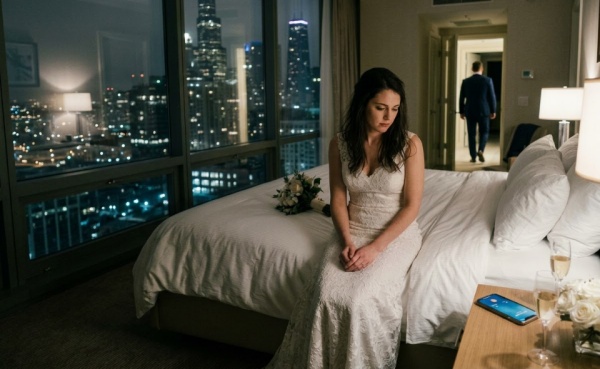
On Our Wedding Night, His Phone Rang — And He Left Me in My Dress for Another Woman.. For forty-three minutes, I believed I had married the love of my life. Then Daniel’s phone rang in our Chicago wedding suite, and the name on the screen was the one woman who had always stood between us: Lauren, his “fragile friend” who somehow needed him every time our relationship mattered most.
I begged him not to answer, but he picked up anyway, listened to her cry, and told me he had to go. That night, while I sat alone in my wedding dress, I finally understood I had never been his first choice when it counted.
PART I — THE CALL IN THE WEDDING SUITE
My name is Madeline Carter, and for exactly forty-three minutes, I believed I had married the love of my life.
That was how long it took after we entered our wedding suite at the Langham Hotel in Chicago for my husband’s phone to ring.
The room was beautiful in that quiet, expensive way hotels use to make people feel like their lives are softer than they really are. There were white roses on the table, champagne chilling in a silver bucket, floor-to-ceiling windows overlooking the glittering lights of the city, and my wedding dress pooled around my legs like something from a dream I had waited years to step inside. My hair still smelled faintly of hairspray and peonies, my feet ached from dancing, and my cheeks hurt from smiling.
Across the room, Daniel Whitman loosened his tie and smiled at me.
My husband.
Even now, that word feels complicated.
Only an hour earlier, he had stood in front of two hundred guests at a historic church in Lincoln Park and promised to choose me every day for the rest of his life. He had held both of my hands and said his vows with tears in his eyes. My mother cried. His father cleared his throat like men of his generation do when emotion tries to embarrass them. Our friends clapped and cheered as we walked out under a canopy of white petals.
I thought the hard part was over.
Not because marriage is easy.
Because getting to that day had not been.
There had been planning stress, family opinions, seating charts, budget fights, and the usual chaos of merging two lives. But there had also been Lauren Ellis, Daniel’s best friend from college, the woman whose name came up so often in our relationship that I sometimes felt like I was dating both of them by proxy.
Lauren was not at the wedding.
That was what everyone had noticed.
She had texted Daniel that morning saying she was “too overwhelmed” to attend but wished us “a beautiful day.” He had gone quiet when he read it. I had watched his face fall while my bridesmaids zipped me into my dress, and for one horrifying second, I wondered if he would leave the church to check on her before marrying me.
He did not.
He put the phone away.
He smiled for the photographer.
He married me.
I told myself that meant something.
In the suite, Daniel poured champagne into two crystal flutes and handed one to me. His fingers brushed mine, and I wanted to believe the electricity I felt was proof that everything before this moment had been insecurity, not instinct.
“To us,” he said.
“To us,” I whispered.
We clinked glasses.
Then his phone rang.
Not a text.
Not an email.
A call.
The sound cut through the room like a knife through silk.
Daniel’s body changed before he even looked at the screen. His shoulders tightened. His eyes flicked toward the nightstand where he had placed the phone. The softness left his face.
I knew before he turned it over.
Still, I asked.
“Who is it?”
He looked at the screen.
Then he looked away.
“Lauren.”
One word.
One name.
One shadow stepping fully into the room.
I tried to keep my voice calm. “Don’t answer.”
He ran one hand through his hair. “Maddie—”
“It’s our wedding night.”
“I know.”
“Then don’t answer.”
The phone kept ringing.
Daniel stood frozen between me and the sound. I had seen him hesitate before when Lauren called, but never like that. There was panic in his face, guilt, and something worse: obligation that looked stronger than love.
“She wouldn’t call tonight unless it was serious,” he said.
A laugh escaped me, small and bitter. “She absolutely would.”
His eyes snapped to mine. “That’s not fair.”
“No,” I said. “What’s not fair is my husband considering taking another woman’s call forty-three minutes after we got to our wedding suite.”
He flinched at the word husband.
Good.
He should have.
The call stopped.
For three seconds, the room was silent.
Then the phone rang again.
Daniel picked it up.
My champagne glass felt suddenly heavy in my hand.
“Daniel,” I said, and my voice sounded different to my own ears. Lower. Clearer. “If you answer that call, you are making a choice.”
He stared at me.
The phone buzzed in his palm.
“She’s fragile,” he said.
There it was.
The phrase that had excused everything for three years.
Lauren was fragile when she interrupted date nights because she had fought with her mother. Lauren was fragile when Daniel left my birthday dinner early because she had gotten bad news at work. Lauren was fragile when she cried in his apartment at midnight because her boyfriend had broken up with her, even though she had broken up with him first. Lauren was fragile when she called during our engagement party and Daniel disappeared for twenty minutes.
Fragile.
A word people used to make her untouchable.
I looked at the man I had just married.
“And what am I?” I asked.
He opened his mouth.
Nothing came out.
That silence told me more than any answer could have.
The phone rang a third time.
Daniel answered.
“Lauren?”
I closed my eyes.
His voice changed immediately. It softened in a way I had been begging to hear all week. “Slow down. What happened?”
I stood there in my wedding dress, holding untouched champagne, listening to my husband become someone else for another woman.
He turned his back slightly, but not enough that I couldn’t hear.
“No, don’t do that. Just breathe. Where are you?”
My stomach went cold.
He looked at me then, and I knew.
I knew before he said it.
“She’s at her apartment,” he said, covering the phone with his hand. “She’s having a panic attack.”
I stared at him.
“A panic attack.”
“Yes.”
“On our wedding night.”
“She didn’t choose the timing.”
I almost admired the audacity of that sentence.
“She chose to call you,” I said.
Daniel’s jaw tightened. “I can’t ignore her like this.”
“You can call emergency services if you think she’s unsafe. You can call one of her friends. You can call her sister.”
“She asked for me.”
“Of course she did.”
He looked wounded, as if I had insulted something sacred.
“She doesn’t have many people.”
“She has you,” I said. “She has always had you.”
His face hardened. “I’m going over there.”
The words did not feel real at first.
They hovered in the room, impossible and ugly.
“You’re leaving me,” I said slowly, “on our wedding night.”
“For an hour. Maybe less.”
I looked down at my dress.
The beadwork had taken six months to select. My grandmother’s pearl bracelet circled my wrist. My bouquet, placed gently on the table by the hotel staff, had started to wilt at the edges.
Everything beautiful in the room suddenly looked staged around a humiliation.
Daniel grabbed his jacket from the chair.
I placed my glass on the table.
“If you walk out that door, don’t come back tonight.”
He stopped.
For one heartbeat, I thought love might win.
Then he said, “Don’t make me choose when someone is in crisis.”
My chest ached so sharply I almost reached for the bedpost.
“You already did.”
Daniel stared at me like I was being unreasonable. Like I had failed some test of compassion that Lauren, conveniently, had designed from a distance.
“I’ll text you,” he said.
He left.
The door closed softly behind him.
Not slammed.
Not dramatic.
Softly.
That somehow made it worse.
I stood alone in the honeymoon suite, still wearing my wedding gown, still legally his wife, while my husband rode the elevator down to comfort the woman he had always insisted was just a friend.
For ten minutes, I did not move.
Then I walked to the mirror.
The woman reflected back at me looked perfect. Perfect makeup. Perfect hair. Perfect dress. Perfectly abandoned.
I touched the pearl bracelet on my wrist and heard my mother’s voice from that morning.
“Marriage is not about the wedding day, sweetheart. It is about the choices after.”
I had thought she meant ordinary things.
Bills.
Patience.
Compromise.
Children someday.
I had not understood that the first choice would come before midnight.
And I had not understood that my husband would fail it.
PART II — THE FRIEND WHO ALWAYS NEEDED HIM
People love to say you should trust your partner.
They say it especially when they do not want to examine what “trust” is being used to excuse.
I trusted Daniel for a long time. Not blindly, but deliberately. I knew he had been close to Lauren since college. I knew they had survived hard years together, helped each other through family issues, job losses, breakups, and the kind of early-twenties chaos people later call formative. I did not expect him to erase his friendships because he loved me.
I am not that woman.
But there is a difference between accepting your partner has a past and realizing you are being asked to build your future around someone else’s emotional emergencies.
Daniel and Lauren met at Northwestern University, where they were both communications majors. She was from Evanston, artistic and anxious, with divorced parents and a talent for making her pain feel like the most urgent thing in any room. Daniel was from Oak Park, the oldest son in a family that praised responsibility until it became his entire personality.
They fit each other in a dangerous way.
Lauren needed rescuing.
Daniel needed to be needed.
By the time I met him at a nonprofit fundraising event downtown, they had already built a pattern neither of them recognized as unhealthy. She called; he answered. She cried; he came. She spiraled; he stabilized. He dated; she approved or disapproved. He moved forward; she reminded him she might fall apart without him.
When Daniel first told me about her, I thought it was sweet.
“She’s like family,” he said on our third date.
I remember smiling. “That’s nice.”
He looked relieved, like I had passed a test. “Some women get weird about female friends.”
“Some men give them a reason to,” I said lightly.
He laughed.
I wish I had paid more attention to how quickly he changed the subject.
The first time Lauren interrupted us, Daniel and I had been dating two months. We were at a small Italian restaurant in River North, sharing tiramisu, when his phone lit up. He glanced at it, silenced it, and put it facedown.
Then it lit up again.
And again.
Finally, he said, “I’m sorry. I should check.”
It was Lauren.
She had seen her ex-boyfriend’s engagement announcement on Instagram and was “not okay.”
Daniel stepped outside for fifteen minutes.
When he came back, he looked guilty and tender, but not toward me.
“Sorry,” he said. “She’s just really sensitive about abandonment.”
I nodded because I wanted to be kind.
Kindness is a beautiful thing when freely given.
It becomes dangerous when weaponized against you.
Over the next year, Lauren became a presence in our relationship without ever being physically present most of the time. She texted during movies. She called during weekend trips. She sent Daniel articles about emotional dependency with notes like, “This made me think of us, in a good way.” She gave him birthday gifts that were just a little too intimate: framed college photos, inside-joke playlists, handwritten letters about how he had “saved” her.
When I raised concerns, Daniel always made me feel smaller for noticing.
“She’s been through a lot.”
“You don’t understand our history.”
“You’re reading into it.”
“She supports us.”
That last one was the biggest lie.
Lauren supported us the way fog supports a road: by making everything harder to see.
When Daniel proposed, Lauren cried.
Not happy tears.
He told me she was overwhelmed.
“She always thought I’d end up with someone different,” he admitted one night, as if that were an innocent observation.
“Different how?”
He hesitated.
“Someone who understood the bond.”
The bond.
I hated that phrase.
Still, I married him.
That is the part people judge from the outside.
They ask why women stay, why they proceed, why they ignore red flags bright enough to land aircraft. The answer is rarely simple. I loved Daniel. He was not cruel. He volunteered at shelters, called his grandmother every Sunday, remembered how I took my coffee, and cried during old movies when fathers reconciled with sons. He made me feel safe most of the time.
Most of the time can trick you into tolerating what should never be tolerated.
The wedding planning made everything worse.
Lauren declined to be a bridesmaid but insisted she wanted to be “emotionally present.” She offered opinions on the venue, the menu, and even the first dance song. When I chose “Can’t Help Falling in Love,” she texted Daniel a laughing emoji and wrote, “Classic Maddie. Very safe.”
He showed it to me like it was harmless.
I did not laugh.
Two months before the wedding, Lauren had what Daniel called a “bad episode” because her company reorganized and she feared losing her job. He canceled our cake tasting to sit with her. I went with my sister, Caroline, who said nothing for half an hour before finally asking, “Are you sure you want to marry a man who treats someone else’s discomfort like your emergency?”
I defended him.
I said he was loyal.
Caroline looked at me sadly.
“To whom?”
That question followed me all the way to the altar.
On the morning of our wedding, Lauren sent Daniel a long message.
I saw only the first line before he turned the screen away.
I know today is supposed to be about her, but I need you to understand what this feels like for me.
About her.
Not about you.
Not about your marriage.
Her.
Me.
Daniel became quiet after that, but he still showed up. He still said the vows. He still kissed me in front of everyone we loved.
I let myself believe that meant he had chosen.
But choices made in public are easy.
It is the private ones that reveal the truth.
And on our wedding night, when Lauren called, Daniel did not hesitate because he was confused.
He hesitated because some part of him already knew he was about to do the indefensible.
Then he did it anyway.
PART III — THE NIGHT I STOPPED COMPETING
After Daniel left the wedding suite, I sat on the edge of the bed for a long time.
I do not know exactly how long.
Time felt strange, as if the clock had become embarrassed and stopped looking at me. My phone buzzed constantly with messages from guests: photos from the reception, laughing emojis, congratulations, heart reactions, reminders to enjoy the honeymoon. My college roommate sent a video of Daniel and me dancing under string lights three hours earlier.
In the video, he looked happy.
So did I.
That was the thing that made me cry.
Not his leaving.
The evidence that I had been happy before I knew I had been abandoned.
At 12:18 a.m., Daniel texted.
She’s calming down. I’ll be back soon. Please don’t be mad.
Please don’t be mad.
Not I’m sorry.
Not I made a terrible mistake.
Not I should not have left you.
Please don’t be mad, as if my anger were the problem to manage.
I did not respond.
At 12:46 a.m., he texted again.
Maddie, I know this looks bad. It’s not what you think.
That sentence has probably kept divorce attorneys in business for decades.
At 1:22 a.m., he called.
I let it ring.
At 1:24 a.m., he called again.
I turned the phone off.
Then I stood, unzipped my wedding dress as far as I could reach, and failed.
For some reason, that was what broke me.
Not the call.
Not Lauren.
Not the door closing.
The zipper.
I twisted my arms behind me until my shoulders hurt, trying to get free from the dress I had needed two bridesmaids to fasten that afternoon. I laughed once, a terrible sound, then sank onto the carpet and cried like a woman whose body had finally caught up with her reality.
Eventually, I called the front desk.
A female manager named Denise came upstairs with a sewing kit, a robe, and the kindest professional expression I had ever seen. She helped me out of the dress without asking questions. She hung it carefully on the wardrobe door as if it were still sacred.
“Would you like me to send up tea?” she asked.
I nodded.
“Chamomile?”
“Anything without champagne.”
Her face softened.
When she left, I showered for almost thirty minutes.
I scrubbed hairspray from my hair and mascara from under my eyes. I took off the pearl bracelet and placed it on a towel. I watched glitter from my makeup swirl down the drain and thought, absurdly, that this was what marriage looked like when illusion dissolved: tiny shining pieces disappearing into plumbing.
At 2:07 a.m., there was a knock on the suite door.
I knew it was Daniel.
I did not move.
“Maddie,” he called softly. “Open the door.”
I tightened the robe around myself.
He knocked again.
“Please.”
I walked to the door but did not open it.
“Go home, Daniel.”
“This is my room too.”
That sentence hit me with surprising clarity.
Legally, yes.
Emotionally, no.
“Go home,” I repeated.
“We need to talk.”
“You needed to stay.”
Silence.
Then he said, “Lauren was scared.”
“So was I.”
Another silence.
“She didn’t ask me to leave you,” he said.
“No. She just knew you would.”
I heard him exhale through the door.
“You’re being unfair.”
The word snapped something clean inside me.
Unfair.
After everything, he still thought the moral burden belonged to me.
I opened the door.
Daniel stood in the hallway with his tuxedo jacket wrinkled, his hair messy, and guilt written all over his face. He looked young suddenly, not like my husband, but like a boy caught between two women and still expecting the one he married to be the reasonable one.
I stepped back, but not to let him in.
To let him see me.
No wedding dress. No makeup. No bouquet. No illusion.
“Tell me the truth,” I said.
He swallowed.
“I did.”
“No. Tell me the truth you keep dressing up as friendship.”
His eyes filled with frustration. “Maddie, I love you.”
“I didn’t ask that.”
“It should matter.”
“It does. That’s why this hurts.”
He looked away.
I waited.
Finally, he said, “Lauren has always been complicated.”
“That is not an answer.”
“She depends on me.”
“And you like that.”
His head snapped back.
The truth had landed.
I saw it before he denied it.
“That’s not fair,” he said again, weaker this time.
“You like being the person she can’t live without,” I said. “You like being needed more than you like being partnered. And tonight, you proved that being her emergency mattered more than being my husband.”
He stepped toward me. “I made a mistake.”
“No,” I said. “A mistake is forgetting the room key. Leaving your wife alone on your wedding night for another woman is a decision.”
His face crumpled slightly.
For a moment, I saw real remorse.
It would have been so easy to soften.
That is what women are taught to do when men finally look sorry: lower the temperature, accept the apology before it is complete, protect them from the full consequences of their own choices.
I did not soften.
“Where is Lauren now?” I asked.
“At her apartment.”
“Did you call her sister?”
He hesitated.
“No.”
“Did you call a crisis line?”
“No.”
“Did she need medical attention?”
“No.”
“Did she ask you to stay?”
His silence answered.
I nodded slowly.
“Did she know you were leaving me in our wedding suite?”
He closed his eyes.
There it was.
The answer I did not want but already knew.
“She was upset,” he whispered.
I stepped back.
“You need to leave.”
“Maddie—”
“No. I am not competing with her anymore. Not tonight. Not during a honeymoon. Not for the next forty years.”
His voice broke. “We just got married.”
“Yes,” I said. “And you left.”
He stood there, searching my face for the woman who would reassure him.
She was gone.
“Where am I supposed to go?” he asked.
The question was so absurd I almost laughed.
“Call Lauren.”
Then I closed the door.
This time, I locked it.
PART IV — THE MARRIAGE THAT LASTED SIX HOURS
By morning, my marriage was six hours old and already separated into before and after.
I woke at 6:30 a.m. because my body did not understand heartbreak as an excuse to sleep. For a few seconds, I forgot. The room was soft and gray with early light, room service trays had been removed, and my wedding dress hung silently by the wardrobe. Then memory returned all at once.
Daniel had not come back.
He had texted seventeen times.
I read none of them at first.
Instead, I called Caroline.
She answered with a sleepy, happy voice. “Mrs. Whitman?”
I started crying.
She was at the hotel in twenty minutes.
My sister is not dramatic. She works as a nurse at Northwestern Memorial, has three children under ten, and considers panic an inefficient use of energy. But when she walked into the suite and saw me sitting in a hotel robe beside my untouched wedding bouquet, her face changed in a way I had never seen before.
“I’m going to ask once,” she said. “Are you safe?”
“Yes.”
“Did he hurt you physically?”
“No.”
“Good. Then we breathe, we document, and we do not make permanent decisions before breakfast.”
That was Caroline.
Love with a checklist.
She ordered coffee, eggs, toast, fruit, and pancakes I did not eat. Then she sat beside me while I told her everything: the call, the argument, Daniel leaving, Lauren’s panic attack, the hallway conversation.
When I finished, Caroline said nothing.
That scared me.
Finally, she asked, “Do you want advice or witness?”
“What?”
“Do you want me to tell you what I think, or do you want me to simply sit here and witness what happened?”
I looked at my hands.
“Both.”
She nodded. “Then here is both. What he did was not normal. It was not kind. It was not the behavior of a man ready to be married. And I witnessed you trying for years to make room for a woman who never intended to make room for you.”
That sentence settled into me like truth.
At 8:12 a.m., Daniel came back.
Caroline opened the door while I sat on the sofa wearing leggings, a sweatshirt, and no ring.
His eyes went straight to my hand.
“Maddie,” he said.
Caroline stepped aside but did not leave.
Daniel looked at her. “Can we have privacy?”
“No,” I said.
He flinched.
“I deserve to speak to my wife alone.”
Caroline’s expression hardened. “You had that chance last night.”
Daniel swallowed whatever he wanted to say.
He looked awful. Not devastated enough to satisfy my pain, but shaken. He held a paper bag from a coffee shop as if pastries might function as an apology.
“I messed up,” he said.
I waited.
“I should not have left.”
“No,” I said. “You should not have.”
“I panicked. Lauren called, and I reacted without thinking.”
“That’s not true.”
He frowned.
“You thought,” I said. “I watched you think. I warned you exactly what leaving meant. You did it anyway.”
His eyes filled. “I’m sorry.”
The apology was real.
It was also too small for the damage.
“What did Lauren say after you left here?” I asked.
He looked uncomfortable.
I smiled sadly. “Still protecting her?”
“No.”
“Then answer.”
He rubbed his forehead. “She was upset. She said she felt like she was losing me. She said the wedding made everything real.”
Caroline made a sound under her breath.
Daniel looked ashamed.
“She said she didn’t know who she was to me anymore,” he continued.
“And what did you say?”
“I told her she was my best friend.”
“Did you tell her I was your wife?”
He looked at me.
The silence was enough.
I nodded.
“Did you spend the night there?”
“No. I slept in my car for a while, then at my parents’ house.”
That detail hurt less than I expected.
Maybe because the worst thing had already happened.
Daniel stepped closer. “Please don’t do this. We can still go on the honeymoon. We can talk. I’ll set boundaries with Lauren.”
I looked at him carefully.
There were the words.
Finally.
Boundaries.
The thing I had asked for repeatedly before the wedding.
The thing he had called insecurity, jealousy, misunderstanding.
Now, after humiliating me, he was offering them like a gift.
“Why now?” I asked.
He blinked.
“Because I see how badly I hurt you.”
“No,” I said. “You see consequences.”
That landed hard.
He sat down across from me.
“I love you, Maddie.”
“I believe you.”
Hope flashed in his eyes.
Then I continued.
“But I don’t think love is enough if you use it to ask me to survive being second.”
His face fell.
Caroline put a hand on my shoulder.
I slipped the wedding ring from the table where I had placed it and held it in my palm. It was beautiful, a simple oval diamond on a gold band. We had chosen it together on a snowy afternoon the previous winter. I remembered Daniel holding my hand in the jewelry store and saying he wanted me to have something timeless.
Six hours.
That was how long timeless had lasted.
“I’m not filing for divorce today,” I said.
Daniel exhaled.
“But I’m not going on the honeymoon. I’m going home with Caroline. You are not coming with me. And before I make any decision about this marriage, I need you to do three things.”
He leaned forward. “Anything.”
“First, you tell Lauren that your emotional relationship with her has damaged your marriage and that you are taking space. Not a soft version. Not a version that makes me the villain.”
He nodded quickly.
“Second, you start therapy. Not couples therapy first. Individual therapy. You need to understand why being needed by her matters more to you than honoring commitments to me.”
He nodded again.
“Third, you give me time without pressuring me, guilt-tripping me, or asking my family to advocate for you.”
“I can do that.”
I looked at him.
“I hope so.”
He reached for my hand.
I did not give it to him.
That was the first consequence.
Not divorce.
Not screaming.
Not public humiliation.
Just my hand no longer automatically available.
Daniel cried then.
I did too.
But I still left with Caroline.
As we walked through the hotel lobby, I passed a family checking in, a businessman on his phone, and a bride taking photos near the staircase where I had posed the night before. Life continued with brutal indifference. The world does not stop because your marriage collapses before the thank-you notes are written.
In the car, Caroline drove while I stared at the skyline.
My phone buzzed.
A message from Lauren.
I’m sorry if last night caused problems. I was in a really dark place and Daniel was the only person I trusted. I hope someday you understand.
If last night caused problems.
If.
I looked at the message until my grief hardened into something stronger.
Then I replied with one sentence.
I understand more than you think.
Then I blocked her.
PART V — THE CHOICE I FINALLY MADE FOR MYSELF
The next six months became the real marriage test.
Not the wedding.
Not the vows.
Not the photographs.
The aftermath.
Daniel did some things right.
He called Lauren in front of his therapist, not in front of me, because I refused to supervise his boundaries like a mother checking homework. He told her they needed at least ninety days of no contact outside genuine emergencies handled through appropriate support systems. He apologized to me without using the phrase “but you have to understand.” He started weekly therapy and, after two months, asked if I would attend couples counseling when I was ready.
I did not move back in.
Instead, I stayed in my own apartment in Lakeview, the one I had planned to give up after the wedding. My lease still had four months left, which felt like accidental mercy. Daniel remained in the condo we had chosen together, surrounded by unopened wedding gifts and boxes labeled KITCHEN, LINENS, and OUR LIFE.
We told family and close friends that we were taking time.
People reacted the way people react when a story makes them uncomfortable.
Some were kind.
Some were nosy.
Some minimized it.
His aunt told me men sometimes panic after weddings and that I should be patient. My coworker said at least he had not cheated physically, as if betrayal only counts when clothing is removed. One of Daniel’s friends said Lauren was “a lot” but harmless.
Harmless.
I wondered how many women had been asked to bleed quietly because the person holding the knife looked fragile.
Therapy helped, but not in the way Daniel hoped.
It did not quickly repair us.
It clarified us.
Our counselor, Dr. Melissa Grant, was calm, direct, and immune to Daniel’s charm. In the first session, he explained Lauren’s anxiety, their history, his sense of responsibility, and how he had never meant to make me feel abandoned.
Dr. Grant listened carefully.
Then she asked, “Daniel, when you left the wedding suite, what did you believe Madeline would do?”
He looked confused.
“I don’t know.”
“Did you believe she would leave you?”
“No.”
“Did you believe she would lock the door?”
“No.”
“Did you believe there would be consequences?”
He was silent.
Dr. Grant nodded. “So part of you believed she would absorb it.”
Absorb it.
That phrase described years of my life.
I had absorbed the interruptions, the guilt, the comparisons, the late-night calls, the careful way Daniel’s loyalty bent around Lauren while I was told not to feel its absence. I had absorbed so much that he mistook my capacity for pain as permission to continue causing it.
Daniel cried in that session.
I did not comfort him.
That became my healing.
Not cruelty.
Restraint.
Letting him feel what belonged to him.
Lauren did not respect the no-contact boundary.
At day twelve, she emailed him from a new address.
At day twenty-seven, she mailed a handwritten letter to his office.
At day forty-one, she posted a vague Instagram story about being abandoned by someone who promised to always be there. At day sixty-three, she called Daniel’s mother crying. His mother, to her credit, told her gently that Daniel’s marriage was not a community resource.
That line became family legend.
Daniel showed me every attempted contact.
At first, I appreciated it.
Then I noticed something.
He seemed proud of resisting.
Like sobriety chips for not betraying me emotionally.
I told him that in therapy.
He looked hurt.
Dr. Grant asked, “Madeline, what would feel different?”
I thought for a long time.
“Not needing applause for doing what should have been done all along.”
Daniel looked down.
That was when I realized something painful.
He was changing.
But I no longer knew if I wanted the version of him that came after I was broken enough to demand it.
People talk about forgiveness as if it restores everything.
Sometimes forgiveness simply clears the smoke so you can see the ruins.
At month four, Daniel asked me to dinner.
We went to a quiet restaurant in West Loop, the kind of place we used to love, with exposed brick walls and overpriced small plates. He looked nervous. I wore a black dress and the pearl bracelet from the wedding, not because I was sentimental, but because I wanted to reclaim it from that night.
Halfway through dinner, Daniel reached across the table.
This time, I let him take my hand.
“I know I may have lost you,” he said.
My throat tightened.
“I’m trying not to make this about what I want,” he continued. “But I need you to know I understand now that Lauren wasn’t just a friend. She was a role I kept choosing. I liked being necessary to someone who never asked me to grow. With you, I had to be a partner. With her, I got to be a hero.”
It was the truest thing he had ever said.
That made it hurt more.
“Do you love her?” I asked.
He shook his head. “No.”
“Did you ever?”
He hesitated.
“I loved who I got to be with her.”
I looked out the window at people walking by under streetlights.
That answer mattered.
Not because it excused anything.
Because it finally named the ghost.
Lauren had not been my competition in the traditional sense. She was not simply another woman Daniel desired. She was an escape hatch from adulthood, accountability, and equal partnership. With her, he was needed without being challenged. With me, he was loved but expected to show up.
Some men confuse peace with control.
Some confuse love with admiration.
Some confuse rescue with intimacy.
Daniel had confused all three.
“I believe you’re growing,” I said.
His eyes filled with hope.
“And I’m proud of you for that.”
The hope trembled.
“But I don’t know if I can be your wife anymore.”
He closed his eyes.
I kept going because if I stopped, I might choose comfort over truth.
“The night you left, something changed in me. I saw a version of our future where I spent years waiting for you to choose me in private the way you chose me in public. I saw children, holidays, hospital rooms, hard days, and every vulnerable moment becoming a test I might lose if Lauren or someone like her needed you louder.”
Tears slipped down his face.
“I won’t do that to you again,” he said.
“I know you believe that.”
“But you don’t believe me?”
“I believe you mean it now. I don’t know if I believe in us.”
That was the most honest sentence I had.
Two months later, we filed for divorce.
Quietly.
Legally.
Without spectacle.
In Illinois, there was no dramatic courtroom battle. We had been married on paper for less than a year and had kept most finances separate. We divided wedding debt, returned some gifts, donated others, and sold what we had bought together. The photographer delivered the wedding album anyway. I put it in a box in my closet because I was not ready to throw away proof that I had once been happy.
Daniel respected the process.
That mattered.
It did not save the marriage, but it preserved some dignity.
Lauren tried once more after news of the divorce reached mutual friends.
She sent me a message from an account I had not blocked.
I never wanted this to happen.
For the first time, I did not feel rage.
I felt tired.
I replied:
Maybe not. But you were willing to benefit from it. Please don’t contact me again.
Then I blocked her too.
A year after the wedding, I went back to the Langham.
Not to punish myself.
To finish something.
I booked afternoon tea with Caroline in the hotel lounge. I wore jeans, a cream sweater, and my grandmother’s pearl bracelet. No gown. No photographer. No husband. Just my sister, tiny sandwiches, and the knowledge that I had survived the thing I once thought would define me.
At one point, Caroline raised her teacup.
“To first choices,” she said.
I smiled. “To choosing ourselves.”
That is what I wish someone had told me before the wedding.
Being chosen by someone else is beautiful.
But it is not enough if you abandon yourself to keep the role.
I had spent years trying to be understanding enough, secure enough, compassionate enough, patient enough. I thought if I loved Daniel correctly, he would eventually see that marriage required a different kind of loyalty. But love cannot compete with a pattern someone refuses to break.
On our wedding night, Daniel’s phone rang.
For a moment, I thought the tragedy was that he answered.
But that was not the whole truth.
The deeper tragedy was that some part of me had expected him to.
And the beginning of my freedom was finally admitting that expectation was not marriage.
It was warning.
I do not hate Daniel.
I do not even hate Lauren.
Hate requires carrying people too closely.
What I carry now is clarity.
If a man promises forever but cannot protect one sacred night, listen.
If he calls another woman fragile while asking you to be endlessly strong, listen.
If you are always told to understand a bond that keeps hurting you, listen.
And if the door closes behind him on the night he vowed to choose you, do not chase.
Lock it.
Turn off the phone.
Take off the dress.
Call someone who loves you without making you compete for basic care.
Then, when morning comes, choose the woman in the mirror.
She was the first choice all along.
