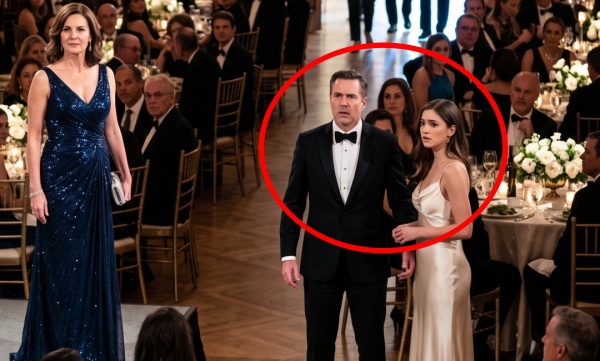
Graham thought I would smile through anything, even on our eighth wedding anniversary, even while he stood in front of hundreds of donors preparing to introduce another woman as the future of the foundation I had helped build. He reached for Lila’s hand like I was already part of his past, not realizing the board had been reviewing the secrets he thought were buried in budgets, vendor contracts, and quiet little approvals.
I did not scream, confront her, or ruin the night with a scene. I simply waited until the ballroom doors opened — and watched my husband learn that silence was never the same as surrender.
PART I — THE ANNIVERSARY GALA
My name is Evelyn Whitaker, and the day my husband underestimated me was the day he destroyed himself.
It happened on the night of our eighth wedding anniversary, inside the grand ballroom of the Waldorf Astoria in Washington, D.C., under chandeliers that made every lie look polished. There were more than four hundred guests in the room: donors, doctors, board members, lobbyists, journalists, hospital executives, and politicians who smiled like generosity was a language they had invented. Everyone was there to celebrate the annual gala of the Whitaker Hope Foundation, the nonprofit my husband, Graham Whitaker, loved to describe as his life’s mission.
His life’s mission.
That phrase still makes something in me tighten.
Because for years, I had been the one who wrote the early grant proposals, called donors when Graham was too proud to ask twice, sat with grieving families in pediatric oncology wards, reviewed budgets until midnight, and kept the foundation from collapsing every time Graham chased applause instead of infrastructure. I was the one who remembered that behind every glossy brochure was a parent sleeping in a hospital chair beside a sick child. I was the one who insisted that dignity mattered more than branding.
But to the room that night, I was simply Mrs. Graham Whitaker.
I stood near the stage in a midnight blue gown, smiling while people thanked my husband for work he had not done alone. A senator’s wife kissed my cheek and told me I must be so proud. A hospital CEO shook Graham’s hand and told him the foundation’s new family housing initiative was “visionary.” A donor from Connecticut told me Graham had a rare gift for compassion.
I said thank you every time.
That is what quiet wives are trained to do.
Graham stood fifteen feet away, wearing a black tuxedo and the easy confidence of a man who believed the room belonged to him. He was forty-three, handsome in a deliberate way, with silver beginning at his temples and a voice that softened whenever cameras were close. He knew how to lower his chin when listening, how to place a hand over his heart during speeches, how to make grief-stricken families feel seen for exactly as long as a photographer needed.
Beside him stood Lila Hart.
She was twenty-nine, director of strategic partnerships at the foundation, and for six months she had been appearing in places she did not need to be. Late-night planning meetings. Donor dinners. Weekend retreats. Private calls that ended when I entered the room. She had a careful kind of beauty, all cream silk and soft hair and eyes that moved too quickly around powerful people.
I had noticed.
Of course I had noticed.
Women notice the shift before anyone says the truth out loud. We notice when our husbands start dressing for someone else’s approval. We notice when a name becomes too frequent. We notice when laughter changes temperature. We notice when the person who once reached for our hand in crowded rooms begins keeping both hands free.
For months, Graham had told me I was imagining things.
“You’re stressed, Evie.”
“You’re reading too much into it.”
“Lila is important to the foundation.”
“You should be grateful she’s taking some weight off your shoulders.”
That last sentence had been the most insulting because the weight had not left my shoulders. It had simply been repackaged in someone else’s perfume.
Still, I had remained composed.
Not because I was weak.
Because I was watching.
That night, the gala theme was A Future of Hope. The foundation was announcing a major expansion: a national program to provide emergency housing for families whose children were receiving long-term treatment far from home. The expansion had been my idea. I had built the first model after spending three nights at Children’s National Hospital with a mother from rural Virginia who could not afford a hotel and had been washing her clothes in a restroom sink.
Graham had initially dismissed the plan as “not scalable enough.”
Then a donor liked it.
After that, he called it his signature initiative.
The ballroom doors had been closed for dinner service, and the program was about to begin. Guests settled into gold chairs around tables decorated with white roses and glass votive candles. Servers moved quietly between tables. A string quartet faded into recorded music. On the large screens near the stage, a video loop showed smiling children, hospital corridors, and carefully selected images of families looking hopeful but not too desperate.
Everything was beautiful.
Everything was controlled.
Then Graham stepped up beside me.
For one brief second, I thought he might take my hand. It was our anniversary, after all. Eight years since we had stood in a small chapel in Georgetown, promising partnership, loyalty, and love before God, family, and one photographer we could barely afford at the time.
Instead, he leaned close and said, “I need you to stay calm tonight.”
I turned my head slowly. “About what?”
His eyes did not meet mine. They were fixed on Lila, who stood near the podium speaking with the emcee.
“After my remarks, I’m bringing Lila onstage.”
My stomach tightened.
“For what reason?”
“She’s going to be announced as executive director.”
I stared at him.
The executive director position had been vacant for three months. I had recommended a national search. The board had agreed. At least I thought they had. The role involved legal oversight, donor management, program accountability, grant compliance, staff leadership, and direct reporting to the board.
Lila had never managed a budget larger than a gala sponsorship package.
“You can’t be serious,” I said.
Graham smiled faintly, the kind of smile he used when he wanted me to feel unreasonable for objecting.
“She’s the future of the foundation.”
The words were rehearsed.
That made them worse.
“The board approved this?”
His mouth tightened. “The board trusts my judgment.”
“That is not an answer.”
“Evelyn,” he said softly, “do not embarrass me tonight.”
There it was.
The warning.
Not do not be hurt.
Not I know this is difficult.
Not I should have discussed this with you.
Do not embarrass me.
Before I could respond, Lila walked toward us. She touched Graham’s arm, light and familiar, and he did not move away. In fact, he reached for her hand.
Right there.
At our anniversary gala.
In front of donors, board members, journalists, and hundreds of people who still believed my marriage was part of the foundation’s moral architecture.
My breath caught, but my face did not change.
Graham glanced at me, almost daring me to react.
He thought he knew me.
He thought I would swallow anything to protect the foundation’s image. He thought I would smile through humiliation because I had spent years choosing the work over my pride. He thought quiet meant powerless.
At that exact moment, the ballroom doors opened.
A low murmur moved through the room.
Graham turned, irritated by the interruption.
Then he froze.
Because walking into the ballroom were three people he had not expected to see: Marianne Kline, the foundation’s outside counsel; Victor Reyes, the chair of the audit committee; and Dr. Helen Park, the newly appointed interim executive director whose appointment Graham had somehow convinced himself he could outrun.
Behind them came two uniformed hotel security managers and a court reporter carrying a slim black case.
Graham’s hand dropped away from Lila’s.
I looked at my husband and finally stopped smiling.
PART II — THE QUIET WIFE WHO KEPT RECEIPTS
To understand what happened that night, you need to understand what Graham never bothered to learn about me.
Before I was Evelyn Whitaker, I was Evelyn Grant, a nonprofit compliance attorney from Arlington, Virginia. I did not come from old money. I did not come from political power. My father taught high school history, and my mother worked as a pediatric nurse for thirty-one years. I grew up understanding that institutions can save people, but only when the people running them do not confuse the mission with their own reflection.
I met Graham at a hospital fundraiser when I was thirty-two.
He was charming then, in the way ambitious men can be before ambition devours the parts of them that know shame. He had started the Whitaker Hope Foundation after his younger brother died from a rare blood disorder in childhood. He spoke beautifully about families sleeping in waiting rooms, children needing access to specialists, and the cruelty of medical hardship compounded by financial hardship.
I believed him.
More than that, I believed in the work.
At the time, the foundation had three employees, a rented office in Dupont Circle, and less than $400,000 in annual donations. Graham had passion, a tragic origin story, and a remarkable ability to make wealthy people feel emotionally connected for the length of a cocktail reception. What he did not have was structure.
I gave him structure.
At first, I volunteered. Then I joined the board. Then, after we married, I stepped back from my legal practice and became the foundation’s unofficial backbone, though no one called it that in public. I drafted governance policies, built conflict-of-interest procedures, formalized grant review processes, created donor reporting templates, reviewed vendor contracts, and convinced Graham that “trust me” was not an acceptable accounting system.
He hated that at first.
Then he realized structure made donors comfortable.
After that, he loved structure as long as I handled it quietly and he could take credit out loud.
The foundation grew fast. By our fifth anniversary, annual donations had passed $12 million. By our seventh, we had partnerships with hospitals in D.C., Maryland, Virginia, Pennsylvania, and North Carolina. We funded emergency travel grants, housing stipends, counseling support, and pilot programs for children with complex medical conditions.
Families wrote letters that I kept in a box in my office.
Graham kept framed newspaper profiles.
That difference became important.
Because somewhere along the way, Graham stopped serving the mission and started using the mission to serve himself.
The first red flag was spending.
Not theft in the obvious sense. Graham was too polished for that. It was subtler: luxury travel described as donor cultivation, expensive dinners labeled partnership development, consultants hired without bids, branding contracts awarded to friends, event costs rising while direct family assistance requests sat delayed in review.
When I questioned him, he accused me of not understanding growth.
“Scale requires image,” he said.
“No,” I told him. “Scale requires trust.”
He laughed.
That laugh was the beginning of the end, though I did not know it then.
The second red flag was Lila.
She joined the foundation as a communications consultant, recommended by a donor Graham was trying to impress. She was capable, but not exceptional. What she had was instinct. She knew how to praise the right insecurity. She knew when to make a man feel brilliant. She knew how to frame disagreement as admiration.
“I completely understand Evelyn’s concern,” she would say in meetings, turning toward Graham, “but I think your vision is bigger than traditional nonprofit models.”
Your vision.
Not the board’s.
Not the foundation’s.
His.
Graham began inviting her into decisions she had no authority to make. He gave her access to donor lists, strategy documents, and draft budgets. He started using her language in speeches, more polished but emptier than before. He began dismissing my questions as “legal anxiety.”
Then money started moving strangely.
A vendor called Luminary Strategy Group received a six-figure contract for national expansion branding. I had never seen an approved competitive bid. Another payment went to a Los Angeles event consultant for “stakeholder engagement,” though no event had occurred. A restricted donation meant for family housing support sat untouched while unrestricted funds paid for a donor retreat at a resort in Palm Beach.
I asked our CFO, Daniel Reese, for backup documentation.
He stalled.
That told me he was afraid.
Not of me.
Of Graham.
So I did what compliance attorneys do.
I documented.
I did not break into Graham’s email. I did not access private accounts illegally. I did not follow anyone. I did not make accusations online. I used what I had legal authority to review as a board member, spouse involved in foundation governance, and former counsel still copied on operational matters.
Board minutes.
Expense reports.
Vendor contracts.
Donor restriction letters.
Internal memos.
Calendar invitations.
Approved budgets.
Payment authorizations.
Hotel invoices.
Email threads sent to foundation accounts.
I preserved everything.
Then I called Marianne Kline, outside counsel, from a bench near the reflecting pool outside the Lincoln Memorial because I did not want Graham overhearing me at home.
“Marianne,” I said, “I need to ask a hypothetical.”
She sighed. “Evelyn, when a lawyer starts with ‘hypothetical,’ it is never hypothetical.”
I told her enough.
Not every suspicion.
Enough to require action.
Within two weeks, Marianne had quietly informed the board chair, the audit committee, and independent counsel. A preliminary review began under attorney-client privilege. The board formed a special committee. Graham was not told immediately because several issues involved his own conduct and potential conflicts of interest.
The findings were not simple, and it is important to be precise.
There was no evidence at that stage that Graham had stolen charitable funds directly into his personal bank account. That would have been easy to understand and easy to condemn. What existed instead was a pattern of troubling governance failures, undisclosed conflicts, questionable expenditures, misleading donor communications, and potential misuse of restricted funds through timing and allocation decisions.
In nonprofit law, those things matter.
A lot.
Especially when a foundation represents to donors that money will support vulnerable families and then uses operational fog to fund prestige-building exercises.
Then came the discovery that changed everything.
Luminary Strategy Group, the branding vendor receiving major payments, had a subcontractor relationship with a consulting LLC registered in Delaware.
The LLC’s beneficial ownership was not obvious at first.
But one payment memo referenced a contact email.
Lila’s personal email.
When confronted by outside counsel during review, the CFO produced additional files. Those files suggested Lila had financial ties to consulting work paid through foundation vendors while she was also influencing internal decisions about those vendors. Graham had approved the contracts.
Whether he fully understood the structure became a legal question.
Whether he should have disclosed the relationship was not a question at all.
He should have.
The board planned to confront him privately after the gala.
That had been the original plan.
Then Graham decided to use the gala stage to announce Lila as executive director without full board approval.
That changed the timeline.
Marianne called me that afternoon while I was having my hair done.
“Evelyn,” she said, “has Graham mentioned an announcement tonight?”
My throat went cold.
“Yes.”
“What exactly?”
“He plans to name Lila executive director.”
There was a pause.
Then Marianne said, “He does not have authority to do that.”
“I know.”
“We are moving tonight.”
I looked at myself in the salon mirror: hair pinned elegantly, face calm, eyes tired.
“Will this hurt the foundation?”
Marianne’s voice softened.
“Not as much as letting him continue.”
So I went to the gala.
I smiled.
I greeted donors.
I stood beside my husband on our anniversary while he reached for another woman’s hand.
And I waited for the ballroom doors to open.
PART III — WHEN THE ROOM LEARNED THE TRUTH
The interruption was quiet at first.
That is how serious consequences often enter wealthy rooms.
Not with shouting.
With credentials.
Marianne Kline walked toward the stage with Victor Reyes beside her. Victor was a retired federal judge, seventy-one years old, dignified, and allergic to nonsense. Dr. Helen Park followed them, composed and grave, wearing a black evening suit instead of a gown. She had been selected by the special committee as interim executive director pending full board ratification.
Graham recovered faster than most people would have.
He smiled.
“Marianne,” he said, spreading warmth over his face like paint. “Victor. Helen. Wonderful timing. We’re just about to begin.”
Victor looked at him without expression.
“Graham, we need to speak before the program proceeds.”
The room had not gone silent, not fully, but nearby guests were listening. Donors are experts at pretending not to hear while hearing everything.
Graham’s smile tightened. “This is not the moment.”
“I’m afraid it is,” Marianne said.
Lila stepped closer to Graham, then seemed to realize that physical proximity might not help her and stopped.
I stood still.
Graham looked at me then, and in his eyes I saw the first spark of understanding.
Not full understanding.
Just suspicion.
“You did this,” he said quietly.
“No,” I replied. “You did.”
Victor turned to the hotel event manager. “Please pause the program for ten minutes.”
The emcee, visibly confused, stepped away from the podium. The music softened. Servers stopped moving near the stage.
Graham lowered his voice. “Whatever this is, we can handle it privately.”
Marianne handed him an envelope.
“By vote of the special committee and pursuant to the foundation’s bylaws, you are being placed on administrative leave from your role as president pending completion of an independent governance and financial review. You are not authorized to make personnel announcements, execute contracts, solicit donations on behalf of the foundation, or represent foundation decisions until further notice.”
For once in his life, Graham had no immediate words.
He opened the envelope and scanned the first page.
His face changed slowly.
Administrative leave.
Independent review.
Conflict-of-interest inquiry.
Restricted fund compliance.
Vendor relationship audit.
Preservation notice.
Lila whispered, “Graham?”
That was a mistake.
Victor looked at her.
“Ms. Hart, you have also been placed on administrative leave pending review. You are instructed not to access foundation systems, contact donors on foundation business, or delete, alter, or remove any records. Your counsel may contact Ms. Kline.”
Lila went pale.
It happened beautifully, almost gently, which made it worse. No one shouted mistress. No one mentioned the affair. No one needed to. The professional consequences were cleaner and more devastating than public humiliation could ever be.
Graham tried one final performance.
He stepped toward Victor and lowered his voice enough that only those nearby could hear.
“You cannot do this tonight. There are major donors in this room.”
Victor did not blink.
“That is why it must be done tonight.”
Graham looked at me.
“You betrayed me.”
The sentence was so absurd that I almost smiled.
“No, Graham,” I said. “I protected the foundation.”
His eyes hardened. “You protected yourself.”
“For once,” I said, “yes. That too.”
The words landed between us with eight years of weight behind them.
Nearby, guests were beginning to understand that something more serious than a scheduling issue had occurred. A board member from Baltimore leaned toward another and whispered. A donor at table twelve set down her wineglass. A journalist from a philanthropy publication stared very deliberately at the ceiling while obviously memorizing the entire scene.
Marianne turned to me.
“Evelyn, are you ready?”
That was Graham’s second shock of the night.
“Ready for what?” he demanded.
I looked at him for one final second before stepping toward the podium.
Because the gala still had to continue.
That was the part Graham never understood. The foundation was not him. It had never been him. The families needing housing, the children needing treatment access, the donors who had given in good faith, the staff who worked late because they believed in the mission—none of them deserved to lose the night because one man mistook stewardship for ownership.
Elaine, the emcee, looked at me with wide eyes.
I touched her arm. “I’ll take it from here.”
Then I walked onto the stage.
The ballroom quieted.
Four hundred people looked at me.
For years, I had avoided the center of rooms. I had believed that work mattered more than recognition, and I still believe that. But there are moments when refusing the microphone does not look humble. It looks like surrender.
So I took the microphone.
“Good evening,” I said.
My voice was steady.
“My name is Evelyn Whitaker. Many of you know me as Graham’s wife. Some of you know me as a board member. A few of you have sat with me in hospital family rooms, grant meetings, and late-night calls when a child needed help faster than paperwork wanted to move.”
A few faces softened.
I continued.
“Tonight has taken an unexpected turn. I will not discuss internal governance matters from this stage, because the foundation respects process, confidentiality, and the rule of law. But I want to be very clear about one thing: the mission of the Whitaker Hope Foundation is not paused.”
A ripple moved through the room.
“The children we serve are not governance issues. Their parents are not branding opportunities. Their fear is not a backdrop for anyone’s ambition. This foundation exists to provide practical, accountable support to families facing medical crisis, and that work will continue.”
Applause began at one table.
Then another.
Then the room.
I saw Graham near the side of the stage, still holding the envelope.
He looked stunned.
Not because I was speaking.
Because people were listening.
I introduced Dr. Helen Park as interim executive director, pending formal ratification by the board. I thanked donors for their patience. I announced that an independent review would be conducted and that the foundation would provide appropriate updates consistent with legal obligations and donor confidentiality. Then I returned the focus to the families featured in the evening’s program.
No accusations.
No scandalous details.
No public revenge.
Just control.
By the time the first video began, Graham had left the ballroom.
Lila was gone too.
But the gala did not collapse.
That was the first proof he had never been as essential as he believed.
PART IV — THE FOUNDATION WITHOUT GRAHAM
The days after the gala were brutal.
Not publicly brutal at first. Publicly, the foundation issued a carefully worded statement announcing temporary leadership changes and an independent governance review. It emphasized continuity of services, respect for process, and the board’s commitment to donor trust. Privately, everything felt like a house being inspected for fire damage while people were still inside.
Graham did not come home that night.
He texted me at 1:17 a.m.
You have no idea what you’ve done.
I read it once and forwarded it to my attorney.
Then he sent another.
If you think I’m going to let you take my foundation, you’re delusional.
Forwarded.
Then another.
You were nothing before me. Remember that.
I stared at that one for a long time.
Not because it was true.
Because I could hear the fear underneath it.
By morning, I had retained Caroline Bennett, a family law attorney in D.C. who specialized in high-asset divorces involving closely held businesses, nonprofits, reputational risk, and emotionally polished men who thought charm was a legal strategy.
Caroline read the messages, the initial board documents, and the prenuptial agreement Graham and I had signed before marriage.
Then she looked at me over her glasses and said, “He is going to try to make you look vindictive.”
“I know.”
“Good. Then we will not give him evidence.”
That became the rule.
I did not post about him.
I did not contact Lila.
I did not leak documents.
I did not call donors to tell my side.
I did not scream in hallways or send midnight paragraphs or show up at his hotel. I let attorneys speak when attorneys should speak. I let the board handle the foundation. I let independent reviewers review. I let Graham exhaust himself trying to fight shadows while I stood in the light with clean hands.
That discipline mattered.
Because Graham tried everything.
First, he claimed the board action was invalid. It was not.
Then he claimed I had orchestrated the review because I was jealous of Lila. The existence of documented vendor conflicts, approval irregularities, and restricted fund questions made that argument difficult.
Then he claimed his relationship with Lila was purely professional.
That lasted nine days.
A hotel invoice from Miami ended that lie, followed by travel records, messages sent from foundation devices, and one particularly embarrassing florist receipt charged to a foundation card under “donor hospitality.”
The affair was not the central legal issue.
But it revealed judgment.
And in nonprofit leadership, judgment is not decorative.
The independent review took four months.
Its findings were not criminal charges. That distinction matters. The report did not say Graham had stolen millions. It said governance had been overridden by founder control, conflict-of-interest disclosures were inadequate, certain vendor relationships required further review, restricted funds had been tracked poorly, and leadership had created reputational and compliance risk by failing to separate personal relationships from institutional decisions.
For donors, that was enough.
For the board, that was more than enough.
Graham resigned before he could be removed permanently.
The resignation letter was elegant, self-pitying, and full of phrases like “distraction,” “family hardship,” and “the need to allow the mission to move forward.” He did not apologize to staff. He did not apologize to families. He did not apologize to me.
Not then.
Lila left D.C. within two months.
Her attorney negotiated the return of certain documents and cooperation with the review. I do not know whether she loved Graham or loved what standing beside him promised her. I also no longer care. Some women enter another woman’s life like a match, but the fire only spreads where someone has already poured gasoline.
Graham had poured it.
Our divorce began officially in March.
By then, I had moved out of our Georgetown townhouse and into a smaller rowhouse near Capitol Hill. It had creaky floors, a narrow kitchen, and a small back garden where I planted lavender in pots because I needed proof that living things could survive transplanting. For the first time in years, I slept without listening for Graham’s key in the door.
Divorce, in reality, is not one dramatic moment.
It is forms, disclosures, account statements, property appraisals, negotiations, temporary agreements, attorney invoices, and the strange grief of dividing a life into categories. Furniture. Retirement accounts. Art. Vehicles. Wedding gifts. Tax liabilities. Personal property. Separate property. Marital property.
Our prenup simplified some things and complicated others.
Graham had insisted on it because he believed his future success needed protection. My attorney at the time had insisted on clauses preserving my own separate assets, legal rights, and any unpaid contributions that could be relevant in certain contexts. Graham had skimmed those sections. Graham always skimmed anything that did not flatter him.
Caroline did not.
The divorce settlement was fair.
Not satisfying in the revenge fantasy sense.
Fair.
I did not take his inheritance. He did not touch mine. The townhouse was sold. Retirement accounts and investment growth were addressed according to law and agreement. Certain foundation matters stayed separate because charitable assets are not marital property, and I was careful never to blur that line. Graham hated that I would not misuse the foundation against him.
He had assumed everyone used institutions the way he did.
The foundation changed after he left.
Dr. Helen Park became permanent executive director after a national search confirmed what many of us already knew: competence does not need theatrics. The board added stronger controls, term limits, vendor review procedures, whistleblower protections, and clearer donor restriction tracking. We reduced gala spending by forty percent the next year and redirected the difference into emergency lodging grants.
No one missed the ice sculpture.
Families noticed the extra hotel nights.
I remained on the board but refused the chair position at first. I did not want anyone saying I had engineered Graham’s fall for a title. Victor respected that. Marianne did too. A year later, after the review was closed, controls were implemented, and donors had renewed support, I accepted the role.
Not as Graham’s widow.
Not as Graham’s ex-wife.
As Evelyn Grant Whitaker, attorney, board member, and woman who had finally stopped mistaking silence for loyalty.
PART V — THE WOMAN WHO WALKED THROUGH THE DOORS
One year after the anniversary gala, the foundation held its next annual benefit at the National Building Museum.
We changed the theme.
No more A Future of Hope printed in gold on everything.
That year, the theme was Room to Rest.
It focused on the families receiving emergency housing while their children underwent treatment. The centerpieces were simple. The videos were less polished and more honest. The program included two parents who spoke in their own words, not phrases softened by communications consultants.
I stood backstage before my remarks, listening to the sound of eight hundred people settling into their seats.
Eight hundred.
Twice the previous year’s attendance.
Donations had increased after the review closed because accountability, contrary to Graham’s belief, does not frighten serious donors. It reassures them. People will forgive an institution for finding a problem and fixing it. What they will not forgive is being treated like fools.
I wore a white suit instead of a gown.
My hair was shorter. My wedding ring was gone. My name in the program read:
Evelyn Grant Whitaker
Board Chair, Whitaker Hope Foundation
I had considered dropping Whitaker.
Legally, I could have.
Emotionally, I wanted to.
But in the end, I kept it professionally for the foundation because families already knew the name, donors knew the name, and changing it would have centered Graham again. I refused to let even my healing revolve around him.
Just before I went onstage, Marianne approached me.
“You should know Graham is here.”
My body went still.
“Invited?”
“He bought a ticket through a corporate table.”
Of course he did.
“Is Lila with him?”
“No.”
I exhaled.
Not relief exactly.
Just information settling.
“Do you want security to remove him?”
I looked through the curtain gap and saw him near the back of the hall.
Graham looked different. Still handsome, still well dressed, but diminished. Not poor. Not broken. Men like Graham often survive their own wreckage better than the people around them expect. But his certainty was gone. The room no longer bent toward him.
“No,” I said. “Let him stay.”
Marianne studied me.
“Are you sure?”
“Yes.”
Because this was not his punishment.
It was my proof.
When I walked onto the stage, the applause rose in a warm wave. Not the brittle applause of people honoring a brand. Something steadier. Staff members stood. Hospital partners stood. Several families stood too, and that nearly undid me.
I reached the podium and looked out.
For one second, my eyes found Graham’s.
He did not look away.
I began.
“Last year, this foundation faced a test. Not of branding. Not of public relations. A test of whether we were willing to become as accountable as we asked our partners to be.”
The room quieted.
I continued.
“We learned that mission statements are easy. Stewardship is harder. Compassion is easy to photograph. Integrity is what remains after the cameras leave.”
A few people nodded.
I did not mention Graham.
I did not need to.
I spoke about the families who received 2,300 hotel nights that year. About parents who no longer had to sleep in cars. About children able to remain near treatment centers because donors funded not just medicine, but proximity, rest, and dignity. I spoke about the staff who had rebuilt systems while continuing services without interruption.
Then I announced the new initiative.
The Evelyn Grant Family Rest Fund.
I had resisted the name when the board proposed it. It felt too personal, too visible. But one of the parents on our advisory council changed my mind. She told me, “When someone quiet fights for you, you should know her name.”
So I let them use it.
The fund would provide emergency lodging, transportation assistance, grocery cards, and trauma-informed support for families navigating pediatric treatment away from home. It would start with $25 million in committed donations over five years, secured through donors who cared less about founder mythology and more about measurable impact.
The applause was immediate.
I saw Graham stand slowly.
This time, he was not half a second late because he wanted to appear supportive.
He was late because he understood.
The foundation had not died without him.
It had become healthier.
The mission he once used to define himself had survived him because it had never belonged to him in the first place.
After the program, I found him waiting near a side corridor.
Security hovered discreetly nearby, but I signaled that it was fine.
“Evelyn,” he said.
“Graham.”
He looked toward the ballroom, where donors were still talking with staff and families. “You did well.”
“I know.”
A faint, sad smile crossed his face.
“You wouldn’t have said that before.”
“No,” I said. “Before, I would have made you comfortable.”
He looked down.
For a long moment, neither of us spoke.
Then he said, “I was wrong about you.”
I thought of the anniversary gala. His hand reaching for Lila’s. His whisper telling me not to embarrass him. The envelope from Marianne. The stage lights. The moment I realized the room could hear me if I simply stopped protecting him from the sound of my own voice.
“Yes,” I said. “You were.”
“I’m sorry.”
The words were quiet.
Maybe sincere.
Maybe insufficient.
Both can be true.
I looked at the man I had loved, the man I had defended, the man I had helped build, and I felt something I had not expected.
Not anger.
Not longing.
Distance.
Clean, calm distance.
“I hope you mean that,” I said. “But I don’t need it anymore.”
His eyes tightened.
That hurt him. I could tell.
Not because I was cruel.
Because forgiveness, when no longer required for access, becomes something the guilty cannot control.
I left him there and walked back into the ballroom.
A mother from West Virginia stopped me near table sixteen and asked if she could hug me. Her son had leukemia. The foundation had paid for eight weeks of lodging while he received treatment in D.C. She smelled faintly of vanilla lotion and hospital soap, and when she held me, she whispered, “I slept in a real bed because of you.”
That was the moment the night became complete.
Not Graham’s apology.
Not the applause.
Not the fund carrying my name.
That sentence.
I slept in a real bed because of you.
For years, I had let Graham believe I was small because I thought humility required shrinking. I had let him stand in front of work I helped build because I believed the mission mattered more than credit. I still believe the mission matters most. But I no longer believe women must disappear to prove they care.
Quiet is not the same as powerless.
Grace is not the same as permission.
Loyalty is not the same as self-erasure.
And a wife who smiles through pain may not be weak.
She may simply be keeping receipts.
The night Graham reached for Lila’s hand, he believed he was introducing the future of the foundation. He believed I would stand there, wounded and silent, protecting his image one final time. He believed the ballroom belonged to him.
Then the doors opened.
And the future walked in without asking his permission.
