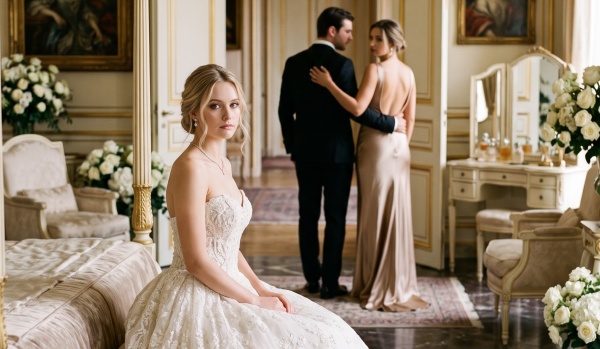
At 10:16 p.m., my husband left our wedding suite to spend our wedding night with the woman he claimed was “just a friend.” Six hours earlier, he had promised me forever in front of five hundred guests, but suddenly, another woman’s tears mattered more than his new wife. When I asked if he loved her, he didn’t deny it—and that silence destroyed everything I thought I had just married.
Part 1 — The Bride He Left Behind
My husband left our wedding suite at 10:16 p.m. to spend our wedding night with the woman he claimed was “just a friend.”
Six hours earlier, Mark had stood beside me beneath thousands of white roses and promised, in front of five hundred guests, that I was the woman he wanted for the rest of his life. He had looked into my eyes with tears shining in his own, his voice shaking just enough to make half the ballroom dab their faces with linen napkins. My mother had squeezed my father’s hand, my bridesmaids had smiled through mascara, and I had believed every word.
Now I was sitting on the edge of our bed at the Grand Whitmore Hotel in downtown Chicago, still wearing my ivory wedding gown. The dress was heavy with beading, the kind of dress I had saved pictures of for years before I could afford it. My veil lay across the carpet like a fallen cloud, and my bouquet of white peonies was already wilting on the nightstand.
Mark’s phone was on the dresser, glowing in the dim light.
Lauren.
Her name appeared once, then disappeared. Then it appeared again. Then again.
I stared at it like a person watching smoke curl under a locked door, knowing fire was on the other side. For three years, Lauren had existed in the margins of my relationship with Mark: a text during dinner, a call during vacations, a crisis whenever we celebrated something that did not include her. She was always “going through a lot,” always “fragile,” always “someone who had no one else.”
And I was always expected to understand.
Mark stepped out of the bathroom wearing his tuxedo pants and an unbuttoned white shirt. His hair was damp from the shower, and he smelled like the cedar soap I had packed for our honeymoon. For one small, foolish second, I thought he would see me sitting there in my wedding dress, realize how absurd it was that another woman was calling on our wedding night, and turn the phone off.
Instead, he picked it up.
He read whatever she had sent him. His expression changed, not dramatically, but enough. The softness left his face, replaced by that alert, guilty focus I had come to recognize whenever Lauren pulled him back into her orbit.
“Is everything okay?” I asked.
He didn’t answer right away.
That silence was the first real answer.
“Mark,” I said. “It’s our wedding night.”
“I know,” he said, still looking at the phone.
The room felt suddenly colder. Outside the tall windows, Chicago glittered in the late-summer dark. Horns sounded faintly from Michigan Avenue, and somewhere below us people were laughing as if the world still made sense.
Mark began searching for his cuff links on the dresser.
“What are you doing?” I asked.
“She needs me,” he said.
The sentence was so familiar that for a moment I almost reacted the way I always had. I almost asked what happened. I almost softened my voice. I almost stepped into the role he had trained me to play: patient, reasonable, generous, never threatened, never selfish.
But I was still wearing my wedding dress.
“She needs you tonight?” I asked.
He sighed, irritated, as if I had asked whether gravity was necessary. “She’s having a panic attack. She’s alone at her apartment.”
“She has friends.”
“No, she doesn’t.”
“She has a therapist.”
“It’s Saturday night, Amelia.”
“She has 911 if it’s an emergency.”
He turned sharply then. “That’s cold.”
There it was. The word he used whenever I refused to organize my life around Lauren’s pain. Cold. Unkind. Jealous. Insecure. He never said those words loudly, never in a way that made him look cruel. He said them with disappointment, which somehow hurt more.
I stood up carefully, gathering the front of my dress so I would not trip. “You promised me tonight.”
“I married you today,” he said, as if that should have been enough. “Don’t turn one phone call into something ugly.”
“One phone call?” I repeated.
He looked away.
Because we both knew it had never been one phone call.
For three years, Lauren had been there every time Mark and I reached for happiness. When we moved into our first apartment together in Lincoln Park, she called crying because her landlord was selling her building. When Mark proposed to me on Navy Pier, she texted him a photo of an old birthday card he had given her, saying she missed when life was simpler. When we announced our engagement, she posted a vague quote online about being replaced.
And Mark always went running.
At first, I thought he was kind. That was one of the reasons I fell in love with him. He remembered people’s coffee orders, helped elderly neighbors carry groceries, and tipped waiters twenty-five percent even when service was slow. He was the sort of man who noticed when someone was uncomfortable at a party and gently pulled them into conversation.
But kindness without boundaries becomes a doorway anyone can walk through.
Lauren had moved in and decorated the place.
“Don’t go,” I said.
His jaw tightened. “I’ll be back in an hour.”
“You said that on my birthday.”
“That was different.”
“You said that when my dad was in the hospital.”
His face flickered with shame, but not enough. “That’s not fair.”
“No,” I said, my voice trembling. “What’s not fair is being a bride begging her husband not to leave their wedding suite for another woman.”
He grabbed his jacket from the chair.
Something inside me shifted.
For years, I had avoided the question because I was afraid of the answer. I told myself that if I never asked it plainly, he would never have to lie plainly. But maybe a marriage that needed silence to survive had already failed before it began.
“Do you love her?” I asked.
Mark stopped near the door.
The entire room seemed to hold its breath.
He did not laugh. He did not look offended. He did not say, “Of course not, Amelia, I love you.” He did not even seem surprised that I had finally asked.
He closed his eyes.
And that was how he stopped pretending.
“I don’t know how to explain it,” he said quietly.
My hands went cold.
“Try.”
He turned back toward me, and the man who had said vows under white roses looked suddenly like a stranger wearing his face. “Lauren and I have history.”
“So do we.”
“It’s different.”
“Different how?”
“She knows parts of me that nobody else does.”
I almost smiled because the pain was so sharp it felt unreal. “You mean parts you never gave me?”
He didn’t answer.
There are moments in life when you do not scream because your body understands screaming would waste air. I looked at my husband, at the gold ring on his finger, at the jacket in his hand, and felt something ancient and humiliating move through me. I had not been chosen. I had been selected for the part of wife while another woman remained the wound he preferred to keep touching.
“Did you marry me because you loved me,” I asked, “or because I was the woman who made your life look normal?”
His face crumpled. “That’s not fair.”
“You keep saying that.”
“I love you, Amelia.”
“But do you love her?”
He stared at the floor.
The city moved beyond the glass. Somewhere in the hotel, music still played from the reception cleanup. Our wedding cake, four tiers of almond buttercream and raspberry filling, was probably being boxed into slices for guests to take home.
Finally, Mark whispered, “Part of me never stopped.”
I sat back down because my knees failed.
He looked terrified then, but not terrified enough to stay.
“I’m sorry,” he said. “I have to make sure she’s okay.”
He opened the door.
“Mark,” I said.
He paused.
“If you walk out tonight, don’t come back expecting to find your wife waiting.”
His eyes filled with tears. For one second, I thought he understood. For one second, I thought love might finally become stronger than guilt.
Then his phone buzzed again.
He left.
The door clicked shut behind him with a softness I would hate for the rest of my life.
Part 2 — The Woman in Every Room
I met Lauren two months after I started dating Mark.
It was at a rooftop bar in River North during one of those Chicago evenings when the air feels expensive and everyone pretends not to be impressed by the skyline. Mark introduced her as an old friend from college, and she hugged him for three seconds too long. When she turned to me, she smiled with her mouth but not her eyes.
“So you’re Amelia,” she said.
I remember the way she said my name, as if she had been given a replacement part she had not approved. She was beautiful in a delicate, unfinished way, with pale blond hair, wide gray eyes, and a voice that made every sentence sound wounded. She wore a cream sweater that kept slipping off one shoulder and laughed only when Mark looked at her.
They had gone to Northwestern together. They had never dated, Mark told me later. They had simply been “very close” during a difficult time in his life, which sounded adult and harmless until I learned that every difficult time in Mark’s life somehow led back to Lauren.
His mother died during his junior year of college. Lauren was the one who sat with him outside the chapel afterward. When he failed his first business finance exam, Lauren stayed up all night helping him study. When his first startup collapsed, Lauren brought him groceries and slept on his couch for a week because he was “too depressed to be alone.”
“She was there before anyone else,” he said once.
I tried to respect that.
I really did.
I knew people came into relationships with pasts. I had my own. Before Mark, I had loved a man named Daniel who taught me how to order wine and then taught me how quietly a person could disappear from your life. I knew it was immature to expect a partner to arrive untouched by history.
But Lauren was not history.
History stays in photographs.
Lauren called during dinner.
She texted during movies.
She sent Mark long voice messages at midnight and then apologized for “being too much,” which always made him reassure her that she wasn’t. She forgot her wallet when they met for coffee. She asked him to review her résumé, pick up her prescription, help assemble a bookshelf, drive her to O’Hare, fix her Wi-Fi, talk her down, talk her through, talk her into sleep.
When I complained, Mark said, “You knew she was important to me.”
I had known she existed. That was not the same thing.
The first time I nearly left him was at Thanksgiving.
We had been dating for a year, and he was supposed to come with me to my parents’ house in Naperville. My mother had ordered a fresh turkey from a butcher because she wanted everything perfect. My father had cleaned the garage, which in his love language meant he approved of Mark.
Mark showed up an hour late.
He apologized, kissed my cheek, and said traffic had been bad. But during dessert, I saw a text pop up on his Apple Watch.
Thank you for not leaving me alone today. I couldn’t have handled it without you.
Lauren.
I waited until we were driving home on I-88, the city lights ahead of us and my untouched pumpkin pie wrapped in foil on my lap.
“You were with her,” I said.
His fingers tightened on the steering wheel. “She had nowhere to go.”
“She knew you had plans with my family.”
“She was crying, Amelia.”
“So was my mother when she thought you didn’t care enough to show up.”
“That’s not the same.”
“Why not?”
“Because your family is stable.”
The word stable became a cage.
Stable meant I could be disappointed and recover. Stable meant I could be hurt quietly. Stable meant I had parents, a job, savings, friends, and therefore fewer rights to need. Lauren’s brokenness made her urgent. My steadiness made me optional.
I broke up with him that night.
For eleven days, I did not answer his calls. On the twelfth, he came to my apartment with flowers, swollen eyes, and a letter written on yellow legal paper. He said he had been unfair. He said he had confused responsibility with friendship. He said he loved me and wanted a future with me, not Lauren.
I wanted to believe him so badly that I mistook wanting for wisdom.
We got back together.
For a while, things improved. Mark set what he called “boundaries,” though looking back they were more like curtains than walls. He stopped taking Lauren’s calls after 10 p.m. He stopped seeing her alone at her apartment. He told her I was uncomfortable, which made me furious because it made the boundary sound like my insecurity instead of his obligation.
Lauren responded exactly as I feared she would.
She posted photos from college: her and Mark at football games, her and Mark wearing ugly Christmas sweaters, her and Mark asleep on opposite ends of the same couch. She captioned one, Some people are home even when life takes them far away. Mark said I was reading too much into it.
I asked him to block her.
He said that was extreme.
I asked him to stop being her emergency contact.
He said she had no one else.
I asked him whether he understood how humiliating it was to keep competing with a woman he insisted I should not worry about.
He said, “You’re not competing.”
But I was.
The competition was just rigged because Lauren got to be fragile, and I had to be fair.
When Mark proposed, I thought it meant I had won.
He did it on a cold December night at the Lincoln Park ZooLights, under a tunnel of golden bulbs. My hands were freezing, my nose was red, and I was laughing because he had spilled hot chocolate on his coat. Then he dropped to one knee, pulled out a velvet box, and asked me to marry him.
People cheered. A little girl shouted, “Say yes!” And I did.
For three days, I lived in a bubble of joy so complete I felt weightless.
Then Lauren sent him a message.
I always knew you’d choose someone like her. Someone easy.
I saw it by accident while he was showing me a photo on his phone. Mark snatched the phone away so quickly he might as well have confessed to a crime.
“What does that mean?” I asked.
“She’s upset.”
“I’m sure she is.”
“She always thought…” He stopped.
“She always thought what?”
He rubbed both hands over his face. “That maybe someday, if things were different…”
I stared at him.
“If things were different, what?”
He said nothing.
I should have handed the ring back right then. I know that now. But engagement has a way of turning red flags into decorations. Once families are excited, deposits are paid, and your mother cries over venue brochures, doubt starts to feel like betrayal.
So I planned a wedding.
A big one.
Too big, honestly. Five hundred guests because Mark’s father was a retired state senator, my parents owned a successful chain of dental clinics, and both families treated the guest list like a diplomatic negotiation. We booked the Crystal Garden Ballroom, hired a string quartet, and ordered white roses from three florists because my mother said one florist could not be trusted with abundance.
Lauren was not invited.
That was my one firm line.
Mark argued, gently at first, then angrily. He said excluding her would be cruel. I said inviting her would be cruel to me. He said she had been part of his life for twelve years. I said I was supposed to be part of the rest of it.
Finally, he agreed.
Or I thought he did.
On the morning of the wedding, while my bridesmaids sipped mimosas and the photographer arranged my shoes beside the rings, I received a small white envelope at the bridal suite. There was no return address. Inside was a note written in slanted handwriting.
He is marrying you because you make sense. That is not the same as being loved.
I knew immediately.
Lauren.
My maid of honor, Rachel, wanted to show Mark. My mother wanted hotel security to check the cameras. My father wanted a last name and five minutes. I told everyone to stop.
Because I was getting married in two hours, and a bride can only survive so much truth before the ceremony.
I folded the note and tucked it into the pocket sewn inside my gown.
Yes, my dress had pockets.
I had been delighted about that during fittings. Now one pocket held lipstick, and the other held a warning from the woman my fiancé claimed I had no reason to fear.
When the music started, I walked down the aisle anyway.
Mark cried when he saw me.
That was the cruelest part.
His tears looked real. His hands trembled when he took mine. His vows were not generic; he mentioned my laugh, my stubbornness, the night we ate gas station donuts during a snowstorm because every restaurant was closed. He said I was his peace.
Five hundred people heard him say it.
I heard it too.
And because love can make a fool out of even an intelligent woman, I believed him for six more hours.
Part 3 — 10:16 P.M.
After Mark left the wedding suite, I did not move for several minutes.
The room was silent except for the low hum of the air conditioner and the distant pulse of traffic below. His champagne glass still sat on the table, half full, a faint mark from his mouth on the rim. Mine was untouched because I had been too busy watching my husband choose another woman in real time.
At 10:23 p.m., Rachel called.
I let it ring.
At 10:29, my mother texted: Everything okay, sweetheart? The planner says you two disappeared fast. Good for you. Love you.
I stared at the message until the words blurred.
Good for you.
If I had been a different woman, maybe I would have changed clothes, removed my makeup, and waited for Mark to return with some explanation I could pretend to accept. Maybe I would have let him touch my shoulder and say Lauren was “in a dangerous headspace.” Maybe I would have slept beside him because the wedding was paid for and the marriage certificate was signed.
But something about the dress made waiting impossible.
It was not just a dress. It was evidence. Every bead, every button, every inch of lace testified to the life I thought I had entered that day. Sitting in it while my husband comforted another woman felt like being forced to play a role after the theater had burned down.
I stood up.
The train dragged behind me as I crossed to the dresser and picked up Mark’s cuff link. He had left one behind, silver with his initials engraved on it. I held it in my palm, thinking of all the tiny things I had mistaken for intimacy: his toothbrush beside mine, his coffee order, the way he always slept on the side closest to the door.
Then I walked to the mirror.
My makeup was still perfect.
That offended me.
I looked like a bride from a magazine, all soft curls and glowing skin, while inside I felt something tearing loose from bone. I reached behind my neck and tried to unfasten the first buttons of my dress, but my fingers shook too badly. After three failed attempts, I grabbed the hotel phone and called Rachel.
She answered immediately. “Amelia?”
“I need you,” I said.
Her voice changed. “What happened?”
“Mark left.”
There was a pause.
“What do you mean he left?”
“For Lauren.”
Rachel said a word my grandmother would have hated.
Then she said, “I’m coming upstairs.”
Within ten minutes, Rachel, my sister-in-law Jenna, and my cousin Tessa were in the suite. Rachel still wore her dusty-blue bridesmaid dress, though she had kicked off her heels somewhere downstairs. Jenna had a bottle of water in one hand and the expression of a woman ready to start a war. Tessa, who worked as a family law attorney in Milwaukee, closed the door behind her very carefully.
None of them asked whether I was sure.
Women know.
Rachel helped me out of the wedding gown while Jenna removed pins from my hair. Tessa gathered Mark’s things from the room and placed them in a neat pile by the door. The practical tenderness of it nearly destroyed me.
When the dress finally fell away, I stepped out of it and stood there in my slip, shivering.
Rachel wrapped me in the hotel robe. “Do you want to call him?”
“No.”
“Do you want me to call him?”
“No.”
“Do you want Jenna to call him and emotionally ruin his life?”
Jenna lifted her hand. “I volunteer.”
For the first time that night, I almost laughed. It came out wrong, half sob, half breath.
At 11:04 p.m., Mark texted me.
I’m with Lauren. She’s okay now, but I need a little more time. Please don’t make this bigger than it is.
Jenna read it over my shoulder and looked like she might bite the phone in half.
“Don’t respond,” Tessa said.
“I wasn’t going to.”
But I did take a screenshot.
Then I took screenshots of the missed calls from Lauren on his phone before he left. Screenshots of old messages I had ignored. Screenshots of the note Lauren sent to the bridal suite. Not because I was already thinking divorce, exactly. Because some instinct deeper than heartbreak told me to preserve reality before anyone tried to rewrite it.
At 11:30, my parents came upstairs.
My mother entered first, still wearing her silver mother-of-the-bride gown. My father followed behind her, his bow tie loosened, his face pale in a way I had never seen before. Parents can tell when their child has been hurt before they know the details.
“Where is Mark?” my father asked.
“With Lauren,” I said.
My mother sat down beside me on the bed. She did not gasp or demand clarification. She simply took my hand between both of hers and held it like I was five years old again and had fallen off my bike.
My father turned toward the window.
He stood there for a long moment, looking out at the city.
Then he said, very quietly, “I paid for the roses.”
It was such a strange thing to say that I stared at him.
He turned back, and his eyes were wet. “I paid for the roses because he told me you deserved to feel like the most important woman in the world today.”
That broke me.
Not Mark leaving. Not Lauren calling. Not the ruined wedding night.
My father remembering the roses.
I cried then, hard and ugly, with my mother’s arms around me and Rachel sitting on the floor at my feet. I cried for the woman who ignored the note in her pocket. I cried for the girl who thought being chosen at the altar meant being chosen everywhere else. I cried because humiliation has a taste, metallic and hot, and I could not get it out of my mouth.
At 12:42 a.m., Mark returned.
He used his key card, but the security latch stopped the door from opening all the way. Through the gap, I saw his face. He looked exhausted, annoyed, and startled to find my father standing on the other side.
“Mr. Whitaker,” Mark said.
My father did not move. “This is not a good time.”
“I need to talk to my wife.”
My father’s voice stayed calm. “Your wife needed you two hours ago.”
Mark looked past him, trying to see me. “Amelia, please.”
I stood from the bed.
Everyone turned toward me.
I walked to the door in the hotel robe, barefoot, face washed clean, hair falling in uneven waves around my shoulders. I looked at the man I had married that afternoon. He looked smaller in the hallway than he had under the roses.
“Did you sleep with her?” I asked.
The question shocked the room.
Mark recoiled. “No.”
“Did you want to?”
His mouth opened, then closed.
That was answer enough.
“I went because she was falling apart,” he said. “I couldn’t just ignore her.”
“But you could ignore me.”
“That’s not what happened.”
“That is exactly what happened.”
His eyes darted toward my father, then my mother, then Rachel. “Can we not do this in front of everyone?”
I almost smiled. He was worried about embarrassment now.
“You left our wedding suite on our wedding night for another woman,” I said. “Everyone is already in it.”
His face reddened. “You’re making this sound worse than it is.”
Tessa stepped forward, but I lifted a hand.
“No,” I said. “Let him talk.”
Mark looked relieved, mistaking my calm for an opening.
“Lauren was in bad shape,” he said. “She said she didn’t know if she could get through the night. I know the timing was terrible, but she needed someone. I was going to come right back.”
“You told me part of you never stopped loving her.”
Silence.
My father’s face changed.
My mother closed her eyes.
Mark whispered, “I was overwhelmed.”
“People say the truth when they’re overwhelmed.”
He gripped the doorframe. “I love you, Amelia.”
“I know,” I said. “But you love me like a house you want to live in, and you love her like a fire you keep running back into.”
He stared at me.
For once, he had no practiced response.
I took off my wedding ring. It resisted for a second because my fingers were swollen from the long day. When it finally slipped free, I held it in my palm and looked at it under the hallway light.
Then I placed it in my father’s hand.
Mark made a sound like I had struck him.
“Amelia, don’t do this.”
“You did this at 10:16.”
I stepped back.
My father closed the door.
The security latch clicked softly, and Mark’s voice came through the wood.
“Amelia. Please. Open the door.”
I turned away.
For the second time that night, a door closed between us.
This time, I was the one who chose it.
Part 4 — The Morning After Forever
By morning, half the wedding guests knew something had happened.
That is the problem with large weddings. Five hundred people can clap politely during vows, but five hundred people cannot keep a scandal from breathing. Someone had seen Mark leave. Someone had seen Lauren waiting outside in a black dress near the valet stand. Someone had watched him get into a rideshare with her while I was still upstairs in my gown.
The story spread through the hotel over continental breakfast.
By 8 a.m., my phone had seventy-three unread messages.
Some were kind. Some were curious pretending to be kind. A few were from Mark’s relatives, urging me not to “overreact” before hearing the full story. His aunt Denise wrote, Marriage is about forgiveness, dear. Don’t let one emotional night ruin your future.
I stared at that message while eating dry toast in bed.
One emotional night.
People love minimizing a wound when they are not the ones bleeding.
Mark texted constantly.
Please answer.
I made a terrible mistake.
Nothing happened physically.
Lauren manipulated the situation.
I was confused.
I chose wrong, but I can fix it.
At 9:12 a.m., Lauren messaged me on Instagram.
I had never followed her, but her profile photo was impossible to mistake. She had sent a paragraph that began with Woman to woman and ended with I never meant to hurt you. Between those two lies, she explained that Mark had come because she was “in crisis,” that their bond was “complicated,” and that she hoped I would not punish him for having a good heart.
I read it twice.
Then I blocked her.
At 10 a.m., I met Mark in a small conference room on the hotel’s second floor. Not alone. Tessa came with me, carrying a yellow legal pad because lawyers apparently find comfort in office supplies. My father waited outside the door, which was his compromise after my mother convinced him not to come in.
Mark looked like he had not slept.
His tuxedo shirt was wrinkled, his hair messy, and his eyes red. He stood when I entered, but I did not sit near him. The conference room smelled like coffee, carpet cleaner, and dying flowers from someone’s corporate event the day before.
“Thank you for meeting me,” he said.
“I’m here because I need clarity.”
He nodded quickly. “Of course.”
“Did Lauren know where we were staying?”
He hesitated.
“Mark.”
“Yes.”
“Did you tell her?”
“She asked.”
That answer was so absurd I almost laughed. “She asked where we were spending our wedding night, and you told her?”
“I didn’t think she would come.”
“She came to the hotel?”
He looked down.
Tessa wrote something on her legal pad.
I gripped the edge of the table. “Was she here before or after the ceremony?”
“Amelia—”
“Before or after?”
“Before.”
The room tilted.
“She came before the ceremony?”
“She said she needed closure.”
I could hear my heartbeat.
“And you saw her?”
His silence answered.
“When?”
He rubbed his forehead. “Before the photos. For ten minutes.”
I remembered that window of time. The photographer had been looking for him. His best man said Mark was taking a call from his father. I had been upstairs having lipstick reapplied, unaware that my fiancé was meeting another woman somewhere inside the same hotel where I was about to marry him.
“What happened during those ten minutes?”
“Nothing.”
“Do not insult me with that word.”
He looked up, wounded. “We talked.”
“About?”
“She was upset.”
“About?”
“Me getting married.”
I leaned back in my chair.
There it was.
Not hidden under panic attacks. Not dressed up as friendship. Not disguised as fragility. Lauren was upset that Mark was marrying me, and Mark had made time for her grief on the day he promised me his life.
“Did you tell her you loved her?”
His face changed.
Tessa stopped writing.
Mark whispered, “She said it first.”
I closed my eyes.
“That is not what I asked.”
He began crying then. Quietly, helplessly, like a boy caught breaking something valuable. “I told her I loved her, but not like that.”
I opened my eyes. “There is no version of that sentence that belongs on a wedding day.”
“I know.”
“You don’t know. If you knew, we wouldn’t be here.”
He reached across the table, but I moved my hands into my lap.
“I was scared,” he said. “Everything was becoming real. The wedding, forever, all of it. Lauren represents this part of my life before expectations and families and money and appearances. With you, everything mattered. With her, I could fall apart.”
I stared at him.
For three years, I had been told Lauren was the fragile one. But now I finally understood the uglier truth. Mark needed her fragility because it gave him permission to be weak. He could be messy with Lauren, heroic with Lauren, unfinished with Lauren. With me, he had to become the man he claimed he wanted to be.
And he resented me for believing him.
“So I was the future,” I said, “and she was the escape.”
He covered his face.
“That’s not love, Mark. That’s cowardice.”
He flinched.
Tessa’s pen moved across the paper.
I stood up.
Mark stood too. “What happens now?”
“Annulment, if possible. Divorce if not.”
His face went white. “Amelia, we’ve been married less than twenty-four hours.”
“And you were faithful for less than twelve.”
“I didn’t sleep with her.”
“You left me for her.”
“That’s not the same.”
“It is to me.”
He looked genuinely stunned, as if the absence of a physical affair should have earned him a discount on betrayal. Maybe in some courtrooms it would. Maybe in some families it would. But not in the room where I was deciding the rest of my life.
“I can change,” he said.
“I hope you do.”
“Then why won’t you give me a chance?”
I looked at him for a long moment.
“Because you had three years of chances. You had Thanksgiving. You had my birthday. You had my father’s hospital stay. You had our engagement. You had yesterday morning. You had the ten minutes before the photos. You had the moment in our suite when I asked you not to go.”
His eyes filled again.
“You did not lack chances,” I said. “You lacked consequences.”
I left the room before he could answer.
The next few weeks were a strange kind of public mourning.
There were thank-you cards to write for wedding gifts I could not look at. There were vendors to settle with, honeymoon reservations to cancel, relatives to inform. My mother offered to handle everything, but I needed to do some of it myself because each cancellation felt like cutting a rope.
We had planned to fly to Maui first class, stay at a resort in Wailea, and spend ten days pretending we were people with no past. Instead, I stayed in my townhouse in Oak Park with Rachel sleeping on my couch for the first week because she did not trust me to be alone with my thoughts. She ordered Thai food, took my phone away after 9 p.m., and made lists titled Things We Are Not Doing, which included texting Mark, stalking Lauren, and cutting bangs.
Mark tried everything.
He sent flowers. I donated them to a nursing home. He left letters at my door. Rachel collected them in a shoebox labeled Evidence or Kindling. He sent my parents a long email apologizing and asking for their help, which my father printed, highlighted in angry yellow, and then refused to discuss.
Lauren posted vague things online.
Quotes about soul ties. Songs about impossible love. A photo of a coffee cup beside a man’s hand that may or may not have been Mark’s. I learned this against my will because someone always thinks a betrayed woman needs updates, when really she needs silence.
After the third screenshot from a “concerned” cousin, I posted one message on my own page.
I’m aware people are curious. I’m safe, supported, and asking for privacy. Please do not send me updates about anyone else. Thank you.
It was polite, restrained, and mature.
Then I threw my phone onto the couch and screamed into a pillow for forty seconds.
Healing did not make me elegant.
It made me honest.
The annulment was not simple. Illinois law, as Tessa patiently explained, did not erase marriages just because the groom behaved like a fool before midnight. There had to be legal grounds, and emotional betrayal was not always enough. So we filed for divorce.
Mark contested nothing.
That should have made me feel better. Instead, it made me sad. He signed papers quickly, paid what he owed, and agreed that I would keep the townhouse because it had been mine before marriage. He behaved decently in the aftermath, which complicated the anger.
That is one of the unfair things about betrayal.
The person who wounds you may not continue acting like a villain. They may become apologetic, respectful, even broken. And then you must grieve not only what they did, but the fact that part of them really does know better.
Two months after the wedding, Mark asked to meet one last time.
I almost said no.
Then I said yes because I wanted to see whether my body still mistook him for home.
We met at a park near Lake Michigan. It was October by then, and the wind had teeth. Mark wore a navy coat I had helped him pick out the year before. I wore sunglasses even though the sky was gray.
He looked thinner.
“Thank you for coming,” he said.
I nodded.
“I’m in therapy,” he said.
“Good.”
“I haven’t seen Lauren.”
I said nothing.
“She called a lot at first. Then she got angry. Then she said if I loved her, I wouldn’t abandon her too.”
I looked at the lake.
“And?”
“And I realized I had taught her that love meant access.”
That sentence stayed in the air between us.
It was the kind of insight I had begged him to have when it could have saved us.
“I’m sorry,” he said. “For all of it. Not just the wedding night. For making you feel like you had to audition for the role you already had.”
My throat tightened.
I hated that he finally had the words.
“I loved you,” I said.
His eyes filled. “I know.”
“No,” I said. “I don’t think you did. Not fully. You loved being loved by me. You loved the life I offered. But loving someone means protecting the place they hold in your life. You kept giving mine away.”
He cried openly then, and I let him.
Not because I wanted revenge.
Because his tears were no longer my assignment.
When we said goodbye, he asked if he could hug me. I thought about it for a moment, then shook my head.
“No,” I said. “I’m still learning not to comfort people who hurt me.”
He nodded.
I walked back to my car alone.
The wind off the lake was brutal, but for the first time in months, I could breathe all the way in.
Part 5 — The Woman I Became After the Suite
A year later, the wedding dress still hung in my closet.
Not because I was sentimental. Not because I hoped to wear it again. I kept it because for a while I did not know what else to do with the physical proof of a day that had split my life in two.
My mother wanted me to sell it.
Rachel wanted me to burn it in a controlled and legally responsible environment.
Tessa suggested donating it to a charity that turned wedding gowns into burial outfits for infants, then immediately apologized when she saw my face. “Too dark?” she asked.
“A little,” I said.
In the end, I donated it to a theater program at a public high school on the South Side.
The drama teacher wrote me a thank-you email saying the students had never seen a gown like that up close. They planned to use it in their spring production, altering it carefully so it could survive multiple performances. Something about that comforted me.
The dress deserved a better story.
So did I.
By then, the divorce was final. Legally, my marriage had lasted 141 days. Emotionally, it had ended before the ink dried on the certificate. People sometimes asked whether I felt embarrassed by that number, as if a short marriage were a failed business venture.
I used to explain.
Now I simply said, “I left when I understood.”
That answer was enough for people who respected me and too much for people who didn’t.
Mark moved to Denver about six months after the divorce. I heard it from his sister Jenna, who called to tell me before someone else did. She said he was working remotely, hiking a lot, still in therapy. She also said Lauren was not with him.
I wished him peace.
I mean that.
Not the fake kind of peace people claim when they are secretly hoping someone gets hit by emotional lightning. Real peace. The kind where he would stop confusing chaos with intimacy and stop making women compete for versions of him he had not healed.
Lauren sent me one message after the divorce.
It came from a new account because I had blocked the others. She wrote that she was sorry, that she had been selfish, that she had believed Mark belonged to her because he had never fully told her he didn’t. She said she hoped I understood that she had been hurting too.
I deleted it.
Not because I doubted her pain.
Because I no longer needed to make room for it.
That was the lesson I paid for with my wedding night: compassion without self-respect becomes self-abandonment. You can understand why someone hurt you and still decide they no longer get access to you. You can wish them healing from a distance so far away your peace never hears their footsteps.
My life became quiet after Mark.
At first, the quiet scared me. I had grown used to the constant background noise of uncertainty: wondering who texted, why he stepped outside, whether Lauren’s crisis would interrupt dinner, whether I was being reasonable or foolish. Without that noise, my nervous system did not know what to do.
So I built new sounds.
Saturday morning farmers markets. Jazz records while I cooked. My neighbor’s dog barking at squirrels with personal conviction. Rachel laughing in my kitchen while we made pancakes shaped like countries no map would recognize.
I went back to work at the nonprofit where I managed literacy programs for low-income schools. I threw myself into grant proposals, classroom visits, and book drives. Children are wonderfully unimpressed by adult heartbreak. They care only whether you brought the good stickers and whether the library has the next book in the dragon series.
One afternoon, a third-grade girl named Marisol asked why I was not wearing my shiny ring anymore.
I froze.
Then I said, “Because I decided it didn’t belong on my hand.”
She considered this seriously, then nodded. “Sometimes stuff doesn’t belong.”
Exactly, Marisol.
Sometimes stuff doesn’t belong.
My parents recovered more slowly than I expected. My father took the betrayal personally, not because his money had been wasted, though a horrifying amount had been. He was hurt because he had trusted Mark with me. Fathers do not always have the language for that kind of grief, so he expressed it by fixing things in my townhouse that were not broken.
One Saturday, I found him replacing a perfectly functional cabinet hinge.
“Dad,” I said.
“What?”
“That hinge was fine.”
“It squeaked.”
“It did not.”
“It might have someday.”
I hugged him from behind while he pretended to inspect the screwdriver.
My mother dealt with it by becoming aggressively supportive. She joined a yoga class with me, though she hated yoga and spent most of the first session whispering that downward dog was “a lawsuit waiting to happen.” She also stopped mentioning grandchildren for the first time in ten years. That was how I knew she understood the depth of what had happened.
As for me, I went to therapy.
Not because I was broken, but because I was tired of being a mystery to myself. I wanted to understand why I had stayed after Thanksgiving, after the engagement text, after the note in my pocket. I wanted to know why I had been more afraid of seeming jealous than of being disrespected.
My therapist, Dr. Harris, had silver glasses and a talent for asking questions that ruined my week.
One day she asked, “What did being chosen mean to you?”
I gave a long answer about love, partnership, family, stability.
She waited.
Eventually, I said, “It meant I was safe.”
“And when Mark chose Lauren?”
“I felt unsafe.”
“And before the wedding night?”
I opened my mouth, then closed it.
Because the truth was, I had felt unsafe for years. I had simply called it patience because patience sounded noble. I had called it trust because trust sounded mature. I had called it understanding because understanding made me feel less powerless.
That realization hurt.
But it also freed me.
A year and a half after the wedding, Rachel convinced me to go to a charity gala at the Art Institute. I wore a black dress, red lipstick, and no emotional expectations. The room was full of donors, educators, city officials, and people pretending tiny appetizers were dinner.
That was where I met Noah.
He was a pediatric nurse from Evanston who volunteered with a children’s health literacy program. He had kind eyes, a crooked smile, and the calm energy of someone who did not need to be the center of anything. When I spilled sparkling water on the silent auction table, he handed me napkins and said, “Don’t worry. I once dropped an entire tray of juice boxes in front of a hospital board member.”
I laughed.
Not politely.
Actually laughed.
We talked for twenty minutes about children’s books, Chicago winters, and whether deep-dish pizza counted as pizza or a casserole with ambition. He asked for my number at the end of the night. I gave it to him after a pause long enough that he smiled and said, “No pressure. I’m very respectful of pauses.”
That made me like him more.
Dating after betrayal is strange. You are not only getting to know someone else; you are getting to know the person you became after surviving. I moved slowly. Very slowly. Noah never complained.
On our fourth date, my phone buzzed during dinner, and I flinched.
He noticed.
“You okay?” he asked.
I nodded too quickly.
He put his fork down. “We don’t have to talk about it, but I saw that.”
So I told him.
Not everything, but enough. The wedding suite. Lauren’s name on the phone. Mark leaving. The question I asked. The answer he couldn’t hide.
Noah listened without interrupting.
When I finished, he did not say Mark was an idiot, though I would not have objected. He did not say he would never hurt me, which would have sounded like a promise no human can guarantee. He simply said, “That must have made you feel incredibly alone.”
I cried in the restaurant.
Not dramatically. Just enough that the waiter brought extra napkins and pretended not to notice.
Noah did not reach across the table without asking. He said, “Can I hold your hand?” And somehow that question, so small and respectful, healed a place in me that grand vows had not protected.
We dated for a year before I introduced him to my parents.
My father stared at him for the first ten minutes like a border agent. Noah survived by complimenting his lawn and asking sincere questions about dental equipment, which was apparently the key to my father’s guarded heart. My mother liked him because he helped clear plates without making a performance out of it.
After dinner, my father pulled me aside.
“He seems steady,” he said.
I smiled. “He is.”
“You seem steady with him.”
That mattered more.
I did not marry Noah quickly.
In fact, when he proposed three years after my divorce, it was in my kitchen on a rainy Tuesday, with soup boiling over on the stove and my hair in the least romantic bun known to humanity. He did not hire a photographer. He did not hide the ring in dessert. He did not ask in front of five hundred people.
He turned off the burner, took my hands, and said, “I love the life we have. I’d be honored to keep building it with you, but only if marriage feels peaceful to you, not pressured.”
I cried before he opened the box.
The ring was simple: an oval sapphire with small diamonds on each side. It looked nothing like the ring Mark had given me. That helped.
I said yes.
We had a small wedding in my parents’ backyard with forty-two guests, folding chairs, string lights, and barbecue from a place in Oak Park that served brisket so good my father briefly forgot to be emotional. I wore a cream silk dress with no train and no pockets. Not because I hated pockets, but because I refused to carry warnings into another ceremony.
Before walking down the aisle, I stood alone in my childhood bedroom and looked at myself in the mirror.
I thought about the Grand Whitmore Hotel. The ivory gown. The phone glowing with Lauren’s name. The door closing at 10:16 p.m.
For a long time, I believed that was the night I was humiliated.
Now I understand it was the night I was released.
If Mark had stayed, he might have continued dividing his heart in ways I could not prove but always felt. I might have spent years shrinking my needs to fit beside Lauren’s emergencies. I might have mistaken marriage for endurance and called my loneliness commitment.
Instead, he left.
And because he left so publicly, so unmistakably, so cruelly, I could no longer negotiate with the truth.
The truth saved me.
When my father knocked and asked if I was ready, I smiled.
“Yes,” I said. “I am.”
This time, when I walked toward my future, there were no white roses imported from three florists. No ballroom full of political acquaintances and distant cousins. No performance large enough to hide what was missing.
There was just a backyard, the smell of summer grass, my mother crying into a tissue, Rachel giving me a thumbs-up, and Noah waiting under an old maple tree.
He cried when he saw me.
I believed those tears, but I no longer needed them as proof.
That was the difference.
Years ago, I thought being loved meant someone choosing me in front of a crowd. Now I know it means being chosen in the quiet moments no one applauds. It means the phone stays face down during dinner. It means your pain is not ranked beneath someone else’s drama. It means you do not have to become smaller to make room for a ghost.
Sometimes people ask if I regret marrying Mark.
I regret ignoring myself.
I regret the Thanksgiving excuse, the engagement message, the note in my pocket, and every time I swallowed discomfort to appear secure. I regret mistaking a man’s guilt for kindness and another woman’s dependence for harmlessness. But I do not regret leaving.
Because the woman Mark abandoned in that wedding suite became the woman who finally stopped abandoning herself.
And that woman built a life no one had to rescue her from.
