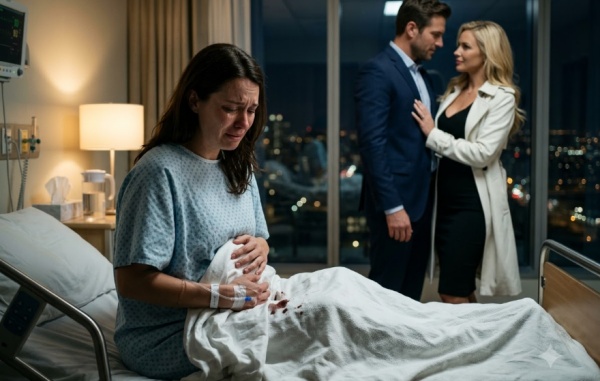
My Husband Chose His First Love While I Was Five Months Pregnant and Bleeding — So I Walked Away With Our Child and Took My Life Back…
Maya was five months pregnant when she saw blood on the bathroom floor and begged her husband to drive her to the hospital. But while their unborn daughter was being monitored for danger, Ethan stayed on the phone with Lauren, the first love he swore was only a friend. Maya drove herself to the ER that night, terrified and alone, and finally understood the truth: love is not enough when the person beside you keeps choosing someone else….
Part 1: The Blood on the Bathroom Floor
The first time I saw blood during my pregnancy, I was standing barefoot on the cold tile of our bathroom in Nashville, Tennessee, holding the sink with both hands and trying not to scream.
It was 11:42 p.m. on a Thursday in late September. I remember because the little digital clock on the bathroom counter glowed red beside a bottle of prenatal vitamins and the half-empty water glass my husband always forgot to take downstairs. I was five months pregnant, twenty-one weeks and three days, far enough along that our daughter had already begun kicking when I drank orange juice.
My name is Maya Bennett, though back then my driver’s license still said Maya Whitmore.
My husband, Ethan Whitmore, was downstairs in the living room, or at least he had been twenty minutes earlier. He was supposed to be assembling the crib that had arrived in three flat cardboard boxes from Target. Instead, he had been sitting on the couch with his phone tilted away from me, wearing the distracted expression I had started to hate more than anger.
I called his name once.
Nothing.
I looked down again at the blood.
Not a lot, but enough.
Enough to turn my knees weak.
Enough to make the world narrow to the place where my hand covered the small curve of my stomach.
“Ethan!” I shouted.
This time my voice cracked.
Footsteps crossed the hallway downstairs, then stopped. A second later, his voice floated up from below.
“What?”
“I’m bleeding.”
Silence.
Then fast footsteps.
He appeared in the bathroom doorway wearing gray sweatpants, a Vanderbilt hoodie, and an annoyance he had not fully managed to hide before fear replaced it.
“What do you mean bleeding?”
I stared at him.
“What do you think I mean?”
His eyes dropped.
He saw the tissue in my hand.
His face changed.
“Okay,” he said quickly. “Okay. Don’t panic.”
That sentence made me panic more.
Pregnant women do not enjoy being told not to panic by men whose only medical skill is Googling symptoms and choosing the least inconvenient interpretation.
“I need to call the doctor,” I said.
“Yeah. Yes. Call.”
I grabbed my phone with shaking fingers and called the after-hours number for my OB-GYN practice near Saint Thomas Midtown Hospital. A nurse called back in less than five minutes. She asked questions I answered badly because fear kept cutting through my concentration.
How much bleeding?
Any cramping?
Any pain?
Was the baby moving?
Had I had intercourse?
Any falls?
Any dizziness?
I said I did not know about movement. I had been so scared that I could not tell if the flutter beneath my hand was our daughter or my own pulse. The nurse listened, then told me to go to labor and delivery triage immediately.
“Do you have someone who can drive you?” she asked.
I looked at Ethan.
“Yes,” I said.
He was already staring at his phone.
Not scrolling.
Reading.
His face had gone pale in a way that had nothing to do with me.
After I hung up, I said, “We need to go.”
He did not answer.
“Ethan.”
He looked up.
“I know. Just give me a second.”
“A second? I’m bleeding.”
“I said I know.”
His phone buzzed again in his hand.
I saw the name before he turned the screen away.
Lauren.
For a moment, even through fear, everything in me went still.
Lauren Hale.
His first love.
His high school sweetheart from Franklin, the girl whose name had drifted through our marriage like perfume left behind in a room. The girl his mother still mentioned with a softness she never used for me. The girl who had moved back to Tennessee three months earlier after a divorce in Atlanta, suddenly single, suddenly fragile, suddenly texting my husband about “old times” and “needing a friend.”
I looked at the phone.
Then at him.
“Is she texting you right now?”
His jaw tightened.
“Maya, not now.”
“Then put the phone down.”
“She’s upset.”
I thought I had misheard him.
“She’s upset?”
He rubbed his forehead.
“Her dad is in the hospital. She’s freaking out.”
I stood there, five months pregnant, bleeding, with my hospital bag nowhere near packed because this was not supposed to happen yet.
“Your pregnant wife is bleeding,” I said slowly.
“I understand that.”
“No, you don’t.”
“I do. But she doesn’t have anyone else.”
The bathroom light seemed suddenly too bright.
I stared at the man I had married two years earlier in a garden behind a historic inn in Leiper’s Fork, the man who had cried when we saw our baby’s heartbeat, the man who promised me I would never have to wonder where I stood with him.
And there it was.
I was standing in blood and fear.
Lauren was standing in memory.
He was looking between us.
That should never have been a choice.
I walked past him into the bedroom, pulled on maternity leggings with shaking hands, grabbed a sweatshirt, and shoved my feet into sneakers.
He followed.
“Maya, I’m coming.”
“Then get your keys.”
“I just need to call her and make sure—”
I turned so fast he stopped.
“Finish that sentence carefully.”
His phone buzzed again.
He looked down.
That tiny motion ended something.
Not our marriage on paper.
Not yet.
But the version of it that still had a heartbeat in me.
I picked up my purse.
“You can drive me to the hospital,” I said. “Or you can call Lauren. But you don’t get to make me wait while you decide which woman matters more.”
He stared at me, offended.
As if I had made this ugly.
As if the ugliness had not been sitting in his palm with her name on it.
Then his phone rang.
Lauren’s name filled the screen.
He looked at it.
I waited.
He answered.
“Lauren, hey. I know. I know, breathe.”
I did not scream.
I did not throw anything.
I did not beg him to choose me.
I walked downstairs, grabbed my car keys from the bowl by the front door, and drove myself to the hospital while my husband stayed in our house comforting the woman he had loved before me.
The streets were dark and wet from an earlier storm. Nashville glowed in blurred gold lines through my windshield. Every bump in the road made my hand fly to my stomach.
“Stay with me,” I whispered to my daughter.
I said it again at every red light.
Stay with me.
Stay with me.
Stay with me.
At 12:21 a.m., I pulled into the hospital parking garage. A security guard saw me struggling near the elevator and helped me to the entrance. A nurse took one look at my face, put me in a wheelchair, and asked, “Are you alone?”
I opened my mouth.
For a second, I almost said no.
Because technically I had a husband.
But the word would not come.
“Yes,” I said.
“I’m alone.”
That was the first honest sentence I had spoken all night.
Part 2: The Ghost Named Lauren
Ethan had told me about Lauren on our third date.
We were eating hot chicken at a restaurant in East Nashville, sitting outside under string lights, laughing because I had dramatically underestimated the spice level and was crying into a stack of napkins. He handed me his sweet tea and said, “If it helps, my first girlfriend once dared me to eat a whole habanero at a county fair, and I threw up behind a funnel cake stand.”
I laughed.
“What was her name?”
He hesitated just half a beat.
“Lauren.”
It was a normal answer.
Everyone has a past.
I had a past too. A college boyfriend who wore beanies indoors and quoted bad poetry. A short-lived dating app phase. One decent man in Chicago I might have loved if we had not wanted completely different lives.
So I did not fear Lauren then.
Ethan said they dated all through high school and the first year of college. She went to the University of Georgia, he went to Belmont University, and long distance turned them into people who called each other crying more than laughing. She married someone else at twenty-six. He claimed he had been happy for her.
“She was my first love,” he said. “But first love doesn’t mean best love.”
I believed him because I wanted to.
That is how many women get hurt.
Not because we are foolish.
Because trust is required for intimacy, and distrust is exhausting.
Ethan and I met when I was thirty-one and working as a project manager for a healthcare nonprofit. He was thirty-three, a civil engineer, quiet in groups but funny when he felt safe. We met through mutual friends at a backyard cookout in 12 South, where he spent twenty minutes helping the host fix a wobbly patio table before introducing himself to me.
He was steady.
That was the word everyone used.
Ethan is steady.
Ethan is dependable.
Ethan is the kind of man who shows up.
After dating men who treated basic communication like emotional labor, steady felt like luxury.
He called when he said he would.
He remembered my allergy to shellfish.
He carried groceries without making a performance of it.
When my father had a minor stroke in Knoxville, Ethan drove me three hours east at midnight and sat with my mother in the waiting room while I handled forms.
My mother loved him after that.
So did I.
We married after eighteen months. Not because I was desperate, not because thirty-three felt like a deadline, but because life with him felt calm in a way I had stopped believing was possible. Our wedding was small, eighty people, wildflowers, bluegrass music, bourbon pecan pie instead of cake because Ethan hated frosting.
His mother, Diane Whitmore, cried during the ceremony.
Later, during photos, she squeezed my hands and said, “I’m so glad Ethan found someone after Lauren.”
After Lauren.
Not found you.
Not found happiness.
Found someone after Lauren.
I laughed it off because newlywed joy is an excellent anesthetic.
But the words stayed.
Lauren remained mostly theoretical for the first year.
A name in stories.
A girl in old photos tucked inside family albums at Diane’s house.
A memory people handled too gently.
Then her marriage ended.
I learned this from Diane, not Ethan.
We were having Sunday dinner at his parents’ home in Franklin. I was helping clear plates when Diane said, “Did Ethan tell you Lauren moved back?”
I looked up.
“No.”
“Oh.” Diane’s eyes flickered. “Well, poor thing. Her divorce was terrible. She’s staying with her mother for a while.”
Ethan entered the kitchen at that exact moment.
The timing was almost funny.
Almost.
“You didn’t mention Lauren was back,” I said.
He grabbed two glasses from the counter.
“I just heard.”
Diane looked confused.
“No, honey, you spoke to her last week.”
Silence.
Ethan’s hand tightened around the glasses.
I remember the quiet clink they made against each other.
In the car later, I asked why he lied.
He said he had not lied.
He had “forgotten to mention it.”
That became the beginning of our new language.
Forgotten meant hidden.
Complicated meant guilty.
Friend meant emotionally intimate woman whose presence made me feel unreasonable for noticing.
At first, Lauren’s messages were innocent enough.
She asked for contractor recommendations.
She asked whether Ethan knew a good attorney to review some post-divorce paperwork.
She asked about Nashville neighborhoods.
Then she began asking about things that had nothing to do with real estate or legal forms.
Did he remember driving out to Percy Priest Lake after prom?
Did he ever wonder what would have happened if they had stayed together?
Did he still listen to the songs they loved?
Ethan told me because, at first, he thought honesty about the messages made the messages harmless.
I said, “She’s leaning on you emotionally.”
He said, “She’s going through a hard time.”
I said, “Then she needs a therapist, not someone else’s husband.”
He got quiet.
I should have paid attention to that quiet.
A month later, I found out I was pregnant.
Two pink lines on a Tuesday morning.
I sat on the bathroom floor and cried into my hands, not because I was sad but because joy sometimes terrifies the body before it knows what to do. Ethan cried too when I showed him. He spun me around, then panicked because he remembered I was pregnant and set me down like glass.
For a few weeks, Lauren disappeared.
Or maybe I simply stopped seeing her.
Pregnancy changed the center of my world. Nausea, fatigue, cravings, blood tests, ultrasounds, insurance calls, baby name lists. I was busy growing organs and trying not to fall asleep at my desk by 2 p.m.
Ethan seemed excited at first.
He downloaded a pregnancy app.
He read that the baby was the size of a blueberry, then a grape, then a lime.
At twelve weeks, when we heard the heartbeat through the doppler, his eyes filled with tears.
“That’s our kid,” he whispered.
I reached for his hand.
“Yes.”
For one clean moment, there was no Lauren.
Only us.
Then we had the anatomy scan at twenty weeks and learned the baby was a girl.
Ethan smiled, but something strange moved through his face.
Later, in the car, he was quiet.
“You okay?” I asked.
“Yeah.”
“Were you hoping for a boy?”
“No. A girl is great.”
But he said great like he was accepting a restaurant reservation time that was not his first choice.
That evening, Lauren called.
I knew because Ethan stepped onto the back porch to answer.
When he came back inside, he looked lighter.
Not because of our daughter.
Because of her.
I watched him put his phone face down on the counter and understood with a clarity I tried to deny that Lauren had not returned to his life.
She had returned to collect the version of him she believed still belonged to her.
And Ethan, instead of locking the door, had opened it and called it compassion.
By the time I started bleeding, their emotional affair had already trained him to prioritize her pain over my peace.
I just did not know it would go so far that he would choose her fear over our child’s safety.
Part 3: The Hospital Night
At labor and delivery triage, they gave me a gown, a bed, a fetal monitor, and the kind of calm voices medical professionals use when they do not want fear multiplying in the room.
A nurse named Tanya helped me lie back.
She had warm hands and silver hair pulled into a bun.
“Any pain right now?”
“Some cramping. Not terrible.”
“Bleeding still active?”
“I think it slowed.”
“Okay. We’re going to monitor baby, check your vitals, and the doctor will be in.”
She lifted my sweatshirt and placed the monitor against my belly.
For a moment, there was only static.
Then a galloping sound filled the room.
Fast.
Steady.
Alive.
Our daughter’s heartbeat.
I burst into tears so suddenly Tanya squeezed my arm.
“There she is,” she said.
“She’s okay?”
“Heartbeat sounds good. We’ll let the doctor evaluate everything, but that sound is what we want.”
I covered my face with both hands.
Relief did not arrive gently.
It crashed.
I cried hard, the way you cry when your body has held terror past capacity. Tanya handed me tissues and did not tell me to calm down. I loved her for that.
“Is your partner on the way?” she asked after a minute.
I lowered the tissue.
I could have lied.
I could have said yes, he was parking.
I could have protected Ethan because wives are trained to protect the image of the household even when the household has abandoned them.
Instead, I said, “I don’t know.”
Tanya’s expression changed only slightly.
That small softness nearly undid me.
I texted Ethan from the hospital bed.
I’m at Saint Thomas. Baby’s heartbeat is okay so far. They’re monitoring me.
He read it after six minutes.
He did not call.
He replied:
Thank God. I’m dealing with something. Keep me updated.
I stared at the words until they blurred.
I’m dealing with something.
What a clean little phrase for betrayal.
I did not answer.
At 1:18 a.m., my best friend Nora Collins called because I had texted her from the parking garage without thinking. She was a labor and delivery nurse at another hospital and the kind of friend who could detect disaster in punctuation.
“Where is Ethan?” she asked immediately.
I closed my eyes.
“With Lauren. On the phone, I think.”
There was a silence so violent it had weight.
Then Nora said, “I’m coming.”
“You have work tomorrow.”
“I said I’m coming.”
She arrived forty minutes later wearing leggings, a sweatshirt, and rage with mascara. She walked into the triage room, kissed my forehead, then looked at the empty chair beside my bed.
“Interesting,” she said.
“Don’t start.”
“Oh, I’m not starting. I’m documenting internally.”
The doctor came in around 2:05 a.m.
She explained that the bleeding could be from several causes, some less serious, some concerning. They performed an exam, checked the placenta position, monitored contractions, and ordered an ultrasound. The words threatened miscarriage were not used as a diagnosis exactly, but they hovered near the room like a storm cloud.
The baby continued to have a strong heartbeat.
I held onto that.
At 3:12 a.m., Ethan finally called.
Nora saw his name and handed me the phone with the expression of someone passing evidence to a prosecutor.
I answered.
“Where are you?” he asked.
His voice sounded tired.
Not frantic.
Not destroyed.
Tired.
“At the hospital.”
“I know. I mean, are you admitted?”
“No. Still in triage.”
“Is she okay?”
“She has a heartbeat. They’re doing more tests.”
“Okay. Good.”
Good.
I waited for him to say he was coming.
He did not.
“Lauren’s dad might not make it,” he said.
I looked at the white hospital wall.
For a second, I wondered if I had left my body.
“I’m sorry for her,” I said carefully. “But I need you here.”
“She’s alone at the hospital.”
I almost laughed.
So was I.
That was the shape of it.
Lauren was alone in a hospital because her father was ill.
I was alone in a hospital because my husband chose to be with her emotionally even if not physically.
“She has family,” I said.
“It’s complicated.”
“There’s that word again.”
“Maya, don’t do this tonight.”
I looked down at the monitor strap across my stomach.
“I’m not doing anything. I’m lying in a hospital bed with our baby being monitored because I was bleeding.”
He exhaled sharply.
“I said I’m worried too.”
“Then come here.”
Silence.
Nora stood very still beside the bed.
Finally, Ethan said, “I can’t leave her like this.”
Something inside me went cold.
“Then stay.”
“Maya—”
“No. Stay. You made your choice. Own it.”
“That’s not fair.”
“Neither is making your pregnant wife beg you to come to the hospital.”
His voice hardened.
“You’re emotional right now.”
“Yes,” I said. “I am. Because I’m pregnant, bleeding, scared, and married to a man who thinks another woman’s crisis outranks his own child.”
He said my name.
I hung up.
My hand shook so badly Nora took the phone from me.
Then I said something I had not known until it came out.
“I can’t go home with him.”
Nora’s face softened.
“No, honey. You can’t.”
I was discharged just after sunrise with instructions for pelvic rest, reduced activity, warning signs, and a follow-up appointment. The bleeding had slowed. The baby was stable. They told me to return immediately if symptoms worsened.
The hospital doors opened to pale morning light.
Nora drove me home.
My house looked the same when we pulled up.
Brick front.
Black shutters.
Two planters I kept forgetting to water.
A half-assembled crib visible through the nursery window.
Ethan’s car was in the driveway.
I sat in Nora’s passenger seat and felt no desire to go inside.
That scared me.
A home becomes something else the moment your body understands it is not safe for your heart.
“Do you want me to come in?” Nora asked.
“Yes.”
Inside, Ethan stood in the kitchen making coffee.
He looked like he had not slept.
I felt nothing at the sight of him.
That was new.
“Maya,” he said. “Thank God.”
He moved toward me as if to hug me.
I stepped back.
He stopped.
Nora stood behind me, arms crossed.
Ethan noticed her and frowned.
“I think we should talk alone.”
“No,” I said.
His eyes returned to me.
“Okay. Fine. I’m sorry I didn’t come. Lauren’s father—”
“Stop.”
He blinked.
“You do not get to use her father’s illness as a shield.”
“That’s not what I’m doing.”
“It is exactly what you’re doing.”
He put the mug down.
“You hung up on me.”
“You stayed with her.”
“I was on the phone with her, Maya. I wasn’t physically there.”
That sentence told me he still did not understand betrayal.
He thought presence was geography.
It is not.
Presence is priority.
“At the moment our daughter might have been in danger,” I said, “you chose Lauren.”
His face twisted.
“That’s unfair.”
“No. It’s accurate.”
He looked at Nora.
“Can you give us a minute?”
Nora smiled without warmth.
“Nope.”
I walked past him to the bedroom and packed a bag.
Not everything.
Just enough.
Maternity clothes.
Toiletries.
Medical paperwork.
My laptop.
The ultrasound photos.
The little yellow onesie I had bought before we knew she was a girl.
Ethan followed me.
“What are you doing?”
“Leaving.”
“Where?”
“Nora’s for now.”
“You’re not serious.”
I folded a sweater.
He grabbed it from my hand.
“Maya, stop.”
Nora appeared in the doorway.
“Put it down.”
Ethan glared at her.
“This is my marriage.”
“No,” she said. “It’s her suitcase.”
He dropped the sweater.
I zipped the bag.
Then I went to the nursery.
The crib sat half-built on the rug, one side panel leaning against the wall. Screws were scattered in a little plastic bag. Ethan had started it, then left it undone because Lauren called.
I picked up the ultrasound photo from the windowsill and held it against my chest.
Ethan’s voice softened behind me.
“Don’t do this to us.”
I turned.
“To us?”
His eyes filled.
“I made a mistake.”
I wanted to believe him.
Not because he deserved it.
Because belief would be easier than starting over at five months pregnant.
But then I remembered the bathroom floor.
The phone in his hand.
Lauren’s name.
His voice saying, I can’t leave her like this.
And I knew.
A mistake is missing an exit.
A choice is watching the road sign approach and turning anyway.
“I’m not doing this to us,” I said.
“I’m saving what’s left of me.”
Then I walked out.
Part 4: Choosing the Baby and Myself
I stayed at Nora’s condo in Germantown for eleven days.
She gave me her bedroom and slept on the pullout couch despite my protests. Her cat, a judgmental orange creature named Biscuit, appointed himself guardian of my belly and hissed at my phone every time Ethan called.
Ethan called a lot.
At first, I answered none of them.
I texted once:
I am safe. The baby is stable. I need space. Please communicate by text only.
He replied:
This is insane. Come home.
Then:
You’re punishing me during the worst night of Lauren’s life.
I stared at that one for a long time.
The worst night of Lauren’s life.
Not ours.
Not our daughter’s.
Lauren’s.
I sent nothing back.
Nora read the text and said, “Sometimes a man hands you a shovel and still doesn’t understand why he’s in a hole.”
The next morning, I called an attorney.
Her name was Denise Carter, a family law attorney in Nashville recommended by one of Nora’s coworkers. She had a calm voice, a direct manner, and a waiting room full of women pretending not to cry over paperwork.
When I explained the situation, Denise listened without interrupting.
Then she asked three questions.
“Are you physically safe?”
“Yes.”
“Do you have access to money?”
“Yes. My paycheck goes into my own account, and we have a joint account.”
“Do you intend to reconcile?”
I hesitated.
That hesitation hurt.
“I don’t know.”
Denise nodded.
“You don’t have to decide today. But you do need information.”
She explained Tennessee divorce basics in practical terms. Tennessee allows both fault and no-fault grounds, but proving fault is not always emotionally or financially worth it. Custody — technically called a permanent parenting plan once the child is born — would be based on the child’s best interests. Since the baby was not yet born, we could discuss future arrangements, support, medical costs, insurance, and temporary financial issues, but the immediate priority was my health and stability.
“Do not empty accounts,” Denise said.
“I wasn’t planning to.”
“Good. Do not block him from medical information unless there is a safety reason. Do not post about Lauren online. Do not threaten him. Preserve messages. Keep communication written and calm.”
“I can do calm.”
“You may not feel calm.”
“I didn’t say I’d feel it.”
She smiled faintly.
“That’s enough.”
I was not ready to file that day.
But I left with a list.
Gather financial records.
Photograph important documents.
Secure personal identification.
Track medical expenses.
Create a written timeline.
Document Ethan’s involvement or lack of involvement.
Stay off social media.
Tell my OB about stress and living arrangements.
That list gave me something fear had taken away: motion.
My OB was kind when I told her.
Not dramatic.
Not pitying.
Kind.
She checked the baby, reviewed precautions, and told me stress could affect my body even when it was not the cause of bleeding. She asked if I felt safe at home. I said I was not at home.
She paused.
“Sometimes not feeling emotionally safe is enough information.”
I thought about that all day.
Ethan came to Nora’s building on the fourth night.
He texted from downstairs.
Please. Five minutes. I need to see you.
I should have said no.
Instead, I went down because some part of me still loved the man who drove me to Knoxville when my father was sick.
I met him in the lobby, not outside, because Nora insisted public spaces reduced foolishness. She also stood near the elevator with Biscuit’s cat carrier for no reason except intimidation.
Ethan looked awful.
Unshaven.
Red-eyed.
Thinner somehow.
For one second, my heart moved toward him.
Then I remembered my heart was not the only organ I had to protect.
“How’s the baby?” he asked.
“Stable.”
“Good.” His voice cracked. “That’s good.”
I nodded.
He stepped closer.
“I’m sorry.”
I waited.
“I panicked,” he said. “Lauren was hysterical, her dad was crashing, and I didn’t know what to do.”
“You knew what to do.”
He swallowed.
“I should have come.”
“Yes.”
“I thought you’d be okay because you’re strong.”
That sentence exhausted me more than any insult could have.
“Ethan, strength is not a reason to abandon someone.”
“I know.”
“No, you don’t. You keep making my competence the excuse for why I get less care.”
He looked down.
“I love you.”
I almost closed my eyes.
Almost.
“Do you love me more than the version of yourself Lauren remembers?”
His face changed.
Not because the question was cruel.
Because it was accurate.
“That’s not fair,” he whispered.
“There it is again.”
He looked up.
“Maya, Lauren is going through hell.”
“And I am carrying your child.”
“I know.”
“Do you?”
“Yes.”
“Then answer this. If she calls right now, will you ignore it?”
His phone sat in his hand.
As if the universe had a sick sense of timing, it buzzed.
He looked down.
Lauren.
I saw the name reflect in his glasses.
For one second, he did not move.
That was all the answer I needed.
I laughed softly.
Not because it was funny.
Because sometimes the truth becomes so obvious it stops being tragic and starts being absurd.
“Goodbye, Ethan.”
“Maya, wait.”
“No. I asked one question. You answered it.”
“I didn’t answer.”
“Exactly.”
I went back upstairs.
Nora did not say I told you so.
She handed me tea and said, “Now you know.”
Yes.
Now I knew.
The next week, I moved into a furnished short-term rental near Sylvan Park using my savings. It was small, bright, and overpriced, but it had an elevator, parking, and a bedroom where no one had ever chosen Lauren over me.
My mother came from Knoxville and stayed for a week.
She did not ask why I had not left earlier.
She cooked, cleaned, came to appointments, and folded tiny baby clothes with the grave tenderness of someone handling religious objects.
One evening, she found me sitting on the floor beside a pile of onesies, crying.
“I wanted her to have a family,” I said.
My mother sat beside me carefully because her knees were bad.
“She does.”
“You know what I mean.”
“Yes,” she said. “You wanted her to have the picture. But a picture is not the same as a home.”
I leaned against her shoulder.
“I’m scared.”
“Good.”
I looked at her.
“Good?”
“Fear means you understand this matters. Just don’t let fear drive.”
That became another rule.
Fear can ride.
Fear cannot drive.
At twenty-four weeks, Ethan missed a follow-up ultrasound because Lauren’s father died and the funeral was that day.
I did not begrudge Lauren her grief.
I did not begrudge anyone a funeral.
But Ethan had known the ultrasound date for weeks. He could have spoken to me. He could have asked. He could have acknowledged the conflict like a husband and father.
Instead, he texted an hour before:
I can’t make it. Lauren needs me today. Please send pictures.
I did not send pictures.
I sent one response:
The baby is healthy. Further updates can be discussed through a structured communication plan.
Then I called Denise.
“I’m ready,” I said.
We filed for divorce two weeks later.
Not because I wanted revenge.
Because I wanted reality on paper.
Ethan was served at our house on a Tuesday afternoon.
He called me fourteen times.
I did not answer.
Then he texted:
You’re really going to break up our family while I’m grieving too?
I looked at the message.
Then I placed my hand on my stomach, where my daughter was kicking in steady little thumps.
“No,” I whispered.
“I’m going to build one she can breathe in.”
Part 5: Taking My Life Back
The divorce was not finished before our daughter was born.
Divorce rarely moves at the speed of emotional clarity.
There were temporary orders, financial disclosures, attorney emails, mediation dates, continuances, and conversations about medical expenses, the marital home, insurance, and what parenting would look like once the baby arrived. Since she was unborn when we filed, many custody details had to wait until after her birth, though Denise made sure the record reflected Ethan’s choices during the pregnancy.
I stayed in the rental through my third trimester.
It became mine slowly.
A white noise machine on the nightstand.
A rocking chair from Facebook Marketplace.
A changing table Nora helped assemble while swearing at instructions written by someone who clearly hated mothers.
A row of tiny sleepers washed in fragrance-free detergent.
At night, when fear came, I made lists.
Hospital bag.
Birth plan.
Pediatrician.
Car seat installation.
Emergency contacts.
Legal documents.
Postpartum support.
I learned that rebuilding a life is not one grand act of courage.
It is a thousand small refusals to go back to what was breaking you.
Ethan tried to attend appointments after the divorce filing.
Sometimes I allowed it.
Sometimes I did not, depending on the appointment, my stress level, and Denise’s advice. When he came, I kept conversation focused on the baby. He tried to reminisce in waiting rooms, touching old memories like keys that might still open me.
“Remember when we first talked about kids?” he asked once.
I looked at the ultrasound monitor.
“Yes.”
“I thought it would be different.”
“So did I.”
He turned toward me.
“I ended things with Lauren.”
I said nothing.
“I mean it. I told her I couldn’t be that person for her anymore.”
I watched our daughter’s profile appear on the screen, tiny nose, one hand near her face.
“That’s good for you,” I said.
“For us.”
“No. For you.”
He flinched.
I did not apologize.
Because his decision to finally set boundaries with Lauren did not erase the fact that he had refused them when I needed him most.
Our daughter was born on a rainy morning in February.
Labor began at 3:06 a.m., because apparently she inherited my dramatic timing. Nora drove me to the hospital. My mother met us there with a tote bag full of snacks, phone chargers, and enough anxiety to power the entire maternity ward.
I notified Ethan when I was admitted.
Not because he deserved my softness.
Because he was her father.
He arrived two hours later with wet hair and terrified eyes. He paused at the door of the delivery room, waiting for permission.
I appreciated that.
Small as it was.
“You can come in,” I said. “But if you make this about us, you leave.”
He nodded.
“I understand.”
Labor lasted fourteen hours.
Ethan stayed mostly quiet. He held one leg when the nurse told him to, brought ice chips, and cried silently when our daughter’s heartbeat dipped for a scary minute and the room filled with urgency. I did not comfort him. I was busy giving birth.
At 5:42 p.m., Clara June Whitmore-Bennett entered the world weighing 7 pounds, 2 ounces, with dark hair, furious lungs, and one tiny fist pressed against her cheek.
When they placed her on my chest, everything else fell away.
The lawyers.
Lauren.
The blood.
The bathroom floor.
Ethan’s choices.
My fear.
There was only Clara.
Warm, slippery, perfect Clara.
“Hi, baby,” I whispered, sobbing into her hair.
“You stayed.”
Ethan stood beside the bed, crying.
“She’s beautiful,” he said.
“Yes,” I said.
She was.
She was also mine in a way that made me understand motherhood instantly, not as possession but as duty.
My first duty was not to preserve a marriage.
It was to protect the child who had trusted my body before she ever saw my face.
Ethan held her later, sitting in a chair near the window.
He looked wrecked by love.
I hoped that love would make him better.
I did not let it make me forget.
After Clara’s birth, the parenting negotiations became real.
Infant schedules are delicate. Breastfeeding, sleep, bonding, medical care, postpartum recovery, and the child’s best interests all mattered. Denise helped me navigate it legally and calmly. Ethan received frequent parenting time that gradually increased, with clear communication expectations and flexibility as Clara grew.
He was angry at first.
He wanted more.
He said I was punishing him.
Denise reminded his attorney that parenting a newborn is not about adult fairness; it is about infant stability.
Eventually, a temporary plan took shape.
Ethan visited Clara several times a week at first, then had short independent periods as she got older. He learned to change diapers, prepare bottles, track naps, and send updates without emotional commentary. Sometimes he was good at it. Sometimes he looked like a man discovering that love involves laundry.
Lauren sent me one message when Clara was three weeks old.
I do not know how she got my number.
It said:
I never meant to come between you two. Ethan was my oldest friend, and I was grieving. I’m sorry for the pain this caused.
I read it while Clara slept against my chest.
For a moment, I felt the old anger flare.
Then I looked at my daughter’s eyelashes.
Lauren had been wrong.
But she had not vowed to choose me.
Ethan had.
I deleted the message without responding.
Some apologies are not doors.
They are receipts.
The divorce finalized when Clara was ten months old.
The settlement was fair.
We sold the house because neither of us could afford it comfortably alone without sacrificing Clara’s future. I moved into a two-bedroom condo near Belle Meade, close to my job, daycare, and Nora. Ethan moved into an apartment in The Nations.
Child support was calculated according to Tennessee guidelines.
Healthcare costs were divided.
Decision-making responsibilities were outlined.
The parenting plan grew as Clara did, prioritizing consistency, communication, and her developmental needs.
The decree did not feel like victory.
It felt like exhale.
Afterward, I sat in my car outside the courthouse and cried for the woman who had driven herself to the hospital bleeding. I cried because she had been so scared. I cried because she still got there. I cried because the baby lived, and so did she.
Then I went to daycare to pick up Clara.
She saw me and crawled fast across the rug, laughing like I was the best thing that had ever happened to the room.
That was victory.
Not the courthouse.
Not the settlement.
Not Ethan’s regret.
Her face lighting up because Mom had arrived.
The first year after divorce was hard in ordinary ways.
Bills.
Exhaustion.
Daycare germs.
Work deadlines.
Clara’s first fever.
My first night alone without her when Ethan’s parenting time expanded overnight.
I walked around the condo touching things that did not need touching, then cried in the laundry room because her crib was empty. Nora came over with Thai food and said, “You can hate the quiet and still be glad you left.”
She was right.
Healing is rarely one emotion at a time.
Ethan became a better father than husband.
I say that carefully.
He missed some things at first, but he learned. He showed up for pediatric visits. He stopped bringing Lauren into any conversation after Denise made it clear that personal history had no place in co-parenting communication. He respected the parenting app. He paid support on time.
When Clara was eighteen months old, he apologized without asking to come back.
We were standing outside daycare after her little winter program, where toddlers mostly jingled bells and stared at their shoes. Clara was in my arms wearing a red dress and one missing sock. Ethan walked us to the car.
“I need to say something,” he said.
I waited.
“I used Lauren’s grief as an excuse to avoid making a choice I didn’t want to admit I had already made.”
I held Clara tighter.
He continued.
“When you were bleeding, I should have been with you. No hesitation. No phone call. No divided loyalty. I failed you, and I failed Clara before she was even born.”
The words entered me slowly.
They did not fix the past.
But they named it.
“Yes,” I said. “You did.”
He nodded, eyes wet.
“I’m sorry.”
“I believe you.”
Hope flashed across his face.
I recognized it and did not feed it.
“I believe you’re sorry,” I clarified. “That doesn’t change where we are.”
He looked down.
“I know.”
Maybe he did.
Maybe he finally understood that regret is not a bridge unless both people choose to cross, and I had built my home on the other side.
Years passed.
Clara is four now.
She has Ethan’s dimples, my stubbornness, and a laugh that makes strangers turn around in grocery stores. She loves purple rain boots, blueberry pancakes, and telling people our cat is “emotionally complicated,” which she learned from Nora. She calls my condo “Mommy House” and Ethan’s apartment “Daddy House,” and she seems secure in both, which is more grace than I sometimes feel we deserve.
Ethan and I co-parent peacefully most of the time.
Not perfectly.
Peacefully.
We attend preschool conferences together. We split costs for ballet even though Clara mostly spins in circles and ignores instruction. We sit three seats apart at birthday parties and exchange hand sanitizer like civilized adults.
Lauren moved back to Atlanta two years ago.
Diane Whitmore once mentioned it during a pickup at Ethan’s apartment, then looked horrified, as if she had said a forbidden word in church. I simply said, “I hope she’s well.” And strangely, I meant it in the distant way you hope a storm has moved out to sea.
I do not hate Lauren anymore.
Hate takes energy I would rather spend elsewhere.
On Clara.
On work.
On Saturday mornings at the farmers market.
On learning who I am when I am not trying to be chosen by a man who kept one foot in a memory.
I took my maiden name back the summer after the divorce.
Maya Bennett.
Seeing it on my new driver’s license made me cry in the DMV parking lot. The photo was terrible. My hair was frizzy. Clara had smeared applesauce on my sleeve before we left the house.
Still, I looked at that little plastic card and felt like someone had handed me myself.
I bought a small house last year in Donelson.
Nothing fancy.
Three bedrooms, one creaky porch, a backyard with a maple tree, and a kitchen that needs updating. But it is mine. My name is on the mortgage. My emergency contacts are people who answer. My bedroom has no ghosts.
On the day we moved in, Clara ran from room to room yelling, “This one is ours! This one is ours too!”
I stood in the empty living room while Nora carried in a box labeled kitchen-ish, and my mother cried into a roll of paper towels.
“What?” I asked her.
She shook her head.
“You got your life back.”
I looked around.
The walls needed paint.
The floors needed refinishing.
The air smelled like cardboard and lemon cleaner.
Clara was singing nonsense in the hallway.
“Yes,” I said.
“I did.”
Sometimes, late at night, I remember that bathroom.
The red clock.
The cold tile.
The blood.
Ethan looking at Lauren’s name on his phone.
For a long time, that memory hurt like a bruise someone kept pressing.
Now it feels like a door.
A terrible door.
A door I would never have chosen.
But the one I walked through to reach this life.
I used to think the worst thing Ethan did was choose Lauren while I was bleeding.
It was not.
The worst thing was that he made me understand I could not trust him to choose us when it mattered most.
And once I understood that, leaving was no longer destruction.
It was protection.
I did not walk away because I stopped loving him in one night.
I walked away because love was no longer enough to make his absence safe.
That is the part people misunderstand.
They ask, “How could you leave while pregnant?”
As if pregnancy should make women tolerate more.
As if carrying a child means carrying a marriage alone too.
But pregnancy clarified everything.
I was not just choosing for myself anymore.
I was choosing the emotional climate my daughter would be born into.
I wanted her first home to be peaceful, even if it was small.
I wanted her mother to be whole, even if she was scared.
I wanted her to grow up knowing love does not require you to compete with a ghost.
And if one day Clara asks me why her father and I divorced, I will tell her the truth gently.
I will say:
“Your dad and I both loved you very much. But before you were born, I realized I could not be safe in that marriage. So I made a hard choice to build a better life for us.”
I will not tell her everything when she is little.
Children do not need adult wounds handed to them like heirlooms.
But when she is old enough, I will teach her what I learned.
That being chosen once is not the same as being cherished daily.
That first love can be powerful, but it should never be allowed to haunt a marriage.
That crisis reveals priorities.
That legal advice is not bitterness.
That documentation is not drama.
That leaving can be an act of motherhood.
That a woman can drive herself to the hospital terrified, survive the night, and still build a home full of laughter.
Ethan chose his first love while I was five months pregnant and bleeding.
So I chose our child.
I chose peace.
I chose my name.
I chose the little house with the maple tree.
I chose the life where my daughter never has to watch her mother beg to matter.
And in choosing all of that, I finally chose myself.
