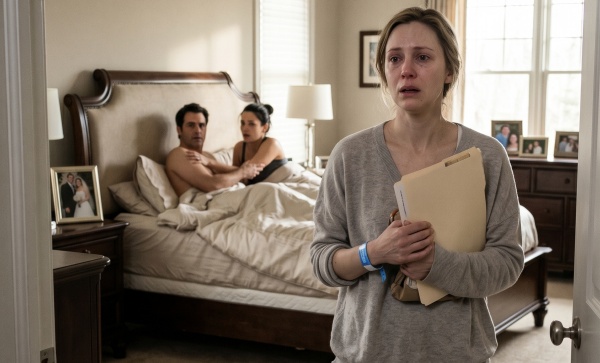
I Came Home Early From Surgery — And Found My Husband With the Woman I Trusted Most
Emma thought the hardest part of the weekend would be recovering from surgery. She expected her husband to be waiting with medication, clean sheets, and the kind of care a wife deserves after leaving the hospital. Instead, she opened her bedroom door and found him with the one woman who knew every heartbreak she had ever survived. In that moment, Emma realized her marriage was not the only thing that had betrayed her.
Part 1: The Ride Home She Wasn’t Supposed to Take
Emma Caldwell was not supposed to come home until Sunday.
That was what her husband, Nathan, kept repeating when he dropped her off at Saint Thomas Midtown Hospital in Nashville on Friday morning. He kissed her forehead in front of the nurses, held her overnight bag like a devoted husband, and told her not to worry about anything at home.
“I’ve got everything handled,” he said.
At the time, Emma believed him.
She wanted to believe him.
After eleven years of marriage, two miscarriages, one failed round of IVF, and a diagnosis that had taken three doctors to finally take seriously, Emma was too tired to question kindness when it appeared in front of her. Nathan had been distant for months, but that morning, he was gentle. He even warmed up the car before driving her to the hospital because the Tennessee rain had turned cold overnight.
Emma was scheduled for a laparoscopic procedure to remove scar tissue from years of endometriosis. It was not life-threatening, her surgeon had said, but it was not nothing either. She would be sore, tired, and foggy from anesthesia, and she needed someone responsible with her for at least twenty-four hours after discharge.
That someone was supposed to be Nathan.
When Nathan said he had an important client call Friday afternoon, Emma’s best friend, Lauren Whitaker, volunteered to help. Lauren had been in Emma’s life since sophomore year at the University of Tennessee. She had stood beside Emma at her wedding, cried with her after the miscarriages, brought casseroles after surgeries, and knew the garage code to Emma’s house.
“If Nathan gets stuck with work, I’ll stay with you,” Lauren had promised. “You know I’ve got you.”
Emma did know.
Or she thought she did.
The surgery went better than expected. By Saturday morning, Emma was awake, steady enough to walk with help, and desperate to sleep in her own bed. Her doctor agreed to discharge her early as long as someone drove her home, stayed with her, and made sure she followed the instructions.
Nathan didn’t answer his phone.
Emma called him once, then twice. The first call rang until voicemail. The second went straight there.
She texted: They’re letting me go early. Can you come get me?
No response.
She waited twenty minutes, watching hospital staff move quietly around the recovery wing. A woman across the hall laughed softly with her husband as he helped her into a cardigan. Emma tried not to stare.
Then she called Lauren.
Lauren answered on the fourth ring, breathless. “Hey, Em. Everything okay?”
“They’re discharging me early,” Emma said. “Can you come get me?”
There was a pause.
Not a long pause.
But long enough.
“Oh,” Lauren said. “Today?”
Emma frowned. “Yes. Now, actually.”
“I thought you were staying until Sunday.”
“So did I.” Emma tried to laugh, but it hurt her abdomen. “Surprise.”
Lauren said nothing for another second. In the background, Emma thought she heard a low male voice, then the faint closing of a door.
“Lauren?”
“Sorry,” Lauren said quickly. “I’m at the grocery store. Bad signal. I can come, but it might take me a while.”
Emma looked down at the discharge papers in her lap. She was tired, aching, and suddenly embarrassed by the simple act of needing someone.
“It’s okay,” she said. “I’ll figure it out.”
“No, no, I can come,” Lauren said. “Just give me, like, an hour.”
Emma did not want to wait an hour.
She called her neighbor, Mrs. Alvarez, a retired school secretary who lived two houses down and treated the entire street like her personal classroom. Mrs. Alvarez arrived in thirty minutes wearing a red raincoat and carrying a travel mug of tea.
“Men,” she said as she helped Emma into the passenger seat of her Subaru. “They can find every sports score in America but somehow miss a phone call from their wife.”
Emma smiled weakly. “Nathan’s probably on a work call.”
Mrs. Alvarez gave her a look over the top of her glasses. “Mmm.”
The drive from the hospital to Franklin took about thirty-five minutes. Rain blurred the windshield, and the bare branches along I-65 looked black against the gray sky. Emma leaned against the headrest, one hand pressed lightly over the bandage beneath her loose sweatshirt.
She kept checking her phone.
No message from Nathan.
No message from Lauren.
By the time they turned into the Caldwell subdivision, Emma felt something heavy gathering inside her that had nothing to do with surgery. Their neighborhood was the kind people called “safe” in real estate listings: brick homes, wide driveways, basketball hoops, American flags, and lawns kept short by homeowners who compared mowing schedules like moral achievements.
Nathan’s truck was in the driveway.
So was Lauren’s white Lexus.
Emma stared at both vehicles as Mrs. Alvarez slowed the car.
“Maybe Lauren got here before us,” Mrs. Alvarez said.
Emma heard the carefulness in her voice.
“Yes,” Emma said.
But Lauren had said she was at the grocery store.
Mrs. Alvarez parked at the curb. “Do you want me to come in with you?”
Emma almost said yes. Then pride, or denial, or the last fragile thread of normal life made her shake her head.
“No, thank you. I’m okay.”
Mrs. Alvarez did not look convinced. “Call me if you need anything. And I mean anything.”
Emma nodded, climbed out slowly, and stood in the drizzle while Mrs. Alvarez waited for her to unlock the front door. Emma waved once before stepping inside.
The house smelled like coffee, rain, and Nathan’s cedarwood cologne.
For a moment, nothing seemed wrong.
Then she saw Lauren’s purse on the entryway bench.
It was open, careless, familiar. Beside it sat a pair of black heels Emma had helped Lauren pick out for a charity dinner last year. Emma remembered teasing her that they were too expensive.
The house was quiet.
Too quiet.
Emma moved slowly toward the stairs, one hand sliding along the wall for balance. Every step pulled at her stitches. Her doctor had told her to take it easy, not climb stairs unless necessary, and avoid stress.
Emma almost laughed.
At the top of the stairs, she heard it.
A woman’s laugh.
Soft, breathless, and unmistakably Lauren’s.
Emma stood in the hallway outside her bedroom door and felt the world narrow to a single strip of light beneath it.
She could have turned around.
She could have gone back downstairs, called Mrs. Alvarez, called her mother, called an attorney, called anyone.
Instead, Emma opened the door.
Nathan was in their bed.
Lauren was beside him, wrapped in the gray quilt Emma’s mother had handmade for their tenth anniversary.
For one second, nobody moved.
Nathan sat up first, his face draining of color. Lauren clutched the quilt to her chest, eyes wide, her hair falling over one shoulder in the way Emma had seen a thousand times across coffee shops, bridal showers, and hospital waiting rooms.
Emma did not scream.
She could not.
Her body was still full of anesthesia, pain medicine, and betrayal so sharp it felt surgical.
Nathan said her name like it was an inconvenience.
“Emma.”
Lauren whispered, “Oh my God.”
Emma looked at them both.
Then she looked at the pill bottles lined up neatly on her nightstand, the water glass waiting for her, the stack of clean pajamas Lauren had folded that morning before doing whatever this was in Emma’s bed.
Nathan swung his legs over the side of the bed. “You weren’t supposed to be home.”
Emma’s eyes met his.
“No,” she said quietly. “I can see that.”
Part 2: The Woman She Trusted Most
Lauren cried first.
That surprised Emma, though later she wondered why. Lauren had always cried easily. She cried at commercials, at church services, at wedding speeches, at videos of soldiers coming home to their dogs.
But this time, the tears looked different.
Not innocent.
Not soft.
Strategic.
“Emma, please,” Lauren said, her voice breaking. “This isn’t how I wanted you to find out.”
Emma stared at her best friend.
Her best friend.
The woman who knew the exact date of Emma’s first miscarriage. The woman who had held Emma’s hand in a bathroom at a Christmas party when Emma found out another IVF cycle had failed. The woman who had promised, just one day earlier, to help care for her after surgery.
Emma felt suddenly cold.
“How long?” she asked.
Nathan stood and reached for his jeans. “You need to sit down.”
Emma laughed once, a small sound that hurt her ribs. “I just had surgery, Nathan. Don’t pretend you care whether I’m sitting.”
His jaw tightened.
Lauren pulled the quilt higher. “It wasn’t planned.”
Emma looked at her. “Today?”
Lauren flinched.
Emma took one careful step into the room. “You mean today wasn’t planned? Or betraying me wasn’t planned?”
Neither of them answered.
That was the answer.
Nathan ran a hand through his hair, already shifting into the version of himself he used during arguments. Calm. Tired. Superior. The reasonable man trapped with an emotional wife.
“Emma, you’re medicated,” he said. “This isn’t the time.”
The words landed like a slap.
She was medicated.
She was also awake.
For years, Nathan had done this—made her feelings sound like symptoms. When she worried about late nights, she was anxious. When she questioned strange credit card charges, she was stressed. When she cried after another negative pregnancy test, she was “letting hormones take over.”
Now he was standing in their bedroom, half-dressed beside her best friend, and still trying to make reality sound like something her body had invented.
Emma reached for the doorframe to steady herself. “I need both of you out of my room.”
Nathan blinked. “Our room.”
Emma looked at the bed, then back at him. “Not today.”
Lauren began gathering her clothes with shaking hands. “I’ll go. I’ll go right now.”
Emma turned to her. “You were supposed to pick me up from the hospital.”
Lauren stopped moving.
“You told me you were at the grocery store,” Emma said. “Was that before or after you got into my bed?”
Lauren’s face crumpled. “I panicked.”
“You panicked?” Emma repeated. “I was sitting in a hospital discharge room waiting for someone to care enough to answer the phone.”
Nathan stepped forward. “Enough.”
Emma turned to him. “Don’t.”
One word.
Quiet.
Final.
Something in Nathan’s expression shifted. He was used to Emma’s sadness. He was used to her pleading, explaining, trying to keep peace in rooms where he had already declared war. He was not used to this version of her—pale, trembling, bandaged, and suddenly finished.
Lauren dressed in the bathroom and came out with her shoes in one hand. She looked smaller now, stripped of the intimacy she had borrowed. At the doorway, she paused.
“Emma,” she whispered, “I love you.”
Emma stared at her.
The cruelty of that sentence almost took her breath away.
“No,” Emma said. “You loved being needed by me. That’s not the same thing.”
Lauren began crying again.
Emma did not comfort her.
For the first time in twenty years of friendship, Emma let Lauren stand inside the consequences of her own choices without rushing to soften the edges.
Lauren left.
Downstairs, the front door opened and closed. A few seconds later, the Lexus started in the driveway. Emma listened until it pulled away.
Then only Nathan remained.
He buttoned his shirt slowly, buying time. “You need to calm down.”
Emma almost smiled. “You keep saying that like my calmness is your biggest problem.”
He looked at her with irritation now, the shock fading. “This didn’t happen in a vacuum.”
There it was.
The speech.
Emma could hear it coming before he said another word. Their marriage had been hard. He had felt lonely. She had been consumed by medical appointments. She had shut him out. Lauren understood him.
Emma raised her hand before he could begin.
“I am not having this conversation in this room.”
“Fine,” he said. “Let’s go downstairs.”
“I’m not having it tonight either.”
His eyes narrowed. “So what, you’re kicking me out?”
Emma looked at the bed again, at the indentation where Lauren’s body had been.
“Yes.”
Nathan laughed. “Emma, you just got out of surgery. You can barely stand.”
“Then imagine how badly you had to behave for me to still mean it.”
He stepped closer. “You can’t just throw me out of my own house.”
Emma met his eyes. “It’s a marital home, and I’m not going to fight you about property while I’m bleeding through a bandage. But tonight, you are leaving because if you stay, I’m calling Mrs. Alvarez, my mother, and then the police if necessary.”
His face reddened. “You would call the police on me?”
“If you refuse to leave after I ask for space in my own home while recovering from surgery? Yes.”
Nathan stared at her.
The word “police” changed the room. Not because Nathan was afraid of consequences in the moral sense, but because he cared deeply about appearances. A patrol car in the driveway would ruin the clean, respectable image he worked so hard to maintain.
He grabbed a duffel bag from the closet and began shoving clothes into it.
“You’re making a huge mistake,” he said.
Emma leaned against the doorframe, her abdomen throbbing. “No, Nathan. I’m finally looking at one clearly.”
He pushed past her without touching her.
At the stairs, he stopped and looked back. “You’ll regret this when you realize nobody else is going to put up with all your issues.”
For a moment, the old wound opened.
All your issues.
The pain.
The infertility.
The surgeries.
The grief.
The ways her body had failed to become the simple story he wanted to tell.
Emma swallowed hard.
Then she said, “Maybe. But at least they won’t be sleeping with my best friend.”
Nathan left without another word.
When his truck pulled out of the driveway, Emma locked the door. Then she slid down to the floor of the foyer, phone in one hand, discharge papers scattered beside her, pain blooming through her abdomen.
She called Mrs. Alvarez.
The moment the older woman answered, Emma finally cried.
Part 3: The House After Betrayal
Mrs. Alvarez arrived in less than four minutes.
She came through the front door using the spare key Emma had given her years earlier for emergencies. She found Emma sitting on the floor, pale and shaking, and immediately stopped asking questions.
First came water.
Then medication.
Then a check of the discharge instructions taped to Emma’s hospital folder.
“You are not going upstairs again tonight,” Mrs. Alvarez said in the tone of a woman who had disciplined three children, seven grandchildren, and half the Franklin school district.
Emma tried to protest. “My bedroom—”
“No,” Mrs. Alvarez said. “Your bedroom can wait. Your body cannot.”
She helped Emma to the guest room downstairs, changed the sheets, set alarms for medication, and placed a trash can beside the bed in case the anesthesia nausea returned. Only after Emma was settled did Mrs. Alvarez sit in the chair nearby and ask, “Do you want to tell me?”
Emma looked at the ceiling.
“I found Nathan with Lauren.”
Mrs. Alvarez closed her eyes.
The silence that followed was not surprise. That hurt more than anything.
“You knew?” Emma whispered.
“I suspected something,” Mrs. Alvarez said carefully. “Not that. Not today. But I saw her car here sometimes when you weren’t home.”
Emma turned her face away.
Mrs. Alvarez leaned forward. “Listen to me. Suspicion is not proof. And it was not my place to throw a match into your marriage without facts.”
Emma wanted to be angry.
She was too tired.
By midnight, her mother was on the phone from Knoxville, furious enough to drive three hours in the rain. Emma told her not to come until morning. Her mother ignored her and arrived at 3:17 a.m. carrying a suitcase, a heating pad, and the kind of anger only a mother can keep warm over state lines.
“I never liked his mouth,” her mother said after kissing Emma’s forehead.
Emma blinked through swollen eyes. “His mouth?”
“The way he talked around the truth,” her mother said. “Like a salesman with a Bible verse.”
Despite everything, Emma laughed.
It hurt.
By Sunday afternoon, the house had become a quiet command center. Emma’s mother took over laundry and meals. Mrs. Alvarez handled pharmacy pickups. Emma’s younger brother, Jack, came by to install a new smart lock on the front door after Emma’s attorney confirmed she could change access codes for safety as long as Nathan was not unlawfully denied property retrieval through proper arrangements.
That was the first legal lesson Emma learned.
Betrayal felt emotional.
Divorce required documentation.
On Monday morning, Emma called a family law attorney named Rebecca Monroe, whose office was near downtown Nashville. Rebecca spoke in a calm, practical voice that made Emma feel like the ground beneath her might eventually become solid again.
“Do not post about this online,” Rebecca said.
Emma almost laughed. “I wasn’t planning to.”
“Good. Do not destroy property. Do not empty joint accounts. Do not threaten him. Save texts, emails, call logs, financial records, and any messages from Lauren. If he needs belongings, we arrange a time with a neutral third party.”
Emma closed her eyes. “I just want him gone.”
“I understand,” Rebecca said. “But we are going to do this in a way that protects you.”
Protects you.
Emma had spent years trying to protect the marriage.
No one had asked who was protecting her.
Nathan texted at 10:42 a.m.
We need to talk like adults.
Emma stared at the screen for a long time. Then she forwarded it to Rebecca and did not respond.
At 11:03, Lauren texted.
Please don’t shut me out. I know I hurt you, but you are my family.
Emma’s hands shook so badly she almost dropped the phone.
Family.
Lauren had been at every holiday when Emma and Nathan decided traveling between families was too much. Lauren had a stocking at their house. Lauren knew where Emma kept emergency chocolate, old journals, and the baby blanket Emma had bought before the second miscarriage.
Emma typed three different replies and deleted them all.
Finally, she wrote: Do not contact me again unless it is through my attorney.
Lauren sent a long message anyway.
Emma did not read it.
She screenshotted it, sent it to Rebecca, and blocked the number.
That afternoon, Emma made herself walk to the upstairs bedroom with her mother beside her. The bed had been stripped. Mrs. Alvarez had done it while Emma slept, bagging the sheets and quilt in the laundry room like contaminated evidence.
Still, the room felt wrong.
Emma stood in the doorway, one hand over her bandage, breathing slowly.
Her mother said, “You don’t have to reclaim everything today.”
Emma nodded.
But she walked in anyway.
On the nightstand, Nathan had left his wedding ring.
Not in anger.
Not thrown.
Placed carefully beside her pill bottles, as if he were the one making a dignified decision.
Emma stared at it.
Then she opened the drawer, took out a small envelope, dropped the ring inside, and wrote the date on the front.
Her mother watched silently.
“What are you doing?” she asked.
“Documentation,” Emma said.
The word felt strange in her mouth.
Strong.
Two days later, Nathan returned with his brother to pick up clothes, work files, and golf clubs. Rebecca had arranged the time. Jack and Mrs. Alvarez stayed at the house. Emma remained in the downstairs guest room, listening to footsteps overhead.
Nathan did not come to see her.
But he left a note on the kitchen counter.
I’m sorry you found out this way. But you need to accept your part in why it happened.
Emma read it once.
Then she laughed.
Not because it was funny.
Because it was so perfectly Nathan.
Even his apology came with an invoice.
Part 4: The Truth Lauren Didn’t Want Told
The worst part was not losing Nathan.
Emma realized that slowly, and then all at once.
The worst part was losing Lauren.
A husband’s betrayal broke the structure of her daily life. A best friend’s betrayal rewrote her memories. Every girls’ trip, every late-night phone call, every moment Lauren had sat across from Emma with sympathetic eyes while knowing what she was doing behind her back became poisoned.
When had it started?
Emma asked herself that question constantly.
Was it after the second miscarriage, when Nathan began sleeping in the guest room and saying Emma needed “space to heal”? Was it during Lauren’s divorce, when Nathan helped her move into her townhouse and came home smelling like her vanilla shampoo? Was it before that?
The answer came from Lauren herself.
Not directly.
Through an email Emma almost deleted.
The subject line read: Please just read this once.
Emma forwarded it to Rebecca first, then asked if she could read it. Rebecca said yes, but reminded her not to respond emotionally.
So Emma read it sitting at the kitchen table, wrapped in a cardigan, with a mug of tea going cold beside her.
Lauren wrote that she and Nathan had “connected” two years earlier when Emma was recovering from her second miscarriage. She said they were both lonely. She said Nathan felt invisible. She said Emma’s pain had filled the house so completely that nobody else had room to breathe.
Emma stopped reading there.
Her mother, sitting across the table, saw her face change.
“What?”
Emma turned the laptop around.
Her mother read silently, then closed it with more restraint than Emma expected.
“That woman is trying to make your grief sound like a crime scene she had to escape,” her mother said.
Emma pressed her hands to her face.
There it was again.
Her pain had been too much.
Her body had been too much.
Her sorrow had been too much.
But somehow Nathan and Lauren’s betrayal was being presented as a weather event, something unfortunate that happened because the emotional climate was difficult.
Emma finished reading the email later.
Lauren apologized, then explained, then apologized again. She claimed she never meant to replace Emma. She said she still wanted to be there for her recovery. She said ending their friendship would destroy her.
Emma sat with that line for a long time.
Ending their friendship would destroy Lauren.
Not the affair.
Not the lies.
Not abandoning Emma at the hospital.
The consequence.
Emma closed the laptop.
For the first time since coming home from surgery, she felt something stronger than heartbreak.
Clarity.
Three weeks later, Rebecca filed for divorce.
Tennessee allowed no-fault grounds, but Rebecca explained that Nathan’s behavior could still matter in certain parts of the case depending on facts, finances, and negotiations. Emma learned to stop asking what was “fair” emotionally and start asking what was strategic legally.
She gathered bank statements.
Credit card records.
Insurance policies.
Mortgage documents.
Phone logs.
The financial picture was not as dramatic as a movie, but it was painful enough. Nathan had spent thousands of dollars on hotel rooms, jewelry, dinners, and weekend “work conferences” that were not conferences at all.
Some charges were from Nashville.
Some from Atlanta.
One from a resort outside Asheville where Emma had once begged Nathan to take her for their anniversary.
He had said they couldn’t afford it.
Rebecca’s mouth tightened when she reviewed the records. “We’ll use what is relevant.”
Emma nodded.
At night, when the house was quiet, Emma still cried. Healing was not a clean line. Some mornings she felt brave enough to call contractors and change passwords; some evenings she cried because she found Lauren’s favorite coffee mug in the back of a cabinet.
Recovery from surgery forced her to move slowly.
Recovery from betrayal did too.
At her two-week post-op appointment, Dr. Kline told Emma she was healing well physically. “Avoid heavy lifting for a few more weeks,” she said. “And keep stress low if you can.”
Emma laughed before she could stop herself.
Dr. Kline looked up from the chart. “That bad?”
Emma hesitated.
Then she told her.
Not everything.
Enough.
Dr. Kline listened without interrupting, then said, “Emma, emotional trauma can affect physical healing. Do you have support?”
Emma thought of her mother sleeping in the guest room, Mrs. Alvarez bringing soup, Jack changing locks, Rebecca building a legal wall around her life.
“Yes,” Emma said. “I do.”
It was the first time she had answered that question honestly.
A month after the filing, Lauren showed up at the house.
Emma saw her through the doorbell camera. Lauren stood on the porch holding flowers, wearing a cream sweater Emma had once borrowed for Thanksgiving. Her eyes were red.
Emma’s mother came into the hallway. “Do you want me to handle it?”
Emma shook her head.
She opened the door but kept the storm door locked.
Lauren began crying immediately. “Emma, please. I can’t live like this.”
Emma looked at her through the glass.
For twenty years, Lauren had been close enough to walk in without knocking.
Now there was a locked door between them, and it felt exactly right.
“You need to leave,” Emma said.
“I made a mistake.”
Emma’s voice stayed even. “A mistake is forgetting my birthday. You had a relationship with my husband for two years and left me sitting in a hospital waiting for a ride.”
Lauren flinched. “I hated myself every day.”
“Not enough to stop.”
Lauren pressed a hand to her mouth.
Emma continued, “I trusted you with the most fragile parts of my life. You used them to get closer to the person hurting me.”
“That’s not fair,” Lauren whispered.
Emma almost smiled. “No. It isn’t.”
Lauren looked past her into the house. “I miss you.”
Emma felt tears rise, but she did not let them soften her voice.
“I miss who I thought you were.”
Lauren stood there for several seconds.
Then she placed the flowers on the porch and left.
Emma waited until the Lexus disappeared before opening the storm door. She picked up the flowers, carried them to the trash bin, and dropped them inside.
Her mother watched from the hallway.
“That was cold,” she said gently.
Emma closed the door. “No. It was clean.”
Part 5: The Bed She Chose for Herself
The divorce took nine months.
Not because there were children to fight over, but because Nathan fought over everything else. The house. The retirement accounts. The furniture. Even the espresso machine, though Emma had bought it and Nathan drank gas station coffee without complaint for most of their marriage.
Rebecca warned Emma early that divorce often turned symbolic.
“People argue over lamps because they can’t argue effectively over betrayal,” she said.
Nathan claimed Emma had become “emotionally unavailable.” He claimed the marriage had been over long before Lauren. He suggested Emma’s medical struggles had created “intimacy issues” that drove them apart.
Emma read that phrase in a legal document and felt her body go still.
Medical struggles.
As if her pain were a character flaw.
As if surgery were a rejection.
As if grief gave him permission to seek comfort in the one person Emma trusted most.
Rebecca advised her not to respond with outrage.
So Emma responded with records.
Therapy notes showing she had asked Nathan to attend counseling and he refused.
Text messages where she invited him to appointments and he said he was busy.
Bank records showing hotel charges while Emma was recovering from procedures.
Lauren’s email.
The facts did not heal Emma.
But they protected her.
Nathan eventually settled.
The house was sold because Emma did not want it anymore. That surprised everyone except Mrs. Alvarez.
“Too many ghosts,” the older woman said.
Emma nodded. “Too many performances.”
She bought a smaller home twelve miles away, a one-story brick cottage near downtown Franklin with a porch swing, two bedrooms, and a kitchen that caught morning light. It did not have a dramatic staircase, a formal dining room, or a primary suite big enough for betrayal.
It felt honest.
Her mother stayed for the first week, unpacking dishes and labeling boxes in a handwriting so neat it looked printed. Jack installed shelves. Mrs. Alvarez brought a lemon cake and declared the house “peaceful enough to hear yourself think.”
Emma’s body healed.
Slower than she wanted.
But it healed.
Her first night alone in the new house, she expected to fall apart. Instead, she ordered Thai food, took her medication, and watched an old Sandra Bullock movie on the couch with a blanket over her knees. At 9:30 p.m., she realized no one had lied to her all day.
The peace was so unfamiliar she almost mistook it for emptiness.
Spring came gently that year.
Dogwoods bloomed along the streets. The farmers market reopened with strawberries, honey, and handmade soap. Emma began walking half a mile each morning, then one mile, then two.
Her therapist called it rebuilding trust with her body.
Emma called it taking the long way home.
One Saturday in April, Emma ran into Lauren at a bookstore in downtown Franklin.
For a second, both women froze between the fiction shelves.
Lauren looked thinner. Her hair was shorter. She held a paperback and a paper cup of coffee, ordinary objects in hands that had once helped dismantle Emma’s life.
“Hi,” Lauren said softly.
Emma felt the old reflex rise.
Ask how she is.
Make it less awkward.
Protect everyone from discomfort.
Then Emma let the reflex pass.
“Hello,” she said.
Lauren swallowed. “You look good.”
“I’m doing better.”
“I heard you moved.”
“Yes.”
Lauren nodded, eyes shining. “I think about you every day.”
Emma believed her.
That was the complicated part.
People could be sorry and still unsafe. They could miss you and still not deserve access. They could carry regret without being invited back into the rooms they helped destroy.
“I hope you’re getting help,” Emma said.
Lauren looked down. “I am.”
“Good.”
For a moment, Emma saw their entire friendship like a road behind her—college dorms, bridesmaid dresses, midnight pancakes, hospital rooms, secrets whispered under blankets, years of laughter. Losing it still hurt. Maybe it always would.
But hurt was not a command.
Lauren said, “Do you think you’ll ever forgive me?”
Emma thought carefully before answering.
“I’m working on not letting what you did live in my body forever,” she said. “If that becomes forgiveness someday, I’ll know. But it won’t mean you get to come back.”
Lauren cried silently.
Emma did not.
She wished her well, then walked to the register and bought the novel she had come for.
Outside, the sun was bright enough to make her squint.
By summer, Emma had turned the second bedroom into a reading room. She painted the walls sage green, hung white curtains, and bought a deep blue armchair that cost more than she intended to spend. When the delivery men carried it in, she signed the receipt with a thrill she could not explain.
It was her chair.
Her room.
Her house.
Her life.
No committee approval required.
On the anniversary of the surgery, Emma took the day off work. Not because she wanted to mourn, exactly, but because her body remembered dates even when her calendar tried not to. She made coffee, sat on the porch swing, and watched a summer storm roll across the Tennessee sky.
Her phone buzzed.
A message from Nathan.
She had unblocked him only because the final paperwork required occasional communication through a co-parenting-style legal app for shared financial matters, though they had no children. This message came through email instead.
I hope you’re well. I’ve had a lot of time to think. I’m sorry for how everything happened.
Emma stared at the sentence.
How everything happened.
Still passive.
Still careful.
Still standing outside the burning house with a match in his pocket, calling it weather.
She did not answer.
Instead, she opened a drawer and took out the envelope containing his wedding ring. She had kept it through the divorce, through the move, through every late night when memory tried to convince her that love and damage were the same thing.
Now she drove to a small jeweler near Main Street.
The owner, a woman in her sixties with silver hair and turquoise glasses, examined the ring and asked what Emma wanted to do with it.
“Can it be made into something else?” Emma asked.
“Of course,” the woman said. “Pendant, charm, credit toward another piece.”
Emma looked at the gold band on the black velvet tray.
For years, it had symbolized promises Nathan did not keep.
But gold was just metal.
It did not have to remain loyal to a lie.
“Credit,” Emma said.
She chose a simple necklace with a tiny compass pendant.
Not because she was lost.
Because she wasn’t anymore.
That night, Emma invited her mother, Jack, Mrs. Alvarez, and a few close friends to dinner at her new house. They ate fried chicken, corn salad, watermelon, and peach cobbler from a bakery downtown. Nobody gave speeches.
Emma was grateful for that.
After dinner, while everyone sat on the porch watching fireflies blink over the lawn, Mrs. Alvarez raised her glass of sweet tea.
“To Emma,” she said. “Who came home early and still managed to find her way out.”
Everyone grew quiet.
Emma touched the compass at her throat.
For a second, she was back in that upstairs hallway, fresh from surgery, hand on the doorframe, hearing Lauren laugh behind the bedroom door. She saw the woman she had been—tired, trusting, wounded, still hoping the truth would be smaller than her fear.
Then she looked around the porch.
Her mother barefoot on the steps.
Jack balancing a paper plate on his knee.
Mrs. Alvarez smiling like she had been waiting all year to see Emma breathe normally.
Friends who had shown up without asking for gossip as payment.
This was not the life Emma had planned.
It was better than the lie she had been living.
Later, after everyone left, Emma walked through the cottage turning off lights. In the bedroom, the white quilt was smooth across the bed. No memory lived there that she had not chosen herself.
She changed into soft pajamas, checked the small scar near her abdomen, and placed her phone on the nightstand.
Then she stood beside the bed for a moment.
For months, she had been afraid of beds.
Not sleeping.
Beds.
The place where vows were supposed to rest. The place where she had found betrayal wearing the face of comfort. The place where her marriage ended before her body had even finished healing.
But this bed was different.
It belonged to no performance.
No secret.
No one who confused her pain with permission.
Emma pulled back the quilt and climbed in slowly. Rain began tapping against the window, soft and steady, like the night she came home early. But this time, there were no trucks in the driveway that shouldn’t be there, no familiar purse on the entryway bench, no voices behind a closed door.
Only quiet.
Only safety.
Only Emma.
She turned off the lamp and lay in the dark, one hand resting lightly over the place where her body had been opened and repaired.
Nathan had once told her nobody else would put up with her issues.
Lauren had once told her she was family.
Both of them had been wrong in different ways.
Emma no longer wanted to be tolerated.
She no longer confused history with loyalty, or closeness with trust, or someone knowing her wounds with someone deserving access to them.
The next morning, she woke to sunlight spilling across the floor.
For the first time in years, she did not reach for her phone to check who had disappointed her overnight. She did not brace for excuses, apologies, or the emotional weather of someone else’s guilt.
She made coffee.
Opened the windows.
And let the whole house breathe.
