At Our Anniversary Dinner, My Husband Toasted My Sister for Giving Him the Babies I Had Prayed For…
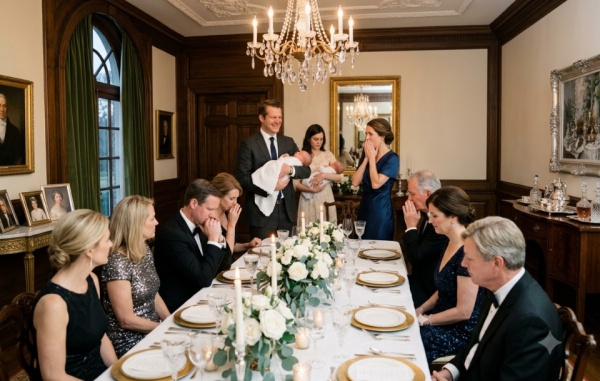
I thought our tenth anniversary dinner would be the night Michael and I found our way back to each other. Instead, he walked into our Lake Forest dining room holding a newborn wrapped in a blanket embroidered with our family initial. A few seconds later, my younger sister Jennifer stepped in behind him holding the baby’s twin, wearing the cream dress I had bought for her.
When Michael raised his champagne glass and said she had given him the family I never could, I realized the real betrayal was not just what they had done — it was how many people at that table already knew.
PART I — THE DINNER UNDER THE CHANDELIER
My name is Anna Whitmore, and the night my husband brought another woman’s babies to our anniversary dinner was the night I learned betrayal can enter a room wrapped in a monogrammed blanket.
It was our tenth wedding anniversary, and I had spent three days preparing the house in Lake Forest, Illinois, as if beauty could still save something already rotting beneath the surface. The dining room smelled of white roses, roasted rosemary chicken, and the expensive vanilla candles Michael always said made the house feel “like old money.” Crystal glasses waited beside gold-rimmed plates, and above the table, the chandelier scattered soft light over everything like a blessing.
There were fourteen place settings.
Michael’s parents.
My parents.
His brother and sister-in-law.
My aunt Louise.
Two cousins.
And my younger sister, Jennifer, who had texted me that afternoon saying she might be late because she “wasn’t feeling like herself.”
I had replied with a heart.
Of course I had.
Because that is what older sisters do when they have spent a lifetime turning worry into forgiveness.
I was seated at the end of the table in a navy silk dress, the one Michael had bought me five years earlier when he still remembered the difference between a gift and a performance. My hair was pinned low, my makeup careful, my wedding ring cleaned until it caught the light every time I reached for my water glass. I looked exactly like the kind of wife people expected Michael Whitmore to have.
Calm.
Elegant.
Grateful.
Silent when necessary.
Across the table, my mother kept adjusting her napkin. My father stared at the centerpiece. Michael’s mother, Eleanor, took tiny sips of wine and avoided my eyes with the focus of a woman trying not to look at smoke before anyone else smelled fire.
That was the first thing I noticed.
The silence.
Not ordinary dinner silence.
Not the polite waiting before the guest of honor arrives.
This silence had weight.
People were speaking, but not really. My aunt asked about the weather. Michael’s brother commented on traffic coming up from Chicago. My mother complimented the roses twice. Nobody asked where Michael was, even though he was forty minutes late to his own anniversary dinner.
That should have told me everything.
But hope is stubborn.
Especially in a woman who has spent years explaining away what her body already knows.
Michael and I had been struggling for almost two years. That was the polite phrase people used: struggling. It covered the miscarriages, the fertility appointments, the failed IVF cycle, the nights I cried quietly in the bathroom because I could not bear another conversation about “God’s timing.” It covered Michael’s growing distance, his business trips that lasted longer than expected, and the way he began touching my shoulder in public instead of holding my hand.
It covered too much.
Still, I had planned this dinner because ten years mattered to me.
Ten years of marriage.
Ten years of building a life in a house with white columns, old oak trees, and framed photos that told a better story than the one we were living.
At 7:42 p.m., the front door opened.
The sound echoed through the foyer.
Every conversation at the table stopped.
I looked toward the dining room entrance, expecting Michael to appear with a rushed apology, maybe flowers, maybe the charming smile that had convinced donors, clients, and half my family that he was more tender than he truly was.
Instead, he walked in holding a newborn baby.
For one second, my mind refused to understand what my eyes were seeing.
Michael stood beneath the archway in a charcoal suit, his dark hair slightly windblown, his expression solemn but rehearsed. In his arms was a tiny baby wrapped in a white blanket embroidered with navy thread.
W.
The Whitmore family initial.
Our family initial.
The room blurred around the edges.
Then Jennifer stepped in behind him.
My sister.
My little sister.
She was holding another newborn wrapped in an identical blanket.
The twin.
Jennifer wore a cream dress I had bought for her the previous spring for a charity luncheon she said she could not afford to attend otherwise. Her hair was curled softly around her shoulders, and her face was pale in a way that would have made me stand up and rush to her if my body had not turned to stone.
No one gasped.
That was how I knew.
No one gasped.
My mother lowered her eyes.
My father closed his fist around his napkin.
Michael’s mother pressed her lips together and looked toward the window.
They knew enough.
Maybe not all of it.
But enough.
Michael walked to the head of the table, still holding the baby with the careful awkwardness of a new father. Jennifer stood beside him, swaying slightly with the second child against her chest. The babies made tiny sleeping sounds, innocent and impossibly small in a room full of adults who had failed every moral test that mattered.
“Anna,” Michael said.
My name sounded like a formality in his mouth.
I could not speak.
He looked around the table, then lifted his champagne glass with his free hand. Someone had poured it for him before he arrived. That detail would haunt me later. Someone had expected him to need a glass for a toast.
Eleanor whispered, “Michael, don’t.”
He ignored her.
“Tonight,” he said, “is not how I imagined this conversation happening.”
I stared at him.
Conversation.
He had brought newborn twins into our anniversary dinner and called it a conversation.
“But I believe truth is better than pretending,” he continued.
Jennifer looked at the floor.
Not at me.
Not once.
Michael adjusted the baby in his arms and looked at me with a strange mixture of pity and triumph.
“Jennifer has given birth to my sons,” he said. “And I think everyone here understands what that means.”
My mother made a soft sound, almost a sob.
Michael raised his glass higher.
“She has given me the family I never could have with Anna.”
The words entered me slowly.
Not because I did not understand them.
Because they were too cruel to absorb at normal speed.
The family I never could.
After five miscarriages.
After injections in my stomach.
After surgeries.
After hormones that made my body feel like it belonged to a stranger.
After waking up from anesthesia and finding Michael on his phone in the corner.
After holding the ashes of dreams no one else could see.
My husband stood in our dining room with my sister and newborn twins and framed my grief as her victory.
For a moment, I heard nothing.
Not the babies.
Not the crystal.
Not my mother crying.
Not my aunt whispering my name.
Then my chair scraped against the floor.
I stood slowly.
Michael watched me carefully, as if expecting hysteria.
That was his mistake.
Men like Michael prepare for tears because tears make women easier to dismiss.
They do not prepare for stillness.
“Who knew?” I asked.
No one answered.
I looked around the table.
My mother covered her mouth.
My father looked sick.
My cousin Beth stared down at her plate.
Michael’s brother would not meet my eyes.
“Who knew?” I repeated.
Jennifer finally lifted her face.
“Anna, please.”
The sound of her voice hurt worse than Michael’s.
Because I remembered that voice at six years old asking me to check under her bed for monsters. I remembered it at seventeen, crying after her first heartbreak. I remembered it three months earlier on the phone, telling me she felt alone and asking if she could come stay for a weekend.
I had made up the guest room.
I had bought her favorite tea.
I had never thought to ask if the secret she carried was my husband’s children.
Michael set his glass down.
“This isn’t productive,” he said.
I turned to him.
“Do not speak to me about productive.”
His jaw tightened.
“This is painful for everyone.”
“No,” I said. “This is painful for me. It is inconvenient for everyone else.”
A silence followed that.
Sharp.
Clean.
Finally, my father stood.
“Anna, come with me.”
I looked at him, and for the first time that night, anger cut through the numbness.
“You knew?”
His face collapsed.
Not enough.
Never enough.
“I suspected,” he said.
That was worse than knowing.
Suspecting gave people room to do nothing and call it uncertainty.
My mother began crying harder.
“I didn’t know how to tell you,” she said.
I looked at her.
My own mother.
The woman who had held me after my second miscarriage and said no one could understand a daughter’s pain like her mother.
“You could have started with the truth.”
Jennifer whispered, “I’m sorry.”
I turned to her.
She stood there holding a child whose face I could not yet bear to look at, dressed in a gown I had bought her, standing beside my husband like the replacement wife in a tragedy none of them had warned me about.
“Are you?” I asked.
Tears slipped down her cheeks.
“I didn’t plan for this to happen.”
I almost laughed.
People always say that after making a hundred small choices.
They did not plan to betray you.
They simply answered the calls.
Stayed too late.
Accepted comfort.
Kept the secret.
Let the lie grow large enough to need a dinner announcement.
Michael stepped closer to her.
Protective.
Of her.
That was the moment my marriage ended in my heart.
Not when he admitted the babies were his.
Not when he humiliated me.
When he moved toward my sister as if I were the danger.
I took off my wedding ring.
The room watched.
I placed it beside my untouched dinner plate.
The small sound of gold touching porcelain seemed louder than his toast.
“Happy anniversary, Michael,” I said.
Then I walked out of the dining room before anyone could decide what kind of woman I was allowed to be in response to being destroyed.
PART II — THE SISTER IN THE CREAM DRESS
I drove aimlessly for twenty minutes before realizing I was in no condition to drive.
Lake Forest roads are too beautiful at night for a woman trying not to fall apart behind the wheel. The old homes sit back from the street behind gates and hedges, their windows glowing warmly like every family inside has kept its promises. I pulled into the parking lot of a closed bakery and turned off the engine.
Then I screamed.
Not elegantly.
Not quietly.
I screamed until my throat hurt and the steering wheel blurred beneath my hands.
Afterward, I sat in the dark with my phone buzzing in the cup holder.
Michael.
My mother.
My father.
Aunt Louise.
Jennifer.
Michael again.
I did not answer any of them.
At 8:34 p.m., my best friend Rachel Monroe called.
Rachel had been my college roommate at University of Illinois Urbana-Champaign, my maid of honor, and the only person who had ever looked Michael in the eye and seemed unimpressed. She lived in Evanston, worked as a family therapist, and had once told me that rich families hide rot behind better curtains.
I answered.
She did not say hello.
“Where are you?”
That made me cry again.
Not because the question was dramatic.
Because it was practical.
“I don’t know,” I said.
“Send me your location.”
“I can’t go home.”
“You’re not going home. Send me your location.”
Fifteen minutes later, Rachel pulled into the lot beside me wearing sweatpants, a winter coat, and the expression of someone prepared to commit legal but emotionally satisfying violence. She got into my passenger seat and took one look at my face.
“Tell me.”
I did.
Not well.
Not coherently.
I told her about the babies, the blankets, Jennifer’s dress, Michael’s toast, my parents’ silence, and the ring beside the plate.
When I finished, Rachel leaned back and closed her eyes.
For several seconds, she said nothing.
Then she whispered, “Oh, Anna.”
That almost broke me more than any outrage could have.
I spent that night at Rachel’s house in her guest room, under a quilt her grandmother had made, staring at the ceiling while my marriage replayed itself backward. Michael kissing my forehead after our first embryo transfer. Jennifer sleeping on our couch after a breakup. My mother insisting Michael was “under pressure too.” Eleanor asking strange questions about whether I had considered adoption. My father suddenly changing the subject when I mentioned Jennifer gaining weight.
Signs.
Everywhere.
Not proof.
But signs.
By morning, shock had become something colder.
At 7:10 a.m., I called Caroline Mehta, a divorce attorney in Chicago whose name Rachel gave me before I even asked. Caroline answered through her assistant and offered me an emergency consultation at noon.
“Do not move money,” Rachel said while making coffee. “Do not threaten him. Do not post anything. Do not call Jennifer.”
“I wasn’t going to post.”
“You might want to.”
“I want to burn down the dining room.”
“That is why we drink coffee and call lawyers.”
Rachel was right.
Rage is real.
It is also legally inconvenient when mishandled.
By noon, I was sitting in Caroline Mehta’s office downtown, wearing borrowed jeans and a sweater, my hair still pinned badly from the anniversary dinner. Caroline was in her fifties, calm, direct, and dressed in a black suit that made her look like bad news delivered with perfect grammar.
She listened without interrupting.
Then she asked, “Were the babies born during the marriage?”
“Yes.”
“Do you know when?”
“No. They looked newborn.”
“Do you know whether your husband is listed on the birth certificates?”
“No.”
“Did he use marital funds to support your sister during pregnancy?”
I froze.
Because I had not thought of that yet.
Money.
Apartments.
Medical bills.
Gifts.
Hotel rooms.
The cream dress.
The guest room weekend.
Caroline watched my face.
“We will request records through the proper legal process,” she said. “Illinois is an equitable distribution state. Adultery itself is generally not used to punish someone financially in a no-fault divorce, but dissipation of marital assets can matter if marital funds were spent for a purpose unrelated to the marriage after the breakdown began.”
I nodded slowly.
Legal language steadied me.
It gave shape to chaos.
“There’s something else,” I said.
Caroline waited.
“My family knew.”
“Did they participate financially?”
“I don’t know.”
“Did anyone pressure you to remain silent?”
“Not yet.”
“They will.”
She said it so simply that I believed her.
At 2:03 p.m., Michael texted.
We need to talk like adults.
I showed Caroline.
She smiled without warmth.
“Adults usually do not introduce affair babies at anniversary dinners.”
Rachel, sitting beside me, muttered, “Put that on a mug.”
Caroline instructed me to communicate only in writing and preferably through counsel. She also told me to document everything I remembered: dates Michael traveled, unexplained charges, Jennifer’s visits, family behavior, anything related to fertility treatment, finances, or property.
“Your goal is not revenge,” she said. “Your goal is clarity, protection, and evidence.”
I repeated those words to myself all the way back to Rachel’s house.
Clarity.
Protection.
Evidence.
That evening, I opened my laptop and began building a timeline.
The first entry was five years earlier: First miscarriage, April.
I hated starting there.
But it mattered.
Because Michael’s cruelty at the dinner was not simply that Jennifer had given birth. It was that he had weaponized my infertility in front of relatives who had watched me suffer.
I wrote down every treatment cycle.
Every time Michael missed an appointment.
Every weekend Jennifer stayed with us.
Every unexplained charge I remembered.
Every Chicago hotel receipt I had seen and dismissed.
Every time my mother seemed nervous when I said Jennifer’s name.
The timeline became ten pages.
Then sixteen.
Then twenty-three.
At midnight, Rachel came into the room and set tea beside me.
“You need sleep.”
“I need to know when it started.”
She sat beside me.
“Maybe. But you also need to know something else.”
“What?”
“You are not responsible for failing to detect a betrayal that multiple people worked to hide.”
I stared at the screen.
That sentence saved me from a spiral I might not have escaped.
Because betrayed people often become detectives against themselves. We cross-examine our own memories. We ask why we did not see sooner, why we trusted, why we loved, why we accepted explanations that now look ridiculous under the fluorescent light of aftermath.
But betrayal is not a puzzle you failed.
It is a choice someone else made in secret.
By the third day, I was ready to return to the Lake Forest house with Caroline’s paralegal and a private security escort arranged by Rachel’s husband, who owned a small corporate security firm. Not because I expected violence, but because emotion makes unpredictable people believe they are entitled to access.
Michael was there when I arrived.
So was Jennifer.
That surprised me.
It should not have.
She sat on my living room sofa holding one baby while the other slept in a carrier at her feet. Michael stood near the fireplace, looking tired and offended, as if I had inconvenienced him by taking time to respond to my own humiliation.
“You brought a lawyer?” he asked.
Caroline’s paralegal, Nina, smiled politely. “I’m here to assist Mrs. Whitmore in retrieving personal belongings and documents.”
Michael looked at me.
“Anna, this is ridiculous.”
I glanced at Jennifer.
She looked smaller than she had at dinner, her hair unwashed, her eyes swollen, the cream dress replaced by leggings and one of Michael’s old college sweatshirts.
That sweatshirt felt like another slap.
“I want to explain,” she said.
“No,” I replied.
Her mouth trembled.
“You don’t understand.”
I almost admired the phrase.
It was always the betrayed person who supposedly did not understand.
Not the people who lied.
Not the people who looked away.
Not the sister who carried my husband’s children.
I walked past them toward the stairs.
Michael followed.
“Anna, stop. You can’t just ignore reality.”
I turned.
“Reality is why I brought legal assistance.”
His jaw tightened.
“Those boys are my sons.”
“I know.”
“They’re innocent.”
“I know that too.”
That stopped him.
Maybe he had expected me to attack the babies, emotionally if not verbally. Maybe he needed me to become monstrous so he could feel noble protecting them. But I would not give him that.
The twins were innocent.
That was part of the horror.
They had been born into the wreckage adults created and would someday deserve a truth gentler than the one I received under a chandelier.
Jennifer stood, rocking the baby.
“Anna, I didn’t mean to hurt you.”
I looked at my sister.
“You knew I was injecting myself with hormones while you were pregnant with his children.”
She flinched.
Good.
“You knew I was blaming my body while you were carrying proof that my husband had already left our marriage in every way that mattered.”
Tears slipped down her face.
“I was scared.”
“So was I,” I said. “You had people protecting you. I had people lying to me.”
Michael stepped between us.
“Enough.”
I looked at him.
There it was again.
Protective.
Of her.
I smiled then.
Not because anything was funny.
Because something inside me had finally detached.
“Yes,” I said. “Enough.”
I went upstairs and packed my documents, jewelry, personal keepsakes, laptop, passports, fertility records, tax folders, and the box of baby items I had bought over the years and hidden in the back of the closet because hope had become too painful to display.
I did not cry until I held the tiny yellow blanket I had bought after our first positive test.
Jennifer had known about that blanket.
She had once hugged me while I held it.
I placed it carefully in the suitcase.
Some grief is not ready to be thrown away.
PART III — THE FAMILY THAT LOOKED AWAY
The story spread faster than I expected.
Not publicly, at first.
Lake Forest families have a special talent for gossip wrapped in concern. People did not say, “I heard your husband had twins with your sister.” They said, “Anna, I just wanted to check on you,” with voices so soft they could have smothered a candle. They said, “I can’t imagine what you’re going through,” while clearly imagining every detail.
I answered almost none of them.
Caroline filed the divorce petition in Cook County citing irreconcilable differences, because Illinois does not require proving fault to dissolve a marriage. The petition was clean, controlled, and devastating in its restraint. We requested temporary orders regarding household expenses, access to marital funds, preservation of assets, and production of financial records.
Michael responded through an attorney known for aggressive letters and expensive suits.
His position was predictable.
He wanted the divorce handled “quietly.”
He wanted to preserve “family dignity.”
He wanted me to avoid “unnecessary emotional escalation.”
He wanted to keep the Lake Forest house until the divorce was final.
He wanted me not to discuss “private family matters” with extended relatives or mutual friends.
Most of all, he wanted me to accept that the twins changed everything.
Caroline read his attorney’s letter aloud, then removed her glasses.
“Men love privacy after public humiliation.”
I laughed for the first time in days.
It came out sharp but real.
We did not respond emotionally. We requested records.
Bank statements.
Credit card statements.
Wire transfers.
Travel receipts.
Medical payments.
Apartment leases.
Insurance reimbursements.
Gift purchases.
Communications about Jennifer’s pregnancy.
Any expenses related to Jennifer from marital accounts.
That was when Michael’s confidence began to crack.
Because he had been careless.
Not criminally careless, at least not in any obvious way.
Personally careless.
Financially careless.
Arrogantly careless.
The records showed payments to a luxury apartment building in Chicago’s Gold Coast beginning seven months earlier. The tenant listed on related documents was not Michael, but Jennifer. There were charges at maternity boutiques, medical co-pays, grocery delivery accounts, rideshares, and a private postpartum nurse paid through a business account Michael partially owned.
There were hotel stays.
Jewelry purchases.
A $9,800 “consulting fee” paid to Jennifer from one of Michael’s side companies, despite no evidence she had performed any consulting work.
Caroline circled that one in red.
“This may matter.”
I looked at the page.
There it was.
Proof that while I was cutting coupons for fertility medications not fully covered by insurance, my husband had been funding my sister’s secret life with money connected to ours.
Then came the emails.
Not romantic emails.
Worse.
Logistical emails.
Michael arranging doctor appointments.
Jennifer asking whether he had told “E.”
Eleanor.
His mother.
Michael replying:
She knows enough not to make trouble.
I read that sentence three times.
She knows enough not to make trouble.
Eleanor had sat at my table.
Eleanor had toasted me at bridal showers.
Eleanor had told me after my fourth miscarriage that perhaps motherhood comes in different forms.
All while knowing enough not to make trouble.
Another email came from my mother to Jennifer.
Your father thinks Anna deserves to hear something before the dinner, but Michael says timing matters. Please don’t push him.
I put the paper down.
Rachel, beside me in Caroline’s conference room, whispered, “Anna.”
I could not breathe.
My parents had known before dinner.
Not suspected.
Known.
Not everything, perhaps.
But enough.
Enough to believe I deserved to hear something.
Enough to stay silent anyway.
That night, I met my parents at Rachel’s house because I refused to see them in the home where they had watched me be humiliated.
My mother arrived crying.
My father looked ten years older.
I did not hug either of them.
We sat in Rachel’s living room while rain tapped against the windows.
My mother began first.
“Anna, I am so sorry.”
I held up a hand.
“No. Before apologies, answers.”
She nodded shakily.
“When did you know?”
My father closed his eyes.
“Two weeks before the dinner.”
My stomach dropped.
“How?”
“Jennifer told your mother she had given birth.”
My mother sobbed.
“I thought she meant she had hidden a pregnancy from all of us. I didn’t know Michael was the father until later.”
“When later?”
My mother looked at the floor.
“Four days before the dinner.”
Four days.
Ninety-six hours.
They had known for four days that my husband had fathered newborn twins with my sister, and they still came to my anniversary dinner.
“Why didn’t you tell me?”
My father answered, voice hoarse.
“Michael said he needed to do it himself.”
I stared at him.
“And you believed he would do it kindly?”
No answer.
“Or did you just want to avoid being the ones to ruin my life?”
My mother covered her face.
“That’s not fair.”
I stood.
The words came before I could soften them.
“What exactly do you think fair looks like right now?”
She cried harder.
My father looked at me with wet eyes.
“We failed you.”
That was the first honest thing either of them said.
“Yes,” I replied. “You did.”
My mother reached toward me.
I stepped back.
Not dramatically.
Just enough.
Her hand fell.
“I need time,” I said.
“Anna, please,” she whispered. “Jennifer is your sister.”
That sentence.
That old, poisonous sentence.
As if biology were a debt that required me to finance my own erasure.
“She was my sister when she slept with my husband,” I said. “She was my sister when she carried his children. She was my sister when she walked into my home behind him and let him announce that she had given him what I could not. Do not use that word to make me smaller.”
My father nodded slowly.
My mother looked broken.
I felt no satisfaction.
Only distance.
Clean, necessary distance.
After they left, Rachel sat beside me without speaking.
Eventually, I said, “I don’t know who my family is anymore.”
She took my hand.
“Then we find out who shows up when telling the truth costs them something.”
That became the measure.
Not blood.
Not history.
Not holidays.
Truth.
Over the next month, people revealed themselves with astonishing efficiency.
Aunt Louise sent me a handwritten letter saying she had not known and was ashamed she had not stood up faster at the dinner. My cousin Beth admitted she had heard rumors but dismissed them because they seemed too cruel to be real. Michael’s brother apologized but said he did not want to “take sides,” which is what people say when they have already chosen comfort.
Eleanor sent flowers.
I donated them to a hospice center.
Jennifer sent a long email.
I did not read it for three days.
When I finally did, it was exactly what I expected: apology, explanation, loneliness, Michael’s attention during a hard time, things got complicated, she never meant for pregnancy to happen, she was terrified, she loved the babies, she hoped someday I could know them.
I printed it.
Caroline filed it.
Then I put it in a folder labeled Jennifer — Communications.
Not because I had no feelings.
Because feelings without boundaries had already cost me too much.
PART IV — WHAT HE THOUGHT I COULD NOT PROVE
Michael underestimated me in one specific way.
He thought grief would make me disorganized.
He had watched me fall apart after miscarriages. He had seen me lose days to hormone crashes, doctor calls, and quiet depression. He believed pain made me weak because pain had made me gentle with him. He did not understand that gentleness was a choice, not a limitation.
Once I stopped protecting him, I became precise.
Caroline filed a formal claim for dissipation of marital assets. Under Illinois law, dissipation generally involves using marital property for a purpose unrelated to the marriage while the marriage is undergoing an irretrievable breakdown. The timing mattered. The records mattered. Michael’s own emails mattered.
He argued the marriage had not broken down until the anniversary dinner.
Caroline nearly smiled when she read that.
Then she produced text messages.
Sixteen months before the dinner, Michael had written to Jennifer:
I can’t keep pretending with Anna forever.
Eleven months before:
After the next treatment cycle, I’ll figure out how to end it without looking like the bad guy.
Eight months before:
If this pregnancy works out, everything changes.
If this pregnancy works out.
Jennifer’s pregnancy.
While I was still attending fertility appointments.
That message sat on the conference table like a loaded weapon no one needed to fire.
Michael’s attorney shifted strategy quickly after that.
Suddenly, they wanted mediation.
Suddenly, they wanted privacy.
Suddenly, they were concerned about the “emotional well-being of the children.”
The children were innocent, and I agreed their privacy mattered. I refused to let anyone use them as shields for adult misconduct. Caroline made that clear in every communication: no public attacks, no identifying information shared online, no harassment, no contact except through legal channels when necessary.
I did not want revenge on babies.
I wanted accountability from adults.
There is a difference.
Mediation took place in a downtown Chicago office with gray walls and coffee that tasted like paper. Michael sat across from me wearing a navy suit and the expression of a man who had slept poorly. I had not seen him in person since the day I retrieved my belongings.
He looked at me as if he expected softness.
I gave him nothing.
The mediator, a retired judge named Susan Bell, began with the usual language about resolution, dignity, and avoiding unnecessary litigation. Then she separated us into different rooms.
That was wise.
In my room, Caroline reviewed our position.
Sale or buyout of the Lake Forest home.
Fair division of marital assets.
Reimbursement or accounting for dissipated funds.
Payment of my attorney’s fees related to the dissipation dispute.
Preservation of my separate inheritance from my grandmother.
No confidentiality clause preventing me from discussing my own life in general terms.
No clause requiring me to maintain relationships with Jennifer, Michael, or the children.
That last one became necessary because Michael had floated the idea through counsel that I should “eventually participate in family healing.”
Family healing.
A phrase that often means the betrayed person is expected to make everyone else feel less guilty.
I declined.
After two hours, the mediator came back with Michael’s first proposal.
It was insulting.
Caroline slid it back without letting me touch it.
“No.”
The mediator sighed.
By hour five, Michael requested to speak to me directly.
Caroline looked at me. “You do not have to.”
“I know.”
“Do you want to?”
I thought about it.
“Yes.”
We met in a conference room with both attorneys present.
Michael sat across from me, hands folded on the table.
For a moment, I saw the man I married at thirty-one, dancing barefoot with me in our first apartment kitchen because we could not afford a honeymoon longer than three days in Door County. I remembered him painting the nursery pale green after our first pregnancy test. I remembered him crying into my shoulder after the first miscarriage, saying he could not bear to see me in pain.
Then I remembered the chandelier.
The blankets.
The toast.
The family I never could.
“What do you want, Michael?” I asked.
His face tightened.
“I want us not to destroy each other.”
I laughed softly.
That surprised him.
“You destroyed our marriage at my dinner table. I am asking for financial records.”
His eyes flashed.
“You think this is only my fault.”
“No,” I said. “Jennifer has fault. My parents have fault. Your mother has fault. But you were my husband. Your betrayal has its own category.”
He looked away.
“I was lonely too.”
There it was.
The excuse that dresses selfishness in human clothing.
“So was I,” I said. “I went to doctors. You went to my sister.”
He flinched.
Good.
“I loved you,” he said quietly.
I believed him.
That was one of the cruelest parts.
People can love you and still choose themselves in ways that ruin you. Love does not prevent cowardice. It does not guarantee loyalty. It does not make a weak person brave.
“Maybe,” I said. “But you loved your image more.”
He looked at me.
“You could have asked for a divorce. You could have told me you wanted children another way. You could have told me you were unhappy. You could have done a hundred painful but honest things. Instead, you built a second family with my sister and let me walk into a room full of people who knew enough to pity me before I knew why.”
His eyes shone.
“I regret how it happened.”
That sentence told me everything.
Not what happened.
How.
He regretted the scene.
Not the betrayal.
I stood.
“Then we’re done here.”
The settlement came three weeks later.
Not because Michael became generous.
Because evidence made generosity cheaper than trial.
The Lake Forest house was sold. I could not bear to keep it, and he could not afford to buy me out cleanly without liquidating assets he preferred not to touch. Dissipated funds were accounted for in the marital division. My attorney’s fees were partially covered. My separate property remained mine. The final agreement included standard privacy protections regarding financial terms but did not gag me from telling my own story without identifying minors or sharing confidential records.
Jennifer did not attend any legal proceeding, but her presence hovered over all of it.
She continued living in the Gold Coast apartment for a while. Then I heard through Aunt Louise that she moved to Oak Park to be closer to Michael’s parents, who wanted access to the babies. My parents tried to visit her and me separately, as if geography could solve morality.
I maintained distance.
At first, people called it cold.
Then, after a while, they called it healthy.
People often need time to rename a woman’s boundaries once they realize she will not surrender them.
The divorce was finalized eleven months after the anniversary dinner.
On the day I signed, I did not feel victorious.
I felt tired.
Grief does not end because paperwork says a marriage does.
But when Caroline handed me the final decree, she said, “You protected yourself well.”
I held those words carefully.
For years, I had protected everyone else.
Michael’s reputation.
Jennifer’s feelings.
My parents’ comfort.
The appearance of a happy marriage.
The myth that silence is dignity.
Protecting myself felt unfamiliar.
It also felt like oxygen.
PART V — THE TABLE I BUILT AFTERWARD
One year after the anniversary dinner, I hosted dinner again.
Not in Lake Forest.
Never there.
I had moved to a condo in Evanston, three blocks from the lake, with wide windows, warm wood floors, and a kitchen too small for performances. The first morning I woke there, I made coffee and watched Lake Michigan turn silver under the sunrise. No chandelier. No white roses. No fourteen place settings waiting for people who knew too much and said too little.
Just quiet.
Mine.
The dinner was not an anniversary. It was not a statement. It was simply a meal with people who had proven safe. Rachel and her husband came. Aunt Louise came. Caroline stopped by with wine even though she insisted attorneys should not become friends with clients, then stayed for dessert anyway. My cousin Beth came and apologized again, not because I needed her to keep apologizing, but because she understood trust rebuilds slowly.
My parents were not invited.
Not then.
Maybe someday.
Maybe not.
Forgiveness, I learned, is not a family obligation delivered on a holiday schedule. It is not owed because someone cries. It is not required because babies are born or because people are aging or because neighbors ask whether you are “still not speaking.” Forgiveness without safety is just another way of asking the injured person to absorb damage.
Jennifer sent a card that week.
I recognized her handwriting immediately.
For ten minutes, I stood in my kitchen holding it.
Then I opened it.
Inside was a photo of the twins.
I did not look long.
They were beautiful, which hurt in a way I could not explain to anyone who had not lost children they never got to hold. Two small boys with Michael’s dark hair and Jennifer’s mouth. Innocent. Alive. Proof of betrayal and also proof that life refuses to organize itself around fairness.
Her note was short.
Anna, I know I have no right to ask anything from you. The boys are healthy. I think about what I did every day. I am sorry for the pain I caused you. I will respect whatever distance you need. — Jennifer
For the first time, she did not ask for forgiveness.
She did not ask me to meet them.
She did not say “family.”
I placed the card in a drawer.
Not the trash.
Not the mantel.
A drawer.
That was the most honest place for it.
Michael tried to speak to me once after the divorce.
It happened outside a coffee shop in Highland Park on a cold March morning. I was leaving with a latte when I saw him standing near the door, holding one of the twins in a carrier while his mother adjusted the other baby’s blanket in a stroller. He looked exhausted in the way new parents look exhausted, but also proud.
For a moment, we stared at each other.
“Anna,” he said.
“Michael.”
His mother went pale.
The baby in the carrier slept, mouth slightly open.
Michael stepped toward me, then stopped.
“You look well.”
It is a strange thing, being told you look well by someone who once made you feel like ruins.
“I am,” I said.
He nodded.
“I’ve wanted to say I’m sorry.”
I looked at him.
There had been a time when those words from him would have rearranged my entire heart. I would have searched his face for sincerity, collected each syllable like proof that the man I loved still existed somewhere beneath the damage.
Now, I simply heard them.
“I hope you become a better man for them,” I said, glancing at the babies.
His eyes filled.
Maybe with shame.
Maybe with love.
Maybe with the pressure of being seen clearly.
Then I walked away.
Not because I was strong every second.
Because leaving is sometimes how strength behaves when staying would reopen a wound for someone else’s comfort.
That evening, I walked along the lake until my cheeks went numb from the wind. Chicago winters do not care about heartbreak. They push against you until you either turn back or learn how to keep moving with your head down.
I kept moving.
My life did not become magically perfect.
No honest story ends that way.
There were nights I still cried over the children I lost. There were mornings I woke furious at my mother. There were moments when I saw sisters laughing together in grocery store aisles and felt something collapse quietly inside me. There were fertility clinic ads I had to scroll past quickly, baby showers I declined, and holidays that felt like rooms missing walls.
But there was also peace.
Real peace.
Not the silence of people hiding truth.
The silence of a home where no one was lying to me.
I began volunteering with a support group for women navigating infertility, pregnancy loss, divorce, and family betrayal. Not as a savior. Not as an expert. Just as someone who could sit beside another woman and say, “You are not crazy for being devastated.” Sometimes that sentence is medicine.
Eventually, I started a small fund through a local nonprofit to help women pay for counseling after reproductive loss or marital trauma. I named it the White Rose Fund, not because white roses reminded me of beauty, but because I wanted to reclaim them from the table where my life cracked open. The first grant paid for six therapy sessions for a woman whose husband left during IVF. The thank-you note she sent me stayed on my refrigerator for months.
Pain is not automatically meaningful.
Sometimes people say that because they want suffering to sound less senseless.
But pain can become useful if you choose what to build around it.
Not because the betrayal was worth it.
It was not.
Nothing Michael did became justified because I survived.
But survival gave me authority over the next chapter.
That mattered.
A year and a half after the dinner, I invited my parents to meet me in a therapist’s office.
Neutral ground.
Professional witness.
No dining tables.
My mother cried when she saw me. My father looked scared, which was new. We spent ninety minutes talking about what they knew, why they stayed silent, and how deeply their fear of conflict had become complicity.
I did not forgive them that day.
But I told them what repair would require: honesty, no pressure, no messages from Jennifer passed through them, no surprise meetings, no minimizing, and no asking me to “think of the boys” as if children could erase adult betrayal.
My father agreed immediately.
My mother struggled.
But she tried.
Trying did not heal everything.
It opened a door.
A small one.
On my terms.
As for Jennifer, I have not seen her since the day I collected my belongings from the Lake Forest house. I do not know if that will change. Some people believe sisters should always reconcile. I think sisters should not destroy each other and then expect biology to do the work of remorse.
Maybe one day I will be able to sit across from her.
Maybe one day I will want to know the boys as separate from the way they came into my life.
Maybe not.
Both possibilities are mine to decide.
That is the part people often miss: healing does not require restoring access to everyone who hurt you.
Sometimes healing is accepting that love existed and still was not safe.
The night Michael brought newborn twins to our anniversary dinner, he believed he was revealing a truth that would force me into a smaller place. The barren wife. The humiliated sister. The woman who could not give him sons. He thought the babies in monogrammed blankets made him powerful because they proved he had found what he wanted somewhere else.
He was wrong.
They proved only that he had mistaken fatherhood for character.
They proved that my family had mistaken silence for mercy.
They proved that Jennifer had mistaken being chosen for being loved.
And they proved that I had spent too many years confusing endurance with devotion.
Now, when I set a table, I choose every chair carefully.
No one sits there out of obligation.
No one sits there because appearances demand it.
No one sits there while hiding a truth that belongs to someone else.
Sometimes there are white roses.
Sometimes there are paper napkins.
Sometimes dinner is takeout eaten from containers while Rachel sits on my couch and we laugh so hard we forget, for a few minutes, what it cost me to get here.
That is family now.
Not blood alone.
Not shared last names.
Not people who look away while someone raises a glass to your pain.
Family is the person who asks where you are and comes to get you.
Family is the attorney who reminds you not to ruin your case with a midnight text.
Family is the aunt who says, “I should have stood up sooner.”
Family is the friend who sits beside you while you pack away a yellow baby blanket and does not tell you to move on before you are ready.
And family is also the woman you become when everyone else fails you.
I was sitting beneath a chandelier when Michael tried to replace me in my own life.
I walked out without my ring.
But I did not walk out empty.
I carried the truth.
And in the end, the truth gave me back to myself.
