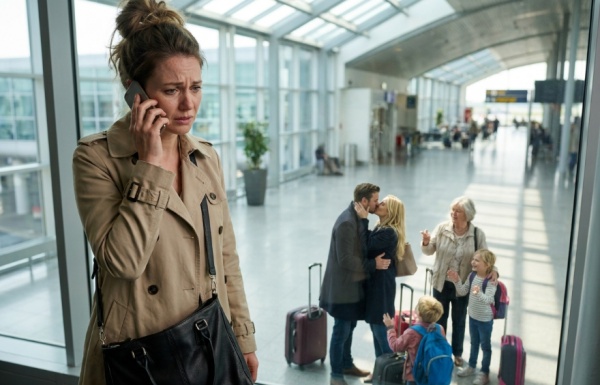
My Husband Said He Was in Emergency Surgery — But I Saw Him at the Airport With Another Woman
Nathan called his wife from the airport and told her he was trapped in emergency surgery. His voice was tired, gentle, and full of apologies, just convincing enough to sound real. But at that exact moment, Elena was standing above Terminal C, watching him kiss another woman beside the check-in counter. What he didn’t know was that she had already uncovered the secret his entire family helped him hide.
Part 1: The Call From the Airport
My husband called me at 6:18 p.m. and told me he was trapped in emergency surgery.
His voice sounded exactly the way it always sounded when he wanted me to believe him: tired, gentle, slightly apologetic, with just enough affection to make me feel guilty for needing anything from him. “Baby, I’m so sorry,” he said. “A case came in at the worst possible time. I promise I’ll make it up to you.”
For a moment, I almost believed him.
That was the strange cruelty of being married to a man like Dr. Nathan Whitaker. He knew how to sound loving even while he was lying. He knew where to soften his voice, when to pause, and how to use exhaustion as a shield.
I stood on the glass pedestrian bridge above Terminal C at Hartsfield-Jackson Atlanta International Airport, holding my phone to my ear while travelers rolled carry-ons beneath me. Through the windows below, I could see the Delta check-in counters, the blue signs, the silver luggage scales, and the bright river of people moving toward security.
And I could see my husband.
He was not wearing scrubs. He was not in an operating room. He was wearing a linen shirt, dark jeans, and the sunglasses I bought him for Father’s Day.
His arm was wrapped around another woman.
She was standing beside him near the check-in counter with a cream-colored suitcase, laughing as he bent down and kissed her. Not quickly. Not politely. Not like a colleague. He kissed her the way a man kisses someone he believes he is allowed to want in public.
I did not move.
Below me, his mother, Eleanor Whitaker, stood beside a stack of Louis Vuitton luggage with the posture of a woman who believed every airport employee should recognize her importance. His sister, Lauren, was checking something on her phone while her husband tried to keep their two little boys from climbing onto the luggage scale.
And my children were there.
My twelve-year-old daughter, Madison, wore a pink hoodie and hugged her backpack to her chest. My nine-year-old son, Oliver, bounced on the balls of his feet, excited in the nervous way children get before a flight. They had been told I was too busy to come.
I knew that before anyone said it.
I knew because Madison looked around the terminal with a small, uncertain frown, the same frown she wore when adults explained something that did not quite make sense. Oliver was simply thrilled. He was young enough to believe any trip involving airplanes and snacks was good news.
Nathan turned slightly, still holding the other woman close, and pressed the phone tighter to his ear.
“I hate missing tonight,” he said to me. “I know we were supposed to have dinner. I’ll send you something from the hospital cafeteria so you know how miserable I am.”
From the hospital cafeteria.
I looked down at the woman beside him. She touched the front of his shirt and said something I could not hear. He smiled at her while listening to me breathe on the other end of the line.
“What kind of surgery?” I asked.
He paused.
That pause was the first mistake.
“Trauma case,” he said. “Complicated. I can’t really talk details.”
Nathan was a pediatric orthopedic surgeon at a private hospital in Atlanta. He was brilliant, respected, and very careful about using words like “emergency” and “can’t talk details” because they made ordinary questions sound intrusive. For years, I had trained myself not to question the sacred wall of his profession.
“Are you at Piedmont?” I asked.
“Of course.”
Below me, he shifted his weight and glanced toward the departure screens.
A Delta agent reached for their passports.
I could see the destination tag appear on the luggage monitor.
Providenciales, Turks and Caicos.
I had not been invited on a family vacation to Turks and Caicos.
My husband, his mistress, his mother, his sister, his brother-in-law, their children, and my children were all preparing to fly to a luxury resort without me while he called me “baby” and pretended to be saving someone’s life.
“Lena?” he said. “Are you there?”
My name is Elena Whitaker. Before I married Nathan, I was Elena Morales, daughter of a public school principal and a woman who ran a small bakery in Decatur for thirty-one years. My parents taught me that dignity did not mean silence, but it did mean timing.
So I did not scream.
I did not shout his name from the glass bridge. I did not race down the escalator, slap him in front of the check-in counter, or give the hundreds of strangers in Terminal C a story to film and upload before boarding.
Instead, I said, “I’m here.”
“I really am sorry,” Nathan said. “I know you were looking forward to tonight.”
Tonight was supposed to be our fifteenth wedding anniversary dinner.
He had asked me to reschedule it twice.
First for a medical conference. Then for an emergency board meeting. Finally, earlier that afternoon, he had said surgery might run late and told me not to wait up.
“I was,” I said.
He sighed softly. “I love you.”
Below me, the other woman leaned her head against his shoulder.
His mother looked straight at them and smiled.
Not surprised. Not uncomfortable. Smiled.
That was the moment I understood the betrayal was not only marital. It was familial. Every person below me knew exactly what was happening, and every one of them had agreed to help erase me from the picture.
“I love you too,” I said.
The words tasted like metal in my mouth.
Nathan softened his voice. “Go home, baby. Get some rest. I’ll call when I’m out.”
“You do that,” I said.
He ended the call.
I lowered the phone and watched him kiss the woman again before handing his passport to the Delta agent.
For a few seconds, I felt nothing.
Then my phone buzzed with a notification from our joint credit card.
Delta Air Lines — $18,742.60 — Pending
I stared at the number.
First-class tickets. Not for me. Charged to the account I paid from the household fund every month because Nathan was “too busy” to manage bills.
I took a photo.
Then another.
Then a short video, steady and clear, of my husband standing in an airport with his arm around another woman while his family prepared to take my children out of the country without telling me the truth.
They thought the biggest secret in Terminal C belonged to him.
They were wrong.
Because I had not come to the airport by accident.
Part 2: The Marriage They Helped Him Hide
Nathan and I met when I was twenty-seven and he was thirty-one.
At the time, he was finishing his fellowship, exhausted and charming, living on coffee and ambition. I was working as an operations manager for a nonprofit healthcare network in Atlanta, the kind of job that required spreadsheets, diplomacy, and the ability to make impossible budgets look less impossible.
We met at a fundraiser for a children’s rehabilitation center. He gave a speech about helping kids walk again after traumatic injuries, and I remember thinking no one that handsome should also be that sincere. Later, he found me near the dessert table and asked whether the mini pecan pies were worth risking public judgment.
I told him public judgment was the foundation of Southern society.
He laughed like I had surprised him.
For the first few years, Nathan made me feel chosen. He came to my mother’s bakery before sunrise to help stack pastry boxes for holiday orders. He learned enough Spanish to speak respectfully to my grandmother. When my father died suddenly of a heart attack, Nathan sat beside me through every terrible decision and never once acted impatient.
That was the man I married.
Or at least, that was one version of him.
His family had never fully accepted me. Eleanor Whitaker was polite in the way expensive people are polite when they want you to remember you are being tolerated. She called me “sweetheart” in a tone that made the word feel like a correction.
Lauren, his younger sister, was sharper. She smiled at me in photos and excluded me in group texts. She once told me, after two glasses of wine at Thanksgiving, that Nathan had always been “destined for a certain kind of life.”
I asked what kind.
She said, “You know. The kind that fits.”
I did not fit their idea of Nathan’s life.
I was not old Atlanta. I did not belong to the country club. My parents did not have a lake house, a trust, or a family attorney on speed dial.
But I had something they underestimated.
I had patience, records, and a memory for details.
For years, I tried to make peace with his family for the sake of our children. Madison and Oliver loved their grandmother. They loved their cousins. I told myself adult pettiness should not shrink a child’s world.
So I hosted holidays. I sent birthday gifts. I thanked Eleanor for advice I did not ask for. I swallowed little insults because I thought marriage required not turning every wound into a war.
Nathan noticed.
He rewarded my patience with absence.
By year twelve, he had become the kind of husband who treated home like a hotel with emotional obligations. He missed dinners, school conferences, and birthdays because patients, surgeries, donors, and hospital politics always needed him more. When he was home, he was affectionate enough to keep me hopeful and distant enough to keep me hungry for more.
Then came Rebecca Sloane.
She was not a nurse, not a surgeon, not someone who could be explained away as hospital proximity. She was a development director at the hospital foundation, responsible for wealthy donors, gala sponsorships, and making rich people feel noble about writing checks.
She was thirty-six, blonde, polished, and trained in the art of looking interested when powerful men spoke.
I first met her at a hospital benefit at the St. Regis Atlanta. Nathan introduced her as “Becca from development.” She shook my hand, complimented my dress, and looked at my husband with the casual warmth of someone who had already moved past introductions.
That night, when I asked him whether she worked closely with him, he laughed.
“Lena,” he said, “she raises money. I fix bones. Not exactly romantic.”
I believed him because the alternative required rebuilding my entire life around a suspicion.
Six months later, I found a receipt from a restaurant in Buckhead hidden inside the pocket of his suit jacket. Dinner for two. Oysters, steak, two glasses of Bordeaux, and one dessert. The time stamp was from a night he told me he was consulting on a surgery in Macon.
I did not confront him.
Not because I was weak.
Because I had learned something from watching women before me lose everything by demanding the truth before they had proof. Liars are not frightened by suspicion. They are frightened by documentation.
I began paying attention.
There were hotel charges described as conference expenses. Gift shop purchases from places he claimed he had not visited. A second phone I saw once in his car console before he closed it too quickly.
Then came the passport applications.
I found them in a kitchen drawer under takeout menus: renewal forms for Madison and Oliver, already signed by Nathan. Mine was not there. When I asked him about it, he said his mother had mentioned maybe taking the kids to the Bahamas in the summer, nothing serious, just “family talk.”
Family talk.
Two weeks later, Madison asked if Turks and Caicos had dolphins.
The room went cold.
I asked where she had heard about Turks and Caicos. She looked immediately guilty, the way children do when they realize they have stepped into adult secrecy by accident.
“Grandma said maybe,” she mumbled. “But Dad said not to tell yet because it was a surprise.”
“For who?” I asked.
She shrugged.
I knew then that the trip was real.
What I did not know yet was whether Nathan planned to take Rebecca.
The answer arrived three days later through a shared iCloud calendar he had forgotten was still synced to our old iPad. A Delta itinerary appeared, then vanished. Not fast enough.
Atlanta to Providenciales.
Six passengers under the Whitaker family booking.
One separate reservation connected to Rebecca Sloane.
Same flight.
Same dates.
Same resort shuttle.
That was when I called Marissa Chen.
Marissa had been my college roommate at the University of Georgia before becoming one of the most terrifying family law attorneys in Fulton County. She had represented women whose husbands hid money in shell companies, dental practices, hunting cabins, and cryptocurrency wallets they thought no one could trace.
When I told her what I had found, she asked one question.
“Have they used marital funds?”
I said, “I think so.”
“Then we start there,” she replied.
For four weeks, while Nathan called me baby and kissed my forehead and told me I was imagining distance where there was only exhaustion, I gathered documents. Credit card statements. Bank transfers. Travel confirmations. Receipts. Screenshots.
Marissa filed nothing at first.
“Not yet,” she said. “If he’s about to walk onto an international flight with your children and his girlfriend while lying about emergency surgery, let him create the record.”
So on our fifteenth anniversary, when Nathan claimed he might be stuck at the hospital, I did not go home.
I drove to the airport.
I parked in the hourly deck.
I walked to the glass bridge above Terminal C.
And I waited.
Part 3: The Secret I Carried Through Security
Watching Nathan lie in real time was different from suspecting it.
Suspicion leaves room for imagination. Proof closes the door. Once I saw him kiss Rebecca beside the check-in counter with my children twenty feet away, there was no version of the story left where I had misunderstood.
I called Marissa from the glass bridge after Nathan hung up.
She answered on the first ring.
“Is he there?” she asked.
“Yes.”
“With her?”
“Yes.”
“Children?”
“Yes.”
“Family?”
“All of them.”
Marissa was quiet for one breath. “Do not confront him in front of the children.”
“I wasn’t planning to.”
“Good. Take photos. Video. Save the call log. Screenshot the credit card charge. Do not interfere with boarding unless you believe the children are unsafe.”
I looked down at Madison, who was now sitting on a suitcase while Oliver pointed at a plane through the windows. They were not unsafe in the immediate sense. They were being lied to, but they were with their father and grandmother, holding passports he was legally allowed to use because we did not yet have a court order restricting travel.
That would change.
Not in the airport.
Not with a scene.
But soon.
“There’s something else,” I said.
Marissa’s voice sharpened. “What?”
“The card charge just came through. Almost nineteen thousand dollars.”
“Joint account?”
“Yes.”
“Send it.”
I sent everything.
Then I stood there, watching the performance below unfold.
Eleanor adjusted Madison’s hoodie, smiling like she was grandmother of the year. Lauren took a selfie with her boys near the luggage. Rebecca stepped back when the children came close, but not far enough to suggest shame.
Nathan lifted Oliver onto the luggage scale for a second, making him laugh. Then he looked down at his phone, probably checking whether I had texted.
I did not.
At 6:47 p.m., a man in a gray blazer approached me on the glass bridge.
“Mrs. Whitaker?” he asked quietly.
I turned.
He was in his late forties, calm, professional, carrying a slim envelope. For one wild second, I thought he was airport security.
“I’m David Ross,” he said. “Ms. Chen sent me.”
Marissa had not told me she had someone nearby.
David was a licensed process server. He had been waiting at the airport in case Nathan confirmed the trip. In Georgia, service of divorce papers can be handled by authorized individuals, and Marissa had prepared a filing that morning after the international itinerary appeared in the credit card pre-authorization.
“You don’t have to do this here,” David said. “But your attorney wanted the option.”
I looked down at my children.
“No,” I said. “Not before they board.”
David nodded. “Understood.”
“Can he be served when he lands?”
“Yes,” he said. “We have someone in Miami if they connect there, and local counsel can coordinate at the resort if needed. But Ms. Chen asked me to tell you something else.”
“What?”
“The bank accepted the fraud hold on the home equity draw.”
My knees nearly weakened.
That was the other secret.
Three weeks earlier, I had discovered Nathan was trying to open a $300,000 home equity line of credit against our house in Sandy Springs. He said it was for a renovation and liquidity planning. The documents included my electronic consent, except I had never given it.
The signature looked like mine.
It was not mine.
Marissa had brought in a forensic document specialist. The bank had been notified. The draw had been frozen that afternoon pending review.
Nathan did not know yet.
Neither did Eleanor.
That mattered because Eleanor was the one who had pushed him toward the loan. I knew from emails Lauren accidentally forwarded to an old family thread that Eleanor believed I had “benefited long enough” from Whitaker status and that Nathan needed “a clean exit with enough liquidity to start over properly.”
Start over properly.
With Rebecca.
On a beach.
With my children smiling in photos cropped carefully enough to make my absence look like a scheduling conflict.
They thought they were boarding a luxury vacation.
They were also walking into the first documented act of a divorce case involving marital funds, possible signature fraud, and an international trip planned around deception.
At 7:05 p.m., Nathan’s phone rang.
I could see him look at the screen.
He frowned.
He stepped away from the group, still within my view, and answered.
Even from the glass bridge, I could read his posture changing. First irritation. Then confusion. Then fear.
The bank had reached him.
He turned sharply toward Eleanor. She looked annoyed at first, then alarmed. Rebecca touched his arm, but he pulled away to keep talking.
I did not need to hear the conversation.
I knew what he was learning.
The home equity line was frozen. The bank had flagged the authorization. Any attempt to access the funds would require in-person verification from both spouses.
I had already told the bank I would not verify.
Nathan looked up suddenly.
For one impossible second, his eyes found the glass bridge.
He saw me.
Our gazes locked through layers of airport glass, fluorescent light, and fifteen years of marriage.
His face emptied.
I lifted my phone slightly, not waving, not threatening, simply letting him see that I had it in my hand.
Then I turned and walked away.
My phone rang before I reached the parking deck.
Nathan.
I let it ring.
He called again.
Then again.
Then came the first text.
Lena, what are you doing at the airport?
Then another.
This is not what it looks like.
Then another.
Call me right now.
I stood beside my car in the hourly parking deck, watching planes rise into the dark Georgia sky.
For years, I had answered every emergency Nathan created.
This time, I called Marissa.
“He saw me,” I said.
“Good,” she replied. “Then he knows the story no longer belongs to him.”
Part 4: The Vacation That Became Evidence
Nathan did not board the flight.
Rebecca did.
So did Eleanor, Lauren, Lauren’s husband, their boys, and my children.
That was the part people misunderstood later when they heard the story in pieces. They asked why I let the children go. They asked why I did not run downstairs and pull them from the line.
Because real life is not a courtroom drama or a movie trailer.
Real life is a mother standing in an airport with no custody order yet, watching her children excited for a trip they do not understand, knowing that a public confrontation might frighten them more than protect them. Real life is calling your attorney, documenting everything, and making the safest legal choice available in the moment rather than the most satisfying emotional one.
Nathan stayed behind because the bank freeze scared him more than missing the vacation.
That told me something.
At 8:14 p.m., he texted: We need to talk tonight.
At 8:16: You don’t understand what’s happening.
At 8:22: My mother took the kids. They’re fine. Don’t make this ugly.
Don’t make this ugly.
I sat in my car and laughed for the first time that night. It was not a joyful sound. It was the kind of laugh that comes when a person who set a house on fire complains about the smoke.
I did not answer.
Marissa filed the emergency motion the next morning.
By 10:30 a.m., Nathan had been served at his hospital office. The petition for divorce included a request for temporary financial restraints, preservation of marital assets, and emergency provisions regarding international travel with the children. It also included the airport documentation, the joint credit card charge, the call log, the false emergency surgery claim, and the frozen home equity issue.
Nathan called me eleven times that day.
I answered none of them.
At 3:40 p.m., Madison called from Turks and Caicos.
“Mom?” Her voice was small.
“Hi, sweetheart.”
“Are you mad?”
My heart broke cleanly.
“At you? Never.”
“Dad didn’t come,” she said. “Grandma said he had work.”
I closed my eyes. “I know.”
“Were you supposed to come?”
There it was.
The question they had all hoped she would never ask.
I chose my words carefully because children deserve truth without adult poison.
“I would have loved to be with you,” I said. “Some grown-up decisions were made without me. That is not your fault.”
She was quiet.
“Did Dad lie?” she asked.
I looked across my kitchen at the anniversary flowers Nathan had sent that morning, white roses again, as if men in crisis all used the same florist.
“I think your dad needs to explain his choices to you when you get home,” I said. “But you and Oliver are safe, and I love you, and I want you to enjoy the ocean.”
“Are you sad?”
“Yes,” I said. “But I’m okay.”
“Okay,” she whispered.
Then Oliver got on the phone and told me there was a pool that looked like a river and that Grandma said he could order pancakes from room service. I listened, smiled, and told him to wear sunscreen.
When the call ended, I cried for ten minutes.
Then I wiped my face and joined a Zoom call with Marissa and a forensic accountant.
The numbers were worse than I expected.
Nathan had used marital funds for Rebecca for at least eight months. Restaurants. Hotels. Jewelry. Airline upgrades. A down payment on a condo lease in Midtown Atlanta. He had coded some expenses as professional development, which mattered because hospital reimbursements and tax reporting were involved.
Marissa was careful.
“We are not accusing him of crimes in the divorce petition unless we have to,” she said. “But we are absolutely preserving the record.”
The hospital learned sooner than expected.
Not from me.
From Nathan.
In trying to justify his absence, he told his department chair that “a personal family emergency” had interfered with travel and financial matters. Unfortunately for him, his earlier story involved an emergency surgery that did not exist. Hospitals keep schedules. Operating rooms keep logs. Surgeons cannot invent cases casually and expect no one to notice.
By the end of the week, Nathan had taken a leave of absence.
Rebecca resigned from the foundation two days later.
Eleanor called me once.
I answered because Marissa said I could, as long as I recorded nothing without understanding Georgia’s consent rules and kept the conversation brief. Georgia is a one-party consent state for recording, but I still did not record. I did not need Eleanor’s voice to prove what her emails already had.
“You have humiliated this family,” she said.
That was her opening line.
I stood in my pantry, holding a bag of rice because I had been reorganizing shelves to keep my hands busy.
“No, Eleanor,” I said. “I revealed what your son was doing.”
“You could have handled this privately.”
“You mean quietly.”
“There are children involved.”
“Yes,” I said. “Mine.”
Her voice sharpened. “You will regret turning this into a battle.”
I looked at the shelves my father had helped install when we moved into the house. I thought of all the holidays I had hosted for people who smiled at my table while planning how to remove me from theirs.
“I regret trusting all of you,” I said. “That is different.”
Then I hung up.
Nathan returned to the house on Saturday night, three days after the airport.
He looked exhausted. Not surgeon exhausted. Consequence exhausted.
I had changed the alarm code. He still had legal access to the home, but Marissa had advised basic safety boundaries and documentation. My brother was in the guest room, just in case.
Nathan stood in the foyer with his overnight bag and stared at me.
“Where are the kids?”
“With your mother, in another country, on the vacation you planned without me,” I said. “You tell me.”
He flinched.
“Lena.”
“No.”
“I made a mistake.”
“You made an itinerary.”
He closed his eyes briefly. “Rebecca and I—”
“If you say her name like this is a love story, I need you to understand I will walk out of the room.”
His mouth shut.
For once, the great Dr. Nathan Whitaker had no elegant explanation ready.
I handed him a folder.
“What is this?” he asked.
“Copies of the temporary financial order Marissa filed. You should give them to your attorney.”
His face hardened. “You’re really doing this.”
I looked at him.
Fifteen years of marriage stood between us. Two children. A mortgage. Holidays. Hospital galas. My father’s funeral. Madison’s first steps. Oliver’s broken arm. Thousands of ordinary mornings I had once believed added up to a life.
“Yes,” I said. “I’m really doing this.”
Part 5: The Woman on the Glass Bridge
The divorce did not end quickly.
Divorce rarely does when money, children, pride, and public reputation all sit at the same table. Nathan hired an expensive attorney from a firm in Midtown. I had Marissa, a forensic accountant, and fifteen years of knowing exactly where the paperwork lived.
Georgia is an equitable distribution state, which means marital property is divided fairly, not automatically equally. Fairness depends on facts. Facts depend on records.
I had records.
The airport video mattered. The call log mattered. The Delta charge mattered. The bank freeze mattered. The attempted home equity draw mattered most of all.
Nathan’s attorney tried to frame the trip as a “family vacation poorly communicated during a marital rough patch.”
Marissa called it what it was: a luxury international trip funded with marital resources, planned while Nathan misrepresented his location, excluded his spouse, included his romantic partner, and attempted to access home equity using disputed authorization.
Poorly communicated did not survive contact with the documents.
The children came home sunburned, tired, and full of questions.
Madison would barely look at Nathan when he picked them up from Eleanor’s house. Oliver was confused because everyone had been tense on a trip that was supposed to be fun. They both needed reassurance more than explanations.
So we started family therapy.
Nathan resisted at first. Then the parenting evaluator recommended it, and suddenly he became cooperative. That was one of the hardest parts of divorcing him: learning to accept good behavior even when I suspected it arrived for strategic reasons.
Madison asked me once, months later, “Did Dad take Miss Rebecca because he wanted a new family?”
I sat beside her on the edge of her bed, under the glow-in-the-dark stars Oliver had stuck to her ceiling without permission.
“I think your dad made selfish choices,” I said. “But you and Oliver are not replaceable. No adult’s mistake changes your worth.”
She cried then, and I held her.
I did not tell her that I had asked myself the same question.
Rebecca disappeared from our lives after resigning. I heard she moved to Nashville for another development job. I did not follow her online. I did not need to watch another woman try to rebrand a relationship that had already served its purpose in my life.
Eleanor remained Eleanor.
She blamed me in careful phrases. She told relatives I had “overreacted.” She told Lauren I had “always been looking for a reason to take Nathan down.”
What she never understood was that I had loved her son enough to build a life around him. I had loved him enough to excuse absences, soften disappointments, and protect the children from adult tension for as long as I could.
Leaving was not the opposite of love.
Sometimes leaving is what love becomes when respect is gone.
Eight months after the night at Terminal C, Nathan and I reached a settlement.
I kept the house until Oliver finished middle school, after which it would either be sold or refinanced under terms we both signed. The marital accounts were divided. Nathan became responsible for certain debts connected to his hidden spending. The disputed home equity line was closed permanently.
The parenting plan was specific.
No international travel without written consent from both parents. No romantic partners introduced to the children without a waiting period and mutual notice. Holiday schedules in writing. Medical decisions shared. School events documented.
It was not romantic.
It was stable.
Stable had become my favorite word.
Nathan’s career survived, but not untouched. His leave of absence ended. His reputation changed in ways people did not say directly but communicated through shorter conversations and fewer invitations. He remained a skilled surgeon, but he was no longer treated like a man whose judgment floated above question.
That mattered to him.
More than losing Rebecca.
More than losing the house.
Maybe even more than losing me.
One year after the airport, I flew with Madison and Oliver to San Diego for spring break.
Just the three of us.
Coach seats. Snacks from Target. A hotel with a pool and free breakfast. Nothing luxurious by Whitaker standards, which made it perfect.
At the Atlanta airport, we walked through Terminal C again.
Madison reached for my hand.
“Are you okay?” she asked.
I looked up at the glass bridge.
For a second, I saw myself there: standing still, phone in hand, watching my old life reveal itself beneath me. I remembered the shock, the coldness in my fingers, Nathan’s voice calling me baby while he kissed another woman below.
Then I looked at my children.
Oliver was arguing that airport pretzels counted as dinner. Madison had grown two inches and developed the careful emotional intelligence of a child who had learned adults could fail and still keep going.
“I’m okay,” I said.
And I meant it.
On the flight to San Diego, Oliver fell asleep before takeoff with his mouth open. Madison watched a movie with one earbud in and leaned against my shoulder. I looked out the window as Atlanta became a grid of lights beneath us.
I thought about secrets.
Nathan’s secret had been obvious once I knew where to stand. A mistress. A vacation. A family willing to lie. A husband who believed affection on the phone could cover betrayal in public.
My secret was quieter.
I knew how to wait.
I knew how to document.
I knew how to protect my children without turning their pain into theater.
And I knew, finally, that being excluded from a vacation was not the same as being left behind.
Months later, Nathan apologized.
Not the first apology. There had been many of those, mostly useless. This one came in the parking lot after Madison’s school concert, while Oliver chased a friend near the gym doors and parents carried folding chairs to their cars.
Nathan stood beside me under a streetlight and said, “I thought if I controlled the story, I could control the consequences.”
I looked at him. “I know.”
He swallowed. “I didn’t understand you.”
“No,” I said. “You didn’t.”
“I thought silence meant you didn’t see it.”
I thought of the glass bridge, the phone call, Rebecca’s cream suitcase, Eleanor’s smile, the Delta charge lighting up my screen.
“My silence meant I was deciding what to do next,” I said.
He nodded.
There was no victory in that moment. No dramatic music. No public humiliation. Just two people standing in a school parking lot with the wreckage of what they had made and unmade between them.
But there was peace.
And peace, I had learned, is often quieter than revenge.
That night, after the children were asleep, I sat at the kitchen table with a cup of tea and opened the photo from the airport one last time. Nathan below me. Rebecca beside him. Eleanor smiling. The luggage stacked like evidence waiting to be named.
I deleted nothing.
I did not need to look at it often anymore, but I kept it because there are some truths a woman should never let the world convince her she imagined.
Then I closed the phone and turned off the kitchen light.
People think the dramatic moment was when I saw my husband kiss another woman in Terminal C.
It wasn’t.
The dramatic moment was when I did not collapse.
When I did not beg.
When I did not give them the scene they could use to call me unstable.
The dramatic moment was the quiet decision on the glass bridge to become the kind of woman my children could lean on, the kind of woman my parents had raised, the kind of woman Nathan’s family never believed I was.
They thought the biggest secret in that airport belonged to him.
They were wrong.
The biggest secret was that I already knew enough to leave.
And by the time Nathan looked up and saw me standing above him, it was already too late for him to lie his way back into my life.
