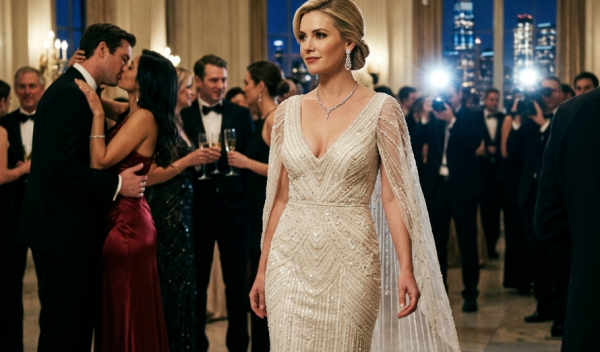
My Husband Kissed His Mistress in Front of Manhattan’s Elite while I stood only a few feet away. He Thought Publicly Betraying Me Would Break Me. He wanted the world to see me lose. But by the time I finished speaking, everyone understood he had been living on borrowed power all along.
Part 1: The Kiss in Front of Two Hundred Cameras
The flashbulbs started before our black town car even reached the curb. In Manhattan, money had a sound, and that night it sounded like camera shutters, champagne corks, and the sharp little gasps people made when someone more powerful than them entered the room. My husband, Grant Whitmore, stepped out first, adjusting his tuxedo cuffs as if the city itself had been built to admire his wrists.
I stayed in the car for three seconds longer than necessary. Not because I was nervous, but because I had learned that timing was the only language men like Grant respected. By the time I placed one silver heel on the sidewalk, the cameras had shifted toward me, and for one brief, glittering moment, I was still Mrs. Whitmore.
The gala was being held at the Whitmore Arts Foundation, a glass-and-limestone building on Fifth Avenue that my husband liked to call “his legacy.” It had his name across the front, his portrait inside the lobby, and his favorite reporters lined up behind velvet ropes. What it did not have, though no one in Manhattan knew it yet, was his money.
“Smile, Evelyn,” Grant murmured without looking at me.
His hand found the small of my back, light enough for photographs and cold enough for the truth. Ten years of marriage had taught him exactly how to touch me in public: not with love, never with tenderness, but with ownership. To the cameras, we were elegance. To me, we were a contract with lipstick on it.
I smiled anyway.
Inside, the ballroom glittered beneath a ceiling of suspended crystal lights. Women in designer gowns moved like expensive birds, and men with seven-figure watches laughed too loudly near the bar. Every wall carried a framed photograph of Grant shaking hands with governors, CEOs, actors, judges, and one former vice president who had once called him “the future of American philanthropy.”
At the center of the room stood the man himself, pretending not to enjoy being worshipped.
Grant Whitmore was fifty-one, handsome in the polished way of men who bought their good health by the hour. His hair had gone silver at the temples, his jaw stayed sharp through personal trainers and private chefs, and his smile could convince investors to hand over millions before dessert. He was the most powerful man in Manhattan, or at least he had spent twenty years making sure everyone believed that.
Then I saw her.
Avery Lane stood near the stage in a red dress cut just low enough to be photographed and just tasteful enough to be defended. She was thirty-two, blonde, ambitious, and beautiful in a way that made other women feel they had walked into the room under the wrong lighting. She was also the woman whose perfume I had smelled on my husband’s shirts for eight months.
She laughed when Grant touched her elbow.
Not a friendly laugh. Not a professional laugh. A soft, private laugh that belonged in hotel rooms and deleted text messages.
My stomach did not drop. That surprised me. I had expected pain, humiliation, maybe even rage, but what moved through me instead was something cleaner and colder. Recognition.
My husband had finally stopped hiding.
The speeches began at eight-thirty. Grant took the stage beneath a banner that read BUILDING A BETTER TOMORROW, which was almost funny enough to make me laugh out loud. He spoke about generosity, responsibility, family values, and the sacred duty of those blessed with wealth to lift others up.
The crowd applauded every lie.
I sat at the front table with a glass of untouched champagne in front of me and my hands folded neatly in my lap. My wedding ring, a five-carat emerald-cut diamond, caught the light each time I moved. People had always assumed Grant bought it for me, and I had never corrected them.
Avery stood near the side of the stage, her face glowing as though Grant’s words were sunlight. Every few seconds, he looked at her. Every time he did, the cameras followed his eyes.
That was the thing about being powerful in New York. People watched where you looked, because your attention was currency.
After the speech, Grant stepped down to thunderous applause. I rose automatically, because wives of powerful men are trained like show dogs to stand at the right moments. He did not come to me.
He crossed the polished floor toward Avery.
At first, the room simply tightened. Conversations thinned. A waiter froze with a tray of crab cakes suspended at shoulder height. Then Grant reached Avery, placed both hands on her face, and kissed her in front of two hundred cameras.
For one full second, no one moved.
Then Manhattan exploded.
Flashbulbs burst like lightning. Reporters shouted his name. Someone dropped a champagne flute, and the sound cracked across the marble floor like a gunshot without the danger. Avery’s hands slid up Grant’s lapels, and she leaned into him as if she had been waiting her whole life for that kiss to become public property.
I remained standing.
That was what people remembered later. Not the kiss, though it played on every gossip site from Page Six to TikTok. Not Avery’s red dress or Grant’s smug, reckless smile. They remembered that I stood there, in a black silk gown, with my champagne untouched and my face perfectly calm.
Grant finally turned toward me.
His expression was not ashamed. It was not apologetic. If anything, he looked relieved, as if humiliating me in front of Manhattan had solved an inconvenience he had been tired of carrying.
“Evelyn,” he said, loud enough for the closest cameras to catch it. “We should talk.”
I looked at him for a long moment.
Then I picked up my clutch, walked to the stage, and took the microphone from the stunned event host.
Part 2: The Wife Nobody Studied
The ballroom went so quiet I could hear the elevator doors open in the lobby. Grant’s smile flickered for the first time that night. He was used to controlling rooms, headlines, charity boards, politicians, mistresses, even me, or at least the version of me he had invented for public consumption.
“Evelyn,” he said again, lower this time. “Don’t.”
That single word confirmed everything.
He thought I was emotional. He thought I was about to cry, scream, beg, or embarrass myself in a way his crisis team could spin by morning. Men like Grant always made the same mistake: they confused silence with weakness because silence had served them so well.
I tapped the microphone once.
The sound echoed across the room, and every camera swung toward me. I could see the reporters adjusting their stance, hungry now, sensing the second act of a scandal. Avery stepped behind Grant, but not far enough to disappear.
“Good evening,” I said. My voice did not shake. “For those of you who don’t know me beyond my last name, I’m Evelyn Whitmore.”
A nervous ripple moved through the crowd.
“I was invited tonight as Grant’s wife,” I continued. “Apparently, I am leaving as his announcement.”
Someone laughed before realizing it was not safe to laugh.
Grant’s jaw tightened.
I turned slightly toward him. “You kissed her in front of two hundred cameras, Grant. That was bold. Careless, but bold.”
Avery’s face flushed. Grant took one step toward the stage, but two security guards, unsure what side history would choose, instinctively moved closer to the stairs. That was when I saw him understand that the room was no longer his.
“I won’t discuss the private pain of a marriage in public,” I said. “That would be beneath the dignity of everyone here, including me.”
A murmur of approval spread through the older women near the front.
“But I will correct a public misunderstanding.” I lifted my left hand, the diamond flashing under the lights. “This foundation, this building, the Whitmore investment vehicles, the penthouse on Park Avenue, the house in East Hampton, the Aspen property, the private jet, the art collection, the voting shares, and every dollar attached to Grant Whitmore’s name are not his.”
Grant stopped moving.
Avery’s mouth opened.
“They are mine.”
The silence that followed was physical. It pressed against the walls and settled over every table. The most powerful man in Manhattan forgot how to breathe.
I could see it happen. His shoulders locked. His lips parted. His eyes, usually so bright with calculation, went blank for half a second, and in that half second, the entire room saw him not as a titan, not as a kingmaker, not as the man whose endorsement could move markets, but as a husband who had badly misread his own marriage.
I looked at the crowd.
“My maiden name is Evelyn Mercer,” I said. “My grandfather founded Mercer Equities. My mother expanded it. I inherited controlling interests at twenty-six and built the rest while my husband built a public image.”
A few people knew. Most did not. Wealth in America has layers, and the oldest money is often the quietest because it has nothing to prove.
“When Grant and I married, we signed a prenuptial agreement drafted by his attorneys and revised by mine,” I continued. “He insisted on protecting himself. I agreed.”
I looked at him again. “That was the smartest decision you ever made for me.”
The room shifted. Phones were raised higher. Even the donors who pretended to dislike gossip were recording now.
“For ten years, Grant has presented my assets as his empire. I allowed it because I believed partnership sometimes meant letting the person you love stand in brighter light. But love is not a blank check, and marriage is not a costume a man can wear while humiliating the woman who paid for the stage.”
Grant found his voice. “This is absurd.”
“No,” I said gently. “This is documented.”
At that exact moment, the ballroom screens behind me changed. The foundation’s logo disappeared, replaced by a clean slide prepared by my attorneys. It showed corporate ownership charts, trust structures, signatures, dates, and the Mercer name in places Grant had spent a decade pretending not to see.
No confidential account numbers. No private addresses. Nothing illegal. Just enough truth to end a myth.
Avery stepped away from him.
That, I admit, almost made me smile.
“Effective this morning,” I said, “Grant was removed from all executive and advisory roles in Mercer-controlled entities. His corporate cards have been canceled. His access to foundation accounts has been suspended pending audit. His apartment staff has been reassigned. The jet will not be available to him tonight.”
Someone gasped.
“And because the Whitmore Arts Foundation was funded entirely through the Mercer Family Trust, its board voted this afternoon to rename it the Mercer Community Arts Fund, with new leadership to be announced next week.”
Grant stared at the screen as if it had betrayed him personally.
Then he looked at me with something I had not seen in years.
Fear.
Part 3: The Empire Built on Borrowed Gold
People later asked me why I chose that night. They imagined revenge as a sudden flame, but mine had been a slow winter. It began eight months earlier, on a Tuesday morning, with a lipstick stain on the collar of Grant’s shirt and a $6,400 receipt from a boutique hotel in SoHo.
I did not confront him then.
I had grown up around powerful men, and I knew confrontation only taught them what to hide next. Instead, I called my attorney, Lillian Brooks, a woman with silver hair, sharp glasses, and the moral patience of a locked vault. “Are you ready to know everything?” she asked me.
“No,” I said. “But I’m ready to stop being the last to know.”
The investigation was legal, quiet, and thorough. No hacking. No tricks. No stolen passwords. Just accountants, corporate records, credit card statements, public filings, board minutes, staff reports, and the kind of paper trail arrogant men leave because they believe no one will ever read the fine print.
Grant had not merely had an affair. He had used Mercer-funded events to promote Avery’s consulting firm. He had placed her on advisory committees she was not qualified for. He had arranged “business travel” that included suites in Miami, Napa, and Santa Barbara, all billed under philanthropic development expenses with language so vague it insulted the intelligence of anyone sober.
The money was not enough to ruin me. That was never the point. The betrayal was not the dollars spent; it was the entitlement behind them.
He had taken the life my family built and used it as lighting for his affair.
Still, I waited.
I watched him lie over breakfast in our Park Avenue kitchen while the city moved below us in gray morning light. I listened to him call me “darling” with the same mouth he used to whisper to Avery in voice messages. I let him discuss legacy, expansion, and reputation while my attorneys prepared the documents that would remove his hands from everything he thought he owned.
There were moments when I hated myself for waiting. At night, I would stand in our bathroom, staring at my reflection under those cruel white lights, wondering when dignity had started to feel like performance. But then I remembered my mother.
She had been the kind of woman who wore pearls to board meetings and made grown men sweat by asking one polite question. When my father died, people suggested she sell the company, retire, remarry, or let “experienced leadership” handle things. She smiled, thanked them for their concern, and tripled the family’s holdings in six years.
“Never interrupt a man while he is revealing himself,” she once told me. “Just take notes.”
So I took notes.
By the week of the gala, Grant had grown reckless. He stopped hiding calls. Avery’s name appeared in conversations as if I were too dull to hear it. He even suggested, two nights before the event, that “modern marriages require modern understandings.”
I remember looking at him across the dinner table, at the candlelight softening his face, and realizing he had mistaken my grief for permission.
“What kind of understanding do you mean?” I asked.
He swirled his wine. “The kind where adults don’t make dramatic scenes.”
That was when I knew he was planning something public.
He wanted to force my humiliation into acceptance. If he kissed Avery behind closed doors, it was betrayal. If he kissed her in front of Manhattan, he thought it became reality. He believed the room would pressure me into silence because wealthy people hate discomfort more than they hate cruelty.
Grant understood money.
He did not understand ownership.
At 9:07 p.m., as I stood on that stage, I watched years of borrowed authority drain from his face. His tuxedo was still custom. His cufflinks were still platinum. His name was still known in every important room in the city.
But the invisible machinery that made people obey him had stopped.
“Evelyn,” he said, voice low enough that the microphone barely caught it, “you’re making a mistake.”
“No,” I replied. “I made a mistake ten years ago when I believed gratitude could become character.”
The ballroom inhaled.
Avery’s eyes darted from Grant to me, then toward the exits. I almost felt sorry for her. Almost.
She had not fallen in love with a man. She had fallen in love with a skyline reflection, a black card, a Hamptons weekend, a private elevator, and the way hostesses suddenly remembered her name when she entered a restaurant beside him. Now she was discovering that all of it had been rented from a wife she had underestimated.
Grant turned toward the crowd, attempting to recover. “Ladies and gentlemen, my wife is upset. This is a private marital matter.”
“It became public when you kissed your mistress beneath a foundation banner funded by my family,” I said.
A reporter near the front shouted, “Mrs. Whitmore, are you filing for divorce?”
“Yes,” I answered.
Grant flinched.
“The petition was filed this afternoon in New York County Supreme Court,” I said. “The filings are sealed where appropriate, and I will not discuss personal details beyond what is necessary. But I will say this: I am not seeking revenge. I am seeking accuracy.”
That word mattered.
Accuracy was clean. Accuracy was legal. Accuracy was impossible for Grant to fight without exposing more lies.
I stepped away from the microphone, then paused. The room leaned toward me.
“One final clarification,” I said. “My name is Evelyn Mercer. I will be using it again.”
Then I set the microphone down.
No one applauded at first. Scandal had stunned them, truth had frozen them, and money had made them cautious. But then an elderly woman named Beatrice Caldwell, who had known my grandmother and owned half a block of Tribeca, stood up and clapped once.
Then again.
Then the room followed.
Part 4: The Woman in the Red Dress
I did not leave through the front.
Lillian had arranged for a side exit, a security team, and a car waiting on East 79th Street. In New York, dignity sometimes means knowing which door not to use. Behind me, the gala dissolved into whispers, phone calls, and the kind of panic that wears diamonds.
My assistant, Nora, handed me my coat as soon as I reached the hallway.
“You were perfect,” she said.
“No,” I replied. “I was finished.”
Outside, the June air felt heavy and expensive, full of exhaust, damp pavement, and the distant sound of sirens. Manhattan does not stop for anyone’s heartbreak. It simply absorbs the wreckage and raises the rent.
I slid into the back seat of the car, and for the first time that night, my hands began to shake.
Nora noticed but said nothing. Good assistants, like good friends, understand when silence is a kindness. She placed a bottle of water beside me and closed the door.
My phone had become a weaponized beehive. Text messages from friends, board members, cousins, journalists, people I had not heard from since our wedding, and three women who had once warned me about Grant in language too polite for me to understand at the time. I turned the screen face down.
At 10:14 p.m., Avery called.
I stared at her name for three rings before answering.
“Evelyn,” she said, and her voice had lost all its velvet. “I didn’t know.”
I looked out the window as we passed the glowing windows of Madison Avenue boutiques. “You didn’t know he was married?”
“No, I mean—” She stopped. “I didn’t know the money was yours.”
There it was.
Not apology. Not remorse. Astonishment at the collapse of value.
“That must be very upsetting for you,” I said.
She exhaled sharply. “He told me you were separated. He said the marriage was basically over. He said you were cold, that you only cared about appearances.”
I almost laughed, but exhaustion got there first.
“Avery,” I said, “a man who asks you to stand in another woman’s life and wait for her to be erased is not offering you love. He is testing how much of yourself you will surrender for proximity to power.”
She was quiet.
“I didn’t call to fight,” she said finally.
“Then why did you call?”
“I don’t know.” Her voice cracked. “Maybe because everyone is looking at me like I’m stupid.”
For the first time all night, my anger softened into something sadder. Avery was not innocent, but she was also not the architect. She was a woman who had mistaken selection for security, and now the man who chose her had become a liability on live video.
“You are not stupid,” I said. “But you were willing not to look too closely.”
She cried then, quietly.
I did not comfort her. I also did not punish her. There are some debts women pay to themselves, and no insult from me would cost her more than tomorrow morning would.
“Do yourself a favor,” I said. “When he calls you, do not become his emergency exit.”
Then I hung up.
By midnight, Grant was everywhere.
Cable news called it “The Whitmore Meltdown.” Business blogs called it “a stunning governance reversal.” Social media, less generously, called him “Manhattan’s most expensive plus-one.” Someone clipped the exact moment his face went empty after I said, “They are mine,” and by morning it had been viewed eleven million times.
I did not watch it.
At 1:30 a.m., Grant arrived at the Park Avenue penthouse.
Or rather, he attempted to.
I was sitting in the library with Lillian, two security consultants, and a cup of tea I had not touched when the front desk called. Grant was downstairs demanding access. His name had been removed from the approved resident list at 6:00 p.m., pursuant to ownership documents and legal notice.
“Let him up to the private conference room,” Lillian said. “Not the residence.”
Five minutes later, Grant walked in looking like a man whose reflection had resigned.
His bow tie was gone. His hair was no longer perfect. There was a faint red mark on his cheek, perhaps lipstick, perhaps stress, perhaps the first visible sign that consequences had touched him.
“You locked me out of my home,” he said.
“My home,” I corrected.
He looked at Lillian. “This is marital property.”
“It is not,” she said calmly. “The residence is held by a Mercer family entity acquired prior to the marriage. You have been notified.”
Grant’s face darkened. “You’re enjoying this.”
“No,” I said. “That is what you don’t understand. I’m not enjoying any of this.”
He turned back to me, and for a second I saw the man I had married, or maybe just the mask he wore back then. “Evelyn, come on. We can fix this.”
That sentence almost broke me.
Not because I believed it, but because once, years earlier, I would have given anything to hear him say it. I would have mistaken those four words for love. Now they sounded like a banker trying to renegotiate terms after default.
“What exactly do you want to fix?” I asked. “The marriage, or the access?”
His silence answered.
I nodded slowly. “There he is.”
Grant stepped closer. “You think people will side with you forever? They won’t. They’ll get bored. They always do.”
“I’m not asking people to side with me.”
“You destroyed me in public.”
“No,” I said. “You revealed yourself in public. I brought receipts.”
His eyes flashed. “I made that name mean something.”
“You rented that name from me.”
For a moment, I thought he might shout. Instead, he laughed once, bitter and ugly. “You were nobody before me.”
Lillian closed her folder.
I stood.
Grant knew immediately that he had gone too far. I could see regret cross his face, not moral regret, but strategic regret. The kind men feel when they realize cruelty has cost them leverage.
“My family’s money bought the first firm you ran,” I said. “My contacts got you your first board seat. My mother’s reputation opened doors you later claimed you kicked down. I stood beside you while you confused applause with achievement.”
His mouth tightened.
“But thank you,” I added. “I needed to hear you say that.”
He frowned. “Why?”
“Because tomorrow, when I wonder whether I was too harsh, I will remember this conversation.”
For the first time that night, he had no answer.
Part 5: The Morning After the King Fell
Divorce in New York is not a movie scene. It is paperwork, calendars, disclosures, valuations, affidavits, and lawyers using calm voices to describe emotional disasters. By sunrise, my private life had become a public timeline, but the legal process moved with the ordinary rhythm of courts and deadlines.
That steadiness saved me.
The next morning, I woke in the guest suite of my own penthouse because I could not bear to sleep in the bedroom where Grant had lied beside me for years. Sunlight spilled over Central Park, soft and gold, indifferent to scandal. My coffee went cold on the nightstand while I read one message from my mother’s old friend Beatrice.
Your grandmother would have stood up first too.
That was when I cried.
Not dramatically. Not beautifully. I sat on the edge of the bed in a robe I did not remember putting on and cried like someone whose bones had finally received permission to be tired. For ten years, I had been elegant. That morning, I was only human.
The public story moved fast. Sponsors paused their relationships with Grant. Two boards requested his resignation. A university quietly removed him from an upcoming commencement panel about ethical leadership, which would have been funny if I had not been so exhausted.
Avery disappeared from social media for three days.
Grant, however, tried to fight.
He released a statement through a crisis communications firm claiming that I had “mischaracterized complex marital and business arrangements during an emotionally charged event.” It was the kind of sentence rich men pay other rich men to write when the truth is too short. My attorneys responded with one paragraph and thirteen attached documents.
By lunch, his statement had been deleted.
Two weeks later, I met him in a conference room overlooking Bryant Park. It was neutral territory, gray-carpeted and cold, with bottled water lined up like evidence. Grant sat across from me with his attorney, wearing a navy suit and the expression of a man trying to look humbled without actually experiencing humility.
He had aged in fourteen days.
Power had kept him inflated, and without it, his face seemed smaller. He still looked handsome, but now it was obvious how much of his presence had been borrowed from rooms that were afraid to disappoint him. Nobody in that conference room was afraid.
His attorney spoke first. “Mr. Whitmore is prepared to resolve this privately and respectfully.”
Lillian smiled in a way that made private and respectful sound like two knives being placed on the table.
“That has always been our preference,” she said.
Grant kept staring at me.
Finally, he said, “Was any of it real?”
The question surprised me. Not because it was profound, but because it was late. Men like Grant often arrived at sincerity only after every other strategy had failed.
“My love was real,” I said. “Your performance was expensive.”
He looked down.
For a moment, the room held the ghost of our marriage. There we were, ten years after our wedding at the New York Public Library, surrounded not by flowers and music, but by settlement drafts and asset schedules. I remembered him touching my hand during our vows, his eyes wet enough to convince me he understood the promise he was making.
Maybe he had loved me then.
Maybe he had loved what loving me gave him.
There is a difference, and women are often punished for learning it too late.
The settlement was clean. The prenup held. Grant received what the agreement allowed and nothing his ego invented. He kept his clothes, personal effects, a modest account in his own name, and the burden of discovering who still answered his calls when I was no longer attached to them.
I kept my name.
Not Whitmore.
Mercer.
In September, the foundation reopened under its new banner: The Mercer Community Arts Fund. We shifted its mission away from elite galas and toward public school arts programs, neighborhood theaters, immigrant artist grants, and community studios in all five boroughs. The first event was held in Queens, not Fifth Avenue, and the tickets were free.
No red carpet.
No champagne tower.
No husband pretending charity was a mirror.
A young girl from the Bronx played violin that afternoon, standing beneath fluorescent lights in a renovated community center that smelled faintly of paint and cafeteria pizza. She was twelve, nervous, and brilliant. When she finished, the room stood for her, and the applause felt different from anything I had heard at Grant’s galas.
It was not social currency.
It was joy.
Afterward, I stepped outside with a paper cup of coffee and watched parents take pictures of their children against the new mural on the building wall. My phone buzzed with a news alert I did not ask for. Grant had been seen leaving a restaurant downtown with a venture capitalist who specialized in “reputation rehabilitation.”
I deleted the alert.
Some stories do not need a sequel.
Avery sent me an email in October. It was short, careful, and more honest than anything Grant had ever written me. She apologized without excuses, said she had left the consulting firm he helped promote, and admitted she was trying to understand why she had mistaken proximity to wealth for worth.
I read it twice.
Then I wrote back: I hope you build something that belongs to you.
I meant it.
By winter, Manhattan had moved on, because Manhattan always does. There was a new scandal, a new billionaire behaving badly, a new viral clip of someone important discovering gravity. My name still appeared in articles sometimes, usually beside phrases like “quiet power” or “the woman behind the empire,” which made me laugh because people still could not understand the simplest truth.
I was never behind the empire.
I was the empire.
On the first anniversary of that gala, I returned to the building on Fifth Avenue alone. The Mercer name stood above the entrance now, carved in clean bronze letters. Inside, the lobby no longer displayed Grant’s portrait. In its place hung photographs of students, painters, dancers, and musicians from programs we had funded across the city.
I stood there for a long time.
A security guard asked if I was waiting for someone.
“No,” I said.
And it was true.
For years, I had waited for Grant to notice me, respect me, choose me, tell the truth, come home, become the man he had pretended to be. I had waited through dinners, board meetings, birthdays, apologies, rumors, hotel receipts, and silence. Waiting had become so familiar that freedom felt strange at first, like walking through my own house after all the mirrors had been removed.
But I was done waiting.
That night, I walked twelve blocks home in low heels, because in New York, twelve blocks can clear more from your head than therapy if the weather is right. The air smelled like roasted chestnuts from a street cart and wet concrete after rain. A yellow cab splashed through a puddle near the curb, and the driver shouted an apology through the window.
I laughed.
Not a polite laugh. Not a gala laugh. A real one.
When I reached Park Avenue, I looked up at the penthouse windows glowing high above the street. For the first time in years, the place did not look like a beautiful cage. It looked like property.
Mine.
The doorman opened the door and smiled. “Good evening, Ms. Mercer.”
I stopped for half a second.
Then I smiled back. “Good evening.”
Upstairs, I removed the diamond ring Grant had never bought and placed it in a velvet box inside my desk. I did not throw it away. I did not sell it. Some symbols do not need destruction; they only need retirement.
Then I opened the windows despite the cold and let Manhattan noise fill the room.
Sirens. Horns. Footsteps. A dog barking somewhere below. The living sound of a city that had watched me be humiliated and then watched me stand taller than the man who tried to shrink me.
People still asked whether I regretted what happened that night.
The answer was complicated.
I regretted the years I spent explaining away small cruelties because the big life around them looked so beautiful. I regretted confusing loyalty with self-erasure. I regretted every time I made myself easier to betray by being easier to underestimate.
But I did not regret the microphone.
I did not regret the truth.
And I certainly did not regret the look on Grant Whitmore’s face when he realized that the kingdom he had flaunted in front of Manhattan had never belonged to him.
Not the foundation.
Not the penthouse.
Not the jet.
Not the name.
Not even the applause.
He had kissed his mistress in front of two hundred cameras because he believed public humiliation would make me powerless. Instead, he gave me an audience. And when I revealed that every dollar attached to his name had always been mine, the most powerful man in Manhattan finally learned what real power looked like.
It did not shout.
It did not beg.
It simply took the microphone and told the truth.
