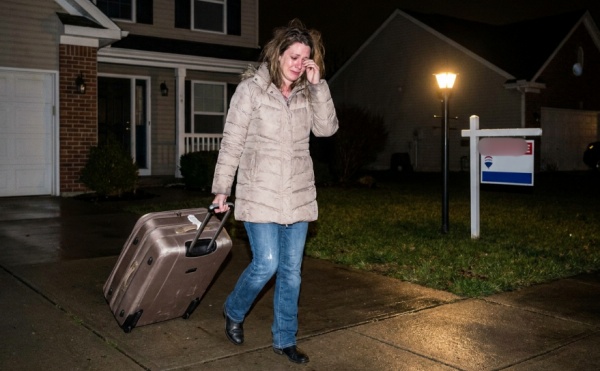
My husband called me and said, ‘I want a divorce. She’s pregnant, and it’s mine. As for you… you can never be a mother.’ I didn’t cry, scream, or curse… I just quietly packed my bags and walked out. Two years later, we crossed paths at a supermarket while I was holding my baby boy. My ex froze dead in his tracks the moment he saw the child. That was the exact moment he realized who his real child was.
PART 1 — The Phone Call That Ended My Marriage
The call came at 7:42 p.m. on a rainy Thursday in Portland, Oregon.
I remember the exact time because I had been sitting at our kitchen island, staring at a white pharmacy bag like it contained either a miracle or a cruel joke. Outside, rain tapped against the windows in soft, steady lines, the kind of rain that made the whole city smell like wet pavement, pine trees, and old coffee.
Inside the bag were three pregnancy tests.
All positive.
For almost four years, my husband, Ethan Caldwell, and I had tried to have a baby. Four years of ovulation calendars, blood work, hormone shots, awkward doctor appointments, and smiling politely at baby showers while dying a little inside. Four years of hearing people say, “Just relax, it’ll happen,” as if my uterus needed a vacation and not medical help.
Ethan used to hold my hand during fertility appointments.
At least, he did in the beginning.
Back then, he would kiss my forehead in the waiting room and tell me, “We’re in this together, Maddie.” He would squeeze my fingers when the doctor explained another failed cycle, another low chance, another expensive option insurance refused to cover. He made me believe that even if we never had a child, we would still have each other.
But somewhere between the second miscarriage scare and the third failed treatment, Ethan changed.
He started working late at his marketing firm downtown. He started taking calls in the garage instead of the living room. He stopped looking at me with concern and started looking at me like I was a bill he regretted signing.
That Thursday night, I had planned to tell him everything.
I had even set the dining table, which now feels ridiculous when I think about it. I roasted chicken with rosemary, made mashed potatoes the way he liked them, and bought the local IPA from the brewery near his office. I wanted the moment to feel warm, ordinary, hopeful.
I wanted to say, “Ethan, we’re finally going to be parents.”
Instead, my phone rang.
His name flashed across the screen.
I smiled before answering because I thought he was calling to say he was on his way home.
“Hey,” I said. “Dinner’s almost ready.”
There was a pause on the other end. Not the distracted pause of a man checking traffic or answering an email. This pause was sharp and heavy, like he had already decided something and was waiting for me to step into it.
“Maddie,” he said, “we need to talk.”
My smile faded.
Those four words have a temperature. Cold. Metallic. Final.
“Okay,” I said slowly. “Are you coming home?”
“No.”
I looked at the table, at the two plates, the folded napkins, the little candle I had lit because I wanted tonight to be special.
“Where are you?”
Another pause.
“With Vanessa.”
I did not recognize the name at first. Then I did. Vanessa Reed. His coworker. Twenty-eight, glossy hair, loud laugh, always leaning too close in office party photos. Ethan had once described her as “just ambitious,” which I later learned was what married men called women they wanted to defend before anyone accused them.
My hand tightened around the phone.
“Why are you with Vanessa?”
Ethan exhaled like I was exhausting him.
“Because I’m in love with her.”
The room became very quiet.
The rain kept falling. The candle kept burning. The chicken sat cooling on the counter, filling the kitchen with the smell of a dinner no one was going to eat.
I waited for the pain to hit all at once, but it didn’t. It came slowly, like cold water rising around my ankles.
“What did you say?” I whispered.
“I said I’m in love with her,” Ethan repeated, more firmly this time. “And I want a divorce.”
I stood up from the stool, but I had nowhere to go.
“You’re telling me this over the phone?”
“I didn’t want a scene.”
A scene.
That was what my heartbreak was to him. Not a marriage. Not vows. Not years of trying, grieving, hoping, failing, and trying again. A scene.
Then he said the sentence that split my life in half.
“She’s pregnant, Maddie. And it’s mine.”
I stopped breathing.
For one terrible second, my eyes dropped to the pharmacy bag on the counter. Three positive tests. Three tiny plastic sticks that had made me press my hand over my mouth and laugh-cry in the bathroom twenty minutes earlier.
I opened my mouth to tell him.
But Ethan kept talking.
“I know this hurts,” he said, in the same tone someone uses when returning a sweater. “But I have a chance to be a father now. A real father. I can’t keep pretending we’re okay when we both know you can never give me that.”
The words landed like stones.
You can never give me that.
Not we struggled. Not we went through something painful. Not our marriage is broken. Just me. My body. My failure. My worth reduced to one thing he believed I could not do.
I gripped the edge of the counter.
“You’re cruel,” I said quietly.
He sighed. “I’m being honest.”
“No,” I said. “Honesty doesn’t require cruelty.”
There was a moment when I thought he might soften. Maybe apologize. Maybe realize what he had just done.
He didn’t.
“I’ll come by tomorrow for some things,” he said. “My lawyer will contact you next week. The house is in both our names, so we’ll need to figure that out.”
I looked around our little Craftsman home in Southeast Portland. The blue front door we painted ourselves. The scratched hardwood floors. The nursery room we never finished because I couldn’t bear to walk past an empty crib every day.
Then I looked at the pregnancy tests.
“No,” I said.
“No what?”
“You don’t come tomorrow.”
“Maddie, don’t make this difficult.”
I almost laughed.
He had called me from another woman’s apartment, told me his mistress was pregnant, asked for a divorce, and blamed me for infertility while I was carrying his child.
And I was the one making things difficult.
I wiped my cheek and realized I was not crying. Not really. A few tears had slipped out, but the big breakdown never came. Something inside me had gone strangely still.
“I’ll be gone by morning,” I said.
He scoffed. “Where are you going to go?”
That was the moment I understood something important.
Ethan did not just think I was broken.
He thought I was trapped.
I looked down at my left hand, at the wedding ring he had chosen six years earlier, back when he still looked at me like I was a future instead of a disappointment.
Then I took it off and set it beside the pregnancy tests.
“I don’t know yet,” I said. “But I won’t be here.”
“Maddie—”
I hung up.
For several seconds, I stood in the kitchen listening to the silence after his voice disappeared. Then I moved.
I packed one suitcase, then another. Clothes, documents, my grandmother’s earrings, my laptop, the ultrasound referral form my doctor had given me that morning. I took the pregnancy tests, too, wrapping them in a paper towel like evidence from a crime scene.
At midnight, I called my older sister, Rachel, in Bend.
She answered on the second ring, groggy and worried.
“Maddie? What’s wrong?”
I finally cried then.
Not because Ethan had left.
Because I had nearly told him about the baby before he showed me who he really was.
By 4:30 a.m., Rachel was in my driveway wearing sweatpants, a parka, and the kind of furious expression only a sister can wear properly.
She walked into my kitchen, saw the untouched dinner, saw my suitcase, saw the wedding ring beside the pregnancy tests, and said one word.
“Good.”
Then she hugged me so hard I could barely breathe.
At 5:10 a.m., I locked the blue front door for the last time.
I did not leave Ethan a note.
I did not call him back.
I did not scream in the driveway, slash his tires, or post about him online. I simply got into my sister’s Subaru, rested one hand over my still-flat stomach, and watched the house disappear behind us in the gray morning rain.
That was the day Ethan Caldwell believed he had chosen his real family.
That was also the day he unknowingly threw his real child away.
PART 2 — The Secret I Carried
My sister’s house in Bend smelled like cedar, laundry detergent, and cinnamon coffee.
It was the opposite of the home I had left behind. Portland had been wet streets, narrow sidewalks, and crowded coffee shops. Bend was wide skies, snowy peaks in the distance, and quiet mornings where the cold air felt clean enough to forgive you for surviving.
Rachel put me in her guest room and told me I could stay as long as I needed.
Her husband, Mark, was a firefighter and a man of few words. When I arrived, he carried my suitcases upstairs, placed a mug of tea on the nightstand, and said, “Nobody gets to treat you like that here.” Then he went downstairs and gave me privacy.
I cried for two days.
Not gracefully.
I cried in the shower. I cried into cereal. I cried while folding tiny baby socks Rachel bought before I was ready to admit I wanted them. I cried because I still loved the man I had married, even though that man no longer seemed to exist.
On the third day, I called my OB-GYN.
“Madeline Caldwell?” the receptionist asked.
I almost corrected her to my maiden name, Parker, but the words stuck.
“Yes,” I said.
I scheduled my first ultrasound for the following week.
Rachel drove me. She sat beside me in the waiting room, flipping through an outdated parenting magazine while I stared at the floor. Every pregnant woman around me seemed to have a partner holding their hand, carrying their water bottle, rubbing their back.
I had my sister.
And honestly, that was better than a husband who thought loyalty expired when life got hard.
When the nurse called my name, my heart began pounding.
The exam room was small and warm, with pale yellow walls and a poster showing fetal development by week. I lay back on the table, pulled up my shirt, and tried not to shake as the technician placed cool gel on my stomach.
At first, the screen looked like gray weather.
Then there it was.
A tiny flicker.
The heartbeat.
Fast, steady, impossible.
Rachel gasped and grabbed my hand.
The technician smiled. “There’s your baby.”
My vision blurred.
For years, I had imagined this moment with Ethan beside me. I had imagined him crying, laughing, kissing my hand. I had imagined us leaving the clinic and buying the first ridiculous onesie we saw.
Instead, my sister whispered, “That little heartbeat is the strongest sound I’ve ever heard.”
And I believed her.
The baby measured eight weeks and three days.
That meant I had already been pregnant the night Ethan called me. Two months pregnant while he told me I could never be a mother. Two months pregnant while he bragged about another woman carrying his child.
On the drive home, Rachel asked the question everyone eventually asked.
“Are you going to tell him?”
I looked out the window at the pine trees rushing past.
“No.”
Rachel did not answer right away.
“Maddie,” she said carefully, “I hate him. You know I do. But legally—”
“I’ll talk to an attorney,” I said. “I’m not disappearing forever. I’m not doing anything reckless. I just don’t want him near me while I’m pregnant.”
Rachel nodded slowly.
That week, I hired a family law attorney named Dana Whitaker. She had silver hair, square glasses, and the calm energy of a woman who had spent thirty years watching people weaponize marriage certificates.
I told her everything.
The affair. The phone call. Vanessa’s pregnancy. Ethan’s words. My pregnancy.
Dana listened without interrupting, taking notes in a yellow legal pad.
When I finished, she leaned back and said, “First, you are not required to personally notify him tonight, tomorrow, or before you are emotionally stable. Second, if divorce proceedings begin, pregnancy may matter legally depending on timing, paternity presumptions, and custody issues. Third, do not lie in legal filings. But you can protect your medical privacy until disclosure becomes necessary.”
I nodded.
“I don’t want revenge,” I said.
Dana looked at me over her glasses.
“Yes, you do.”
I opened my mouth, then closed it.
She wasn’t wrong.
I wanted Ethan to hurt. I wanted him to feel the humiliation of standing in front of someone and realizing he had been cruel to the wrong person. I wanted him to understand that the woman he called barren had walked away carrying the only child who was actually his.
But I also knew something else.
If I let revenge raise my baby with me, Ethan would still be controlling my life.
So I asked Dana, “What can I do that’s legal, clean, and protects my child?”
Dana smiled slightly.
“That,” she said, “is the right question.”
We filed for legal separation first. Ethan’s lawyer responded quickly, almost smugly. Ethan wanted the house sold, retirement accounts divided, and no spousal support either way. He claimed the marriage had “irretrievably broken down due to infertility stress,” which made Rachel so angry she had to go outside and shovel snow that wasn’t there.
Ethan did not mention Vanessa in the paperwork.
Men like Ethan never wrote their ugliest truths in legal documents if softer lies were available.
Meanwhile, my pregnancy continued.
At twelve weeks, I heard the heartbeat again. At sixteen weeks, I felt the first flutter, like a secret knocking from the inside. At twenty weeks, the ultrasound technician asked if I wanted to know the sex of the baby.
I said yes.
“It’s a boy,” she told me.
Rachel burst into tears before I did.
I named him Oliver James Parker.
Not Caldwell.
Parker.
My father’s name had been James, and Oliver was simply a name I had loved since college. I did not choose it to punish Ethan. I chose it because my son deserved a name born from love, not bitterness.
Pregnancy was not magical every day.
Some mornings I vomited so hard I cried on the bathroom floor. Some nights I woke up terrified I would lose him. Sometimes I would be shopping for maternity jeans and suddenly remember Ethan’s voice saying, You can never be a mother, and I would have to leave the store before panic swallowed me whole.
But slowly, I rebuilt myself.
I found a remote job doing communications work for a nonprofit based in Seattle. I opened my own bank account. I changed my emergency contact from Ethan to Rachel. I joined a prenatal yoga class where nobody knew me as the woman whose husband left her for a pregnant mistress.
I was just Maddie.
A woman having a baby.
A woman starting over.
Ethan emailed twice during my pregnancy.
The first email was about the house.
The second was about a box of vinyl records he believed I had taken.
He never asked how I was.
He never apologized.
Through mutual friends, I heard pieces of his new life with Vanessa. They moved into a townhouse near Lake Oswego. They had a gender reveal party with blue smoke, matching outfits, and a professional photographer. Ethan posted a picture online with his hand on Vanessa’s stomach and the caption: Can’t wait to meet my son.
Rachel showed me by accident.
She thought I had already seen it.
I stared at the photo for a long time.
Ethan looked proud. Not peaceful. Not humbled. Proud. Like fatherhood was a trophy he had won after trading in the wife who couldn’t give it to him.
I placed my hand on my own stomach.
Oliver kicked.
Hard.
I smiled through the pain.
“Don’t worry,” I whispered. “He doesn’t know what he lost.”
PART 3 — The Baby Who Saved Me
Oliver was born during a snowstorm in February.
Not the soft, romantic kind of snowstorm people put on Christmas cards. This was Central Oregon snow, thick and stubborn, piling against the hospital windows while plows scraped the roads outside. Rachel drove me to St. Charles Medical Center with one hand on the wheel and the other ready to honk at anyone who dared delay her nephew’s arrival.
Labor lasted nineteen hours.
By the end, I was sweaty, shaking, exhausted, and absolutely certain I would never again believe any movie that showed childbirth as a few dramatic pushes and a glowing mother.
But then Oliver cried.
One sharp, furious, beautiful cry.
The doctor placed him on my chest, slippery and warm, with a head full of dark hair and tiny fists curled against my skin. I looked down at him and felt the world rearrange itself around his face.
He had Ethan’s mouth.
I noticed it immediately.
That should have broken me, but it didn’t. Because he also had my father’s chin, my sister’s stubborn little frown, and something entirely his own. He was not a reminder of Ethan. He was a reminder that life can come through heartbreak and still belong completely to itself.
Rachel stood beside the bed sobbing openly.
Mark took one look at Oliver and said, “That kid already looks like he’s judging my tax returns.”
I laughed so hard the nurse told me to be careful.
Those first months were brutal and beautiful.
I slept in ninety-minute pieces. I learned to eat sandwiches one-handed. I discovered that newborns make noises like tiny farm animals and that love can feel less like fireworks and more like staying awake at 3:00 a.m. because someone smaller than your forearm needs you.
I also learned that motherhood was not something Ethan had given me permission to become.
It was mine.
Every bottle washed, every diaper changed, every pediatrician visit, every midnight lullaby became a quiet answer to his cruelty. Not a public answer. Not a dramatic one. Just a daily truth.
I was a mother.
I had always been capable of being one.
He simply had not been worthy of witnessing it.
When Oliver was six months old, my divorce became final.
By then, Ethan’s life had begun to crack.
I did not know the full story yet, only fragments.
Vanessa’s baby had been born three months after Oliver. Ethan named him Caleb Michael Caldwell and posted a long announcement about “becoming the man I was meant to be.” The photos looked perfect at first. Ethan smiling in a hospital room, Vanessa wearing a flawless face of makeup, the baby wrapped in a blue blanket.
But perfection is expensive to maintain when it is built on lies.
Dana called me one afternoon while Oliver napped.
“I need to tell you something,” she said.
My stomach tightened. “Is it about Ethan?”
“Yes.”
I walked into the kitchen, away from the nursery.
“Vanessa’s former boyfriend has filed a paternity petition in Multnomah County,” Dana said. “He claims Vanessa told him privately that he may be the biological father of her child.”
I gripped the counter.
“Oh.”
“There may be testing,” Dana continued. “This does not directly involve you unless Ethan attempts to revisit issues in your divorce, but I thought you should be aware in case you hear rumors.”
I sat down slowly.
For a moment, I felt nothing.
Then I laughed.
Not loudly. Not happily. Just one short, shocked sound.
Ethan had destroyed our marriage for a baby he believed was his. He had called me defective, disposable, and replaceable. He had built a new life on the idea that Vanessa had given him what I never could.
And now even that might have been a lie.
Rachel reacted exactly as expected.
“Karma wore heels and walked right into court,” she said.
But I did not celebrate the way I thought I would.
Maybe motherhood had changed me. Maybe exhaustion had burned the theatrical revenge out of me. Or maybe holding Oliver every day had made it impossible to enjoy a child being pulled into adult messes.
Because Caleb was innocent.
Whatever Ethan deserved, that baby deserved stability, truth, and adults who did not treat him like evidence.
A month later, the results became known through the same gossip channels that had once carried news of Ethan’s “miracle son.”
Ethan was not Caleb’s biological father.
The real father was Vanessa’s former boyfriend, a contractor from Vancouver, Washington, who had apparently dated her during one of her “breaks” with Ethan. Vanessa claimed confusion. Ethan claimed betrayal. The internet did not need claims; it had screenshots, timelines, and too many people eager to talk.
Ethan removed every photo of Caleb from his social media.
That was how I knew the worst part of him had not changed.
A decent man would have grieved privately. A decent man would have remembered that he had held that child, named him, smiled over him, and called himself Dad. A decent man would have understood that biology changes facts, but it does not erase months of love if the love was real.
Ethan erased the baby like a bad investment.
That told me everything.
Still, I kept my distance.
I did not call him. I did not email. I did not send a photo of Oliver with a caption. I did not stand outside his office with a stroller and a speech prepared.
I simply kept living.
Oliver turned one with cake frosting in his hair and both hands smashed into a vanilla cupcake. Rachel decorated her backyard with blue and green balloons, Mark grilled burgers in twenty-degree weather because he insisted “real Oregon men don’t fear February,” and Oliver laughed every time the dog barked.
I cried when everyone sang happy birthday.
Not because I was sad.
Because one year earlier, I had been terrified I would not be enough for my son. And now there he was, chubby-cheeked, bright-eyed, adored by people who showed up without being begged.
That night, after Oliver fell asleep, I sat on the floor beside his crib.
“You saved me,” I whispered.
Then I corrected myself.
“No. You gave me a reason to save myself.”
Two years passed from the night Ethan called me.
Two years since he said Vanessa was pregnant.
Two years since he said I could never be a mother.
By then, Oliver had dark curls, serious brown eyes, and a habit of pointing at bananas in grocery stores like he was accusing them of crimes. He loved trucks, blueberries, ducks, and the word “no,” which he used with the confidence of a Supreme Court ruling.
He was twenty-two months old the day we went to the supermarket.
It was a Saturday morning in early spring.
I almost went to our usual grocery store, but Oliver had thrown his favorite red sneaker into the laundry basket, and by the time I found it, we were closer to a larger Fred Meyer on the north side of Bend. I remember thinking it was annoying.
I did not know I was being moved by the strange little machinery of fate.
Oliver sat in the cart seat wearing a dinosaur hoodie, swinging his legs and eating crackers from a snack cup. I was comparing applesauce pouches when I heard my name.
“Maddie?”
My body knew the voice before my mind accepted it.
I turned.
Ethan stood at the end of the aisle holding a basket with a frozen pizza, a six-pack of sparkling water, and the stunned expression of a man who had just walked through a door into his own past.
He looked older.
Not dramatically. Just worn around the edges. His hair was still styled, his jacket still expensive, but the confidence that once surrounded him like cologne had thinned. He looked like someone who had spent two years discovering that consequences are not rumors.
His eyes moved from my face to Oliver.
And then he froze.
Dead still.
Oliver stared back at him, cracker in hand.
For one impossible second, nobody moved.
Then Ethan whispered, “Whose child is that?”
I felt my pulse in my throat.
I had imagined this moment more times than I care to admit. In my fantasies, I was clever. Ruthless. Perfectly dressed. I delivered a line so devastating strangers applauded in the produce section.
But real life is quieter.
Real life smells like applesauce, floor cleaner, and rotisserie chicken.
Real life gives you a toddler with cracker crumbs on his hoodie and an ex-husband who suddenly looks like he might collapse beside the canned soup.
I placed one hand on Oliver’s back.
“My son,” I said.
Ethan’s face changed.
Not all at once. Slowly. First confusion. Then calculation. Then disbelief. Then horror.
“How old is he?” Ethan asked.
I looked him in the eye.
“Almost two.”
The basket slipped slightly in his hand.
“No,” he said.
I said nothing.
He stepped closer, staring at Oliver’s face. My son frowned at him with the same crease between his eyebrows that Ethan had when reading contracts. The same dark eyes. The same tiny dimple near the left corner of his mouth.
Ethan saw it.
I watched the truth enter him.
It did not ask permission.
PART 4 — The Aisle Where Truth Caught Him
“Maddie,” Ethan said, his voice barely above a whisper. “Is he mine?”
I had spent two years preparing for that question.
Still, hearing it hurt.
Not because I doubted the answer. I had done a private paternity test after Oliver was born for legal documentation, even before Dana suggested it might become necessary someday. I knew exactly who my son’s father was.
But biology was the smallest part of fatherhood.
Ethan had been Oliver’s father by DNA since the day I walked out of that blue front door. He had simply not been a dad for a single minute.
I looked at Oliver, who was now trying to feed a cracker to a stuffed dinosaur.
Then I looked back at Ethan.
“Yes,” I said.
Ethan’s face drained of color.
He set his basket down on the floor like his hands had forgotten how to hold things.
“You knew?”
“Yes.”
“When?”
“The night you called me.”
He blinked.
“What?”
“I had three positive pregnancy tests on the kitchen counter while you told me Vanessa was pregnant,” I said. “I was two months along while you told me I could never be a mother.”
The words hung between us.
A woman pushing a cart slowed at the end of the aisle, sensed danger, and wisely turned around.
Ethan ran a hand through his hair.
“Why didn’t you tell me?”
I almost smiled.
There it was.
Not I’m sorry. Not I destroyed you. Not I abandoned my pregnant wife. Just the injured outrage of a man who believed every truth in the world still owed him immediate delivery.
“Because you had already told me who you were,” I said.
His eyes flashed. “That’s not fair.”
“No,” I said. “Fair was me sitting alone in fertility clinics while you slept with your coworker. Fair was you calling me from her apartment to say she was giving you the child I couldn’t. Fair was you letting me carry the shame for a problem that was never only mine.”
Ethan flinched.
I kept my voice low because Oliver was listening, even if he didn’t understand.
“I didn’t hide him to punish you,” I said. “I protected my pregnancy. I protected my peace. And when the divorce required legal honesty, my attorney handled what needed to be handled. You were notified through counsel after Oliver was born.”
Ethan stared at me.
“I never got anything.”
“That is something to discuss with your former attorney,” I said. “Not in a grocery store.”
His jaw worked.
I could see him trying to rebuild himself in real time. Ethan had always been good at finding angles. If shame didn’t work, he tried charm. If charm failed, he tried anger. If anger failed, he became the victim.
Right on schedule, his eyes filled.
“I lost a child,” he said.
“No,” I replied. “You lost an illusion.”
“That’s cruel.”
“You taught me the difference between cruelty and honesty.”
His mouth opened, then closed.
Oliver dropped his cracker cup. It hit the floor, spilling crackers across the aisle. I crouched immediately, gathering them into my hand.
Ethan crouched too, but Oliver pulled back against me.
That tiny movement said more than any speech could.
Ethan noticed. His face crumpled for half a second before he covered it.
“What’s his name?” he asked.
“Oliver.”
“Oliver,” he repeated, like the name hurt his tongue.
I stood, lifting Oliver from the cart. He wrapped his arms around my neck and rested his cheek against my shoulder, suspicious of the stranger in the expensive jacket.
Ethan looked at him as if trying to memorize two years in ten seconds.
“I want to know him,” he said.
I felt anger rise so fast it nearly took my breath.
For two years, I had done the night feedings. I had taken the temperatures, changed the diapers, paid the medical bills, sung through fevers, worked during naps, cried quietly in the laundry room, and learned to be both soft place and strong wall.
Now Ethan wanted to know him because another child had turned out not to be his.
My son was not a consolation prize.
“You don’t get to walk into aisle seven and claim fatherhood like a coupon you forgot to use,” I said.
People were definitely listening now, but I did not care as much as I thought I would.
Ethan lowered his voice. “I have rights.”
“Yes,” I said. “And Oliver has rights too. Including the right to stability, safety, and a father who shows up through the court system instead of ambushing his mother next to applesauce.”
His face tightened.
“I’m not dangerous.”
“I didn’t say you were.”
“You’re acting like I am.”
“I’m acting like I learned.”
He looked away.
That landed.
For a moment, I saw something unfamiliar in Ethan’s expression. Not pride. Not self-pity. Something closer to recognition. It was small, but it was there.
“Maddie,” he said quietly, “Vanessa lied to me.”
“I know.”
His eyes snapped back. “You know?”
“People talk.”
He gave a bitter laugh. “Of course they do.”
I shifted Oliver on my hip.
“I’m sorry Caleb got hurt in the middle of that,” I said.
Ethan looked startled.
Maybe he expected me to celebrate. Maybe he expected me to say he deserved it. And he did deserve pain, in some ways. But Caleb did not deserve to become the punchline of Ethan’s karma.
Ethan swallowed.
“I thought he was mine,” he said.
“And when you found out he wasn’t?”
His silence answered before his mouth did.
I nodded slowly.
“You walked away.”
His eyes hardened defensively. “It was complicated.”
“No,” I said. “It was revealing.”
Oliver touched my cheek with one sticky hand.
“Mommy,” he said.
Ethan’s entire body reacted to that one word.
Mommy.
The word he told me I would never hear.
The word that had become my sunrise, my exhaustion, my purpose, my proof.
Ethan stared at us, and I saw the exact moment he understood the full shape of what he had done. He had not just left a wife. He had left a pregnant wife. He had not just chosen the wrong woman. He had rejected his real child before knowing the child existed.
And the worst part was that he had done it with arrogance.
“Maddie,” he whispered, “I’m sorry.”
There it was.
Two years late.
Still, I had once wanted those words so badly that I thought they might heal me.
They didn’t.
They were just words. Small ones. Too small to cover the distance between the woman crying in the kitchen and the mother standing in the supermarket holding her son.
“I believe you’re sorry,” I said.
His eyes filled with hope.
“But I don’t believe your apology is bigger than your regret.”
The hope died.
I reached into my purse and pulled out Dana’s business card. I had carried one for months, not because I expected this exact moment, but because motherhood had taught me to be prepared for messes.
I handed it to him.
“If you want to discuss legal paternity, custody, or visitation, contact my attorney. Do not come to my home. Do not follow us. Do not post about Oliver. Do not contact my family. Everything goes through proper channels.”
Ethan took the card with shaking fingers.
“Can I just—” He looked at Oliver. “Can I say goodbye to him?”
I looked at my son.
Oliver was not afraid, exactly. Just uncertain. He saw a stranger, and that was what Ethan was.
“You can say goodbye from there,” I said.
Ethan’s face twisted, but he nodded.
He crouched slightly, keeping distance.
“Bye, Oliver,” he said softly.
Oliver stared at him.
Then he lifted one hand and gave the smallest wave.
Ethan pressed his lips together like he was trying not to break in half.
I put Oliver back in the cart, picked up the applesauce pouches, and turned away.
“Maddie,” Ethan said behind me.
I stopped but did not turn.
“I really did love you once.”
I looked over my shoulder.
“I know,” I said. “That was part of the problem. You thought loving me once excused what you did later.”
Then I walked toward checkout.
I did not look back until I reached the front of the store.
Ethan was still standing in the aisle, holding the attorney’s card, surrounded by spilled crackers and the groceries he had forgotten to buy.
For the first time since that phone call, I did not feel like the woman he abandoned.
I felt like the woman who survived him.
PART 5 — The Price of What He Threw Away
Ethan contacted Dana the following Monday.
Of course he did.
Men like Ethan needed the weekend to turn shock into strategy.
Dana called me after lunch. Oliver was napping, and I was sitting at my kitchen table with a mug of coffee I had reheated three times and still hadn’t finished.
“He wants a paternity test,” Dana said.
I almost laughed.
“He can have one,” I replied.
“You’re sure?”
“I already know the answer.”
“He’s also asking about visitation.”
My fingers tightened around the mug.
“What did you tell him?”
“That we will follow Oregon family law, prioritize the child’s best interests, and move gradually if paternity is legally established,” Dana said. “I also made it clear that showing up emotionally overwhelmed does not entitle him to immediate access.”
I exhaled.
“Thank you.”
The court-ordered DNA test came back exactly as expected.
Ethan Caldwell was Oliver’s biological father.
Dana forwarded the official result to me as a PDF. I opened it while Oliver sat on the floor stacking blocks with great seriousness. There it was in sterile legal language: probability of paternity greater than 99.99%.
I looked at my son.
He knocked down the blocks and clapped for himself.
I closed the laptop.
The result changed Ethan’s legal position, but it did not change our life overnight. That was the part he seemed unable to understand. He expected biology to unlock a door. The court expected consistency, accountability, and a plan.
At the first hearing, Ethan looked polished but nervous.
I wore a navy dress Rachel helped me choose because she said it made me look “like a woman who has receipts.” She sat behind me in court, arms crossed, glaring so hard I worried the judge might cite her for emotional arson.
Ethan’s attorney argued that he had been unaware of Oliver’s existence.
Dana responded with documentation showing that proper legal notice had been sent after Oliver’s birth during the finalization process and that Ethan’s former counsel had acknowledged receipt. Whether Ethan read the paperwork was not my responsibility.
The judge was calm, middle-aged, and deeply unimpressed by drama.
“This court is not here to punish adults for failed marriages,” she said. “This court is here to determine what arrangement serves the child.”
I appreciated that.
Because I did not want the court to punish Ethan for me.
Life had already begun doing that.
Ethan had lost his reputation in ways I had not caused. His office affair became known after Vanessa’s paternity scandal. He left his marketing firm six months later, officially for “new opportunities,” unofficially because clients did not enjoy seeing their brand strategist become office gossip.
Vanessa moved to Arizona with Caleb and the child’s biological father.
I heard Ethan contested nothing related to Caleb. No visitation. No continued relationship. Nothing. The baby he once publicly celebrated disappeared from his life like a deleted photo album.
That fact mattered to the judge.
It mattered to me more.
Because Oliver was not going to be another child Ethan loved only when the story made him look good.
The court ordered a step-up parenting plan.
At first, Ethan would have supervised visits twice a month at a family center in Bend. If he attended consistently, completed a parenting class, paid child support, and followed communication rules, the arrangement could expand. If he missed visits or used them to pressure me, the court would know.
Ethan looked disappointed.
I looked relieved.
Outside the courthouse, he approached me carefully.
Rachel immediately stepped between us.
“It’s okay,” I told her.
She moved aside, but only by about six inches.
Ethan looked tired.
“I’m going to do it,” he said. “The classes. The visits. All of it.”
I nodded. “Good.”
“I don’t want to be the man you think I am.”
I studied him.
“That’s between you and your choices.”
He looked down. “Does he like trucks?”
I hesitated.
“Yes.”
“What kind?”
“All kinds. Fire trucks especially. His uncle Mark is his hero.”
The words slipped out before I could soften them.
Ethan absorbed the hit.
“Right,” he said quietly.
His first supervised visit was awkward.
Oliver clung to me at drop-off, confused by the room full of toys and the stranger who kept looking at him with desperate softness. The supervisor was kind, explaining that toddlers needed time, and Ethan should not force affection.
For once, Ethan listened.
He sat on the floor and pushed a toy truck back and forth without asking Oliver to come closer. After ten minutes, Oliver watched. After twenty, he crawled over and took the truck. After thirty, he said, “Mine,” and Ethan smiled like he had been handed a crown.
I watched from behind the observation glass with my arms wrapped around myself.
It hurt.
Not because I wanted Ethan back. That door had closed, locked, and grown ivy over it. It hurt because healing is rarely clean. Sometimes the person who harmed you begins doing the right thing, and you have to make room for that without pretending the wrong thing never happened.
Months passed.
Ethan did not transform into a perfect man.
That would be too easy.
He was late once and received a warning. He sent me a message directly instead of through the parenting app and Dana reminded him of the order. He brought an expensive toy Oliver ignored in favor of the cardboard box, which felt like the universe making a point.
But he kept showing up.
Slowly, Oliver learned his name.
Not Dad.
Not at first.
Just Ethan.
The first time Oliver said it, Ethan cried in the family center parking lot when he thought no one could see him. I saw from my car, and for a moment, I felt something like pity. Not forgiveness, exactly. Pity.
There is a difference.
By Oliver’s third birthday, the court allowed short unsupervised visits at a public park.
Ethan arrived with a small fire truck, a bag of apple slices, and sunscreen. The old Ethan would have brought something flashy and expected praise. This Ethan knelt down, opened the toy carefully, and let Oliver decide whether to play.
Oliver did.
I sat on a bench thirty feet away, watching my son laugh as Ethan rolled the truck down a slide.
Rachel sat beside me with iced coffee.
“I still hate him,” she said.
“I know.”
“Less than before, maybe.”
“That sounds healthy.”
She sighed. “Do you forgive him?”
I watched Ethan catch Oliver at the bottom of the slide. My son squealed, cheeks flushed with joy, completely unaware of the adult wreckage that had shaped his first years.
“I don’t know,” I said. “I don’t think forgiveness is one big door. I think it’s a bunch of small gates. Some open. Some don’t.”
Rachel nodded.
“What gate opened?”
I thought about it.
“I don’t wake up wanting him to suffer anymore.”
“That’s annoying mature of you.”
I laughed.
The truth was, I had wanted Ethan to pay.
On that rainy night two years earlier, when I packed my bags with shaking hands and a baby no bigger than a raspberry inside me, I wanted a dramatic reckoning. I wanted him abandoned, humiliated, exposed, and forced to watch me become everything he said I couldn’t be.
And he did pay.
Not because I destroyed him.
Because his own choices sent the bill.
He paid when Vanessa’s lie collapsed. He paid when he learned the child he rejected was his. He paid when a judge told him fatherhood was not a feeling but a responsibility. He paid every time Oliver reached for me instead of him. He paid in the slow, ordinary currency of consequences.
But I learned something motherhood teaches whether you ask or not.
If you build your life around making someone pay, you keep handing them the keys.
I had not escaped Ethan just to let revenge move into the guest room.
So I built something else.
A small house with warm lights. Saturday pancakes. Library story time. Work emails answered during naps. Birthday candles. Rain boots by the door. A child who knew he was loved before he knew he had ever been at the center of a heartbreak.
One evening, after Ethan dropped Oliver off from a two-hour park visit, he lingered near the porch.
Oliver ran inside to show Rachel a leaf he considered extremely important.
Ethan stood with his hands in his jacket pockets.
“Maddie,” he said, “I know I’ve said sorry before. But I need to say something else.”
I waited.
“I used your pain to excuse my selfishness,” he said. “I blamed you because it was easier than admitting I was weak. And when Vanessa said she was pregnant, I didn’t just choose her. I chose the version of myself that got to feel like a winner.”
The porch light buzzed softly above us.
I said nothing.
He continued.
“When I saw Oliver in that grocery store, I thought the worst part was realizing he was mine,” Ethan said. “But it wasn’t. The worst part was realizing you became a mother without me, and maybe that was the safest thing for both of you.”
For the first time, his apology did not sound like a performance.
It sounded like a man standing in the wreckage with no audience left to impress.
“I appreciate you saying that,” I said.
His eyes searched my face, but he did not ask for more.
That mattered.
A year earlier, he would have tried to pull comfort from me like a debt. Now he simply nodded.
“I’ll see you next Saturday,” he said.
“Yes.”
He walked to his car.
Not a luxury SUV anymore. Just a used Honda Accord with a dent near the back bumper. I watched him drive away, and I felt no triumph.
Only peace.
Inside, Oliver was sitting on the floor with Rachel, explaining the leaf in great detail.
“It’s a dinosaur leaf,” he announced.
“Obviously,” Rachel said with complete seriousness.
I picked him up, and he wrapped his arms around my neck.
“Mommy,” he said, “Ethan truck park.”
“Yes,” I said. “You had fun at the park.”
He nodded sleepily.
I carried him upstairs, brushed his teeth, changed him into pajamas with little planets on them, and read the same bedtime book three times because toddlers negotiate like trial attorneys. When he finally drifted off, his hand rested against my wrist.
I sat there in the soft glow of the nightlight.
For years, I had thought the worst sentence anyone could say to me was, You can never be a mother.
But Ethan had been wrong.
Not just medically wrong. Spiritually wrong. Humanly wrong.
Motherhood was not something he had the power to deny me.
It had arrived quietly, secretly, under my own heart, on the very night he tried to make me feel empty.
Two years later, in a grocery store aisle, he saw my baby boy and finally understood.
The child he had chased was never his.
The child he had thrown away was.
And me?
I did not scream. I did not curse. I did not beg the universe to strike him down.
I held my son.
I told the truth.
And I let Ethan Caldwell spend the rest of his life learning that some losses do not happen when someone walks away from you.
Some losses happen when you are too blind to see what you already had.
