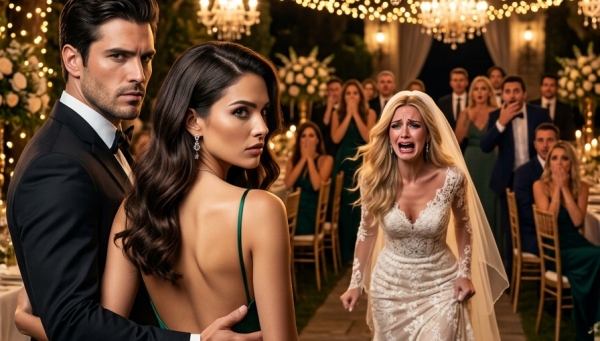
My Ex Invited Me to His Wedding to Humiliate Me—But My Date Knew the Bride’s Darkest Secret… David didn’t invite me to his wedding because he respected me as the mother of his three children. He invited me because he wanted his family, his friends, and his new bride to see me sitting quietly in the back row, proving that his betrayal had somehow become acceptable.
I almost stayed home, but instead I arrived in an emerald dress with a stranger named Nathan by my side. The moment the bride locked eyes with him, her perfect smile vanished—and I realized David’s fairytale wedding was about to become evidence of something much bigger.
Part 1: The Invitation That Felt Like a Trap
The night my ex-husband planned to humiliate me at his wedding, I showed up with a handsome stranger on my arm.
That was not the plan at first. My original plan was to throw the invitation into the trash, pour myself a glass of cheap red wine, and spend Saturday night watching a crime documentary with my cat judging me from the couch.
But David knew me too well.
He knew I had spent most of our marriage trying to be gracious, reasonable, and calm. He knew I hated giving anyone the satisfaction of seeing me break. And he definitely knew that if he mailed me a cream-colored wedding invitation with my full name written in perfect calligraphy, I would stare at it for three days wondering if not going would make me look bitter.
The invitation arrived on a Tuesday.
I found it wedged between a utility bill and a coupon flyer from a grocery store I never shopped at. At first, I thought it was a mistake. The envelope was thick, expensive, and addressed to Mrs. Hannah Whitmore, which was funny because I had stopped being Mrs. Whitmore fourteen months earlier.
Inside was a folded card with gold lettering.
David Whitmore and Elise Camden request the honor of your presence as they celebrate their marriage.
I read the sentence twice.
Then I laughed.
Not because it was funny. Because my body did not know what else to do with the insult.
David had cheated on me with Elise.
Everyone knew it, though he had managed to polish the story until it sounded like something softer. According to David, our marriage had “ended emotionally” long before anything happened between them. According to Elise, they had “fallen in love unexpectedly.” According to me, my husband had started spending late nights at his marketing firm with a woman who wore my perfume and then told me I was paranoid when I noticed.
We had been married for six years.
Not a lifetime, but long enough to know the sound of each other’s footsteps in the hallway. Long enough to have shared a mortgage, a dog we later fought over in mediation, and a folder on my laptop labeled Baby Names, even though David eventually admitted he had never been sure he wanted children with me.
He told me that part during our final argument.
It was two weeks before he moved out, and we were standing in the kitchen of our townhouse in Arlington, Virginia. I remember the dishwasher running, the smell of burnt toast, and how ordinary the morning light looked on the countertops.
“You want a life that feels heavy,” he said. “Kids, family dinners, routines. I want something bigger.”
“Bigger than a family?” I asked.
“Bigger than this,” he said, gesturing around the kitchen like our life was a waiting room he had been trapped in.
Three months later, he posted a picture with Elise in front of the Eiffel Tower.
The caption said: Sometimes life begins when you finally choose happiness.
I blocked him after that.
Or I thought I did.
Somehow, the wedding invitation still found me.
For the next few days, I told myself I would not go. I was thirty-four years old, not a character in some messy reality show. I had a job I liked, friends who loved me, and a therapist who kept reminding me that dignity did not require attendance.
Then my phone buzzed.
It was a text from David’s sister, Mallory.
Hey Hannah. Just checking that you got the invite. David said he really hopes you can come. It would mean a lot if everyone could see there are no hard feelings.
I stared at those words for a long time.
No hard feelings.
That was David’s favorite trick. He hurt people, then acted wounded if they bled in public. If I stayed home, he could tell everyone I was still bitter. If I came alone, he could parade Elise around in her designer gown while people whispered about how brave I was to show up.
Either way, he got the story he wanted.
That evening, I met my best friend, Ava, for dinner at a crowded taco place in Georgetown. She listened while I explained the invitation, the text, the careful wording, and the way my stomach had not unclenched since Tuesday.
Ava took one bite of her fish taco and said, “Absolutely not.”
“I know.”
“No, I mean absolutely not to going alone.”
“I’m not going at all.”
She gave me the look she usually reserved for bad parking and worse men.
“You’re going,” she said.
“I am?”
“Yes. Because if you don’t, he gets to say you couldn’t handle it. But you are not walking into that wedding looking like the tragic ex-wife in a sad beige dress.”
“I don’t own a sad beige dress.”
“Good. We’re keeping it that way.”
I rubbed my temples. “Ava, I don’t have a date.”
She smiled.
That should have scared me.
“I might know someone.”
“No.”
“You haven’t even heard who.”
“I don’t care who.”
“He’s normal.”
“That’s what people say right before introducing you to someone who owns a snake.”
“He does not own a snake.”
“Does he own a podcast?”
“No.”
“Then I’m listening.”
His name was Nathan Reed.
Ava knew him through her brother, who worked with him at a commercial architecture firm in D.C. He was thirty-seven, divorced, polite, and apparently “annoyingly handsome in a quiet way,” which sounded like something Ava had invented to make me agree.
“I am not using a random man as emotional armor,” I said.
“You’re not using him. You’re hiring him emotionally.”
“That is worse.”
“He already knows the situation.”
I stared at her. “You told a stranger about my divorce?”
“I gave him the highlights.”
“Ava.”
“He said he’d go if you wanted. No pressure. He’s good at awkward social situations.”
“Why?”
“He grew up with three sisters and a mother who ran a church committee.”
That did sound like training.
I said no for two days.
Then David emailed me.
Hannah, I know this may feel complicated, but Elise and I truly hope you’ll come. It could be healing for everyone.
Healing.
The man had cheated on me, moved out, fought me over a couch he did not even like, and was now inviting me to watch him marry the woman he had chosen while I was still packing his shirts into cardboard boxes. But somehow, my attendance would be healing for everyone.
I called Ava.
“Does Nathan own a suit?” I asked.
She screamed so loudly I had to pull the phone away from my ear.
I met Nathan for coffee the next afternoon in Old Town Alexandria. I arrived early because anxiety makes me punctual. He walked in at exactly 3:00 p.m., wearing dark jeans, a navy sweater, and a gray wool coat that looked too good to be accidental.
Ava had not exaggerated.
Nathan was handsome, but not in a loud way. He had dark hair, steady eyes, and the kind of face that seemed more interested in listening than performing. When he smiled, one corner of his mouth lifted first, as if he had to approve the expression before letting the rest of it happen.
“You must be Hannah,” he said.
“And you must be the emotionally hired stranger.”
He laughed.
“That might be the best job title I’ve ever had.”
We talked for an hour. I told him the basics: ex-husband, affair partner, wedding invitation, likely public humiliation disguised as maturity. Nathan listened without interrupting, which made me trust him more than I wanted to.
Finally, he said, “What do you need me to do?”
“Stand next to me. Smile occasionally. Don’t let me look pathetic.”
“You don’t look pathetic.”
“You haven’t seen me near an open bar and unresolved trauma.”
“Fair.”
I studied him over my coffee.
“Why would you agree to this?”
His expression changed.
Only slightly.
“I know what it’s like to walk into a room where everyone thinks they know the story,” he said.
There was something behind that sentence, but he did not offer it, and I did not ask.
The wedding was the following Saturday at a vineyard outside Middleburg, Virginia. Of course it was. David had always loved places that looked like money but called themselves rustic.
I wore a deep emerald dress that Ava picked because, according to her, “green says healed, expensive, and slightly dangerous.” She did my hair in soft waves, loaned me earrings, and made me repeat three times that I would not cry in public unless someone died or Taylor Swift personally arrived to sing at the reception.
Nathan picked me up at 4:30 p.m.
When I opened the door, he looked at me for one second too long.
Then he said, “David is an idiot.”
It was the nicest thing anyone had said to me all week.
Part 2: The Bride Turned White
The vineyard looked like a wedding magazine had exploded across the Virginia countryside.
There were white roses climbing wooden arches, string lights hanging over the reception tent, and a long gravel driveway lined with lanterns. Guests in cocktail dresses and dark suits gathered near a stone patio, sipping champagne and pretending not to stare when Nathan and I arrived.
I felt the staring immediately.
Divorce gives people a terrible kind of curiosity. They do not want to ask questions, but they want your face to answer them anyway. Were you devastated? Are you over it? Did he leave you, or did you drive him away? Are you thinner because you’re thriving or because you stopped eating?
Nathan placed his hand lightly at the small of my back.
“You’re doing fine,” he said under his breath.
“I haven’t done anything yet.”
“That’s usually when people do best.”
I almost smiled.
Then I saw David.
He stood near the entrance to the ceremony area wearing a black tuxedo and the expression of a man who had expected to be admired all evening. His hair was styled more carefully than I remembered, and he had grown a little beard that made him look like he was trying to seem thoughtful.
For a second, my chest tightened.
Not with love.
With memory.
There had been a time when seeing David across a room made me feel chosen. He used to wink at me during crowded parties, bring me coffee on Sunday mornings, and kiss the back of my hand at red lights. The hardest part of betrayal is not losing the villain. It is realizing the villain once knew how to be gentle.
David saw me.
Then he saw Nathan.
His smile flickered.
That alone was almost worth the dress.
“Hannah,” David said, walking toward us with his arms slightly open, as if we were old friends meeting at a charity event. “You came.”
“You invited me.”
His eyes moved to Nathan.
“And you brought a guest.”
“I did.”
Nathan extended his hand.
“Nathan Reed.”
David shook it, but his grip looked tighter than necessary.
“David Whitmore.”
“I figured.”
A tiny silence passed between them.
David’s smile returned, thinner now.
“Well, I’m glad you’re here. Both of you. It means a lot to Elise and me.”
“I’m sure it does,” I said.
David’s eyes narrowed just enough for me to notice.
Before he could answer, someone called his name from across the patio. He excused himself, but not before glancing at Nathan one more time, measuring him like an unexpected expense.
I exhaled.
Nathan leaned closer.
“Was that him?”
“That was him.”
“He looks like he uses the phrase ‘personal brand’ unironically.”
A laugh escaped me before I could stop it.
For the first time all day, I felt like I might survive the evening.
Then the music changed.
Guests began moving toward the ceremony chairs arranged on the lawn. The sun was lowering behind the hills, turning the sky pink and gold. A string quartet played something delicate and expensive.
Nathan and I took seats near the back, which felt safe.
David stood at the altar under an arch covered in white flowers. His groomsmen lined up beside him, including two men who used to come to our house for football Sundays and had apparently decided adultery was not enough to decline a tuxedo.
Then the bridesmaids walked in.
Pale champagne dresses. Small bouquets. Perfect smiles.
Finally, everyone stood.
Elise appeared at the top of the aisle.
She looked beautiful.
I hated that she looked beautiful.
Her dress was fitted and elegant, with lace sleeves and a long veil that caught the evening light. Her blond hair was pinned low at her neck, and she carried herself with the confidence of a woman who believed the story had already been written in her favor.
Then she saw me.
Her expression tightened, but only briefly. She must have expected me. Maybe she had even helped address the invitation. Maybe she had imagined this moment, the gracious bride smiling at the defeated ex-wife in the crowd.
Then her eyes moved to Nathan.
Everything changed.
Elise stopped walking.
Not slowed.
Stopped.
The guests shifted awkwardly. The quartet stumbled for half a beat, then kept playing. David’s smile froze at the altar.
Elise’s face lost all color.
I felt Nathan go still beside me.
At first, I thought she was going to faint. Her bouquet trembled in her hands. Her father whispered something to her, but she did not seem to hear him.
“Nathan?” I whispered.
He leaned close, his eyes fixed on the bride.
Then he said the sentence that changed everything.
“The bride is my ex-fiancée.”
My heart dropped.
“What?”
“Elise,” he said quietly. “She’s my ex-fiancée.”
I turned to stare at him.
“You didn’t know?”
“No.”
“Are you sure?”
His mouth tightened.
“I was supposed to marry her two years ago.”
The world seemed to tilt.
At the front, David had stepped down from the altar and was walking toward Elise with a forced smile. Guests whispered around us, their curiosity blooming into something sharper.
Elise looked from Nathan to me.
Then back to Nathan.
Her lips parted.
I could not hear what she said, but I saw the shape of his name.
Nathan.
David reached her.
“Elise,” he said loudly enough for the front rows to hear. “Are you okay?”
She did not answer him.
She was still looking at my date.
And that was when I understood something that made my skin prickle.
This was not just surprise.
This was fear.
Nathan stood.
I grabbed his wrist.
“What are you doing?”
“I need to leave.”
But before he could step into the aisle, Elise spoke.
This time, everyone heard her.
“You shouldn’t be here.”
Nathan’s face changed in a way I could not read.
“I was invited as Hannah’s guest,” he said.
David turned slowly toward me.
His expression moved from confusion to anger to something almost panicked.
“You know him?” David asked Elise.
Elise’s father looked between them, bewildered.
The guests had stopped pretending not to listen.
The officiant stood frozen beneath the floral arch, clutching a leather-bound folder like it might protect him from whatever was about to happen.
Elise swallowed.
“No,” she said.
Nathan let out a short, humorless laugh.
That laugh did more damage than any accusation.
David looked at Elise.
“You just said his name.”
“I was surprised.”
“Why?”
No answer.
Nathan looked at me then, and I saw apology in his eyes.
“I’m sorry,” he said quietly. “I didn’t know she was the bride.”
Before I could respond, a woman in the second row stood up.
She was older, elegant, with silver hair and a pearl necklace. I later learned she was David’s aunt, a retired judge from Fairfax County, which explained the way her voice cut through the chaos without needing to rise.
“Perhaps,” she said, “someone should explain what is happening before this ceremony continues.”
No one moved.
No one breathed.
Then Elise’s maid of honor burst into tears.
And just like that, David’s perfect fairytale wedding began to fall apart.
Part 3: The Secret Before the Secret
The maid of honor’s name was Lauren.
I knew that because she had been tagged in enough of Elise’s Instagram posts for me to recognize her, though I had never met her in person. She was a petite brunette in a champagne dress, and she was crying so hard another bridesmaid had to hold her bouquet.
“Elise,” Lauren said. “You have to tell him.”
Elise turned on her.
“Not now.”
David’s face went red.
“Tell me what?”
Lauren covered her mouth.
The guests were fully silent now. Even the vineyard staff had stopped moving near the patio. Somewhere behind us, a champagne glass clinked too loudly against a tray.
Nathan remained standing beside me.
I stood too, though I had no idea why. Maybe because sitting made me feel like an audience member, and somehow I had become part of the scene.
David pointed at Nathan.
“Who is this guy?”
Nathan’s voice stayed calm.
“I’m Nathan Reed.”
“That doesn’t answer my question.”
“I was engaged to Elise.”
A wave of whispers moved through the guests.
David turned to Elise.
“You were engaged?”
Elise’s eyes flashed.
“It was before you.”
“Before me?” David repeated. “You told me you’d never been close to marriage.”
Nathan’s jaw tightened.
“We had a venue booked.”
Another wave of whispers.
Someone in the third row said, “Oh my God,” not quietly enough.
Elise’s mother stood abruptly.
“This is not appropriate,” she said. “This is a private matter.”
David’s aunt looked at her.
“Apparently not private enough.”
I should have felt satisfaction.
I wanted to feel satisfaction.
David had invited me to sit quietly while he married the woman who helped destroy my marriage. He had expected my discomfort to decorate his redemption story. If life were fair, I would have enjoyed watching him sweat under the same kind of public embarrassment he had once forced on me.
But satisfaction did not come.
Instead, I felt the old familiar nausea of realizing people had been lying in rooms where someone else was trusting them.
David looked at Elise.
“Is that true?”
Elise lifted her chin.
“Yes. I was engaged to him. It ended. That’s all.”
Nathan’s expression hardened.
“That is not all.”
Elise’s eyes filled with warning.
“Nathan.”
He looked at the guests, then back at her.
“I’m not here to ruin your wedding.”
David laughed once.
“Really? Because you’re doing an incredible impression of a man ruining my wedding.”
Nathan looked at him.
“You should ask her why our engagement ended.”
Elise’s father stepped forward.
“That is enough.”
But Lauren shook her head, still crying.
“No, it’s not. It’s not enough. She can’t marry him without telling him.”
Elise’s voice turned sharp.
“Lauren, stop.”
Lauren looked at David.
“She left Nathan three weeks before their wedding.”
“I know that part now,” David snapped.
Lauren shook her head.
“No. You don’t.”
Elise’s face crumpled for half a second before she forced it back into place.
David took a step away from her.
“What don’t I know?”
Nobody answered.
Then Nathan spoke, quietly but clearly.
“She disappeared.”
The sentence landed strangely.
David frowned.
“What does that mean?”
“It means three weeks before our wedding, Elise told me she needed space. Then she stopped answering calls. Her apartment was empty. Her parents said she was staying with a friend. Two days later, I found out our joint wedding account had been drained.”
Elise’s mother gasped.
“That is not fair.”
Nathan turned toward her.
“Mrs. Camden, I have bank records.”
The air changed.
This was no longer messy.
This was legal.
David looked at Elise.
“What wedding account?”
Elise’s voice shook.
“It was complicated.”
“How much money?”
Nathan looked at her, then at David.
“Forty-two thousand dollars.”
The guests erupted into whispers.
I felt my stomach tighten.
Forty-two thousand dollars was not a misunderstanding. It was not a bad breakup. It was a down payment, a year of rent, a small business loan, a future someone had trusted you to share.
David’s face had gone pale now too.
“Elise,” he said, “tell me he’s lying.”
She did not.
That was answer enough.
Nathan continued, his voice controlled.
“I didn’t press charges because her parents repaid part of it after I hired an attorney. I signed a settlement agreement. There was a confidentiality clause.”
Elise stared at him.
“You can’t talk about that.”
“I haven’t said anything false.”
“You signed—”
“You also signed,” Nathan said. “And if you want to discuss legal obligations in front of everyone, maybe we should be careful about who violated what first.”
David looked like he might be sick.
I almost felt sorry for him.
Almost.
Then I remembered the email he had sent me about healing.
He had wanted me here to validate his new life.
Instead, he had invited the one person who could expose how little he knew about the woman he was marrying.
David turned to me suddenly.
“Did you know?”
I laughed, because the question was absurd.
“David, I met him last week.”
“You expect me to believe that?”
“I don’t really care what you believe anymore.”
His face tightened.
“You brought him here on purpose.”
That was when something inside me snapped—not loudly, but cleanly.
“No,” I said. “You brought me here on purpose.”
The whole lawn went still.
“You invited your ex-wife to your wedding after cheating on her with the bride. You wanted me sitting here alone so everyone could see how mature and forgiving I was while you got the ending you wanted. You wanted me to make your betrayal look civilized.”
David opened his mouth.
I kept going.
“You don’t get to act shocked that the room became uncomfortable. You built this room.”
For once, David had no polished answer.
Elise looked at me with pure hatred.
“You’re enjoying this,” she said.
I looked at her in her beautiful dress, holding flowers with shaking hands.
“No,” I said. “That’s the sad part. I’m not.”
Nathan turned to me softly.
“Hannah, we can leave.”
I wanted to.
Every rational part of me wanted to walk back down the aisle, get into his car, and leave these people to drown in their own secrets.
But then Lauren spoke again.
“There’s more.”
Elise closed her eyes.
David whispered, “More?”
Lauren nodded, crying harder now.
“She wasn’t honest with you about how she and Hannah’s marriage ended.”
My breath caught.
David went very still.
Slowly, everyone looked at me.
I felt exposed, though I had done nothing wrong.
“What does that mean?” I asked.
Lauren looked terrified.
“Elise told people David was separated when they got together.”
I stared at her.
“He wasn’t.”
“I know,” she whispered.
Elise’s voice turned cold.
“Lauren, if you say another word—”
Lauren looked at David.
“She knew he wasn’t separated.”
The vineyard seemed to go silent in a deeper way.
Even the wind seemed to pause.
David looked at Elise.
“You told me you thought Hannah and I were basically over.”
Elise’s laugh was small and bitter.
“You told me that.”
“Yes,” David said. “But you said you believed it.”
Lauren wiped her face.
“She didn’t. She knew. She told me she didn’t want to wait for you to ‘grow a spine.’”
The words hit me harder than I expected.
Not because I had believed Elise was innocent. I had not. But there is a difference between suspecting someone knew they were helping destroy your life and hearing it said out loud in front of two hundred folding chairs and a string quartet.
David looked at me then.
For the first time in a long time, he looked ashamed.
It did nothing for me.
That surprised me.
Once, I had wanted his remorse so badly I would have mistaken any sad expression for accountability. Now his shame arrived too late to be useful.
Elise threw her bouquet onto the grass.
“This is insane,” she said. “I’m not doing this.”
She turned and began walking back up the aisle.
But before she reached the stone patio, two men in suits stepped forward from near the reception tent.
They were not guests.
One of them said, “Elise Camden?”
She stopped.
The other man held up a badge.
“We need to speak with you.”
The wedding guests collectively inhaled.
And that was when the evening became truly explosive.
Part 4: The Wedding That Became Evidence
For one surreal second, nobody moved.
Elise stood halfway between the altar and the reception tent, veil trailing behind her, while two plainclothes officers waited near the patio. David looked as if the ground had shifted beneath him. Nathan muttered something under his breath that sounded like a prayer and a curse sharing the same sentence.
I turned to him.
“Did you call the police?”
“No.”
“Then why are they here?”
His eyes stayed on Elise.
“I don’t know.”
One of the officers spoke again.
“Ms. Camden, we’d like to ask you some questions regarding an active fraud investigation.”
Fraud.
The word moved through the guests like a chill.
Elise’s father stepped forward, furious.
“This is my daughter’s wedding.”
The officer’s voice remained calm.
“Sir, we understand. We’re not here to create a scene.”
A woman in the back actually laughed at that, then immediately covered her mouth.
Elise looked at David.
“Do something.”
David stared at her.
For a moment, I saw the exact second he realized he did not know what to defend. The woman in front of him was his bride, his prize, his proof that leaving me had been worth it. But she was also becoming a stranger in real time.
“Elise,” he said quietly, “what is this?”
She looked around at the guests, at the officers, at Nathan, at me.
Then she did the one thing people like her often do when the truth gets too close.
She blamed someone else.
“This is because of him,” she said, pointing at Nathan. “He’s obsessed with me. He couldn’t let go.”
Nathan’s face went still.
I had known him for only a week, but even I could tell that accusation struck somewhere old.
The officer glanced at Nathan.
“Mr. Reed is not the complainant in the current matter.”
Elise froze.
That sentence changed everything again.
David’s aunt stepped closer, her retired-judge instincts apparently impossible to suppress.
“Officer,” she said, “is Ms. Camden being detained?”
“Not at this time,” he replied. “We’re asking her to speak with us voluntarily. If she declines, we’ll proceed through other channels.”
Elise’s mother grabbed her daughter’s arm.
“Don’t say anything without an attorney.”
That, at least, was good advice.
David looked at Elise.
“What current matter?”
No answer.
The second officer held a folder at his side. He did not open it, but Elise stared at it like it contained a loaded weapon.
Lauren, still crying, whispered, “Oh God.”
I looked at her.
“What is happening?”
Lauren shook her head.
“I thought it was just the credit cards.”
David turned sharply.
“What credit cards?”
Elise snapped, “Shut up, Lauren.”
But the damage was done.
The officers exchanged a glance.
Nathan leaned toward me.
“We should step back.”
He was right.
Whatever satisfaction David had imagined for himself that evening had collapsed into something much larger and uglier than my divorce. This was no longer about an ex-wife, an affair, or a wedding invitation sent as a power move. This was about patterns.
Later, I would learn more.
Not that night. That night was chaos, rumor, and carefully worded statements. But over the next few weeks, details came out through people who could not stop talking and local public records that anyone could search if they knew where to look.
Elise had allegedly opened credit cards using information from an elderly former employer. She had used a business account from a previous job to make unauthorized personal purchases. There were questions about a nonprofit fundraiser she had helped organize in Maryland. Nothing had gone to trial yet, and I am careful with words now, because accusations are not convictions.
But the officers at the wedding were real.
The investigation was real.
And David’s face when he realized his perfect bride might have been lying to him too was very, very real.
Elise did not get arrested on the lawn.
That would have made the story too neat.
Instead, she left with her parents and an attorney who happened to be a guest. The ceremony was “paused,” according to the wedding planner, which was the most generous word anyone could have chosen for a disaster involving an ex-fiancé, a crying maid of honor, a fraud inquiry, and a groom standing under a flower arch with no bride.
Guests scattered in small groups.
Some went to the bar because Americans may not know how to handle emotional catastrophe, but they do know how to handle an open bar. Others whispered near the parking lot. David’s mother sat in the front row with her face in her hands.
I stood near the back, unsure whether leaving would look cowardly or staying would look cruel.
Nathan touched my arm.
“I’m sorry,” he said.
“You keep saying that.”
“Because I keep meaning it.”
I looked at him.
“Did you really not know?”
“No. Ava told me your ex’s name was David. She didn’t mention the bride’s last name. I never saw the invitation.”
“Elise Camden.”
He nodded slowly.
“She used to be Elise Marlow professionally. Camden is her mother’s maiden name. She started using it after we split.”
Of course she did.
People who reinvent themselves often leave paperwork behind.
David approached us then.
For a second, I braced myself for anger.
Instead, he looked destroyed.
“Hannah,” he said.
I said nothing.
He looked at Nathan.
“I owe you an apology.”
Nathan’s expression did not soften.
“You owe a lot of people a lot of things.”
David flinched.
Fair.
Then David looked back at me.
“Did you really not plan this?”
The old me would have rushed to reassure him.
The old me would have said, Of course not, David, I would never, I’m not that kind of person.
But the old me had spent too many years managing David’s comfort.
“No,” I said. “But I’m not sorry it happened.”
His mouth tightened.
“I guess I deserve that.”
I almost laughed.
“David, this isn’t a movie. You don’t get one line of self-awareness and a clean exit.”
He looked down.
“I know.”
“Do you?”
He did not answer.
Behind him, the wedding planner was speaking urgently into a headset. The string quartet was packing up. A bartender poured someone a very large whiskey.
David rubbed both hands over his face.
“I didn’t know,” he said. “About Nathan. About the money. About any investigation.”
“I believe you.”
He looked up, surprised.
“But you knew about me,” I said.
His face changed.
There it was.
The truth he could not blame on Elise.
“You knew you were married when you started with her. You knew I was at home wondering why my husband suddenly treated me like a burden. You knew exactly how much of our story you were rewriting so you could feel like the good guy.”
His eyes filled with tears.
I had seen David cry before. At his father’s funeral. During the last episode of a show he pretended not to like. Once, years ago, when we thought I might be pregnant and then found out I was not.
This time, his tears felt far away.
“I’m sorry,” he said.
I nodded.
“I hope someday that sentence becomes useful to you.”
Then I turned to Nathan.
“Can we go?”
“Yes,” he said.
We walked back through the vineyard as the sun disappeared behind the hills. My heels sank slightly into the grass. Behind us, the wedding dissolved into phone calls, arguments, and the low roar of people realizing they had witnessed something they would retell for years.
At the car, I finally started shaking.
Nathan noticed immediately.
“Hey,” he said gently. “Sit down.”
“I’m fine.”
“You’re not.”
“I don’t even know what I am.”
“That’s more honest.”
I sat in the passenger seat and stared through the windshield at the rows of grapevines darkening in the dusk.
Then I began to laugh.
Not because anything was funny.
Because the alternative was screaming, and the vineyard probably had noise rules.
Nathan leaned against the car beside my open door.
“I’m guessing this was not the awkward reunion you expected.”
“No,” I said. “This was more of a limited-series finale.”
That made him laugh too.
For a minute, we stayed like that: two strangers tied together by other people’s lies, laughing in a parking lot while a wedding burned quietly behind us.
Then his phone buzzed.
He looked at the screen and sighed.
“Ava,” he said.
I checked mine.
I had twelve missed calls from her.
Nathan answered on speaker.
Ava did not say hello.
“Are you both alive?”
“Yes,” I said.
“Did the bride actually get questioned by police at the altar?”
“Technically near the aisle.”
“Oh my God.”
Nathan looked at me.
“You told her?”
“I texted one sentence.”
Ava’s voice rose. “You texted, ‘The bride is Nathan’s ex and cops are here,’ and then stopped responding. That is emotional terrorism.”
Despite everything, I smiled.
“We’re leaving now.”
“Good. Come to my place. I have wine, sweatpants, and absolutely no cheating men.”
Nathan glanced at me.
I should have gone home.
I should have ended the night, taken off the dress, fed my cat, and sat quietly with everything that had happened.
Instead, I said, “Wine sounds good.”
Part 5: What I Learned After the Wedding
The story spread faster than I expected.
Not nationally, not in some viral internet way, thank God. But in our overlapping D.C. social circles, it moved like fire through dry grass. By Monday morning, people who had not texted me once during my divorce were suddenly very concerned about my well-being.
Heard something happened at David’s wedding. Are you okay?
Hannah, I’m so sorry. I had no idea Elise had that kind of history.
You looked amazing, by the way.
That last one came from one of David’s old coworkers, which felt both flattering and deeply unnecessary.
Ava wanted me to ignore everyone.
“Let them choke on curiosity,” she said.
For the most part, I did.
But I did call my therapist.
When I finished telling the story, there was a long silence.
Then she said, “How are you feeling?”
I stared at my bedroom wall.
“Like I was invited to my own humiliation and accidentally brought a witness for the prosecution.”
“That’s very specific.”
“I’ve had time to process.”
“And underneath that?”
I thought about it.
“Relieved,” I said finally. “But not because David got hurt.”
“Why, then?”
“Because for so long, I felt like everyone believed his version. That our marriage was already dead. That Elise was just the woman who came after. That I was sad and bitter because I couldn’t accept reality.”
I swallowed.
“But that wedding made it obvious. Not just to them. To me. I wasn’t crazy. I wasn’t dramatic. I was lied to.”
My therapist’s voice softened.
“That matters.”
It did.
More than I expected.
For months after the divorce, I had tried to heal by being above it all. I told myself I did not need validation, did not need anyone to know what David had done, did not need Elise exposed. And maybe the healthiest version of me truly would not have needed it.
But I am human.
There was comfort in the truth finally entering the room wearing shoes everyone could hear.
David called me three days after the wedding.
I almost did not answer.
Then I remembered I was no longer afraid of his voice.
“Hannah,” he said. “I know I don’t have the right to ask, but can we talk?”
“We are talking.”
“I mean in person.”
“No.”
He exhaled.
“Fair.”
There was a pause.
“Elise and I are not getting married.”
“I assumed.”
“She says the investigation is a misunderstanding.”
“Maybe it is.”
“You don’t believe that.”
“I don’t know enough to believe anything.”
Another pause.
Then he said, “I was cruel to you.”
The sentence was simple.
No excuse attached.
That made it harder to dismiss.
“Yes,” I said.
“I told people things about our marriage that weren’t fair.”
“Yes.”
“I made it sound like we were over before I crossed a line.”
“You didn’t cross a line, David. You built a door through it and decorated the hallway.”
He let out a breath that was almost a laugh, but not quite.
“I deserved that.”
“You keep saying things like that.”
“I’m trying to take responsibility.”
“No,” I said gently. “You’re trying to feel better. Responsibility is what you do when there’s nothing in it for you.”
He was quiet for a long time.
Then he said, “What would that look like?”
I was surprised he asked.
Even more surprised that I had an answer.
“Tell the truth when people ask why we divorced. Stop saying we grew apart. Stop saying it was mutual. Stop letting people think I was unstable because I was hurt. And don’t contact me every time guilt starts to feel uncomfortable.”
He absorbed that.
“Okay,” he said.
“Goodbye, David.”
“Goodbye, Hannah.”
That was the last real conversation we had.
Nathan and I did not become some instant fairytale.
Life is not that lazy.
He had his own history to untangle, and I had mine. The week after the wedding, we met for coffee again—not because Ava forced us, but because I wanted to check on him. He looked tired, the kind of tired that comes from old wounds reopening with better lighting.
“I’m sorry you had to see her like that,” I said.
He shrugged.
“I’m not.”
I raised an eyebrow.
“I don’t mean I enjoyed it,” he said. “I mean I spent two years wondering if I had imagined how bad it was. Elise left so fast, and then the settlement made everything quiet. People told me to move on. They said at least I found out before the wedding.”
“At least,” I repeated.
“I hate that phrase.”
“Me too.”
He looked down at his coffee.
“Seeing her there, watching the lies catch up, it didn’t fix anything. But it made me feel less alone in what I remembered.”
I understood that perfectly.
Over the next few months, Nathan and I became friends.
Real friends, not trauma-bonded wedding survivors pretending chemistry was healing. We went to museums, tried new restaurants, and once spent an entire Sunday helping Ava assemble a bookshelf that nearly ended three friendships. He never pushed. I never performed.
Eventually, slowly, something softer grew.
But that is not the point of this story.
The point is not that I walked into my ex-husband’s wedding with a handsome stranger and left with poetic justice wrapped in a tuxedo.
The point is that humiliation only works when you agree to carry the shame someone else packed for you.
David invited me because he thought my presence would prove he had done nothing wrong. Elise smiled at me because she thought winning him meant winning the story. They both assumed I would sit quietly in the back row, polished and wounded, useful in my own erasure.
Instead, I showed up.
That was all.
I showed up in an emerald dress with my shoulders back and a man beside me who happened to carry the missing chapter of the bride’s past. I did not expose Elise. Her own history did. I did not destroy David’s wedding. The truth did.
Six months later, I ran into Mallory at a farmers market in Arlington.
David’s sister looked embarrassed when she saw me near a stand selling peaches.
“Hannah,” she said.
“Hi, Mallory.”
She shifted a canvas tote on her shoulder.
“I owe you an apology.”
I waited.
“The text I sent before the wedding,” she said. “About there being no hard feelings. David told me you were okay with everything. He made it sound like inviting you was generous.”
I smiled sadly.
“That sounds like David.”
“I should have known better.”
“Maybe.”
She nodded, accepting that.
“How are you?” she asked.
I looked around at the market: families buying tomatoes, dogs pulling at leashes, kids begging for lemonade. Ordinary life. The kind I once thought had ended because one man walked out of it.
“I’m good,” I said.
And I meant it.
Not perfect. Not magically healed. But good.
I bought peaches that day, then went home and made a cobbler using my grandmother’s recipe. Ava came over. Nathan came too, carrying vanilla ice cream and a bottle of wine that cost more than he admitted. We ate dessert on my balcony while the summer air settled warm around us.
At one point, Ava lifted her glass.
“To the worst wedding none of us technically attended all the way through.”
Nathan smiled.
“To surviving other people’s lies.”
I looked at them both, then out at the lights of the city.
“To telling the truth before it has to explode,” I said.
We drank to that.
Sometimes people ask if I regret going to David’s wedding.
I don’t.
Not because it was dramatic, though it certainly was. Not because David was embarrassed, though he was. Not even because Elise’s secrets came out under a flower arch in front of two hundred people and a deeply traumatized string quartet.
I don’t regret going because that night taught me something I should have known long before.
Walking into a room where people expect you to be small does not mean you have to shrink.
You can arrive with your head high.
You can refuse to play the role written for you.
You can let people think they are setting a trap, then watch as the truth walks in beside you wearing a navy suit and a calm expression.
David wanted a perfect fairytale wedding.
What he got was a mirror.
And for the first time in a long time, when I looked into it, I did not see the abandoned wife, the awkward guest, or the woman everyone expected to pity.
I saw myself.
Standing.
Steady.
Free.
