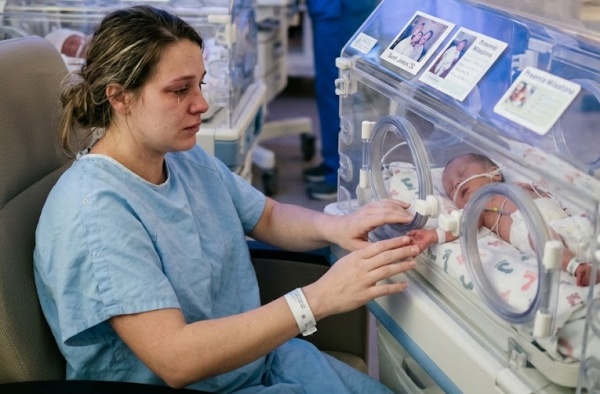
I was twenty-six weeks pregnant with triplets when I started bleeding and was rushed to the hospital. While doctors prepared me for emergency surgery, my husband ignored my calls and stood in his parents’ backyard beside the woman he had once promised to marry. By the time he arrived, our babies were already in the NICU, and there was frosting on his cuff. Four days later, he came back to the hospital and realized the wife who used to wait for him was gone.
PART I — THE PAPERS I SIGNED ALONE
While I was bleeding in a hospital bed, signing emergency surgery papers to save our unborn triplets, my husband was cutting a cake with his ex-girlfriend.
Not just any woman.
Vanessa Cole, the woman he had once promised to marry before me.
The woman his mother still called “almost family.”
The woman whose engagement ring had been returned but apparently never forgotten.
At the time, I didn’t know about the cake. I didn’t know about the champagne, the photographer, the soft gold balloons spelling out WELCOME HOME, VANESSA, or the way my husband stood beside her with one hand resting too comfortably at the small of her back. I didn’t know that while my blood pressure dropped and nurses moved faster around me, he was smiling under string lights in his parents’ backyard in Scottsdale, Arizona.
All I knew was that Caleb was not answering his phone.
My name is Mara Whitaker. I was thirty-three years old, twenty-six weeks pregnant with triplets, and lying in a hospital bed at Banner – University Medical Center Phoenix while a doctor explained that we were running out of time.
Triplets change every plan you ever had.
When Caleb and I first saw the ultrasound, three tiny flickering heartbeats blinking on the screen, he laughed so loudly the technician smiled. Then he cried, which made me cry, and for a while I believed that moment would become the beginning of the rest of our life.
We had been married for five years.
We lived in Chandler, in a three-bedroom house with a half-finished nursery, a mortgage, a desert willow tree in the yard, and a garage full of unopened baby gear because I had been too afraid to set everything up early.
After two miscarriages, fear becomes part of pregnancy.
It follows you into every bathroom. It sits beside you at every ultrasound. It makes you count kicks before breakfast and study every ache like it might be a warning.
My pregnancy was considered high-risk from the beginning. Three babies meant extra appointments, extra monitoring, extra specialists, extra caution. My OB, Dr. Elaine Porter, was calm but direct.
“With triplets, we celebrate every week,” she told me. “Twenty-four weeks is one milestone. Twenty-eight is another. Thirty-two would be wonderful. But if anything feels wrong, you don’t wait.”
I did not wait.
That Saturday afternoon, I felt a sharp cramp low in my abdomen while folding onesies in the nursery. At first, I thought I had stood too long. Then I saw blood.
Not a little spotting.
Enough to turn my body cold.
I called Caleb first.
No answer.
I called again.
No answer.
I texted:
Something is wrong. I’m bleeding. Calling 911. Please answer.
The message showed delivered.
Not read.
I called my neighbor, Mrs. Alvarez, who lived across the street and had raised four children, six grandchildren, and enough neighborhood panic to qualify as emergency support. She arrived before the ambulance did, wearing garden gloves and slippers.
“Oh, honey,” she said when she saw my face. “I’m here.”
I remember the paramedics asking questions.
How many weeks?
Triplets?
Any complications?
Was there pain?
Was my husband coming?
I said yes automatically, because the idea that he would not come felt impossible.
Caleb was many things: distracted, ambitious, conflict-avoidant when his mother was involved, too eager to be admired, too slow to apologize.
But absent during an emergency?
No.
Not Caleb.
At least, not the Caleb I thought I had married.
At the hospital, everything moved quickly. Nurses strapped monitors across my belly, searching for three separate heartbeats. One baby was easy to find. The second took longer. The third made everyone in the room go too quiet until the sound finally appeared, fast and faint and miraculous.
I cried then.
Not gently.
I cried with my whole body because they were still there.
Dr. Porter arrived with her hair pulled back and her face serious. She explained that I had signs concerning for placental complications and possible preterm labor. They were giving medication to help the babies’ lungs, medication to slow contractions if possible, fluids, monitoring, and bloodwork.
“We’re going to do everything we can,” she said. “But if the bleeding worsens or the babies show distress, we may need to act quickly.”
“Act quickly means C-section?” I asked.
“Yes.”
“At twenty-six weeks?”
“Yes.”
I pressed both hands to my belly.
Caleb still had not called back.
I called him again.
No answer.
I called his office, even though it was Saturday.
No answer.
I called his best friend, Ryan.
No answer.
I called my mother in Denver, and when she answered, I finally broke.
“Mom, I’m at the hospital. I’m bleeding.”
She was on a plane within three hours.
But three hours can be an entire lifetime when doctors are using phrases like fetal distress and surgical consent.
Around 6:40 p.m., the bleeding worsened.
I will not describe it in detail. I do not need to. If you have ever watched a nurse’s face change from reassuring to urgent, you know that fear does not require graphic details.
Dr. Porter came back with another physician and an anesthesiologist.
“Mara,” she said, sitting beside the bed so her eyes were level with mine, “we are concerned enough that we need to prepare for emergency delivery if things continue this way. I need to talk you through the consent forms now.”
I looked toward the door.
“My husband is coming.”
No one corrected me.
That kindness hurt more than honesty would have.
A nurse asked, “Is there another number we can try?”
I gave them Caleb’s number. His work number. His mother’s number. Ryan’s number. His sister’s number.
No one answered except his mother, Diane, who sounded annoyed before she sounded concerned.
“Mara? Is this urgent? We’re in the middle of something.”
“I’m in the hospital,” I said. “I’m bleeding. They might have to deliver the babies.”
There was a pause.
Then music in the background.
Laughter.
A woman’s voice saying something I could not understand.
Diane lowered her voice.
“Oh. Well, Caleb stepped away from his phone.”
“Where is he?”
“At the house.”
“What house?”
“Our house.”
“Why?”
Another pause.
“It’s Vanessa’s welcome-home gathering. I’m sure he’ll call you as soon as he can.”
The room tilted.
For one second, the hospital sounds became distant.
Beeping monitors.
Rolling carts.
Soft shoes against tile.
My own breathing.
“Vanessa?” I said.
Diane sighed like I was being difficult.
“Mara, this is not the time to be insecure. She just moved back from Seattle after a very hard year.”
I looked down at the IV in my hand.
At the hospital gown.
At the blood pressure cuff tightening around my arm.
At the consent forms waiting on the tray table.
“This is exactly the time,” I whispered.
“What?”
“Tell Caleb to call me right now.”
“I said I’ll tell him.”
The line clicked dead.
That was the first crack.
Not the affair. Not yet.
Not the secret.
Just the first undeniable proof that in the emergency of my life, my husband’s family saw me as an interruption.
The anesthesiologist began explaining risks.
Bleeding.
Infection.
Anesthesia complications.
NICU admission.
Risks to me.
Risks to the babies.
Possible hysterectomy in extreme circumstances.
My hand shook so badly the pen slid between my fingers.
The nurse, Janelle, placed her hand gently over mine.
“You can take a breath,” she said.
“I’m alone.”
“You’re not alone,” she replied.
She meant it kindly.
But I was.
I was surrounded by skilled, compassionate professionals doing everything they could to keep me and my babies alive. Still, the chair beside my bed was empty. The person whose name was on my emergency contact form was somewhere across town, celebrating another woman’s return.
I signed the forms.
Mara Whitaker.
My signature looked like it belonged to someone older.
At 7:18 p.m., Caleb finally called.
I answered before the first ring finished.
“Where are you?” I asked.
His voice was tight.
“Mom said you’re at the hospital.”
“I’ve been calling you for hours.”
“I know. My phone was in the kitchen.”
“I’m bleeding. They may have to deliver the babies.”
Silence.
Then, behind him, a woman laughed.
Vanessa.
I knew her laugh from old videos Caleb’s family still kept online, even though they pretended they had moved on.
“Caleb,” I said slowly. “Are you at a party?”
“It’s not a party.”
“Are you with Vanessa?”
“Mara, don’t start.”
Don’t start.
Those words landed harder than any confession could have.
I was twenty-six weeks pregnant with his three children, facing emergency surgery, and he thought my concern was a fight I had chosen.
“Get to the hospital,” I said.
“I’m coming.”
“When?”
“I said I’m coming.”
“Now?”
“Mara, I need ten minutes to explain to everyone and—”
“Explain what?” I asked. “That your wife and unborn children are in danger?”
He exhaled sharply.
“You’re making this sound like I don’t care.”
The monitor beside me sped up as one baby shifted.
Dr. Porter stepped into the room again.
“Mara, we need to reassess.”
I looked at the doctor, then closed my eyes.
“Caleb, if you are not here in thirty minutes, don’t come.”
“That’s dramatic.”
“No,” I said. “It’s the first clear thing I’ve said in years.”
I ended the call.
He did not arrive in thirty minutes.
He did not arrive in one hour.
He did not arrive before they wheeled me toward surgery.
At 8:09 p.m., Baby A’s heart rate dropped.
That was the moment everything else disappeared.
No Vanessa.
No Diane.
No unanswered calls.
No marriage.
Only three tiny lives inside me and the doctors trying to save them.
As the ceiling lights passed overhead, Janelle walked beside the bed holding my hand.
“You’re doing great, Mara.”
“I’m scared.”
“I know.”
“If they cry—”
“They may not cry right away,” she said gently. “They’re very early. But the NICU team is ready.”
The operating room was bright and cold. People moved with practiced urgency. Someone placed a blue drape. Someone adjusted monitors. Someone told me I might feel pressure but not pain.
I stared upward and whispered the names Caleb and I had chosen.
Noah. Sophie. Eli.
One boy.
One girl.
One boy.
Three names for three heartbeats.
I did not know whether I would hear any of them breathe.
I did not know whether Caleb would walk in.
I did not know that while the first incision was made, someone at Diane’s house was taking a photo of my husband helping Vanessa cut a vanilla cake with lemon frosting.
The caption would later read:
Some people come back exactly when they’re supposed to.
PART II — THE WOMAN WHO NEVER LEFT
Caleb and Vanessa had a history everyone treated like weather.
It was always there, always discussed indirectly, always capable of ruining plans, yet somehow never anyone’s fault.
They met in college at Arizona State University. He was studying business. She was studying interior design. Their families went to the same church in Scottsdale, belonged to the same country club, and moved through the same social circles where people said “bless her heart” with the precision of a small knife.
By the time I met Caleb, he and Vanessa had been broken up for almost three years.
At least, that was the official version.
He told me they had been serious once, engaged briefly, but realized they wanted different things. He said the breakup was mutual and mature. He said they were friendly but not close.
I believed him because I wanted to.
I was twenty-eight then, working as a pediatric physical therapist, paying off student loans, driving a used Honda Civic, and renting a one-bedroom apartment in Tempe. Caleb sold commercial insurance for a regional firm and had the kind of easy confidence I mistook for stability.
He took me hiking at Camelback Mountain on our third date, even though I told him I hated hiking. Halfway up, I threatened to leave him for a rescue helicopter. He laughed and gave me the last of his water.
That was Caleb at his best.
Warm.
Attentive.
Funny.
Capable of making me feel chosen in a room full of louder people.
His family was polite at first.
Diane wore pearls to brunch and asked where my people were from. When I said my parents were divorced and my mother lived in Denver while my father had passed away, she made a soft sympathetic sound, like I had admitted to a stain.
His father, Mark, was quieter. Not unkind, exactly. Just absent in the way some men become after decades of letting their wives manage emotional weather.
Caleb’s younger sister, Olivia, was the only one who welcomed me without measuring me first.
“She’ll compare you to Vanessa,” Olivia warned me after Thanksgiving dinner our first year. “Don’t take it personally.”
“How exactly do I not take that personally?”
She shrugged.
“Wine helps.”
Vanessa was everywhere before she was physically present.
In stories.
In old photos.
In Diane’s comments.
Vanessa loved hydrangeas.
Vanessa made the best lemon bars.
Vanessa always knew how to calm Caleb.
Vanessa and Diane used to go antiquing.
Vanessa would have loved this restaurant.
The first time I told Caleb it bothered me, he kissed my forehead.
“My mom has trouble letting go.”
“And you?”
“I let go.”
I wanted that to be enough.
When Caleb proposed, he did it at sunset in Sedona, with red rocks glowing behind him and my hands shaking so hard he had to help me put on the ring. For two months, I lived inside a happiness so complete I did not notice its weak spots.
Then Diane asked if I would consider using the florist Vanessa had wanted.
“She has exquisite taste,” Diane said.
I refused.
Caleb said I was being sensitive.
During wedding planning, Vanessa’s name appeared like a ghost at every table.
The venue Vanessa loved.
The band Vanessa knew.
The china pattern Vanessa registered for before she and Caleb “called things off.”
I finally said, “I am not marrying Vanessa’s leftover wedding.”
Caleb stared at me like I had slapped him.
“That’s a cruel thing to say.”
“Is it untrue?”
He did not answer.
We married anyway.
The wedding was beautiful. Not perfect, but beautiful. My mother cried. Olivia gave a tipsy toast about how I was too good for all of them. Caleb danced with me under market lights and whispered, “Ignore the noise. It’s you and me.”
For a while, I did.
Then life became complicated in ordinary ways.
Work.
Bills.
House repairs.
Family holidays.
Pregnancy losses.
The first miscarriage happened at nine weeks.
The second at eleven.
Both times, Caleb was devastated. I know he was. He cried in the bathroom when he thought I could not hear him. He slept with his hand on my stomach for weeks afterward, as if apology could pass through skin.
But grief changed us differently.
I needed to talk.
He needed to escape.
I wanted counseling.
He said therapy made things worse because it “kept wounds open.”
Diane said, “Maybe it’s God’s timing,” and I did not speak to her for three weeks.
Then Vanessa reappeared.
She moved to Seattle after breaking off her engagement to Caleb, built a design career, dated a tech entrepreneur, and posted tasteful photos of rain-soaked windows and ceramic mugs online. But after her relationship ended and her design firm downsized, she decided to return to Arizona.
Diane was ecstatic.
Caleb pretended not to be.
The welcome-home gathering was Diane’s idea.
At least, that was what everyone claimed.
I knew about it vaguely. Diane had mentioned hosting “a little family thing” for Vanessa and said I did not need to come because I was on modified activity due to the triplet pregnancy.
The invitation itself never reached me.
Later, Olivia told me that was deliberate.
Diane did not want me there because she wanted the evening to feel “like old times.”
Old times.
That phrase can hide so much disrespect.
The week before the emergency, Caleb became distant.
He took calls outside.
He went to his parents’ house twice to “help set up patio lights.”
He bought a new shirt and said it was for work.
He was kinder to me in small bursts, which somehow made me more anxious. Men who are hiding something often alternate guilt with irritation, tenderness with disappearance.
The morning of the emergency, he kissed my forehead before leaving.
“I’ll be back by five,” he said.
“From where?”
“Dad needs help moving some boxes.”
“At your parents’ house?”
“Yeah.”
“Is Vanessa going to be there?”
His expression changed.
Barely.
But after five years of marriage, I saw it.
“I don’t know. Maybe. Mom invited people.”
“Caleb.”
“What?”
“I’m not comfortable with how much space she’s taking up again.”
He sighed.
“Mara, she just moved back. She’s going through a lot.”
“I’m pregnant with triplets.”
“I know that.”
“Do you?”
That hurt him. Or offended him. Sometimes Caleb treated those as the same thing.
He grabbed his keys from the counter.
“I’m not doing this today.”
“Doing what?”
“Being accused because my mother invited an old friend over.”
“Old fiancée.”
He looked at me then.
Hard.
“That was before you.”
“Then act like it.”
He left without answering.
I spent the afternoon in the nursery folding tiny clothes while trying to convince myself I was being unfair.
That was something I did often in our marriage.
I put my instincts on trial before I let them speak.
Maybe Diane was just nostalgic.
Maybe Vanessa was just vulnerable.
Maybe Caleb was just tired.
Maybe I was just hormonal.
Maybe pregnancy after loss had made me see threats everywhere.
Then I bled.
And Caleb did not answer.
In the NICU waiting area after surgery, hours blurred.
The babies were delivered by emergency C-section.
Noah was born first at 8:27 p.m., weighing 1 pound, 14 ounces.
Sophie came one minute later, 1 pound, 11 ounces.
Eli came last, 1 pound, 13 ounces.
They did not cry in the way full-term babies cry. Their tiny bodies were rushed to waiting teams. I caught only glimpses: red skin, fragile limbs, caps too small to seem real, tubes and hands and movement.
I kept asking, “Are they alive?”
Someone said, “Yes.”
Then again.
“Yes.”
Then again.
“All three are alive.”
I held those words like oxygen.
Caleb arrived at 11:46 p.m.
Nearly four hours after the surgery.
Nearly seven hours after my first call.
He came into my recovery room wearing the new shirt.
There was frosting on his cuff.
I noticed before he spoke.
That is the kind of detail pain preserves.
“Mara,” he said, voice breaking. “I’m so sorry.”
I looked at him.
He looked pale, shaken, almost young.
For one brief second, I wanted to collapse into him. I wanted him to be the husband I had needed that night. I wanted him to hold me and cry and explain that something impossible had happened, something understandable, something that could soften the shape of his absence.
Then I smelled vanilla and lemon.
I turned my face away.
“The babies are in the NICU,” I said. “Ask the nurse.”
“Mara, please—”
“Ask the nurse.”
He sat beside me anyway.
“I came as soon as I could.”
“No,” I said. “You didn’t.”
He flinched.
“I didn’t understand how serious it was.”
“I said I was bleeding. I said emergency surgery.”
“My mom said you sounded upset but stable.”
I laughed once.
It hurt my incision.
“So you called your mother for medical interpretation?”
His eyes filled.
“I messed up.”
That was the smallest possible truth.
I closed my eyes.
“Where were you when Noah, Sophie, and Eli were born?”
Silence.
I opened my eyes again.
He looked down.
“At my parents’ house.”
“With Vanessa.”
“It wasn’t like that.”
I looked at the frosting on his cuff.
“What was the cake for?”
His face crumpled.
And that was how I learned that while our children were being pulled from my body far too early, Caleb had been helping his ex-fiancée cut a welcome-home cake in his parents’ backyard.
PART III — FOUR DAYS
I did not scream.
I think that disappointed some people later when they heard the story. There is an expectation that devastation should perform itself loudly, that betrayal must look like broken dishes, shouted curses, or dramatic exits.
But surgery pain makes rage practical.
I was attached to IV lines, wearing mesh underwear and hospital socks, trying not to cough because my abdomen felt like it had been split by lightning. My three children were in incubators down the hall, fighting minute by minute for lungs, temperature, blood sugar, oxygen, and everything full-term babies are supposed to get from time.
I had no energy to give Caleb a cinematic scene.
So I gave him instructions.
“Do not touch me.”
He pulled his hand back.
“Do not call your mother and put her on speaker.”
He opened his mouth, then closed it.
“Do not bring Vanessa here.”
His face changed.
“I would never—”
“You would.”
He looked wounded by that.
Amazing, how quickly men can feel insulted by the consequences of their own choices.
“Go see the babies,” I said. “Then leave.”
“Mara, I’m their father.”
“Yes. So act like it somewhere other than my room.”
A nurse entered then, and Caleb stood as if hoping another adult might interpret me as unreasonable.
The nurse did not.
“Mrs. Whitaker needs rest,” she said.
Caleb left.
After he was gone, I cried so hard that my oxygen monitor beeped.
My mother arrived at 2:15 a.m.
She had flown from Denver to Phoenix, taken a rideshare straight to the hospital, and reached my room carrying a duffel bag, a cardigan, and the ferocious calm of a woman who had already decided whom she would destroy if necessary.
She did not ask where Caleb was first.
She asked, “Are you alive?”
I nodded.
“The babies?”
“Alive.”
Then she climbed carefully into the chair beside my bed and held my hand until morning.
Her name is Ruth, and she is not a soft woman by nature. She is practical, direct, and allergic to self-pity. After my father died when I was sixteen, she worked two jobs and still made it to every school meeting, every doctor appointment, every bad teenage theater performance where I played a tree or a villager.
When I told her about Caleb and Vanessa, she closed her eyes.
Not surprised.
That hurt too.
“You knew?” I asked.
“No,” she said. “But I knew that family never made room for you unless you folded yourself smaller.”
That sentence stayed with me.
The next four days were both endless and gone in flashes.
Day one, I saw my babies in the NICU.
No one prepares you for how small a premature baby can be until you are looking at your child through plastic walls, afraid even your breath might disturb them. Their skin looked translucent. Their eyes were fused closed. Their chests moved with mechanical help, tiny and determined.
A nurse named Keisha explained each monitor.
Heart rate.
Oxygen saturation.
Respiratory support.
Lines.
Feeding plans.
Risks.
Milestones.
She spoke with respect, never pity. I loved her for that.
“Can I touch them?” I asked.
“For now, we can help you do a gentle hand hug,” she said.
She guided my hand through the incubator opening and showed me how to rest my fingers softly around Noah’s tiny body without stroking, because preemies can be overstimulated.
His entire torso fit beneath my hand.
I whispered, “Hi, baby. I’m your mom.”
That was the first time I felt like one.
Not during the pregnancy tests.
Not during the ultrasound.
Not even during the emergency.
There, beside an incubator, with my son smaller than a loaf of bread, I became someone who could no longer afford illusions.
Caleb came in and out.
He cried when he saw the babies. I believe those tears were real. That made everything more complicated, not less.
He stood beside Eli’s incubator and whispered, “Daddy’s here.”
I wanted to say, Too late.
I didn’t.
Not because he deserved grace.
Because my children deserved a NICU room not filled with adult poison.
Diane arrived on day two wearing perfume too strong for the hospital and carrying a gift bag.
A gift bag.
Inside were three monogrammed blankets the babies could not use yet and a card that said:
Our little miracles. Love, Grandma and Grandpa.
I stared at the card.
Our.
Diane leaned over to kiss my cheek. I turned my head.
She froze.
“Mara.”
“You told me not to be insecure while I was bleeding.”
Her face tightened.
“This is not the place.”
“You’re right,” my mother said from the chair. “It is not the place for you.”
Diane looked at Caleb, expecting rescue.
He looked exhausted.
“Mom, maybe come back later.”
Her mouth opened slightly.
Diane was not accustomed to Caleb choosing someone else’s comfort over hers, even weakly.
Before leaving, she said, “Vanessa feels terrible.”
The room went still.
My mother stood.
I had never seen her move that fast.
“If that woman’s name comes out of your mouth again in my daughter’s hospital room, you will be speaking to security.”
Diane left.
Caleb looked at the floor.
I realized then that my marriage had always included too many people.
Me.
Caleb.
Diane.
Vanessa’s memory.
Vanessa herself.
And somewhere near the bottom of that list, my needs.
On day three, Caleb asked if we could talk.
I was pumping colostrum every few hours, or trying to. NICU mothers are asked to produce nourishment while recovering from trauma, and somehow no one gives medals for that. I was sleep-deprived, sore, and living on hospital turkey sandwiches and fear.
“Talk,” I said.
He sat beside the bed.
“I know I failed you.”
I looked at him.
“I did,” he repeated. “I should have answered. I should have left immediately. I should never have gone to that gathering.”
“Why didn’t you answer?”
“My phone was inside.”
“For hours?”
He rubbed his face.
“I kept checking it at first. Then Mom made a speech. Then Vanessa—”
He stopped.
“Vanessa what?”
“She got emotional.”
I laughed again, carefully this time because of the incision.
“She got emotional?”
“She talked about how hard it was to come back. How she felt like she lost her old life. People were comforting her.”
“Including you.”
He closed his eyes.
“Mara.”
“Our babies were being born while you comforted your ex-fiancée at a party thrown by your mother.”
“It sounds terrible when you say it like that.”
“It is terrible.”
He leaned forward.
“I was confused.”
That word entered the room and took up all the air.
“Confused,” I repeated.
“I don’t mean about you. I mean about everything. Vanessa coming back stirred things up. My mom was pressuring me. I felt guilty for how things ended back then, and then with the pregnancy, everything has been so intense—”
“Stop.”
He stopped.
I felt something inside me go cold and clear.
“You are not going to blame my pregnancy complications for your emotional affair.”
His face lost color.
“It wasn’t an affair.”
“What was it?”
Silence.
“What was it, Caleb?”
He looked toward the window.
“We kissed once.”
The room narrowed.
“When?”
“A few weeks ago.”
I closed my eyes.
The babies’ monitors seemed louder from down the hall, though I knew I could not actually hear them from my room.
“Where?”
“At my parents’ house.”
“Did your mother know?”
He did not answer quickly enough.
That was answer enough.
I nodded.
“Mara, it was a mistake. I stopped it.”
“But you kept seeing her.”
“Because our families—”
“No. Because you wanted to.”
He cried then.
Quietly.
I had imagined that if I ever got a confession, his tears would satisfy something in me.
They did not.
They made me tired.
On day four, I woke before sunrise with a decision already formed in my body.
Caleb had gone home the night before to shower and “clear his head.” My mother was asleep in the chair. The hospital room was dim, lit by machines and hallway light.
I opened my phone and searched for family law attorneys in Phoenix.
Then I stopped.
Not because I changed my mind.
Because I remembered someone.
Jenna Morales, a former NICU mother from an online support group I had joined when I learned I was carrying triplets. She was also an attorney, though not my kind of attorney. She had once posted about helping women find legal resources during medical crises.
I messaged her at 5:42 a.m.
By 6:10, she replied.
By 8:30, she had connected me with Andrea Kim, a family law attorney in Phoenix who had experience with high-conflict divorces, medical decision-making issues, and newborn custody arrangements.
Andrea came to the hospital at 1:00 p.m.
She wore a navy suit, carried a leather folder, and spoke to me like I was neither fragile nor foolish.
That was exactly what I needed.
She explained that I did not need to decide everything immediately. But I could take steps to protect myself: document Caleb’s absence, preserve messages and call logs, clarify hospital visitation preferences, create boundaries around who could access me and the babies, and prepare for separation if that was my choice.
“Can I stop Diane from visiting the NICU?” I asked.
“As a practical matter, you can speak with the hospital social worker about approved visitors and privacy settings,” Andrea said. “Legally, Caleb has parental rights too, but hospitals often work with parents to manage safety, privacy, and conflict. We need to be careful and strategic.”
Careful and strategic.
Those words became my next breath.
By 4:00 p.m., my hospital record had a privacy note. My visitors were limited. Diane was no longer allowed to come to my room. Vanessa was explicitly not allowed anywhere near me.
Caleb did not know any of this yet.
He returned that evening carrying flowers.
White lilies.
The same flowers Vanessa had wanted at her canceled wedding, according to Diane’s old stories.
I looked at them and almost laughed from the cruelty of coincidence.
Or maybe it was not coincidence.
“Where’s Mom?” he asked.
“At a hotel resting.”
He looked relieved.
“I thought we could talk without everyone watching.”
“No.”
He blinked.
“No?”
“I spoke with an attorney today.”
His face changed so quickly that I knew some part of him had still believed I would forgive him before discharge.
“Mara.”
“I’m not discussing the marriage tonight. I’m recovering from surgery, and our children are in the NICU.”
“An attorney? Are you serious?”
“Yes.”
“This is insane. We just had three babies.”
“I had three babies,” I said. “You had cake.”
He flinched like I had hit him.
Good.
Four days later, Caleb returned to the hospital and discovered that the wife who had waited for him was gone.
Not physically.
I was still there, moving slowly between my hospital room and the NICU, carrying pumped milk in tiny labeled syringes like treasure.
But the woman who had waited for him to choose her, defend her, answer her, prioritize her, and finally grow up?
She was gone.
And she was not coming back.
PART IV — WHY HE STOPPED ANSWERING
The most devastating truth did not arrive all at once.
It came through Olivia.
Caleb’s sister had been quiet during those first days, sending only short texts:
I love you. I’m sorry. I’m here if you want me.
I did not respond at first because I had no room inside me for another Whitaker.
On day six, she came to the hospital alone.
No Diane.
No Mark.
No Caleb.
She stood in the doorway holding coffee and looking like someone who had not slept.
“Can I come in?”
I nodded.
She placed the coffee on the tray table.
“It’s decaf. I remembered.”
That made me cry.
Kindness from someone connected to people who hurt you can feel like a trap even when it is real.
Olivia sat carefully.
“I need to tell you something.”
My body went still.
“What?”
She clasped her hands.
“I didn’t know how bad the hospital situation was until later. Mom told everyone you were having ‘some monitoring’ and that Caleb had talked to you.”
“He hadn’t.”
“I know that now.”
She swallowed.
“During the party, your calls kept showing up on his phone.”
The room seemed to contract.
“He said his phone was inside.”
“It was on the kitchen island for a while. But later, Vanessa had it.”
I stared at her.
“What?”
Olivia’s eyes filled.
“I saw her pick it up when it kept buzzing. She looked at the screen. I thought she was taking it to him.”
My throat closed.
“She didn’t?”
“She walked outside first. Toward the side patio.”
I felt my incision pulse with my heartbeat.
“Olivia.”
“I followed because it felt weird. I didn’t hear everything, but I heard her say, ‘If you answer now, everything goes back to being about her.’”
I could not speak.
Olivia continued, voice shaking.
“Caleb said, ‘She’s pregnant with my kids.’ Vanessa said, ‘And I was supposed to be your wife.’”
The air left my body.
A nurse passing in the hallway glanced in. I must have made a sound.
Olivia wiped her face quickly.
“I’m sorry. I’m so sorry.”
“What did Caleb do?”
“He told her to give him the phone.”
“And?”
“Diane came over.”
Of course.
My hands curled around the bedsheet.
“What did his mother say?”
Olivia’s voice dropped.
“She said you were probably panicking and that if it were truly serious, the hospital would call again. She said Vanessa had waited years for closure and Caleb owed her ten minutes.”
Ten minutes.
Emergency medicine measures time in minutes.
So does betrayal.
“And he listened?” I asked.
Olivia looked down.
“For a while.”
A coldness spread through me.
Not shock anymore.
Recognition.
Caleb had not simply missed my calls because his phone was in another room. He had seen them. He had known something was wrong. He had allowed Vanessa and Diane to frame my emergency as emotional inconvenience.
“Why are you telling me?”
“Because Mom is trying to rewrite it already. She’s saying no one understood. Vanessa is saying she never knew you were in danger. Caleb is saying he was overwhelmed.” Olivia looked at me directly. “But I saw enough. And you deserve the truth.”
Truth can be merciful and cruel at the same time.
I thanked her.
Then I asked her to write down everything she remembered while it was fresh.
She did.
Andrea was very interested in that statement.
Not because family court would punish Caleb for being a terrible husband in the dramatic way people hope courts will. Divorce law is not a moral scoreboard. But documentation matters when patterns affect parenting, decision-making, boundaries, credibility, and the best interests of children.
Three premature children in the NICU meant everything had to be structured carefully.
Who could visit.
Who could receive medical updates.
Who made decisions if procedures were needed.
Who could be trusted not to bring conflict into a fragile medical environment.
Andrea filed for legal separation first, with temporary orders addressing communication, finances, and issues related to the babies’ medical care. She did not file a public emotional manifesto. She filed clear, boring, powerful documents.
Caleb reacted exactly as Andrea predicted.
First came remorse.
Please don’t do this while the babies are fighting.
Then guilt.
They need both parents together.
Then blame.
Your mom and your lawyer are poisoning you.
Then anger.
You’re punishing me for one mistake.
One mistake.
I counted them silently.
Not answering.
Dismissing me.
Staying with Vanessa.
Allowing Diane to minimize my emergency.
Kissing Vanessa weeks earlier.
Continuing contact.
Letting me sign surgery papers alone.
Showing up with frosting on his cuff.
Calling a lawyer “insane” before asking how my incision felt.
No, Caleb.
It was not one mistake.
It was a system.
Diane tried to visit the NICU twice and was turned away because of the privacy restrictions and approved visitor list. She called Caleb crying. Caleb texted me that I was being cruel to his mother.
I sent the message to Andrea.
Andrea replied:
Do not engage. Keep everything.
I learned that keeping everything is both legal advice and emotional discipline.
Screenshots.
Voicemails.
Call logs.
Hospital records.
Visitor lists.
Messages from Olivia.
Messages from Diane.
Photos someone sent me from the welcome-home party.
Yes, photos.
Because people document their own cruelty when they think it is celebration.
The photo of Caleb and Vanessa cutting the cake arrived anonymously through a newly created email account. I still do not know who sent it. Maybe Olivia. Maybe a guilty cousin. Maybe someone who had enjoyed the party until the story changed.
Caleb stood behind Vanessa, one hand guiding hers over the knife.
She leaned back against him slightly.
They were both smiling.
The cake was white with lemon slices and flowers.
Behind them, gold letters read:
WELCOME HOME, VANESSA
The timestamp was 8:31 p.m.
Four minutes after Noah was born.
Three minutes after Sophie.
Two minutes after Eli.
I stared at the timestamp until the numbers blurred.
Then I placed the phone face down and walked to the NICU.
Noah had needed increased respiratory support that morning. Sophie was under phototherapy lights. Eli had a tiny hand curled around a line, and I wanted to scream at the unfairness of how hard they were fighting while adults outside their incubators behaved like spoiled children.
Keisha saw my face.
“Bad update?”
“Bad photo.”
She nodded like she understood more than I said.
“Put your hand on your baby,” she said. “Come back to what’s real.”
So I did.
My palm rested gently around Sophie’s tiny body.
Her skin was warm beneath my fingers.
Real.
The babies became my compass.
Not revenge.
Not humiliation.
Not making Caleb suffer.
Them.
Every decision had to answer one question:
Does this protect peace around Noah, Sophie, and Eli?
If yes, I did it.
If no, I let it wait.
Caleb was allowed to visit the babies, but we coordinated through a shared parenting app recommended by Andrea. He hated the app because it removed tone, manipulation, and late-night emotional ambushes.
He could ask medical questions.
He could schedule time.
He could receive updates.
He could not demand private conversations with me beside incubators.
When he cried in the hallway one afternoon and said, “I don’t know how we got here,” I almost answered.
Almost.
Then I remembered Vanessa holding his phone.
Diane saying he owed her ten minutes.
Me signing papers alone.
“We got here one choice at a time,” I said.
He covered his face.
I walked past him into the NICU.
The babies had good days and terrifying ones.
At twenty-seven weeks adjusted, Noah developed an infection scare that put everyone on edge. Sophie had feeding intolerance. Eli’s oxygen needs went up and down like my heart was tied to the monitor.
I learned NICU language.
Brady.
Desat.
CPAP.
Kangaroo care.
Fortifier.
Corrected age.
Rounds.
I learned how to pump at 3:00 a.m. while crying from exhaustion. I learned that one milliliter of milk can feel like a miracle. I learned that hope in the NICU is not a straight line. It is a graph with alarms.
Caleb slowly became more consistent as a father.
That is also true.
He attended rounds when allowed. He learned to change diapers through incubator doors. He cried the first time he held Noah skin-to-skin. He whispered apologies to babies too young to understand them.
I was glad for the babies.
I was not moved as a wife.
That distinction confused him.
He thought fatherhood effort should count as marital repair.
It did not.
A man can love his children and still have destroyed his marriage.
Both things can be true.
Vanessa tried to send a letter.
Andrea received it first.
In it, Vanessa claimed she had been “caught in unresolved emotions” and never intended to interfere with a medical emergency. She said she believed Caleb and I were already emotionally separated. She said Diane had made it seem like I exaggerated complications often.
I almost laughed at that.
Often?
My entire pregnancy had been medical appointments and caution.
But Vanessa needed a version of me that made her behavior survivable.
People rarely volunteer to be villains in their own stories.
I told Andrea I did not want contact.
Vanessa’s letter went into the file.
Diane sent a longer message through Caleb because she was blocked from contacting me directly.
It was not an apology.
It was a defense brief with Bible verses.
She wrote that motherhood is about sacrifice, that families must forgive, and that I should not deprive my children of their grandmother because adults made imperfect choices during a stressful evening.
A stressful evening.
That was what she called the night I nearly lost three children.
I did not respond.
My mother did, privately, against my advice.
She sent Diane one sentence:
The next time you want to discuss sacrifice, remember my daughter signed surgical consent alone while your son cut cake.
Diane did not write again for three weeks.
PART V — THE WIFE WHO LEFT
Noah came home first after seventy-one days in the NICU.
Sophie came home eight days later.
Eli stayed twelve days longer than both of them because he needed more help with feeding and breathing. Leaving one baby at the hospital while taking two home is a special kind of heartbreak. It feels like splitting your soul across locations.
By the time all three babies were home, I was living in a rented one-story house in Mesa, close enough to the hospital for follow-ups and far enough from Caleb’s family that no one could “drop by” without effort.
My mother stayed for six weeks.
Mrs. Alvarez flew back from Chandler in spirit through daily texts and casseroles delivered by neighbors.
Olivia visited with permission and washed bottles without asking personal questions.
Caleb had scheduled parenting time under temporary agreements that prioritized the babies’ medical needs. At first, visits were short, structured, and sometimes supervised by a postpartum nurse because three medically fragile infants are not a romantic redemption arc. They are oxygen checks, feeding charts, medication schedules, and washing your hands until your knuckles crack.
Caleb learned.
Slowly.
He also lost things.
Not his children.
I would never use them as punishment.
But he lost access to me.
He lost the right to enter a room and expect my attention.
He lost the right to explain himself at midnight.
He lost the right to turn my pain into a debate.
Our divorce moved carefully because newborn triplets make everything slower. Andrea handled the legal structure: temporary support, medical expenses, insurance, parenting plans, decision-making, and boundaries around extended family.
Arizona law did not care that Caleb had cut a cake with Vanessa in the emotional way Facebook comments might.
But courts care about children’s best interests, credible communication, stability, documentation, and whether parents can prioritize medical needs over family drama.
Andrea made sure the record reflected that.
Caleb eventually gave a real apology.
Not the first month.
Not the second.
Real apologies often arrive after all the strategic ones fail.
He came to a scheduled exchange with red eyes and no speech prepared.
“I saw the photo again,” he said.
I adjusted Sophie’s blanket in her car seat.
“What photo?”
“The cake.”
I said nothing.
“I kept telling myself I didn’t understand. That I didn’t know how bad it was. That Mom confused me. That Vanessa manipulated me.” His voice cracked. “But I knew enough. I knew you were scared. I knew you were calling. I chose not to face it right away because I didn’t want to disappoint everyone there.”
I looked at him then.
“And I was the easiest person to disappoint.”
He nodded.
Tears fell, but he did not ask me to comfort him.
That was new.
“Yes,” he said. “You were.”
Something inside me loosened.
Not forgiveness.
Not reconciliation.
Just the relief of hearing one true sentence without having to drag it out of him.
“I’m sorry,” he said. “Not because you left. Because I gave you no safe reason to stay.”
I carried that apology home like a stone.
Heavy.
Real.
Not enough to rebuild a marriage, but enough to lay down one weapon I had been tired of holding.
Vanessa left Arizona again within the year.
Seattle, someone said.
Then Portland.
Then maybe San Diego.
I stopped tracking her because she was never truly the center of the story. She was a mirror Caleb chose to stare into while his actual life called from a hospital bed.
Diane’s access to the children remained limited and structured for a long time.
Eventually, when the babies were older and stronger, I allowed short visits during Caleb’s parenting time, with conditions. No unannounced visits. No negative comments about me. No Vanessa. No rewriting the hospital story around my children when they were old enough to understand language.
Diane broke the second rule once.
Caleb corrected her.
That mattered.
Late, but it mattered.
The triplets grew.
Slowly at first.
Then all at once.
Noah became the calm observer, serious-eyed and fascinated by ceiling fans.
Sophie became a warrior in pink socks, loud enough to convince every specialist that her lungs had opinions.
Eli, who had scared us the longest in the NICU, developed the widest smile and a habit of grabbing my hair with shocking strength.
Their medical follow-ups filled binders.
Pulmonology.
Ophthalmology.
Developmental assessments.
Physical therapy.
Feeding therapy.
Insurance appeals.
Co-pays that made me understand why Americans fear mail from hospitals.
The bills were staggering, even with insurance.
One NICU summary showed charges that looked like a house price.
Over $900,000 before adjustments.
I remember staring at the statement and laughing because the alternative was screaming.
Caleb paid what the court ordered. Then, to his credit, more when specific needs arose. Fatherhood made him better in some ways, or maybe consequence did. I stopped trying to diagnose the improvement and simply accepted what benefited the children.
As for me, healing came in unglamorous pieces.
The first time I slept four consecutive hours.
The first time I showered without listening for a monitor alarm.
The first time I took all three babies to a pediatric appointment by myself and only cried once in the parking lot.
The first time I signed a lease in my own name.
The first time I looked at a photo from the hospital and did not feel my whole body return to that operating room.
On the triplets’ first birthday, we had a small party in my backyard.
Not big.
Not Instagram-perfect.
Just cupcakes, balloons, my mother, Olivia, Mrs. Alvarez, a few close friends, and three babies wearing paper crowns they immediately tried to remove.
Caleb came for part of it.
He brought gifts and stayed respectful.
Diane did not come because I was not ready, and for once, no one argued.
As we sang happy birthday, I looked at my children covered in frosting, alive and loud and impossibly here.
Noah stared at the candle like it had insulted him.
Sophie slapped her cupcake.
Eli laughed at nothing.
I cried through the entire song.
My mother put her arm around me.
“You made it,” she whispered.
I looked at the three tiny people who had fought harder in their first year than many adults ever fight in a lifetime.
“We made it,” I said.
Later that night, after the babies were asleep, I opened the folder where I kept hospital documents.
Not the legal folder.
The other one.
Their NICU bracelets.
Tiny blood pressure cuffs.
First photos.
A copy of the emergency consent form I signed alone.
For a long time, that signature represented abandonment.
Then one day, it changed.
It became proof.
Proof that when no one came, I still chose.
Proof that I did the terrifying thing without permission, comfort, or a husband at my side.
Proof that I could survive the moment I once thought would break me.
People sometimes ask if I hate Caleb.
I don’t.
Hate requires a kind of daily devotion I no longer have time to give him.
I co-parent with him.
I document when needed.
I communicate clearly.
I protect my peace.
Some days, I even feel sorry for the man he was that night, standing under patio lights, trapped by his mother’s expectations, Vanessa’s nostalgia, and his own cowardice.
But feeling sorry for someone is not the same as inviting them back into the place they abandoned.
That is something I had to learn.
You can understand why someone failed you and still decide they do not get the same access to you again.
The most devastating truth was not that Caleb attended Vanessa’s welcome-home party.
It was not even that he helped her cut the cake while our children were being born.
It was that he saw my calls.
He knew enough.
And for those crucial minutes, he chose the comfort of avoiding conflict over the urgency of being my husband.
That truth ended something in me.
But it also began something.
A life where I stopped begging people to treat emergencies like emergencies.
A life where I stopped shrinking so Caleb’s family could keep pretending their nostalgia was harmless.
A life where my children would grow up seeing their mother calm, not because nothing hurt her, but because she no longer lived inside the hurt.
Four days after the surgery, Caleb returned to the hospital and found that the wife who had waited for him was gone.
In her place was a mother.
Exhausted.
Stapled together.
Terrified.
Pumping milk by the milliliter.
Reading legal documents between NICU rounds.
Learning to stand upright again.
And done mistaking absence for confusion.
If my children ask someday why their father and I did not stay married, I will tell them the truth in pieces gentle enough for their age.
I will not say he was a monster.
He is not.
I will not say their grandmother is evil.
She is not that simple.
I will say that love requires showing up when it matters, and that sometimes a person can love you in certain ways but still not be safe enough to build a life with.
I will tell them that the night they were born, many people made choices.
Doctors chose urgency.
Nurses chose compassion.
My mother chose a plane ticket.
Olivia chose truth.
Their father chose too late.
And I chose them.
Always them.
That is the part of the story I keep.
Not the cake.
Not Vanessa.
Not Diane’s voice on the phone.
Not Caleb’s frosting-stained cuff.
The part I keep is three heartbeats, three names, and one shaking signature on a surgical consent form.
Mara Whitaker.
Signed alone.
But not powerless.
