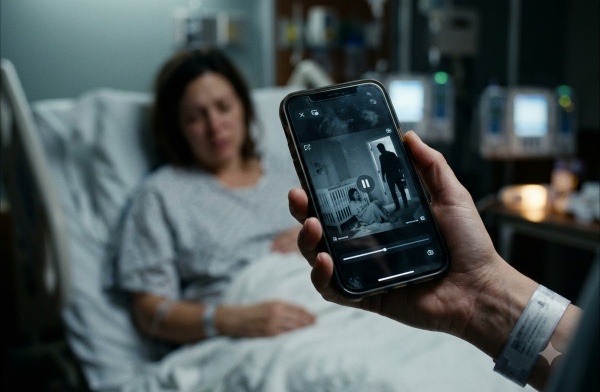
Eight days after giving birth, I was bleeding on the nursery floor when my husband, Tyler, saw the blood and said, “Take care of yourself. I’m going to sleep with her tonight.”
Eleven days later, he and his mistress sat in court while his lawyer insisted that Tyler had no idea I was experiencing health problems when he left. What Tyler didn’t know was that the nursery had recorded everything.
PART I — THE NURSERY FLOOR
Eight days after giving birth, I was bleeding on the nursery floor when my husband, Tyler, saw the blood and said, “Take care of yourself. I’m going to sleep with her tonight.”
For a moment, I thought I had misunderstood him.
Not because the words were unclear.
Because my mind rejected the idea that the man I had married could stand over his postpartum wife, see blood on the floor beside the crib, hear his newborn daughter crying, and still say something that cold.
My name is Hannah Mercer. I was thirty-two years old, living in Raleigh, North Carolina, and eight days earlier I had given birth to our daughter, Lucy Grace Mercer, after thirty-one hours of labor and an emergency C-section neither of us had planned for.
The doctors told me to rest.
That word sounded simple in the discharge paperwork.
Rest.
Do not lift anything heavier than the baby.
Watch for increased bleeding.
Call immediately if you soak through pads quickly, pass large clots, develop fever, dizziness, severe pain, shortness of breath, or feel that something is wrong.
Those instructions were printed in calm black letters on white paper and tucked into a folder with information about breastfeeding, incision care, postpartum depression, and newborn appointments. A nurse went through them with me before discharge, looking directly at Tyler when she said, “She needs help. Recovery from a C-section is major surgery.”
Tyler nodded.
He even put his hand on my shoulder.
“Of course,” he said. “I’ve got her.”
Eight days later, I learned how little that promise weighed.
It was 11:38 p.m. on a Thursday in late March. Rain tapped softly against the nursery window, and the baby monitor glowed on the dresser. Lucy had been crying for forty minutes, the sharp hungry cry that made my body react before my brain could.
I was exhausted in a way I had not known existed.
Not tired.
Not sleepy.
Hollowed out.
My incision burned every time I moved. My milk had come in painfully. I was sleeping in fragments so small they barely counted as rest. My body felt unfamiliar, swollen, stitched, leaking, aching, and still expected to function because a tiny person depended on me every three hours.
Tyler was downstairs.
Not helping.
Not making bottles.
Not washing pump parts.
Not calling the pediatric nurse line when Lucy would not latch.
He was in the kitchen texting someone named Marissa Vale, though at the time I only knew her as “a woman from work.”
Tyler was thirty-five and worked in medical device sales. He had a smooth voice, a good haircut, and the kind of confidence that made people assume he was competent even when he was just well-dressed. He could charm nurses, doctors, administrators, clients, waiters, my mother, and almost every woman at a party within ten minutes.
He had charmed me too.
For years.
I met him at a charity 5K in Durham, though neither of us actually ran the race. He was standing near the coffee table in a blue fleece jacket, making fun of the tiny bananas in the volunteer tent. I laughed, and he spent the next hour acting like making me laugh had been his only goal in life.
When Tyler was good, he was very good.
He brought soup when I had the flu.
He sent flowers after difficult workdays.
He once drove three hours to Wilmington because I casually mentioned missing the ocean.
He knew how to become exactly what a person needed while he wanted to win them.
The problem was what happened after he believed he had already won.
We had been married four years when I got pregnant. The pregnancy was not easy, but Tyler loved the attention it brought him. He posted ultrasound photos. He joked about becoming a “girl dad.” He stood beside me at the baby shower with one hand on my belly and another on my shoulder while everyone told me how lucky I was to have such an involved husband.
Public Tyler was beautiful.
Private Tyler was increasingly absent.
During my third trimester, he stayed late at work more often. He said the medical conference season was intense. He slept with his phone face down. He got irritated when I asked who kept texting him at midnight.
“You’re nesting,” he said once, smiling like he was being affectionate. “Your brain is turning everything into a threat.”
I wanted to believe that.
Pregnancy makes you vulnerable in ways people romanticize until they become inconvenient. You need help tying shoes, carrying laundry, getting out of low chairs. You need patience. You need reassurance that your changing body is still loved.
Tyler gave reassurance in public.
At home, he gave tolerance.
After Lucy was born, things got worse.
My labor began at 2:10 a.m. on a Wednesday. By the time I was wheeled into the operating room the next evening, I was shaking with exhaustion and fear. Lucy’s heart rate had dropped twice. My doctor, Dr. Amelia Rhodes, explained the need for an emergency C-section in a voice that tried to be calm without lying.
Tyler was present for the surgery.
Physically.
He sat near my head, wearing blue scrubs, looking pale.
When Lucy was born, she cried loud enough that everyone laughed with relief. Tyler cried too. The nurse placed Lucy near my face for a second, and I whispered, “Hi, baby,” before they took her to be checked.
In the photos, Tyler looks like a devoted husband.
One hand on my forehead.
One tear on his cheek.
A newborn wrapped like a tiny burrito.
If photographs told the whole truth, my marriage would have survived.
But the week after we came home revealed everything a camera had missed.
Tyler slept through night feedings.
He complained that the baby’s crying gave him headaches.
He asked why the house was “already falling apart” when I had been home all day.
He told me his mother said women in her generation handled recovery without making everything dramatic.
When I cried in the shower because my incision hurt and Lucy would not stop crying, he stood outside the bathroom door and said, “You need to get your emotions under control.”
On day six, Marissa sent him a text while his phone was on the coffee table.
I hate sleeping without you.
I saw it.
He saw me see it.
For ten seconds, neither of us moved.
Then Tyler snatched up the phone and said, “You’re too tired to have this conversation.”
That was his first mistake.
Thinking exhaustion made me easier to fool.
I asked who she was.
He said she was nobody.
I asked why nobody hated sleeping without him.
He said she was going through a divorce and “got attached.”
I asked if he had slept with her.
He told me to lower my voice because I was upsetting the baby.
Lucy was asleep.
That was when I understood Tyler did not need reality to match his accusations. He only needed me to become busy defending myself.
Two days later, I was in the nursery, trying to change Lucy’s diaper while my body screamed from the C-section incision. I had started bleeding more heavily that evening, but I kept telling myself postpartum bleeding could fluctuate. The hospital paperwork said some bleeding was normal.
But this felt different.
I stood too quickly after placing Lucy in the crib, and a wave of dizziness hit me. I reached for the rocking chair, missed it, and lowered myself awkwardly to the floor because falling would have been worse.
Then I saw the blood.
Too much.
On my pajama pants.
On the nursery rug.
On my hand when I touched the floor to steady myself.
Lucy began crying again.
I called Tyler.
Once.
Twice.
Then I shouted his name.
He came to the nursery doorway holding his phone.
His expression showed irritation first.
Then he saw the blood.
For one second, something like concern flashed across his face.
Then his phone buzzed.
He looked down.
The glow lit his jaw.
“Tyler,” I whispered. “Something’s wrong.”
He looked from me to Lucy and back again.
“I can’t do this tonight.”
I stared at him.
“What?”
“I told Marissa I’d be there.”
My brain could not arrange those words into meaning.
“I’m bleeding.”
“I see that.”
“I need help.”
He took a breath, like I had placed a burden on him by requiring basic humanity.
“Take care of yourself,” he said. “I’m going to sleep with her tonight.”
The room went silent except for Lucy crying.
Then he turned away.
Just turned away.
Walked down the hall.
Down the stairs.
Out the front door.
A minute later, I heard his car start.
That sound did something permanent inside me.
Not because he cheated.
I already knew that part.
Because he left.
He saw me on the floor eight days after major surgery, bleeding beside our newborn daughter, and he left to be with another woman.
For several seconds, I did nothing.
Then Lucy cried harder, and my body remembered what my heart could not process.
I reached for my phone on the nursery shelf.
My hands were shaking so badly I almost dropped it.
I called 911.
PART II — WHAT THE CAMERA SAW
The dispatcher’s voice became the first calm thing in my world.
“911, what is your emergency?”
“I’m eight days postpartum,” I said. “I had a C-section. I’m bleeding heavily and dizzy. I’m on the nursery floor with my newborn.”
“Are you alone?”
I swallowed.
“Yes.”
“Is your baby safe?”
“She’s in the crib. She’s crying, but she’s safe.”
“Is anyone else in the house?”
“No. My husband left.”
The dispatcher did not react to that.
Professionals save you partly by not reacting when your life sounds unbelievable.
She asked my address, my symptoms, whether I was conscious, whether I could unlock the door. I told her the front door was unlocked because Tyler had just walked out. Saying it aloud made it real in a way the blood had not.
She stayed on the phone until the paramedics arrived.
Two firefighters came first, followed by EMS.
A woman named Paramedic Shaw knelt beside me while another responder checked on Lucy. Their movements were efficient and respectful. No panic, no judgment, no questions about why a postpartum woman was alone on the floor.
Paramedic Shaw asked how much I had been bleeding, whether I had fever, chest pain, severe abdominal pain, blurred vision, or shortness of breath. She checked my blood pressure, pulse, and level of consciousness. When I tried to apologize for the mess, she shook her head.
“Ma’am, don’t apologize. You did the right thing calling.”
Those words almost broke me.
Because Tyler had made everything feel like overreaction.
The paramedics helped me onto a stretcher.
“I need my baby,” I said.
A firefighter stood near the crib holding Lucy with surprising gentleness.
“We’ve got her,” he said. “Do you have someone we can call?”
My mother lived in Richmond, Virginia, nearly three hours away. Tyler’s mother lived twenty minutes away, but I would have crawled to the hospital before asking her for help. My best friend, Rachel Kim, lived in Cary.
“Rachel,” I said. “Call Rachel.”
Paramedic Shaw found her contact in my phone and called.
I heard only one side.
“This is Wake County EMS. Hannah Mercer listed you as an emergency contact. She’s stable but being transported to Rex Hospital… Yes, the baby is okay… Yes, please meet us there.”
Rachel arrived at the emergency department before they finished triage.
She had one sneaker untied, hair in a messy bun, and the expression of a woman who would ask questions later and commit violence never, because she was an attorney and understood consequences.
She took Lucy from a nurse and said, “I’m here.”
I cried then.
Not loudly.
Just tears sliding sideways into my hair while monitors beeped and a doctor examined me.
The bleeding was scary but controlled. I needed treatment and observation, but I was not dying. The doctor explained postpartum bleeding can become dangerous quickly and that I had been right to call emergency services. They checked my incision, labs, vitals, and signs of infection or other complications.
Rachel sat beside the bed holding Lucy.
“Where is Tyler?” she asked quietly.
“With Marissa.”
Her face changed.
“He left you like this?”
“Yes.”
“Did he know you were bleeding?”
“Yes.”
“Did he see?”
I closed my eyes.
“Yes.”
Rachel took a long breath.
“I’m going to ask this once. Do you feel safe going home with him?”
The answer came without thought.
“No.”
She nodded.
“Okay. Then we make a plan.”
Rachel practiced family law in Raleigh. She handled divorces, custody cases, protective orders, emergency motions, and all the ugly private things people pretend only happen to other families. She had been warning me gently for months that Tyler’s behavior was not normal.
I had defended him.
I had said he was stressed.
I had said new parenthood would settle him.
I had said he was not cruel, just overwhelmed.
Rachel never argued too hard. She knew people have to reach truth on their own timeline. But that night, in the ER, she stopped being gentle.
“Hannah,” she said, “he abandoned you during a medical event eight days after childbirth. He left the baby without a capable adult in the room. This is no longer just adultery.”
The word abandoned made my stomach twist.
“Will anyone believe me?”
She looked at me strangely.
“Why wouldn’t they?”
“Because Tyler will say he didn’t know.”
Rachel’s eyes sharpened.
“Did anyone else hear him?”
I almost said no.
Then I remembered.
The nursery camera.
We had installed it two weeks before my due date. Not just a baby monitor with audio, but a Wi-Fi camera that recorded short motion clips and stored them for seven days unless saved. Tyler had insisted on the model because he liked gadgets and wanted to check on the baby from his phone.
The camera sat on a floating shelf across from the crib.
Angled toward the rocking chair.
And the rug.
And the doorway.
My whole body went cold.
“Rachel,” I whispered. “The nursery camera.”
She leaned forward.
“What about it?”
“It records.”
“Does it have audio?”
“Yes.”
“Do you know how to access it?”
“Yes.”
“Do it now.”
My hands shook as I opened the app.
For one terrifying second, I thought the footage would be gone, or the camera would have missed it, or the audio would fail, or Tyler would somehow already have deleted it.
But there it was.
A motion event at 11:36 p.m.
Then another at 11:38.
Then another at 11:39.
Rachel stood beside me as I pressed play.
The video showed the nursery in dim light. Lucy’s cries filled the audio. I appeared near the crib, unsteady, then lowered myself to the floor. Tyler entered the doorway with his phone in his hand.
My voice sounded small.
“Tyler. Something’s wrong.”
His reply was clear.
“I can’t do this tonight.”
“I’m bleeding. I need help.”
“I told Marissa I’d be there.”
Then the sentence that would later change everything:
“Take care of yourself. I’m going to sleep with her tonight.”
The video showed him turn and walk away.
Rachel put one hand over her mouth.
Not because she was surprised.
Because even when you know someone is selfish, hearing cruelty stated that plainly still shocks the body.
“Save it,” she said.
I saved it.
Then Rachel took my phone and saved it again to a secure cloud folder. She forwarded it to herself with my permission. She told me not to send it to Tyler, not to post it online, not to threaten him with it, and not to let anger make legal evidence messy.
“Evidence first,” she said. “Feelings later.”
That became the rule that carried me through the next eleven days.
By 3:00 a.m., my mother was on the road from Richmond.
Rachel took Lucy home with her temporarily after confirming with the hospital and me, because I was being admitted for observation and needed rest. I hated letting my baby leave the hospital without me, but I trusted Rachel more than I trusted my own husband.
Tyler called at 6:12 a.m.
I stared at his name on the screen.
Rachel, who had returned after dropping Lucy with her husband and teenage daughter, looked at me.
“Do you want to answer?”
“No.”
“Then don’t.”
He texted.
Where are you?
Then:
This is ridiculous.
Then:
Did you take Lucy somewhere?
Then:
Hannah, answer me.
At 6:34 a.m., he sent:
You better not be trying to make me look bad.
Rachel smiled without humor when she saw that one.
“This helps.”
I looked at her.
“How can that help?”
“Because he is more worried about appearance than your medical condition. Keep everything.”
So I did.
Messages.
Call logs.
Medical records.
911 records.
Discharge instructions.
Photographs of the nursery rug.
The saved video.
Every piece of reality Tyler would later try to bend.
PART III — THE STORY TYLER TOLD
Tyler came to the hospital at noon.
Not because he was worried.
Because he realized Lucy was not home.
He walked into my room wearing yesterday’s shirt and the irritated confidence of a man prepared to be wronged.
Rachel was there.
My mother had just arrived and was in the bathroom washing her face after crying in the parking garage for ten minutes.
Tyler stopped when he saw Rachel.
“Why is she here?”
Rachel stood.
“Because Hannah asked me to be.”
“I’m her husband.”
Rachel looked at him the way lawyers look at men who think nouns are arguments.
“And I’m her attorney if she retains me. For now, I’m her friend.”
His face tightened.
“Hannah, where is Lucy?”
“With Rachel’s husband and daughter. Safe.”
“You let strangers take our baby?”
I stared at him.
“You left her crying in the crib while I was bleeding on the floor.”
His eyes flickered.
Only for half a second.
Then he recovered.
“I didn’t know it was serious.”
“You saw blood.”
“I thought postpartum bleeding was normal.”
“I said something was wrong.”
“You were emotional. You’ve been emotional all week.”
Rachel made a small note on her phone.
Tyler noticed.
“What are you doing?”
“Documenting.”
He laughed once.
“Oh, of course. Is this what we’re doing now? You’re turning a marital issue into a legal thing?”
My mother came out of the bathroom.
She had been polite to Tyler for five years. She sent birthday cards, hosted holidays, complimented his promotions, and ignored small remarks because I asked her to. That morning, something in her face had hardened into steel.
“No,” she said. “You did that when you left my daughter on the floor after surgery.”
Tyler looked genuinely offended.
“I didn’t leave her after surgery. It had been over a week.”
Rachel’s eyebrows rose.
“A C-section is major abdominal surgery, Tyler.”
He rolled his eyes.
“Everyone keeps saying that.”
That sentence told the room everything.
My doctor entered shortly after, which was fortunate because I was seconds away from trying to sit up too fast. Dr. Rhodes had delivered Lucy and knew enough about my case to be direct.
She explained that I needed continued monitoring, rest, and reliable support at home. She looked at Tyler when she said reliable. He smiled tightly and performed concern.
“Of course,” he said. “I want Hannah home where I can take care of her.”
I almost laughed.
Dr. Rhodes looked at me.
“Hannah, do you feel safe and supported going home?”
Tyler turned sharply.
That question broke the performance.
I felt everyone waiting.
For years, I had protected Tyler in small ways.
I softened his impatience.
I explained his absence.
I laughed off his cruelty.
I reassured people he was stressed, tired, busy, overwhelmed, under pressure, not himself.
That day, I stopped.
“No,” I said.
Tyler stared at me.
Dr. Rhodes nodded once.
“Okay. We’ll involve the hospital social worker and discuss discharge planning.”
“Discharge planning?” Tyler repeated.
“Yes,” Dr. Rhodes said. “A safe recovery plan.”
He looked at me like I had betrayed him.
That was the thing about Tyler.
He could leave me bleeding, but if I told someone, I was the disloyal one.
The social worker, Janet Ellis, came that afternoon. She spoke privately with me first and asked questions that felt both gentle and alarming.
Had Tyler ever physically hurt me?
Had he prevented me from getting care?
Did he control money?
Did he isolate me?
Did I have somewhere safe to stay?
Did I fear retaliation?
I answered honestly.
No, he had never hit me.
Yes, he had ignored symptoms and discouraged care.
Yes, he controlled most finances because he said I was “too anxious” about money.
Yes, he had become angry when I spent time with Rachel.
Yes, I could stay with my mother temporarily or Rachel.
Yes, I feared what he would do when he realized I was serious.
Janet gave me resources without pushing me. She explained that neglect during a medical event, postpartum vulnerability, and child safety concerns were serious. She also explained that custody and divorce would involve legal processes, not instant moral justice.
That phrase stayed with me.
Not instant moral justice.
People think court is where truth walks in dramatically and lies collapse under a judge’s glare.
Real court is paperwork, timelines, standards, evidence, sworn statements, and attorneys arguing over what can be proven.
Luckily, I had proof.
I retained Rachel formally the next day.
She recommended bringing in another attorney from her firm, Melissa Grant, because of the complexity: postpartum medical neglect, emergency custody concerns, divorce, financial issues, and potential protective provisions. Rachel did not want friendship to cloud strategy.
Melissa was calm, precise, and terrifying in a navy suit.
She watched the nursery video once.
Only once.
Then she closed the laptop and said, “Do not show him this yet.”
“Why?”
“Because if he knows what we have, he will tailor his story sooner.”
That frightened me.
Because she was right.
Tyler had already begun telling people his version.
He told his mother I was unstable from hormones.
He told friends I “ran off with the baby.”
He told Marissa I was using postpartum complications to punish him for leaving an unhappy marriage.
He told my brother that I had always been dramatic and that he had “no idea” I needed medical care when he left.
He told everyone the same core lie:
He did not know.
Melissa filed quickly.
Emergency temporary custody.
Exclusive possession of the home, or alternatively safe retrieval of belongings.
Temporary support.
Restrictions around removing Lucy from the state.
Communication through a parenting app.
Orders requiring both parents to follow medical recommendations regarding Lucy and my postpartum recovery arrangements.
She also prepared me for the possibility that Tyler would fight dirty.
“He will likely claim you are unstable,” she said. “He will use postpartum mental health stigma if he thinks it benefits him.”
I looked down at my hands.
“I am struggling.”
“Of course you are. You gave birth, had surgery, experienced a medical scare, and were abandoned by your spouse. Struggling is not the same as being unsafe.”
That sentence saved me more than once.
Because Tyler knew exactly where to aim.
Two days after I left the hospital, he texted:
You need help. Not a lawyer. Help.
Then:
A judge will see you’re keeping my daughter from me because you’re emotional.
Then:
Marissa thinks you’re dangerous.
I stared at that one for a long time.
Marissa.
The woman he left to sleep with had opinions about my fitness as a mother.
I wanted to reply with the video.
I wanted to send the sentence back to him.
Take care of yourself. I’m going to sleep with her tonight.
But Melissa’s rule held.
Do not show him.
Not yet.
The hearing was scheduled for eleven days after the night in the nursery.
Eleven days can feel short unless you are postpartum, recovering from surgery, caring for a newborn, and preparing to sit in court across from the man who left you bleeding.
Then eleven days becomes a lifetime.
My mother stayed with me at Rachel’s house. Rachel’s husband, David, learned how to warm bottles. Their daughter, Mia, folded tiny onesies with the seriousness of a surgeon. Lucy slept in a bassinet beside my bed, making little squeaking noises that reminded me the world still contained innocence.
At night, after feeding her, I sometimes watched the nursery video again.
Not because I enjoyed suffering.
Because Tyler’s gaslighting had trained me to doubt even what I remembered clearly.
The video anchored me.
He saw.
He knew.
He left.
Those were facts.
And facts became the floor under my feet.
PART IV — ELEVEN DAYS LATER
The courthouse in downtown Raleigh looked colder than I expected.
Not physically cold.
Morally cold.
Security lines, polished floors, fluorescent lights, people holding folders containing the worst moments of their lives. Divorce court is full of strangers trying not to cry in public.
Tyler arrived with Marissa.
That was his arrogance showing.
She wore a beige coat, sleek blond hair, and the careful expression of a woman trying to look supportive without looking guilty. She sat beside him in the hallway, scrolling through her phone like she was waiting for brunch.
When she saw me, her eyes moved over my body.
Postpartum belly.
Loose black dress.
Slow movements.
Tired face.
For one second, I saw something like satisfaction in her expression.
Then Lucy made a tiny sound from the carrier beside my mother, and Marissa looked away.
Tyler’s attorney, Grant Hollis, was an expensive man with silver hair and a voice like polished stone. He greeted Melissa as though they were meeting at a country club rather than court.
Inside the courtroom, everything moved faster than my emotions could follow.
Temporary matters.
Emergency concerns.
Parenting time.
Medical recovery.
Communication.
Stability.
Tyler’s attorney stood and framed the story exactly as Melissa predicted.
“Your Honor, Mr. Mercer deeply loves his daughter and has been unfairly deprived of access during a period of heightened emotion. Mrs. Mercer recently gave birth and understandably may be experiencing postpartum stress, but Mr. Mercer had no idea she was experiencing a health problem when he left the home that evening. He believed she was upset about marital conflict.”
No idea.
There it was.
The lie, dressed in a suit.
Tyler sat at counsel table looking solemn.
Marissa sat behind him, hands folded in her lap.
Grant Hollis continued.
“Mr. Mercer left after an argument. He did not abandon a medical emergency. Had he known Mrs. Mercer required assistance, he would have called 911 himself.”
I felt my pulse in my incision.
My mother’s hand closed gently over mine.
Melissa stood.
“Your Honor, we disagree with counsel’s characterization. Mrs. Mercer was eight days postpartum after a C-section. She was bleeding, dizzy, and on the nursery floor with the newborn nearby. Mr. Mercer saw her condition and left anyway.”
Grant Hollis shook his head.
“That is a serious allegation with no foundation beyond Mrs. Mercer’s emotional interpretation.”
Emotional interpretation.
That phrase made something in me go still.
For years, Tyler had used similar words.
Emotional.
Dramatic.
Sensitive.
Hormonal.
Anxious.
Now his lawyer had turned the same dismissal into legal strategy.
Melissa looked at the judge.
“Your Honor, we have video and audio from the nursery camera.”
The courtroom changed.
Not loudly.
No gasps, no dramatic music.
Just a shift.
Tyler turned his head so quickly I thought he might hurt his neck.
His attorney froze for half a second.
Marissa stopped scrolling.
The judge looked over her glasses.
“Video and audio?”
“Yes, Your Honor,” Melissa said. “The recording captures Mr. Mercer entering the nursery, observing Mrs. Mercer on the floor, hearing her state that something was wrong and that she was bleeding, and then leaving after making a statement about going to be with another woman.”
Grant Hollis stood quickly.
“Your Honor, we have not been provided—”
Melissa replied calmly, “We disclosed the existence of digital evidence in our filing and are prepared to provide a copy subject to the Court’s direction. Given counsel’s representation that Mr. Mercer had no knowledge of the medical issue, the recording directly addresses credibility and urgency.”
The judge asked to review it.
My stomach dropped.
I knew this moment was coming.
Still, knowing a knife is coming does not make it soft.
The video played on a laptop at the bench first, with counsel present. The audio was not blasted through the courtroom, but I could hear faintly from where I sat.
Lucy crying.
My voice.
Tyler’s.
Take care of yourself.
I’m going to sleep with her tonight.
Tyler looked straight ahead.
Marissa’s face drained of color.
Grant Hollis leaned toward Tyler and whispered something sharp.
The judge watched the recording without expression.
That was somehow worse.
When it ended, she sat back.
The courtroom was silent.
Then she said, “Mr. Hollis, would you like to revise your statement regarding your client’s knowledge?”
Grant Hollis stood slowly.
“Your Honor, I had not seen that recording.”
The judge’s eyes moved to Tyler.
“I gathered that.”
That was the first consequence.
Not jail.
Not screaming.
Not cinematic revenge.
Just a judge looking at Tyler and understanding he had allowed his attorney to stand in court and say something the nursery camera proved false.
Melissa argued for structured temporary orders.
She did not ask the court to erase Tyler as a father. That would not have worked, and I did not want Lucy used as punishment. She asked for safety, stability, and accountability.
Temporary primary physical custody with me.
Parenting time for Tyler in a structured way.
No overnight visits initially due to Lucy’s age, feeding schedule, and the circumstances.
Communication through a co-parenting app.
No disparaging remarks.
No introducing romantic partners to Lucy without agreement or court order.
Temporary child support.
Access to necessary household items and baby supplies.
Restrictions preventing Tyler from canceling insurance or moving funds.
The judge granted much of it.
Not everything.
Court rarely gives everything.
But enough.
Enough for Lucy to remain with me.
Enough to keep communication documented.
Enough to prevent Tyler from rewriting the night as a misunderstanding.
Tyler tried to speak after the ruling.
“Your Honor, I love my daughter.”
The judge looked at him.
“Then your actions going forward should reflect that.”
He sat down.
Marissa would not look at him.
I thought seeing her discomfort would satisfy me.
It did not.
By then, she seemed small.
Not innocent.
Not harmless.
Just small.
A woman who had believed Tyler’s version of himself and found herself sitting in a courtroom while his words played back from a nursery camera.
After the hearing, Tyler approached me in the hallway despite Melissa stepping between us.
“Hannah,” he said.
Melissa raised one hand.
“All communication through counsel or the app.”
His eyes were red.
“You really played it in court?”
I stared at him.
“You said you didn’t know.”
“I didn’t think—”
“No,” I said. “You didn’t.”
Then I walked away.
That was the first time I left him standing somewhere.
Not the other way around.
PART V — WHAT THE RECORDING COULD NOT SHOW
People think evidence heals you.
It does not.
Evidence protects you.
Healing is slower.
The nursery recording changed the legal case, but it did not make postpartum nights easier. Lucy still woke every two to three hours. My incision still hurt when I stood too fast. My milk supply still rose and fell with stress. Some mornings, brushing my teeth felt like ambition.
But I was safe.
Safe at Rachel’s house first.
Then at my mother’s rental.
Eventually back in my own home after temporary orders gave me exclusive possession while the divorce proceeded.
Walking into the nursery again was harder than I expected.
The rug had been cleaned, but I could still see the place where I had sat. Trauma gives memory its own geography. Doorway. Crib. Rocking chair. Shelf. Camera.
For weeks, I could not look at the camera without hearing his voice.
Take care of yourself.
I’m going to sleep with her tonight.
Rachel suggested taking it down.
Melissa advised keeping it for security but saving all footage properly.
My therapist suggested I decide whether the camera was a threat or a witness.
That question changed everything.
A threat watches you.
A witness verifies what happened.
I kept it.
Not because I wanted to live under surveillance, but because that small camera had done what I had failed to do for years.
It did not argue.
It did not soften.
It did not protect Tyler’s image.
It simply recorded the truth.
The divorce took eleven months.
Tyler’s strategy shifted after the video. He stopped claiming complete ignorance and began claiming “poor judgment during marital distress.” His attorney described the night as “a regrettable failure of communication.” Melissa described it as abandonment during a medical event.
Words matter.
Regrettable failure of communication sounds like missed dinner plans.
Abandonment during a medical event sounds closer to the truth.
Financial discovery revealed things I had not known.
Hotel charges.
Restaurant bills.
A weekend in Charleston he had called a work conference.
Gifts for Marissa purchased during my third trimester.
Money from our joint account used for what Melissa called “marital waste.”
That phrase sounds clinical, almost boring.
It is not boring when you are looking at a receipt for earrings bought for another woman while you were comparing stroller prices and worrying about hospital bills.
Tyler eventually moved into an apartment near North Hills.
Marissa stayed with him for a while.
Then she didn’t.
I heard through mutual friends that she left after discovering he had been messaging another woman from a conference in Atlanta. I wish I could say I felt shocked. I wish I could say I felt triumphant.
Mostly, I felt tired.
A man who leaves one woman bleeding does not become loyal because the next woman feels special.
Lucy grew.
That is the part that mattered.
She grew from a red-faced newborn into a round-cheeked baby who loved ceiling fans, hated peas, and smiled first at my mother, which I pretended not to resent. She learned to roll over on a quilt Rachel’s daughter made. She laughed for the first time when David sneezed.
Every milestone pulled me further from the nursery floor.
Not because I forgot.
Because life kept offering proof that the worst night was not the whole story.
Tyler’s parenting time expanded gradually under court orders as Lucy got older and he complied with requirements. I will be honest: that was difficult. Part of me wanted the world to permanently mark him as unsafe in every possible way. But family court does not operate on my pain alone, and Lucy deserved decisions made from stability, not revenge.
So I documented.
I followed orders.
I communicated through the app.
I kept my messages brief, factual, and boring.
Lucy ate 4 ounces at 9:00 a.m. She has extra diapers in the bag. Please return the sleep sack.
That was the language of survival.
Boring is underrated when chaos has been your marriage.
Tyler apologized many times.
Most were not real.
“I’m sorry you felt abandoned.”
“I’m sorry things got so bad.”
“I’m sorry we hurt each other.”
We.
That tiny word can carry so much cowardice.
The first apology I believed came almost a year later, during a mediated conversation about final custody terms. He looked older. Less polished. The kind of tired that does not photograph well.
“I knew,” he said quietly.
No one spoke.
“I knew you were scared. I knew you were bleeding. I didn’t know how dangerous it was, but I knew enough to stay, and I left because I was angry and selfish and wanted to prove I could.”
I looked at him for a long time.
That was the closest thing to truth he had given me without being cornered by evidence.
“Thank you for saying that,” I replied.
He started crying.
I did not comfort him.
That was growth.
The final divorce decree gave us joint legal custody with defined decision-making processes, primary physical custody to me, structured parenting time for Tyler, child support, division of assets, and provisions about communication and introducing romantic partners. It also addressed reimbursement for certain expenditures.
No judge declared me the winner.
No courtroom audience applauded.
There was no perfect justice.
There was only a legal ending to a marriage that had emotionally ended on a nursery floor.
After the divorce, I changed Lucy’s nursery.
New rug.
New curtains.
New paint, a soft green instead of pale pink.
I moved the rocking chair to the other corner.
I kept the crib.
I kept the shelf.
I kept the camera but changed the settings.
One Saturday morning, while Lucy napped, I sat on the floor exactly where I had been that night.
For months, I had avoided that spot.
I expected panic.
Instead, I felt grief.
Not just for what Tyler did, but for the woman I had been before he did it.
The woman who still hoped he would choose her if the emergency was big enough.
The woman who thought childbirth would make him tender.
The woman who believed being a good wife meant absorbing disappointment until it became invisible.
I put my palm on the rug.
Then I stood up.
Slowly, because my body had learned patience the hard way.
That evening, Rachel came over with takeout from a Thai place we loved in college. My mother held Lucy while we ate noodles from cartons and talked about ordinary things: daycare waitlists, mortgage rates, whether Raleigh traffic had gotten worse, and how Lucy had somehow inherited Tyler’s eyebrows despite my objections.
Normal conversation felt like a miracle.
Before Rachel left, she looked toward the nursery.
“Do you ever regret not posting the video?”
I knew why she asked.
In the early days, part of me had wanted the world to see it. I wanted Tyler’s friends, his mother, his coworkers, Marissa, everyone to hear what he said. I wanted public outrage to match private harm.
But Melissa had advised against posting it.
Not because Tyler deserved privacy.
Because Lucy deserved dignity.
Because legal cases can be complicated by online retaliation.
Because the internet consumes pain faster than it protects people.
“No,” I said. “Court was enough.”
Rachel nodded.
“That’s healthy. Annoying, but healthy.”
I laughed.
There were days I still felt angry.
There probably always will be.
But anger became less like fire and more like a fence. It no longer burned everything. It marked where Tyler could not enter.
The nursery recording remains saved in multiple secure places.
I hope I never need it again.
But knowing it exists gives me a strange peace.
Not because I want to relive it.
Because one day, if Tyler tries to rewrite the story for Lucy when she is older, if he tells her I was unstable, dramatic, or cruel, I will know reality was preserved somewhere.
I will not show it to her as a child.
Children deserve protection from adult ugliness.
But I will raise her with the lessons that came from it.
I will teach her that postpartum mothers deserve care, not criticism.
I will teach her that love is not proven by public photos but by private presence.
I will teach her that if someone sees you in pain and leaves to satisfy their ego, their absence is information.
I will teach her that documenting the truth is not vindictive when someone is committed to lying.
And I will teach her that asking for help is not weakness.
That night, I called 911 from the nursery floor because my husband walked away.
For a long time, I thought that was the most humiliating sentence in my life.
Now I hear it differently.
I called 911.
I asked for help.
I protected my baby.
I survived.
Tyler thought he could leave me bleeding, then walk into court eleven days later and say he had no idea.
He thought his suit, his lawyer, his mistress sitting behind him, and his practiced wounded expression would be enough to make me look unstable.
He thought the truth would be just my word against his.
But the nursery had recorded everything.
Not just the blood.
Not just his voice.
Not just the moment he chose another woman over his wife and newborn daughter.
It recorded the end of one life and the beginning of another.
The old Hannah might have begged him to stay.
The new Hannah called for help, saved the evidence, walked into court, and let the truth speak in his own voice.
