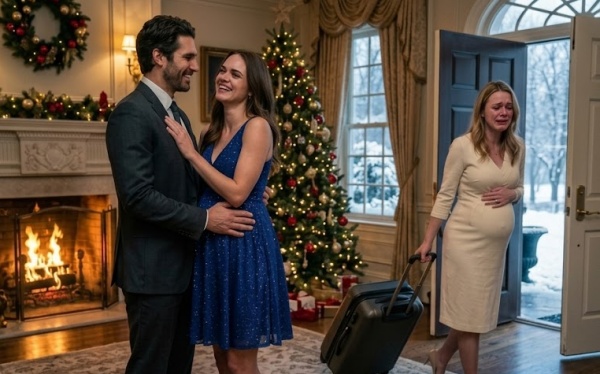
My Husband Left Me for My Best Friend Because She Gave Him a Son. He called her his future, his family, and the second chance he believed I could never give him. A year later, he saw me in a children’s hospital and mocked me in front of strangers, still convinced he had won. Then…
Part 1: The Boy He Thought I Could Never Give Him
When my husband left me, he did not slam the door. He closed it softly, like he was doing me a favor. That was what hurt the most.
His name was Caleb Morrison, and for eight years, I believed he was the safest place in my life. We lived in a modest two-bedroom house outside Columbus, Ohio, with a white porch, a cracked driveway, and a maple tree that turned bright red every October. I used to think we would grow old in that house.
We were not rich, but we were comfortable. Caleb managed inventory for a regional grocery chain, and I worked as a billing coordinator at a pediatric clinic. Together, we paid our mortgage, saved for vacations we never took, and made Sunday pancakes like it was a family tradition, even though there were only two of us at the table.
For years, that empty third chair bothered Caleb. At first, he hid it well. He would smile when friends brought their babies over and make silly faces until the kids laughed, but afterward, he would go quiet in the car.
I wanted children too. I wanted the bedtime stories, the school concerts, the muddy sneakers by the back door. I wanted to hear someone call me Mom.
But after three years of trying, two miscarriages, and more medical appointments than I could count, my body became a subject everyone seemed allowed to discuss. Doctors used careful words. Relatives used careless ones.
“Just relax,” Caleb’s mother would say during Thanksgiving dinner, as if my uterus simply needed a spa day. “Stress can do strange things.”
I smiled through it. Caleb did not defend me as often as he used to. That was the first sign, though I did not recognize it then.
The second sign was my best friend, Vanessa Reed.
Vanessa and I had been friends since community college. She was the kind of woman who could walk into a Target wearing sweatpants and somehow look like she had a stylist hiding behind the cereal aisle. She had honey-blonde hair, perfect nails, and a laugh that made people turn around.
I loved her like a sister. When my first pregnancy ended at eleven weeks, she brought me soup and slept on my couch for two nights. When the second one ended before I even had time to believe it was real, she sat on my bathroom floor while I cried into a towel.
So when she started coming over more often, I did not question it. She said she was lonely after her breakup with a firefighter named Drew. Caleb said she was “good energy” in a house that had become too sad.
I should have hated that sentence. Instead, I blamed myself for making our home heavy.
By spring, Vanessa was at our house almost every weekend. She helped Caleb grill burgers, teased him about burning corn on the cob, and watched basketball with him while I cleaned the kitchen. When I joined them, they sometimes stopped talking too quickly.
I noticed, of course. Women always notice. We just convince ourselves that noticing is not the same as knowing.
One Friday evening in May, Caleb came home wearing a new cologne. It was sharp and expensive, the kind of scent he used to say was a waste of money. When I asked about it, he shrugged and said, “Vanessa said I should try something different.”
I looked at him over the laundry basket in my arms. “Vanessa?”
“She has good taste,” he said. Then he smiled at his phone.
That summer, our marriage became a room where someone had turned off the heat. Caleb stopped touching my lower back when he passed me in the kitchen. He stopped asking about my day. He started working late, showering immediately when he came home, and taking calls in the garage.
I told myself he was grieving in his own way. I told myself men processed pain differently. I told myself everything except the truth.
The truth arrived on a Sunday afternoon in September.
Vanessa came over wearing a pale blue dress and white sandals, even though it was raining. Her makeup was perfect, but her hands trembled around the mug of tea I made her. Caleb stood by the window, his arms crossed, staring at the wet maple leaves stuck to the glass.
I remember thinking they looked like two people waiting for me to catch up to a conversation that had already happened.
Vanessa placed one hand on her stomach. “Emily,” she said, “there’s something I need to tell you.”
My name sounded strange in her mouth that day. Formal. Guilty.
I sat down slowly. “Okay.”
She looked at Caleb first. Not at me. At him.
“I’m pregnant,” she whispered.
For half a second, I thought she had come to me because she was scared. I thought I was supposed to hug her, comfort her, ask if Drew knew. My heart opened out of habit.
Then Caleb walked over and put his hand on her shoulder.
The room tilted.
I looked from his hand to her face. Vanessa started crying, but she did not step away from him. Caleb did not remove his hand.
“How far along?” I asked, though I already knew the answer would destroy me.
“Fourteen weeks,” she said.
Fourteen weeks. Late May. The new cologne. The garage calls. The weekends I thought I was being a good friend.
My lips felt numb. “Is it Caleb’s?”
Vanessa covered her mouth. Caleb did not.
“Yes,” he said.
One word. No apology before it. No shame after it.
Something inside me went quiet. Not calm. Not numb. Quiet, like a TV after someone pulls the plug.
I stood up, then sat back down because my knees were shaking. “You slept with my best friend.”
Caleb looked annoyed, as if I had chosen the least important detail. “It wasn’t planned.”
I laughed once. It came out ugly. “Oh, then that makes it beautiful.”
Vanessa cried harder. “Emily, I never meant to hurt you.”
People always say that when they have already done the hurting.
Caleb stepped forward. “She’s having a boy.”
That sentence hit harder than the confession.
A boy.
Not a baby. Not a child. A boy.
His voice changed when he said it. It filled with something I had begged to hear when I was pregnant, when I was bleeding, when I was lying in a hospital bed praying for a heartbeat that never came. Pride. Wonder. Victory.
I stared at him. “You know that already?”
Vanessa nodded through tears. “We did early genetic testing.”
“We,” I repeated.
Caleb looked me straight in the eyes. “I’m sorry, Emily. I really am. But this changes everything.”
I waited for him to say he was confused. That he made a terrible mistake. That he wanted to fix what he had broken.
Instead, he said, “I have a chance to be a father.”
I pressed my palm against my chest because I felt like I had been physically struck. “And what was I? A failed attempt?”
He flinched, but not enough. “That’s not what I mean.”
“It is exactly what you mean.”
Vanessa whispered, “Caleb, maybe we should go.”
Go. From my house. With my husband. Carrying his child.
Caleb grabbed his jacket from the chair. “I’ll come by tomorrow for my things.”
I stood in the living room while he walked past our wedding photo, past the bookshelf we built together, past the scratch marks on the hallway wall from the Christmas tree we dragged in our first year as homeowners. He opened the door, and rain blew onto the floor.
Before he left, he turned back. His eyes were wet, but his voice was steady.
“She’s my future, Emily. She’s giving me the family I always wanted.”
Then he walked out with my best friend.
I did not chase them. I did not scream. I stood there until the rain soaked the welcome mat and the cold air filled the house.
That night, I sat at the kitchen table until sunrise. My phone buzzed nonstop with texts from Vanessa, then Caleb, then Caleb’s mother, who somehow already knew. I did not open any of them.
By morning, the life I had built had become evidence. Two coffee mugs. Two toothbrushes. His work boots by the back door. A half-used bottle of prenatal vitamins in the bathroom cabinet from the last time I had been hopeful.
I threw the vitamins away first.
Then I called a divorce attorney.
Part 2: The Woman Everyone Pitied
Divorce in America is not like the dramatic courtroom scenes people imagine. Most of it happens through emails, bank statements, legal forms, and cold conference rooms with bad coffee. Nobody plays sad music while your marriage gets reduced to assets and signatures.
Caleb moved into Vanessa’s apartment within a week. It was a newer complex near Dublin, with gray siding, a fitness center, and rent that cost almost as much as our mortgage. I knew because Vanessa had once complained to me about paying $1,650 a month for “thin walls and fake luxury.”
Now my husband lived behind those thin walls, building a nursery with the woman who used to borrow my sweaters.
Our small town did what small towns do. It talked.
At church, people hugged me too long. At the grocery store, women from my old book club lowered their voices when I walked by. Some people were kind, but kindness can still feel like a spotlight when you are trying not to fall apart in the produce section.
Caleb’s mother, Linda, made it worse.
She posted a photo on Facebook of a tiny blue onesie that said Daddy’s MVP. Her caption read, “God has a way of turning heartbreak into blessings.” She tagged Caleb and Vanessa.
I stared at that post for ten minutes. Then I deleted the Facebook app from my phone.
My own mother wanted me to move back to Cleveland for a while. “You shouldn’t be alone in that house,” she said.
But I stayed. Not because I was strong. Because I refused to be erased.
Caleb wanted the house sold. His attorney argued it was “emotionally unhealthy” for both parties to remain attached to the property. My attorney, a sharp woman named Marisol Grant, slid the paperwork back across the table and said, “My client can afford the mortgage refinance. Your client chose to leave.”
I kept the house.
It cost me nearly every dollar of my savings, but I kept it. I painted the bedroom a soft green because Caleb had always insisted on gray. I replaced the couch where Vanessa had cried her fake tears with a blue one I found on clearance for $699.
At first, silence swallowed me.
I would come home from work and stand in the kitchen, waiting for a sound that no longer belonged there. No keys in the bowl. No ESPN from the living room. No Caleb calling out, “Em, did you see my wallet?”
Then slowly, the silence changed. It stopped being empty. It became mine.
I started walking every evening, first around the block, then two miles, then three. Ohio autumn turned cold, and I bought a thick coat from Kohl’s and kept walking anyway. My breath came out in white clouds, and every step felt like I was dragging myself back into my own body.
In November, the divorce became final.
Caleb wore a navy suit to the courthouse and avoided looking at me. Vanessa waited outside in a white SUV, visibly pregnant, one hand resting on her belly like a queen protecting an heir. I walked past her without speaking.
She rolled down the window. “Emily.”
I stopped, though I hated myself for it.
“I hope one day you can forgive us,” she said.
I looked at her face, at the woman who knew every scar I had and still chose to cut over them. “I hope one day you stop calling betrayal a love story.”
Her eyes filled with tears, but I walked away before she could perform them.
Two months later, their son was born.
I found out because Linda mailed me a Christmas card. I do not know if it was cruelty or stupidity. The card had a photo of Caleb holding a newborn wrapped in a blue blanket, Vanessa leaning against his shoulder, both of them glowing with sleepless joy.
On the back, Linda had written, “Meet our miracle boy, Mason Caleb Morrison. Seven pounds, eight ounces. Born December 14.”
I held the card over the trash can for a long time. Then I placed it in a drawer with the divorce papers. Not because I wanted to keep it, but because some pain becomes proof, and part of me still needed proof that I had not imagined any of it.
Winter passed. Spring came.
I did not date. I did not have a revenge makeover montage like in the movies. I gained eight pounds, lost five, cut my hair to my shoulders, cried in the shower, paid bills, unclogged a drain, and learned how to sleep in the middle of the bed.
Then, in April, my life changed again.
I was at work when a nurse from our pediatric clinic asked if I could help with a billing issue for a family whose insurance had been denied. Their little girl had a rare immune disorder, and they were drowning in paperwork. The mother, a tired woman named Hannah, sat across from me with a folder so thick it barely closed.
I spent two hours on the phone with the insurance company. I argued codes, dates, authorizations, and appeals until my throat hurt. When I finally got the claim reopened, Hannah burst into tears.
“You have no idea what this means,” she said.
I did, though. Not exactly, but enough.
After that, I started volunteering twice a month at Riverside Children’s Hospital in Columbus, helping families understand medical bills and charity care forms. It was not glamorous. It was fluorescent lights, vending machine dinners, and parents trying to be brave next to hospital beds.
But somehow, being useful stitched something together inside me.
I met children who laughed with IV poles beside them. I met fathers who slept upright in chairs for weeks. I met mothers who knew every medication dose by memory and still remembered to thank the janitor.
The hospital became the place where my own grief stopped being the largest thing in the room.
One little boy named Tyler changed me the most. He was six, with leukemia, bright red glasses, and a serious addiction to knock-knock jokes. His mother, Renee, worked nights at a warehouse and drove forty miles each way to be with him.
The first time I helped Renee apply for a hospital assistance program, she brought me a gas station coffee and said, “You’re the first person who made me feel like I wasn’t stupid for not understanding this.”
I went home that night and cried in my driveway. Not sad tears. Something else. Something warmer.
By summer, I had a new rhythm. Work, volunteering, walks, dinner with my mom once a month, therapy every other Tuesday. My therapist, Dr. Ellis, taught me that healing was not forgiveness, and moving on did not require pretending the wound was small.
“Some people want closure,” she told me. “But sometimes closure is just deciding the door can stay closed.”
I liked that.
I heard things about Caleb and Vanessa anyway. People always find ways to deliver information you did not order. Someone told me Caleb bought a used Ford F-150 because “a man needs a truck when he has a son.” Someone else said Vanessa quit her job to stay home with Mason.
They got engaged in July, even though our divorce had been final less than a year. Linda posted another photo, or so my cousin informed me before I asked her never to update me again. Apparently, Caleb proposed at a Fourth of July cookout while Mason wore a tiny shirt that said Mommy, will you marry Daddy?
It sounded like something Vanessa would plan and Caleb would believe was destiny.
I told myself I did not care.
Most days, that was true.
But grief is sneaky. It waits until you are buying bananas or folding towels, then whispers, He chose them. He chose the boy. He chose the family photo without you in it.
When that happened, I let myself feel it for ten minutes. Then I got up and did something ordinary. I washed dishes. I answered emails. I walked under the maple tree.
By September, one year after Caleb left, I was no longer the woman collapsed at the kitchen table. I was still bruised, but I was standing. I had survived every day I thought would kill me.
Then Caleb saw me at Riverside Children’s Hospital.
And because men like Caleb mistake survival for loneliness, he decided to humiliate me.
Part 3: The Hospital Hallway
It happened on a Thursday afternoon.
I had taken half a day off work to help with a family resource event at Riverside Children’s Hospital. The lobby was decorated with paper leaves, and volunteers were handing out information about financial assistance, Medicaid eligibility, and local support programs. I wore dark jeans, ankle boots, and a navy hospital volunteer badge clipped to my sweater.
I was standing near the elevators with a clipboard when I heard a baby crying.
At first, I did not look. Babies cried in children’s hospitals all the time. But then I heard Vanessa’s voice.
“Caleb, can you grab the diaper bag?”
My body recognized them before my mind did.
I turned slowly.
Caleb stood about twenty feet away wearing a gray hoodie, jeans, and the same expensive cologne. Vanessa was beside him, thinner than I remembered, her blonde hair pulled into a messy ponytail. In her arms was Mason, almost ten months old, red-faced and fussy.
For a moment, nobody moved.
Caleb saw my badge first. Then my face. Then the clipboard.
“Well,” he said loudly enough for nearby people to hear. “Look at that.”
Vanessa’s eyes widened. “Caleb, don’t.”
But he was already smiling.
That smile used to make me feel safe. Now it looked like a cheap lock on a broken door.
“Emily,” he said, walking closer. “Didn’t expect to see you here.”
I held the clipboard against my chest. “I volunteer here.”
He glanced around, as if checking for an audience. A few parents sat nearby. A nurse at the desk looked up. Vanessa shifted Mason against her shoulder.
“Volunteering at a children’s hospital,” Caleb said. “That’s… interesting.”
I knew that tone. It was the one he used when he wanted to sound polite while being cruel.
I said nothing.
He took another step. “I guess it makes sense. Being around kids somehow, right?”
The words landed quietly, but they landed.
A woman sitting nearby looked down at her phone. The nurse’s face tightened. Vanessa whispered, “Caleb, stop.”
But he did not stop.
He bounced slightly on his heels, full of the confidence of a man who thought life had rewarded him for betrayal. “You know, I always hoped you’d find peace with everything. I know seeing me as a dad probably isn’t easy.”
I stared at him. “This is a hospital, Caleb.”
“I’m aware.”
“Then act like it.”
His smile flickered.
Mason cried harder, and Vanessa tried to soothe him. She looked exhausted. Not just new-mom tired, but hollow-eyed, anxious, frayed at every edge. For the first time, I noticed that the perfect glow from the Christmas card was gone.
Caleb, however, seemed polished by his own importance.
He looked at Mason and then back at me. “We’re here for a checkup. Nothing major. Vanessa worries too much.”
Vanessa’s jaw tightened, but she did not argue.
I should have walked away. That would have been mature, healthy, evolved.
Instead, I said, “Then I hope the checkup goes well.”
That was all. Civil. Brief. More grace than he deserved.
But Caleb wanted a reaction, and my refusal to give him one irritated him.
He leaned closer and lowered his voice, though not enough. “You don’t have to pretend. I know this must hurt. Me having a son. A real family.”
A real family.
The nurse behind the desk looked openly disgusted now.
For a second, the hallway disappeared. I was back in our living room, hearing him say Vanessa was his future. I was back at the courthouse, passing the woman who had stolen my grief and called it love. I was back at the kitchen table, watching sunrise over the ruins of my marriage.
But I was also at Riverside. I was wearing a badge. Families were watching. Children were sick upstairs. This was not the place to bleed.
So I smiled.
Not warmly. Not kindly. Just enough.
“Caleb,” I said, “if having a child made someone a better person, this hallway would be full of saints.”
His face changed.
Vanessa looked at me, and something like shame passed across her features.
I turned to leave, but Caleb said, “Still bitter.”
I stopped.
He adjusted Mason’s blanket, performing fatherhood for strangers. “I mean, I get it. You wanted what Vanessa gave me.”
The air went still.
I heard someone inhale sharply.
Vanessa said, “Caleb.”
This time, her voice had a warning in it.
But he ignored her again. “A son changes a man, Emily. You wouldn’t understand.”
I looked at Mason. He had Caleb’s dark hair, Vanessa’s nose, and the helpless, angry cry of a baby who did not ask to be anyone’s trophy. My anger softened around him. None of this was his fault.
Then I looked back at Caleb.
“You’re right,” I said quietly. “I don’t understand using a child to hurt someone.”
His face flushed.
Before he could answer, a doctor stepped into the hallway and called, “Mason Reed?”
Not Morrison. Reed.
It was small, but I noticed.
Vanessa noticed that I noticed.
Caleb’s head snapped toward the doctor. “It’s Morrison,” he said.
The doctor checked the tablet. “I have Mason Reed for genetics follow-up.”
Genetics.
The word moved through the hallway like a draft under a door.
Vanessa went pale.
Caleb blinked. “Genetics follow-up?”
The doctor looked from Vanessa to Caleb, clearly realizing there was tension. “You can discuss details with Dr. Hargrove inside.”
Vanessa clutched Mason tighter. “Caleb, let’s just go in.”
But Caleb did not move. “Why does he have your last name in the system?”
Vanessa’s eyes flicked toward me, then away. “Insurance paperwork. It’s complicated.”
He laughed once. “Complicated?”
The doctor said gently, “We can continue this in the exam room.”
I should have left then. I should have walked to the volunteer desk, refilled pamphlets, and let their private disaster unfold without me.
But I stood frozen, not because I wanted revenge, but because I had just seen the first crack in the life Caleb had used to replace me.
Vanessa touched his arm. “Please, not here.”
Caleb pulled away. “What genetics follow-up?”
Mason cried again, louder this time, and a security guard near the entrance glanced over.
The doctor lowered their voice. “Mr. Morrison, I’m not able to discuss the patient’s medical information in the hallway.”
That should have ended it. In any normal situation, it would have.
But Caleb was not normal when pride was threatened.
He turned to Vanessa. “What did you not tell me?”
Vanessa’s face crumpled. “Caleb, please.”
I had seen her fake cry. This was not that. This was terror.
The doctor guided them toward the exam area. Caleb followed, stiff and silent, while Vanessa carried Mason like the floor might open beneath her. Just before they disappeared through the double doors, Caleb looked back at me.
For once, he was not smiling.
I went to the restroom and locked myself in a stall.
My hands were shaking. I gripped the metal divider and tried to breathe.
I did not know what was happening. I did not know why Mason was there, why his chart said Reed, or why the word genetics had turned Vanessa white. I only knew that Caleb had come into that hospital wanting to prove he had won.
And somehow, within five minutes, the universe had placed a question mark over his victory.
I stayed in the stall until my breathing slowed. Then I returned to the lobby and finished my shift. I helped a father fill out a charity care form. I gave a grandmother directions to the cafeteria. I smiled at Tyler when he rolled by in a wheelchair and shouted, “Knock knock!”
Life continued, because life always has the audacity to continue.
At 6:15 p.m., I walked to the parking garage. The sky was gray, and rain tapped against the concrete openings. I had just reached my car when I heard my name.
“Emily.”
Vanessa stood near a silver SUV, Mason asleep against her shoulder. Her eyes were swollen. Caleb was nowhere in sight.
I could have ignored her.
I almost did.
But something in her face stopped me. It was not the face of a woman who wanted forgiveness. It was the face of someone whose lie had grown teeth.
“What do you want?” I asked.
She swallowed. “I need to tell you something.”
“No.”
“Please.”
I laughed without humor. “You had a year to tell me things.”
“I know.”
“You had a year to tell the truth before you took my husband, my home life, my dignity—”
“I didn’t take your dignity,” she whispered. “Caleb tried to. I did too. But we didn’t succeed.”
I hated that she was right.
Mason stirred, and she kissed his head. The gesture looked instinctive, not performed. Whatever else Vanessa was, she loved that baby.
She looked at me with tears slipping down her face. “Caleb ordered a paternity test.”
I went still.
“Why?”
Her lips trembled. “Because the doctors found something during Mason’s testing. A genetic marker. Something that made them ask questions about family history.”
I waited.
Vanessa closed her eyes. “Caleb isn’t Mason’s father.”
The rain seemed to get louder.
For one impossible second, I felt nothing. Then everything hit at once. Shock. Anger. A dark, unwanted satisfaction. And beneath it, sadness so deep it surprised me.
Not for Caleb.
For the woman I used to know. For the baby sleeping on her shoulder. For the destruction that could have been avoided if anyone in that mess had cared more about truth than winning.
“Who is?” I asked.
Vanessa wiped her cheek. “Drew.”
“The firefighter?”
She nodded.
I stared at her. “You knew there was a chance?”
She broke.
A sob tore out of her, and she turned away so she would not wake Mason. “Yes.”
The answer was small, but it was enough to rewrite everything.
Part 4: The Truth Has a Price
Vanessa told me the story in pieces under the dim lights of the parking garage.
She and Drew had not fully broken up when she started sleeping with Caleb. They were “on and off,” which is what people say when they want chaos to sound romantic. She had been angry at Drew, flattered by Caleb’s attention, and jealous of my marriage in ways she said she did not understand until it was too late.
I stood there listening, feeling the old version of myself disappear completely.
“When I found out I was pregnant,” she said, “I didn’t know who the father was.”
“So you chose Caleb.”
She nodded, crying silently now. “He wanted it so badly. The baby. A son. A family.”
“And Drew?”
“I told him the baby wasn’t his.”
My mouth fell open. “Vanessa.”
“I know.”
“No, I don’t think you do.”
She shifted Mason carefully, protecting him from the edge of her own confession. “Drew asked for a test. I refused. I said it would be too stressful and that Caleb had already accepted responsibility.”
“Accepted responsibility?” I repeated. “You mean you let him destroy our marriage for a maybe.”
Her face twisted. “Yes.”
The honesty should have satisfied me. It did not. It only made the betrayal more stupid.
I thought about Caleb standing in the hospital hallway, mocking me with a child who might never have been his. I thought about Linda’s Facebook posts, the onesie, the miracle boy. I thought about all the people who had looked at me like I was the sad woman left behind while Caleb marched into fatherhood.
A year of humiliation built on a lie Vanessa could have questioned with one test from any reputable lab.
“Why are you telling me?” I asked.
“Because Caleb is about to find out officially.” She looked toward the hospital doors. “The results come through tomorrow, but the doctor basically confirmed what the genetic testing suggested. Caleb knows enough to be suspicious.”
I folded my arms. “That still doesn’t explain why you’re telling me.”
She looked at me then, and for the first time, I saw something stripped of performance.
“Because I ruined your life,” she said. “And tomorrow he’s going to act like he’s the only victim.”
I had no answer for that.
A car passed slowly through the garage, headlights sliding over her face. Mason slept through everything, his tiny fist curled near his cheek. He was not Caleb’s trophy. He was not Drew’s proof. He was just a baby, soft and unaware, caught in the wreckage of adults.
“Does Drew know?” I asked.
Vanessa shook her head. “Not yet.”
“Tell him.”
“I’m scared.”
“You should be.”
She flinched.
I did not soften my voice. “But he deserves to know. Mason deserves the truth. And Caleb…” I stopped.
Caleb deserved many things. The truth was one of them, though not for his sake.
Vanessa whispered, “He’ll hate me.”
“He already left one woman for what he thought he could get from another,” I said. “You built your life with a man who loved the idea of a son more than the people around him. What did you think would happen when the idea cracked?”
She looked down.
I walked to my car, unlocked it, and opened the door.
“Emily,” she said.
I looked back.
“I’m sorry.”
There were years when those words would have meant everything. That night, they sounded like a receipt for something already burned.
“I believe you,” I said. “But I’m not carrying your guilt for you.”
Then I drove home.
The next day was Friday. I went to work, answered emails, processed claims, and acted like my phone was not glowing with messages from numbers I had blocked long ago. At lunch, my cousin texted me: “Something is happening with Caleb. Linda deleted all the baby posts.”
I stared at the message.
Then I turned my phone face down and ate my turkey sandwich.
At 3:42 p.m., Caleb called from a number I did not recognize. I let it go to voicemail. He called again. Then again.
Finally, a text appeared.
“Please call me. I need to talk to you.”
I almost laughed.
Need. Men like Caleb always discovered need after pride failed.
I did not respond.
At 5:10 p.m., there was a knock at my front door.
I looked through the peephole and saw Caleb standing on my porch in the rain.
For a moment, memory betrayed me. I saw the man who had carried me inside when I sprained my ankle on a hike in Hocking Hills. I saw the man who once drove forty minutes at midnight because I wanted blueberry pancakes from a diner off I-71. I saw my husband.
Then he lifted his face, and I saw the man from the hospital hallway.
I opened the door but left the chain on.
“What do you want?”
He looked terrible. His hair was wet, his eyes red, his hoodie dark with rain. He had aged ten years in twenty-four hours.
“I got the results,” he said.
I said nothing.
“He’s not mine.”
The words should have felt like revenge. Instead, they hung between us like something dead.
“I’m sorry for Mason,” I said.
Caleb blinked, as if he expected me to say I was sorry for him.
He stepped closer. “You knew.”
“I found out yesterday.”
“From Vanessa?”
“Yes.”
He laughed bitterly. “Of course she ran to you.”
“She didn’t run to me. She told me the truth, which is more than either of you gave me.”
His face collapsed, then hardened. “I lost everything.”
I felt my hand tighten around the door.
“No,” I said. “You threw everything away. There’s a difference.”
He looked past me into the house. The green bedroom wall was not visible from the entryway, but I liked knowing it existed. Proof that his absence had color.
“I made a mistake,” he whispered.
“A mistake is forgetting milk. You had an affair with my best friend, got her pregnant, humiliated me, divorced me, and mocked me in a children’s hospital.”
“I thought he was my son.”
“And that made cruelty acceptable?”
He looked down.
Rain dripped from his sleeves onto my porch. The maple tree behind him shook in the wind, scattering red leaves across the wet steps.
“I wanted a family,” he said.
“So did I.”
His eyes filled with tears. “Emily…”
“No.”
It came out sharper than I expected.
He swallowed. “You don’t even know what I’m going to say.”
“Yes, I do.”
Because I did. I could see it forming in his face. The old entitlement. The belief that my love had been sitting untouched on a shelf, waiting for him to return it to his cart.
He whispered, “I miss my wife.”
Something inside me almost broke again.
Almost.
I looked at the man who had once known every version of me: hopeful, grieving, funny, tired, scared. I looked at the man who had decided I was replaceable because another woman’s pregnancy offered him a title he wanted. I looked at the man who had come back not because he understood my worth, but because his prize had been taken from him.
“Your wife doesn’t live here anymore,” I said.
He stared at me.
“I do.”
His mouth opened, but no words came.
I closed the door.
He knocked once. Then twice. Then he stopped.
I stood in the hallway with my back against the wall, shaking from head to toe. I did not cry immediately. My body waited until I heard his truck start and pull away.
Then I slid to the floor and sobbed.
Not because I wanted him back. Because some endings have to happen more than once before your heart believes them.
The fallout spread quickly.
Drew found out two days later. From what I heard, he demanded a legal paternity test and hired an attorney. Vanessa moved out of Caleb’s apartment within a week and stayed with her older sister in Cincinnati.
Caleb’s mother vanished from Facebook for nearly a month.
People who had pitied me before now approached me with bright, hungry eyes, eager to discuss karma. I hated that too. They wanted the story to be simple: cheating husband punished, betrayed wife vindicated, lying best friend exposed. Clean lines. Easy morals.
But real life is messier.
Mason had done nothing wrong, yet his world turned upside down. Drew had been denied almost a year of his child’s life. Vanessa had to face what she had built. Caleb had to grieve a son who was never his and a marriage he had destroyed.
And I had to be careful not to mistake his suffering for my healing.
One evening, Linda came to my house.
I saw her through the window and considered pretending I was not home. But she looked smaller than usual, wrapped in a beige coat, holding a paper bag from a local bakery. She had always believed pastries could soften anything.
I opened the door.
“Emily,” she said. “May I come in?”
“No.”
She nodded, accepting it. “I deserve that.”
I waited.
She held out the bag. “I brought lemon bars.”
I did not take them.
Her eyes filled. “I was cruel to you.”
“Yes.”
“I told myself I was supporting my son.”
“You were celebrating my replacement.”
She flinched but did not deny it. “I’m sorry.”
The words were late. Maybe too late. But unlike Vanessa’s apology, Linda’s did not ask me to carry anything. It simply stood there, ugly and true.
I took the bag because lemon bars were still lemon bars.
“I’m not ready to forgive you,” I said.
She nodded. “I understand.”
“No,” I said. “You don’t. But you can respect it.”
“I will.”
She walked back to her car, and I closed the door. The lemon bars sat on my counter for three days before I ate one. It was annoyingly delicious.
By November, the legal truth was official: Drew was Mason’s biological father. He petitioned for parental rights, and Vanessa agreed to a custody plan. Caleb’s name had to be removed from documents he had proudly signed.
I did not know every detail, and I did not want to.
Caleb sent me one long email around Thanksgiving. I opened it against my better judgment. It was full of regret, memories, and sentences that began with “I see now.”
I did not reply.
Instead, I printed the email, folded it, and placed it in the drawer with the Christmas card and divorce papers. Not because I needed proof anymore, but because I wanted all the old ghosts in one place.
Then I closed the drawer.
Part 5: What Broke Him Did Not Break Me
A year after the hospital hallway, I went back to Riverside for the same fall resource event.
The lobby had paper leaves again. The coffee was still terrible. Tyler, now seven and in remission, visited with his mother and told me a knock-knock joke so bad I laughed until my stomach hurt.
I was standing by the elevators when I saw Drew.
I recognized him from old photos Vanessa had shown me years earlier. He was tall, broad-shouldered, with tired eyes and a toddler balanced on one hip. Mason had grown into a sturdy little boy with dark curls and sneakers that lit up when he kicked his feet.
Drew saw my volunteer badge. “Are you Emily?”
For a second, I braced myself.
“Yes.”
He shifted Mason to his other side. “I’m Drew. I just wanted to say thank you.”
I frowned. “For what?”
He looked down at Mason, who was trying to peel a sticker off his jacket. “Vanessa said you told her to tell me the truth.”
I exhaled slowly. “She already knew she had to.”
“Maybe. But she said you made it impossible for her to keep pretending.”
I did not know what to say.
Drew gave me a tired smile. “I lost time with him. I’m angry about that. But I have him now.”
Mason looked at me and held out the half-peeled sticker. It was shaped like a dinosaur.
“For me?” I asked.
He nodded solemnly.
I took it and stuck it on my clipboard. “Thank you. Very professional.”
Mason giggled.
Drew’s eyes softened. “He’s a good kid.”
“I’m sure he is.”
There was no bitterness in me when I said it. That surprised me. Somewhere along the way, Mason had stopped being the symbol of what Caleb chose over me. He had become what he always was: a child who deserved adults brave enough to tell the truth.
Drew nodded once, then carried him toward the elevators.
As they left, I felt a strange peace. Not dramatic. Not movie-ending peace with sunlight bursting through clouds. Just a quiet settling, like a house after a storm.
That evening, I drove home through streets lined with orange and red trees. The air smelled like rain and wood smoke. At a stoplight, I saw a father helping a little girl zip her jacket outside a pizza place, and the sight did not pierce me the way it once would have.
Some dreams still hurt when you touch them. But they no longer owned me.
When I got home, Caleb was sitting on my porch.
My first thought was not pain or longing. It was irritation. I had planned to make soup and watch a true-crime documentary, and there he was, blocking my peace like an unpaid bill.
He stood when I approached. He looked thinner, older, less polished. His truck was parked at the curb, and he held a small envelope in both hands.
“I know I shouldn’t be here,” he said.
“You’re right.”
“I won’t stay long.”
I unlocked the door but did not open it. “Say what you came to say.”
He looked at the maple tree. Its leaves were turning again, bright red against the gray sky. “This time last year, I thought I had everything.”
I said nothing.
“I thought having a son proved I made the right choice.”
There it was. The truth, finally stripped of romance.
He swallowed. “When I saw you at the hospital, I wanted you to feel small because I felt powerful. I’ve replayed that moment a thousand times.”
“I haven’t,” I said.
That seemed to hurt him, which was not why I said it. It was simply true.
He looked down at the envelope. “I wrote you a letter. An apology. A real one, I hope.”
I did not take it.
“Caleb, apologies are not keys.”
His eyes lifted.
“You don’t get to use one to come back into someone’s life.”
“I know.”
“Do you?”
He breathed out. “I’m trying to.”
For the first time in years, I believed he might be telling the truth. Not enough to trust him. Not enough to open the door. But enough to see that he was no longer performing victory.
He was standing in the ruins with a flashlight, finally noticing the damage.
“Mason asks about me sometimes,” he said quietly.
That surprised me. “He remembers you?”
“A little. Vanessa lets me see him occasionally. Drew agreed, as long as it’s healthy for Mason.” Caleb’s mouth trembled. “He calls me Cal.”
I felt something complicated move through me. Sadness, maybe. Not forgiveness. Not pity exactly. Just the recognition that consequences can be cruel even when they are deserved.
“He’s lucky if the adults around him choose peace,” I said.
Caleb nodded. “I’m trying to be one of them.”
The streetlights flickered on.
He held out the letter again. “You don’t have to read it.”
“No,” I said. “I don’t.”
His hand dropped.
“I hope you become better,” I told him. “Not for me. Not so you can be forgiven. Just because the world has enough people who only learn after they break someone.”
His eyes filled, but he did not cry. “I loved you, Emily.”
I looked at him for a long moment.
There was a time when those words would have pulled me under. I would have searched his face for the man I married. I would have mistaken memory for destiny.
But the woman standing on that porch had survived him. She had painted walls, paid bills, sat with sick children, argued with insurance companies, eaten lemon bars from an enemy, and learned that being chosen by herself mattered too.
“I know,” I said. “But you loved what you wanted more.”
He closed his eyes.
I opened my front door. Warm air spilled out behind me.
“Goodbye, Caleb.”
This time, the word did not shake.
I stepped inside and closed the door. Not softly. Not dramatically. Just firmly.
After a minute, I heard him walk down the porch steps. His truck started. The sound faded down the street.
I made soup that night.
Tomato basil, from a recipe I found online, with grilled cheese cut diagonally because that is the correct way no matter what anyone says. I ate at the kitchen table, the same table where I had once watched my life collapse before sunrise.
The house was quiet.
But it was not empty.
A week later, I cleaned out the drawer.
The divorce papers went into a file box in the closet. The Christmas card went into the trash. Caleb’s email followed it. I paused over the old prenatal vitamins receipt I had forgotten was tucked under everything, then threw that away too.
Not because I wanted to erase the past. Because I did not need to keep touching it to prove it happened.
At the bottom of the drawer, I found a photo from our wedding. Caleb and I were standing under string lights, laughing at something outside the frame. For a moment, I let myself remember that we had been happy once.
Then I placed the photo in the box with the papers.
Some things do not belong in the trash. They belong in the past.
By December, I had become the coordinator for a new family assistance program at the clinic. It came with a small raise, only $4,000 a year, but I was proud of it. I used part of my first bigger paycheck to buy a new dining table, round instead of rectangular.
No empty third chair. Just space.
On Christmas Eve, I volunteered at Riverside for a few hours. A little girl in pink pajamas asked me if Santa knew how to find kids in hospitals. I told her Santa had excellent GPS, better than most delivery drivers.
Her mother laughed so hard she cried.
When I got home, snow was falling lightly, dusting the porch and the maple branches. I stood outside for a while, letting the cold touch my face. Across the street, a family was loading gifts into a minivan, arguing cheerfully about who forgot the pie.
For once, I did not feel outside of life looking in.
I went inside, turned on the Christmas tree lights, and made hot chocolate with too many marshmallows. My phone buzzed with a text from my mother: “Merry Christmas, honey. Proud of you.”
I typed back, “Merry Christmas. I’m proud of me too.”
And I meant it.
People love stories where the truth destroys the villain. They want the cheating husband ruined, the lying friend exposed, the betrayed wife glowing in a red dress while everyone regrets underestimating her. I understand the appeal.
But the truth did not arrive like a lightning bolt to make me powerful.
It arrived late, messy, and expensive. It broke Caleb, yes. It cracked open the family he bragged about and forced everyone to face what had been built on lies.
But it did not heal me by itself.
I healed in smaller ways.
I healed by staying in the house. I healed by walking three miles in the cold. I healed by learning medical billing codes for families too tired to fight alone. I healed by refusing to answer emails that only existed to ease someone else’s guilt.
I healed when I stopped asking why Vanessa was enough to make him leave and started asking why I had ever believed being left made me less.
I healed when I realized Caleb had not chosen a better woman, a better life, or a better future. He had chosen an illusion that flattered him. He wanted to be the hero in a story where biology rewarded him and no one questioned the cost.
And when that illusion collapsed, he came looking for the woman who used to clean up his pain.
But I was no longer available for that job.
Sometimes, people ask if I forgive them.
The honest answer is complicated. I do not wake up angry anymore. I do not wish Caleb misery. I do not want Vanessa punished forever, especially because Mason needs peace more than adults need revenge.
But forgiveness, if it comes, will be private. It will not be a bridge back to people who burned the first one and complained about the smoke.
I hope Mason grows up loved. I hope Drew becomes the father he was denied the chance to be at first. I hope Vanessa tells the truth sooner in every life she touches from now on.
And Caleb?
I hope he learns that fatherhood is not a trophy, marriage is not a placeholder, and a woman’s worth is not measured by what her body can give.
As for me, I am building a life that does not need his regret to feel complete.
Last week, I drove past Caleb at a red light near the old grocery store where we used to shop together. He was in his truck, staring ahead, looking tired but calm. For a second, his eyes met mine.
He raised one hand.
I nodded.
Then the light turned green, and I drove on.
No tears. No shaking. No imaginary speech in my head. Just the road ahead, the heater humming, and a paper cup of coffee cooling in the cup holder.
It was not a dramatic ending.
It was better.
It was freedom.
