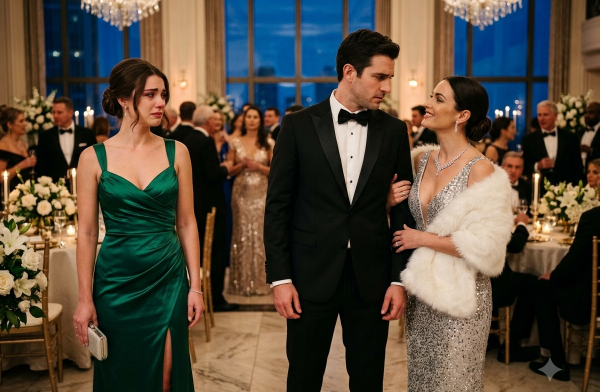
He admitted he had betrayed me with my best friend on the very night we became husband and wife. He thought that confession would make me look weak, emotional, and broken. Instead, I thanked him — because the truth he spoke in anger became the proof that ended his lies.
PART I — THE BACKYARD WENT SILENT
When Caleb finally said the words out loud, the whole backyard went silent.
It happened on a warm Saturday evening in Franklin, Tennessee, beneath the white string lights I had spent two hours hanging across my sister’s backyard. There were paper plates stacked on the patio table, half-empty glasses of sweet tea sweating in the humidity, and the smell of smoked brisket drifting from my brother-in-law’s grill. It was supposed to be a simple family cookout to celebrate my parents’ thirty-fifth wedding anniversary.
Instead, it became the night my husband destroyed the last lie he had left.
Caleb stood near the firepit with a beer in his hand and anger on his face. He had that look he got when he felt cornered, the one where his jaw tightened and his eyes went flat. Around us, my family and several close friends had slowly stopped pretending not to listen.
My older sister, Maggie, was frozen beside the picnic table, holding a tray of deviled eggs. My mother sat beneath the maple tree with her hand pressed against her chest. My father stood near the grill, still holding the tongs, his face hard in a way I had only seen twice in my life.
And beside the sliding glass door, pale and shaking, stood my former best friend, Brianna Wells.
Former.
That word still felt strange in my mouth then, even after everything.
For fourteen years, Brianna had been the person I called first. We met at Middle Tennessee State University, in a freshman composition class where she borrowed a pen from me and never returned it. She was loud, beautiful, funny, dramatic, and magnetic in the way some people are before you realize magnetism can pull knives as easily as flowers.
She was my maid of honor.
She stood three feet away from me when I married Caleb Monroe.
She held my bouquet while I said my vows.
She toasted us at the reception, laughing through tears as she said, “If anyone deserves a love story that lasts forever, it’s Emma.”
My name is Emma Monroe.
At least, that was still my legal name then.
I was thirty-one, an elementary school counselor in Murfreesboro, and I had been married to Caleb for just under three years. Our marriage had looked ordinary from the outside. A starter house with a small porch. Two dogs. Student loans. Costco runs. Church on some Sundays. Arguments over laundry, bills, and whose turn it was to call the plumber.
But beneath the ordinary surface, there had been something rotten almost from the beginning.
I just did not know how far back the rot went.
That evening, Caleb had not planned to confess.
Men like Caleb rarely confess when silence still benefits them.
He had planned to intimidate me.
He had planned to make me look unstable.
He had planned to say I was emotional, paranoid, unforgiving, impossible to satisfy. He had rehearsed that version of me so many times in private that he expected others to believe it on command.
But anger is careless.
And Caleb was very angry.
The argument started because my aunt Denise asked why Caleb and I were “taking space.” She said it gently, with concern, because everyone knew we had been separated for six weeks. I had told people only that we were dealing with private marital issues and that I needed time.
Caleb hated that.
He hated that I was not begging.
He hated that I had moved into Maggie’s guest room instead of staying in our house and letting him explain himself into innocence.
He hated that I had hired an attorney.
Most of all, he hated that I had stopped answering phone calls and insisted that anything important be put in writing.
Documentation terrified him more than tears ever had.
Aunt Denise’s question hung in the air for half a second before Caleb laughed.
It was an ugly laugh.
“Taking space,” he repeated. “That’s what she’s calling it?”
I looked at him across the patio.
“Caleb, not here.”
“Oh, now you don’t want to talk?” he said. “That’s funny, Emma. You’ve been telling everyone I’m some kind of monster.”
“I haven’t told everyone anything.”
“You don’t have to. You do that thing where you go quiet and make people feel sorry for you.”
The backyard shifted.
Conversations stopped.
A cicada buzzed loudly from somewhere in the trees.
Brianna stared at the ground.
I remember noticing that before I noticed my own heartbeat. She looked not guilty, exactly, but afraid in a way that told me she already knew what Caleb might say if he lost control.
My father set down the grill tongs.
“Son,” he said evenly, “this is not the place.”
Caleb turned toward him.
“With all due respect, Mr. Harper, you don’t know what she’s like behind closed doors.”
My mother gasped softly.
I felt Maggie move closer to me.
I should have walked away then.
Part of me wishes I had.
But another part of me knows I needed the world to hear him, because for weeks he had been careful. In texts, he was apologetic but vague. In public, he was wounded. In private, he was cold, defensive, and sharp enough to cut without leaving evidence.
So I stayed still.
“What am I like behind closed doors, Caleb?” I asked.
His eyes snapped back to mine.
“You want the truth?”
“Yes,” I said. “For once.”
That was when his face changed.
Something reckless flashed across it.
Maybe he wanted to punish me.
Maybe he wanted to humiliate me.
Maybe he believed that if he threw the worst truth into the yard, I would crumble and everyone would turn to comfort him for “finally being honest.”
He pointed toward Brianna without looking at her.
“You want to act like I ruined some perfect marriage?” he said. “Fine. I slept with Brianna on our wedding night. There. Is that honest enough for you?”
The world stopped.
Not metaphorically.
It truly felt like all movement ended at once.
The ice in someone’s plastic cup cracked.
A child laughed in a neighboring yard, distant and completely unaware.
My mother made a sound that I had no name for.
Maggie whispered, “Oh my God.”
Brianna covered her mouth.
Caleb’s face remained hard, but his eyes flickered. A man can know he has gone too far and still be too proud to walk backward. He looked around the yard, expecting shock to become judgment against me somehow.
It did not.
Everyone stared at him.
Not at me.
At him.
I felt something strange happen inside my chest.
Pain, yes.
Humiliation, yes.
But beneath both, there was a stillness so clean it almost felt like relief.
Because I had suspected.
I had asked.
I had been denied, mocked, and told I was rewriting history because I could not handle “normal marital conflict.”
For six weeks, Caleb had said I had no proof.
Now he had given it to me in front of twelve witnesses.
I looked at him for a long moment.
Then I said, “Thank you.”
His eyebrows pulled together.
“What?”
“Thank you,” I repeated, my voice calm enough to scare even me. “That was all I needed.”
He stared at me.
I reached into my purse, took out my phone, and opened the recording app.
Caleb’s face changed.
I had not recorded the confession.
Tennessee is a one-party consent state for many recordings, but I had not been recording that conversation, and I was not going to pretend otherwise. I did not need to. There were witnesses. There were faces. There was silence so thick it had weight.
But Caleb did not know what I had or had not captured.
That uncertainty hit him like a physical thing.
“Emma,” he said, his voice suddenly lower.
“No,” I said. “You don’t get to manage this one.”
Brianna took a step toward me.
“Emma, please—”
I turned to her.
“Do not speak to me.”
She stopped.
The woman who had once known every secret of my life stood there in my sister’s backyard, exposed beneath string lights and summer humidity, and I felt the final thread between us snap.
Not dramatically.
Quietly.
Like a seam giving way.
My father walked over and stood beside me.
His voice was calm when he spoke to Caleb.
“You need to leave.”
Caleb looked at him, then at me.
“This is my family too.”
“No,” my father said. “It was. Leave.”
Caleb looked around for someone to defend him.
No one moved.
Not even Brianna.
Especially not Brianna.
He threw his beer bottle into the trash harder than necessary and walked toward the side gate. Brianna hesitated for two seconds, then followed him, which answered a question nobody had asked out loud.
The gate slammed.
Nobody spoke.
The brisket smoked.
The string lights glowed.
My mother began crying.
And I stood in the middle of my sister’s backyard, realizing that the worst sentence my husband had ever spoken might also be the one that finally set me free.
PART II — THE WEDDING NIGHT I COULD NEVER REMEMBER CORRECTLY
For nearly three years, my wedding night existed in my memory like a photograph with one corner burned away.
Most of it was beautiful.
The ceremony took place at a restored barn outside Leiper’s Fork, with rolling green hills behind us and white roses tied to the aisle chairs. It was late September, warm but not miserable, the kind of Tennessee evening that makes people forgive the mosquitoes. My mother cried before I even started walking down the aisle.
Caleb cried too.
At least, I thought he did.
He stood beneath the wooden arch in a navy suit, his hands clasped in front of him, his eyes shining as my father walked me toward him. When Caleb took my hands, he squeezed them twice, our private signal for I’m here. I believed him.
That belief now feels like a country I once lived in.
A place with old maps and no bridges back.
Brianna stood to my left in sage green satin, holding my bouquet. She looked stunning, as always, her dark curls pinned loosely and a gold bracelet shining on her wrist. I remember thinking how lucky I was to have a best friend who celebrated me without needing to compete.
That memory embarrasses me now.
Not because I was foolish.
Because I was trusting.
And trust, when placed in the wrong hands, becomes evidence only after it has been betrayed.
The reception was loud, joyful, and slightly chaotic. Caleb’s college friends drank too much bourbon. My cousins danced badly to Shania Twain. Brianna gave her speech after dinner, lifting her champagne flute with one hand and wiping tears with the other.
“Emma loved carefully,” she told the room. “She waited for someone who made her feel safe. Caleb, thank you for being that person.”
People clapped.
Caleb kissed my cheek.
Brianna hugged me so tightly my earrings caught in her hair.
I remember all of that.
What I could never remember clearly was what happened after midnight.
Caleb had been attentive for most of the night, but near the end of the reception, he disappeared for almost half an hour. When he came back, his tie was loosened, his hair was damp near his temples, and he smelled faintly of perfume under the bourbon.
I asked where he had been.
He laughed and said, “Trying to find the venue manager. They almost packed up the leftover food without telling us.”
It sounded plausible.
Weddings are full of logistics.
Brianna was missing too, but I did not connect the two absences.
Why would I?
She was my maid of honor.
He was my husband.
Some possibilities are too ugly for the mind to recognize without evidence.
Later, at the hotel in downtown Franklin, Caleb was distant in a way I blamed on exhaustion. He said he had too much to drink and felt sick. He kissed me quickly, changed clothes in the bathroom, and fell asleep turned away from me.
I lay beside him in my wedding-night lingerie, feeling embarrassed and confused.
Then I felt guilty for feeling embarrassed.
Marriage had begun hours earlier, and already I was scolding myself for wanting too much.
The next morning, Brianna did not answer my texts until nearly noon.
When she finally replied, she said she had slept through her alarm and felt “destroyed from dancing.” She added three laughing emojis and a heart. I accepted that because acceptance was easier than suspicion.
For the first year, our marriage was normal enough to hide what was wrong.
Caleb was affectionate in public and unpredictable in private. Not cruel every day. Not even most days. That was part of the confusion. He could be funny, thoughtful, and generous when it suited him, then impatient and dismissive when I needed something inconvenient.
If I cried, he sighed.
If I asked questions, he said I was anxious.
If I noticed inconsistencies, he told me I was “building a case” like I worked for the FBI.
That phrase became one of his favorites.
“You’re building a case again, Em.”
It made me feel ashamed for wanting clarity.
Brianna remained close to us.
Too close, I understand now.
She came over for game nights, birthdays, cookouts, and Sunday football. She knew the code to our garage. She borrowed dresses from my closet. She called Caleb “Cal” before I did, which bothered me once, though I quickly told myself I was being ridiculous.
Caleb encouraged that.
Not directly.
He did not say, “Your discomfort is ridiculous.”
He said softer things.
“Brianna’s family.”
“You know how she is.”
“Don’t make it weird.”
Three sentences that can train a woman to distrust her instincts.
The first real crack came six months after the wedding, when I found a silver earring under the passenger seat of Caleb’s truck.
It was not mine.
When I held it up, he barely glanced at it.
“Probably Brianna’s,” he said. “She rode with me to pick up ice for your birthday party.”
That was true.
She had.
I texted her a photo.
She replied almost immediately:
OMG yes, that’s mine! I’ve been looking everywhere. Thank you babe!
Babe.
She called everyone babe.
I told myself that too.
Another time, I walked into the kitchen during a cookout and found them standing too close near the sink. Caleb moved first. Brianna smiled too brightly and said they were arguing about whether banana pudding counted as a casserole. I laughed because everyone else laughed.
The body knows before the mind admits.
Mine knew.
It tightened whenever Caleb’s phone lit up and he angled the screen away. It went cold when Brianna knew details I had not told her. It became restless when Caleb criticized me in ways that sounded rehearsed, as if he had discussed my flaws with someone who agreed too quickly.
Still, suspicion without proof can feel like self-betrayal.
Especially when the people you suspect are the people you love most.
By the second year, Caleb and I were fighting often.
He said I was distant.
I said he was secretive.
He said I made marriage feel like a courtroom.
I said honesty would make it feel less like one.
Sometimes he stayed out late and claimed he was with coworkers. Sometimes he came home smelling like expensive vanilla perfume, which Brianna wore. When I mentioned it, he rolled his eyes and said half the women in Tennessee wore vanilla perfume.
I wanted therapy.
He wanted me to “stop making everything heavy.”
We tried one couples counselor in Murfreesboro. Caleb charmed her for forty minutes, then cried when describing how hard it was to love someone who “never felt safe no matter what he did.” The counselor turned to me and asked whether my anxiety predated the marriage.
I left that session feeling like the problem.
Caleb was kind for exactly two days afterward.
Then he told me therapy would not work if I kept “weaponizing feelings.”
That was when I began writing things down.
Not dramatically.
Just dates.
Times.
What he said.
What I observed.
What I felt.
I did not know then that those notes would matter later. I only knew that I needed proof for myself. Gaslighting is not always loud. Sometimes it is the slow erosion of your confidence in your own memory.
The night everything began to unravel was an ordinary Tuesday.
Caleb was in the shower.
His phone buzzed on the bathroom counter, not locked because he had been playing music through the speaker. I saw Brianna’s name before I could look away.
She still doesn’t know about the wedding night. You need to stop acting guilty.
I froze.
The message remained on the screen for maybe seven seconds before it disappeared into the notification stack.
My whole body went cold.
The wedding night.
There are phrases that do not need explanation because your nervous system understands them before language catches up.
I did not confront him immediately.
That was new for me.
Old Emma would have opened the bathroom door and demanded answers while he stood dripping on the tile. Old Emma would have given him time to recover, deny, delete, accuse, and turn my pain into his inconvenience.
Instead, I stepped back.
I picked up my own phone.
I wrote down the exact words.
Then I left the bedroom and sat in the dark living room, shaking.
For three days, I said nothing.
During those three days, I watched Caleb more closely than I had in three years. He seemed normal. Cheerful, even. He kissed my forehead, asked about dinner, complained about a vendor at work, and texted under the table during a movie.
I wondered how many versions of him existed.
Then I wondered how many versions of me he had invented to justify them.
On Friday, I asked him calmly.
“Did something happen with Brianna on our wedding night?”
The color left his face.
Only for a second.
Then he laughed.
“What?”
I repeated the question.
He stood up from the couch.
“That is an insane thing to ask.”
“Answer it.”
“No, Emma. I’m not entertaining that.”
“Did you sleep with her?”
His expression hardened.
“You need help.”
There it was.
The pivot.
Not denial alone.
Diagnosis.
“You saw something, didn’t you?” I asked.
He stared at me.
“You went through my phone.”
“I saw a text.”
“So you admit you invaded my privacy.”
I almost lost the thread then.
That was Caleb’s gift: turning the light away from the wound and toward the way you discovered it.
I said, “What happened on our wedding night?”
He stepped closer.
His voice dropped.
“You are going to destroy this marriage with your paranoia.”
I believed him less than I ever had.
But I still had no proof beyond a message I had not captured.
Brianna denied it too.
When I called her, she cried.
Actually cried.
“Emma, how could you even ask me that?” she said. “I stood beside you. I love you.”
The word love sounded like a costume.
I told her about the text.
She went quiet.
Then she said Caleb must have been talking about something else and I was spiraling. She suggested I was under stress from work. She told me, gently, that I had always struggled with fear of abandonment.
That sentence was when I knew.
Because I had told her that secret at nineteen, lying on the floor of our dorm room after my high school boyfriend cheated on me.
She used it now as a weapon wrapped in concern.
The next morning, I packed a suitcase and went to Maggie’s house.
Caleb texted twenty-three times.
Brianna called eleven.
I answered neither.
Six weeks later, at my parents’ anniversary cookout, Caleb gave me the proof himself.
PART III — THE PROOF HE SPOKE IN ANGER
After Caleb left Maggie’s backyard, nobody knew what to do with their hands.
That is what I remember most.
People in shock always seem suddenly aware of their bodies. My aunt folded napkins that were already folded. My cousin stirred a bowl of potato salad nobody wanted. Maggie set down the deviled eggs and picked them back up again.
My mother kept saying my name.
“Emma. Emma, sweetheart.”
I heard her.
But I was watching the side gate.
Not because I wanted Caleb to come back.
Because part of me still could not believe he had walked out after saying it.
He had admitted, in front of my family and friends, that he betrayed me with my best friend on the night we became husband and wife.
There are sentences so ugly they need time to become real.
My father came to stand in front of me.
“Did you know?”
I looked at him.
“I suspected.”
His eyes filled with a kind of pain I had rarely seen from him.
“Why didn’t you tell us?”
“Because I didn’t have proof.”
Maggie made a sound behind me.
“Oh, Em.”
That nearly broke me.
Not Caleb’s confession.
Not Brianna’s trembling silence.
My sister’s grief for the loneliness I had carried.
I sat down on the patio chair nearest me.
The backyard slowly resumed sound, but not normal sound. Low voices. Careful footsteps. The scrape of a chair. Somewhere inside the house, Maggie’s kids were watching a movie with the volume too high, protected from adult disaster by animated animals and closed doors.
My mother knelt in front of me.
“What do you need?”
I stared at her.
It was such a simple question.
For weeks, everyone had asked what happened, what Caleb said, whether we might work it out, whether counseling was an option, whether I was sure. Nobody had asked what I needed in that exact moment.
“I need someone to write down what he said,” I answered.
My mother blinked.
Then her face changed.
Not softer.
Sharper.
She stood and looked around the patio.
“Everyone who heard Caleb say it, come to the dining room.”
Caleb later accused my mother of being manipulative.
He was wrong.
My mother was a retired school principal.
She knew how to organize a crisis.
Within ten minutes, six adults sat around Maggie’s dining table with notebooks, phones, and stunned expressions. My father, Maggie, my aunt Denise, my cousin Laura, Caleb’s friend Trevor, and my brother-in-law Nate had all heard the confession clearly. Trevor looked like he wanted to evaporate.
He had been Caleb’s roommate in college.
He had also been a groomsman at our wedding.
“I didn’t know,” Trevor said, his voice rough. “Emma, I swear to God, I didn’t know.”
“I believe you,” I said.
And I did.
Trevor had looked more shocked than anyone.
My mother asked each person to write a brief statement in their own words while the memory was fresh. Date. Time. Location. Who was present. What Caleb said. Nobody embellished. Nobody needed to.
Trevor’s hand shook while he wrote.
When he finished, he pushed the paper toward me.
“I’m sorry,” he said.
“You didn’t do it.”
“No,” he said. “But I stood next to him that day. I signed the marriage license as a witness. I hate that he made all of us part of a lie.”
That sentence stayed with me.
Betrayal spreads wider than the two people involved.
It turns guests into props.
Vows into theater.
Photographs into evidence of a room where at least two people knew the truth and smiled anyway.
I forwarded the written statements to my attorney, Rachel Stein, before midnight.
Rachel was based in Nashville, sharp and direct, with the calm voice of a woman who had heard every version of heartbreak and still believed in documentation. I had hired her two weeks after leaving Caleb, when he drained $4,000 from our joint savings account and called it “his half.”
It was not his half.
Not without discussion.
Not without accounting.
Rachel had explained Tennessee divorce law to me in clear terms. Tennessee allows both no-fault and fault-based grounds for divorce, and adultery can matter in certain contexts, though it does not automatically decide everything. Property division is equitable, meaning fair under the circumstances, not necessarily an exact fifty-fifty split.
“What matters,” she had told me, “is that you stop trying to win emotional arguments and start protecting your legal position.”
I did not like hearing that then.
I needed it.
By the time Caleb confessed in the backyard, we had already filed for divorce on grounds that included inappropriate marital conduct. We had suspected adultery. Now we had public admission, witness statements, and a timeline that began on our wedding night.
Rachel called me the next morning.
Her first words were, “Do not speak to him by phone.”
“I haven’t.”
“Good. He is going to try to walk this back.”
“He already texted.”
“What did he say?”
I opened the message.
Caleb had written at 1:13 a.m.:
You pushed me until I said something extreme. Don’t twist my words.
Then at 1:24:
Nothing happened the way you’re imagining.
Then at 2:02:
If you use this against me, you’ll regret it.
Rachel was quiet for half a second.
“Send screenshots.”
“I did.”
“Good. Any threats beyond that?”
“No.”
“If there are, we address them. For now, no direct engagement unless I approve the language.”
“Rachel?”
“Yes?”
“He said it in front of everyone.”
“I know.”
“He really said it.”
Her voice softened.
“Sometimes people give us the truth only when they think it will hurt us more than it helps us.”
I closed my eyes.
That was exactly what happened.
Caleb had weaponized truth.
He just forgot truth can change hands.
Brianna tried to contact me three days later.
Not by phone.
She knew I had blocked her.
She sent an email with the subject line: Please let me explain before you hate me forever
I did not open it at first.
Then I forwarded it to Rachel.
Rachel replied:
You may read it if you want to emotionally. Legally, do not respond.
So I read it at Maggie’s kitchen table while she sat across from me with coffee and the expression of someone prepared to catch a falling object.
Brianna’s email was 1,842 words.
I know because I copied it into a document later.
It began with apology.
Then childhood trauma.
Then alcohol.
Then confusion.
Then how lonely she had felt watching me “get chosen” when she was always the one men wanted temporarily.
That sentence made my stomach turn.
She wrote that the wedding night “just happened” after she and Caleb went looking for the venue manager. She wrote that they were both drunk, both emotional, both overwhelmed by the day. She wrote that it lasted only a few minutes, as if brevity could make betrayal smaller.
Then she wrote the line that ended any remaining grief I had for our friendship.
Part of me thought if it happened before your marriage really began, maybe it didn’t count the same way.
I stood up so fast the chair scraped the tile.
Maggie reached for the laptop.
“Do you want me to close it?”
“No.”
I kept reading.
Brianna said Caleb told her it was a mistake.
Then he told her he loved me.
Then he kissed her again two months later in his truck.
Then, over the next two years, there were “moments.”
Moments.
A hotel after a conference in Atlanta.
A late night at our house while I was visiting my parents.
An afternoon at Brianna’s apartment when she said Caleb came over to “talk.”
She wrote that she ended it several times.
She wrote that Caleb always came back.
She wrote that she loved me.
People use the word love in astonishingly ambitious ways.
At the end, she begged me not to “destroy Caleb’s life” because he was already ashamed.
I laughed then.
Not because anything was funny.
Because shame, in Brianna’s world, apparently deserved more protection than I did.
Maggie printed the email.
Rachel added it to the file.
Caleb denied everything in Brianna’s email after learning she sent it.
Then he blamed her.
Then he blamed me.
Then he claimed he had confessed sarcastically and everyone misunderstood.
But Caleb had forgotten something important.
His own anger had been clearer than any planned statement.
And Brianna, in trying to save herself, had confirmed the timeline in writing.
The proof was no longer a whisper on a phone screen.
It was everywhere.
PART IV — THE LIES THAT LOST THEIR POWER
Once the truth became documented, Caleb changed strategies.
At first, he begged.
Then he raged.
Then he became spiritual.
That was the strangest phase.
He sent long emails about forgiveness, marriage vows, grace, and how “broken people hurt people.” He quoted Scripture he had never cared about when I was crying alone in our bathroom. He suggested we meet with a pastor from a church we had attended maybe eight times in three years.
I replied through Rachel:
Emma is not available for reconciliation meetings. All legal communication should go through counsel.
He hated that sentence.
I loved it.
Not because it was cold.
Because it was a door with a lock.
Caleb had always been skilled at pulling me into conversations where the point changed every five minutes. If I asked about Brianna, he talked about my anxiety. If I asked about money, he talked about respect. If I asked why he lied, he said I never created a safe place for honesty.
Now he could not do that.
A legal process has flaws, costs, delays, and frustrations, but it also has one powerful feature: it prefers records over performances.
Caleb could not charm a bank statement.
He could not gaslight a witness affidavit.
He could not tell a judge that my “energy” made him feel accused and expect that to erase his own written messages.
Our divorce became uglier before it became final.
That is often how it works.
Caleb wanted the house.
I did not.
Not emotionally.
The house felt contaminated by every lie told inside it. But legally, the equity mattered. We had bought it together after the wedding, using savings from both of us and a gift from my parents. Caleb argued that because he paid more toward the mortgage in the last year, he deserved more.
Rachel requested full financial disclosure.
That was when we discovered he had opened a credit card I did not know about and used it for hotel stays, dinners, and gifts connected to Brianna.
The total was $12,486.73.
I remember staring at the number.
Twelve thousand dollars.
That was more than the cost of our honeymoon in Savannah.
It was almost what I owed on my car.
It was money spent making a fool of me in restaurants where servers probably assumed they were a couple without consequences.
Rachel called it dissipation of marital assets.
I called it theft from the life I thought we were building.
Both were true.
The hardest part was not even the money.
It was the dates.
A hotel charge from the weekend before our first anniversary.
A jewelry store purchase two days after I miscarried at nine weeks.
A restaurant in Nashville on the night Caleb told me he was helping his cousin move.
That miscarriage had been early, private, and devastating.
I had told only Caleb, Brianna, Maggie, and my mother.
Brianna came over with soup and flowers.
She cried with me on the couch.
Two days later, Caleb bought her earrings.
When I saw that charge, something in me went quiet.
Not numb.
Finished.
There are betrayals you mourn.
And then there are betrayals that cauterize the wound.
That one did.
Brianna tried one more time to reach me in person.
She came to Maggie’s house on a Tuesday afternoon, wearing jeans, no makeup, and the face she used when she wanted to look harmless. Maggie saw her through the front window and locked the door.
I was upstairs folding laundry.
Maggie called up, “Do you want to see her?”
I came halfway down the stairs.
Through the glass, Brianna looked smaller than I remembered.
She held a paper bag from Nothing Bundt Cakes, as if dessert could bridge moral collapse.
I opened the door only as far as the chain lock allowed.
“Leave.”
Her eyes filled instantly.
“Emma, please. I need to say it to your face.”
“You emailed enough.”
“That wasn’t everything.”
“I don’t need everything.”
She swallowed.
“I miss you.”
That sentence hurt.
I wish it had not.
Fourteen years do not vanish because someone deserves to be cut off. They remain in the body as reflex. For a second, I remembered us at nineteen, eating ramen on a dorm room floor, promising to be in each other’s lives forever.
Then I remembered her standing beside me in sage satin, holding my bouquet after what she had done.
“No,” I said. “You miss access.”
She flinched.
“I loved you.”
“You competed with me.”
“That’s not fair.”
“You slept with my husband on my wedding night.”
Her face crumpled.
Maggie stepped behind me, silent but solid.
Brianna whispered, “I was drunk.”
“So was I,” I said. “I managed not to betray anyone.”
She closed her eyes.
“I don’t know how to live with this.”
“That is no longer my job.”
I shut the door.
Then I sat on the stairs and cried.
Maggie sat beside me.
“I’m proud of you,” she said.
“I feel awful.”
“Both can be true.”
Both can be true became my survival phrase.
I missed my best friend.
I did not want her back.
I loved my husband once.
I was divorcing him.
I was devastated.
I was not destroyed.
Caleb eventually requested mediation.
Rachel prepared me carefully.
“Do not expect remorse,” she said. “Expect negotiation.”
She was right.
At mediation in Nashville, Caleb wore a navy suit and the expression of a man who wanted everyone to know he was being reasonable under difficult circumstances. He did not look at me much. When he did, his eyes held anger more than grief.
His attorney argued that the marriage had been troubled, that both parties had contributed to the breakdown, and that Caleb’s actions, while regrettable, should not be used to punish him financially beyond legal relevance.
Rachel remained calm.
She placed documents on the table.
Witness statements.
Brianna’s email.
Credit card records.
Hotel receipts.
The unknown account.
Text messages.
Caleb’s own written threat: If you use this against me, you’ll regret it.
The mediator, a retired judge with silver hair and very tired eyes, read quietly.
Caleb shifted in his chair.
For years, he had relied on emotional fog.
But paperwork is weather-resistant.
The settlement took nine hours.
By the end, I kept my retirement account intact, received my equitable share of the house proceeds after sale, and secured reimbursement for a significant portion of funds spent on the affair. Caleb took responsibility for the undisclosed credit card debt. Neither of us received alimony. We had no children, which simplified the legal process and complicated the grief in different ways.
When we walked out, Caleb followed me into the hallway.
Rachel immediately stepped closer.
He noticed.
“I’m not going to do anything,” he said bitterly.
“No,” Rachel replied. “You’re not.”
I almost smiled.
Caleb looked at me.
“Was it worth it?”
The question was so absurd I thought I had misheard.
“Was what worth it?”
“Destroying everything.”
For a moment, I saw our whole marriage in that sentence.
He had betrayed me.
He had lied.
He had spent marital money on another woman.
He had confessed publicly in anger.
And somehow, in his mind, I was the destroyer because I refused to absorb the damage quietly.
I looked at him.
“You destroyed the marriage,” I said. “I documented the debris.”
Rachel coughed once, possibly to hide a laugh.
Caleb’s face reddened.
I walked away before he could answer.
That was another kind of freedom.
Not needing the last word from someone committed to misunderstanding you.
PART V — THE WOMAN WHO SAID THANK YOU
The divorce was finalized on a cold morning in February.
I wore a black dress, a camel coat, and the small pearl earrings my mother gave me when I graduated college. Caleb sat across the courtroom with his attorney, looking tired and older than thirty-four. For the first time in months, I did not feel adrenaline when I saw him.
Just sadness.
Not the kind that pulls you back.
The kind that acknowledges a grave.
The judge reviewed the agreement, asked a few questions, and signed the final decree. It took less than twenty minutes to legally end what had taken years to emotionally survive. When it was over, Rachel touched my arm and said, “You’re officially done.”
Officially done.
The phrase should have felt triumphant.
Instead, it felt quiet.
Outside the courthouse, downtown Nashville moved on without noticing. Cars passed. People carried coffee. A man in a gray hoodie argued with a parking meter. My marriage had ended, and the world did not pause.
That was comforting, somehow.
Maggie picked me up and took me to lunch at a small restaurant near 12 South. My mother and father met us there with flowers, though I told them divorce flowers were strange.
My mother said, “They’re not divorce flowers. They’re survival flowers.”
Fair enough.
For a while, survival was all I did.
I went to work.
I moved into a small apartment in Murfreesboro with beige walls, a noisy upstairs neighbor, and a balcony just big enough for two chairs and a fern I kept forgetting to water.
I changed my last name back to Harper.
That mattered more than I expected.
The first time my principal introduced me at a staff meeting as Emma Harper, I had to blink back tears. It felt like hearing someone call me from across a long distance, using a name I thought I had lost.
Healing was not linear.
People say that because it is true, but they rarely explain how annoying it is.
Some days, I felt strong enough to run through walls.
Other days, a wedding song in a grocery store made me abandon a cart full of food in the cereal aisle. A student’s mother once wore Brianna’s perfume to a parent meeting, and I spent the next hour smiling professionally while my hands went cold. I deleted hundreds of photos slowly, not in one dramatic purge, because grief has its own pace.
The wedding album remained in a box for nearly a year.
When I finally opened it, I did not cry at the ceremony pictures.
I cried at the reception.
There was Brianna, laughing beside me.
There was Caleb, his hand on my waist.
There was the three of us in one frame, smiling at a camera that captured the shape of a lie before I knew I was inside it.
For a long time, I hated that photograph.
Then my therapist, Dr. Lane, asked, “What if the photo does not prove you were foolish? What if it proves you were sincere?”
That question changed something.
I had been sincere.
My vows were sincere.
My friendship was sincere.
My trust was sincere.
Their betrayal did not retroactively make my love stupid.
It made their choices cruel.
There is a difference.
Brianna moved to Austin, Texas, about eight months after the divorce. I heard it from a mutual friend who did not know whether she was allowed to say her name around me. Caleb sold the house and relocated closer to Nashville for work. I saw him once at a gas station in Brentwood, standing beside a pump in a wrinkled shirt, looking ordinary.
That startled me.
I had made him enormous in my mind because pain magnifies people.
But there he was, buying gas like any other man.
He saw me through the windshield.
For a second, he looked like he might come over.
I drove away.
Not dramatically.
I simply did not need anything from him.
Two years later, I bought a townhouse of my own.
Nothing fancy.
Two bedrooms, one and a half baths, a small kitchen with outdated cabinets, and a backyard barely large enough for a patio set. But the mortgage was mine. The keys were mine. The quiet was mine.
My father helped paint the living room.
Maggie brought champagne.
My mother gave me a framed print that said, Peace is a place you build.
I used to think peace was something other people gave you by loving you correctly.
Now I know peace is built with boundaries, truth, bank passwords, supportive witnesses, and the courage to leave rooms where your reality is being negotiated.
I started hosting Sunday dinners once a month.
Small ones.
Family, a few trusted friends, sometimes coworkers. We ate chili, tacos, pasta, whatever I could cook without burning. People laughed in my kitchen. My dogs begged under the table. Nobody had to perform perfection.
At the first dinner, my father raised his glass.
“To Emma,” he said. “Who survived what should have broken her.”
I shook my head.
“No.”
Everyone looked at me.
I lifted my glass.
“To Emma,” I corrected, “who was broken for a while and survived anyway.”
My mother cried.
Maggie said, “That’s better.”
It was.
I did date again eventually.
Not quickly.
Not because I needed to prove I was desirable.
At first, dating felt like walking into a room where every chair might collapse.
I learned to move slowly.
I learned to believe patterns over promises.
I learned that privacy and secrecy are not the same thing, that chemistry is not character, and that a man who respects boundaries does not need three reminders to do it.
When I met Daniel Reyes, a physical therapist from Smyrna, I nearly canceled our second date because he seemed too normal.
Maggie told me, “Maybe normal feels suspicious because chaos trained you wrong.”
She was right.
Daniel was steady.
Not boring.
Steady.
He asked direct questions and gave direct answers. He did not call his exes crazy. He did not pressure me to trust him faster than my nervous system could manage. When I told him the outline of my divorce after two months of dating, he listened without trying to become the hero of a story he had not lived.
Then he said, “I’m sorry they made you doubt yourself.”
That sentence reached a place in me I had not realized still hurt.
We are not married.
Maybe someday.
Maybe not.
I no longer measure my life by whether someone chooses me permanently. I measure it by whether I can remain whole inside the choosing.
Last summer, Maggie hosted another backyard cookout.
Same yard.
Same maple tree.
Same string lights.
Different life.
Her kids were older. My parents moved a little slower. The firepit had been replaced. I brought peach cobbler and arrived early to help set up, because apparently trauma did not cure me of being the person who arranges napkins.
At one point, I stood near the spot where Caleb had confessed.
The grass had grown over whatever invisible mark I thought the night had left.
Daniel came up beside me with two glasses of lemonade.
“You okay?”
I looked around the yard.
Maggie laughing by the grill.
My mother fussing with a tablecloth.
My father telling a story nobody believed.
Children chasing fireflies near the fence.
“I am,” I said.
And I meant it.
Not because I forgot.
Not because betrayal became acceptable.
But because the memory no longer owned the place.
For a long time, I thought Caleb’s confession was the worst moment of my life. In some ways, it was. It exposed a cruelty so intimate it felt almost impossible to carry. Wedding night betrayal has a particular brutality because it reaches backward and stains the beginning.
But that confession also ended the fog.
It gave shape to what I had sensed.
It turned private suspicion into public truth.
It gave my family the chance to stand beside me with full knowledge.
It gave my attorney what she needed.
It gave me back my reality.
That is why I thanked him.
People sometimes misunderstand that part.
They think “thank you” meant forgiveness.
It did not.
It meant: You finally stopped making me prove the fire while I was choking on smoke.
It meant: You said the truth loudly enough that I no longer have to whisper it to myself.
It meant: Your anger did what your conscience never would.
I do not believe everything happens for a reason.
Some things happen because people are selfish, careless, cowardly, or cruel.
But I do believe meaning can be built afterward.
The meaning I built is this:
Being betrayed does not make you weak.
Being deceived does not make you foolish.
Needing proof does not make you dramatic.
Walking away does not mean you failed to love hard enough.
Sometimes the strongest thing a woman can do is stand still while someone reveals exactly who they are, then refuse to carry the shame that belongs to them.
Caleb thought his confession would make me look broken.
For a moment, I was.
But broken is not the same as destroyed.
Broken can be repaired differently.
Broken can become open space.
Broken can become the place where truth finally gets in.
That night in the backyard, under string lights and stunned silence, my husband tried to humiliate me with the truth.
Instead, he handed me the key to my own freedom.
So yes.
I thanked him.
And then I used it.
