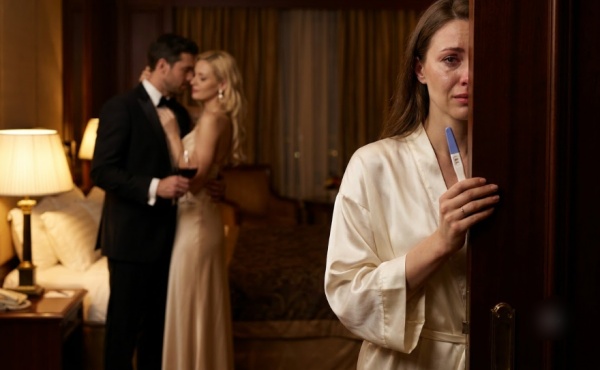
The Night Before My Wedding, I Found Out I Was Pregnant — But My Groom’s Secret With My Maid of Honor Changed Everything
Madeline thought the two pink lines on the pregnancy test would be the biggest secret she carried into her wedding day. But later that night, she overheard her fiancé laughing in the dark with her maid of honor, calling her “sweet,” “useful,” and a polished trophy wife. By morning, she knew she would still walk down the aisle in front of two hundred guests — but not to give Caleb her vows. She was going to take back the moment he thought he controlled.
Part 1: The Night Before the Wedding
I found out I was pregnant the night before my wedding.
Not in a romantic way.
Not with candles, happy tears, or my fiancé lifting me off the bathroom floor while promising forever to me and the tiny life we had created.
I found out alone, in the guest bathroom of a coastal inn in Newport, Rhode Island, with my wedding dress hanging on the back of the door and my hands shaking so hard I dropped the pregnancy test into the sink.
Two pink lines.
Clear.
Immediate.
Unmistakable.
For almost a full minute, I could not breathe.
My name is Madeline Hayes, though everyone except my grandmother called me Maddie. I was thirty-two years old, a corporate event designer in Boston, and less than twelve hours away from marrying Caleb Whitmore, the kind of man women described as a catch before they knew what catching him actually required.
Caleb was thirty-six, handsome, confident, and born into one of those old Massachusetts families whose money had learned to speak quietly. He worked in commercial development, wore tailored suits even when “casual” was printed on the invitation, and had the gift of making every room feel as if he had just improved it by entering.
When we met, I thought he was steady.
That was the word I used.
Steady.
After years of dating men who confused ambition with chaos, Caleb seemed like a man with roots. He loved tradition, Sunday dinners, handwritten thank-you notes, and sailing out of Marblehead in the summer. He remembered my coffee order. He opened doors. He told my father he intended to take care of me.
My father liked that.
My mother liked the family name.
My grandmother asked only one question after meeting him.
“Does he listen when you say no?”
I laughed then.
I wish I had answered more carefully.
Caleb proposed after two years together on a private terrace overlooking Boston Harbor, with a ring that had belonged to his great-grandmother. It was beautiful, old-fashioned, and heavy with family expectation. His mother, Eleanor Whitmore, cried when she saw it on my finger and said, “Now it finally belongs where it should.”
Where it should.
I did not understand at the time that some families do not welcome daughters-in-law.
They acquire them.
Our wedding was planned for a Saturday in September at Cliffhaven House, a historic inn near the water in Newport. Caleb’s family had rented the entire property for the weekend. There would be white hydrangeas, a string quartet, oysters during cocktail hour, and a tent overlooking the Atlantic.
It was exactly the kind of wedding Caleb’s mother wanted.
Elegant.
Photogenic.
Socially appropriate.
I told myself I wanted it too.
Maybe part of me did.
But the longer the planning went on, the less the wedding felt like mine. Caleb’s mother selected the rehearsal dinner menu, adjusted the guest list, replaced my preferred florist with “someone more experienced with our kind of event,” and referred to my family’s table placements as “a delicate balancing act.”
Caleb always told me to let it go.
“She means well.”
“It’s just tradition.”
“Don’t take everything personally.”
That last one became his favorite.
The night before the wedding, after the rehearsal dinner, everyone gathered for drinks on the inn’s back terrace. The ocean was dark beyond the lawn, and lanterns swung gently in the wind. Guests laughed under wool wraps and navy blazers. My bridesmaids drank champagne. Caleb’s groomsmen smoked cigars near the stone wall.
I smiled until my cheeks hurt.
I accepted hugs.
I thanked people for coming.
I pretended the nausea I had been feeling for a week was nerves.
But around 10:30 p.m., after my mother’s friend asked for the third time whether I was “ready to become a Whitmore woman,” I slipped away upstairs.
My maid of honor, Lauren Bell, noticed me leaving.
“Are you okay?” she asked.
Lauren had been my best friend since freshman year at Boston College. We had survived bad roommates, first jobs, breakups, and the kind of twenties where you think brunch counts as a financial plan. She was sharp, beautiful, funny, and loyal in a fierce way that made people either adore or fear her.
At least, that was what I believed.
“I’m fine,” I said. “Just tired.”
“You sure?”
“Yes. Stay. Have fun.”
She squeezed my hand.
“Tomorrow you become Mrs. Whitmore.”
Something about the way she said it bothered me.
Not enough to stop.
Enough to remember later.
Upstairs, in my suite, I opened the small box I had bought at a pharmacy that afternoon when I went out under the excuse of needing lip balm. I had been late for my period, nauseated by the smell of coffee, and strangely emotional whenever anyone mentioned the honeymoon.
Still, I did not think I was pregnant.
Or maybe I did.
Maybe women know before tests do.
When the result appeared, I sat on the edge of the bathtub and pressed one hand to my stomach.
A baby.
Caleb’s baby.
My baby.
For one dangerous moment, happiness broke through the fear.
I imagined telling him after the ceremony, maybe during our first quiet moment as husband and wife. I imagined his face softening, his arms around me, his voice low with wonder. I imagined this child making us a real family, not just a perfect couple inside a perfect weekend.
Then reality returned.
Caleb had been distant for weeks.
Not cruel.
Not exactly.
But distracted, impatient, harder to reach. He blamed work, wedding stress, his mother’s demands, and my “sensitivity.” Every time I tried to talk about how overwhelmed I felt, he kissed my forehead and said, “Just get through the weekend, Maddie. Everything will settle after.”
After.
That word had become a bridge I kept walking toward.
After the wedding, he would prioritize us.
After the honeymoon, we would talk about boundaries with his mother.
After the stress, he would be tender again.
After, after, after.
I wrapped the pregnancy test in tissue and hid it in the zippered pocket of my overnight bag. Then I washed my face, brushed my teeth, and tried to decide whether to tell him before the wedding.
I almost did.
That is the part that haunts me.
I put on a cardigan over my silk pajamas and left the suite, intending to find Caleb. The inn was mostly quiet by then. The older guests had gone to bed, and the younger crowd had drifted toward the carriage house bar or the terrace.
I walked down the back staircase, the one near the library, because I did not want to run into my mother or Caleb’s mother and answer questions about sleep masks and bridal hydration.
Halfway down, I heard voices.
A man’s voice.
Caleb’s voice.
And a woman laughing softly in the dark.
I stopped.
The library door was partly open.
Inside, only one lamp was on, casting amber light across leather chairs and old books no one probably read anymore. I could not see them at first, only their shadows near the window.
Then Lauren laughed again.
My maid of honor.
My best friend.
“You’re awful,” she said.
Caleb chuckled.
“No, I’m honest.”
Something in my stomach tightened.
I should have walked in.
I should have announced myself and ended the moment before it became something worse.
But instinct held me still.
Lauren said, “You really think she has no idea?”
Caleb replied, “Maddie? No. She sees what she wants to see.”
My name in his mouth sounded different when he did not know I was listening.
Loose.
Careless.
Unprotected.
Lauren said, “That’s cold.”
“She’s sweet,” Caleb said. “Sweet and useful. And let’s be real, she looks good beside me. My mother loves that.”
My body went cold.
Lauren laughed under her breath.
“So, trophy wife?”
Caleb paused.
Then said, “A very polished one.”
Lauren laughed again.
I gripped the banister.
Trophy wife.
The words landed somewhere deep and humiliating.
Not because I had never heard the phrase.
Because the man I was supposed to marry in the morning had just used it like a private joke.
Lauren asked, “And what am I?”
There was silence.
Too much silence.
Then Caleb said softly, “You already know.”
I stepped closer before I could stop myself.
Through the gap in the door, I saw them.
Caleb standing near the window.
Lauren leaning against the sill.
His hand was on her waist.
Not accidentally.
Not friendly.
His thumb moved against the fabric of her dress in a slow, familiar way.
Lauren looked up at him with an expression I had never seen directed at me when she talked about him.
Possession.
Amusement.
Victory.
My best friend.
My maid of honor.
The woman who had helped me choose my dress, hold my bouquet at fittings, and plan my bachelorette weekend.
Caleb lowered his head.
Lauren did not move away.
He kissed her.
Not a drunken mistake.
Not a stumble.
Not confusion.
A kiss with history.
I pressed one hand over my mouth to keep from making a sound.
The baby.
The wedding.
The guests sleeping upstairs.
The dress hanging in my room.
My parents.
My grandmother.
Everything collapsed inward at once.
Then Lauren whispered, “You’re still going through with it?”
Caleb sighed.
“Yes.”
“Why?”
“Because canceling now would be a disaster.”
She smiled.
“For whom?”
“For everyone.”
“For your mother?”
“Mostly.”
“And Maddie?”
He shrugged slightly.
“She’ll be fine. She wants the life.”
The life.
Not me.
The life.
Lauren traced a finger along his lapel.
“And after?”
Caleb’s voice dropped.
“After, I handle it.”
“Handle her?”
“She’s not difficult if you make her feel safe.”
I almost fell.
That sentence did something the kiss had not.
It clarified the whole relationship.
Every calming phrase.
Every forehead kiss.
Every time he called me sensitive instead of listening.
Every time he made me feel unreasonable for asking questions.
He had not loved my trust.
He had managed it.
Lauren whispered, “You are dangerous, Caleb Whitmore.”
He smiled.
“Only when underestimated.”
I stepped back.
Slowly.
Carefully.
I climbed the stairs without making a sound.
Inside my suite, I locked the door and stood in the middle of the room.
My wedding dress hung beside the window, white and perfect.
The pregnancy test was hidden in my bag.
My fiancé was downstairs kissing my maid of honor and calling me a trophy wife.
By morning, two hundred guests would expect me to walk down the aisle.
I sat on the bed.
I did not cry.
Not yet.
Instead, I picked up my phone and called the only person I trusted more than my own panic.
My grandmother answered on the fourth ring.
“Madeline?” she said, her voice rough with sleep. “What’s wrong?”
I took one breath.
Then another.
“Grandma,” I whispered, “I need you to listen very carefully.”
Part 2: The Plan Before Sunrise
My grandmother, Rose Hayes, arrived at my suite seventeen minutes later wearing a navy robe, pearl earrings, and the expression of a woman who had survived enough men to be surprised by very little.
She was seventy-eight, widowed twice, and still ran the family’s small chain of boutique stationery stores across New England with more discipline than most CEOs. She believed in handwritten notes, strong coffee, clean financial records, and never making emotional decisions in rooms where a man expected you to cry.
When I opened the door, she stepped inside, locked it behind her, and looked at my face.
“Tell me.”
So I did.
Everything.
The pregnancy test.
The library.
Caleb calling me a trophy wife.
Lauren laughing.
The kiss.
His words.
“She’s not difficult if you make her feel safe.”
My grandmother’s face did not change much.
Only her eyes hardened.
When I finished, she sat beside me and took my hand.
“First,” she said, “you are safe. Second, you are not marrying that man. Third, we are going to decide exactly how he learns it.”
I finally cried.
Not loudly.
Not beautifully.
Just tears sliding down my face while I tried to breathe around the fact that my life had split in half before dawn.
“I’m pregnant,” I said.
“I heard you.”
“What am I going to do?”
“You are going to call a doctor when we get home. You are going to call a lawyer before you speak to Caleb privately. And you are going to remember that a pregnancy is not a reason to marry a man who has already shown you contempt.”
That sentence held me upright.
A pregnancy is not a reason to marry contempt.
My grandmother asked if I had proof.
I stared at her.
“Proof?”
“Yes. Of what you heard.”
“No. I didn’t record it.”
“Good,” she said. “Recording laws can be complicated. In Rhode Island, one-party consent generally applies, but you were not part of that conversation in the way I’d want to rely on. We won’t play games with that.”
Even at 1:00 a.m., betrayed and exhausted, my grandmother thought like a woman who had once sued a landlord and won.
“What do I need proof for?” I asked.
“To protect the narrative. Not to punish. To prevent them from turning you into the unstable bride who panicked.”
My stomach turned.
“They would do that?”
She gave me a sad look.
“Darling, people who betray you at midnight often become reputation managers by breakfast.”
I thought of Caleb.
His family.
His mother’s careful smile.
Lauren’s social ease.
The guests.
The photographers.
The money already spent.
The wedding that had become more machine than celebration.
“What if I just leave?” I whispered.
“You can.”
“I want to.”
“I know.”
“Then why not?”
My grandmother looked toward the dress.
“Because if you vanish, they will write the story. If you walk away clearly, you write it.”
I was silent.
“You said you would still walk down the aisle,” she continued.
“I don’t know why I said that.”
“Maybe because part of you knows that aisle belongs to you too.”
That was when the idea formed.
Not revenge.
Not exactly.
Something cleaner.
I would not sneak out before sunrise and let Caleb explain my absence.
I would not stand at the altar and let him perform surprise.
I would not marry him.
But I would walk down the aisle.
To reclaim the moment he thought belonged to his family, his image, and his convenience.
My grandmother called my parents next.
My mother arrived first, wrapped in a beige cashmere shawl, terrified and pale. My father came behind her, hair messy, glasses crooked, looking like someone had woken him from a dream and delivered him into a nightmare.
When they heard the story, my mother sat down hard.
My father did not speak for nearly a minute.
Then he asked, “Where is Caleb now?”
My grandmother said, “You are not going downstairs.”
“I didn’t say I was.”
“You were thinking it with your whole face.”
My father turned toward me.
“Are you sure?”
It was the right question.
Not because he doubted me.
Because he knew the weight of what I was about to do.
“Yes,” I said. “I saw them.”
My mother covered her mouth.
“Lauren?”
I nodded.
“Oh, honey.”
That nearly broke me more than anything.
Lauren had spent holidays at our house. My mother had mailed her soup when she had the flu. My father had helped her move apartments twice. Betrayal rarely hurts only the person directly struck. It sends cracks through everyone who trusted the structure.
By 2:00 a.m., my suite had become a quiet command center.
My grandmother called Ellen Mercer, an attorney she knew in Boston, who had enough experience with broken engagements, prenuptial agreements, and family disputes to understand urgency. Ellen answered because my grandmother had once helped her daughter get into a private school waitlist, and certain debts are social currency.
Ellen was calm.
Almost too calm.
She asked whether any marriage license had been signed and filed yet.
No.
She asked whether Caleb and I had signed a prenuptial agreement.
Yes.
Three weeks earlier.
She asked whether it contained terms triggered only upon marriage.
Yes.
She asked whether any gifts, deposits, shared accounts, wedding expenses, or family contributions needed documentation.
Yes.
Then she said, “Do not make accusations in front of guests beyond what is necessary. Do not defame anyone. You can say the wedding will not proceed due to information you learned that makes marriage impossible. If you name infidelity publicly, be prepared for consequences unless you have evidence. We can handle details privately.”
My grandmother put the call on speaker.
I listened like a student.
Ellen continued, “If you are pregnant, do not disclose that publicly unless you choose to. That is medical information. Caleb may have legal responsibilities if he is the father, but you do not need to discuss that at the altar.”
At the altar.
The phrase made me dizzy.
My mother asked, “Should we cancel everything now?”
Ellen said, “That depends on Madeline’s emotional state and goals. If she leaves before the ceremony, that is completely valid. If she chooses to address the guests briefly, keep it concise and non-inflammatory. Control comes from restraint.”
Control comes from restraint.
That became my second anchor.
My first was the baby.
By 3:15 a.m., the plan was simple.
I would sleep if I could.
I did not.
In the morning, I would get dressed.
The ceremony would begin as scheduled.
My father would walk me down the aisle.
When the officiant asked everyone to be seated, I would ask for the microphone.
I would not marry Caleb.
I would not mention Lauren by name.
I would not reveal the pregnancy.
I would say the wedding could not proceed because I had learned the night before that the trust required for marriage had been broken. I would thank the guests, apologize for the disruption, ask for privacy, and leave with my family.
Then Ellen would contact Caleb’s attorney.
My father hated the plan.
Not because he wanted me to marry Caleb.
Because he did not want me to have to be brave in front of people.
“You don’t owe them a performance,” he said.
“I know.”
“Then why do this?”
I looked at the dress.
“Because if I don’t show up, everyone will ask where I was. If I do show up and walk away, they’ll ask what he did.”
My grandmother smiled faintly.
“There she is.”
At 6:00 a.m., I showered.
At 7:00, the hair stylist knocked.
My mother answered and told her plans had changed slightly but we still needed the room kept calm. The stylist, a kind woman named Tessa, looked at my face, then at my mother’s, and said only, “Understood.”
People in wedding industries have seen more heartbreak than priests.
She styled my hair in a low chignon.
My makeup artist covered the redness around my eyes without asking questions.
The photographer arrived at 9:00 and was told no getting-ready photos today.
At 9:30, Lauren knocked.
The room went silent.
My mother looked at me.
My grandmother stood.
“I’ll handle it,” she said.
She opened the door only halfway.
Lauren stood outside wearing her pale blue maid of honor robe, hair perfectly curled, holding a mimosa.
“Is Maddie awake?” she asked.
Her voice sounded normal.
That offended me more than if she had sounded nervous.
My grandmother smiled politely.
“She’s resting.”
Lauren tried to look past her.
“I just wanted to check on her.”
“How thoughtful.”
“I’m her maid of honor.”
“My dear,” my grandmother said softly, “today may involve fewer honors than expected.”
Lauren’s face changed.
Just slightly.
“What does that mean?”
“It means Madeline will call for you if she needs you.”
Then my grandmother closed the door.
I had never loved her more.
Lauren texted two minutes later.
Are you okay? Your grandma is being weird.
I stared at the screen.
Then another:
Caleb said you seemed stressed last night. Don’t let nerves ruin your day.
Don’t let nerves ruin your day.
My laugh came out sharp enough that my mother flinched.
My grandmother said, “Do not respond.”
“I won’t.”
At 10:15, Caleb texted.
Morning, almost wife. Can’t wait to see you.
I nearly dropped the phone.
Almost wife.
The phrase felt obscene.
Another message came:
Everything okay? Lauren said your grandmother blocked her at the door lol.
Lol.
I placed the phone face down.
My father entered at 10:40.
He stopped when he saw me in the dress.
His eyes filled.
“You look beautiful.”
“Dad.”
“I know. I know.”
He held out a small velvet box.
Inside was my grandmother’s sapphire pin, the one she wore every Christmas Eve.
“She said you needed armor.”
I laughed through tears.
My mother pinned it inside the bodice of my dress, hidden against my ribs.
Something old.
Something blue.
Something that reminded me I came from women who survived.
At 11:15, guests began taking their seats under the tent.
At 11:45, the string quartet started.
At 11:55, my bridesmaids lined up.
Lauren stood at the front of them, holding her bouquet, smiling too brightly.
She looked at me.
For one second, her confidence flickered.
Maybe she saw my face.
Maybe she understood.
Maybe not.
I did not speak to her.
At noon, the coordinator opened the doors.
My father offered his arm.
“You don’t have to do this,” he whispered.
“I know.”
“Still time to leave through the kitchen.”
That almost made me smile.
“I’m walking.”
He nodded.
The music began.
Everyone stood.
I stepped into the aisle.
Caleb waited at the far end, handsome in his black tuxedo, smiling the smile that had convinced me once that safety could have a face.
Lauren stood just to the side, bouquet clutched tightly.
The ocean moved behind them.
Two hundred people watched.
I walked slowly.
Not toward marriage.
Toward the truth.
Part 3: The Wedding That Became a Goodbye
The aisle felt longer than it had during rehearsal.
Maybe because during rehearsal, I believed I was walking into a future.
Now I was walking out of one.
Guests smiled as I passed. Some wiped tears. My aunt pressed both hands to her chest. Caleb’s mother watched from the front row with an expression of satisfied control, already imagining the photos.
She did not know there would be no first kiss.
No reception introduction.
No cake cutting.
No polished Whitmore wedding album.
My father’s arm was steady under my hand. I could feel how tightly he was holding himself together. When we reached the front, Caleb stepped forward.
His smile softened.
“You look incredible,” he whispered.
I looked at him.
Really looked.
At the clean shave.
The perfect bow tie.
The eyes that had once made me feel chosen.
For a moment, grief rose so sharply I thought I might faint.
Then the baby fluttered into my mind.
Not physically.
It was too early for that.
But as an idea.
A future.
A witness inside me who deserved a mother willing to stand in truth.
Caleb reached for my hands.
I did not give them.
His smile faltered.
The officiant, Reverend Thomas Hale, began.
“Dearly beloved, we are gathered here today—”
“Reverend,” I said.
My voice was quiet, but the microphone near him caught it.
The tent shifted.
Reverend Hale looked startled.
“Yes, Madeline?”
I turned toward the guests.
My heart was pounding so hard I could hear it in my ears.
“I need to say something before we continue.”
Caleb’s face changed.
“Maddie,” he whispered.
I ignored him.
Reverend Hale hesitated, then stepped back from the microphone.
The coordinator near the floral arch looked like she might pass out.
I took the microphone.
It felt heavier than expected.
For three seconds, I looked at the crowd.
My mother was crying silently.
My grandmother sat upright in the front row, calm as a queen.
Caleb’s mother’s expression had gone from satisfied to alarmed.
Lauren was no longer smiling.
I took a breath.
“Thank you all for being here today,” I said. “I know many of you traveled a long way to celebrate what was supposed to be the beginning of a marriage.”
Caleb’s hand moved slightly, as if he wanted to stop me but understood touching me in front of everyone would look worse.
“Last night,” I continued, “I learned information that made it impossible for me to enter this marriage honestly.”
A murmur went through the tent.
I kept my voice steady.
“Marriage requires trust. It requires respect. It requires the person standing beside you to honor you when no one is watching, not only when everyone is.”
Caleb went pale.
Lauren looked down.
I did not look at her.
“I will not share private details here,” I said. “This is painful enough without turning it into a spectacle. But I cannot make vows today to a man who broke the trust those vows depend on before we even reached the altar.”
Caleb whispered, “Maddie, don’t.”
I finally looked at him.
“No.”
One word.
The clearest word I had ever said to him.
Then I turned back.
“I’m sorry for the shock and inconvenience this causes our guests. I’m grateful for those who came here out of love. I ask that you respect my family’s privacy as we leave.”
I handed the microphone back to Reverend Hale.
The tent was silent.
Not quiet.
Silent.
The kind of silence that follows a truth no one can politely unhear.
Caleb stepped toward me.
“Maddie, we need to talk.”
I said softly, “Not here.”
His eyes were wide now.
Fear.
Anger.
Humiliation.
All fighting for space.
“You can’t do this,” he said.
“I just did.”
He looked toward his mother, then the guests, then Lauren.
That glance ruined him.
Because several people saw it.
So did I.
His mother stood.
“Madeline,” she said, voice sharp beneath the silk, “whatever this is, surely it can be handled privately.”
My grandmother stood too.
“Eleanor, sit down.”
Caleb’s mother froze.
There are tones older women use when they are done observing manners.
My grandmother had found one.
My father stepped between Caleb and me, not aggressively, just enough.
“We’re leaving,” he said.
Caleb lowered his voice.
“Maddie, please. You’re upset.”
I almost laughed.
Even now.
Even at the altar.
Upset.
Not informed.
Not betrayed.
Upset.
I looked at him one last time.
“You called me a trophy wife.”
His face drained completely.
The people nearest us heard.
Lauren’s bouquet trembled in her hands.
Caleb whispered, “I didn’t mean—”
“You did.”
He swallowed.
My voice stayed low.
“And you kissed her like you meant that too.”
His eyes darted to Lauren.
That was the final confirmation for anyone still wondering.
A gasp rose from somewhere in the front rows.
Lauren’s face crumpled.
“Maddie—”
I turned to her.
“No.”
She stopped.
I did not shout.
I did not insult her.
I did not ask how she could do this.
There was nothing she could say that would restore what she had broken.
I lifted the front of my dress and walked back down the aisle with my father beside me.
This time, no music played.
No one stood because they were already standing.
Guests moved back slightly as I passed, faces stunned, sympathetic, curious, horrified.
I saw my college roommate crying.
I saw Caleb’s cousin filming, until my grandmother pointed at him and said, “Put that phone away,” in a voice that could have ended wars.
He put it away.
Outside the tent, the air hit me cold and salty.
I kept walking until we reached the side entrance of the inn.
Then my knees buckled.
My father caught me.
My mother wrapped her arms around both of us.
The wedding coordinator appeared, whispering apologies and asking what should happen next.
My grandmother took over.
“The reception is canceled as a wedding reception,” she said. “Food already prepared may be served to guests if the venue permits. No speeches. No first dance. No cake cutting. The bride will not attend. Direct all billing questions to counsel.”
The coordinator blinked.
“Yes, ma’am.”
Inside a small parlor, I sank onto a sofa.
My dress spread around me like spilled light.
My mother knelt and removed my veil.
That was when I broke.
I sobbed into my hands while the muffled sounds of confusion continued outside.
My father stood by the window, facing away.
His shoulders shook.
My grandmother sat beside me and rubbed my back.
“You did it,” she said.
“I feel like I’m dying.”
“You’re not. You’re leaving the wrong life before it becomes legally harder.”
That was true.
It did not make the pain smaller.
Five minutes later, Caleb tried to enter.
My father blocked the door.
“I need to talk to her,” Caleb said.
“No.”
“She’s my fiancée.”
“Not anymore.”
“Mr. Hayes—”
“You heard her.”
Caleb’s voice cracked.
“I made a mistake.”
My grandmother stood and went to the doorway.
“No, Caleb. A mistake is forgetting the rings. You made choices.”
“I love her.”
My grandmother’s laugh was quiet and devastating.
“You loved being admired by her. That is not the same thing.”
There was silence.
Then Caleb said, lower, “I need to know what she heard.”
My grandmother turned back toward me.
“Enough.”
Then she shut the door.
By 1:30 p.m., the tent had emptied.
Some guests stayed for lunch because food had been paid for and shock makes people hungry. Others left quietly, sending texts I did not read. My bridesmaids gathered their things in stunned silence. Lauren was escorted out by her sister after reportedly crying in a restroom and insisting “it wasn’t what Maddie thought.”
It was exactly what I thought.
Worse, maybe.
Because betrayal is not only the act.
It is the confidence that you can survive someone else’s ignorance.
Caleb sent fourteen messages before my grandmother took my phone.
Please talk to me.
You misunderstood.
Lauren means nothing.
I was scared.
You humiliated me.
My mother is devastated.
We can fix this.
Don’t throw away our life over one conversation.
One conversation.
That was how he tried to shrink it.
Not a kiss.
Not contempt.
Not manipulation.
One conversation.
My attorney, Ellen, called at 2:15.
“Are you safe?”
“Yes.”
“Are you with family?”
“Yes.”
“Good. Do not meet Caleb alone. Do not respond emotionally in writing. If he contacts you about property, the wedding, gifts, or the prenuptial agreement, forward everything.”
I hesitated.
“What about the pregnancy?”
There was a pause.
“Have you told anyone besides your family?”
“My grandmother. My parents.”
“Keep it that way for now. Schedule a medical appointment. Once pregnancy is confirmed, we can discuss timing and legal obligations. You do not need to tell him today.”
I placed one hand over my stomach.
“Okay.”
That evening, my family drove me back to Boston.
I wore sweatpants under my wedding dress because I could not bear changing fully at the inn. Somewhere along I-95, we stopped at a rest area, and my mother helped me out of the gown in a family bathroom while my grandmother guarded the door like a Secret Service agent.
I left Newport unmarried.
Pregnant.
Heartbroken.
But not trapped.
That distinction would become everything.
Part 4: The Truth After the Altar
The first week after the canceled wedding felt like living underwater.
Everything came slowly.
Sound.
Food.
Sleep.
Thoughts.
My phone filled with messages, but I answered almost none of them. My mother managed relatives. My father handled vendor communications. My grandmother handled anyone who called “just to understand what happened,” which meant she terrified half of New England before lunch on Monday.
Caleb kept trying.
At first, his messages were desperate.
Then defensive.
Then strategic.
By Tuesday, he had hired an attorney.
By Wednesday, his mother had begun telling select people that I suffered “a sudden emotional episode” due to wedding pressure.
That phrase reached my grandmother by Thursday.
On Friday, Eleanor Whitmore received a letter from Ellen.
It was concise, factual, and cold enough to preserve fish.
It stated that any attempt to portray me as unstable, dishonest, or irrational would be met with appropriate legal response. It noted that the wedding was canceled due to information I learned regarding Caleb’s conduct. It demanded preservation of communications relevant to the matter, including messages between Caleb and Lauren.
My grandmother read the letter and said, “Frame it.”
I did not frame it.
But I did save it.
Lauren tried to contact me too.
I blocked her after the fifth message.
The first said:
Please let me explain.
The second:
It wasn’t what you think.
The third:
Caleb told me you two were having doubts.
The fourth:
I was confused too.
The fifth:
You’re really going to throw away ten years of friendship without hearing me?
That last one made me shake with anger.
I wanted to reply.
I wanted to say friendship was not something I threw away; it was something she carried into the dark library and placed in Caleb’s hands.
Instead, I sent the messages to Ellen.
Then I blocked her.
A week later, I went to the doctor.
My pregnancy was confirmed.
Six weeks.
The heartbeat was not visible yet, just a tiny flicker of possibility on a screen too small for the enormity of what it represented.
My mother cried.
I did not.
I was too afraid.
The doctor discussed prenatal vitamins, follow-up appointments, nausea management, stress, and support. She asked whether the pregnancy was wanted.
The room went quiet.
I placed my hand over my stomach.
“Yes,” I said.
My voice was barely audible.
“But I’m scared.”
The doctor nodded gently.
“Both can be true.”
Both can be true.
That became another anchor.
I could be devastated and protective.
Heartbroken and relieved.
Terrified and already in love.
Ellen advised me to inform Caleb through counsel once I felt ready and after the next appointment. Legally, if the baby was his, issues of paternity, child support, custody, and medical expenses could arise after birth or earlier in planning. But I did not owe him emotional access to my pregnancy as a substitute for trust.
When Caleb learned, his response came within forty minutes.
Not through his attorney.
Directly.
You’re pregnant?
Then:
Why didn’t you tell me before humiliating me?
Then:
Is that why you panicked?
Then:
This changes everything.
I stared at the messages.
This changes everything.
No.
It clarified everything.
Ellen responded formally:
Mr. Whitmore should direct all communication through counsel. Ms. Hayes is under medical care and will make decisions with appropriate legal and medical guidance. Any attempt to use her pregnancy to pressure reconciliation will be documented.
Caleb did not like that.
He sent flowers.
I donated them to a nursing home.
He sent a handwritten letter.
I read it once, with my grandmother beside me.
In it, he said he had been scared of marriage, overwhelmed by family expectations, confused by Lauren’s attention, and drunk on the night before the wedding. He said calling me a trophy wife was “a cruel joke taken out of context.” He said he loved me and wanted to raise our child together as husband and wife.
My grandmother sipped tea.
“Do you believe him?”
I looked at the letter.
“I believe he is scared.”
“That was not the question.”
“No,” I said. “I don’t believe him.”
“Good.”
That did not mean co-parenting would be avoided.
It meant marriage would be.
Caleb requested a meeting.
Ellen arranged it in her office with attorneys present.
I was nine weeks pregnant by then, nauseated constantly, emotionally exhausted, and wearing a gray sweater dress because nothing with a waistband felt trustworthy.
Caleb looked wrecked when he saw me.
He stood.
“Maddie.”
I sat without hugging him.
His attorney, a polished man named Peter Lang, began with careful language about privacy, mutual respect, and “future family considerations.”
Ellen let him speak for three minutes.
Then she said, “There will be no marriage.”
Peter paused.
Caleb looked at me.
“Maddie, please.”
I kept my hands folded in my lap.
“We can still fix this,” he said.
“No.”
“You’re carrying my child.”
“Yes.”
“That means we’re connected forever.”
“It means you have responsibilities. It does not mean you get a wife.”
His face twisted.
“I made one mistake.”
I looked at him.
“You keep saying that because it sounds smaller than what you did.”
He leaned forward.
“I didn’t sleep with Lauren.”
I felt nothing when he said it.
That surprised me.
Maybe he expected relief.
Maybe he expected me to bargain.
Instead, I said, “You kissed her. You mocked me. You discussed managing me. You planned to marry me while keeping another emotional door open. Whether you slept with her is not the only measure of betrayal.”
His eyes filled.
“I was scared.”
“So was I.”
“That night?”
“No,” I said. “For months. I kept telling you I felt pushed aside. I kept asking you to listen. I kept hoping the wedding would make me feel chosen.”
He looked down.
“And you called me a trophy wife.”
“I didn’t mean it that way.”
“How many ways are there?”
He had no answer.
I continued.
“Our child will not be used as a reason for me to marry a man I no longer trust. If you want to be a father, become stable, respectful, and legally accountable. But do not confuse fatherhood with access to me.”
The room went silent.
Ellen’s pen paused.
Caleb stared at me like he was seeing someone new.
Maybe he was.
Or maybe he was seeing the woman who had always been there beneath the softness he found convenient.
The months that followed were difficult but survivable.
Caleb’s public narrative collapsed under its own contradictions. Too many people had seen Lauren’s face at the altar. Too many had heard my words. Too many understood that brides do not cancel weddings in front of two hundred guests because they are mildly nervous.
Lauren left Boston for Chicago within three months.
At least, that was what mutual friends said.
She sent one final email through a new address.
I know you hate me. I hate myself too. Caleb made me feel like what we had was real, like you were just part of the life he was expected to have. I wanted to believe I mattered more. I’m sorry.
I did not respond.
Maybe she was sorry.
Maybe she was ashamed.
Maybe she missed being close to my life.
None of that required my participation.
Caleb attended two prenatal appointments by video after legal boundaries were established. He asked appropriate questions. He cried the first time he heard the heartbeat. He seemed smaller without the wedding, the tuxedo, the family machine around him.
I felt compassion.
Carefully.
Compassion is not permission.
At twenty weeks, I learned I was having a girl.
I named her privately first.
Grace Rose Hayes.
Grace, because I needed some.
Rose, for my grandmother.
Hayes, because she would begin life with the name of the family that stood beside me when promises failed.
Caleb asked about the last name.
I said we could discuss legal naming before birth, but I had made my decision.
He looked hurt.
I let him.
Not every hurt required me to fix it.
Grace was born on a snowy March morning at Massachusetts General Hospital.
She weighed 6 pounds, 9 ounces, had dark hair, long fingers, and the angriest cry I had ever heard from something so small. My mother was in the delivery room. My grandmother waited outside wearing pearls and intimidating the vending machine.
Caleb was not present for the birth.
That was my choice.
He met Grace the next day during a scheduled visit.
When the nurse placed her in his arms, his face changed.
Not enough to rewrite history.
Enough to show me that love and failure can exist in the same person.
“She’s perfect,” he whispered.
“Yes,” I said.
He looked at me.
“I’m sorry.”
“I know.”
This time, I believed he meant it.
I also knew meaning it was not the same as undoing it.
Part 5: The Aisle I Took Back
Grace is five now.
She has my eyes, Caleb’s dimple, and my grandmother’s ability to win arguments without raising her voice. She likes pancakes, tide pools, purple sneakers, and telling strangers in grocery stores that dinosaurs are not actually gone because birds are dinosaurs and people should “keep up.”
Caleb is in her life.
Consistently enough to matter.
Not perfectly.
But better than I once feared.
We have a formal parenting plan, child support arrangements, holiday schedules, medical decision rules, and a co-parenting app that keeps adult emotion from spilling into practical logistics. Caleb hated the app at first. Then he realized written records helped everyone behave better.
His relationship with Grace belongs to him.
I do not manage it.
I do not decorate it.
I do not lie for him.
If he is late, he explains.
If he misses something, he repairs.
If Grace asks hard questions, I answer with age-appropriate truth.
She knows her parents were going to get married but did not.
She knows adults can love each other and still not be right to live together.
She knows she was wanted.
Always.
That matters most.
When she was four, she asked, “Did Daddy wear a suit at the almost-wedding?”
I laughed.
“Yes.”
“Did you wear a princess dress?”
“Kind of.”
“Why didn’t you marry?”
I paused.
Because children ask life-changing questions while eating cereal.
“Because I learned Daddy and I did not have the kind of trust people need for marriage.”
She considered this.
“Trust is when someone doesn’t take your markers without asking.”
“That’s a good start.”
“Did Daddy take your markers?”
“In a way.”
She nodded seriously.
“Not okay.”
No, baby.
Not okay.
Caleb eventually apologized publicly in the only way that mattered: he stopped letting his mother blame me.
At a family event for Grace’s preschool, I overheard Eleanor Whitmore tell someone the wedding had been “a painful misunderstanding during a stressful weekend.”
Caleb, standing nearby, interrupted.
“No, Mom,” he said. “I hurt Maddie. She made the right decision.”
Eleanor looked stunned.
So did I.
Caleb did not look at me afterward for approval.
That was how I knew the apology had matured.
It no longer needed applause.
My grandmother lived long enough to meet Grace.
For four years, they were inseparable whenever possible. Grace called her “Grand-Rose,” which delighted my grandmother so much she pretended not to. They played cards, baked shortbread, and discussed “business,” which mostly involved Grace charging family members $3 for hand-drawn bookmarks.
When my grandmother died, she left me her sapphire pin.
The one I had worn inside my wedding dress.
The one she called armor.
I keep it in a small velvet box beside my bed.
Every year, on the anniversary of the canceled wedding, I used to feel sick.
The first year, I stayed home with Grace asleep on my chest and cried for the woman I had been.
The second year, I took Grace to the aquarium.
The third year, I realized at 8:00 p.m. that I had forgotten the date until my mother texted, Thinking of you. Proud of you.
By the fifth year, the date had changed meaning.
It was no longer the day I lost Caleb.
It was the day I did not lose myself.
People still tell the story dramatically.
The bride who found out she was pregnant.
The groom in the library.
The maid of honor.
The altar speech.
The canceled Newport wedding.
They focus on the spectacle because spectacle is easier to digest than the quieter truth.
The real story did not begin at the altar.
It began months earlier, every time I swallowed discomfort because I did not want to seem difficult. Every time Caleb minimized my feelings with a forehead kiss. Every time I mistook his family’s approval for belonging. Every time Lauren asked careful questions about our relationship and I thought she was being supportive.
The real story began when I forgot that love should make you more yourself, not easier to manage.
Walking down that aisle was not revenge.
It was reclamation.
I had chosen the flowers.
I had written vows.
I had stood for fittings.
I had thanked guests and absorbed pressure and smiled through decisions that were made around me.
That aisle was not Caleb’s stage.
It was also mine.
So I used it to tell the truth without giving anyone the satisfaction of watching me beg.
I did not marry him.
I did not scream.
I did not call Lauren names.
I did not announce my pregnancy to shock the crowd.
I simply said no.
No to contempt dressed as commitment.
No to friendship that laughed in the dark.
No to a marriage built on being handled.
No to becoming a mother who taught her daughter that humiliation should be endured for appearances.
That no became the foundation of every yes that followed.
Yes to Grace.
Yes to therapy.
Yes to legal boundaries.
Yes to rebuilding a career after maternity leave.
Yes to dating again, slowly, after I learned how to trust my own instincts before trusting someone else’s promises.
I am not married now.
I may be someday.
Or not.
Either way, my life is not waiting in a bridal suite for completion.
I have a daughter who asks impossible questions, parents who show up, friends chosen more carefully, and a business designing events for people who understand that weddings are not proof of love. They are ceremonies. Love is what happens when the music stops and the room empties.
Last summer, I returned to Newport for a client event.
The venue was not Cliffhaven House, but close enough that the ocean had the same dark blue line against the sky. After the meeting, I walked alone along the seawall. The air smelled like salt and roses.
For the first time, I did not feel haunted.
I thought about the younger version of myself standing at the top of the aisle, pregnant, heartbroken, terrified, and still moving forward.
I wanted to tell her she would survive the walk back.
I wanted to tell her the baby would have her grandmother’s laugh.
I wanted to tell her Caleb’s regret would not be her responsibility.
I wanted to tell her Lauren’s betrayal would eventually stop feeling like a mirror and start feeling like evidence of someone else’s emptiness.
Most of all, I wanted to tell her that she was not a trophy.
A trophy sits on a shelf and reflects someone else’s victory.
I was never that.
I was the woman who heard the truth before the wedding.
The woman who carried a secret life inside her.
The woman who walked down the aisle anyway.
Not to become Caleb Whitmore’s wife.
But to become the mother, daughter, and woman who would never again mistake being displayed for being loved.
