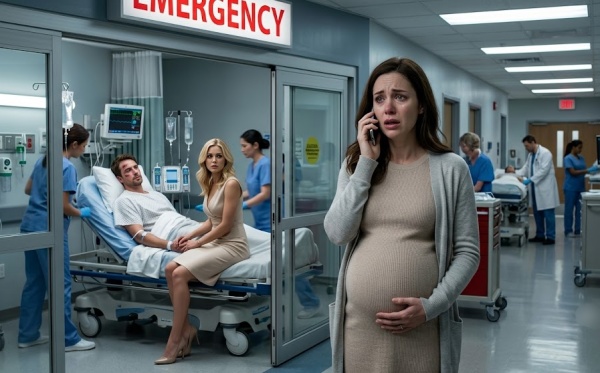
Pregnant, I Got a Call at 2:17 A.M.: My Husband Was in the ER With Another Woman
Part 1: The Call at 2:17 A.M.
The nurse did not know she was ending a marriage when she called at 2:17 in the morning.
Her voice was soft, professional, and careful in the way hospital voices become when they are trying not to frighten people before they have facts. She asked if she was speaking with Emily Carter, wife of Nathan Carter. Then she told me my husband had been brought into the emergency room at St. David’s Medical Center in Austin after a car accident.
I was seven months pregnant, sitting upright in bed before she finished the sentence.
My first thought was not anger. It was not suspicion. It was pure fear, immediate and physical, as if someone had reached into my chest and squeezed my heart with both hands. Nathan was my husband. The father of the baby pressing her little heel into my ribs. For one bright, terrified second, all I could think was, Please let him be alive.
“He’s stable,” the nurse said quickly, probably hearing my breathing change. “He has a concussion, some bruising, and a fractured wrist. He is conscious.”
I closed my eyes and placed one hand on my belly.
“Okay,” I whispered. “Okay. I’m coming.”
“There is one more thing,” she said.
Something in her tone changed.
I sat very still.
“The vehicle registered to you was involved,” she said. “A 2022 white Toyota Highlander?”
My SUV.
The one with the infant car seat box still unopened in the garage. The one Nathan said he needed to borrow that evening because his truck was “acting weird.” The one I had begged him not to take too far because I was exhausted, swollen, and nervous about being without a car so late in my pregnancy.
“Yes,” I said slowly. “That’s mine.”
The nurse paused.
“And there was a passenger,” she continued. “A woman was brought in with him. She is also stable.”
For a few seconds, the room went completely silent.
Not actually silent. The air conditioner was humming. The digital clock on the nightstand glowed blue. Somewhere outside, a dog barked once and stopped. But inside me, something dropped so hard it seemed to take sound with it.
“A woman?” I asked.
“Yes, ma’am.”
“Do you know who she is?”
“I’m sorry, I can’t disclose another patient’s information over the phone,” the nurse said. “But your husband listed you as his emergency contact, and the vehicle registration matched your name.”
My mouth went dry.
Nathan was supposed to be in San Antonio.
That was what he told me at 8:11 p.m. He had kissed my forehead while I was sitting on the couch with my feet propped on two pillows, watching a baby sleep tutorial on YouTube. He said a vendor meeting had run late, and he needed to drive down for an early breakfast appointment the next morning.
I had believed him.
Not because the story was perfect, but because pregnancy had made me tired in every possible way. Tired of questioning his distance. Tired of noticing the way he angled his phone away from me. Tired of asking why he smelled like expensive hotel soap when he said he had been at the office. Tired of hearing him tell me I was “hormonal” whenever I reacted to things he made suspicious.
So I believed him because sometimes believing is easier than having enough energy to be right.
“Where did the accident happen?” I asked.
The nurse hesitated again.
“Near South Congress Avenue,” she said. “Emergency services transported them from the scene.”
South Congress.
Not San Antonio.
Not even close.
South Congress was twenty minutes from our house, full of restaurants, hotels, bars, tourists, live music, and people pretending Austin was still weird in a way that could be monetized. My husband had not crashed my SUV on the way to a vendor breakfast. He had crashed it after leaving somewhere he had no business being at 2 a.m.
“With another woman,” I said, though I was not asking anymore.
The nurse did not answer that part.
“I recommend you come to the ER if you’re able,” she said gently. “Please don’t drive if you feel unsafe or too upset.”
That nearly made me laugh.
Too upset.
I was seven months pregnant, barefoot, wearing one of Nathan’s old T-shirts, holding a phone that had just turned my marriage into a crime scene with fluorescent lighting. My husband was in the ER with an unnamed woman after crashing my SUV in the middle of the night. I had passed “upset” several exits ago.
“I’ll call my sister,” I said.
“That’s a good idea.”
After I hung up, I stared at the wall for a full minute.
The nursery door was open across the hallway. I could see the pale green wall we had painted together in May, back when I still believed Nathan’s restlessness was fear about becoming a father. The crib was assembled. A stack of tiny washed onesies sat in a basket on the rocking chair. Above the changing table, wooden letters spelled out our daughter’s name.
Lily.
I put both hands on my stomach and whispered, “We’re okay.”
I did not know if that was true.
But she kicked once, firm and stubborn, as if answering.
Then I called my sister.
Maddie picked up on the second ring, because older sisters develop strange emergency instincts even when they live thirty miles away in Round Rock.
“What’s wrong?” she said immediately.
“Nathan was in an accident.”
“Oh my God. Is he—”
“He’s stable,” I said. “He crashed my SUV near South Congress. There was a woman with him.”
Silence.
Then Maddie said, very carefully, “I’m coming to get you.”
“No lectures.”
“I’m not lecturing.”
“No threats.”
“I am evolving.”
“Maddie.”
“I’m putting on shoes,” she said. “Do not move heavy things. Do not drive. Drink water. I’ll be there in twenty-five minutes.”
After we hung up, I changed into leggings and a loose maternity sweater with shaking hands. I packed my insurance card, phone charger, prenatal records, and a bottle of water. Then, after a moment, I opened the drawer of Nathan’s nightstand.
I don’t know what I expected to find.
A confession, maybe. A second phone. A hotel key card. Something dramatic enough to match the storm rising in my chest.
There was no second phone.
But there was a folded receipt from a boutique hotel on South Congress.
The date was that night.
The room charge was $487.
The name on the receipt was Nathan Carter.
The second guest line had been left blank.
I took a photo of it.
Then I put the receipt back exactly where I found it.
That was the first smart thing I did that night.
Not the strongest. Not the bravest. Just smart.
At 2:49 a.m., Maddie pulled into my driveway in her Subaru, wearing sweatpants, a University of Texas hoodie, and the expression of a woman who had already convicted Nathan in a private courtroom.
She got out and hugged me gently, careful of my belly.
“Breathe,” she whispered.
“I am breathing.”
“You’re doing that thing where you technically breathe but look like you’re trying not to shatter.”
That made my eyes fill.
“I don’t want this to be real.”
“I know.”
“I’m having his baby.”
“I know.”
“He was with someone else.”
Maddie looked toward the house, then back at me.
“Then tonight we collect facts,” she said. “Tomorrow we decide what they mean.”
That was Maddie: furious, but practical.
On the drive to St. David’s, Austin looked strange through the windshield. The streets were mostly empty, slick from a light rain that had passed earlier. Neon signs glowed over closed restaurants. A few rideshare cars moved through intersections like insects under streetlights.
I held my phone in one hand and my belly with the other.
Nathan had called once while Maddie was driving.
I did not answer.
He texted immediately after.
Em, it’s not what you think. Please don’t panic.
That sentence was almost insulting.
It is never “not what you think” at 3 a.m. when your husband has crashed your SUV after leaving a hotel with another woman. It may be more complicated than you think. It may be worse than you think. But it is almost never innocent.
Maddie glanced over. “Was that him?”
“Yes.”
“What did he say?”
I read the text aloud.
Maddie made a short sound. “Classic.”
I forwarded the text to myself and took a screenshot.
Maddie nodded approvingly. “Good.”
“Why am I doing that?”
“Because facts matter.”
When we arrived at the ER, the waiting room smelled like antiseptic, burnt coffee, and old fear. A man slept under a gray hoodie near the vending machines. A teenage girl held an ice pack to her cheek while her mother filled out paperwork. Somewhere behind the double doors, a monitor beeped steadily.
I walked to the desk and gave my name.
The nurse looked up, then looked at my belly.
Her face softened.
“Mrs. Carter?”
“Yes.”
“Your husband is in room six. Before I take you back, I want you to know he is alert.”
“And the woman?”
The nurse’s expression became carefully neutral.
“She is being treated separately.”
Maddie stepped closer to me.
I said, “Can you tell me her name?”
“I’m sorry,” the nurse said again.
Of course she couldn’t.
HIPAA did not care about my broken heart.
The nurse led us through the doors. Each step felt heavier than the last. I passed curtained beds, rolling carts, nurses in navy scrubs, a police officer speaking quietly with a doctor. Then I saw him.
Nathan was sitting upright on a hospital bed, his left wrist splinted, a bruise darkening along his cheekbone. He looked pale, frightened, and younger than his thirty-six years. When he saw me, his eyes filled with relief.
“Emily,” he said.
For one terrible second, I almost went to him.
My body remembered being his wife before my mind could stop it.
Then I saw the glitter on his shirt collar.
Not mine.
Not from work.
Not from a vendor meeting.
I stopped at the foot of the bed.
Nathan looked at Maddie behind me and swallowed.
“Can we talk alone?”
“No,” Maddie said.
I held up one hand without looking back at her.
Nathan’s eyes returned to mine.
“Em, I know how this looks.”
“How does it look?”
He winced. “Bad.”
“Try accurate.”
His mouth opened, then closed.
I glanced at the curtain beside his bed. “Where is she?”
“She’s nobody.”
That was the moment I felt something inside me turn cold.
Not because of the affair.
Because of the cowardice.
A woman had been injured in a car accident with him, and his first instinct was to erase her. Just like he had been erasing me. Just like he had been erasing our daughter every time he lied, took my vehicle, and made choices that could have destroyed our stability before she was even born.
“She was in my SUV,” I said. “At two in the morning. After you told me you were going to San Antonio.”
Nathan closed his eyes.
“I made a mistake.”
I looked at his splinted wrist.
“No,” I said. “You made a series of decisions.”
His face tightened.
“Please don’t do this here.”
That almost made me laugh too.
Men love privacy after they create public consequences.
A doctor entered before I could answer. He explained Nathan’s injuries, follow-up instructions, and the fact that because the crash involved property damage and possible impaired driving concerns, police were documenting the incident. Nathan quickly said he had not been drunk. The doctor simply repeated that law enforcement would handle the report.
I looked at Nathan.
“Were you drinking?”
He hesitated.
That was answer enough.
“Not much,” he said.
Maddie muttered something behind me that sounded like a prayer trying not to become profanity.
The doctor advised that Nathan should not drive, should rest, and should be monitored for concussion symptoms. I nodded like I was listening as a wife. But inside, I was already becoming someone else.
Someone who needed to protect a baby.
Someone who needed to protect a home.
Someone who needed to know what else had been hidden.
When the doctor left, Nathan reached for my hand.
I stepped back.
His face crumpled. “Emily.”
“Do you know what I was doing when the hospital called?” I asked.
He said nothing.
“I was sleeping on my side with three pillows because your daughter keeps pressing on my spine. I had a glass of water on the nightstand and heartburn medicine beside it. I thought you were in San Antonio working.”
Tears filled his eyes.
“I’m sorry.”
I nodded slowly.
“I believe you’re sorry you got caught.”
“That’s not fair.”
“Neither is crashing my car with your girlfriend while I’m seven months pregnant.”
He flinched.
“I was going to tell you.”
“No, you weren’t.”
“You don’t know that.”
“I know you posted receipts in your nightstand and lied badly enough for a nurse to finish the job.”
His eyes widened.
Then I knew.
The hotel receipt was not the only thing.
By sunrise, adultery would no longer be the worst thing Nathan had done.
Part 2: The Woman in the Other Room
Her name was Vanessa Reed.
I learned that at 4:38 a.m., not from the hospital staff, but from a police officer who asked Nathan to confirm the name of his passenger for the accident report. The officer stood near the curtain with a clipboard, calm and businesslike, while Nathan answered in a voice that sounded like it belonged to a man being slowly lowered into cold water.
Vanessa Reed.
The name did not shock me.
The recognition did.
Vanessa was not a stranger from a bar or a dating app. She was Nathan’s former coworker from Meridian Home Lending, the mortgage company where he had worked before launching his “independent financial consulting firm” the year before. I had met her twice, once at a company Christmas party and once at a charity golf event, where she complimented my dress and asked when we were planning to have kids.
At the time, I thought she was being friendly.
Now I wondered if she had already been measuring the distance between my life and hers.
Maddie saw my face change.
“You know her?”
“Yes,” I said. “Apparently not well enough.”
Nathan looked miserable.
“Emily, please.”
“Don’t.”
The officer asked routine questions: where they had been coming from, who was driving, whether Nathan had consumed alcohol, whether the vehicle was insured, whether anyone else was involved. Nathan answered carefully. Too carefully. He said they had met to “discuss business,” left a hotel bar, and he lost control when another car swerved.
The officer wrote everything down.
“Was there another vehicle?” he asked.
Nathan hesitated.
“I think so.”
“You think so?”
“It happened fast.”
The officer’s expression did not change, but I saw him glance at Nathan’s chart.
There would be a report. There might be traffic citations. There would be insurance claims. My SUV was likely sitting in a tow yard, damaged or totaled. And every step of that process would have my name attached because I was the registered owner.
That was when fear moved from my heart into my finances.
Nathan had not only betrayed me.
He had created liability.
Maddie must have felt me sway, because she grabbed my elbow.
“Sit,” she said.
“I’m okay.”
“You are pregnant and standing in an ER at four in the morning listening to your husband audition for a courtroom. Sit down.”
I sat.
Nathan looked offended. “I’m not auditioning for anything.”
Maddie stared at him.
“Nathan, I have known you for nine years, and this is the first time I’ve seen you tell the truth accidentally.”
“Maddie,” I said quietly.
She stopped, but her eyes did not soften.
The officer eventually left. A nurse returned with discharge paperwork. Nathan was told he could go home if someone responsible stayed with him and monitored symptoms. He looked at me with desperate expectation, as if marriage were an automatic ride from the ER no matter what seat he had placed another woman in before the crash.
I stood slowly.
“You can call your brother.”
His face went white.
“Emily, come on.”
“You need supervision. Your brother can supervise you.”
“After everything, you’re just leaving me here?”
After everything.
The phrase landed between us like something rotten.
“Yes,” I said. “After everything.”
His eyes filled again, but this time I felt almost nothing. I was too tired, too pregnant, too suddenly aware of how much danger had been carried into my life without my consent. Love was still somewhere inside me, but it was behind glass now. I could see it, but I could not reach it.
Maddie drove me home just after 5:30 a.m.
The sunrise was beginning to gray the sky over Austin. Morning traffic had not started yet, and the streets looked rinsed clean in that brief hour before the city remembered itself. I leaned my head against the window and tried to think in steps.
Step one: baby.
Step two: legal advice.
Step three: insurance.
Step four: money.
Step five: breathe.
At home, the driveway was empty because my SUV was gone.
That emptiness hit me harder than expected.
The garage door was open from when Nathan left the night before. Inside, the unopened infant car seat box sat against the wall, still labeled with the brand I had spent three weeks researching. I stood there staring at it until Maddie touched my shoulder.
“Inside,” she said. “Now.”
We walked through the laundry room into the kitchen.
Nathan’s coffee mug sat in the sink. His laptop was on the island. A half-eaten banana rested on a paper towel near his keys—the truck keys he claimed he couldn’t use because the truck was “acting weird.”
Maddie picked them up.
“His truck keys are here.”
“Yes.”
“So his truck wasn’t acting weird.”
“No.”
“His soul was.”
Despite everything, I laughed.
Then I cried again.
Maddie made tea while I called my OB’s after-hours line. The nurse told me to monitor fetal movement, hydrate, and come in if I had contractions, bleeding, severe pain, dizziness, or reduced movement. Lily kicked three times while I was on the phone, each one sharp and reassuring.
After that, I called my mother.
Mom lived in Fort Worth and answered with a sleepy, worried voice. I told her Nathan had been in an accident, that I was safe, that the baby was moving, and that there was another woman. I did not explain everything. Mothers can hear the shape of disaster without details.
“I’m coming,” she said.
“You don’t have to drive this early.”
“I did not ask for instructions.”
She arrived four hours later with a suitcase, a casserole, and the kind of quiet fury only Southern women over sixty can carry without raising their voices.
By then, Nathan had been discharged and taken to his brother Chris’s apartment in Cedar Park. He had called seven times. Texted eleven. Left two voicemails. I answered none of them.
At 9:12 a.m., I received a call from our insurance company.
The claims representative was polite. She explained that my vehicle had sustained significant front-end damage and had been towed from the scene. An adjuster would inspect it. She also mentioned that because there had been injuries and a police report, the claim might take time.
Then she asked whether Nathan had permission to drive the vehicle.
I closed my eyes.
“Yes,” I said. “He had permission to drive it.”
Not permission to use it for an affair.
Not permission to risk our finances.
Not permission to put another woman in the passenger seat and wreck the one car I could comfortably get in and out of while pregnant.
But permission, legally, yes.
That was the thing about betrayal. It did not always fit neatly into the boxes forms provided.
At 10:30 a.m., I spoke with a family law attorney named Karen Whitman.
Karen had been recommended by a friend from work who had once said, “I hope you never need her, but if you do, she’s the woman you want between you and chaos.” Karen’s office was near downtown Austin, but she agreed to a video call because I was pregnant and had spent the night in the ER.
She listened without interrupting as I explained the call, the accident, Vanessa, the hotel receipt, the SUV, the texts, and Nathan’s vague answers to the police officer.
Then she asked, “Do you feel safe at home?”
I looked around my kitchen.
My mother was wiping counters with unnecessary intensity. Maddie was sitting beside me, arms crossed. The nursery was upstairs. Nathan had keys.
“I don’t think he would hurt me,” I said.
Karen nodded. “That is not the only kind of unsafe.”
That sentence stayed with me.
She explained my immediate options under Texas law. Texas recognized both no-fault divorce and fault grounds, including adultery, though fault could matter in property division depending on facts. She explained community property, separate property, temporary orders, preservation of financial records, pregnancy considerations in divorce timing, and the importance of not emptying accounts, destroying property, or engaging in public accusations online.
“Do not post about this,” Karen said.
“I wasn’t going to.”
“Good. People ruin strong cases because they want weak applause.”
My mother whispered, “Amen.”
Karen continued.
“Start gathering financial records you can legally access. Bank statements, credit cards, tax returns, mortgage documents, retirement accounts, insurance policies, vehicle title, medical bills, business documents, anything showing debts or unusual spending. Do not hack accounts. Do not impersonate him. Do not contact the other woman.”
“What if she contacts me?”
“Do not engage emotionally. Preserve the message.”
I nodded.
Then Karen asked, “You said he recently started a consulting business?”
“Yes.”
“What kind?”
“Financial consulting for small real estate investors. At least that’s what he says.”
Karen’s expression sharpened slightly.
“At least?”
I looked at Maddie.
Then my mother.
Then back at the screen.
“I never understood exactly how it made money.”
Karen leaned forward.
“Then we need to understand that very quickly.”
By noon, I was sitting at the kitchen table with my laptop, opening bank statements.
By 12:30, I had found the first account transfer I did not recognize.
By 1:15, I found a credit card payment from our joint checking account to a card I had never seen.
By 2:40, I found a $15,000 withdrawal labeled “business bridge.”
By 3:05, I found another.
By 4 p.m., adultery was no longer the worst thing Nathan had done.
Not because the betrayal hurt less.
But because numbers do not care how pregnant you are when they start telling the truth.
Part 3: The Debt Beneath the Affair
Nathan came home the next evening.
Not because I invited him.
Because he still had keys, still lived there, and still believed the house operated on rules that benefited him. His brother drove him and waited in the car like a getaway driver for a man returning to the scene of his own bad decisions. Nathan walked in wearing sweatpants, a hospital sling, and the wounded expression of someone who expected sympathy to outrank accountability.
My mother was in the living room folding baby blankets.
Maddie was at the kitchen table with a spreadsheet.
I was sitting across from her with printed bank statements, a highlighter, and the quiet exhaustion of a woman whose marriage had become an audit.
Nathan stopped when he saw the papers.
“What is this?”
“Records,” I said.
His eyes moved from the table to my mother.
“Can we not do this in front of everyone?”
My mother looked up slowly.
“Nathan, you stopped being entitled to a private audience when a hospital called my pregnant daughter at 2:17 in the morning.”
He flushed.
Maddie coughed into her tea.
Nathan looked at me. “I made a horrible mistake.”
I set down the highlighter.
“Which one?”
He blinked.
“The accident. Vanessa. All of it.”
“All of it includes the debt?”
His face changed.
That was how I knew.
He did not ask what debt.
He did not say there was no debt.
He simply went still, like a man hearing footsteps in a house he thought was empty.
“What have you been looking at?” he asked.
“Our accounts.”
“You shouldn’t be digging through business finances you don’t understand.”
There he was.
Not sorry anymore.
Threatened.
I felt Lily move beneath my ribs, and the sensation steadied me.
“I understand enough to know money left our joint account for a credit card I’ve never seen,” I said. “I understand enough to know there were withdrawals labeled business bridge. I understand enough to know you used my SUV to leave a hotel with another woman.”
Nathan rubbed his forehead with his uninjured hand.
“It’s complicated.”
“Then simplify it.”
He looked toward the front door, as if escape might be hiding there.
“The business had cash flow problems.”
“How many?”
“What?”
“How many problems, Nathan? In dollars.”
He looked at Maddie.
Maddie smiled without warmth. “I love math.”
Nathan turned back to me.
“I was going to fix it before the baby came.”
That sentence frightened me more than anything else he had said.
Before the baby came.
As if Lily were a deadline for concealment instead of a child entering a home that deserved stability.
“How much?” I asked.
He did not answer.
My mother stood, folded blanket in hand.
“How much money did you hide from my daughter?”
Nathan swallowed.
“About eighty thousand.”
Maddie’s pen stopped moving.
I stared at him.
“About?”
He looked away.
“Maybe more.”
The room tilted slightly.
I pressed one hand to the table.
Maddie stood. “Emily?”
“I’m okay.”
But I was not okay.
Eighty thousand dollars was not a mistake. It was a second life. It was tuition for a child. It was medical bills. It was a down payment. It was years of work converted into secrecy. And if he was saying eighty, I knew enough by then to suspect the real number had a worse face.
Karen filed for divorce two days later.
Because I was pregnant, the process had specific complications. In Texas, a divorce generally could not be finalized until after the baby was born, because issues like paternity, custody, child support, and medical support had to be addressed properly. But temporary orders could still protect me and the baby before delivery.
Karen moved quickly.
She requested temporary financial orders, exclusive use of the residence, preservation of assets and records, disclosure of debts, limits on spending community funds, and arrangements regarding contact and support. She also addressed the wrecked SUV, insurance claim, medical costs, and Nathan’s obligation not to create additional liabilities.
Nathan was served at his brother’s apartment.
He called me fifteen minutes later.
I did not answer.
He texted:
You filed for divorce while I’m injured?
I forwarded it to Karen.
She replied:
Do not engage.
Nathan texted again:
This is the mother of my child acting like a stranger.
I stared at that one for a long time.
The mother of my child.
Not my wife.
Not Emily.
Not the woman I hurt.
Just a title he could use to pull me back into service.
I forwarded that one too.
Over the next few weeks, the truth came out in layers.
Nathan’s consulting business was barely functioning. He had inflated income projections, borrowed from two private lenders, missed payments, opened credit cards, and used community funds to cover business expenses without telling me. He had also spent thousands on Vanessa: hotel rooms, dinners, rideshares, boutique purchases, and one weekend trip to Scottsdale he had described to me as a “client workshop.”
There was more.
He had used my excellent credit to support a business line of credit I did not remember signing.
That became a serious issue.
Karen brought in a forensic accountant and began reviewing documents. The signature looked like mine at first glance, but wrong in small ways. Too sharp. Too fast. The date was during a week I had been in Fort Worth helping my mother after knee surgery.
I had not signed it.
When Karen explained the possibility that my signature may have been forged or improperly obtained, my body went cold.
“Is that a crime?” I asked.
“It can be,” she said carefully. “We’re going to handle this properly. Do not accuse him directly in writing. We will request documents and proceed through legal channels.”
The woman who had cried in the passenger seat outside St. David’s began to disappear after that.
Not because I became hard.
Because I became focused.
Every morning, I woke up and checked Lily’s movement. Every afternoon, I gathered records. Every evening, my mother cooked food I often could not finish while Maddie updated a spreadsheet called Nathan’s Parade of Bad Choices, which Karen eventually asked her to rename before producing anything formal.
Maddie changed it to Financial Timeline.
But in our hearts, it kept the original title.
Nathan tried several approaches.
First, apologies.
He sent messages about fear, pressure, impending fatherhood, and not wanting to disappoint me. He said Vanessa had been “an escape” and the money problems had made him feel like a failure. He said he loved me and wanted therapy.
Then, defensiveness.
He said I was overreacting because of pregnancy hormones. He said I had never supported his business. He said my family was poisoning me against him. He said divorce would hurt Lily more than anything he had done.
Then, panic.
That started when Karen’s discovery requests arrived.
Suddenly he wanted to “sit down like adults.” Suddenly he claimed the line of credit paperwork was a misunderstanding. Suddenly Vanessa was not his girlfriend, not really, just someone who “made him feel seen” during a difficult season.
I learned to hate that phrase.
Made him feel seen.
I was seven months pregnant, working full time as a pediatric occupational therapist, paying bills, preparing a nursery, attending appointments alone when he was “busy,” and sleeping with hip pain so intense I sometimes cried quietly in the bathroom. But he needed to feel seen by a woman in a hotel bar.
Some men call it loneliness when what they really mean is a lack of worship.
The temporary hearing was scheduled when I was thirty-two weeks pregnant.
Karen told me to wear comfortable shoes, bring water, and prepare to hear Nathan minimize everything.
He did.
His attorney portrayed him as a stressed soon-to-be father who had made personal mistakes but wanted reconciliation. They described the accident as unfortunate, the affair as irrelevant to parenting, and the business debt as a shared marital risk. They argued that excluding him from the home would be unfair while he recovered.
Karen stood with a folder thick enough to make Nathan’s attorney stop smiling.
She presented the accident timeline, the hotel receipt, the insurance claim, the undisclosed debts, the suspicious line of credit, and evidence of community funds spent on Vanessa. She emphasized my pregnancy, my need for stability, and the importance of preventing additional financial harm before delivery.
The judge listened.
Judges in family court hear betrayal all day. They are not easily shocked by affairs. But money has a different temperature in court. Debt, concealment, questionable signatures, and a pregnant spouse facing medical and financial instability—that was not romance gone wrong.
That was risk.
The judge granted temporary exclusive use of the home to me.
Nathan was ordered to contribute to household expenses and pregnancy-related medical costs. He was restrained from taking on new debt in my name or using community funds for nonessential personal expenses. He had to produce business records, credit applications, lender communications, and documentation related to the line of credit.
He also had to surrender his house key.
Outside the courtroom, Nathan looked at me like I had betrayed him.
That was almost impressive.
He stepped toward me.
Karen moved slightly, not dramatic, just enough.
“Nathan,” she said, “all communication should go through counsel.”
He ignored her.
“Emily, this isn’t you.”
I looked at him.
For years, that sentence might have worked. It suggested the real me was the version that forgave quickly, absorbed quietly, and made his life easier. It suggested boundaries were a costume I was wearing under bad influence.
But I knew better now.
“This is me,” I said. “You just never needed to meet her before.”
Then I walked away with one hand on my belly and my mother beside me.
That night, Lily kicked so hard it made me gasp.
Maddie placed her hand on my stomach and grinned.
“She’s cheering.”
For the first time in weeks, I smiled without forcing it.
Part 4: Before Lily Was Born
The last two months of my pregnancy were not peaceful.
People like to imagine that once you set boundaries, life becomes calm and cinematic, full of sunrise walks and empowering music. In reality, my ankles were swollen, my marriage was in litigation, my SUV was declared a total loss, and I cried one afternoon because the crib sheet would not fit properly. Healing did not make me graceful.
It made me honest.
Nathan was allowed scheduled communication about the pregnancy and later about the baby, but Karen helped keep it structured. He attended one medical appointment by video after I said I was not comfortable with him in the exam room. He asked the doctor two performative questions, then texted me afterward that hearing the heartbeat made him realize what mattered.
I did not respond.
What mattered had been beating inside me long before consequences arrived.
Vanessa disappeared from the center of the story, which was fine with me.
I heard through a mutual acquaintance that she claimed Nathan had lied to her about the state of our marriage. Maybe he had. Men like Nathan often describe their wives as distant, unstable, or practically separated before they cheat, because it makes betrayal sound like rescue. But Vanessa had known I was pregnant. There are some facts you cannot soften without lying to yourself.
She eventually sent me a message on Facebook.
I did not open it immediately.
When I did, it was three paragraphs long. She said she was sorry for the pain “the situation” had caused. She said Nathan had told her we were unhappy and only staying together because of the baby. She said she never meant for anyone to get hurt.
Anyone.
I stared at that word.
Then I sent the message to Karen.
Karen replied:
Do not answer. Preserve.
So I did.
There was a time when I might have written back, when I might have poured every ounce of pain into a message explaining what it felt like to receive that ER call. I might have told her about the nursery, the SUV, the nightstand receipt, the way Nathan said she was nobody while she was injured in another room. I might have tried to make her understand.
But I was tired of educating people who benefited from not knowing.
So I said nothing.
Silence can be a boundary too.
As my due date approached, Karen helped me prepare a hospital plan. Not a birth plan with music and lighting, though I had one of those too. A legal and emotional plan. Who could visit. Who would be contacted. What information the hospital could share. How to handle Nathan if he appeared unexpectedly.
This was not about punishing him.
It was about making sure the day Lily entered the world did not become another stage for Nathan’s feelings.
My mother and Maddie would be with me.
Nathan would be informed after the birth and allowed appropriate visitation according to medical advice and temporary agreements. Karen reminded me that he had rights as a father, and Lily had a right to support and a relationship with him if safe and appropriate. I understood that.
But fatherhood did not require access to my body, my delivery room, or my most vulnerable hours.
Lily arrived on a rainy Tuesday morning in October.
Labor began at 3:40 a.m., because apparently my daughter inherited a flair for dramatic timing. My mother drove while Maddie sat in the back seat timing contractions and crying before anything emotional had happened. By the time we reached the hospital, I was terrified, determined, and deeply offended by every speed bump in Austin.
Labor was long.
There were moments when I wanted Nathan.
That is the truth.
Not the Nathan who lied, crashed my car, hid debt, and broke our marriage. I wanted the Nathan from the beginning. The man who once drove across town to bring me soup when I had the flu. The man who cried during our first ultrasound. The man I thought would hold my hand through the hardest thing my body had ever done.
Grief is cruel because it does not only mourn what happened.
It mourns what should have happened.
When I started crying during transition, my mother pressed her forehead to mine.
“You can miss who you hoped he would be,” she whispered. “But we are here.”
And they were.
Maddie held one hand. My mother held the other. A nurse named Carla looked me in the eye and told me I was doing beautifully even when I was absolutely certain I was doing terribly. At 11:26 a.m., Lily Grace Carter entered the world furious, healthy, and louder than anyone expected.
They placed her on my chest.
Everything else disappeared.
Not permanently. Not magically. The debt did not vanish. The divorce did not dissolve. Nathan did not become irrelevant.
But for one sacred minute, the world narrowed to warm skin, tiny fists, damp hair, and the astonishing fact that my heart now existed outside my body.
“Hi, baby,” I whispered. “I’m your mom.”
Lily stopped crying for half a second, as if considering me.
Then she resumed with greater conviction.
Maddie sobbed.
My mother laughed through tears.
Nathan was notified two hours later.
He came to the hospital that evening with his brother driving him. By then, I had slept for forty minutes, eaten half a turkey sandwich, and learned that postpartum bleeding is one of the many things women are expected to endure while also hosting visitors. I told the nurse I was willing for Nathan to see Lily in the nursery viewing area first, then visit briefly with Maddie present if I felt okay.
He looked shattered when he saw her.
To his credit, he did not make a scene.
He washed his hands, sat in the chair beside the bed, and held Lily awkwardly, carefully, as if she were made of both glass and judgment. Tears slipped down his face. For a moment, I felt my own tears rise.
Then he looked at me and whispered, “We made something perfect.”
I said, “She is perfect.”
Not we.
Not anymore.
He noticed.
His face fell, but he nodded.
The visit lasted twenty minutes.
Before he left, he said, “I want to be a good father.”
I believed that he wanted to want it.
But wanting is not parenting. Parenting is consistency, support, humility, accountability, and showing up when no one is applauding you. Nathan had a long road between intention and trust.
“I hope you become one,” I said.
After he left, Maddie looked at me.
“That was generous.”
“No,” I said, watching Lily sleep. “It was accurate.”
The months after Lily’s birth were a blur of feeding schedules, legal filings, pediatric appointments, sleep deprivation, and discovery responses. Nathan provided support under temporary orders but complained through attorneys about the amount. He requested more parenting time than he could realistically manage, then missed two scheduled visits because of “work emergencies.”
Karen documented everything.
The forensic review continued.
The questionable line of credit became a major settlement issue. Nathan denied forging my signature, then claimed I had verbally approved it, then suggested an assistant may have processed documents incorrectly. The lender eventually produced emails that did not help him. Karen did not dramatize it. She simply used the facts.
Facts had become our most reliable witnesses.
By the time Lily was five months old, Nathan’s business had collapsed.
He took a salaried job with a regional lending company in Dallas. That complicated parenting logistics, but it also created stable income for child support. He moved into an apartment and began trying, in uneven ways, to show up for Lily.
I did not interfere.
I also did not rescue him.
There is a difference between supporting your child’s relationship with her father and cushioning a grown man from the consequences of his own choices. I kept communication focused, documented, and civil. I sent updates about Lily’s health, feeding, milestones, and appointments. I did not send emotional weather reports.
Nathan sometimes tried to pull me into old patterns.
He would text, I miss us.
I would reply, Lily’s pediatric appointment is Tuesday at 9.
He would write, Do you ever think about forgiving me?
I would answer, Please confirm pickup time for Saturday.
Maddie called it “weaponized maturity.”
Karen called it “excellent.”
I called it survival.
Part 5: By Sunrise
The divorce was finalized almost a year after the ER call.
Lily was ten months old, crawling everywhere, pulling herself up on furniture, and treating my phone charger like a forbidden treasure. I wore a navy dress to court, partly because it fit, partly because navy made me feel steady. My mother watched Lily in the hallway while Maddie sat beside me, ready to glare at anyone who moved suspiciously.
Nathan looked different.
Not destroyed. Life is rarely that neat. But smaller, somehow. The confidence he once wore like a tailored jacket no longer fit him. He had lost the business, damaged his credit, moved cities for steady work, and learned that charm did not negotiate well against documented financial misconduct.
The final decree addressed property division, debt responsibility, child support, medical support, parenting time, and decision-making. I was protected from the line of credit tied to the disputed signature. Nathan took responsibility for significant business debts and repayment obligations. The insurance settlement for the SUV had been resolved, and I had purchased a used Honda CR-V with enough space for Lily’s stroller and enough history that I did not flinch every time I started it.
The parenting plan was structured.
Nathan would have regular time with Lily, increasing as she grew, with transportation arrangements and clear communication rules. I wanted stability more than punishment. Lily deserved peace more than courtroom drama.
When the judge signed the decree, I felt something I did not expect.
Not joy.
Not victory.
Relief, yes, but also sadness.
A marriage ending is still a death, even when the person standing across the courtroom helped cause it. You mourn the wedding photos, the inside jokes, the baby names you chose together, the Sunday mornings, the future that kept appearing in your mind long after reality stopped supporting it. You mourn the version of yourself who believed love would make someone careful with you.
Outside the courtroom, Nathan approached slowly.
Karen watched him like a hawk with a law degree.
“I know I don’t deserve much from you,” he said.
I almost smiled. “That may be the most accurate thing you’ve said in a year.”
He nodded, accepting it.
“I’m sorry,” he said. “Not just for Vanessa. For the money. For the lies. For making you carry fear when you were carrying Lily.”
That one landed.
I looked away toward the hallway, where my mother was bouncing Lily on her hip. Lily saw me and squealed, reaching both arms out.
“I hope you stay sorry in a way that makes you better,” I said.
Nathan’s eyes filled.
“I’m trying.”
“Good. Try for her.”
Then I walked away and took my daughter into my arms.
Lily grabbed my necklace immediately and tried to eat it.
Maddie wiped her eyes and muttered, “Beautiful emotional moment, very on brand for a baby.”
Six months later, I moved to a smaller house in Georgetown.
Not far from Austin, but quieter. It had a fenced backyard, a big oak tree, and a front porch just wide enough for two rocking chairs. My mother said the kitchen needed updating. Maddie said the closets were criminal. I said it felt like a place where no one had lied to me yet.
That was enough.
I returned to work part-time at first, then gradually increased my hours. My colleagues were kind in the awkward way people become when they know your life has exploded but still need you to attend staff meetings. I appreciated the ones who did not ask for details. I appreciated even more the ones who simply brought coffee.
Lily grew.
She learned to clap, then walk, then say “mama” with the seriousness of a judge issuing a ruling. She loved blueberries, hated socks, and believed every dog existed specifically to meet her. Nathan visited according to the plan, sometimes imperfectly, sometimes well. Over time, he became more consistent.
I allowed myself to be grateful for that without rewriting the past.
That mattered.
Because there is pressure, especially when children are involved, to make the story prettier. To say everything happened for a reason. To say betrayal made the family stronger. To say forgiveness fixed what accountability actually repaired.
I refused.
What Nathan did was wrong.
The affair was wrong. The lies were wrong. The debt was wrong. The suspected signature issue was wrong. Crashing my SUV after leaving a hotel with another woman while I was seven months pregnant was not a “rough patch.” It was a collapse of character with paperwork attached.
But I also refused to let his worst season define every day of Lily’s life.
So I built boundaries sturdy enough that she could have peace inside them.
One evening, when Lily was almost two, I found the old folder Karen had helped me organize. It was in a plastic storage bin in the closet, labeled Divorce Records. Inside were bank statements, accident documents, hospital notes, court orders, screenshots, hotel receipts, and copies of messages I had once read with shaking hands.
At the top was my handwritten timeline.
2:17 a.m. — Hospital call.
I sat on the closet floor and stared at it.
That timestamp used to feel like a wound.
Now it felt like a doorway.
I heard Lily laughing in the living room, where Maddie was pretending a stuffed giraffe had strong opinions about crackers. The house smelled like laundry detergent and chicken soup. Rain tapped softly against the windows.
I realized I had not thought about Vanessa in months.
I rarely thought about the ER anymore.
I thought about bills, bedtime, daycare forms, grocery lists, patient schedules, and whether Lily’s shoes still fit. Ordinary life had returned, not as it was before, but as something new and solid. Something earned.
I took the folder to the kitchen table.
For a moment, I considered shredding everything.
Then I stopped.
Those records had protected me. They had spoken when I was too tired to speak. They had turned confusion into facts and facts into safety. They did not deserve to be destroyed just because I no longer wanted to live inside them.
So I placed them back in the bin and returned it to the closet.
Closed.
Not erased.
That night, after Lily fell asleep, I sat on the porch with a cup of peppermint tea. The Texas heat had finally softened into a mild evening. Crickets sang in the yard, and somewhere down the street, a neighbor’s wind chime moved in the breeze.
My phone buzzed.
A message from Nathan.
Lily left her bunny in my car. I can drop it off tomorrow morning before daycare.
I replied:
Thank you. 7:45 works. Please leave it on the porch if we’re not outside yet.
Simple.
Civil.
Peaceful.
A miracle made of boundaries.
I thought back to that night in the ER, to Nathan sitting in the hospital bed with glitter on his collar, saying Vanessa was nobody. I thought of how desperately I had wanted him to become the man I needed him to be. How long I had mistaken potential for partnership.
Then I thought of the nurse.
The woman who called at 2:17 a.m. with a voice full of caution, not knowing she was ending a marriage.
Except maybe she did not end it.
Maybe Nathan ended it long before, in hotel rooms, hidden accounts, false signatures, and every moment he decided my trust was a resource he could spend without permission.
The nurse only delivered the truth.
And by sunrise, the truth had done what truth does.
It separated what was real from what was pretending.
It showed me that adultery was not the only betrayal. Sometimes the affair is just the light left on in a house full of deeper damage. Sometimes the other woman is not the biggest threat. Sometimes the biggest threat is the person beside you who has learned how to use your love as cover.
But truth also gave me something.
It gave me a choice.
Not an easy choice. Not a painless one. But a clean one.
I chose my daughter.
I chose my name.
I chose legal protection over emotional chaos.
I chose documented facts over late-night explanations.
I chose a smaller house with honest walls over a larger life built on hidden debt.
And if another woman ever receives a phone call like the one I received, I hope she remembers this:
You do not have to decide everything in one night.
You do not have to scream to be strong.
You do not have to protect someone else’s reputation at the expense of your safety.
You can drink water. Call your sister. Call your doctor. Call an attorney. Save the messages. Gather the records legally. Let people help you. Let the truth arrive in order.
At 2:17 a.m., I thought I was being called to my husband’s hospital bed.
By sunrise, I understood I was being called back to myself.
And this time, I answered.
