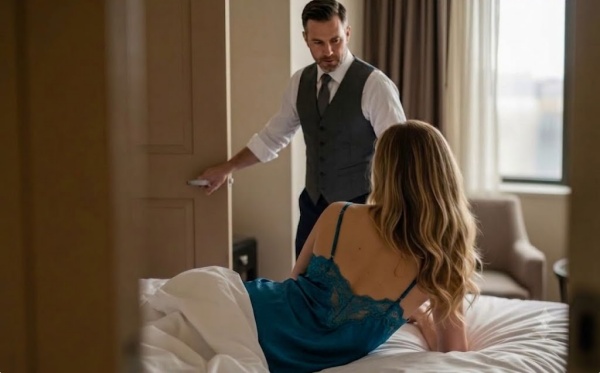
Room 502. 8:00 PM. Silk lingerie… At 8:00 PM, my husband walked into Room 502 at the hotel. He thought he was meeting his mistress. But what he saw horrified him…
Part 1: The Reservation
Room 502.
8:00 PM.
Silk lingerie folded neatly across the foot of the king-sized bed.
My husband walked into that hotel room expecting to meet his mistress. What he found instead left him horrified, not because I screamed, not because I threw anything, and not because I had brought the whole family there to shame him. He was horrified because for the first time in eighteen years, he saw the truth of his life arranged in front of him like evidence in a courtroom.
The hotel was the kind of place married men chose when they wanted to pretend they were still young enough to be reckless. It sat just off the interstate outside Columbus, Ohio, with a polished lobby, dim gold lighting, and a bar where nobody asked too many questions. The rooms were expensive enough to feel special but anonymous enough to disappear into.
I knew that because I had checked the receipt three times.
“Two nights, executive king suite, room service credit, late checkout,” the charge had said on our joint credit card statement. Four hundred and eighty-seven dollars and nineteen cents, including taxes. My husband, Mark, had told me he was going to Indianapolis for a regional sales meeting.
The funny thing about lies is that they usually come dressed in boring clothes. A fake work trip. A dead phone battery. A calendar invite with vague wording like “client dinner.” Nothing dramatic at first, nothing that would make a wife stop folding laundry and think, This is the moment my marriage cracks open.
But I had been married to Mark long enough to know the sound of his lies. They had a rhythm. A little too much detail in the wrong places, a little too little in the places that mattered.
He said, “I’ll be at the Hyatt downtown.”
The charge was from The Bellweather Hotel in Columbus.
He said, “Probably won’t get back until Friday afternoon.”
The reservation was for Thursday night only.
He said, “Don’t wait up.”
That was the first honest thing he had said all week.
For three days, I carried the knowledge quietly. I made coffee. I packed lunches. I paid the electric bill and reminded our fifteen-year-old son, Ethan, to bring his cleats for soccer practice. I stood in the kitchen while Mark kissed my cheek with the distracted politeness of a man already living in another woman’s imagination.
Every marriage has ghosts, but ours had become crowded. There was the ghost of the man who used to leave notes in my glove compartment. The ghost of the woman I used to be before I learned to monitor tone, tension, and transaction alerts. The ghost of every dinner where I asked, “How was your day?” and he answered like I was customer service.
I did not discover the affair through lipstick on a collar or perfume on a shirt. Real life is rarely that cinematic. I found it because Mark forgot that our family iPad still synced with his messages.
It happened on a Tuesday night while Ethan was doing algebra at the dining room table. Our daughter, Claire, was away at Ohio State, calling me between classes and shifts at the campus coffee shop whenever she had time. I was sitting on the couch, trying to order new filters for the refrigerator, when a message appeared at the top of the screen.
Can’t stop thinking about Thursday. Room 502. 8 PM. Wear something for me.
The name said Maddie R.
For a moment, I thought my mind had misunderstood the words. I stared at the screen until the message faded, then swiped down with a finger that did not feel attached to my body. There were more.
Not hundreds, but enough.
Enough to know this was not flirting. Enough to know Mark had told her things he had stopped telling me years ago. Enough to know she called him “M,” and he called her “my escape.”
That word did something to me.
Escape.
As if our home was a prison. As if the mortgage, the dishwasher, the birthday parties, the hospital bills, the family vacations to Lake Erie, the Christmas mornings, the college savings account, the photographs on the hallway wall, and the woman who had stood beside him through his father’s stroke were all a locked door he needed to sneak away from.
I did not cry that night. That surprised me. I had always thought betrayal would turn me into one of those women in movies who collapses against a kitchen counter while rain hits the window.
Instead, I became still.
Very still.
Ethan looked up from his math worksheet and said, “Mom, are you okay?”
I smiled so fast it hurt. “Yes, honey. Just remembered something.”
“What?”
“That I forgot to take chicken out of the freezer.”
He went back to his equations. I went upstairs, locked myself in the bathroom, and read every message I could find. Then I took screenshots.
The first thing people ask later is, “Why didn’t you confront him right away?” They ask that because they imagine confrontation as justice. They imagine the slammed door, the shouted question, the husband cornered and exposed.
But confrontation is only useful when the other person still respects the truth.
Mark had spent months building a second life out of excuses. If I asked him on Tuesday, he would deny it by Wednesday. If I showed him the messages, he would call it emotional confusion. If I cried, he would make my pain the problem.
So I waited.
Waiting is not weakness. Sometimes waiting is strategy.
On Wednesday morning, I dropped Ethan at school and drove to a coffee shop on High Street, where nobody knew me. I sat in the corner with a large black coffee and opened my laptop. My hands shook only once, when I typed “Ohio divorce attorney consultation” into the search bar.
By noon, I had spoken to a lawyer named Denise Caldwell, whose voice was calm in the way emergency room nurses are calm. She asked me about accounts, assets, children, income, debts, property, and whether I felt physically safe at home. I told her yes, because I did.
Mark was many things, but he was not violent. His cruelty wore sweaters and expensive watches. It smiled in family photos. It paid the car insurance on time.
Denise told me not to empty accounts, not to destroy property, not to post anything publicly, and not to involve the children in adult matters. “You want dignity,” she said. “Dignity protects you later.”
I wrote that down on a napkin.
Dignity protects you later.
Then I did something that surprised even me. I called The Bellweather Hotel.
A woman at the front desk answered with the bright, tired cheerfulness of someone who had already dealt with six complaints about parking fees. I gave her Mark’s confirmation number from the email I had found in his deleted folder. I said I was his wife and needed to adjust the reservation.
There was a pause.
Then she said, “Mrs. Ellison, I see you’re listed on the profile. How can I help?”
I closed my eyes.
Listed on the profile.
Even his affair reservation had my name attached to it, because I had booked our anniversary trip there two years earlier. We had stayed in a room on the seventh floor, ordered cheesecake at midnight, and Mark had told me he wanted us to grow old somewhere with a porch. Now he was using the same hotel loyalty account to betray me.
“I’d like to add a note,” I said. “And I’ll be checking in early.”
The woman hesitated. “Will Mr. Ellison be arriving with you?”
“No,” I said. “He’ll arrive later.”
“Of course.”
I almost laughed. Of course. The phrase of polite strangers and collapsing marriages.
That afternoon, I went shopping at Easton Town Center. Not because I wanted revenge to look pretty, but because the message had mentioned silk lingerie, and a strange, cold part of me wanted the room to look exactly the way Mark expected it to look. I wanted him to step into the fantasy he had purchased and discover that reality had arrived early.
I bought a black silk set from a boutique where the sales associate called me “ma’am” in a voice too young to understand what that word does to a forty-four-year-old woman. I also bought a garment bag, a pack of blank white envelopes, and a small silver picture frame.
The lingerie stayed in the bag all evening while I sat at the kitchen table after everyone went to bed. I printed screenshots. I printed the credit card charge. I printed a copy of the consultation notes Denise had emailed me. I printed a photograph of our family from the previous Thanksgiving, taken in front of my sister’s fireplace.
In the picture, Mark had his arm around my waist. Claire was leaning against him, Ethan making a face beside me. We looked like a family people would envy.
I put the photo in the silver frame.
Then I wrote five words on a blank card.
This is what you risked.
I slept for two hours that night.
On Thursday morning, Mark came downstairs in a navy suit, carrying his overnight bag. He looked handsome in the clean, practiced way he always did when he was about to sell someone something. His hair was damp from the shower, his wedding ring still on his finger.
“I’ll text when I get there,” he said.
“Indianapolis?” I asked.
He looked up from his phone. “Yeah.”
I poured coffee into his travel mug. “Drive safe.”
For half a second, something flickered across his face. Not guilt, exactly. Maybe suspicion. Maybe the faint discomfort of a man being treated kindly by someone he is betraying.
Then he kissed my forehead.
Not my lips.
My forehead, like I was a relative in a hospital bed.
“I love you,” he said.
I looked at him, really looked at him, and wondered when those words had become muscle memory. “I know,” I answered.
He left at 7:12 AM.
By 7:20, I was upstairs packing my own bag.
Part 2: Room 502
The Bellweather Hotel smelled like citrus polish and money. I arrived at 2:37 PM, wearing jeans, a cream sweater, and sunglasses even though the sky was gray. The valet asked if I was checking in, and I almost said, “No, I’m here to bury a life.”
Instead, I said yes.
At the desk, the same woman from the phone call recognized my name. Her smile softened when she handed me the key cards. People who work in hotels know more about marriage than therapists, priests, and bartenders combined.
“Room 502,” she said gently. “Elevators to your left.”
“Thank you.”
The room was colder than I expected. Hotels always are. The air-conditioning hummed like it was trying to erase every human trace before the next secret arrived.
I walked in and stood there for a long time.
The bed was made with white sheets tucked so tightly they looked military. There was a gray sofa near the window, a desk with a glass top, and a view of the parking garage across the street. Not romantic. Not tragic. Just a room with walls that had probably heard everything.
I unpacked slowly.
The silk lingerie went across the foot of the bed, exactly like an invitation. The framed family photo went on the nightstand. The envelopes went on the desk, arranged in a neat row.
One said MORTGAGE.
One said COLLEGE FUND.
One said MESSAGES.
One said ATTORNEY.
The last one said ME.
Inside the first envelope, I placed copies of our mortgage statement, showing twenty-two years of payments and repairs and tax assessments. Inside the second, I placed a printout of Claire and Ethan’s college savings accounts, both smaller than they should have been because Mark had recently withdrawn $6,000 for what he called “business expenses.”
Inside the third were screenshots of the messages. Not all of them. I did not need all of them. A betrayal does not become more true because you stack it higher.
Inside the fourth was a note from Denise confirming our appointment the next morning.
Inside the fifth, I placed nothing.
That envelope was empty on purpose.
At 4:10 PM, my phone buzzed.
Mark: Made it to Indy. Long drive. Meetings all afternoon.
I looked out the window at the parking garage and typed back: Glad you got there safe.
He replied with a thumbs-up emoji.
A thumbs-up emoji.
Eighteen years of marriage, two children, one affair, and a thumbs-up emoji.
For a while, I sat on the edge of the bed and let the anger come. It arrived hot and bright, then passed through me like a summer storm. Underneath it was grief, and under that was something harder to name.
I was not only mourning Mark. I was mourning the version of myself who had believed that being loyal enough could keep someone loyal back.
At 5:30, I ordered room service. Not champagne. Not oysters. I ordered a club sandwich, fries, and iced tea, because I had barely eaten in two days and revenge on an empty stomach is just self-harm.
The young man who delivered it avoided looking at the lingerie on the bed. I tipped him ten dollars. He said, “Have a good night,” with the fragile optimism of someone who did not know he had walked into the first act of a disaster.
After he left, I ate half the sandwich at the desk. The fries were excellent. I remember that because grief makes strange things permanent.
At 6:45, I changed clothes. Not into the lingerie. That was part of Mark’s fantasy, not mine.
I put on the black dress I had worn to Claire’s high school graduation dinner, the one Mark once said made me look “classy.” I fixed my hair, applied lipstick, and stared at myself in the bathroom mirror.
I did not look young. I did not look old. I looked like a woman who had finally stopped asking permission to be hurt.
At 7:12, I received another message from Mark.
Dinner running late. Might crash early after.
I pictured him in the hotel parking lot, maybe checking his hair in the rearview mirror, maybe texting Maddie with a different kind of energy. I wondered if his heart was beating faster. I wondered if he felt guilty at all.
At 7:40, someone knocked.
For one wild second, I thought he was early. My stomach dropped. I walked to the door, checked the peephole, and saw not Mark but a woman with auburn hair, a camel coat, and a face I recognized from a tiny profile picture beside hundreds of messages.
Maddie R.
The mistress had come early too.
I opened the door.
She stared at me. Her eyes moved from my face to the room behind me, then back again. She was younger than me, but not as young as I had feared. Maybe thirty-six. Maybe thirty-eight. Old enough to know better, young enough to still think wanting something made it destiny.
“Who are you?” she asked.
I almost smiled. “I’m Mark’s wife.”
The color left her face in a way that felt less satisfying than I expected.
She looked down the hallway as if the carpet might offer an emergency exit. “I—I didn’t know he was still married.”
That sentence hit me harder than I wanted it to.
Still married.
Not married. Still married. As if marriage were an old subscription he had forgotten to cancel.
I opened the door wider. “Come in.”
She shook her head quickly. “No. I should go.”
“You should,” I said. “But you may want to hear what I’m about to say before you do.”
Maddie looked at me like I was holding a match near gasoline.
“I’m not here to fight you,” I said. “I’m not here to call you names. I don’t know what he told you, and I don’t need the details unless they concern my finances or my children. But Mark will be here in about twenty minutes, and I want you to understand something.”
Her lips trembled. “He told me you were separated.”
“We had meatloaf together on Monday.”
She closed her eyes.
“He told me he was sleeping in the guest room,” she whispered.
“He snores next to me every night.”
“He said you didn’t love him.”
That one almost made me laugh. Not because it was funny, but because it was such a lazy lie. Men like Mark never tell the mistress, My wife loves me, trusts me, and built a life with me, but I am selfish anyway. They tell a story where they are lonely heroes trapped in beige houses.
“I loved him,” I said. “That was never the problem.”
Maddie put a hand over her mouth. For the first time, she looked less like a threat and more like another woman standing in the wreckage of a man’s convenience.
“Did he borrow money from you?” I asked.
Her eyes opened.
There it was.
“How much?” I asked.
She swallowed. “Eight thousand dollars.”
I felt something inside me go cold.
“For what?”
“He said his son needed a medical procedure insurance wouldn’t cover.”
For a moment, I could not speak. Ethan had braces, seasonal allergies, and a bruised left shin from soccer. He did not need surgery. He did not need anything Mark could buy with stolen sympathy.
Maddie started crying then, silently, with one hand pressed to her chest.
I stepped back from the door. “Come in.”
This time, she did.
She stood near the desk, staring at the envelopes. Her eyes landed on the silk lingerie and then shot away as if it had burned her.
“I brought that,” I said. “He asked you to wear something like it, didn’t he?”
She nodded once.
I picked it up from the bed, still folded, still untouched. “Then it belongs to the version of this night he thought he was getting.”
At 7:58, the hallway outside Room 502 went quiet.
Maddie wiped her face with a tissue from her purse. I stood near the window, hands folded in front of me. The room felt suddenly too small for the three lives about to collide inside it.
At exactly 8:00 PM, the key card clicked in the lock.
Mark walked in smiling.
He had changed out of his suit into dark jeans and a button-down shirt I had bought him last Christmas. His wedding ring was gone. He carried a bottle of red wine in one hand and a small gift bag in the other.
“Maddie,” he began.
Then he saw me.
The smile died so completely that for a second he looked like a stranger wearing my husband’s face.
His eyes moved to Maddie. Then to the bed. Then to the framed family photo on the nightstand. Then to the envelopes on the desk.
Nobody spoke.
The door closed behind him with a soft, final click.
Part 3: The Man in the Doorway
Mark’s first instinct was not apology. It was calculation.
I watched it happen across his face. He looked at me, then Maddie, then the envelopes, and I could almost hear the machinery inside him trying to build a bridge out of lies before the ground disappeared. Good salesmen are trained to recover quickly.
“Leah,” he said, using the careful tone he used with angry clients. “This isn’t what it looks like.”
Maddie made a sound that was almost a laugh.
I looked at the bottle of wine in his hand. “Really? Because it looks like you drove twenty minutes from our house to a hotel room you told me was in Indianapolis.”
His jaw tightened.
“I can explain,” he said.
“You can try.”
He set the wine and gift bag on the dresser. His hands were shaking now, just a little. That frightened him more than anything, I think. Mark liked control the way some people like oxygen.
He turned toward Maddie. “Why are you here already?”
She stared at him. “That’s your question?”
“Maddie, listen—”
“No,” she said, voice rising. “You listen. You told me you were separated.”
Mark glanced at me, then back at her. “We are emotionally separated.”
I almost admired the speed of it.
Emotionally separated. A phrase elastic enough to cover anything. He could have sold it in a seminar.
“We filed taxes jointly in April,” I said. “You asked me to proofread your company bio last week. You ate the last piece of my birthday cake standing in front of our refrigerator at midnight.”
Maddie turned away from him, wiping her eyes again.
Mark exhaled sharply. “This is humiliating.”
That was the first time my anger truly sharpened.
“Humiliating?” I repeated. “For whom?”
He looked at me, and I saw the flash of irritation he usually hid from strangers. He was not horrified because he had hurt me. He was horrified because I had made his private selfishness visible.
“Leah, you had no right to set this up.”
I laughed once. It sounded strange in the room.
“No right?” I said. “You used our credit card. Our hotel account. Our money. Our marriage. You brought your affair into every room of our house before I ever walked into this one.”
His face flushed.
“This is between us,” he said.
Maddie crossed her arms. “Apparently it’s between all of us.”
Mark pointed at her. “You don’t understand our marriage.”
“No,” she said. “I understand what you told me about it.”
For the first time, he had no answer.
I walked to the desk and picked up the envelope marked MESSAGES. I held it out to him. He did not take it, so I placed it on the bed beside the silk lingerie.
“Those are copies,” I said. “I kept the originals.”
His eyes narrowed. “Copies for what?”
“For myself. For my attorney, if needed. Not for Facebook, not for your boss, not for your mother. I’m not here to ruin your public life, Mark. You already did enough damage to the private one.”
That seemed to confuse him. He had expected rage. Rage would have helped him. Rage would have let him call me unstable, dramatic, unreasonable.
Calm made him nervous.
He took a step toward me. “Leah, please. Can we talk alone?”
“No.”
“Please.”
“You gave up private conversation when you invited another woman into our marriage.”
He looked toward Maddie again, and the gift bag on the dresser suddenly seemed to embarrass him. I wondered what was inside. Jewelry. Perfume. Something small enough to hide and expensive enough to make a woman believe she mattered.
Maddie saw me looking.
“What’s in the bag?” she asked.
Mark closed his eyes briefly. “This isn’t helping.”
She walked to the dresser and opened it before he could stop her. Inside was a delicate gold necklace in a velvet box.
For one second, I forgot to breathe.
Not because of the necklace itself. Because I recognized it.
Three weeks earlier, I had sent Mark a picture of a necklace almost exactly like it from a local jewelry store. I had written, Maybe for our anniversary? No pressure. Just thought it was pretty.
He had responded, Money’s tight right now.
Maddie held up the necklace, her face hardening.
“Did you buy this with my eight thousand dollars?” she asked.
Mark’s mouth opened, then closed.
There are silences that confess more clearly than words.
Maddie put the necklace back in the box as if it disgusted her.
I picked up the envelope marked COLLEGE FUND and placed it beside the messages. “Six thousand dollars came out of Claire and Ethan’s 529 accounts in the last two months.”
Mark’s head snapped toward me. “That was temporary.”
“For what?”
“Cash flow.”
“For your company?”
He said nothing.
“For hotel rooms? Gifts? Restaurants? Weekend trips?”
“It was temporary,” he repeated, louder.
“Our daughter is working twenty hours a week at a coffee shop so she doesn’t have to ask us for extra grocery money,” I said. “Our son thinks we’re cutting back on vacation this summer because gas is expensive. You took from their future and called it cash flow.”
His face changed then.
That was the moment horror finally entered. Not shame, not fear, but horror. Because I had found the one place he could not spin without hearing himself become ugly.
He sat down on the edge of the bed, too close to the lingerie, then stood back up as if the fabric accused him.
“I was going to put it back,” he said quietly.
“When?”
“I don’t know.”
“With what money?”
He rubbed both hands over his face.
Mark made good money. More than I did. He was a regional sales director for a medical equipment company, the kind of job that came with bonuses, miles, dinners, and a vocabulary full of numbers. But he also liked expensive watches, golf trips, and the feeling of being admired.
Admiration is costly when you have to rent it.
Maddie looked at me. “I can show you the bank transfers.”
I nodded. “Please send them to my email.”
Mark looked up. “Maddie, don’t.”
She stared at him. “You used your son’s health to get money from me.”
“I panicked.”
“No,” she said. “You planned.”
That sentence landed cleanly.
I had not planned on liking her, not even a little. I had wanted her to be shallow, cruel, easy to blame. But standing there in her camel coat, mascara smudged, hands trembling, she looked like someone waking up from a dream she had not known was designed for her.
Mark turned to me. “Leah, I made a mistake.”
“A mistake is forgetting milk,” I said. “A mistake is missing an exit on I-71. This was a schedule. A budget. A hotel reservation. A lie repeated until it became a second address.”
His shoulders sank.
“I don’t love her,” he said.
Maddie flinched.
I did not.
That line was supposed to save him with me and destroy her in the same breath. It was the cruelest thing he had said all night, and I think he did not even realize it.
I looked at Maddie. “You didn’t deserve that.”
Her eyes filled again, but she nodded.
Mark stood between us, surrounded by two women who had believed different versions of him. For years, I had imagined betrayal as a triangle. That night I understood it was more like a mirror maze. Everyone sees something, but nobody sees the whole room until the lights come on.
He reached for my hand.
I stepped back.
“Don’t,” I said.
His face crumpled then, but only slightly. Mark had always been handsome when wounded. He knew how to make remorse look romantic.
“I’m sorry,” he whispered.
I waited.
He looked at Maddie. “I’m sorry.”
She said nothing.
He looked back at me. “I’m so sorry, Leah. I don’t know what happened to me.”
I knew that line too. It sounded humble, but it was another escape hatch. I don’t know what happened means please don’t make me name what I chose.
“I know what happened,” I said. “You wanted to feel important without doing the work of being honorable.”
The room went very still.
Outside the window, headlights moved across the parking garage wall. Somewhere down the hall, someone laughed near the ice machine. Life continued with insulting normalcy.
I picked up the envelope marked ATTORNEY and placed it on the bed.
Mark stared at it.
“What is that?”
“My appointment is tomorrow morning at nine.”
His face went pale.
“Leah.”
“I’m not filing tomorrow,” I said. “I’m listening tomorrow. There’s a difference.”
He moved toward me again, slower this time. “Please don’t do this.”
“I’m not the one who did this.”
He looked like he might cry. Part of me wanted him to. Part of me wanted proof that something in him could still break for the right reasons.
But tears would not refill the college fund. Tears would not unteach our children the lesson he had created. Tears would not turn Room 502 back into an ordinary Thursday night.
Maddie picked up her purse.
“I’m leaving,” she said.
Mark turned quickly. “Maddie, wait.”
She laughed then, but it was bitter and small. “You cannot be serious.”
“I just need to talk to you.”
“No,” she said. “You need to talk to your wife. And probably a lawyer. And maybe God, if He’s taking appointments.”
Despite everything, I almost smiled.
She walked to the door, then stopped beside me.
“I’m sorry,” she said. “I know that doesn’t fix anything.”
“No,” I said. “But thank you.”
She nodded, opened the door, and left.
Mark and I listened to her footsteps fade down the hallway.
Then we were alone.
For eighteen years, I had imagined there would always be more to say. In that room, with the wine unopened and the silk untouched, I realized sometimes the end of a marriage begins not with screaming but with exhaustion.
Mark sat heavily in the desk chair.
“What happens now?” he asked.
I looked at the empty envelope marked ME.
“Now,” I said, “I tell you what you stole.”
Part 4: What He Stole
I sat across from him on the gray sofa. The room between us looked staged, almost theatrical, but everything in it was painfully real. Mark kept his eyes on the carpet like a boy in a principal’s office.
“You think I’m here because of her,” I said.
He did not answer.
“I’m not.”
His eyebrows pulled together.
“Yes, the affair matters,” I continued. “The lying matters. The money matters. But what you stole from me started long before Maddie.”
He looked up then, defensive already.
I held up a hand. “Don’t interrupt.”
For once, he didn’t.
“You stole my sense of reality,” I said. “Every time I asked if something was wrong and you told me I was imagining things, you made me doubt my own mind. Every time you came home distant and made me feel needy for noticing, you stole a little more.”
His face tightened.
“You stole ordinary peace. I used to hear your car in the driveway and feel relieved. Lately, I heard it and started checking my own mood, the kitchen, the kids, the house, trying to make sure nothing would irritate you.”
He whispered, “I didn’t know you felt that way.”
“That’s because you stopped asking.”
That landed. I saw it.
“You stole our history,” I said. “Not all of it, maybe. But enough. Now when I look back at last Christmas, I wonder who you were texting in the bathroom. When I remember our anniversary dinner, I wonder if you were already bored. You turned my memories into crime scenes.”
He covered his mouth with one hand.
I had expected to feel satisfaction, but I didn’t. Telling the truth out loud did not feel like victory. It felt like reading a damage report after a tornado.
“And you stole from our children,” I said.
He flinched.
“Not just money. Trust. Stability. The version of their father they deserve to keep.”
His voice broke. “They don’t have to know.”
I stared at him.
“They don’t have to know everything,” he corrected quickly. “I mean, we can protect them.”
“We?” I asked.
He swallowed.
“The children will not be used as props,” I said. “They will not hear details they don’t need. They will not carry adult pain because you want forgiveness faster. But do not confuse privacy with protection for yourself.”
Mark leaned forward, elbows on his knees. “I’ll put the money back.”
“Yes,” I said. “You will.”
“I’ll end everything with Maddie.”
“She already ended it.”
“I’ll go to counseling.”
“You should.”
“We can go together.”
I let that sit in the air.
There had been a time when those words would have felt like a lifeline. I had begged for counseling two years earlier, after months of silence and sharp little comments and sleeping back-to-back like polite enemies. Mark had said therapy was for people who wanted strangers in their business.
Now, with his affair exposed, therapy had become an emergency exit.
“I asked you for counseling,” I said.
“I know.”
“You said we didn’t need it.”
“I was wrong.”
“Yes.”
He looked at me with wet eyes. “Is there any chance?”
The question should have moved me. Instead, it made me tired.
I looked at the family photo on the nightstand. Claire had texted me that afternoon about a statistics exam. Ethan had asked if we could order pizza Friday night. Our children were moving through ordinary life while their parents sat in a hotel room with a marriage bleeding out between them.
“I don’t know,” I said honestly.
Mark closed his eyes, as if even uncertainty was more mercy than he expected.
“But I know this,” I continued. “I will not compete for my own husband. I will not audition for respect. I will not let you turn this into a story where you were confused and I was cold and Maddie was a symptom.”
He nodded quickly. Too quickly.
“I mean it,” I said. “If you want even the possibility of repair, you tell the truth without decorating it. You return the money. You provide full financial transparency. You schedule individual counseling. You sleep in the guest room. And tomorrow, you call Claire’s college fund administrator with me sitting beside you.”
He looked embarrassed. Good.
“And,” I said, “you write down every account, every card, every loan, every debt, and every gift paid for with money that belonged to this family.”
He rubbed his jaw. “That’s a lot.”
I laughed softly. “Yes, Mark. Consequences often are.”
For a moment, he looked at me almost like he used to. Not lovingly, exactly, but with recognition. As if the woman across from him was someone he had underestimated and finally remembered too late.
“What about tonight?” he asked.
“You leave.”
He blinked. “What?”
“You leave this hotel. You go home. You tell Ethan your meeting ended early if he’s awake. You sleep in the guest room.”
“And you?”
“I’m staying here.”
His eyes widened. “Alone?”
“Yes.”
“Leah, I don’t think—”
I stood. “You do not get to decide what is safe or appropriate for me tonight.”
He stopped.
I walked to the bed and picked up the silk lingerie. Then I placed it in the trash can beside the desk. Not dramatically. Not with a speech. Just folded fabric dropping into a small plastic-lined bin.
Mark watched it fall like it was a flag being lowered.
“Take the wine,” I said.
He looked at the bottle on the dresser.
“And the necklace,” I added. “Return it. Use the money for the college accounts.”
He nodded slowly.
He picked up the gift bag. Then the wine. He moved like an older man suddenly, though he was only forty-seven.
At the door, he turned back.
“I did love you,” he said.
I hated him a little for using past tense.
“I know,” I replied.
His face changed, hopeful for a second.
“That’s part of what makes this worse,” I said.
He opened his mouth, then closed it. Finally, he nodded and left.
When the door shut, I locked it, fastened the safety latch, and stood in the silence.
Then I cried.
Not pretty tears. Not movie tears. I cried so hard I had to sit on the floor between the bed and the nightstand, still wearing my black dress, one heel digging into the carpet. I cried for the twenty-six-year-old bride who had believed love was a promise adults kept. I cried for the forty-four-year-old woman who had become private investigator, accountant, mother, wife, and witness all in the same week.
At 9:23 PM, my phone buzzed.
Mark: Home. Ethan asleep. I’m in guest room.
I did not answer.
At 9:31, another message came.
Maddie: I sent the transfers. I’m sorry again. I blocked him. I hope you’re okay.
I looked at the message for a long time.
Then I wrote back: Thank you. I hope you are too.
It was strange, the kindness that survived that room. Not forgiveness. Not friendship. Just the recognition that women are too often handed pieces of each other’s pain and told to fight over the man who broke the vase.
At 10:15, I took off my dress, put on the hotel robe, and ordered chocolate cake from room service. The same young man delivered it. This time, there was no lingerie on the bed, no wine on the dresser, no husband in the doorway.
Just me.
He handed me the tray and said, “Anything else, ma’am?”
I almost said, “A time machine.”
Instead, I said, “No, thank you.”
The cake cost fourteen dollars and was too rich. I ate it anyway, sitting cross-legged on the bed, watching a rerun of a home renovation show where every problem could be solved with paint, lighting, and a bigger kitchen island.
Sometime after midnight, I opened the empty envelope marked ME.
I had left it blank because I did not know what belonged inside. A demand. A goodbye. A list of requirements. A version of myself I had misplaced.
I took the hotel pen and wrote one sentence on the inside flap.
I am not the room he walks into when everything else closes.
Then I slept.
Part 5: After Room 502
The next morning, Columbus was gray and wet. Rain tapped against the window in soft, steady lines. For a few seconds after waking, I did not remember where I was.
Then I saw the envelopes.
The room looked different in daylight. Less dramatic. More sad. The kind of sadness that does not need music.
I showered, packed my bag, and left the hotel robe on the bathroom hook. At checkout, the woman at the front desk asked if everything had been all right with my stay. It was such a normal question that I almost laughed.
“Yes,” I said. “Everything was handled.”
She gave me a look that suggested she understood enough not to ask more.
My appointment with Denise Caldwell was at 9:00 AM in a brick office building near German Village. Her conference room had a round table, a box of tissues, and a framed print that said Start where you are. I hated how accurate it felt.
Denise listened while I explained what had happened. She took notes without gasping, which I appreciated. When I told her about the college fund withdrawals and Maddie’s transfers, she paused and asked me to send documentation.
“This may affect how we approach finances,” she said carefully. “I’m not making accusations yet, but we need records.”
Records.
Marriage, when healthy, is made of moments. Marriage, when broken, becomes records.
Bank statements. Screenshots. Receipts. Transfers. Dates. Times. Room numbers.
I did not file that day. I wanted to, briefly, because action feels cleaner than uncertainty. But Denise reminded me that I did not need to decide my entire future within twenty-four hours of a trauma.
“You can prepare without rushing,” she said.
Dignity protects you later.
I went home around noon.
Mark’s car was in the driveway. The house looked ordinary, which offended me. Same porch. Same muddy soccer cleats by the door. Same Amazon package leaning against the railing like nothing had happened.
Inside, Mark was at the kitchen table with a legal pad, bank statements, and eyes red from not sleeping. He had made coffee. He had not touched my mug.
“Ethan’s at school,” he said. “Claire called. I didn’t answer.”
“Good.”
He nodded.
On the legal pad, he had written account names, balances, credit cards, and debts. His handwriting looked less confident than usual. At the top of the page, he had written College Funds: Replace Immediately.
I sat across from him.
For two hours, we went through numbers. It was brutal, boring, necessary work. The kind of work betrayal never includes in the fantasy.
He had spent more than I knew. Not enough to ruin us completely, but enough to prove that recklessness had become a habit. Hotels. Restaurants. Gifts. Cash withdrawals. “Business expenses” that had nothing to do with business.
When I asked a question, he answered. Sometimes slowly. Sometimes with shame. Once with defensiveness, which I shut down so quickly he apologized before finishing the sentence.
By 3:00 PM, we had scheduled a transfer from his personal investment account to repay the children’s college funds. By 3:30, he had emailed a therapist. By 4:00, he had written an apology letter to Maddie that I read before he sent it.
It did not ask for forgiveness. It did not ask to talk. It acknowledged the lie and the money, promised repayment, and stated clearly that there would be no further contact except through written financial documentation if needed.
“Send it,” I said.
He did.
Then he put the phone facedown like it was dangerous.
That evening, Ethan came home from soccer practice hungry and loud, smelling like grass and teenage sweat. He dropped his backpack by the stairs and asked if we could get pizza. Mark looked at me.
I said yes.
We ate pepperoni pizza from the place on Main Street, the one that charges extra for ranch cups and always forgets napkins. Ethan told us about a kid who kicked the ball into a drainage ditch. He did not notice that his father barely spoke.
That is the mercy and cruelty of children. They can live inside the weather without knowing the storm system.
Claire called after dinner. I answered in the laundry room because I could not handle her voice in front of Mark.
“Hey, Mom,” she said. “You sound tired.”
“I am.”
“Everything okay?”
I looked at the dryer, at Ethan’s soccer socks tumbling behind the glass.
“Not completely,” I said.
There was a pause.
“What happened?”
“Your dad and I are dealing with some adult marriage issues,” I said carefully. “You and Ethan are safe. This is not your fault. I’m not ready to talk about details yet, but I don’t want to lie and say everything is perfect.”
Claire was quiet for so long I thought the call had dropped.
“Are you okay?” she asked.
I leaned against the wall.
“I’m going to be.”
That was the first time I had said it. Not I’m fine. Not don’t worry. Something smaller and truer.
“I can come home,” she said immediately.
“No. You have class tomorrow.”
“Mom.”
“I love you,” I said. “And I promise I will tell you what you need to know when I can do it responsibly.”
She hated that answer. I could hear it. But she accepted it because she is my daughter, and she knows the difference between silence and steadiness.
After we hung up, I stayed in the laundry room for another minute.
When I came out, Mark was standing in the hallway.
“Did you tell her?” he asked.
“I told her enough.”
He nodded, eyes wet again.
Over the next month, our house became two countries sharing a border. Mark slept in the guest room. We spoke about schedules, bills, therapy, and the children. Some days he seemed genuinely broken open. Other days I saw him missing the easier version of guilt, the kind where apology is supposed to end the discomfort.
I did not comfort him.
That was harder than people understand.
When you have loved someone for nearly two decades, their pain still reaches for your hands. Even when they caused it. Even when touching it would cut you.
I went to counseling alone. My therapist, a woman named Dr. Patel, had warm eyes and no patience for self-abandonment disguised as compassion. She asked me what I wanted.
I gave respectable answers at first.
“I want stability.”
“I want honesty.”
“I want to protect the kids.”
She nodded each time, then asked again.
“What do you want, Leah?”
The question irritated me because I had spent so many years wanting in plural. Our house. Our retirement. Our children. Our schedule. Our plans.
My own wants felt like furniture stored under sheets.
One afternoon, I finally answered.
“I want to stop feeling grateful for crumbs.”
Dr. Patel smiled, not happily, but like we had found the door.
Mark attended therapy too. I know because he showed me appointment confirmations, though I never asked what he discussed. His healing was not mine to manage.
After six weeks, he asked if I would attend one session with him. I said yes, not because I had decided to stay, but because I wanted to hear him speak in a room where truth had witnesses.
The therapist’s office was in Dublin, Ohio, above a dental clinic. Mark sat on a blue couch, hands clasped, and told the story badly at first. He used phrases like “poor boundaries” and “emotional disconnection.”
I let him talk.
Then the therapist asked, “What choices did you make?”
Mark stared at the carpet.
And for the first time, he did not escape.
“I lied,” he said. “I had an affair. I used family money. I manipulated two women. I made myself the victim in a life where I had responsibilities I didn’t want to face.”
I looked at him then.
He was crying, but not beautifully. His face was blotchy, his voice uneven. It was the least attractive and most honest I had seen him in years.
The therapist asked me how it felt to hear that.
I said, “Late.”
Mark closed his eyes.
“But true,” I added.
That was all I could give.
People like clean endings. They want to know if I divorced him or forgave him. They want a door slammed or a kiss in the rain. They want Room 502 to become either the night everything ended or the night everything began again.
Real life is less generous with categories.
Three months after the hotel, I leased a small townhouse fifteen minutes away. Not permanently, I told the kids, and not as a punishment. I needed space to hear myself think.
Ethan was angry. Claire was quieter, which worried me more. We told them the marriage had been damaged by dishonesty and financial betrayal, that both parents loved them, and that adult choices were not children’s burdens to carry.
Claire asked if there was another woman.
I did not answer immediately.
Mark looked at me, then at her.
“Yes,” he said. “There was.”
The room broke in a new way then.
But something else happened too. Mark did not make me say it. He did not hide behind me. He let the truth cost him in front of the people whose respect he wanted most.
It did not fix everything.
But it mattered.
Maddie sent one final email two months later confirming Mark had repaid the money. She wrote only three sentences.
The transfer cleared. I hope your children are okay. I’m sorry for my part, even the part I didn’t understand.
I never wrote back.
Not because I hated her. Because some doors deserve to close quietly.
As for Mark and me, we remained legally married while separated. We attended a few counseling sessions together, then paused. Some weeks I thought reconciliation might be possible in some faraway, rebuilt form. Other weeks I felt nothing but relief when I unlocked the townhouse door and heard only silence.
I learned to sleep diagonally across the bed.
I learned to buy flowers without waiting for an occasion.
I learned that loneliness can be cleaner than suspicion.
On my forty-fifth birthday, Claire drove down from campus, Ethan baked a lopsided chocolate cake, and Mark came by with dinner from my favorite Thai place. He brought no jewelry. No dramatic letter. No performance.
Just food, paper plates, and a card that said, Thank you for letting me show up today.
That was the right size of apology for that moment.
After dinner, the kids watched a movie in the living room while Mark and I stood on the small back patio. It was April, still chilly, with the smell of rain in the air. The townhouse complex backed up to a narrow strip of trees, and beyond that, the highway murmured like distant water.
“I drove past The Bellweather last week,” Mark said.
I looked at him.
“For a work thing,” he added quickly. “I didn’t go in.”
I said nothing.
“I felt sick,” he said. “I think about that room all the time.”
“So do I.”
He nodded.
“Not the same way you do,” he said.
“No,” I agreed. “Not the same way.”
He looked older now. Not ruined. Just less polished. There was humility in him that had not been there before, or maybe it had been buried under applause and convenience.
“I’m still hoping,” he said.
“I know.”
“Are you?”
I watched a car pass on the road beyond the trees.
“I’m healing,” I said. “That’s all I can promise.”
He accepted that. The old Mark would have pushed for reassurance. This Mark stood quietly and let the answer be smaller than what he wanted.
Later, after everyone left and the townhouse was mine again, I found myself thinking about Room 502.
For a long time, I believed that was the room where my marriage ended. Then I thought it was the room where Mark’s lies ended. But now I think it was something else.
It was the room where I finally walked into my own life.
Not as a wife waiting to be chosen. Not as a mother swallowing pain to keep the peace. Not as a woman measuring her worth by a man’s ability to recognize it.
Just me.
Leah Ellison.
Forty-five years old. Mother of two. Owner of a used Honda with 96,000 miles on it. Renter of a townhouse with bad water pressure and excellent morning light. A woman who had been betrayed, yes, but not erased.
People ask if I regret setting up that hotel room.
I don’t.
I regret that it became necessary. I regret the money, the lies, the damage to our children’s trust. I regret every moment I confused patience with disappearing.
But I do not regret standing in Room 502 at 8:00 PM with the truth laid out in envelopes.
Because my husband walked into that room expecting to meet his mistress.
What he found instead was his wife.
Not the quiet version. Not the convenient version. Not the woman who would cry in the dark and help him protect his image in the morning.
He found the woman who had finally understood that love without respect is just a beautiful cage.
And for the first time in years, I was not the one who felt trapped.
