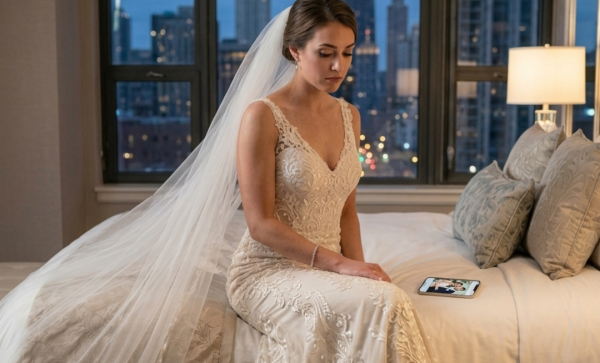
The Night Before Wedding, I Found Out My Fiancé Had Already Married Another Woman. Four Hundred Guests Came to Watch Me Marry Him—They Watched Me Expose the Truth Instead
The morning before my wedding, I learned my fiancé had legally married another woman two weeks earlier. He still expected me to wear the ivory gown, walk through forty thousand white roses, and protect his reputation in front of everyone we knew.
But he had underestimated the woman he planned to use, the best friend who found the records, and the family who stood behind me. By sunset, the ceremony was canceled, the ballroom was renamed, and the night became the beginning of a life he could no longer control.
Part 1: The Photograph at the Peninsula
The night before my million-dollar wedding in Chicago, I discovered that my fiancé had married another woman.
Not slept with her. Not kissed her. Not promised her some secret future behind my back while pretending to love me in public.
He had legally married her.
At 8:42 a.m., my best friend Megan sent me a photograph of Michael holding hands with Jessica outside a civil office while she carried their marriage certificate. In the picture, Jessica was smiling like a woman who had just won something, and Michael was looking down at her with an expression I had once believed belonged only to me.
Less than eighteen hours later, I was still expected to put on my custom ivory gown and become his bride in front of four hundred guests.
I was sitting in the bridal suite at the Peninsula Chicago when the photograph arrived. My cathedral veil covered the bed like a soft white cloud. Champagne waited in a silver bucket beside two engraved glasses that said Emma & Michael — Forever Begins Tomorrow.
Downstairs, forty thousand white roses were being installed.
Forty thousand.
That number had sounded romantic when the florist first said it. Now it sounded like evidence in a trial about waste, vanity, and humiliation. Four hundred people were flying in from New York, Dallas, Los Angeles, Miami, Boston, and San Francisco to watch me marry a man who was apparently already someone else’s husband.
The wedding coordinator, Patrice, stood in front of me with a clipboard and the calm urgency of a woman who had managed enough wealthy weddings to know that disaster often wore diamonds.
“So,” she said, “for the childhood photo montage, do you want that to play before the officiant’s welcome, or right before the vows?”
I stared at my phone.
Megan’s voice trembled through the speaker.
“Emma,” she whispered, “a private investigator confirmed it. They are legally married.”
For a moment, I could not hear Patrice.
I could only hear my own heartbeat.
It was not loud in a dramatic way. It was slow, heavy, impossible to ignore. Like a door closing somewhere deep inside my body.
“Emma?” Patrice asked.
I looked up.
She noticed my face and stopped talking.
My mother, who had been standing near the window inspecting the seating chart, turned around. “Sweetheart?”
I could not speak at first.
My mouth opened, but no sound came out. I had spent a year planning the most expensive weekend of my life. I had approved menus, flowers, lighting designs, invitations, favors, security details, photography schedules, rehearsal dinner speeches, and custom linens imported from Italy.
But no one had given me a checklist item for what to do if the groom is already married.
Megan kept talking.
“I didn’t want to send it until I knew,” she said. “I swear I didn’t. I thought maybe it was fake, or maybe it was some staged thing, or maybe—”
“Megan,” I said.
My voice sounded unfamiliar.
“Send me everything.”
“I already emailed it to your personal account. Not your wedding account. The legal record is attached. The PI says the marriage license was filed in Cook County two weeks ago.”
Two weeks.
Two weeks ago, Michael and I had been at our final tasting, deciding between herb-crusted halibut and filet mignon for the reception. Two weeks ago, he had held my hand under the table and told the caterer, “Emma has perfect taste. I just show up and agree.”
Everyone had laughed.
I had loved him for saying it.
That same week, he had married Jessica.
My mother walked toward me.
“Emma, what is happening?”
I looked at her, then at Patrice, then at the veil on the bed.
“Michael is married,” I said.
The room went silent.
Not wedding-day silent, full of reverence and anticipation.
Dead silent.
My mother blinked. “What?”
“He legally married Jessica two weeks ago.”
Patrice lowered the clipboard slowly.
My mother’s face changed in stages: confusion, denial, fear, then a cold anger I had never seen on her before.
“Jessica who?”
I almost laughed.
Because of course there was a Jessica.
There is always a Jessica in stories like this, but in real life she had been introduced to me as Jessica Lane, strategic communications consultant. She handled crisis messaging for Michael’s company, Brennan Capital Partners. She was thirty-two, sleek, ambitious, and always close enough to Michael at events to look necessary without looking inappropriate.
I had once complimented her navy dress at a fundraiser.
She had smiled and said, “You’re going to be such a beautiful bride.”
I wondered if she already knew then.
My mother reached for the phone. “Let me see.”
I handed it to her.
The photograph was clear.
Michael in a gray suit. Jessica in a cream dress. Their hands linked. The marriage certificate visible in her other hand. Behind them, the familiar stone building near the civil office.
My mother stared at it for a long time.
Then she said, very quietly, “Call your father.”
I shook my head.
“No.”
My mother looked at me sharply.
“Emma.”
“No,” I said again. “Not yet.”
My father, Richard Alden, did not react to betrayal with tears. He reacted with attorneys, accountants, and a tone of voice that made grown men remember appointments elsewhere. He had built Alden Logistics from one warehouse outside Indianapolis into a national shipping company worth more than most people could imagine.
He loved me.
He also loved control.
If I called him in that moment, the wedding would become a corporate crisis before I understood the personal one.
I needed five minutes that belonged only to me.
Just five.
I stood up.
The room tilted.
Patrice moved toward me. “Please sit down.”
“I’m fine.”
“You are not fine,” my mother said.
“No,” I said. “I’m not. But I’m standing.”
That mattered.
I walked to the window.
Below, Chicago shone bright and indifferent. Michigan Avenue moved beneath us like nothing had happened. Taxis slid past. People carried coffee. Somewhere downstairs, workers were probably unpacking the white roses that were meant to transform the ballroom into a winter garden.
The rehearsal dinner had been scheduled for 6 p.m.
The welcome cocktail hour for out-of-town guests was at 8 p.m.
The wedding itself was the next afternoon at 4:30 p.m. in the hotel ballroom, followed by cocktails, dinner, dancing, and a late-night after-party with a jazz band Michael insisted made the weekend feel “old Chicago.”
Michael loved old Chicago.
Or at least he loved the version of it that made men like him feel important.
He came from a respected but financially thinner family in Winnetka. His father had been a judge. His mother served on nonprofit boards and spoke in a soft voice that somehow made every sentence sound like a correction. Michael grew up around country clubs, prep schools, lake houses, and people who knew how to make limited money look inherited.
I grew up with more money but less polish.
That difference mattered to his mother.
It mattered to him too, though he denied it.
When we met at a charity event three years earlier, Michael was charming, thoughtful, and attentive in a way that felt almost cinematic. He remembered details. He asked about my work. He seemed genuinely impressed that I had chosen to run the Alden Family Foundation instead of taking an executive role in my father’s company.
“You actually care where the money goes,” he told me on our second date.
I did.
That was the beginning of his access to my life.
My friends liked him. My parents tolerated him at first, then approved of him after he became useful at dinners. He knew how to talk to donors, board members, family office managers, and politicians without sounding desperate. He was never the richest man in the room, but he knew how to make wealth feel comfortable around him.
By the time he proposed, he had become part of the machinery of my family’s world.
Too much a part, I was realizing.
My phone buzzed again.
Megan sent another message.
I’m downstairs in the lobby. I didn’t want to come up until you said so.
I typed:
Come up. Use the service elevator if you can. Don’t let Michael see you.
She replied:
Already avoiding him like federal evidence.
Despite everything, I almost smiled.
My mother was still holding her own phone, probably resisting the urge to call my father.
“Emma,” she said, “we need to stop the wedding.”
I turned from the window.
“Yes.”
The word came out quietly.
But once it was in the room, it became real.
Patrice inhaled. “I need to ask this carefully. Are we canceling the wedding, postponing, or changing the nature of the event?”
The question was so absurdly professional that it grounded me.
“I don’t know yet,” I said. “But I am not marrying him.”
Patrice nodded once.
“Understood.”
Her eyes sharpened.
“Then we need to secure your dress, jewelry, personal documents, vendor contracts, hotel access, and guest communications. We should also decide who is authorized to speak on your behalf.”
My mother looked surprised.
Patrice said, “Mrs. Alden, unfortunately, high-end weddings produce high-end emergencies.”
I looked at Patrice with new respect.
“Can you keep the vendors moving for now?”
She hesitated. “You want them to keep setting up?”
“Yes.”
My mother stared at me. “Emma.”
“I need time,” I said. “If everything stops right now, Michael will know before I decide how to handle this. I want the truth confirmed by my attorney first. I want the contracts reviewed. I want security ready. And I want to know exactly what he planned to do tomorrow.”
Patrice nodded slowly.
“That is wise.”
My mother’s anger softened into fear.
“He was going to stand beside you,” she said. “Knowing he was already married.”
“Yes.”
The horror of that settled over us.
This was not an affair discovered months before a breakup. This was not cold feet. This was not a man confused about two women. Michael had legally married someone else and still intended to walk down the aisle with me in front of our families, friends, donors, executives, political figures, and four hundred witnesses.
Why?
Money was the obvious answer.
But obvious answers are sometimes only the front door.
Megan arrived twelve minutes later, breathless, carrying a laptop bag and wearing sunglasses indoors like a spy in a movie with budget issues.
The moment she saw me, her face crumpled.
“I am so sorry.”
I hugged her.
That was when I finally cried.
Not loudly. Not beautifully. Not the kind of tears photographers capture in black and white behind veils. I cried into my best friend’s shoulder while my mother stood beside us and Patrice quietly stepped out to “check on the roses,” which I later learned meant calling hotel security.
When I pulled away, Megan opened her laptop.
“Okay,” she said, wiping her eyes. “Facts.”
Megan had been my best friend since sophomore year at Northwestern. She was now an investigative journalist with a talent for finding documents people assumed were too boring to matter. She had disliked Michael from the beginning, but she had never made it my problem.
That morning, she looked like someone who had hated being right.
She showed us the marriage record first.
Michael Brennan and Jessica Lane.
Civil ceremony.
Filed in Cook County.
Two weeks earlier.
Then the photos.
Michael and Jessica entering the building. Michael and Jessica leaving. Jessica holding the certificate. Michael kissing her hand near the curb. A black SUV picking them up.
My stomach turned.
“Who took these?”
“The private investigator I hired after I saw Jessica wearing a ring.”
My mother looked up. “You hired a private investigator?”
Megan winced. “In my defense, I planned to tell Emma after the wedding if I was wrong.”
“That is not a defense,” my mother said.
“No,” Megan agreed. “But it is what happened.”
I stared at the photo of Jessica’s ring.
It was not large.
That offended me in a way I could not explain.
Michael had given me a six-carat emerald-cut diamond that had required a security rider on my insurance policy. He had given Jessica something smaller, simpler, legal.
Maybe that was the real ring.
Mine had been for display.
Megan clicked to another file.
“There’s more.”
My mother sat down.
I remained standing.
“Show me.”
Megan hesitated.
“Emma, this part is about the foundation.”
The room changed.
My grief stepped aside.
Something colder entered.
“What about the foundation?”
Megan opened a folder labeled Brennan — Alden Foundation Contacts.
“Michael has been using your engagement to approach donors and corporate sponsors,” she said. “Some of that is normal. But I found emails suggesting he implied he would have influence over foundation allocations after the wedding.”
I stared at the screen.
There were messages between Michael and potential investment partners. Mentions of “post-marriage alignment.” References to “expanded access to Alden philanthropic networks.” One email to a venture contact said:
Once the wedding is complete, I expect to have a more formal role in Emma’s philanthropic strategy. Her father trusts my judgment more than he admits.
My mother made a sound under her breath.
Megan clicked again.
Another email.
Jessica will manage external messaging discreetly until after the Chicago event. Timing is sensitive.
Jessica.
Not just a mistress.
Not just a secret wife.
A participant.
I put one hand on the back of a chair.
“So they were planning something.”
“Yes,” Megan said softly. “I don’t know exactly what. But I know he wasn’t just cheating.”
The room was very quiet.
My phone buzzed.
Michael.
His name lit up on the screen beside our engagement photo, the one where he was kissing my temple under a canopy of lights at my parents’ lake house.
I let it ring.
Then he texted.
Morning, beautiful. Don’t forget to eat. Tomorrow is our forever.
I looked at the message.
Tomorrow is our forever.
No.
Tomorrow was going to be something else entirely.
Part 2: The Man Who Planned to Marry Me Twice
Michael came to the bridal suite at 10:15 a.m.
Patrice had warned security to call before allowing him upstairs, but technically he was still the groom and still listed on the wedding access schedule. The hotel staff did not know yet that the groom had married another woman at a civil office. That sentence, even in my own head, sounded too ridiculous to be true.
But the documents were on Megan’s laptop.
Truth does not become less real because it sounds dramatic.
When security called, Patrice looked at me.
“Do you want him allowed in?”
My mother immediately said, “Absolutely not.”
Megan said, “Legally, terrible idea.”
I said, “Yes.”
Both of them turned to me.
“I need to see his face,” I said.
Megan shook her head. “Emma—”
“I will not confront him about everything. I will not accuse him in a way that creates chaos. But I need to know whether he can stand in front of me and lie.”
My mother’s expression softened.
“Oh, sweetheart. Of course he can.”
That hurt because she was right.
Still, I nodded to Patrice.
“Let him in. But stay.”
Patrice opened the door three minutes later.
Michael entered carrying a white pastry box from my favorite bakery in Lincoln Park. He wore dark jeans, a navy sweater, and the easy smile of a man who believed the world still belonged to him. His hair was damp from a shower. His left hand was bare.
Of course it was.
“Good morning,” he said.
Then he saw my mother, Megan, and Patrice.
His smile dimmed slightly.
“Full committee already?”
Megan’s face was unreadable.
My mother’s was not.
Michael looked at me.
“You okay?”
I stared at him.
This was the man I had planned to marry. The man whose initials were embossed beside mine on napkins downstairs. The man whose face would appear in the childhood photo montage Patrice had been asking about before my life cracked open.
He looked normal.
That was the worst part.
Not guilty. Not panicked. Not like a man legally married to another woman while preparing for a second wedding. Just normal.
“I’m tired,” I said.
He set the pastry box on the table.
“I brought almond croissants. You barely ate at dinner last night.”
Thoughtful.
Perfectly thoughtful.
That was how men like Michael survived. They did small kindnesses so the large cruelties looked impossible.
My mother stepped forward.
“Michael, Emma has a great deal to handle today. You should go.”
He blinked.
“Is something wrong?”
Megan looked at him over the laptop screen.
For one second, something flickered in his eyes.
Not fear.
Calculation.
He knew Megan was dangerous.
He had always known.
“I just wanted to see my bride,” he said lightly.
I forced myself to breathe.
“Bad luck,” I said.
His smile returned.
“I don’t believe in that.”
Apparently not.
He walked toward me as if to kiss my forehead.
I stepped back.
The movement was small, but everyone saw it.
Michael stopped.
“Emma?”
I looked at his face, searching for the man I thought I loved.
He was there, in fragments. The warm eyes. The charming mouth. The little crease near his eyebrow when he pretended concern. But behind him was the photograph: his hand in Jessica’s, her certificate, their legal marriage filed quietly while mine was being staged with roses.
“I need space this morning,” I said.
His jaw tightened almost imperceptibly.
“From me?”
“Yes.”
“Did I do something?”
My mother inhaled sharply.
Megan froze.
Patrice looked at the floor.
I held his gaze.
“No,” I said. “Not something. Many things.”
There.
Not an accusation.
Not a legal statement.
Just enough.
Michael stared at me.
Then he looked at Megan’s laptop.
“Megan,” he said, “what did you tell her?”
My heart kicked once, hard.
Not what happened.
Not why is everyone upset.
What did you tell her?
Megan closed the laptop slowly.
“The truth tends to tell itself if you leave enough records behind.”
Michael’s face changed.
Only for a second.
But I saw it.
The mask slipped, and behind it was irritation. Not shame. Not regret. Irritation that someone had interrupted the performance before the curtain rose.
He turned back to me.
“Emma, whatever she thinks she found, we should discuss it privately.”
“No,” my mother said.
Michael ignored her.
“This is between us.”
I thought of Jessica holding the certificate.
“No,” I said. “It isn’t.”
He lowered his voice.
“Please don’t let Megan poison this weekend.”
Megan laughed once, softly.
“Bold choice.”
Michael’s eyes sharpened.
“Stay out of my relationship.”
Megan stood.
“You have more than one, apparently.”
Silence.
Michael went pale.
My mother stepped toward me.
Patrice shifted nearer to the door.
For the first time, Michael looked genuinely afraid.
“Emma,” he said.
I raised my hand.
“Leave.”
“Let me explain.”
“You will have that opportunity through attorneys.”
His mouth opened.
Closed.
“Attorneys?”
“Yes.”
He looked around the room, suddenly aware that the bridal suite had become less romantic and more procedural.
“Emma, you are making a mistake.”
That sentence almost steadied me.
There is a strange gift in hearing someone reveal themselves so clearly. He did not say, I made a mistake. He said I was making one by refusing to continue the lie.
“No,” I said. “I made a mistake when I trusted you. I’m correcting it now.”
His eyes darkened.
“Do you understand what canceling this wedding will do?”
“To whom?”
“To everyone.”
There it was.
The crowd.
The guests.
The donors.
The family names.
The photographs.
The million-dollar machine.
He wanted me to feel responsible for the embarrassment he created.
I looked at the pastry box.
Almond croissants.
My favorite.
“I understand exactly what telling the truth will do,” I said.
Michael took one step closer.
My mother’s voice cut through the room.
“Do not move toward my daughter again.”
He stopped.
For the first time all morning, he seemed to remember that I was not alone.
He looked at me.
Then, incredibly, he smiled.
Not warmly.
Strategically.
“Okay,” he said. “Take the morning. We’ll talk before the rehearsal dinner.”
“There will be no rehearsal dinner,” I said.
His smile vanished.
I continued.
“There will be no wedding.”
Michael stared at me as if I had slapped him, though I had not moved.
“You can’t decide that alone.”
That was the moment every remaining tender feeling in me died.
I could not decide whether to marry him alone?
He had married another woman alone.
I walked to the table, picked up the pastry box, and handed it back to him.
“Watch me.”
Patrice opened the door.
Michael looked at her, offended by her silent authority.
Then he looked once more at me.
“This will get ugly,” he said quietly.
I nodded.
“Only if you keep lying.”
He left.
The door closed behind him.
For several seconds, no one spoke.
Then Megan exhaled.
“Well,” she said, “he’s definitely guilty.”
My mother turned to Patrice.
“Get my husband.”
This time, I did not object.
My father arrived at the Peninsula thirty-four minutes later with his personal attorney, Helen Park, and the expression of a man who had been interrupted during peace and chosen war instead.
Helen was in her sixties, calm, precise, and terrifying in beige. She had represented my father’s company for twenty years and had once negotiated a warehouse acquisition while hospitalized with pneumonia. She hugged me first, which almost broke me.
Then she became legal.
Megan walked her through the records. The marriage certificate. The photographs. The emails. The donor implications. The references to foundation influence and Jessica’s role in messaging.
My father said nothing for a long time.
That was worse than shouting.
Finally, he looked at me.
“Did he ask you to sign anything recently?”
The question chilled me.
“Yes,” I said slowly. “Prenup amendments. Two days ago.”
Helen’s eyes sharpened.
“What amendments?”
“Michael said his attorney wanted to clarify post-wedding asset protections. I didn’t sign because I wanted you to review them.”
My father closed his eyes briefly.
Helen said, “Show me.”
I pulled up the documents from my email.
Helen read silently for five minutes.
Then ten.
The room felt airless.
Finally, she looked at my father.
“This is not standard clarification.”
My stomach sank.
“What is it?”
Helen turned the laptop toward me.
“The language appears to create advisory authority and access channels related to certain philanthropic and investment vehicles after marriage. It does not transfer ownership directly, but it creates influence pathways that could be exploited.”
Megan whispered, “Oh my God.”
Helen continued.
“If he was already legally married when he asked you to sign this, we need to examine potential fraud, misrepresentation, and intent.”
My father’s voice was dangerously quiet.
“He planned to use her.”
Helen said, “It appears possible.”
Possible.
Lawyers love that word because it leaves room for documents to become knives later.
I sat down.
The gown hung across the room in its garment bag.
Custom ivory silk.
Hand embroidery.
Pearl buttons down the back.
A dress designed for a wedding that had become evidence of a con.
“What do we do?” I asked.
Helen looked at me, not my father.
That mattered.
“First, you do not marry him. Second, we preserve everything. Third, we notify appropriate parties carefully and truthfully. Fourth, we review every contract, payment, insurance policy, and communication. Fifth, we decide what tomorrow becomes.”
“What tomorrow becomes?”
Patrice, who had been quiet, stepped forward.
“The ballroom is paid for. The food is contracted. Guests are arriving. Security is booked. Flowers are installed. The band, photographers, catering staff, lighting crew, and hotel team are already in motion.”
My mother looked horrified.
“Are you suggesting we still hold an event?”
Patrice said gently, “I’m suggesting Emma has options.”
Everyone looked at me.
For the first time since the photograph arrived, I felt the shape of power return.
Not happiness.
Not calm.
Power.
Michael had expected me to collapse. To cancel in shame. To hide in the bridal suite while he negotiated a story. Maybe he expected me to go through with it to avoid humiliating our families. Maybe he thought the cost, the guest list, and the public spectacle would trap me.
He forgot something.
The wedding had my name on it too.
My family’s money had paid for most of it.
My foundation contacts filled half the guest list.
My life was not his stage.
I stood slowly.
“We are not having a wedding,” I said.
Everyone waited.
“But maybe we are still having a gathering.”
My father studied me.
“What kind?”
I looked toward the window, down at the city, at the invisible workers arranging roses for a marriage that would never happen.
“A truthfully renamed one,” I said.
Megan’s mouth opened.
Then she smiled.
Part 3: Four Hundred Guests and No Groom
The official announcement went out at 3:10 p.m.
Helen drafted it. Patrice formatted it. My father approved every comma. I read it three times before giving permission to send.
It went to all guests by email and text through the wedding communication system.
Dear family and friends,
Due to serious legal circumstances involving the groom that were discovered today, tomorrow’s wedding ceremony will not take place. Emma is safe and surrounded by family. We ask that guests respect her privacy and refrain from speculation.
Because many loved ones have traveled to Chicago and because all arrangements have already been made, tomorrow’s reception will be converted into a private gathering honoring honesty, family, and the organizations Emma has long supported. Attendance is optional. Further details will be provided at check-in.
Thank you for your understanding.
It was elegant.
Restrained.
Legally careful.
Devastating.
Within two minutes, my phone exploded.
Calls. Texts. Voice messages. Group chats. Cousins. College friends. Board members. Former classmates. People I had not spoken to in years who suddenly felt entitled to my pain because they had booked flights.
I turned the phone off.
Megan took over communications with close friends. My mother called my aunts. My father called hotel security, then several people whose names I did not ask for. Helen sent legal notices to Michael’s attorney, Jessica’s attorney if she had one, and Brennan Capital’s general counsel.
Michael called me thirty-one times.
I did not answer.
He texted:
You are destroying both of us.
Then:
This can still be fixed.
Then:
Jessica and I have an arrangement you don’t understand.
That one made the room go silent.
Megan read it aloud twice.
My father said, “Forward it to Helen.”
I did.
Michael continued.
It was for legal protection. It doesn’t change us.
My mother looked physically ill.
Helen’s reply to me came quickly.
Do not respond. Preserve all messages.
So I preserved them.
There is a special kind of heartbreak in becoming organized while your life burns.
Folders. Screenshots. Time stamps. PDF downloads. Backup drives. Attorney-client emails. Vendor contracts. Security lists. Guest communications. Every click felt both surreal and necessary.
At 4:45 p.m., Jessica called me.
Her number was not saved in my phone, but Megan recognized it from the PI’s file.
“Don’t answer,” Megan said.
“I wasn’t going to.”
Jessica left a voicemail.
I played it with Helen on speaker.
Jessica’s voice was smooth, but strained.
“Emma, this is Jessica. I think there has been a misunderstanding. Michael and I entered into a private legal arrangement for reasons that are complicated, but it was never meant to hurt you. He loves you. Tomorrow can still happen if everyone stays calm.”
My father’s face went red.
My mother whispered, “Private legal arrangement?”
Megan said, “That’s a marriage, Jessica.”
Helen said, “Save it.”
I saved it.
The rehearsal dinner did not happen.
Instead, at 6 p.m., my immediate family, Megan, Helen, Patrice, and a small group of trusted staff gathered in a private conference room. The menu originally intended for the rehearsal dinner was served because the food had already been prepared, and because my mother said no daughter of hers was going to face public humiliation on an empty stomach.
I did not eat much.
But I drank water.
People kept reminding me to drink water, as if hydration could hold a person together. Maybe it helped. Maybe rituals matter most when nothing else makes sense.
At 7:30 p.m., my father stepped into the hallway to take a call.
When he returned, he looked older.
“Michael’s parents know,” he said.
My mother straightened.
“And?”
“His mother says there must be an explanation.”
Megan muttered, “There is. Her son is married.”
My father ignored that.
“His father asked whether we would consider delaying public disclosure until they can speak with Michael.”
Helen said, “No.”
I looked at my father.
He nodded.
“I told him no.”
That meant something.
My father cared deeply about reputation, but in that moment, he cared more about me.
At 8:15 p.m., Michael appeared in the hotel lobby.
Security stopped him.
He demanded to speak with me.
He claimed the cancellation notice was defamatory.
He claimed there had been a misunderstanding.
He claimed he had a right to attend his own wedding weekend.
Hotel security, operating under instructions from the contract holder—my father’s office and me—politely informed him that the event parameters had changed and his access was revoked pending legal review.
Michael did not like that.
He called my father.
My father answered on speaker.
“Richard,” Michael said, “this has gone too far.”
My father’s voice was flat.
“You married another woman.”
A pause.
Then Michael said, “It is not what it looks like.”
My father almost smiled.
That was frightening.
“It looks like a public record.”
Michael lowered his voice.
“Emma doesn’t understand the business implications.”
That was the wrong thing to say.
My father stood very still.
“My daughter understands enough to not commit bigamy.”
Megan covered her mouth.
My mother looked at the ceiling, perhaps asking God for restraint.
Michael said, “I want to speak with her.”
“No.”
“You can’t keep her from me.”
“She has chosen not to speak with you.”
Another pause.
Then Michael’s voice changed.
“She’ll regret this.”
My father’s tone became ice.
“Do not threaten my daughter with regret.”
Helen leaned toward the phone.
“Mr. Brennan, this call is over. All further communication should go through counsel.”
My father ended the call.
No one spoke for a moment.
Then Patrice, who had somehow become one of my favorite people in less than twelve hours, said, “For tomorrow, I recommend additional security at all entrances.”
“Yes,” my father said.
By midnight, the wedding had become something else.
The ceremony chairs were removed.
The aisle installation was dismantled.
The white rose arch was repurposed around the stage.
The seating chart was revised.
The band adjusted the program.
The officiant was paid in full and released with a kind note.
The cake remained.
That detail troubled me at first.
A seven-tier wedding cake decorated with sugar flowers and hand-painted gold trim felt obscene under the circumstances. But the pastry chef had spent days making it, and my mother said, “Cake has never been the enemy.”
So the cake stayed.
At 1:20 a.m., I finally stood alone in the bridal suite.
The gown hung by the window.
For a while, I just looked at it.
I had chosen that dress in New York with my mother and Megan. I remembered standing on the platform while the stylist adjusted the train, feeling more beautiful than I had ever felt. I remembered imagining Michael’s face when he saw me.
Now the thought made my stomach twist.
Megan came in quietly.
“You okay?”
“No.”
“Valid.”
“I don’t want to wear it.”
“Then don’t.”
“I don’t want to hide either.”
Megan sat on the bed.
“Then wear something else and be seen.”
I looked at her.
“I don’t have something else.”
Megan’s eyes lit up in a way that should have scared me.
“You are in downtown Chicago with rich people resources and a crisis budget. We can find a dress.”
By 9 a.m. the next morning, Patrice had arranged for three stylists, two tailors, and a private selection from a boutique on Oak Street.
I chose a deep midnight blue gown.
Simple.
Elegant.
Not bridal.
My mother cried when she saw me in it.
Not because I looked like a bride.
Because I looked like myself.
At 3:30 p.m., one hour before the ceremony that would never happen, I stood in the ballroom.
The transformation was astonishing.
The forty thousand white roses remained, but they no longer looked like wedding flowers. They looked like a memorial to an illusion. The stage displayed the logos of three organizations the Alden Family Foundation supported: a Chicago youth arts program, a domestic financial literacy nonprofit, and a legal aid fund for women navigating family and financial crises.
That last one had been my decision.
The guest tables still glittered with crystal and candles.
The menus were revised.
At the top, in elegant script, they now read:
An Evening for Truth, Family, and New Beginnings
I stood beneath the lights and felt the strangest sensation.
Grief, yes.
Humiliation, yes.
But also relief.
I was not marrying him.
No matter what happened next, that truth was clean.
At 4:20 p.m., guests began arriving.
Some looked uncomfortable. Some looked curious. Some looked genuinely concerned. A few looked disappointed in the way people do when a scandal disrupts their weekend entertainment. I decided not to care about those people.
Megan stood beside me.
My mother on my other side.
My father near the entrance, greeting guests with the controlled politeness of a man who could end careers but had chosen appetizers.
At 4:42 p.m., the exact time I would have been walking down the aisle, I stepped onto the stage.
The room quieted.
Four hundred people looked at me.
For one second, my knees almost failed.
Then I saw Megan.
She nodded.
I saw my mother.
She was crying, but smiling.
I saw my father.
He placed one hand over his heart.
So I spoke.
“Thank you for being here,” I said. “I know this is not the event you expected to attend.”
Soft, nervous laughter moved through the room.
“It is not the event I expected to host.”
The room settled.
“I will not discuss private legal details tonight. I will only say that I learned yesterday that the marriage planned for today could not and should not happen. I am safe. I am supported. And I am grateful that the truth arrived before vows were spoken.”
Silence.
Deep.
Complete.
I continued.
“Many of you traveled a long way. Many people worked hard to create this weekend. Rather than turn this room into a monument to embarrassment, my family and I have chosen to redirect tonight toward something honest.”
I glanced at the nonprofit logos behind me.
“Tonight, the planned wedding reception will become a fundraiser. My family will match every donation made in this room up to one million dollars. The funds will support youth arts access, financial literacy education, and legal aid for women facing family and financial crises.”
A ripple moved through the room.
Surprise.
Then applause.
It started at one table.
Then another.
Then the room rose.
I had expected pity.
I received a standing ovation.
I almost broke then.
But I didn’t.
I stood there in my midnight blue gown, under thousands of white roses, and let people clap for the woman who did not walk down the aisle.
Not because she was abandoned.
Because she chose not to abandon herself.
Part 4: The Groom Who Lost the Room
Michael tried to enter the event at 5:12 p.m.
Of course he did.
Men like Michael do not surrender stages easily.
He arrived in a tuxedo.
That detail traveled through the ballroom in whispers before security even finished escorting him away from the private entrance. He had come dressed as the groom, perhaps believing that if he looked the part, someone would let him perform it.
He was wrong.
Security stopped him near the service corridor.
His attorney was with him.
Jessica was not.
That absence said more than her presence could have.
My father went to the corridor with Helen. Megan tried to follow, but I asked her to stay with me. I did not want the evening to become about Michael. He had taken enough.
Later, my father told me what happened.
Michael demanded to address the guests.
Helen refused.
Michael’s attorney argued that the public announcement had damaged his reputation.
Helen replied that public records, preserved communications, and his own messages supported the cancellation.
Michael said I was acting emotionally.
My father said, “My daughter turned a canceled wedding into a million-dollar fundraiser in under twenty-four hours. I suggest you choose a different adjective.”
That line became family legend.
Back in the ballroom, the evening continued.
Dinner was served.
The halibut and filet mignon both appeared because Patrice decided guests deserved options in a crisis. The band played jazz standards instead of first-dance music. The champagne toast became a toast to honesty, delivered by Megan, who managed to make four hundred people laugh and cry without saying Michael’s name once.
“To Emma,” she said, raising her glass. “Who reminded us that grace is not staying quiet for someone else’s comfort. Sometimes grace is telling the truth, changing the program, and making sure the cake still gets served.”
People cheered.
The cake was served at 9 p.m.
I ate a slice.
Vanilla bean with raspberry filling.
It was excellent.
Cake, as my mother said, had never been the enemy.
Donations poured in.
By 10 p.m., we had raised $1.4 million before the family match.
By midnight, the total reached $2.8 million.
People who had arrived expecting scandal left talking about legal aid, financial independence, and how beautiful the room looked in the absence of a groom. Several women hugged me with the particular intensity of people who were not only comforting me, but remembering something of their own.
One older woman, a friend of my mother’s from Palm Beach, held my hands and whispered, “I married mine. You were spared.”
I did not know what to say.
She squeezed my fingers.
“Do something with that.”
I promised I would.
The legal consequences unfolded over the next year.
Helen and my personal attorney coordinated with family law counsel, corporate counsel, and eventually authorities where appropriate. Because Michael had legally married Jessica before attempting to proceed with a second wedding ceremony, the situation involved serious legal exposure. Whether he intended the second ceremony to be legally filed or merely socially performed became a matter for attorneys to examine.
The prenup amendments became a separate issue.
So did the emails about foundation influence.
So did his representations to donors and business contacts.
Brennan Capital Partners placed Michael on leave pending internal review. Then he resigned. Officially, he left to “pursue personal opportunities.” Unofficially, everyone understood that trust is a currency, and Michael had defaulted publicly.
Jessica vanished from public view for several months.
I later learned through counsel that her relationship with Michael deteriorated quickly. That did not surprise me. A marriage built as a strategy often struggles when the strategy fails. I did not contact her, confront her, or try to ruin her online.
I had learned something important.
You do not need to chase consequences when the truth has an address.
Michael tried to control the narrative at first.
He told some people the civil marriage was part of a legal arrangement.
He told others he and I had privately separated before the wedding.
That lie died quickly because too many people had seen us together, smiling through tastings, fittings, showers, and engagement parties. Also, he had texted me Tomorrow is our forever hours before the truth came out.
Screenshots have excellent memories.
He sent me one letter three months later.
Not an email.
A letter.
Handwritten, on expensive paper, because Michael always understood presentation better than substance.
He wrote that he had panicked about the pressure of marrying into my family. He claimed Jessica offered him emotional stability and legal protection during a confusing time. He said he loved me, but feared losing himself in the Alden world. He said he never meant to hurt me.
I read the letter twice.
Then I handed it to Helen.
She read it once and said, “He confesses beautifully to nothing useful.”
That was exactly right.
There was no real apology.
No full truth.
No clear accountability.
Just elegant fog.
I did not reply.
For months, I lived quietly.
That surprised people.
Some expected me to become a public symbol overnight. Some wanted interviews. Some wanted me to write an essay. Some wanted details they had no right to know. I declined everything.
I returned to work at the foundation.
At first, walking into board meetings felt unbearable. I imagined people looking at me and seeing the canceled wedding, the mistress-wife, the million-dollar scandal, the bride in blue. But serious work has a way of rescuing you from your own reflection.
There were grants to review.
Programs to fund.
Budgets to approve.
Families to support.
The legal aid fund from the wedding-that-wasn’t became the beginning of something larger. Six months later, we launched the Alden Women’s Legal Resilience Initiative, supporting women facing financial deception, coercive debt, divorce complications, and emergency legal needs. We partnered with organizations across Illinois, Indiana, Michigan, and Wisconsin.
The first year, we funded 1,200 consultations.
The second year, more than 3,000.
Whenever someone asked why I cared about the issue, I gave the professional answer.
“Because legal access can determine whether a crisis becomes a life sentence.”
That was true.
It was not the whole truth.
The whole truth was sitting in the bridal suite at the Peninsula, wearing a robe, staring at a photograph of her fiancé holding another woman’s marriage certificate.
The whole truth was understanding how quickly love becomes leverage when money, reputation, and silence are involved.
One afternoon, nearly a year after the canceled wedding, Megan and I returned to the Peninsula for lunch.
She suggested it.
I resisted.
Then I agreed because I was tired of letting buildings keep my ghosts.
We sat near the window overlooking Michigan Avenue and ordered salads that cost too much. For a while, we talked about her work, my foundation, her terrible dating life, and whether my father would ever learn to text without sounding like a subpoena.
Then Megan said, “Do you ever miss him?”
I looked down at my water glass.
“No,” I said.
Then I corrected myself.
“I miss who I thought he was.”
Megan nodded.
“That counts.”
“I miss the future I planned.”
“That counts too.”
“I don’t miss the man who showed up.”
Megan reached across the table and squeezed my hand.
“That’s the part that saves you.”
Outside, Chicago moved on.
So did I.
Not quickly.
Not cleanly.
But honestly.
Part 5: The Bride in Blue
Two years after the canceled wedding, I wore the midnight blue gown again.
Not because I wanted to recreate anything.
Because the Alden Women’s Legal Resilience Initiative was hosting its annual benefit at the Art Institute of Chicago, and Megan told me if a dress survives a scandal, raises millions, and still fits, it deserves a second public appearance.
She was right.
The benefit was smaller than the wedding had been, but more meaningful. Two hundred guests. No imported rose forest. No engraved champagne glasses promising forever. No groom waiting at the end of an aisle with another wife hidden in the paperwork.
Just donors, attorneys, advocates, social workers, judges, community leaders, and women whose lives had been changed by access to legal help.
The program opened with a short film about a mother who discovered her husband had taken out loans in her name. Then an attorney spoke about emergency financial protections. Then a young woman named Alina stood at the podium and described how legal aid helped her leave a marriage where every bank account, lease, and bill had been used to control her.
She did not cry.
That made her story even stronger.
After the applause, I stepped onto the stage.
The blue gown moved differently this time.
The first time I wore it, it had been armor.
This time, it felt like history.
I looked out at the room.
My parents sat at the front table. My mother was already emotional. My father looked proud in the restrained way men of his generation often do, as if pride must pass through security before appearing on the face.
Megan sat beside them, grinning.
I began.
“Two years ago, many of you were invited to my wedding,” I said.
Soft laughter moved through the room.
“Some of you attended a very different event instead.”
More laughter.
Then quiet.
“I learned something that weekend. I learned that truth can arrive late and still arrive in time. I learned that legal documents matter. I learned that reputation is not the same as character. And I learned that when a woman is humiliated publicly, she should not be asked to disappear privately.”
The room stilled.
I continued.
“The initiative we are supporting tonight exists because too many people discover too late that love does not protect them from financial deception, legal confusion, or the consequences of trusting someone who benefits from their silence.”
I paused.
“This work is not about bitterness. It is not about revenge. It is about access, clarity, and safety. It is about making sure that when someone’s life changes in one phone call, one document, one betrayal, or one discovery, they are not standing alone.”
The applause began before I finished.
After the program, a woman approached me near the donor wall.
She was in her forties, wearing a black dress and holding a clutch so tightly her knuckles were pale.
“My sister used one of your funded legal clinics,” she said. “Her husband had opened three credit cards in her name. She thought she was trapped.”
I swallowed.
“Is she safe?”
“She is now.”
That was the moment I knew.
The canceled wedding had become something Michael could not touch.
Not because it stopped hurting.
But because it had been transformed into help.
Later that evening, I stepped away from the crowd and walked into one of the quieter galleries. Paintings lined the walls. The sound of the benefit softened behind me. I stood in front of a landscape I did not recognize and let myself breathe.
My phone buzzed.
A message from an unknown number.
For a second, I knew.
I opened it.
Emma. I heard about tonight. I’m glad something good came from what happened. I hope you’re well. — Michael
I stared at the message.
Two years earlier, that name would have sent my body into panic.
Now it felt like seeing an old headline about a storm that had already passed through.
I did not reply.
I blocked the number.
Then I returned to the benefit.
Not dramatically.
Not angrily.
Just done.
Megan noticed my face immediately.
“What happened?”
“Michael texted.”
Her eyes widened. “And?”
“I blocked him.”
She placed one hand over her heart.
“My little girl is all grown up.”
I laughed.
It felt good.
Real.
At the end of the night, the initiative raised $3.2 million.
My father gave the closing toast.
He was not originally scheduled to speak, which made everyone nervous. My father without prepared remarks was either deeply moving or legally concerning. That night, thankfully, he chose deeply moving.
He raised his glass and looked at me.
“Two years ago, my daughter stood in a ballroom and did something I had not taught her,” he said. “She turned humiliation into service before I had even finished being angry.”
The room laughed softly.
He continued.
“I have spent my life building companies, contracts, and systems. Emma reminded me that the strongest systems are the ones that protect people when trust fails. I am very proud of her.”
My mother cried openly.
I did too.
Afterward, when the guests had gone and the staff began clearing tables, I stood alone for a moment near the entrance.
There had been a time when I believed becoming Michael’s wife would be the beginning of my adult life. That thought embarrasses me now, but I try to be gentle with the woman who believed it. She was not foolish. She was hopeful. Hope is not a crime, even when someone uses it against you.
The wedding had cost over a million dollars.
People still mention that.
They say it with disbelief, fascination, judgment, pity. A million-dollar wedding canceled the night before. A groom who had already married someone else. A bride who wore blue and turned the reception into a fundraiser.
But money was never the real cost.
The real cost would have been marrying him.
The real cost would have been waking up beside a man who saw vows as theater and documents as tools. The real cost would have been letting embarrassment push me into a legally and emotionally dangerous future. The real cost would have been teaching myself that public appearances mattered more than private truth.
I was spared that cost.
Barely.
Brutally.
But completely.
Sometimes people ask whether I hate Jessica.
I do not.
That answer disappoints them.
Hate requires a kind of attention I am no longer willing to pay. Jessica made choices. Michael made choices. Attorneys, employers, donors, and public records handled the consequences. I did not need to spend my life keeping score.
Sometimes people ask whether I regret not confronting Michael more dramatically.
I do not.
I said what needed to be said.
I preserved what needed to be preserved.
I let lawyers handle what lawyers are trained to handle.
That is not weakness.
That is strategy.
And sometimes people ask what I would tell another woman who discovers, hours before a wedding or years into a marriage, that the person beside her has built a life on lies.
I would tell her this:
Do not let shock make permanent decisions for you.
Call the person who tells you the truth even when it hurts.
Save the records.
Talk to an attorney before you talk to the liar.
Do not confuse humiliation with obligation.
You are allowed to stop the ceremony.
You are allowed to disappoint the guests.
You are allowed to waste the flowers.
You are allowed to protect the rest of your life.
And if the room is already paid for, if the food is already cooked, if the cake is already waiting and people are already watching, you are still allowed to change the meaning of the night.
You do not have to become someone’s wife just because the programs have been printed.
At 8:42 a.m., I thought a photograph had ruined my life.
It showed Michael holding hands with Jessica while she carried their marriage certificate, smiling outside a civil office like she had won the future he promised me. I thought that image would be the most humiliating thing I would ever see.
I was wrong.
It was the most merciful.
Because less than eighteen hours later, I did not put on the ivory gown.
I did not walk toward a man who had already legally given himself to someone else.
I did not become the bride in his lie.
I became the woman in blue who told the truth.
And that made all the difference.
