My Ex Called Me “Half a Wife” Because We Had No Children—Then Three Little Voices Called Me “Mom” at His Wedding
I spent eleven years carrying shame that was never mine. My ex-husband blamed me for our childlessness, hid the truth, and walked away with a younger woman while everyone treated him like the victim. When his family invited me to his wedding, they expected the quiet, broken woman he had left behind. Instead, they watched three children walk in beside me—and one innocent word changed the entire ceremony.
Part 1: The Name He Gave My Pain
For eleven years, I let people pity my husband for a shame that was never mine.
His name was Michael Callahan, and in our town outside Raleigh, North Carolina, everyone thought he was the kind of man any woman would be lucky to marry. He taught high school history, coached JV baseball in the spring, volunteered at church on holidays, and called older women “ma’am” with just enough Southern charm to make them forgive almost anything. He knew how to look gentle in public.
At home, gentleness was something he rationed.
We married when I was twenty-seven and he was thirty. Our wedding was small, held under white lights in my parents’ backyard, with barbecue from a local smokehouse and a cake my aunt insisted on baking herself. Michael cried during his vows, and everyone said, “That man loves you something fierce.”
For the first two years, I believed them.
We bought a little brick ranch house with a yellow front door and a mortgage that made both of us nervous. I worked as an office manager for a dental practice, and Michael brought home stacks of papers to grade at the kitchen table. On Friday nights, we ordered pizza, watched old movies, and talked about the children we would have someday.
Michael wanted four.
“Two boys, two girls,” he used to say, lying beside me with one arm behind his head. “A loud house. Baseball gloves in the mudroom. Dance recitals. Sunday pancakes. The whole thing.”
I wanted children too. Maybe not four, but I wanted the noise. I wanted lunch boxes and bedtime stories and tiny shoes by the door. I wanted to become a mother in the ordinary, beautiful way I had always imagined.
So when I did not get pregnant after a year, I worried.
When two years passed, I panicked.
By the third year, our marriage had become a calendar of ovulation tests, doctor appointments, lab work, vitamins, awkward conversations, and prayers whispered into a pillow. I learned words I had never expected to know. Follicles. Motility. Hormone panels. Insemination. Viability.
I also learned that infertility does not just visit a marriage. It moves in, rearranges the furniture, and sits between two people at dinner.
At first, Michael acted supportive.
He drove me to appointments, held my hand in waiting rooms, and told me we were a team. When I cried after another negative test, he wrapped his arms around me and said, “We’ll keep trying, Sarah. We’re not giving up.”
But something shifted after the first specialist visit.
The doctor, a calm woman with silver glasses named Dr. Patel, ordered tests for both of us. Mine came back normal. Not perfect, because bodies are not machines, but normal enough that she smiled gently and said, “Your results are encouraging.”
Michael’s results came back a week later.
I was at work when he called me. His voice was tight.
“What did they say?” I asked, stepping into the supply closet so patients would not hear.
“Nothing clear,” he said. “They want to repeat some things.”
“Okay. But what did the first results show?”
He was quiet for a beat too long.
“Low count,” he said finally. “Some motility issues. Dr. Patel said it doesn’t mean impossible.”
I remember leaning against the shelves, surrounded by boxes of gloves and toothpaste samples, feeling relief and sadness at the same time. Relief because there was finally an answer. Sadness because I knew Michael’s pride would take it hard.
“We’ll handle it together,” I said.
He exhaled sharply. “Don’t tell anyone.”
“I wasn’t going to.”
“I mean it, Sarah.”
“I said I won’t.”
He hung up without saying he loved me.
That was the first secret he asked me to keep for him. It would not be the last.
The repeat tests confirmed the same thing. Male factor infertility. Treatable maybe, workable maybe, but real. Dr. Patel explained options in her office while Michael stared at the carpet like she had accused him of a crime.
“There are pathways,” she said. “Medication, lifestyle changes, assisted reproduction. But it’s important you both understand this is a shared medical situation, not anyone’s moral failure.”
Michael nodded, but his jaw was hard.
In the parking lot afterward, he threw the folder into the back seat.
“Don’t ever say that phrase to my mother,” he said.
“What phrase?”
“Male factor.”
I stared at him. “Michael, it’s a medical term.”
“It’s humiliating.”
“It’s not humiliating. It’s health information.”
He looked at me then with eyes I did not recognize. “Easy for you to say. You’re not the one being told you’re less of a man.”
I reached for his hand, but he pulled away.
From that day on, infertility became my public burden and his private secret.
When his mother, Donna, asked when we were going to give her grandbabies, Michael laughed and said, “You know Sarah. She likes to take her time with everything.” When his brothers joked that I should stop focusing on work and start “building the Callahan family,” Michael smiled into his sweet tea and said nothing. When women at church told me to relax and trust God’s timing, he stood beside me like a grieving saint.
I carried it because I loved him.
That is the simple and terrible truth. I thought protecting his pride was part of protecting our marriage. I thought if I absorbed the questions, the pity, the sideways looks, he would eventually heal enough to tell the truth himself.
Instead, my silence became his weapon.
By year six, people had stopped asking kindly.
His mother started leaving articles on our kitchen counter about “natural fertility support.” His aunt mailed me a book about nutrition and motherhood with passages underlined in red. At baby showers, women patted my shoulder and said, “Your turn will come,” in voices usually reserved for hospital beds.
Michael never corrected them.
Once, after Thanksgiving dinner, I overheard Donna crying in the hallway.
“I just don’t understand,” she told Michael. “You always wanted children. You would be such a wonderful father.”
“I know, Mom,” he said softly.
“She doesn’t seem to understand what this is doing to you.”
I stood behind the bathroom door, one hand over my mouth.
Michael did not say, “It isn’t Sarah’s fault.”
He did not say, “Mom, stop blaming my wife.”
He said, “I’m trying to be patient.”
That night, in the car, I confronted him.
“Why would you let her think I’m the problem?”
He gripped the steering wheel. “She’s upset.”
“So am I.”
“You don’t know what this feels like for me.”
I laughed once, stunned by the cruelty of it. “I’m the one everyone blames.”
“Because they don’t know.”
“Because you won’t tell them.”
His face hardened. “You promised.”
“I promised not to humiliate you. I didn’t promise to be humiliated for you forever.”
He said nothing for the rest of the drive.
Three weeks later, during an argument about another failed treatment cycle, he called me “half a wife” for the first time.
We were in the kitchen. Rain hit the windows. I had just asked if he would consider counseling before we spent another $9,000 on a procedure neither of us felt emotionally ready for.
He slammed his hand on the counter.
“You don’t get it, do you?” he snapped. “A wife is supposed to build a family.”
I froze.
He looked at me with a face full of bitterness he had been saving for years. “What am I supposed to do with half a wife?”
The words did not sound shouted. They sounded released.
I stood there in my slippers, holding a mug of tea, feeling the last warm place in my marriage go cold.
“You know this isn’t because of me,” I whispered.
He looked away.
But he did not apologize.
After that, the phrase became something he used when he wanted to hurt me quickly.
Never in front of others. Michael was too careful for that. In public, he was the tragic husband with the quiet, childless wife. At home, when he was angry, he reminded me I had given him “an empty house,” “a dead-end marriage,” and “nothing to show for eleven years.”
I used to wonder how a man could blame someone for a wound he knew he had caused.
Now I know.
Some people would rather destroy the person protecting them than admit they needed protection.
Part 2: The Woman Who Made Him Feel Young
Her name was Olivia Parker.
She was twenty-nine, with glossy brown hair, a fitness instructor’s body, and the kind of laugh that made men sit up straighter. She worked in the front office at Michael’s school, and he mentioned her casually at first. Then often. Then not at all, which told me more than the mentioning had.
I knew before I had proof.
Women usually do. We notice the changed passwords, the phone facedown, the sudden interest in new shirts, the extra breath before a lie. We notice when a husband starts showering after coming home, as if the day has left evidence on his skin.
I asked him once.
“Is there someone else?”
Michael looked insulted. Not hurt. Insulted.
“That’s what we’re doing now?” he asked. “Accusing me because you’re unhappy?”
“I’m asking because you’re different.”
“No, Sarah. I’m tired.”
“Tired of what?”
He stared at me for a long time.
Then he said, “Pretending this is enough.”
I knew what “this” meant.
Our house. Our dinners. Our history. Me.
A month later, he told me he wanted a separation.
He said it at the kitchen table, the same table where we had once made lists of baby names. He wore his school polo, and there was a smear of red pen on his thumb. Outside, our neighbor’s kids were riding bikes in the cul-de-sac, screaming with summer joy.
“I can’t keep living like this,” he said.
I sat across from him with my hands folded tightly in my lap. “Like what?”
He looked around the room as if the walls themselves had disappointed him. “In a marriage that never became a family.”
The cruelty was so familiar by then that it barely shocked me.
“We are a family,” I said.
He shook his head. “No. We’re two people who share bills.”
I wanted to throw Dr. Patel’s folder at him. I wanted to call his mother and tell her every number, every diagnosis, every appointment he had hidden behind my dignity. I wanted to scream until the neighbors stopped pretending not to hear.
Instead, I asked, “Is it Olivia?”
His silence answered.
I nodded slowly. “Does she know?”
His eyes sharpened. “Know what?”
“The truth.”
He stood up. “Don’t start.”
“So she doesn’t.”
“Sarah.”
“She thinks I’m the reason you don’t have children.”
He looked at me with something almost like fear. “Leave her out of this.”
I laughed softly. “You brought her in.”
He rubbed both hands over his face. “Olivia wants kids.”
“So did I.”
“She can have them.”
The room tilted.
There it was. The lie he had chosen to live inside. The fantasy where a younger woman could magically make him someone else. The story where I was the locked door and Olivia was the key.
I stood up carefully.
“You are going to break her heart too.”
His face twisted. “Don’t make this ugly.”
That sentence nearly made me smile.
Men like Michael often create a mess, then accuse women of ugliness for naming it.
The separation became a divorce within six months.
Michael moved into a two-bedroom apartment near the school, though everyone knew he spent most nights at Olivia’s townhouse. Donna cried to anyone who would listen about how her poor son had “waited so long to become a father.” His brothers treated me like I had wasted Michael’s best years.
At church, people hugged him.
They hugged me too, but differently. With disappointment tucked behind sympathy.
Olivia appeared beside him quickly. Too quickly for even polite people to ignore. She was bright, pretty, and careful to look sad around me, as if she had inherited a wounded man rather than helped him wound someone else.
The first time I saw them together was at a farmers market downtown.
I was buying peaches when Michael’s laugh reached me from across the aisle. Olivia stood beside him in a white sundress, holding a paper cup of lemonade. He touched the small of her back, the way he used to touch mine.
For a second, I could not breathe.
Then Olivia saw me.
Her smile faltered. Michael turned, followed her gaze, and his face hardened into public politeness.
“Sarah,” he said.
“Michael.”
Olivia stepped forward, all soft eyes and nervous grace. “Hi. I’m Olivia.”
“I know.”
Her cheeks colored.
Michael cleared his throat. “Hope you’re doing well.”
I looked at him. Really looked. At the man who had let me carry his shame, then left because the burden made me look too tired to love.
“I’m learning,” I said.
He did not know what to do with that.
The divorce was finalized in March.
I kept my car, half the savings, and the house after refinancing it on my own. Michael did not fight me for it. I think he wanted a fresh start too badly to care about brick and drywall.
The first night alone in that house, I sat on the nursery floor.
We had never turned the spare room into a nursery, not fully. But the idea had lived there. A white dresser from IKEA, still empty. A rocking chair I had bought on sale after our second treatment attempt. A box of children’s books I collected quietly over the years because hope is stubborn and sometimes foolish.
I expected to sob.
Instead, I felt anger.
Not the hot kind. The clean kind.
The kind that makes you stand.
I packed the books into a box, carried the rocking chair to the living room, and turned the room into an office. I painted the walls deep blue. I bought a used desk for $120 on Facebook Marketplace and assembled it myself while watching tutorial videos.
For the first time in eleven years, I made a room without asking what Michael wanted from it.
Healing did not come dramatically.
I did not wake up one morning transformed. I went to work. I paid the mortgage. I cried in grocery store aisles when I saw fathers lifting toddlers into carts. I avoided baby showers. I blocked Donna on Facebook after she posted a photo of Michael and Olivia with the caption, “God restores what was stolen.”
Stolen.
That word stayed with me for days.
As if I had stolen fatherhood from him.
As if I had locked children away in some secret room and refused to open the door.
Two months after the divorce, I found Dr. Patel’s old folder in a filing cabinet. I sat on the floor and read it again, every page, every lab result, every note. My name was there, yes. So was his.
The truth looked so plain in black ink.
I could have mailed copies to Donna. I could have uploaded screenshots. I could have ruined his saintly little story with one envelope and a stamp.
But I did not.
Not because he deserved protection anymore. Because I deserved peace more than revenge.
At least, that is what I told myself.
The truth was more complicated. Part of me still felt trained to protect him. Part of me still heard his voice saying, “Don’t humiliate me.” Part of me still believed my own dignity depended on staying quiet.
Then, one rainy Thursday in June, I met the first child who would call me Mom.
Her name was Emma.
She was six years old, sitting in the waiting area of the dental practice where I worked, wearing purple rain boots and holding the hand of a social worker named Denise. Beside her were two smaller boys. Noah, four, with serious eyes and a dinosaur backpack. Ben, two, asleep against Denise’s shoulder with a thumb in his mouth.
They were siblings in foster care.
Their dental records were a mess, their insurance paperwork was worse, and Denise looked like she had been fighting three systems at once before 10 a.m. I helped sort the forms, called Medicaid, corrected their appointment schedule, and found juice boxes in the staff fridge.
Emma watched me the whole time.
When I handed her a sticker afterward, she asked, “Are you somebody’s mom?”
The question hit me so hard I almost dropped the chart.
“No,” I said gently. “Not right now.”
She nodded like she understood more than a child should. “You talk like one.”
That night, I could not stop thinking about her.
Or her brothers.
Or the way Noah had held Ben’s shoe in his lap so it would not get lost.
Two weeks later, I called Denise.
“I know this sounds strange,” I said, gripping the phone in my kitchen. “But I’ve been thinking about fostering.”
Denise was quiet for one second.
Then she said, “It doesn’t sound strange at all.”
Part 3: Three Little Voices
Foster care was not a fairy tale.
The classes made that clear immediately. The instructors talked about trauma, reunification, court dates, attachment, grief, emergency placements, medical histories, and the reality that love alone does not fix what adults have broken. I sat in a classroom at the county office with a notebook and twelve other nervous people, learning how to become safe instead of just hopeful.
It took months.
Background checks. Home inspections. Fire extinguishers. Locked medication boxes. References. Financial statements. Questions about my divorce, my support system, my childhood, my patience, my reasons.
One licensing worker, Angela, sat across from me in my living room and asked, “Why do you want to foster?”
I almost gave the polished answer.
Because children need stable homes. Because I have space. Because I want to help.
All of that was true.
But Angela had kind eyes, and I was tired of pretending.
“I spent eleven years being told I was not a real woman because I didn’t have children,” I said. “I don’t want to foster to prove anyone wrong. I want to make sure I’m not trying to heal myself with a child.”
Angela nodded slowly. “That’s an important thing to know.”
“I’m in therapy,” I added quickly.
“That’s also important.”
I laughed nervously. “Good.”
The house changed before any child arrived.
Outlet covers. Twin beds. A toddler bed. Nightlights shaped like stars. Plastic cups in bright colors. A basket of books in the living room. I bought secondhand toys, washed bedding in fragrance-free detergent, and labeled drawers because organization was the only way I could keep fear from swallowing me.
My first placement was not Emma and her brothers.
It was a seven-year-old named Kayla who stayed for nine days before moving to an aunt in Charlotte. Then a teenager named Marcus came for a weekend respite placement and taught me that seventeen-year-olds can eat a shocking amount of cereal. Then there were two sisters for three weeks, one of whom cried every time I turned off the hallway light.
Each child left.
Each leaving hurt.
But I learned something through every goodbye: motherhood was not only biology, and love was not only permanence. Sometimes love was a safe bed for nine nights. Sometimes it was remembering that a child hated peas. Sometimes it was packing their favorite socks when they moved on.
Then, in February, Denise called.
“I have a sibling group,” she said. “You’ve met them before.”
My heart knew before she said their names.
Emma. Noah. Ben.
Their previous placement had fallen through. Reunification with their mother was uncertain. They needed a home that could take all three, at least for now.
“For now,” I repeated, because foster care teaches you not to steal the future before it arrives.
“For now,” Denise said gently.
They arrived on a cold Friday evening with trash bags full of clothes, two stuffed animals, and the guarded silence of children who had learned adults could disappear.
Emma remembered me.
“You’re the dentist lady,” she said.
“I’m Sarah,” I replied. “But yes, I work at the dentist office.”
Noah hid behind her.
Ben walked straight into my living room, pointed at the basket of toys, and said, “Mine?”
I crouched carefully. “While you’re here, you can play with them.”
He considered that, then picked up a wooden train like we had reached a business agreement.
The first months were beautiful and brutal.
Emma tested every rule because rules had failed her before. Noah hoarded snacks under his pillow and cried when I threw away a moldy granola bar. Ben woke up screaming at 2 a.m. and only calmed if I sat on the floor beside his bed, singing the same off-key lullaby until my throat hurt.
I learned to cook meals they might actually eat. Mac and cheese with peas on the side, not mixed in. Chicken nuggets cut in half for Ben. Pancakes on Saturdays because Emma announced that “families have pancake rules.”
I learned which grocery store had the cheapest apple juice and which thrift shop had kids’ coats for under $10. I learned to keep extra socks in my purse, wipes in my car, and emergency fruit snacks in every jacket pocket.
I also learned how loud love can be.
The house that Michael called empty became chaos.
Shoes by the door. Crayon marks on the coffee table. Toothpaste in the sink. Wet towels on the bathroom floor. Tiny arguments over who got the blue cup. Ben yelling “Noah touched my dinosaur!” at a volume no dinosaur deserved.
At night, when all three were asleep, I would stand in the hallway and listen.
For years, silence had been used as proof of my failure.
Now silence meant three children were safe enough to rest.
The first time one of them called me Mom, it was an accident.
Ben was three by then, sleepy and feverish, curled against me on the couch while cartoons played softly. I lifted a cup of water to his lips, and he mumbled, “Thanks, Mom,” before falling back asleep.
I froze.
Emma, sitting on the floor with a coloring book, looked up sharply.
Noah stopped building Legos.
The room held its breath.
I did not correct him. I did not celebrate. Foster care had rules written on paper and rules written in children’s hearts, and I knew better than to grab at a word that might scare them after it slipped out.
I kissed Ben’s warm forehead and said, “You’re welcome, sweetheart.”
Emma watched me for a long time.
Two weeks later, she called me Mom while asking where her library book was. Then she immediately looked terrified, as if she had broken something. I simply said, “Check your backpack, honey.”
She found the book.
She also found that the world did not end.
Noah was last.
He was careful with words. Careful with hugs. Careful with hope. But one morning before school, he stood in the hallway wearing his dinosaur backpack and whispered, “Mom, can you come to my class thing Friday?”
I bent down and zipped his jacket.
“I wouldn’t miss it.”
He nodded, trying not to smile.
I cried in the car after drop-off.
Not because the word fixed the past. Because it made the past smaller.
The legal road took time.
Their mother loved them, but love and safety are not always able to live in the same house. Their case moved through hearings, plans, extensions, and heartbreaking efforts that did not hold. I took them to visits, therapy appointments, doctor visits, school meetings, and court-approved family sessions.
I never taught them to hate anyone.
Children do not need more adults recruiting them into pain.
When adoption became possible, I spent two nights unable to sleep.
I was terrified to want it too much. Terrified the children would feel guilty. Terrified something would change. Terrified nothing would.
Emma solved it in the direct way only children can.
At dinner, she put down her fork and said, “If the judge says yes, do we get to stay forever?”
I swallowed hard. “If you want that.”
She looked at Noah.
Noah looked at Ben.
Ben had spaghetti sauce on his eyebrow.
Emma turned back to me. “We want that.”
The adoption was finalized in August.
The courthouse was plain, with beige walls and fluorescent lights, but to me it looked holy. Emma wore a yellow dress. Noah wore a clip-on tie he hated. Ben wore sneakers that lit up with every step and proudly told the judge, “They blink.”
Judge Ramirez smiled and said, “I can see that.”
When she declared us a legal family, Emma squeezed my hand so hard it hurt. Noah leaned against my side. Ben shouted, “So she’s our real mom now?”
The courtroom laughed softly.
Judge Ramirez looked at him kindly. “She is your legal mom now.”
Ben considered that. “She was already our real one.”
That was the moment I stopped being ashamed of any empty years behind me.
Three children walked out of that courthouse with my last name.
Not Callahan.
Mine.
Part 4: The Invitation
Michael got engaged the following spring.
I found out through a text from his sister, Megan, who had been the only Callahan to remain quietly kind after the divorce. She sent one sentence: “I wanted you to hear it from someone decent. Michael proposed to Olivia.”
I stared at the message while Ben tried to feed a carrot stick to a toy fire truck.
I expected pain.
Instead, I felt tired.
Not devastated. Not jealous. Just tired in the way you feel when a storm you survived appears on someone else’s weather report.
“Thanks for telling me,” I wrote back.
Megan replied a minute later. “Mom is being unbearable.”
That almost made me laugh.
Donna was thrilled, of course. Within days, photos appeared through mutual friends I had forgotten to mute. Olivia holding up a diamond ring at a rooftop restaurant in downtown Raleigh. Michael kissing her cheek. Donna commenting, “Can’t wait for the babies God has planned for you two.”
I closed the app.
That sentence might have destroyed me once.
Now Emma was at the kitchen table doing math homework, Noah was building a fort out of couch cushions, and Ben was wearing a pajama top, rain boots, and no pants. My life was too full for Donna’s cruelty to find much room.
Then the wedding invitation arrived.
Cream envelope. Gold lettering. Formal script.
Mr. Michael James Callahan and Ms. Olivia Grace Parker request the honor of your presence…
I thought it had been sent by mistake.
Then I found a handwritten note tucked inside from Donna.
“Sarah, despite everything, you were part of this family for many years. We hope you’ll come and show that there are no hard feelings. It would mean a lot to Michael.”
No hard feelings.
I laughed so loudly that Emma looked up from her homework.
“What?” she asked.
“Nothing, baby.”
Noah, suspicious, said, “That’s your fake nothing.”
He was right.
I placed the invitation on the counter like it might bite.
For three days, I ignored it.
Then Megan called.
“You got the invitation,” she said.
“I did.”
“Mom sent it.”
“I assumed.”
Megan sighed. “She thinks it will make the family look mature.”
“Of course she does.”
“I told her not to.”
“Thank you.”
There was a pause.
Then Megan said, “Michael knows she invited you.”
I leaned against the kitchen counter. “And?”
“And he didn’t say no.”
That was interesting.
Michael did not want peace. He wanted a witness. He wanted me in a pew somewhere, quiet and dignified, proof that I had accepted my place in the story. The former wife. The barren woman. The one who could smile sadly while he began again with someone younger and fertile-looking in white lace.
I almost threw the invitation away.
Then Emma walked into the kitchen, picked it up, and read the names.
“Who’s Michael Callahan?”
My hand stilled.
“He’s someone I used to be married to.”
She processed that. “Before us?”
“Yes.”
“Was he nice?”
Children ask simple questions that adults spend years avoiding.
“Sometimes,” I said. “But not enough.”
She nodded, accepting the answer.
Noah appeared behind her. “Is it a party?”
“A wedding.”
“Do they have cake?”
“Usually.”
Ben ran in from the living room. “I like cake!”
I took the invitation from Emma. “We’re not going.”
But later that night, after the kids were asleep, I sat with the invitation again.
There was a version of me Michael expected. Small. Soft-spoken. Alone. Still carrying his shame like an old coat I forgot to take off. He thought inviting me would prove he had moved on first and better.
But I had moved on too.
Not with a man. Not with revenge. Not with a performance.
With a family.
I did not decide that night. I called my therapist the next morning.
Dr. Lewis listened quietly while I explained everything. The invitation. Donna’s note. Michael’s silence. The children asking questions.
“Why would you want to go?” she asked.
“I don’t know.”
“Yes, you do.”
I hated when therapists did that.
I looked out the window at my backyard, where three scooters lay abandoned in the grass. “Because part of me wants them to see me.”
“See what?”
“That I’m not what he said I was.”
Dr. Lewis waited.
I swallowed. “That I was never half a wife. And I’m not half a mother because I didn’t give birth.”
“That sounds important,” she said. “But the children are not props.”
“I know.”
“Do they want to go?”
“They want cake.”
She laughed softly. “That is developmentally appropriate.”
We talked through it carefully.
Would it harm them? Would it confuse them? Could I explain the situation without adult bitterness? Could I leave if things became uncomfortable? Was I going for closure or confrontation?
In the end, I asked the children.
Not with the full adult story. Just enough truth.
“There’s a wedding for someone I used to know,” I told them over breakfast. “Some people there might be surprised to see us. We don’t have to go. If we do go, we dress nicely, we use good manners, we eat cake if there is cake, and we leave if Mom says it’s time.”
Ben raised his hand like he was in school. “Will there be dancing?”
“Probably.”
Noah asked, “Do we have to hug strangers?”
“No.”
Emma watched me carefully. “Do you want to go?”
I took a breath.
“I think I do.”
“Then we’ll go with you,” she said.
Just like that.
So we went.
The wedding was held at a country club outside Cary, the kind with rolling green lawns, white columns, and valet parking that made me glad I had cleaned out the back seat of my SUV. I wore a navy wrap dress and nude heels I regretted within twenty minutes. Emma wore a lavender dress and silver flats. Noah wore a button-down shirt and khakis. Ben wore suspenders and announced to three separate people that his shoes were “fast shoes.”
We arrived ten minutes before the ceremony.
I saw heads turn the moment we entered the lobby.
Donna was near the guest book in a pale blue dress, holding a champagne flute though the ceremony had not even started. Her smile froze when she saw me. Then her eyes dropped to the children.
All three of them were holding my hands or touching my dress.
Megan spotted us from across the room and hurried over.
“You came,” she whispered.
“We did.”
Her eyes filled as she looked at the kids. “They’re beautiful.”
“Thank you.”
Donna approached slowly, as if the floor had changed texture beneath her.
“Sarah,” she said, voice tight.
“Donna.”
Her gaze moved over Emma, Noah, and Ben. “I didn’t realize you were bringing… guests.”
I smiled politely. “These are my children.”
The words landed hard.
Donna blinked.
“Your children?”
“Yes.”
Ben leaned against my leg and said, “I’m Ben. I’m five. My shoes light up, but Mom said not in church weddings.”
“It’s not a church,” Noah whispered.
“It feels like one,” Ben whispered back.
Emma squeezed my hand.
Donna stared like she had forgotten how faces worked.
Before she could respond, Michael walked into the lobby with two groomsmen.
He looked older than I remembered. Still handsome, still polished, but softer around the middle, with silver at his temples. He was laughing at something until he saw me.
Then he saw the children.
The laugh died.
For a moment, the room narrowed to the space between us.
His eyes moved from Emma to Noah to Ben, then back to me.
“Sarah,” he said.
“Michael.”
He swallowed. “I didn’t know you were coming.”
“I was invited.”
His jaw tightened slightly, and I knew Donna had not warned him I might actually accept.
Ben looked up at me. “Mom, is that the Michael?”
The lobby went quiet in a way only public embarrassment can create.
I placed a hand on Ben’s shoulder. “Yes, sweetheart.”
Michael’s face changed when Ben called me Mom.
Not dramatically. Not like in movies. But something in his expression cracked.
Donna heard it too. So did Megan. So did one of the groomsmen, who suddenly became very interested in the floral arrangement.
Michael looked at the children again. “You have kids?”
Emma stepped slightly in front of Noah, protective by instinct. “She’s our mom.”
There it was.
Three words.
Small. Innocent. Unrehearsed.
And powerful enough to pull eleven years of lies into the light.
Part 5: Not Half of Anything
The ceremony should have started at four o’clock.
At 4:07, guests were still whispering.
By 4:10, Donna had pulled Michael aside near a hallway lined with framed golf photos. Olivia’s bridesmaids hovered near the ballroom doors, pretending not to stare. I considered leaving before the ceremony began, but Emma looked up at me and whispered, “Are we okay?”
I looked at my three children.
Ben was trying to make his shoes blink without stomping. Noah was watching every adult face in the room. Emma was studying me the way children study parents when they need to know whether the ground is safe.
“We’re okay,” I said.
And I meant it.
Megan led us to seats near the back. “I’m sorry,” she whispered.
“For what?”
“For all of it.”
I touched her arm. “You were kind when it mattered.”
She wiped her eyes and walked away.
We sat.
The country club ballroom had white flowers, gold chairs, and tall windows overlooking the golf course. A string quartet played softly near the front. Everything smelled like roses and expensive perfume.
I could feel people looking at us.
For once, I did not shrink.
Let them look.
For years, they had looked at me like an unanswered question. Like a failed promise. Like the woman who could not give Michael what he deserved. Now they had to look again and realize the answer had never been so simple.
The music changed.
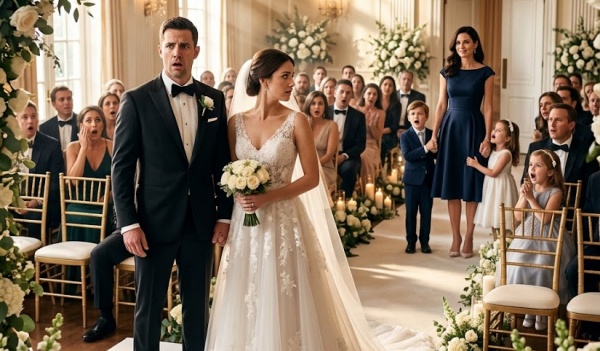
Michael walked to the front with the officiant, his face pale beneath his careful smile. He did not look back at me, but I saw his eyes flick once toward the children. Olivia appeared a minute later on her father’s arm, glowing in a lace gown with pearl buttons down the back.
She was beautiful.
That did not hurt me.
What hurt, unexpectedly, was realizing she might be walking toward the same lie I had once lived inside.
The ceremony began.
The officiant spoke about love, patience, family, and the courage to build a life together. Michael nodded at all the right moments. Olivia smiled up at him with complete trust.
I wondered if he had told her.
Not the edited version. Not “Sarah and I struggled.” Not “She couldn’t have children.” Not the tragic performance he had perfected. The actual truth.
When the officiant said, “Marriage is a promise to walk honestly beside one another,” Michael’s shoulders stiffened.
Emma leaned against me.
Noah whispered, “Mom?”
“Yes?”
“Can we go after cake?”
Despite everything, I almost laughed.
“We’ll see.”
Then came the vows.
Olivia went first.
She promised to love Michael through every season, to build a home full of laughter, to welcome the children they hoped God would send them. Her voice shook with emotion. Her mother cried in the front row.
Michael smiled, but his face was gray.
Then it was his turn.
He unfolded a paper from his jacket pocket.
“Olivia,” he began, “you came into my life when I thought my dream of having a family had been taken from me.”
My whole body went still.
There it was again.
The lie.
Dressed in a tuxedo. Standing under flowers. Being offered to another woman as a vow.
I felt Emma’s hand slide into mine.
Michael continued, “You reminded me that love can restore what was lost.”
Donna dabbed her eyes with a tissue.
Something inside me, old and tired and trained to stay quiet, rose to its feet.
Not my body. I stayed seated.
But inside, I stood.
Then Ben dropped his small program.
It fluttered to the floor, and he bent to pick it up. When he sat back up, he whispered much louder than he meant to, “Mom, why did he say his family was taken? We’re right here.”
The room heard him.
Children do not understand social timing. They understand truth as they see it.
A wave of silence moved through the ballroom.
Michael stopped reading.
Olivia turned slightly, confused.
Donna’s face went white.
I closed my eyes for one second.
Then I opened them, because I was done disappearing.
Olivia looked from Ben to me, then to Michael. “What does he mean?”
Michael swallowed. “Nothing. He’s a child.”
Emma stood.
She was nine by then, small but fierce in her lavender dress.
“He means she’s our mom,” Emma said clearly. “And nobody took a family from you.”
My heart nearly stopped.
I touched her arm gently. “Emma.”
But it was too late.
The room had changed.
Olivia looked at Michael in a way I recognized. It was the first look a woman gives when a story she trusted develops a crack.
“Michael?” she whispered.
The officiant shifted uncomfortably. “Perhaps we should take a brief pause.”
Michael’s eyes found mine then.
Anger flashed first. Then fear. Then something like pleading.
I knew that look.
It was the same look from the parking lot outside Dr. Patel’s office. The same look from the kitchen when I threatened to stop carrying his secret. The look that said, Protect me.
For eleven years, I had obeyed that look.
Not anymore.
Olivia stepped away from him. “What is happening?”
Michael lowered his voice. “Not here.”
She pulled her hand back. “Yes, here.”
Gasps moved through the room.
Donna stood. “Olivia, sweetheart, this is not the time.”
Olivia’s eyes sharpened. “Then when was the time? Before the wedding or after I found out from a child?”
I felt sorry for her then.
Not because she had been innocent in everything. She had known Michael was still married when their relationship began, or at least close enough to married that decency should have stopped her. But she had not known the shape of the lie she was inheriting.
Michael looked trapped.
I could have stayed silent. Part of me still wanted to. There were children beside me, and I did not want their memory of this day to become uglier than it had to be.
So I spoke carefully.
“Olivia,” I said from the back, “I’m not here to disrupt your wedding.”
Every face turned toward me.
My voice did not shake.
“I was invited. I came with my children. What happened between Michael and me is old history, but there are parts of that history he has not told honestly.”
Michael whispered, “Sarah, don’t.”
That whisper gave him away more than any accusation could have.
Olivia turned fully toward him. “Told honestly about what?”
He said nothing.
Donna looked like she might faint.
I stood then.
Noah grabbed my left hand. Ben grabbed my right. Emma stood close enough that her shoulder touched my side.
“I spent years letting people believe I was the reason Michael and I didn’t have children,” I said. “That was not the truth.”
The ballroom was so quiet I could hear the string quartet member shift in their chair.
“I won’t share private medical details in a room full of people,” I continued. “But I will say this: I was blamed for something that was never mine to carry. And I will not let my children sit here and hear that I stole a family from anyone.”
Michael’s face crumpled.
It was not satisfying.
I had imagined, sometimes, that the truth would feel like revenge. Like thunder. Like justice wearing heels. But standing there with my children holding my hands, all I felt was the weight of wasted years.
Olivia looked at Michael. “Is that true?”
He closed his eyes.
That was his answer.
The wedding did not continue.
At least, not then.
Olivia walked out through a side door with her maid of honor following close behind. Michael stood at the altar under white flowers, holding vows built on a lie. Donna sat down slowly, her tissue crushed in one hand.
Guests began murmuring, then standing, then pretending to check phones.
Megan came to me with tears in her eyes. “I’ll walk you out.”
I nodded.
We left through the lobby, past the guest book, past the framed engagement photo, past the table where wedding favors sat in neat gold boxes. Ben looked disappointed.
“But cake?” he asked.
“Not today, sweetheart,” I said.
He sighed with the deep sorrow of a five-year-old denied dessert.
Outside, the late afternoon sun was bright over the golf course. My SUV waited near the valet stand, goldfish crackers visible in the back seat, a booster seat crooked from Ben kicking it earlier.
Real life. My life.
Megan hugged me before we left.
“I’m sorry we let him do that to you,” she whispered.
I hugged her back. “You didn’t know everything.”
“I knew enough to be kinder.”
That was true, so I did not argue.
On the drive home, the children were quiet for almost ten minutes, which was rare enough to concern me.
Then Noah asked, “Are you in trouble?”
“No,” I said immediately. “None of us are in trouble.”
Emma stared out the window. “I shouldn’t have said anything.”
“You told the truth,” I said. “But next time, let me handle the grown-up parts.”
She nodded.
Ben kicked his fast shoes against the car seat. “He made you sad?”
I looked at him in the rearview mirror.
“A long time ago.”
“Are you sad now?”
I thought about it.
“No,” I said. “Not now.”
Emma turned from the window. “Good.”
We stopped for ice cream on the way home because no child should lose wedding cake without compensation. At a Dairy Queen off the highway, Emma ordered a small Oreo Blizzard, Noah got chocolate dipped cone, and Ben somehow got vanilla ice cream on his eyebrow within two minutes.
I sat across from them in a booth and watched them laugh.
Three little voices. Three messy faces. Three children who had walked into a room full of people who once saw me as empty and called me Mom without hesitation.
No ceremony could have given me more.
Michael called that night.
I did not answer.
He texted once.
“You ruined my wedding.”
I stared at the message for a long time.
Then I replied, “No. Your lie did.”
After that, I blocked him.
Not forever, maybe. Forever is a word I use carefully now. But for long enough.
News traveled, of course.
Small communities pretend to value privacy until gossip appears dressed as concern. I received texts from people who had not spoken to me in years. Some apologized. Some asked questions they had no right to ask. Some wanted medical details, as if truth becomes public property once a man is embarrassed.
I answered almost none of them.
Donna sent a letter two weeks later.
It was handwritten on cream stationery, because Donna could make even an apology look like a luncheon invitation. She wrote that Michael had admitted “some things.” She wrote that she had been unfair. She wrote that she had allowed her grief over not having grandchildren to become cruelty toward me.
Then she wrote, “I hope one day you can forgive me.”
I read the letter twice.
Then I placed it in a drawer.
Forgiveness, I had learned, is not a performance we owe people because they finally feel guilty.
Olivia did not marry Michael that day.
I heard from Megan that the wedding was postponed indefinitely, then canceled. Months later, Olivia moved to Charlotte and took a job at a private school. I do not know whether she and Michael ever spoke again.
I hope she asked for the medical records before believing another story.
As for Michael, he tried to reach me through email once.
His message was long. He said he had been ashamed. He said he had hated himself and made me the face of that hatred because I was closest. He said seeing my children call me Mom had broken something in him.
There was one line I read three times.
“I called you half a wife because I could not face that I had been half a husband.”
That line did not heal me.
But it told me he had finally met the truth somewhere he could not escape it.
I did not reply.
Instead, I printed the email and placed it in the same drawer as Donna’s letter. Not because I needed to keep pain as proof anymore, but because some documents belong in an archive, not a wound.
Life went on, which is both rude and merciful.
Emma started fourth grade and joined the school art club. Noah lost two teeth in one week and kept checking the mirror like he had become a different person. Ben began kindergarten and told his teacher his family had “one mom, zero dads at home, and a dog we might get if Mom says yes.”
We did eventually get the dog.
A rescue beagle named Biscuit, who stole socks and snored like a grown man.
Our house became even louder.
There were permission slips on the fridge, muddy shoes by the door, library books under couch cushions, and arguments about screen time that could have qualified for courtroom drama. I spent too much money at Target. I learned the exact price of school lunch, the cheapest day to buy gas at Costco, and how quickly three children can destroy a clean bathroom.
Sometimes, late at night, I still thought about the woman I had been.
The woman at Thanksgiving dinners absorbing Donna’s pity. The woman sitting in fertility clinics beside a husband who would later blame her. The woman who believed being chosen by Michael defined whether she was whole.
I wish I could go back and sit beside her.
I would take her hand and tell her the truth.
You are not empty.
You are not half.
You are not a failed wife because someone else needs a place to hide their shame.
And one day, three children will run through your house yelling for you at once, and you will miss silence for exactly four minutes before one of them hugs your leg and asks what’s for dinner.
A year after the wedding that wasn’t, Emma found the invitation in a drawer while looking for tape.
“Do you regret going?” she asked.
I considered lying, but she was old enough to deserve something honest.
“No,” I said. “But I regret that you had to see adults behave badly.”
She shrugged. “Adults do that a lot.”
“Unfortunately.”
She sat beside me at the kitchen table. “When I said you were our mom, I thought he looked like someone stole his chair.”
I laughed so hard I startled Biscuit.
Then Emma grew serious.
“He was wrong about you.”
“Yes,” I said. “He was.”
She leaned her head on my shoulder. “We knew.”
That was enough.
People often think the most powerful moments are dramatic ones. A bride walking out. A groom exposed. A room full of guests whispering behind white flowers. I understand why they remember that part.
But that was not the moment that changed my life.
My life changed in quieter places.
In a county training room where I learned children are not cures for loneliness. In a courthouse where a judge gave three siblings my last name. In a Dairy Queen booth where Ben mourned cake and got ice cream on his eyebrow. In a hallway where Noah whispered Mom like he was testing whether love would stay.
Michael’s wedding did not make me a mother.
My children had already done that.
The wedding only forced everyone else to see what had been true long before we walked into that country club.
I was never half a wife.
I was a whole woman married to a man who needed me small so he could stand taller.
And when three little voices called me Mom, they did not just interrupt a ceremony.
They ended a lie.
