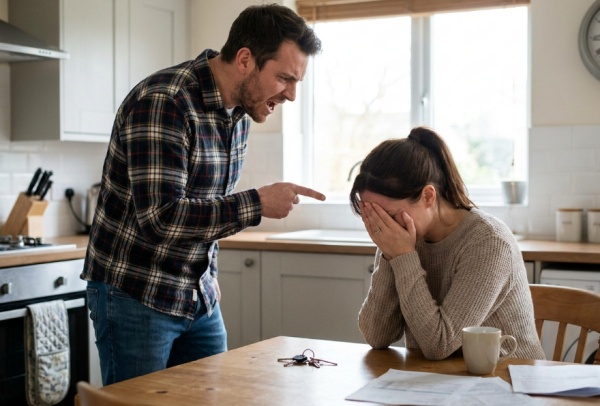
The day we separated, my ex-husband threw a set of keys at me and told me to disappear from his life. For six years, I never went back to the apartment those keys belonged to, even though it was legally mine. But when I finally returned to sell it, I opened the door and found a home that had clearly been lived in for years. What I saw inside made me realize my divorce had not ended the lies—it had only hidden them behind one locked door.
Part 1 — The Keys
The day we separated, my ex-husband threw the keys to an apartment at my face and told me to disappear from his life. They hit my cheekbone, bounced off my coat, and landed on the hardwood floor between us like some ugly little symbol of everything we had become. I remember staring at them instead of crying, because if I looked at his face one more second, I was afraid I would beg for a man who had already decided I was disposable.
His name was Ethan Walker, and for eleven years, I believed he was the safest place in my life. He was the kind of man who remembered how I took my coffee, warmed up my car on icy mornings, and called my mother “Mom” before we were even married. People in our circle used to say we made marriage look easy, which only proved how little people see from the outside.
We lived in Westfield, New Jersey, in a beige colonial with black shutters, a maple tree in the front yard, and a mortgage that made both of us nervous. Ethan worked in medical device sales and spent a lot of time on the road. I worked as a school counselor at a public middle school, which meant I spent my days telling twelve-year-olds that their feelings mattered, then came home and swallowed my own.
The apartment was actually a small condo in Jersey City, but Ethan always called it “the apartment.” It had belonged to my father before he moved to Arizona for his lungs, and when he passed away, he left it to me. It was a one-bedroom place on the sixth floor of an older brick building, with a view of the Hudson if you leaned far enough out the living room window and ignored the parking garage below.
My father bought it in the late nineties for $142,000, back when people still said Jersey City was “up and coming” with a skeptical tone. By the time Ethan and I started falling apart, it was worth almost four times that. We talked about selling it many times, but I could never bring myself to do it because it felt like selling the last place where my father had been fully himself.
Then our marriage collapsed all at once, though now I understand it had been cracking quietly for years. Ethan became impatient with everything about me—my questions, my job, my tiredness, the way I folded towels, the fact that I wanted to visit my mother every Sunday. He started sleeping with his phone face down, taking calls in the garage, and treating normal conversations like cross-examinations.
When I asked if there was someone else, he looked at me like I had insulted him. “You watch too many shows,” he said. Then he kissed my forehead, and somehow that made me feel more foolish than if he had shouted.
Three months later, I found a hotel receipt in the glove compartment of his car. It was from a boutique hotel in Philadelphia, two nights, one king bed, valet parking, room service for two. Ethan told me it was for a client conference and said I was embarrassing myself by “acting like a jealous teenager.”
That became his favorite word for me: embarrassing. My crying was embarrassing. My suspicion was embarrassing. My need for answers was embarrassing.
The final fight happened on a rainy Tuesday in October. He came home late, smelling like airport air and expensive cologne, and told me he wanted a separation. He said he felt “trapped,” that I had become “too heavy,” and that he needed space to figure out who he was without me.
I asked him where I was supposed to go. He laughed, not loudly, but in that dry way people laugh when they have already stopped caring whether they hurt you. Then he went to the junk drawer, grabbed the keys to my father’s condo, and threw them at me.
“There,” he said. “Take the apartment. Take your sadness. Take whatever you need and disappear from my life.”
For a second, I could not move. I had imagined separation in many painful ways, but I had never imagined him standing in our kitchen under the warm light we picked together, speaking to me like I was a stain he wanted scrubbed out. I picked up the keys with shaking fingers and put them in my purse.
I did not go to the condo that night. I went to my friend Meredith’s house in Cranford and slept in her guest room under a quilt her grandmother made. The next morning, I called a divorce attorney from the parking lot of a Dunkin’ Donuts because I could not bring myself to do it from inside anyone’s home.
The divorce took nine months. Ethan fought about small things with surprising cruelty: the dining room table, the snowblower, the Costco membership, even a set of mixing bowls my mother gave me. But he did not fight for the Jersey City condo.
My lawyer said that was strange. Ethan had never been sentimental about my father, and the condo had real value. Still, he signed it over fully to me as part of the settlement, and I was too exhausted to question a gift from a man who had spent months taking.
After the divorce, I rented a small townhouse in Morristown and built a life that looked peaceful from a distance. I went to work. I bought groceries. I attended faculty meetings. I learned how to sleep diagonally in a bed.
But I never went back to the condo. Not once.
I kept paying the property taxes, the insurance, and the monthly HOA fee because avoiding it felt easier than entering the place my father had loved and Ethan had turned into a weapon. Every January, I told myself I would deal with it in the spring. Every spring, I told myself summer would be better.
Six years passed that way. Six years of autopayments, unopened building newsletters, and a key ring hidden in the back of my desk drawer. Six years of pretending that a property worth hundreds of thousands of dollars could be ignored if the memories inside it were expensive enough.
Then my mother fell in her kitchen and fractured her hip. She recovered, but the bills that followed were brutal even with Medicare and supplemental insurance. She needed a safer apartment, a walk-in shower, and help I could not provide with a counselor’s salary and good intentions.
That was when I finally decided to sell the condo.
I called a real estate agent named Paula Martinez, a practical woman with silver hoop earrings and a voice that made everything sound manageable. She told me the market was strong, especially near the PATH train, and said we could probably list it for around $610,000 depending on condition. “Let’s take a look,” she said. “You may be sitting on a blessing.”
I almost told her blessings do not usually come with panic attacks. Instead, I agreed to meet her there on a Saturday morning in March. I took the keys from my desk drawer for the first time in six years and felt my stomach twist like the metal was still warm from Ethan’s hand.
I expected dust. I expected silence. I expected grief.
I did not expect to find another woman’s life inside.
Part 2 — Someone Had Been Living There
The first thing I noticed was the doormat. It was not the plain black mat my father used to keep outside his door. This one had painted lemons on it and the words “Home Sweet Home” in cheerful blue letters.
I stood in the hallway staring at it while Paula checked the unit number on her phone. “This is definitely 6C,” she said. “Are you sure nobody has been renting it?”
“No,” I said slowly. “Nobody was supposed to be here.”
My key still worked. That somehow made it worse. The lock turned easily, as if it had been used often, as if the apartment had been breathing without me all these years.
When the door opened, I smelled lavender detergent, coffee, and something sweet like vanilla candles. The living room was not dusty or empty. It was warm, decorated, and very much alive.
There was a gray sectional sofa where my father’s old recliner used to be. There were framed prints from Target on the walls, a stack of children’s books under the coffee table, and a small pink backpack hanging on the back of a dining chair. On the refrigerator, held up by alphabet magnets, was a crayon drawing of three stick figures under a yellow sun.
One stick figure had long brown hair. One was small with pigtails. One was tall and had the word “Daddy” written above it.
My body went cold in a way I had never felt before. Not frightened exactly. Frozen. As if my mind had stepped away from my body and left it standing in the doorway without instructions.
Paula whispered my name. I heard her, but she sounded far away. My eyes stayed fixed on that drawing, on the word “Daddy,” on the fact that someone had been raising a child in the apartment my father left me.
“Do you want me to call the police?” Paula asked.
I did not answer right away. I was trying to understand what I was seeing. A family had eaten here, slept here, watched TV here, packed lunches here, maybe celebrated birthdays here, all inside a home I had paid taxes on for six years.
The kitchen counter held a school lunch calendar for a private preschool in Hoboken. There was a water bill addressed to “Jenna Collins.” There was also an envelope from the condo association addressed to me, unopened, placed neatly in a small basket by the door.
That was the part that made my knees weaken. My name was still entering this apartment. Someone was receiving mail meant for me and setting it aside like I was a ghost who might someday come collect it.
I walked farther inside, each step feeling illegal even though the deed was in my name. The bedroom had a queen bed, white curtains, and a framed photo on the nightstand. In the photo, Ethan was holding a little girl on his shoulders at what looked like Liberty State Park.
He was older than when I last saw him, with lines around his eyes and gray at his temples. But he was smiling in a way I remembered from the beginning of our marriage. Open, warm, proud.
I picked up the frame with trembling hands. The little girl was maybe five years old. She had Ethan’s eyes.
Paula stood behind me, silent now. There are some situations where real estate training is useless, and this was one of them.
In the bathroom, a small purple toothbrush sat beside an adult one. In the hallway closet, there were winter coats, rain boots, a scooter helmet, and a plastic bin labeled “Maya’s Art.” Inside were finger paintings, preschool worksheets, and a Mother’s Day card decorated with stickers.
I found the worst thing in the desk drawer.
It was a lease.
At the top, it listed me as the owner and Jenna Collins as the tenant. The monthly rent was written as $1,850. The lease term was six years, with an option to renew. At the bottom was a signature that looked almost like mine.
Almost.
My real signature is messy and slants upward because I write too fast. This one was careful, rounded, and wrong. Whoever signed it had practiced being me but had not understood the impatience in my hand.
Paula read over my shoulder and said quietly, “Is that your signature?”
“No.”
That one word came out like air leaving a punctured tire.
I pulled out my phone and called my attorney from the divorce, even though it had been years. Her assistant told me she was in court. I said, “Tell her it’s Claire Bennett and it’s urgent.”
Then I called the non-emergency police number because I was not sure if this was trespassing, fraud, identity theft, a landlord-tenant issue, or all of the above. The dispatcher told me officers would come by and advised me not to remove anything. I stood in my father’s old living room and felt like the law had suddenly become a maze.
While we waited, Paula found more papers in a file folder near the desk. Rent receipts. Maintenance requests. A photocopy of my driver’s license from eight years earlier. A fake email address that used my name with a period in the middle.
Then she found a handwritten note.
“Jenna, don’t worry about Claire. She abandoned the place years ago, but the lease protects you. If anyone ever asks, say you dealt with her by email.”
It was not signed, but I knew Ethan’s handwriting. I knew the sharp E, the way he crossed his t like he was angry at the paper. My ex-husband had not simply moved someone into my apartment.
He had created a version of me.
A careless landlord. An absent woman. A ghost with a fake email address and a forged signature.
The police officers arrived twenty minutes later. They were polite but cautious, which I understood. To them, I was a woman standing inside a furnished apartment claiming strangers lived there illegally. The lease complicated everything, even if I insisted the signature was forged.
One officer asked if I had proof of ownership. I pulled up the county property record on my phone and showed him my name. Paula showed her real estate paperwork and listing agreement. The officer nodded but told me this might require both a police report and civil action because someone appeared to have established residency.
Residency. Such a calm word for theft wearing curtains and family photos.
They advised me to speak with an attorney before changing locks or removing belongings. They documented the suspected forgery, took photos of the lease, and gave me a report number. I appreciated their professionalism, but I wanted someone to point at the apartment and say, “This is wrong, and we will fix it today.”
That is not how real life works. Real life gives you case numbers and tells you to call your lawyer.
Jenna came home while the officers were still there.
She walked in holding a paper grocery bag from Trader Joe’s, with the little girl from the photo beside her in a puffy pink jacket. Jenna was probably in her mid-thirties, with tired eyes and hair pulled into a loose bun. When she saw us, she stopped so suddenly the grocery bag slipped from her arms and oranges rolled across the floor.
The little girl grabbed Jenna’s coat. “Mommy?”
I looked at the child and immediately felt the shape of the situation change. Whatever Ethan had done, this little girl had done nothing. She was not evidence to me in that moment. She was a child standing in her home, terrified because adults had failed her.
Jenna’s face went pale when the officer asked if she lived there. She said yes. Then she looked at me, confused and defensive, and asked, “Who are you?”
I wanted to laugh. I wanted to scream. I wanted to say, “I am the woman whose father painted that windowsill. I am the name on the deed. I am the person whose life your life was built on without permission.”
Instead, I said, “My name is Claire Bennett. I own this apartment.”
Jenna’s eyes narrowed. “No. Ethan owns this place.”
There it was.
Ethan.
The name landed between us like a dropped knife.
Part 3 — The Life He Built With My Walls
Jenna sat on the sofa with her daughter pressed against her side while the officers asked basic questions. Her voice shook at first, then hardened, as if anger was easier than fear. She said Ethan Walker had rented the apartment to her six years earlier and told her the owner was his unstable ex-wife who wanted nothing to do with it.
I stood near the kitchen, gripping the counter. Every sentence added a new layer to the violation. Ethan had not only used my property; he had used my pain as an explanation for my absence.
Jenna said she paid rent every month by Zelle directly to Ethan. She showed us the payments on her banking app. $1,850, sometimes $1,900 when he claimed “HOA fees went up,” every month for six years.
I did the math in my head and nearly lost my balance. More than $130,000. Ethan had collected rent on a condo he did not own while I paid the taxes, insurance, and association dues.
Jenna insisted she had communicated with “me” by email when she moved in. The fake email address had replied with lease documents, permission to paint the bedroom, and approval to get a small dog that apparently died two years earlier. The emails were cold, brief, and grammatically perfect in a way mine never are.
The officer asked if she had ever met me in person. Jenna shook her head. “Ethan said Claire didn’t like being contacted directly.”
That sounded like Ethan too. He always knew how to make a boundary look like someone else’s instability.
When the officers left, they told both of us to contact attorneys immediately. They could not force Jenna out that day because she had paperwork and a child living there. They also could not ignore the forgery, the ownership record, or the rent payments going to Ethan.
So there we were, two women standing in the wreckage of one man’s lie.
Jenna sent her daughter, Maya, to watch cartoons in the bedroom. Then she turned to me with tears in her eyes and said, “I didn’t know.”
I believed her. Not because I wanted to, but because shock has a language. Her hands trembled the same way mine had when I found the hotel receipt all those years ago.
“How do you know Ethan?” I asked.
Her face tightened. “We were together for a while.”
“For how long?”
She looked toward the bedroom door. “Since before Maya was born.”
My stomach sank. Maya was five. Six years ago, when Ethan threw the keys at my face and told me to disappear, Jenna must have already been in his life.
Jenna rubbed her forehead. “He told me you two were separated. He said the condo was part of some messy property thing, but he had the right to rent it. He said you were bitter and might try to cause problems someday.”
I turned away because I did not trust my face. Ethan had prepared her for me. He had built a fence around his lie by describing the truth as madness before it arrived.
That evening, I drove back to Morristown without music. The sky was dark by the time I got home, and I sat in my driveway for almost fifteen minutes with my hands still on the steering wheel. My townhouse looked small and quiet, full of the life I had rebuilt while Ethan was profiting from the one he stole.
My attorney, Rebecca Klein, called at 8:12 p.m. She had already reviewed the photos I sent. Her voice was calm in the way lawyers are calm when they know a situation is serious.
“Claire,” she said, “do not contact Ethan directly.”
“I wasn’t planning to.”
“Good. We need to handle this carefully. There are potential claims for fraud, forgery, conversion of rental income, possibly identity theft, and we also have a tenant in possession who may be a victim too.”
A victim too. That phrase made me close my eyes.
I wanted Jenna to be a villain because villains are easier to hate. But she was a woman with a child, a lease she thought was real, and six years of rent payments to a man who had lied to both of us in different ways. Ethan had placed us on opposite sides of a locked door and told each of us the other was dangerous.
Rebecca told me we needed to gather documents, notify the condo association, file a formal police report with the forgery evidence, and send a legal notice to Jenna. She also said we would likely have to pursue Ethan in civil court to recover rent and damages. “This won’t be fixed overnight,” she warned.
That night, I found an old box in my closet from the divorce. Inside were court papers, bank statements, and photographs I had not looked at in years. At the bottom was a copy of the final settlement agreement.
There it was in black and white: the Jersey City condo was awarded to me as my separate property. Ethan had signed away any claim. His signature was bold, confident, and completely shameless.
I barely slept.
The next morning was Sunday, and I drove to my mother’s apartment with bagels because routine felt like the only rope I had. She was sitting in her recliner with a blanket over her knees, watching a cooking show and complaining that the host used too much cilantro. My mother could survive almost anything if she had an opinion about seasoning.
I told her everything.
At first she said nothing. Then her eyes filled with a rage so clean it almost comforted me. “Your father would have driven to that man’s house,” she said.
“I know.”
“And then I would have had to bail him out.”
Despite everything, I laughed. My mother reached for my hand and squeezed it.
“Listen to me,” she said. “That apartment was your father’s gift to you. Ethan turned it into a hiding place, but that does not change what it is.”
I wanted to believe her. But in my mind, I kept seeing Maya’s backpack on the chair, Jenna’s oranges rolling across the floor, Ethan smiling in that framed photo. The apartment no longer felt like my father’s gift.
It felt like a crime scene with throw pillows.
On Monday, Rebecca sent Ethan a letter through certified mail and email. It demanded preservation of all records related to the condo, rent payments, leases, communications, and access. It also informed him that we had reported suspected forgery and intended to pursue recovery of rental income.
He called me nine times that afternoon.
I did not answer.
Then he texted: “You have no idea what you’re doing.”
The sentence was so familiar that I almost smiled. Six years had passed, and Ethan still believed certainty belonged to him by default.
I forwarded the message to Rebecca.
Her reply was short: “Do not respond.”
So I didn’t.
That evening, Jenna emailed me from her real address. The subject line was “I’m sorry.” She wrote that she had spoken to a legal aid attorney and understood she would need to vacate, but she asked for time to find a place that would not disrupt Maya’s preschool.
I read the email three times. My anger wanted a clean target, but there was a child’s lunch calendar on that refrigerator and a mother trying not to fall apart. I told Rebecca I wanted Jenna out legally, but not cruelly.
Rebecca drafted an agreement. Jenna would vacate within sixty days, cooperate with our case against Ethan, provide records of all rent payments, and leave the apartment in good condition. In return, I would not pursue her for back rent she had paid in good faith to Ethan.
Some people told me that was too generous. Maybe it was. But I knew what it felt like to be deceived by Ethan Walker, and I refused to become the kind of person who punished the wrong target because the right one was harder to reach.
Two weeks later, Rebecca received records from Jenna that changed everything.
Bank transfers. Text messages. Emails. Photos. A timeline.
And buried in those records was proof that Ethan’s family had known.
Part 4 — Everybody Knew Except Me
Ethan’s sister, Lauren, had babysat Maya in the condo. His mother, Diane, had spent Christmas Eve there more than once. His brother had helped assemble a bunk bed when Jenna’s niece stayed over one summer.
All of them had walked through my father’s apartment. All of them had seen another woman living there with Ethan’s child. All of them knew the condo belonged to me, because during our marriage they had visited it for Fourth of July fireworks and birthday dinners.
Yet for six years, not one of them called. Not one sent a message. Not one said, “Claire, something is happening in a property with your name on the deed.”
Instead, they accepted the version of me Ethan sold them. I was unstable. I was absent. I was bitter. I had “basically given him permission.”
That phrase appeared in a text from Diane to Jenna.
“Don’t worry about Claire. Ethan handled her years ago. She basically gave him permission to use the place.”
Handled her.
I sat in Rebecca’s office staring at those words until they blurred. There are betrayals that break your heart, and then there are betrayals that make you question the entire architecture of your past. How many family dinners had I cooked for people who were capable of this?
Rebecca was direct. “We can include the family communications as evidence of knowledge, but the strongest claim is still against Ethan. The rent payments went to him. The forged lease came from the fake email tied to him. The financial benefit is clear.”
I nodded. “I want him under oath.”
That happened in June, in a conference room in Newark with fluorescent lights and a coffee machine nobody trusted. Ethan arrived wearing a navy suit, no tie, and the same expression he used to wear when a restaurant got his order wrong. He looked annoyed, not ashamed.
Seeing him after six years was strange. He was still handsome in a polished, aging-salesman way. But the charm that once pulled me toward him now looked like a costume I could see the seams of.
His attorney sat beside him, flipping through papers. Rebecca sat beside me with a yellow legal pad and the stillness of a woman who enjoyed facts. A court reporter swore Ethan in.
At first, he denied everything meaningful. He said he believed he had “informal permission” to use the condo. He said he thought the lease was “administrative.” He said the rent Jenna paid was not really rent, but “shared household support.”
Rebecca let him talk. That was her gift. She gave people enough rope and waited patiently while they measured it.
Then she placed the divorce settlement in front of him. “Mr. Walker, is this your signature transferring all ownership interest in the Jersey City condo to Ms. Bennett?”
“Yes.”
“And after signing this document, did you have legal authority to lease that property?”
“I believed—”
“That was not my question.”
He exhaled. “No.”
Rebecca then showed him the forged lease. “Did Claire Bennett sign this document?”
“I don’t know.”
“You were married to her for eleven years. Does that look like her signature?”
He looked at it for a long time. “Not exactly.”
“Did you create the email address used to send this lease?”
His attorney objected, but Ethan still had to answer. He shifted in his chair. “I may have helped Jenna set up communication because Claire was difficult to reach.”
Rebecca looked at him over her glasses. “Claire did not know Jenna existed, correct?”
Silence.
The court reporter’s fingers hovered.
“Correct,” Ethan said finally.
There was no dramatic music, no applause, no instant justice. Just one word entering the record. But it felt like a window opening in a room where I had been suffocating for years.
Then Rebecca showed the Zelle records. Month after month, rent payments from Jenna to Ethan. Six years of deposits labeled “rent,” “April rent,” “condo,” and once, heartbreakingly, “sorry late, Maya dentist.”
Ethan tried to claim the money helped cover expenses. Rebecca showed that I had paid the taxes, insurance, and HOA fees from my own accounts the entire time. Ethan had paid nothing toward the property.
By the third hour, he stopped looking annoyed.
By the fourth, he looked smaller.
During a break, he approached me in the hallway despite both attorneys warning him not to. He stood close enough that I could smell his mint gum. For a second, I saw the old Ethan, the man who used to kiss my forehead and call me “Clare Bear” when he wanted forgiveness without accountability.
“You’re really going to do this?” he asked.
I looked at him and felt nothing soft.
“You lived in my father’s apartment with another woman and your child while collecting rent from her and letting me pay the bills,” I said. “Yes, Ethan. I’m really going to do this.”
His jaw tightened. “You abandoned it.”
“No,” I said. “You weaponized my grief.”
That landed. I saw it. Not remorse exactly, but recognition that the line sounded too true to deny.
He looked away first.
The case did not go to a full trial. Ethan’s attorney knew what the documents showed, and Rebecca knew how expensive his denial was becoming. In the fall, we reached a settlement.
Ethan agreed to repay a significant portion of the rental income he had collected, cover legal fees related to clearing the fraudulent lease, and sign a sworn statement acknowledging he had no claim to the condo. The fake email account was preserved as evidence, and the matter remained documented with the police report. It was not the cinematic justice people imagine, but it was real enough to matter.
Jenna moved out in August. She left the apartment clean, with a note on the kitchen counter. It said she was sorry for the pain she had unknowingly been part of, and that Maya had drawn one last picture for “the lady whose house this was.”
The drawing showed a brick building with flowers in front. In the corner, a small orange sun smiled over everything. I stood there holding it and cried for the first time inside that apartment.
Not because I forgave Ethan. Not because everything was fixed. I cried because the apartment had held so many lives, so many lies, and somehow still had sunlight coming through the windows.
Paula listed the condo two weeks later after new paint, deep cleaning, and minor repairs. We replaced the bedroom carpet, fixed a cracked bathroom tile, and removed the cheap blinds Ethan must have installed. I kept only one thing from my father’s original apartment: a brass bottle opener shaped like a fish, found in the back of a kitchen drawer.
The listing went live on a Thursday. By Sunday, we had six offers.
The winning buyer was a young nurse named Allison who worked nights at a hospital in Manhattan. She came to the open house with her fiancé and cried when she saw the view. “It feels peaceful,” she said.
I almost laughed at the impossible irony.
Then I realized she was right.
Part 5 — The Door I Finally Closed
The closing happened in December, six years and two months after Ethan threw those keys at my face. We sat around a polished table in a title office with a bowl of peppermints in the middle and a stack of papers thick enough to stun a horse. I signed my name over and over, each signature sharper than the forged one that had haunted me.
When the wire transfer came through, I stared at the number in my bank account and thought of my father. He had been a quiet man, not especially emotional, but he believed in taking care of people through practical things. Good tires. Extra cash hidden in books. A condo bought before the neighborhood became fashionable.
I used part of the money to move my mother into a safer senior community in Madison with an elevator, a walk-in shower, and neighbors who played cards too loudly on Wednesdays. She complained about the rent for three days, then admitted the place had excellent soup. That was her version of happiness.
I put another portion into savings, paid my legal fees, and donated to a housing nonprofit in Jersey City. I did not do that because I was noble. I did it because for a while, the apartment had made me feel poisoned, and I needed one part of its ending to help someone instead of hurt someone.
Ethan sent one email after the settlement. It was short, which was unlike him. He wrote, “I know I handled things badly. I hope someday you can see I was trying to build a life.”
I read that sentence twice.
Trying to build a life.
That was how men like Ethan explained damage. They were never stealing, lying, cheating, forging, or using. They were “trying to build a life,” and if someone else’s foundation had to crack underneath them, well, that was unfortunate.
I did not reply.
Instead, I printed the email, placed it in my legal folder, and closed the drawer. There was a time when I would have written back three paragraphs trying to make him understand my pain. But I had finally accepted that understanding was not something Ethan lacked.
It was something he avoided.
A few weeks after the closing, Paula mailed me the original key ring. The buyer had changed the locks, of course, but Paula thought I might want the old keys for closure. When I opened the padded envelope, the metal fell into my palm with a sound that took me straight back to that rainy October night.
For a moment, I was in the kitchen again. Ethan’s face. The keys hitting my cheek. His voice telling me to disappear.
But I was not that woman anymore.
I took the keys outside to the small patio behind my townhouse. It was cold enough that my breath showed, and somewhere nearby a neighbor’s dog was barking at absolutely nothing. I placed the keys on the little table where I drank coffee in warmer months.
I thought about throwing them into the trash. I thought about burying them. I thought about mailing them back to Ethan with no note, just to make him wonder.
In the end, I did something quieter.
I took them to a locksmith in town and asked if old keys could be recycled. The man behind the counter said sure, tossed them into a metal bin with dozens of others, and handed me a receipt for no charge. Just like that, the thing Ethan had thrown at me became scrap.
I kept the receipt.
Not because I needed proof for anyone else. Because after everything, I liked having proof for myself.
My life did not become perfect after that. Real healing is not a clean before-and-after photo. I still had bad days, still woke up sometimes angry, still flinched when someone used the word “dramatic” to dismiss a woman’s pain.
But the anger changed. It stopped burning my hands. It became information instead of fire.
I learned that avoidance can feel like peace while quietly costing you money, time, and power. I learned that being “the bigger person” should never mean becoming an easy target. I learned that legal documents matter, signatures matter, and if someone tells you not to ask questions, that is usually the moment you should ask five more.
I also learned that not every person connected to a betrayal deserves the same punishment. Jenna was not my friend, and we did not stay in touch, but I hope she built a safer life for Maya. That little girl deserved a childhood not financed by lies.
As for Ethan’s family, I never heard from them directly. Diane sent one message through a mutual acquaintance saying she “always felt caught in the middle.” I laughed when I heard that.
The middle is a comfortable place for people who benefit from both sides. Diane had not been caught. She had been seated.
Sometimes people ask me if I regret not going to the apartment sooner. The honest answer is yes and no. Yes, because the truth was there all along, living behind a door I owned. No, because I found it when I was strong enough to survive what it showed me.
If I had walked in six years earlier and seen Jenna pregnant or holding a newborn, I might have collapsed into the version of myself Ethan had invented. The unstable ex. The hysterical woman. The person everyone could dismiss.
But when I finally opened that door, I came with a real estate agent, a phone, a lawyer’s number, and a spine I had built one lonely day at a time.
That matters.
Last spring, I drove through Jersey City after a work conference in Manhattan. I did not plan to pass the building, but traffic rerouted me down a familiar street. There it was, the old brick exterior, the awning, the deli on the corner still advertising breakfast sandwiches for $5.99.
I pulled over for a minute across the street.
On the sixth floor, someone had placed plants near the window. I imagined Allison, the nurse who bought it, coming home after a long shift, dropping her bag by the door, and watering basil in the morning light. I hoped the apartment was kind to her.
For the first time, I did not feel robbed when I looked at it. I felt released.
My father’s gift had done what gifts sometimes do in ways we do not expect. It had protected me, exposed a lie, helped my mother, and forced me to walk back into a room I had spent years fearing. It had reminded me that something can be misused and still not lose its original purpose.
When I drove away, I did not cry.
I stopped at a coffee shop, bought an iced latte even though it was too cold outside, and sat in my car while people hurried past in winter coats. My phone buzzed with a message from my mother asking if I had tried the soup at her building because “Thursday is chicken noodle and they finally got it right.”
I smiled so hard my face hurt.
That is what rebuilding looks like sometimes. Not a grand speech. Not revenge posted online. Not someone begging on your doorstep in the rain.
Sometimes rebuilding is your mother liking soup. A bank account with your name on it. A door you no longer have to open. A set of keys turned into scrap metal.
And sometimes, it is finally understanding that when someone tells you to disappear from their life, they may think they are erasing you.
But they are not.
They are only giving you the chance to become someone they can no longer use.
