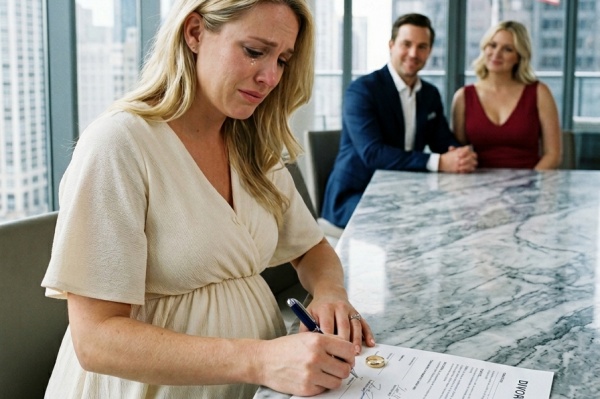
My Husband Left Me One Month Before My Due Date for His Pregnant Mistress. Ryan told me he was doing “the right thing” when he asked for a divorce one month before I gave birth. His mistress was pregnant, and he claimed he couldn’t abandon his child—even while walking away from the son I was carrying. Then One Blood Test Destroyed His Perfect
Part 1: The Coffee Shop Where He Broke Me
My husband asked me for a divorce in a coffee shop on a Tuesday afternoon, exactly thirty-one days before my due date.
Not in our kitchen, where the crib was still half-assembled and the tiny yellow onesies were folded in a basket by the couch. Not in our bedroom, where I had slept propped up on three pillows because our son liked to kick my ribs at 2 a.m. Not even in a lawyer’s office, where a sentence like that might have at least arrived dressed in paperwork.
He chose a coffee shop.
It was called Lake & Ash, a narrow little place in Chicago’s West Loop with exposed brick walls, black metal chairs, and overpriced oat milk lattes served in cups too small for the price. It was the place where he had proposed to me six years earlier, back when we were broke, hopeful, and convinced that love could turn any bad day into a story we would laugh about later.
That day, I sat across from him with swollen ankles, one hand resting on my belly, watching him stir a cappuccino he had not touched.
My name is Claire Donovan. His name was Ryan Donovan, though by the end of that afternoon, even his name felt like something I had borrowed from a stranger. We had been married for five years, together for seven, and expecting our first child after two years of heartbreak, tests, medication, and prayers I whispered in the shower so no one would hear.
Ryan knew what this baby meant to me.
He knew because he had held me after the first miscarriage. He knew because he had cried with me in the parking garage outside Northwestern Memorial when the second pregnancy ended at nine weeks. He knew because when this pregnancy finally passed the first trimester, he kissed my belly and said, “This one’s coming home.”
Now he sat across from me in the same coffee shop where he had once asked me to spend my life with him, and he would not look me in the eye.
“Claire,” he said, “I don’t want to hurt you.”
I almost laughed.
People only say that when they are already holding the knife.
I shifted in the chair, trying to find a position that did not make my back ache. Outside, Chicago was damp and gray, the kind of early March afternoon where the sidewalks looked tired and everyone moved like they were late to somewhere warmer.
“What did you do?” I asked.
His face changed.
That was how I knew.
Ryan had been distant for months, but pregnancy makes people excuse things they should examine. I told myself he was stressed about money. I told myself he was scared of becoming a father. I told myself that some men panic before a baby arrives, then soften the first time they hold their child.
I had become fluent in explanations that protected him.
He looked down at his cup.
“There’s someone else.”
The coffee shop did not go silent. That was the cruel part. The espresso machine still hissed. A barista laughed behind the counter. A man in a Cubs hat walked past our table with a blueberry muffin in a paper bag.
My world stopped, but Chicago kept ordering coffee.
I pressed my palm to my belly. The baby moved, one slow roll under my ribs, as if reminding me I was not allowed to fall apart completely.
“How long?” I asked.
Ryan closed his eyes.
“Claire—”
“How long?”
“Almost a year.”
A year.
A year of doctor appointments. A year of injections and bloodwork. A year of me lying on exam tables while he held my hand and told me we were in this together. A year of him going home afterward to text another woman.
I felt something inside me go very still.
“Who is she?”
He swallowed. “Jenna.”
I stared at him.
Jenna Miller worked at his marketing firm. I had met her twice. She had bright red hair, perfect teeth, and the kind of laugh that made men believe they were funnier than they were.
She had sent us a baby gift last month.
A white blanket embroidered with tiny stars.
I remembered holding it against my cheek and thinking it was soft.
“She’s pregnant,” Ryan said.
For a moment, I thought I had misheard him.
“What?”
“She’s pregnant.”
The word landed differently the second time. Not just betrayal. Competition. A second nursery built out of lies while mine waited at home with unopened diapers stacked by the closet.
I looked at my belly.
“I’m eight months pregnant.”
“I know.”
“You know?”
His eyes filled with tears, and somehow that made me angrier. I did not want his tears. His tears made him look like the injured one, and I refused to comfort the man who had just set our life on fire.
“She says it’s mine,” he whispered.
I leaned back in the chair.
“She says.”
Ryan flinched. “Don’t do that.”
“Do what?”
“Make it ugly.”
I stared at him, truly stunned.
“Ryan, you are asking your eight-month-pregnant wife for a divorce because your mistress is pregnant, and you think I’m the one making it ugly?”
He looked around, embarrassed.
That told me everything about where his mind was. Not on me. Not on our baby. Not on the marriage he had betrayed. He was worried people might hear.
He leaned closer.
“I’m trying to do the right thing.”
“The right thing?”
“I can’t abandon my child.”
The sentence hit so hard I had to breathe through it.
“Our child is due in one month.”
“I know that.”
“Do you?”
He rubbed his face with both hands.
“Jenna needs me.”
I looked at him, and suddenly I saw the story he had written for himself. He was not the cheating husband. He was the brave man taking responsibility. He was not abandoning his wife before childbirth. He was choosing his unborn child.
He had turned his betrayal into morality.
It was almost impressive.
Almost.
“And what do I need?” I asked.
He did not answer.
“What does your son need?”
His mouth tightened.
“We’ll co-parent.”
I laughed then.
Not loud. Not hysterical. Just one sharp sound that made the woman at the next table glance over.
“You want to co-parent a baby you’re walking away from before he’s even born?”
“I’m not walking away from him.”
“You’re walking away from me while I’m carrying him.”
Ryan looked at my stomach, then back at his coffee.
“I’ll be there for the birth.”
Something in me hardened.
“No.”
His head snapped up.
“What?”
“You don’t get to leave me for another pregnant woman and then walk into my delivery room like you’re still my husband.”
“That’s my child too.”
“Yes,” I said. “And we can discuss legal parenting rights through attorneys. But my hospital room is not a stage for your guilt.”
His face turned red.
“Claire, don’t be vindictive.”
There it was.
The word men use when a woman stops making their consequences comfortable.
I picked up my purse slowly. My hands were shaking, but I refused to let him see how badly.
“Do you have papers?” I asked.
He blinked.
“What?”
“Divorce papers. Did you bring them, or was this just a coffee shop performance?”
He looked wounded.
“I thought we could talk like adults.”
I stood, one hand on the table for balance.
“Adults don’t make babies in two homes and call it courage.”
I walked out before he could answer.
The March wind hit my face like cold water. I made it to my car, closed the door, and sat there with both hands on the steering wheel. For five minutes, I did not cry.
Then my son kicked.
One firm, determined little kick beneath my ribs.
That was when I broke.
Not because Ryan left.
Because my baby moved inside me as if saying, “I’m still here.”
And for the first time that day, I answered him out loud.
“I know, sweetheart,” I whispered. “So am I.”
Part 2: One Month Before the Baby
The next thirty-one days were the longest of my life.
People think heartbreak during pregnancy must feel soft, like crying into baby blankets or staring sadly out windows. Mine felt administrative. It felt like changing beneficiaries, calling an attorney, separating bank accounts, documenting mortgage payments, and learning which hospital forms mattered when your husband suddenly became someone you could not trust.
My attorney’s name was Marisol Vega.
She had an office in River North, wore dark green suits, and had the calmest voice I had ever heard. When I told her what happened, she did not gasp. She did not say, “Men are trash,” even though my sister did, loudly, three times.
Marisol took notes.
“How far along are you?” she asked.
“Thirty-five weeks.”
“Do you feel physically safe with him?”
“Yes.”
“Has he threatened you?”
“No.”
“Good. Then we keep everything legal, documented, and boring.”
“Boring?”
“Boring wins in court more often than dramatic.”
I had heard versions of that sentence from divorced women before, but it meant something different when I was the one sitting there with swollen feet and a husband who wanted to become a hero in another woman’s story.
Marisol explained Illinois basics carefully. Divorce would take time. Parenting arrangements would be decided based on the child’s best interests. Ryan had rights as a father, but he did not have the right to barge into my delivery room without my consent because I was the patient. Child support, parenting time, and decision-making responsibilities would be handled through the legal process.
“And paternity?” I asked quietly.
“For your baby?”
I nodded.
“There’s no dispute?”
“No. He’s Ryan’s.”
“Then we proceed accordingly.”
I stared at my hands.
“What about Jenna’s baby?”
Marisol’s face stayed neutral.
“That is not your legal matter unless it affects marital assets, your divorce, or your child.”
“She says it’s his.”
“Then Ryan can request a paternity test after that baby is born, if needed.”
I nodded slowly.
A strange thought came to me then.
Ryan was leaving me because of a claim.
Not a test. Not proof. A claim.
Jenna said the baby was his, and he believed her because believing her allowed him to feel noble. He could pretend he was choosing responsibility instead of desire.
When I got home that afternoon, the nursery door was open.
The room was painted pale blue-gray, a color Ryan and I had chosen together after arguing in Home Depot for forty minutes. The crib stood under the window. A plush elephant sat in the rocking chair. The white blanket from Jenna was folded on the dresser.
I picked it up.
For a moment, I considered throwing it away.
Instead, I placed it in a box with every other thing that belonged to the version of my marriage that had ended at Lake & Ash.
Ryan moved out two days later.
He packed quickly, as if speed made him less guilty. Shirts, shoes, golf clubs, watches, the framed photo from his office but not the wedding album. He left behind the baby monitor he had spent an entire weekend researching.
“I’m staying at Jenna’s for now,” he said from the hallway.
I was sitting on the couch with a glass of water balanced on my belly.
“Of course you are.”
He winced. “Don’t make this harder.”
I looked at him.
“Ryan, I am thirty-five weeks pregnant. Breathing is hard. Putting on socks is hard. Sleeping is hard. You moving into your mistress’s apartment is not something I am doing to you.”
He had no answer.
Before he left, he stood near the nursery door.
“Can I see it?”
“The room?”
He nodded.
I wanted to say no. I wanted to protect that room from him. But the baby inside me was his son too, and I did not want to start my child’s life by confusing boundaries with punishment.
So I said, “Fine.”
Ryan stepped inside.
He looked at the crib. The shelves. The tiny clothes hanging in the closet. The rocking chair where I had imagined him sitting at 3 a.m. with the baby asleep against his chest.
His face crumpled.
“I’m sorry,” he whispered.
I stood in the doorway.
“No, you’re sad. There’s a difference.”
He turned toward me.
“Claire—”
“Sorry would have stopped you before there were two pregnant women.”
His eyes filled, but he wiped them quickly.
Then he left.
That night, my older sister Natalie came over with Thai takeout, a blood pressure cuff, and enough righteous anger to power the South Side for a week.
“I could ruin him,” she said, stabbing pad thai with a fork.
“No, you couldn’t.”
“I know people.”
“You’re a middle school principal.”
“I know angry mothers. That’s worse.”
Despite everything, I laughed.
Natalie stayed that night. Then the next. By the end of the week, she had moved into the guest room “temporarily,” which in big-sister language meant until she decided I could be trusted not to cry while carrying laundry upstairs.
Ryan texted daily.
“Checking on you.”
“How’s the baby?”
“Doctor appointment today?”
“Can we talk?”
I responded only to practical questions.
The baby was active.
Appointment at 10.
No complications.
Please communicate through email for scheduling.
He hated that.
“You’re being cold,” he wrote once.
I stared at the message while sitting in the waiting room at my OB’s office, surrounded by couples holding hands and women comparing stroller brands.
Cold.
I was eight months pregnant, publicly humiliated, sleeping without my husband, and building a legal file between contractions of grief. But yes, I was cold because I refused to make him feel welcome in the wreckage.
At thirty-seven weeks, my OB, Dr. Kim, asked how I was sleeping.
“Badly.”
“Physically or emotionally?”
I smiled weakly. “Both.”
She closed the chart and looked at me with the kind of direct kindness that makes people cry.
“Do you have support at home?”
“My sister.”
“Good.”
“My husband left.”
“I’m sorry.”
“He wants to be at the birth.”
Dr. Kim nodded slowly.
“You choose who supports you during labor. Birth is not a custody event. It is your medical care.”
I wrote that sentence down later.
Birth is not a custody event.
That became another anchor.
By the time my due date approached, Ryan’s life with Jenna had become less romantic than he expected. I knew this not because I spied, but because Ryan complained to Natalie’s husband during a phone call he thought would earn sympathy and instead earned silence.
Jenna was seven months pregnant and demanding. Ryan was stressed. Her apartment in Wicker Park was small. Her dog hated him. She wanted him to sell our house quickly, even though the house was jointly owned and divorce law does not move at the speed of a mistress’s Pinterest board.
My sister told me this while assembling a diaper caddy.
“Do you want the satisfying details or the healthy summary?” she asked.
“Healthy summary.”
“He’s miserable.”
“That was the healthy summary?”
“For me, yes.”
I should have felt triumphant.
I didn’t.
When you are pregnant, your emotions do not line up politely. I could hate him at noon and miss him at 2 p.m. I could feel relief that he was gone and then cry because he was not there to feel the baby hiccup.
Grief is annoying like that.
It refuses to make you look strong all the time.
On April 9, at 3:18 a.m., my water broke.
Not dramatically like in movies. No giant splash in a grocery store aisle. Just enough certainty for me to sit up in bed and say, “Natalie?”
She appeared in my doorway within ten seconds, hair wild, glasses crooked, holding her phone like a weapon.
“Is it time?”
I placed both hands on my belly.
“Yes.”
She started crying immediately.
“Natalie.”
“I’m fine.”
“You’re crying.”
“I’m the support person. I can multitask.”
By 4:10 a.m., we were on our way to Northwestern Memorial.
Chicago was dark and wet, the streets shining under traffic lights. I sat in the passenger seat breathing through early contractions while Natalie drove like a woman transporting a priceless vase and a bomb at the same time.
At 4:37, Ryan called.
Natalie glanced at the screen.
“Do you want to answer?”
I looked out at the city.
“No.”
For once, he could wait.
Part 3: The Son He Almost Missed
My son was born at 1:22 p.m. on April 9.
He weighed seven pounds, four ounces, had dark hair, angry eyebrows, and a cry that sounded like he had very strong opinions about hospital lighting. Dr. Kim placed him on my chest, and every broken thing inside me went quiet for one holy second.
“Hello, Noah,” I whispered.
Noah James Donovan.
We had chosen the name before everything fell apart. I kept it because the name belonged to my son, not to the marriage Ryan damaged. Also, I loved it, and I was tired of losing things I loved just because he had touched them.
Natalie cut the cord.
She cried harder than the baby.
“I’m an aunt,” she said to no one in particular.
“You were already an aunt,” I reminded her weakly. She had two stepchildren.
“Not like this.”
Ryan arrived at the hospital at 2:06 p.m.
I know because Natalie was sitting by the door like security in yoga pants, and she checked the time when his name appeared on my phone. He had called eleven times and texted twenty-three times between my admission and Noah’s birth.
The last message said, “Please don’t do this to me.”
To me.
He missed his son’s first cry because I would not let him turn my labor into his redemption scene. In his mind, that was something I had done to him.
Natalie read the message and said, “I hope he steps on a Lego every day for the rest of his life.”
“Natalie.”
“What? Not a crime.”
When Ryan knocked, I looked at Noah sleeping against my chest.
I wanted to say no.
Then I thought of future Noah. Five years old, asking about the day he was born. Twelve years old, wanting to know whether his father came. Twenty years old, maybe old enough to understand betrayal but still young enough to wish adults had made room for love where they could.
“Ten minutes,” I said.
Natalie opened the door.
Ryan stepped inside holding flowers and a teddy bear from the hospital gift shop. He looked terrible. Unshaven, pale, eyes red, wearing the same navy hoodie he used to wear on lazy Sundays.
Then he saw Noah.
His face changed completely.
The flowers lowered in his hand.
“Oh my God,” he whispered.
I watched him walk toward the bed like he was approaching something sacred. He stopped two feet away, as if he had finally learned that not every space was his to enter.
“He’s beautiful,” he said.
“Yes.”
“Is he okay?”
“Yes.”
“Are you okay?”
That question arrived late, but I was too tired to punish it.
“Yes.”
He swallowed. “Can I hold him?”
I looked at Natalie.
She looked ready to bite him, but she nodded once.
I placed Noah in Ryan’s arms carefully.
Ryan began to cry.
It was not enough. It did not fix anything. But I would be lying if I said it did not hurt to watch him love our son immediately. The tragedy was not that Ryan was incapable of love. The tragedy was that he had become selective with responsibility.
Noah slept through his father’s tears.
After ten minutes, Natalie stood.
“Time.”
Ryan looked up sharply.
“Can I have a few more minutes?”
“No,” I said.
He stared at me.
I met his eyes.
“Ten minutes was generous.”
His jaw tightened, but he handed Noah back.
At the door, he turned.
“I want to talk.”
“Not today.”
“Claire, please.”
“Not today.”
He looked at our son one more time, then left.
I thought that would be the hardest day.
I was wrong.
Three weeks later, Jenna gave birth.
Ryan told me by email because Marisol had insisted that all non-emergency communication be documented.
“Jenna had the baby. A boy. His name is Carter.”
I stared at the message while Noah slept in his swing beside me.
A boy.
Two boys born less than a month apart.
Two mothers. One father. One family broken before either child could hold up their own head.
I replied with one sentence.
“I hope the baby is healthy.”
And I meant it.
That was the strangest part. I did not hate Carter. He was innocent. He did not choose the timeline, the adults, or the lies. He was just a newborn entering a mess he had not made.
But the next email from Ryan was different.
“Something is wrong.”
I read it twice.
Then another message appeared.
“Can we meet?”
I should have said no. Every legal, emotional, rational part of me knew I should say no. But there was something in those three words that did not sound like manipulation.
It sounded like fear.
I called Marisol first.
She advised caution.
“If you meet him, public place. Bring someone nearby. Do not discuss settlement terms without counsel. Do not agree to anything. If this concerns paternity, he needs a proper legal DNA test.”
“I know.”
“Blood type can raise questions, Claire, but it is not enough for court.”
“I understand.”
“Good. Be careful with your heart too.”
That was harder.
Ryan asked to meet at Lake & Ash.
Of course he did.
The same coffee shop where he had ended our marriage. Maybe he wanted symmetry. Maybe he wanted to show he was sorry. Maybe ruined people return to the scene of their worst decision because they think the room owes them a different ending.
I agreed to meet at 10 a.m. the next day.
Natalie insisted on sitting two tables away with Noah in the stroller and “accidentally” holding her keys between her fingers until I told her to stop acting like an action movie.
“This is the West Loop,” I said.
“Bad decisions happen everywhere.”
I arrived first.
Lake & Ash smelled like espresso and cinnamon. The same brick wall. The same black chairs. The same table near the window where Ryan had told me Jenna was pregnant.
I sat there deliberately.
When Ryan walked in, he looked like a man who had not slept since the hospital.
He was thinner. His hair was messy. His eyes searched the room until they found me, then dropped to the empty chair across from mine like he was afraid it might reject him.
He sat.
For a moment, neither of us spoke.
Then he said, “Carter’s blood type is AB positive.”
I waited.
“Jenna is O positive,” he continued.
My stomach tightened.
“And you?”
“You know mine.”
I did.
Ryan was O negative. He had told everyone during college because he donated blood regularly and acted like it made him a better citizen than the rest of us.
Two O-type parents cannot have an AB-type child.
Even I knew that.
But I also knew what Marisol had warned me.
“Blood type is not a legal paternity test,” I said.
Ryan laughed once, without humor.
“I know. The doctor said something because Carter had jaundice, and they ran tests. Jenna tried to brush it off, but I looked it up. Then I asked questions. Then she admitted there was someone else.”
The coffee shop seemed to tilt.
The lie that had ruined my marriage had not even been true.
Jenna’s pregnancy had been the reason Ryan claimed he had to leave. The moral emergency. The innocent child he could not abandon. The proof that his affair had become something noble.
And now he was sitting across from me with his hands shaking because the baby he had used to justify destroying our life was probably not his.
“Did you get a DNA test?” I asked.
His eyes filled.
“It’s scheduled. But she admitted it, Claire.”
I looked at him.
“With who?”
He swallowed.
“My boss.”
I closed my eyes.
Of course.
Not because it was predictable, but because betrayal has a terrible sense of humor.
“The promotion?” I asked.
Ryan nodded slowly.
“I think she used me. Or maybe we used each other. I don’t even know anymore.”
He looked so broken that for one dangerous second, I felt the old instinct to comfort him rise in my chest.
Then Noah stirred in the stroller two tables away.
My son made a tiny sound, and the instinct died.
Ryan had not been tricked into betraying me. He had chosen it. Jenna’s lie did not erase his.
“I’m sorry,” he said.
The words were barely audible.
I looked around the coffee shop.
Six years earlier, he had proposed here. Two months earlier, he had abandoned me here. Now he had returned here to confess that the story he chose over his family had collapsed under the simplest biology.
“Ryan,” I said, “Jenna may have lied to you. But you lied to me first.”
He flinched.
“I know.”
“Do you?”
“Yes.”
“No. I need you to really understand this. Her baby’s blood type did not ruin you. Your choices did.”
He covered his face with both hands.
For a moment, he looked like a little boy.
But I was no longer his shelter.
Part 4: The Lie That Had Ruined Him
The DNA test confirmed it two weeks later.
Carter was not Ryan’s biological child.
Marisol received the update through Ryan’s attorney because Ryan had finally stopped trying to handle legal consequences with emotional emails. Jenna had signed a statement acknowledging that paternity was uncertain before Carter’s birth and that she had not disclosed that fact to Ryan.
Her boss resigned from the firm shortly after.
Ryan lost his job anyway.
Not because of Carter. Not because of me. Because the affair had involved a coworker, his boss, corporate favoritism, and possible misuse of company travel funds. The firm called it a “leadership transition,” which is corporate language for cleaning the carpet without discussing who spilled the wine.
Ryan moved out of Jenna’s apartment three days after the DNA results.
He asked his younger brother if he could stay in the guest room in Evanston. His brother said yes for two weeks. Apparently, two weeks became five days after Ryan spent dinner describing himself as “destroyed” and their mother asked, “By whom, exactly?”
I wish I had been there for that.
I was busy keeping Noah alive.
New motherhood does not pause for drama. Babies do not care that their father has discovered irony. Noah needed feeding, changing, burping, rocking, and a level of patience I had never possessed before he existed.
Some nights, I held him at 3 a.m. and cried quietly into his soft hair.
Not because I wanted Ryan back.
Because this was not the family I had imagined for him.
I had imagined Saturday pancakes, zoo memberships, matching Christmas pajamas, and Ryan teaching him how to ride a bike along the lakefront. I had imagined ordinary problems: sleep regressions, daycare costs, arguments about screen time.
Instead, I had lawyers, custody schedules, and a baby whose father was learning consequences in real time.
Ryan asked to see Noah more often.
Marisol helped create a temporary parenting plan. Short visits at first, then longer ones, based on Noah’s needs and my recovery. Ryan showed up on time. He brought diapers. He learned how to hold a bottle at the right angle.
He also looked at me like a man standing outside a house he had burned down.
One Saturday afternoon in June, he came over for a visit while Natalie sat in the kitchen pretending not to listen.
Noah was lying on a blanket, kicking his legs like he had somewhere urgent to be. Ryan sat beside him, gently touching his tiny foot.
“He looks like my dad,” Ryan said.
I did not answer.
“My mom cried when I showed her a picture.”
“That’s nice.”
He looked up.
“Claire, I know I don’t deserve anything from you.”
“Correct.”
He almost smiled, but it vanished.
“I ended everything with Jenna.”
“That is no longer my business.”
“I know. I just wanted you to know.”
“Why?”
He looked down at Noah.
“Because I think part of me still wants you to see me as someone who can do the right thing.”
I let that sit between us.
Then I said, “Ryan, doing the right thing after every wrong thing catches fire is better than doing another wrong thing. But it is not the same as character.”
His eyes reddened.
“I’m trying.”
“I hope you are. For him.”
He nodded.
For him.
That was the boundary I came back to again and again.
Ryan could become a better father. He could become a healthier man. He could go to therapy, pay support, show up on time, and learn how to put Noah before his shame. I wanted that for my son.
But none of it entitled him to me.
In July, Jenna contacted me.
I was sitting on the porch while Noah napped inside, the baby monitor clipped to my waistband like every exhausted mother in America. Her message arrived through Facebook because apparently blocking people is not a perfect science.
“Claire, I know you hate me, but I need to explain.”
I stared at it.
Then another message.
“Ryan told me your marriage was already over.”
I closed my eyes.
Of course he had.
The classic sentence. The oldest excuse in the book. The emotional divorce that exists only when someone wants permission to betray the legal one.
I did not respond.
She continued.
“I didn’t know he would leave you like that.”
Then:
“I was scared.”
Then:
“I’m sorry.”
I almost typed back, “So am I.”
Not because I forgave her, but because there was a baby named Carter in the world now, and his life had begun inside adults’ lies too. He deserved better than all of us.
Instead, I sent the screenshots to Marisol and blocked Jenna again.
That night, I stood in Noah’s nursery folding tiny pajamas and realized something that felt like freedom.
I no longer needed every detail.
For months, I had wanted the full timeline. Every dinner. Every hotel. Every text. Every lie Ryan told Jenna and every lie Jenna told him. I thought if I knew everything, the pain would finally organize itself.
But betrayal is not a puzzle that heals you when completed.
Sometimes the missing pieces are missing because you are supposed to stop building.
The divorce moved forward slowly, as divorces do. Illinois courts did not care about the poetic cruelty of the coffee shop. They cared about parenting, support, assets, debts, and documented behavior. Marisol made sure everything stayed focused.
Ryan did not fight as hard as I expected.
Maybe he was ashamed.
Maybe he was broke.
Maybe he had finally realized that winning against me would not give him back the life he lost.
At mediation, he looked across the table and said, “I’ll agree to the parenting schedule.”
His attorney looked surprised.
Marisol did not.
I looked at Ryan carefully.
“Why?”
He swallowed.
“Because Noah needs stability more than I need to feel less guilty.”
That was the first answer that sounded like fatherhood.
Not perfect.
Not enough.
But real.
Part 5: Back at Lake & Ash
One year after Ryan asked for a divorce, I returned to Lake & Ash alone.
No meeting. No legal reason. No dramatic plan. I simply found myself walking past it after a pediatric appointment nearby, Noah asleep in his stroller, his little blue hat slipping over one eyebrow.
The coffee shop looked the same.
That annoyed me.
Places should have to change after holding that much pain.
I almost kept walking. Then I looked down at Noah, peaceful and warm under his blanket, and decided I was tired of letting that table belong only to the worst day of my life.
So I went in.
The barista smiled at Noah and asked if he wanted whipped cream. I said he was ten months old and more interested in chewing on socks. She laughed and gave me a coffee in a paper cup with a tiny heart drawn beside my name.
I sat at the window table.
The proposal table.
The divorce table.
The blood type table.
Noah woke up halfway through my latte and stared at the brick wall like he was judging the design choices. I gave him a teething cracker, and he accepted it with the seriousness of a businessman reviewing a contract.
For the first time, I laughed in that coffee shop without bitterness.
That was when Ryan walked in.
I had not planned it. Neither had he, judging by the look on his face. He stopped near the door, holding his own coffee, and for a moment we simply stared at each other across a room filled with ordinary people.
Then his eyes dropped to Noah.
“Hi,” he said carefully.
I nodded. “Hi.”
“Can I say hello to him?”
I looked at Noah, then back at Ryan.
“Briefly.”
He came over slowly and crouched beside the stroller.
“Hey, buddy,” he said softly.
Noah looked at him, blinked, then held out the soggy teething cracker.
Ryan smiled.
“That for me?”
Noah made a sound that could have meant yes, no, or “I control this negotiation.”
Ryan laughed.
Then his eyes filled.
He stood quickly, embarrassed.
“I didn’t know you’d be here,” he said.
“I know.”
“I can leave.”
“You don’t have to.”
He looked at the chair across from me.
“Can I sit for a minute?”
I considered saying no.
Then I said, “One minute.”
He sat.
This time, there was no cappuccino performance. No speech about doing the right thing. No pregnant mistress, no noble sacrifice, no lie big enough for him to hide inside.
Just Ryan, tired and quiet, sitting across from the woman he had left one month before she gave birth.
“I think about this place a lot,” he said.
“So do I.”
“I hate who I was at this table.”
“That makes two of us.”
He nodded, accepting the hit.
Outside, people hurried along the sidewalk in spring jackets. Chicago looked softer than it had a year earlier. Or maybe I had stopped seeing everything through shock.
Ryan took a breath.
“I got the final paperwork from the court.”
“So did I.”
Our divorce was final.
No thunder. No movie music. Just signatures, stamped documents, and a legal ending to something that had emotionally ended long before.
“I’m sorry,” he said.
I had heard it before.
This time, it did not hurt as much.
“I know.”
“I don’t expect forgiveness.”
“Good.”
He gave a sad little smile.
“I walked into this coffee shop last year thinking I was choosing my child.”
I looked at Noah.
“No. You were choosing the story that made you feel least guilty.”
He closed his eyes.
“Yes.”
That surprised me.
Not the answer, but the lack of defense.
He opened his eyes again.
“Carter’s doing okay,” he said quietly.
I looked at him.
“You still see him?”
“Sometimes. Jenna lets me. Not as a father. More like…” He struggled. “I don’t know. Someone who was there at the beginning and shouldn’t disappear completely.”
I did not know what to do with that.
Part of me softened. Part of me stayed guarded. Both parts were allowed to exist.
“He’s innocent,” I said.
“I know.”
“So is Noah.”
Ryan looked at our son.
“I know that too.”
Noah dropped his cracker on the floor.
Ryan immediately picked it up, wrapped it in a napkin, and handed me a clean one from the table. It was such a small thing. A basic parent thing. The kind of thing he should have been doing all along.
But small things matter when trust has to be rebuilt from ash.
After exactly one minute, I said, “I should go.”
Ryan stood.
“Of course.”
I bundled Noah, adjusted the stroller, and reached for my coffee. Ryan moved as if to help, then stopped himself. He had finally learned that help offered too late should wait for permission.
At the door, he said, “Claire?”
I turned.
“The blood type didn’t just expose Jenna’s lie,” he said. “It exposed mine too.”
I waited.
“I told myself I was honorable. I wasn’t. I was selfish, and I used the idea of a child to make it sound better.”
For once, there was nothing to correct.
So I nodded.
“I hope you remember that when Noah needs you.”
“I will.”
Maybe he would.
Maybe he would fail sometimes.
Maybe he would become the kind of father our son deserved, not because he earned redemption, but because Noah deserved effort from both parents.
I pushed the stroller out into the Chicago afternoon.
The air smelled like rain and roasted coffee. Noah kicked his legs beneath the blanket, delighted by nothing in particular. A bus sighed at the curb. Somewhere above us, the train rattled by on the tracks.
Life continued.
Not the life I planned.
Not the life Ryan promised.
But mine.
People later asked me if I felt satisfied when Jenna’s baby’s blood type exposed the lie.
The honest answer is complicated.
There was a moment of satisfaction, yes. I am human. When a lie destroys your home, you do feel something when truth finally knocks it down.
But satisfaction is not healing.
The blood type raised the question. The DNA test confirmed the truth. But neither one changed the fact that Ryan had chosen to leave me when I was one month away from giving birth.
That was the wound.
Not Jenna’s lie.
His choice.
Still, the truth mattered.
It mattered because for months Ryan had wrapped his betrayal in words like responsibility, duty, and fatherhood. He had made me feel like the obstacle standing between him and the right thing. He had looked across a coffee shop table at his pregnant wife and asked her to make room for his moral performance.
Then he returned to that same coffee shop broken by a fact no speech could soften.
Two O-type parents could not explain an AB-positive baby.
And suddenly the noble story collapsed.
Not because biology is drama.
Because truth is.
That night, after Noah fell asleep, I sat in the rocking chair in his nursery and looked around the room. The pale blue-gray walls. The plush elephant. The shelves full of books. The framed print Natalie bought that said, “You are so loved.”
I thought about the woman I had been at that first coffee shop meeting.
Swollen ankles. Broken heart. One hand on her belly. Trying to stay upright while the man she loved chose another woman’s lie over their family’s truth.
I wanted to go back and hold her hand.
I wanted to tell her that she would survive the next month.
That she would give birth to a beautiful boy.
That she would cry, rage, sign papers, learn legal terms she never wanted to know, and still find reasons to laugh at 3 a.m. while covered in spit-up.
I wanted to tell her that one day, she would sit at that same coffee shop table and feel not destroyed, but finished.
Finished begging.
Finished explaining.
Finished being the soft place where Ryan landed after every bad choice.
Noah stirred in his crib.
I stood, placed a hand gently on his back, and felt him settle beneath my touch.
“You and me,” I whispered.
Then I corrected myself.
“No. You, me, and whoever shows up with love that doesn’t require us to disappear.”
Because that was what I had learned.
Family is not always the shape you expected. Sometimes it is a sister sleeping in your guest room, an attorney teaching you how to protect your peace, a baby breathing softly in the dark, and a version of yourself you had to become because someone else failed you.
Ryan demanded a divorce to be with his pregnant mistress one month before my due date.
He thought her baby made him honorable.
He thought my pain made me inconvenient.
He thought the life he was leaving would wait politely in case he changed his mind.
But when he returned to that Chicago coffee shop, the newborn’s blood type exposed the lie that had ruined him.
And the truth was simple.
He had not been ruined by Jenna.
He had not been ruined by me.
He had not even been ruined by the baby who was never his.
Ryan was ruined by the moment he mistook betrayal for courage.
And I was saved by the moment I stopped believing his version of the story.
