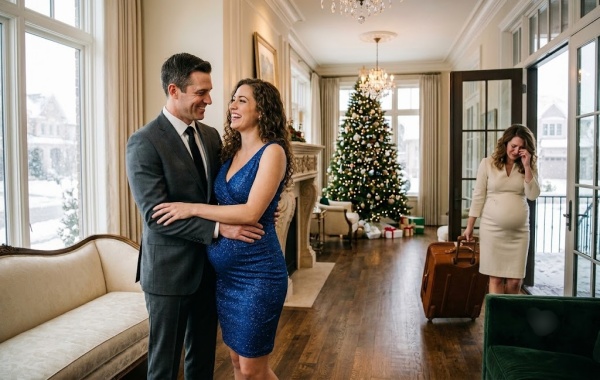
My Ex Denied My Son and Raised My Best Friend’s Baby — Until One Hospital Visit Exposed Everything… When I told Daniel I was pregnant, he called me a liar and walked straight into the arms of my best friend. He gave her baby his name, his love, and the family he refused to give my son. For almost a year, I raised my little boy alone while they played house in public. Then one night at the hospital, the truth finally caught up with him
Part 1: The Day He Chose Her
When I told Daniel I was pregnant, he looked at me like I had placed a bill on the table he had no intention of paying.
We were sitting in the kitchen of the townhouse we rented in Cambridge, Massachusetts, with rain tapping against the windows and a half-empty pizza box between us. I had taken three pregnancy tests that morning, then driven to a clinic near Harvard Square because I wanted to be absolutely sure before I said the words out loud. The nurse had smiled gently when she handed me the paperwork and said, “Congratulations, Emma.”
I had imagined Daniel crying.
I had imagined him pulling me into his arms, laughing into my hair, maybe even dropping to his knees in that dramatic way he did when the Patriots won a close game. We had been together for four years, engaged for nine months, and we had spent entire Sunday mornings talking about baby names while drinking coffee in bed.
Instead, he pushed the ultrasound printout back across the table with two fingers.
“That’s not mine,” he said.
For a moment, I thought I had misheard him. “Excuse me?”
He leaned back in his chair, his face cold in a way I had never seen before. “I said it’s not mine.”
The rain got louder, or maybe the room got quieter.
“Daniel,” I said slowly, “you’re the only man I’ve been with.”
He laughed once, without humor. “That’s convenient.”
Something inside me cracked, but I kept my voice steady. “You don’t get to do this. You don’t get to call me a liar because you’re scared.”
“I’m not scared,” he snapped. “I’m not stupid.”
Those words were the first knife.
The second came five minutes later.
“There’s something you need to know,” he said, rubbing both hands over his face as if my pregnancy had exhausted him. “Madison is pregnant too.”
Madison.
My best friend since sophomore year of college. The woman who had stood next to me when Daniel proposed at Acadia National Park. The woman who had helped me pick out wedding colors, tasted cake samples with me, and cried when I asked her to be my maid of honor.
I stared at him. “What does Madison have to do with this?”
Daniel did not answer quickly enough.
That was when my whole life tilted.
“No,” I whispered.
He looked away.
“No,” I said again, louder this time. “Tell me you did not.”
“It happened once,” he said.
The phrase was so small for something so destructive.
Once.
As if betrayal became lighter when counted singularly. As if one night could not poison every morning after it.
I stood up so fast the chair scraped against the hardwood floor. “You slept with Madison?”
He flinched, but only slightly. “We were confused.”
“We?”
“She’s pregnant, Emma.”
“So am I.”
He looked at the ultrasound again, then back at me. “Hers is mine.”
The words landed with a finality that stole my breath.
“You don’t know that,” I said.
“I know.”
“No, Daniel. You want to know. There’s a difference.”
His jaw tightened. “Madison wouldn’t lie to me.”
I almost laughed. Not because anything was funny, but because the cruelty was too absurd to fit inside my body. Madison, who had lied to my face for weeks, was suddenly the woman he trusted.
“And I would?” I asked.
He said nothing.
That silence ended the engagement more completely than any screaming could have.
I took off my ring and placed it on the kitchen table. It was a modest oval diamond Daniel had bought after saving for months, and I had loved it because I thought it represented effort. Now it looked like evidence from a life that had belonged to someone else.
“Emma,” he said, his voice softening for the first time. “Don’t be dramatic.”
I looked at him then. Really looked.
Daniel Hayes was thirty-two, handsome in that clean-cut Boston way, with dark hair, a runner’s build, and the kind of smile that made waitresses forgive him for taking too long to order. He worked in commercial real estate, wore navy quarter-zips like a uniform, and had always believed life would reward him for looking like someone who deserved reward.
I had mistaken confidence for character.
“I’m not being dramatic,” I said. “I’m being done.”
The next week, Daniel moved out.
Or rather, he moved into Madison’s apartment in Back Bay, which I found out through a mutual friend who called me sobbing because she did not know I did not know. By then, Madison had blocked me on every platform and sent one text so polished it sounded like a crisis PR intern wrote it.
I never meant to hurt you. Things became complicated. Daniel deserves to be part of his child’s life. I hope someday you can understand.
I stared at that message until the words blurred.
Daniel deserves.
Not me.
Not the child inside me.
Daniel.
Two months later, Madison announced her pregnancy online with a soft-focus photo of Daniel holding her waist in front of the Charles River. Her caption read: Sometimes life surprises you in the most beautiful ways. Baby Hayes arriving this fall.
I threw up in the bathroom after seeing it.
Morning sickness, I told myself.
But I knew grief had its own stomach.
Daniel never came to a doctor’s appointment. He never asked if I was okay. He never asked about due dates, cravings, blood pressure, ultrasounds, or whether I needed help lifting the boxes when I moved from our townhouse into a smaller apartment in Somerville.
He sent one email.
Given the circumstances, I think it’s best if we have no contact unless there is legal proof that I’m involved.
Legal proof.
As if my body were making allegations.
I could have filed immediately. I could have hired an attorney, demanded a court-ordered paternity test after birth, and made the whole thing ugly before my son even entered the world. But pregnancy has a way of narrowing your focus to survival.
I had a baby to grow.
So I stopped chasing Daniel and started building a life around the person who had not yet had a chance to disappoint me.
I worked remotely from my kitchen table, my laptop balanced beside saltines, ginger tea, and prenatal vitamins. I took the Green Line to appointments, painted a thrifted dresser pale blue, and learned which grocery stores delivered when my feet were too swollen for errands. At night, I lay awake with one hand on my belly and whispered promises to a baby whose father had denied him before hearing his heartbeat.
“You are wanted,” I told him.
Again and again.
“You are wanted.”
Part 2: The Son Without His Father’s Name
My son was born during a snowstorm.
It was February in Boston, the kind of night when the city turns into a painting of headlights, salt trucks, and frozen breath. My contractions started just after dinner, while I was folding tiny onesies on the couch and watching a true-crime documentary I was pretending did not scare me.
By midnight, I was at Massachusetts General Hospital with my mother on one side and my older sister, Rachel, on the other.
Daniel was not there.
I had not called him.
Not because he did not deserve to know his child was being born, but because I knew exactly what he would do with that information. He would ask for proof while I was in pain. He would make my labor another courtroom where I had to defend my own honesty.
So I chose peace.
At 6:43 a.m., my son entered the world screaming like he had strong opinions about Boston weather. The nurse placed him on my chest, slippery and furious and perfect, and every broken thing inside me went quiet for one sacred second. He had dark hair, a tiny crease between his eyebrows, and Daniel’s mouth.
My mother saw it too.
She looked at me over his head, and her eyes filled with tears she did not let fall.
“What’s his name?” the nurse asked.
I looked down at him.
“Noah,” I whispered. “Noah James Carter.”
Carter was my last name.
Not Hayes.
Never Hayes.
The birth certificate paperwork sat on a clipboard beside my hospital bed that afternoon. There was a blank space for father’s information, and for a long time, I stared at it while Noah slept against my chest. It is strange how a blank line can feel heavier than a paragraph.
My sister touched my shoulder. “You don’t have to decide everything today.”
“Yes,” I said. “I do.”
I left the father section blank.
Not because Daniel was not his father. Because fatherhood is more than biology, and Daniel had made his position brutally clear. If he wanted his name near my son’s, he could earn it through truth, law, and effort — not through my exhaustion.
The first three months were beautiful and brutal.
Noah had reflux, which meant neither of us slept for more than ninety minutes at a time. I learned to eat dinner one-handed, shower in four-minute bursts, and identify three different types of crying with the precision of a bomb technician. My apartment smelled like baby lotion, coffee, laundry detergent, and the faint desperation of a woman learning motherhood alone.
Daniel sent nothing.
No diapers.
No formula.
No money.
No apology.
Meanwhile, Madison posted motherhood like a lifestyle campaign. Her daughter, Harper, was born six weeks after Noah, and the announcement looked like something from a luxury baby catalog. Daniel held the newborn in a cream hospital blanket, his face turned toward her with such tenderness that I had to put my phone down before I dropped it.
Welcome to the world, Harper Grace Hayes. You made us a family.
Us.
A family.
I stared at my son sleeping in a secondhand bassinet beside my bed and felt a pain so sharp it became physical.
Noah had made me a family too.
Daniel just refused to see it.
The resemblance became harder to ignore as Noah grew. By six months, he had Daniel’s dark eyes, Daniel’s dimple, and the same serious expression Daniel wore whenever he was reading a contract. My mother joked that genetics had a sense of humor, but I could see the anger under her voice.
“File,” she said one afternoon while rocking Noah in my living room. “Make him take responsibility.”
“I will.”
“When?”
I looked at my son, who was chewing on a blue teething ring and drooling on his own shirt. “When I can breathe.”
That was the truth.
People love telling women to fight, but fighting takes money, time, childcare, energy, and the ability to survive being called bitter by people who have never paid for formula at 2 a.m. I was not weak for waiting. I was tired.
But tired is not the same as finished.
When Noah turned eight months old, I met with a family law attorney named Priya Shah. Her office was downtown, near Government Center, in a building that smelled like coffee and old paper. She was direct, careful, and did not make sad faces at me, which I appreciated.
“We can file a Complaint to Establish Paternity,” she said. “The court can order genetic testing. If Daniel is the biological father, child support and parenting rights can be addressed.”
“What if he refuses?”
“Then the court handles refusal.”
“What if he says I’m doing this for revenge?”
Priya looked at me over her glasses. “You are allowed to seek support for your child even if the father dislikes the timing.”
I laughed for the first time that day.
Filing the paperwork felt less dramatic than I expected. There was no music, no thunder, no cinematic moment where justice entered wearing a tailored coat. There were forms, signatures, filing fees, and a clerk who told me I had stapled something in the wrong corner.
Still, when I walked out of the courthouse, the air felt different.
Not easier.
Cleaner.
Daniel was served two weeks later.
He called me within an hour from a blocked number.
I answered because Noah was asleep and because curiosity remains one of a betrayed woman’s most dangerous habits.
“What the hell are you doing?” Daniel demanded.
“Establishing paternity.”
“You waited almost a year.”
“I was busy raising the baby you denied.”
His breathing changed. “I have a family now, Emma.”
“So does Noah.”
“That child is not mine.”
The sentence hurt less than it used to. Maybe because I had heard it so many times in my head that the real version had lost some of its power.
“Then take the test,” I said.
“I don’t need a test.”
“Actually, that’s exactly what you need.”
He lowered his voice. “Madison thinks this is harassment.”
I closed my eyes.
Of course Madison did.
“Madison can think whatever helps her sleep,” I said. “This is about Noah.”
“You’re trying to ruin my life.”
“No, Daniel. I’m trying to document my son’s.”
He hung up.
That night, Madison unblocked me long enough to send a message.
You’re embarrassing yourself. Daniel chose his family. Please move on.
I looked at the message while Noah slept in my arms, his little fist curled against my collarbone.
Then I deleted it.
Some women mistake being chosen for being right.
Madison was about to learn the difference.
Part 3: The Hospital Waiting Room
The day everything changed began with a fever.
Noah was eleven months old, round-cheeked and stubborn, crawling everywhere with the confidence of a tiny drunk landlord. He woke from his nap flushed and whimpering, his temperature climbing fast enough to scare me out of every parenting blog I had ever read.
By evening, his pediatrician told me to take him to the emergency department.
I drove to Boston Children’s Hospital with my heart in my throat, one hand gripping the steering wheel and the other reaching back at red lights to touch Noah’s car seat. Snowbanks lined the streets, gray and hard from old storms, and the city lights blurred through my windshield.
Inside the hospital, everything smelled like sanitizer, coffee, and fear.
Parents sat in clusters under bright lights, holding children in pajamas, children with blankets, children coughing into elbows, children too tired to cry. A nurse checked Noah’s vitals, asked questions, and placed a small bracelet around his ankle while he screamed with all the betrayal a baby can fit into one room.
Then I saw Daniel.
He was standing near the registration desk in a charcoal overcoat, holding a diaper bag that looked too expensive to have ever touched a floor. Madison sat nearby with Harper in her lap, her blonde hair pulled into a perfect low bun despite the circumstances. Harper looked pale and sleepy, her head resting against Madison’s chest.
For one strange second, none of us moved.
Daniel saw Noah first.
His eyes dropped to my son’s face, lingered, then snapped back to me. Something flickered there — recognition, maybe, or fear — but he buried it under a smirk.
“Well,” he said, walking toward me. “This is dramatic.”
I shifted Noah higher on my hip. “Not now, Daniel.”
Madison stood, bouncing Harper gently. “Are you following us?”
I stared at her. “My baby has a fever.”
“Convenient,” she said.
The word was so ugly, so absurd, that even Daniel looked uncomfortable.
“Madison,” he muttered.
But she was tired, scared, and apparently still committed to being cruel. “You filed that ridiculous paternity case, and now you just happen to show up at the same hospital?”
“We’re in Boston,” I said. “There are children here because it’s a children’s hospital.”
Daniel gave a short laugh. “Emma always did love a scene.”
I looked at him then, really looked. He was holding himself like a man trying to appear unbothered while standing in the middle of a life that had begun to shake under him. Court papers had done what my pregnancy announcement had not: they had made him nervous.
“I’m here for Noah,” I said. “Not you.”
His eyes moved to my son again.
Noah stared back at him with Daniel’s own dark eyes.
For a second, the air changed.
Then Daniel said the cruelest thing he could have chosen.
“You should have moved on when I did.”
I felt the words hit me, but I did not flinch.
Maybe a year ago, I would have cried. Maybe pregnant Emma, standing in that rainy kitchen with an ultrasound in her shaking hand, would have begged him to see her. But the woman in that waiting room had survived labor alone, rent alone, fevers alone, and the long nights when a baby cried for reasons no one could translate.
I was not there to be chosen.
“I did move on,” I said. “I moved on with the child you abandoned.”
His mouth tightened.
Before he could answer, a nurse called Madison’s name.
“Harper Hayes?”
Madison turned quickly, relief washing over her face. Daniel followed, but the nurse stopped him gently.
“Are you the father?” she asked.
“Yes,” Daniel said automatically.
Madison’s hand tightened around Harper.
The nurse checked the chart. “We need both parents to confirm some medical history. Mom can come back first. Dad, we may need you shortly.”
They disappeared through a set of double doors.
Daniel remained in the waiting room.
For a moment, we stood ten feet apart under fluorescent lights while my son fussed against my shoulder. Around us, life continued in its ordinary emergency rhythm: phones buzzing, vending machines humming, a child crying because someone had taken away a tablet.
Daniel looked at Noah again.
“How old is he now?” he asked.
“Eleven months.”
“When’s his birthday?”
I laughed softly. “You know, the court paperwork included that.”
“I didn’t read every page.”
“Of course you didn’t.”
His face hardened. “You don’t have to be like this.”
“Like what?”
“Bitter.”
There it was.
The favorite word of men who prefer women silent.
I adjusted Noah’s blanket. “Bitter is what people call a woman when she remembers accurately.”
Daniel looked away.
A doctor stepped into the waiting room. “Mr. Hayes?”
Daniel straightened.
The doctor was a woman in navy scrubs with tired eyes and a calm face. “I’m Dr. Keller. We’re evaluating Harper now. We need to clarify some family history and blood compatibility information. Can you come with me, please?”
Daniel glanced at me once, then followed her through the doors.
I should not have cared.
I told myself that while Noah’s fever was checked again, while a nurse gave him medication, while I rocked him in a small exam room and sang the same three lines of “You Are My Sunshine” because they were the only ones I could remember under stress.
I should not have cared what was happening with Daniel and Madison.
But some part of me — the part still standing in that kitchen, the part still holding the ultrasound — could feel the storm moving closer.
An hour passed.
Noah’s fever began to come down. The doctor suspected a viral infection but ordered a few tests because he was small, miserable, and determined to frighten me into losing ten years of my life. I held him while he dozed, his hot cheek pressed against my chest.
Then Priya called.
“Emma,” she said, “Daniel’s attorney just contacted me.”
My heart kicked. “Why?”
“He wants to discuss voluntary genetic testing.”
I sat up carefully so I would not wake Noah. “Now?”
“Yes.”
“Why now?”
Priya paused. “Apparently, there is a medical issue involving Madison’s child. I don’t have details, and we are not entitled to them without authorization. But Daniel may have learned something that makes paternity relevant.”
The room seemed to tilt.
“What does that mean?”
“It means,” Priya said carefully, “that the truth may be catching up.”
Part 4: The Truth He Couldn’t Escape
I learned later that Harper needed a blood transfusion evaluation after complications from a severe infection.
It was not as dramatic as television makes it. There were no doctors shouting family secrets across a hallway, no public announcement, no nurse pointing at Daniel and declaring he was not the father. Real hospitals do not work like that, and real medical staff do not turn private information into entertainment.
The truth came out in pieces.
First, Daniel was asked about family medical history. Then blood type. Then prior testing. Madison became defensive. Daniel became confused. A doctor explained, carefully and privately, that certain results did not align with the information they had been given.
A paternity test was not medically necessary to treat Harper immediately.
But Daniel demanded answers.
Madison refused them.
That refusal did more than any confession could have.
By the time Daniel returned to the waiting room, his face had changed. He looked pale, almost gray, like someone had opened a door inside him and let all the heat out. Madison followed several steps behind him, crying silently, her phone clutched in one hand.
I was standing near the vending machines with Noah asleep in his stroller.
Daniel saw me and stopped.
For once, he did not smirk.
“Emma,” he said.
“No.”
He blinked.
“No,” I repeated. “Whatever is happening with you, do not bring it to me in a hospital hallway while my son is sick.”
His eyes moved to Noah.
This time, he did not look away.
“He looks like me,” Daniel whispered.
The words were so late they almost felt obscene.
“He always did,” I said.
Madison wiped her face. “Daniel, please.”
He turned on her, but not with rage. Worse. With disbelief.
“Did you know?” he asked.
Madison looked around as if the hospital walls might help her.
“Did you know?” he repeated.
A nurse passing by glanced over, and I saw Madison remember where we were. She lowered her voice. “This is not the place.”
Daniel laughed once, hollow and broken. “Now you care about the place?”
I put a hand on Noah’s stroller. “Keep your voices down.”
Daniel looked at me, and something like shame crossed his face.
Actual shame.
Not embarrassment. Not irritation. Shame.
“I need to know,” he said.
“You will,” I replied. “Through the court.”
“I can do the test now.”
“You can call your attorney.”
“Emma—”
“No,” I said, and my voice was quieter than I expected. “You do not get to reject my son for almost a year, mock me in this waiting room, then suddenly rush over because another woman’s lie stopped protecting you.”
He flinched.
Good.
Not because I wanted to hurt him, but because some truths are supposed to land.
Madison covered her mouth, crying harder now. “I was scared.”
I turned to her slowly.
For one year, I had imagined what I would say if Madison ever admitted anything. I had written speeches in my head at 3 a.m. while warming bottles. I had pictured myself asking why, demanding details, throwing every cruel word she deserved.
But in that hallway, looking at her trembling beside the man she had stolen and deceived, I felt something colder than anger.
Distance.
“You were my best friend,” I said.
She squeezed her eyes shut.
“You stood beside me when I tried on wedding dresses,” I continued. “You rubbed my shoulders and told me Daniel adored me. You ate dinner at my table while you were sleeping with him.”
“Emma, I—”
“And then you let him deny my baby.”
Her face crumpled.
That was the part I could not forgive quickly. Not the affair, though it had devastated me. Not even the public posts, the smiling photos, the captions about family. It was that she had watched another woman carry a child alone and allowed the lie to continue because it gave her the life she wanted.
Daniel’s phone rang.
He looked at the screen, then answered. “Martin.”
His attorney, presumably.
Daniel listened for less than ten seconds before saying, “Set it up. I’ll do the test. I’ll do whatever the court needs.”
I looked down at Noah.
He was sleeping peacefully now, fever dampening his curls, one tiny hand wrapped around the edge of his blanket. He had no idea that the man who had denied him was standing a few feet away, finally ready to acknowledge the possibility that should have been obvious from the beginning.
Possibility.
Not love.
Not fatherhood.
Just possibility.
And that was not enough for me anymore.
The genetic test happened two days later through a court-approved lab.
Daniel arrived early, wearing the same charcoal coat from the hospital and a face that looked like he had not slept. I brought Noah in a blue snowsuit with little bear ears because motherhood remains absurd even during legal proceedings. Priya came with me, because she said men like Daniel behaved better when women arrived with counsel.
She was right.
Daniel stood when we entered.
His eyes went immediately to Noah, who was awake, alert, and chewing on a teething cracker with the seriousness of a judge reviewing evidence. Daniel took one step forward, then stopped himself.
“Can I hold him?” he asked.
“No.”
The word came out before I could soften it.
He swallowed. “Right. Of course.”
The technician explained the process. A cheek swab. Simple. Quick. Almost insultingly small for something that had the power to rewrite a year of cruelty.
Noah fussed when they swabbed his cheek, then reached for me. I lifted him and kissed his forehead, whispering that it was over, though of course it was not. Daniel did his swab silently.
Then we waited.
Three business days.
It felt like three years.
During that time, Madison’s story collapsed. Daniel’s attorney confirmed that he had requested testing regarding Harper as well, though the details remained private. Mutual friends began calling, texting, apologizing, asking if I had known, asking if I was okay, asking questions they had no right to ask.
I answered almost none of them.
Daniel sent one message through his attorney.
Daniel would like to begin discussing support and parenting time if paternity is confirmed.
If.
That tiny word made me close my laptop and walk away.
On Friday afternoon, Priya called.
I was sitting on the floor of Noah’s room, stacking soft blocks while he knocked them down. The winter sun was low outside the window, turning the apartment walls gold. My son laughed every time the blocks fell, delighted by destruction because he had not yet learned how much rebuilding costs.
Priya’s voice was calm.
“Emma,” she said. “The results are in.”
I closed my eyes.
“Daniel Hayes is Noah’s biological father. Probability of paternity is greater than 99.99 percent.”
The room went silent.
Not really, of course. Noah was still babbling. A truck was still backing up somewhere outside. My upstairs neighbor was still walking too heavily across the ceiling.
But inside me, everything stopped.
I had known.
From the beginning, I had known.
Still, hearing it confirmed by science, by paper, by the kind of proof Daniel had demanded as a condition of decency, hit me in a place I had been pretending was healed.
I covered my mouth with one hand.
Noah crawled into my lap and slapped the test block against my knee.
“Mama,” he said.
It was not his first word. It was not even new. But that day, it felt like a verdict.
“Yes,” I whispered, pulling him close. “Mama knew.”
Part 5: The Name He Had to Earn
Daniel did not call me first.
His attorney called Priya, and Priya called me. That was how responsible adults handled painful facts when trust had been burned down to ash. There would be child support calculations, amended birth certificate options, custody discussions, parenting plans, and a hearing if we could not agree.
Daniel wanted to see Noah immediately.
I said no.
Not forever. Not as punishment. But because my son was not a prize Daniel could claim the moment another child stopped being his shield. Noah was a baby, not a correction.
A week later, we met in a family visitation center in Brookline.
The room had soft rugs, picture books, a plastic kitchen set, and a social worker named Karen who spoke gently but missed nothing. I arrived with Noah on my hip, his diaper bag over my shoulder, and my heart beating too hard for a place decorated with cartoon animals.
Daniel was already there.
He looked different.
Not transformed. Life is not that generous. But smaller, stripped of the arrogance that had once made him so certain I was lying because believing Madison was easier.
When he saw Noah, his eyes filled.
I hated that part of me noticed.
“Noah,” he whispered.
My son looked at him with mild interest, then reached for the zipper on my coat.
Karen explained the rules. The visit would be supervised. Daniel would not be called “Daddy” yet unless and until the parenting plan supported that transition. He would follow Noah’s cues, not force contact, not overwhelm him, not make adult promises over a child’s head.
Daniel nodded through all of it.
Then he sat on the rug.
For the first ten minutes, Noah ignored him completely. He crawled to the toy kitchen, opened and closed a cabinet, and became deeply invested in a plastic banana. Daniel watched like a man starving outside a bakery window.
Finally, Noah dropped the banana.
It rolled toward Daniel’s knee.
Daniel picked it up slowly and held it out. “Here you go, buddy.”
Noah looked at him.
Then he took it.
Daniel’s face broke.
He turned away quickly, but I saw the tears.
I did not comfort him.
There was a time when Daniel’s pain would have pulled me across any room. I would have reached for his hand, explained away his failure, helped him feel less monstrous so I could keep loving him. That woman had given birth alone in a snowstorm and learned something important between contractions.
A man’s guilt is not always a woman’s assignment.
After the visit, Daniel asked if we could talk.
Karen offered a private room with the door open. Priya had advised me to keep conversations brief and child-focused, so I agreed for five minutes.
Daniel stood by the window, hands in his coat pockets. “I don’t know how to apologize for this.”
“You start by not making the apology about how hard it is for you.”
He nodded, accepting the blow.
“I’m sorry,” he said. “I should have believed you.”
“Yes.”
“I should have taken the test.”
“Yes.”
“I should have been there when he was born.”
I looked at him. “Yes.”
His eyes reddened again. “Madison told me she was sure.”
“And you wanted her to be right.”
He looked down.
That was the truth beneath all the other truths.
Daniel had chosen Madison’s baby not because the evidence was stronger, but because that version of reality cost him less at the time. If Harper was his, then his betrayal had a purpose. If my baby was not his, then I could become the problem instead of the woman he had wronged.
He had built a whole life on the option that made him feel least guilty.
Then the hospital took that option away.
“What about Harper?” I asked.
His face twisted.
“She’s not mine,” he said quietly.
I felt no triumph.
That surprised me.
I had imagined the moment Daniel learned the truth so many times. In my angriest fantasies, I pictured him devastated, Madison exposed, their perfect little family collapsing under the weight of the lie. I thought it would feel like justice.
Instead, it felt like standing in a room full of injured children.
Harper was innocent.
Noah was innocent.
And the adults had turned them into proof, excuses, shields, and consequences.
“I’m sorry for her,” I said.
Daniel looked at me sharply, as if he had expected cruelty.
“She didn’t ask for any of this,” I added.
“No,” he whispered. “She didn’t.”
The legal process took months.
Daniel was ordered to pay child support retroactive to the filing date, plus medical insurance contributions and childcare expenses. His name was added to Noah’s birth certificate only after a long discussion, several agreements, and my insistence that legal recognition did not automatically equal emotional access.
Parenting time began slowly.
One supervised visit a week became two. Then short unsupervised visits in public places. Then Saturday mornings at the children’s museum, where Daniel learned that fatherhood involved snacks, wipes, patience, and the humiliation of singing animal songs in front of strangers.
Noah warmed to him cautiously.
Babies are generous, but they are not stupid. He learned Daniel’s face, then his voice, then the fact that Daniel always brought the same stuffed dinosaur because he was terrified of getting something wrong. Eventually, Noah reached for him.
Daniel cried the first time.
I looked away.
Madison disappeared from our social circle.
From what I heard, Harper’s biological father was someone she had dated briefly before Daniel, a man who wanted no part in public drama but did step forward after testing confirmed the truth. Madison moved to Rhode Island to be closer to her parents. She sent me one letter.
I kept it unopened for two weeks.
When I finally read it, I was sitting at my kitchen table after Noah had gone to bed. Madison’s handwriting was exactly the same as it had been in college, round and pretty, the kind of handwriting that used to fill birthday cards and inside jokes.
She apologized.
Not perfectly. Not enough. But honestly enough that I believed she had finally run out of lies. She wrote that she had been terrified Daniel would leave if Harper was not his. She wrote that watching him love her baby while he denied mine had become unbearable, but she had convinced herself that telling the truth would destroy too many lives.
I folded the letter carefully.
Then I put it in a drawer.
Forgiveness, I had learned, was not a performance for the person who hurt you. Sometimes it was a private door you opened only wide enough to let yourself out.
A year after the hospital waiting room, Noah turned two.
We held his birthday party at a small indoor play space in Somerville with a ball pit, pizza, and a dinosaur cake that cost too much because I panicked when the bakery asked what theme I wanted. My mother came, Rachel came, a few friends came, and Daniel came for the last hour.
He arrived with a gift, child support paid on time, and no expectation of being praised for either.
That was progress.
Noah ran to him when he walked in.
“Dada!” he shouted.
The room did not stop.
No dramatic music played.
No one clapped.
Daniel simply crouched, opened his arms, and caught our son.
I stood near the cake table with a stack of paper plates in my hand and felt grief and relief move through me at the same time. That is the part people do not understand about healing. It does not erase what happened. It makes room for new things beside it.
Daniel looked over Noah’s shoulder at me.
There was gratitude in his face.
There was regret too.
I accepted both without letting either become my responsibility.
Later, after the party, Daniel helped carry gifts to my car. The February air was cold but clear, and the parking lot glittered with old snow under the streetlights. Noah was asleep in his car seat before I finished buckling him in, frosting still on his sleeve.
Daniel stood beside the open trunk.
“I missed so much,” he said.
“Yes,” I replied.
“I’ll spend the rest of my life regretting it.”
“Probably.”
He gave a sad little laugh. “You don’t soften anything anymore.”
“I have a son now,” I said. “Softness is reserved for him.”
He nodded.
Then he looked at Noah through the car window. “Thank you for letting me know him.”
I closed the trunk.
“I didn’t do it for you.”
“I know.”
“I did it because Noah deserves the truth. He deserves support. He deserves to know where he comes from without being defined by your worst mistake.”
Daniel swallowed. “And you?”
“What about me?”
“What do you deserve?”
The question caught me off guard.
For so long, everyone had centered the children, the testing, the support, the legal process, Daniel’s guilt, Madison’s lies, Harper’s innocence, Noah’s needs. I had centered them too. Mothers are good at disappearing into what must be done.
But standing there in the cold, I let myself answer.
“I deserved to be believed,” I said.
Daniel closed his eyes.
“I deserved not to give birth alone because you found a more convenient version of the truth. I deserved not to watch you build a family in public while pretending my child was evidence of my dishonesty. I deserved better from you and from Madison.”
He opened his eyes, wet and ashamed.
“Yes,” he said. “You did.”
It was not enough.
But it was something.
On the drive home, Noah slept while soft music played through the speakers and Boston blurred past in winter lights. I thought about the hospital waiting room, Daniel’s smirk, Madison’s pale face, the doctor’s careful words, and the truth moving toward us like a storm none of them could outrun.
For a long time, I thought the hospital revealed the truth that Daniel could not escape.
But that was only part of it.
The real truth had been there all along.
It was in Noah’s dark eyes. It was in the shape of his smile. It was in every appointment Daniel missed, every bill I paid alone, every night I rocked my son while anger and love fought for space in my chest.
The hospital did not create the truth.
It simply removed the lie that had been standing in front of it.
When we got home, I carried Noah upstairs, changed him into pajamas, and tucked him into his crib. He stirred once, opened his eyes halfway, and reached for my finger. I gave it to him.
“Mama,” he murmured.
“Yes, baby,” I whispered. “I’m here.”
And I had been.
From the first test to the first kick, from the snowstorm birth to the fevered hospital night, from the court filing to the DNA results, from every lonely morning to every hard-won peace.
I had been there.
Daniel had chosen the baby my best friend claimed was his.
He had chosen the easier lie, the prettier picture, the family that did not require him to face what he had done to me. He had mocked me for losing him seconds before life forced him to see that he had lost the first year of his real son’s life.
That was his consequence.
Mine was different.
Mine was Noah breathing softly in the next room.
Mine was a home built without begging anyone to stay.
Mine was knowing that even when Daniel denied my baby, even when Madison lied, even when the world seemed to reward them with the life that should have been mine, I had still chosen truth.
And truth, I learned, does not always arrive loudly.
Sometimes it arrives in a hospital hallway.
Sometimes it wears a doctor’s careful expression.
Sometimes it comes printed on court-approved paper with 99.99 percent written in black ink.
And sometimes, after all the heartbreak, truth is a little boy with his father’s eyes and his mother’s last name, sleeping peacefully because the woman who raised him never once needed a man’s belief to know who he was.
