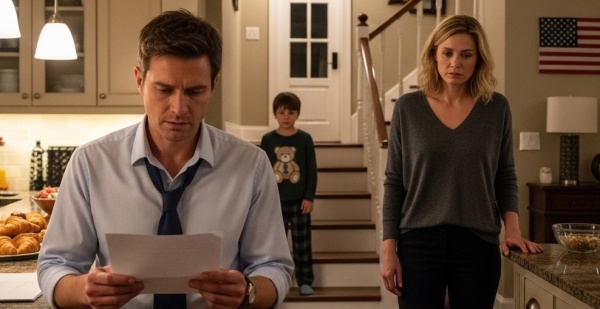
I Thought I Was Hiding My Affair—Until My Son Asked ‘Did You Sleep at That Lady’s Hotel Again?… I’d been cheating on my wife for eight months, sneaking out to hotels with my 29-year-old colleague while my family slept. I thought I was being careful. Until My Son asked me the question that shattered everything: “Did you sleep at that lady’s hotel again?” My son had known all along. He’d been listening, watching, and trying to make sense of why I kept hurting his mother…..
Part 1: The Return of a Guilty Man
At 4:57 a.m., Westport, Connecticut, still looked like the kind of town people used in real estate brochures when they wanted to sell the American dream. The tree-lined streets were wrapped in pale gray fog, and porch lights glowed softly behind perfectly trimmed hedges that cost $300 a month to maintain. Somewhere in the distance, an automatic sprinkler system clicked methodically over a manicured lawn that had never seen a weed. Everything felt controlled, expensive, and peacefully asleep—the way wealthy suburbs always do in the hours before dawn.
Then Ethan Morgan’s black Mercedes S-Class, worth $110,000, rolled into the circular driveway of 47 Meadowbrook Lane like a lie returning home. The engine’s purr was too quiet, too smooth, engineered specifically not to wake sleeping families. But on this particular morning, the silence it carried felt heavier than usual, weighted with secrets and the kind of guilt that expensive cologne can’t quite cover.
Ethan stepped out of the car with the heavy slowness of a man who had enjoyed himself too much to feel clean afterward. His white Tom Ford dress shirt, which had cost $495 and had been crisp and perfect when he’d left the previous evening, was now wrinkled and slightly untucked. His Hermès tie, a $180 silk piece in navy blue, hung loose around his neck like a noose he’d almost escaped. And clinging to his skin, his collar, his wrists, was the unmistakable scent of Harper Lane’s perfume—Chanel No. 5, the kind that cost $150 an ounce and lingered with deliberate, expensive persistence.
Ethan stood for a moment in the cold November air and looked at the house he’d bought three years ago for $2.4 million. It was a grand colonial on one of Westport’s most desirable streets—white-painted brick, black shutters, three-car garage, professionally landscaped yard, the kind of place people in Fairfield County called “comfortable” only because saying “obscenely wealthy” would sound tacky. He’d purchased it after his second major promotion at Morgan & Sterling Investment Bank, after the bonuses started hitting seven figures, after the board of directors began using words like “inevitable” and “future CEO” when they spoke about his career trajectory.
Inside that house was his wife, Clare Morgan, the woman he’d married ten years ago when they were both 28 and still believed in things like forever. Inside that house was his seven-year-old son, Jacob, who still thought his father was a hero, who still ran to the door when Ethan came home from work, who still believed that dads didn’t lie. Inside that house, until a few hours ago, Ethan had believed he still had time—time to fix things, time to end the affair with Harper, time to become the man he’d promised Clare he’d be when he’d gotten down on one knee in Central Park with a $25,000 engagement ring.
He was wrong about the time.
Part 2: The Silence That Screamed
Ethan unlocked the front door with his key and stepped into a silence that felt wrong. Not the normal silence of a sleeping family—the gentle quiet of people at rest, of children dreaming, of a home at peace. This silence had edges. It had texture. It felt like the moment before something breaks, the held breath before a scream, the second before a verdict is read.
Clare always left a small light on in the foyer, a soft amber glow from the antique lamp they’d bought together at an estate sale in Greenwich during their first year of marriage. That morning, the foyer was dark. The lamp was off. The only illumination came from the kitchen at the back of the house, where a single hanging bulb spilled a weak, yellowish pool of light across the Brazilian cherry hardwood floors that had cost $18 per square foot to install.
Ethan shut the door quietly behind him and slipped off his Italian leather shoes, setting them carefully on the mat by the door. His phone buzzed in his pocket, and he pulled it out to see a text from Harper Lane, his 29-year-old colleague at the investment bank, the woman he’d been sleeping with for the past eight months in hotel rooms that cost $600 a night.
Harper: I miss you already. Next time let’s stay the whole weekend. The Ritz-Carlton in Boston? I’ll wear that thing you like.
For one sick, automatic second, Ethan smiled. The message triggered the same dopamine rush it always did—the thrill of being wanted by someone young and exciting, someone who didn’t know about his receding hairline or his bad knee or the way he snored when he’d had too much wine. Harper saw him as powerful, successful, magnetic. She didn’t see him the way Clare did—as a man who’d broken promises, who came home late smelling like someone else, who’d stopped being present even when he was physically there.
Then he looked up from his phone and saw the envelope on the kitchen table.
It was white, slightly crooked, and small—the size of a note card. On the front, written in thick, uneven pencil strokes that wavered and dipped like a child’s first attempts at cursive, was one word: Dad. The letters were different sizes, the “D” much larger than the others, the “a” slightly backwards. It was the handwriting of a seven-year-old who was trying very, very hard to write something important.
Ethan’s stomach tightened so fast it felt physical, like someone had reached inside him and twisted. His hands, which had been steady enough to drive home from the Marriott in Stamford where he’d spent the night with Harper, suddenly started to shake. He crossed the kitchen in three long strides and picked up the envelope with fingers that felt clumsy and cold.
Inside was a torn piece of notebook paper, the kind with blue lines and a red margin. The edges were jagged where Jacob had ripped it from his school notebook. Decorating the margins were jagged lines drawn in blue, red, and green crayon—the kind of abstract art that children make when they’re upset and don’t know how to express it. The handwriting was careful, deliberate, each letter formed with the concentration of a child who understood that words mattered, that this message was important.
Dad,
I saw Mom crying again. She was in the bathroom and she thought I was asleep but I heard her. She said she’s fine but I know she’s not. You said you wouldn’t lie anymore but you did. You said you were working late but I heard you on the phone talking to someone and you were laughing. You don’t laugh like that with us anymore.
If you keep making her cry I don’t want a dad like that. I will try not to need you.
Jacob
The room lurched. The floor seemed to tilt beneath Ethan’s feet, and he had to grip the edge of the kitchen table to steady himself. His breathing changed, becoming shallow and rapid, the kind of breathing that happens when your body realizes something terrible before your mind fully catches up.
Ethan had prepared explanations for Clare. He’d rehearsed them during the drive home, crafting careful sentences about late meetings and demanding clients and the pressures of his job. He had prepared charm for nosy neighbors who might have noticed his irregular hours, excuses for colleagues who might have seen him with Harper at that restaurant in Greenwich, and polished, corporate language for the board of directors if his private life ever slipped into public view and threatened his career.
He had not prepared to be judged by a second-grader. He had not prepared to see his failures reflected in the careful, heartbroken handwriting of his own son. He had not prepared for the sentence that cut deeper than any divorce papers could: “I will try not to need you.”
Part 3: The Confrontation in the Kitchen
A floorboard creaked behind him, the old oak plank near the doorway that always announced someone’s arrival. Ethan turned, still clutching Jacob’s letter in his hand, and saw Clare standing in the kitchen doorway. She was wearing an oversized gray Williams College sweatshirt—his sweatshirt, actually, from his undergraduate days—and loose flannel pajama pants. Her dark blonde hair, which she usually wore in a neat ponytail or styled for her work as a pediatric nurse, was tied up badly with a scrunchie, as if she’d done it with shaking fingers and hadn’t cared how it looked.
Her face was pale, drained of color, with dark circles under her eyes that spoke of many sleepless nights. She’d lost weight, Ethan noticed with a guilty jolt—her cheekbones were more prominent, her collarbones visible above the neckline of the sweatshirt. She looked exhausted, hollowed out, like someone who’d been crying for months and had finally run out of tears.
What frightened Ethan most was not anger. He knew anger. He could manage anger. He could apologize, buy flowers, make promises, deploy the charm that had won her over a decade ago. Anger was hot, explosive, something that could burn out and leave room for forgiveness.
This was something colder. This was resignation. This was the look of someone who had already made decisions, who had already grieved, who had already started the process of letting go.
Clare looked at the letter in his hand and said, quietly, “So you read it.” Her voice was flat, empty of inflection. It was the voice of someone who had used up all their emotional energy and had nothing left to give.
“Clare,” Ethan said, already reaching for the tone he used in high-stakes negotiations at the bank, the low, calm, reasonable voice meant to restore order and convince people that everything could be fixed. “Let me explain. This isn’t what it looks like. I can explain everything.”
Her laugh was so small it barely counted as sound. It was more like a breath, a tiny exhalation of disbelief and exhaustion. “Before you explain,” she said, her voice still eerily calm, “look behind you.”
Ethan turned toward the staircase that curved up from the foyer to the second floor. His heart stopped.
Jacob stood at the top landing, small and vulnerable in his dinosaur pajamas—the blue ones with T-Rexes that they’d bought together at Target three months ago, when Ethan had still been trying to be a good father, when he’d still believed he could balance everything. One of Jacob’s thin arms was wrapped tightly around his worn stuffed bear, Mr. Buttons, the toy he’d had since he was two years old and only held now when he was scared or sad.
Jacob’s face was pale in the dim light from the hallway nightlight. His eyes were swollen and red-rimmed from crying, and his cheeks were still damp with tears. But what made Ethan’s chest constrict with something close to physical pain was the expression in those eyes—his son’s eyes, the same hazel-green as his own.
It wasn’t confusion. It wasn’t childish sadness or the temporary upset of a kid who’d had a bad dream. This was something deeper, something that would leave a mark. This was disappointment. The kind of disappointment that changes how a child sees their parent forever. The kind that makes a seven-year-old boy realize that his father is not a hero, not infallible, not even particularly good.
The kind that makes a man feel smaller than a child.
Ethan swallowed hard, his throat tight. “Buddy…” he started, but his voice cracked on the word. He took a step toward the staircase, one hand reaching out in a gesture that felt pathetic even as he made it.
Jacob gripped Mr. Buttons tighter, his knuckles white against the bear’s brown fur. His small voice, usually so full of energy and questions and excitement, was quiet and careful. “Did you sleep at that lady’s hotel again?”
The question hung in the air like a guillotine blade.
Part 4: The Truth a Child Already Knew
Ethan felt his legs go weak. He gripped the newel post at the bottom of the staircase, his expensive watch—a $12,000 Rolex he’d bought himself after a particularly good quarter—catching the light. “Jacob, I… how do you…” He couldn’t finish the sentence. How did his seven-year-old son know about Harper? How did he know about the hotels?
“I heard you on the phone,” Jacob said, his voice small but steady, the voice of a child who had been holding this pain inside for a long time and was finally letting it out. “Two weeks ago. You were in the garage and you thought I was watching TV but I came to ask if you wanted to play catch. You were talking to someone and you said ‘I’ll meet you at the Marriott at nine.’ And you were laughing. You sounded happy.”
Ethan’s mind raced back. Two weeks ago. The Stamford Marriott. He’d told Clare he had a late client dinner. He’d told Jacob he’d be home in time to say goodnight but had texted Clare at 8:30 saying the dinner was running long. He’d spent the night with Harper in a king suite on the eighth floor, ordering room service and drinking champagne that cost $200 a bottle.
“And then you didn’t come home,” Jacob continued, tears starting to slide down his cheeks again. “Mom said you were working but I knew you weren’t. And the next morning when you came home you smelled different. Like flowers. Like the perfume lady at the mall. And Mom cried in the bathroom for a long time.”
Clare made a small sound, something between a sob and a gasp. She pressed her hand to her mouth, her eyes filling with tears. Ethan looked at her and saw the full weight of what he’d done—not just the affair, not just the lies, but the fact that his seven-year-old son had been watching, listening, trying to make sense of why his father kept hurting his mother.
“I asked Mom if you still loved us,” Jacob said, his voice breaking. “She said yes but she was crying when she said it so I don’t think it’s true. And I asked if you were going to leave like Tommy’s dad left, and she said she didn’t know. She said she hoped not. But I think you are.”
“Jacob, no,” Ethan said, his own voice thick with tears now. He started up the stairs, but Jacob took a step back, clutching Mr. Buttons like a shield. “Buddy, I’m not leaving. I love you and Mom so much. I made mistakes, terrible mistakes, but I’m not leaving.”
“Then why do you keep going to see that lady?” Jacob asked, and the simple, devastating logic of a child’s question cut through every excuse Ethan had prepared. “If you love us, why do you keep making Mom cry? Why do you keep lying?”
Ethan had no answer. Or rather, he had answers—complicated, adult answers about feeling unappreciated and stressed and tempted, about how Harper made him feel young again, about how the affair had just happened and spiraled out of control—but none of those answers would make sense to a seven-year-old. None of them were good enough. None of them were true enough.
“I wrote you that letter,” Jacob said, pointing at the paper still clutched in Ethan’s hand, “because I wanted you to know that I see what you’re doing. I’m not a baby. I know when people are lying. And I know that if you keep doing this, I’m going to stop wanting you to be my dad.”
The words hit Ethan like a physical blow. He sat down hard on the stairs, his legs finally giving out completely. “Jacob, please don’t say that. Please. I’ll fix this. I’ll fix everything. I’ll stop seeing her. I’ll be better. I promise.”
“You promised before,” Jacob said, and his voice was so tired, so much older than seven. “After the last time. You and Mom were fighting and you said you’d stop working so much and you’d be home more and you’d stop lying. But you didn’t. You just got better at hiding it.”
Part 5: The Name He Thought He’d Built
Clare finally moved from the doorway. She walked slowly up the stairs, passing Ethan without looking at him, and knelt down next to Jacob. She wrapped her arms around their son and held him close, and Jacob buried his face in her shoulder and started to cry in earnest—the deep, shaking sobs of a child who had been trying to be brave for too long.
“It’s okay, baby,” Clare whispered, stroking his hair. “It’s going to be okay. I promise.” She looked down at Ethan, and he saw in her eyes that she had already made her decision. This wasn’t a moment of crisis that could be managed or negotiated. This was an ending.
“Ethan,” she said, her voice steady despite the tears on her cheeks, “I need you to leave. Not forever, not yet—we need to figure out custody and the house and everything else. But right now, this morning, I need you to pack a bag and go. Jacob and I need space. We need time without you here.”
“Clare, please—” Ethan started, but she cut him off.
“You’ve been having an affair for eight months,” she said, and the words were like stones, heavy and final. “I’ve known for six of them. I hired a private investigator. I have photos, hotel receipts, text messages. I know about Harper Lane. I know about the Marriott in Stamford, the Ritz-Carlton in Boston, the weekend you told me you were at a conference in Chicago but were actually in the Hamptons with her.”
Ethan felt the blood drain from his face. “You knew? For six months, you knew?”
“I was trying to figure out if our marriage was worth saving,” Clare said. “I was trying to decide if I should fight for you or let you go. I was waiting to see if you’d come to your senses, if you’d end it on your own, if you’d choose us.” She gestured to Jacob, still crying against her shoulder. “But you didn’t. You kept choosing her. You kept lying. And now our son is writing you letters begging you to stop hurting his mother.”
Ethan looked at Jacob’s small, shaking form and felt something inside him crack. All his life, he’d been building toward something. He’d worked 80-hour weeks at the investment bank. He’d climbed the corporate ladder with ruthless efficiency. He’d made managing director by 35, a feat that usually took people until their 40s. He’d bought the house in Westport, the Mercedes, the Rolex, all the symbols of success that were supposed to mean he’d made it, that he was somebody important.
But he’d forgotten the most important thing. He’d forgotten that the name that mattered most wasn’t “Ethan Morgan, Managing Director at Morgan & Sterling.” It wasn’t “Ethan Morgan, the guy with the $2.4 million house.” It was “Dad.” And that name, the one he’d been so proud of when Jacob was born seven years ago, the one he’d thought would always be his—that name was being destroyed by his own choices.
“I’ll pack a bag,” Ethan said quietly. He stood up slowly, his body feeling heavy and old. “I’ll go to a hotel. And Clare… I’m sorry. I know that’s not enough. I know sorry doesn’t fix this. But I am. I’m so, so sorry.”
Clare didn’t respond. She just held Jacob and watched as Ethan climbed the stairs, walked past them into the master bedroom, and began throwing clothes into a duffel bag. His hands were shaking so badly he could barely zip it closed.
Twenty minutes later, Ethan Morgan walked out of his house at 5:47 a.m., carrying a duffel bag and the weight of everything he’d destroyed. The sun was just starting to rise over Westport, painting the sky in shades of pink and gold. It was going to be a beautiful day.
He got into his Mercedes and sat there for a moment, looking at the house through the windshield. Through the kitchen window, he could see Clare and Jacob sitting at the table. She was making him breakfast—probably pancakes, Jacob’s favorite. They looked small and far away, like a photograph of a life he used to have.
Ethan pulled out his phone and opened his text messages. He scrolled to Harper’s name and stared at her last message: “I miss you already.”
Then he started typing.
Ethan: We’re done. Don’t contact me again. I need to fix my family.
He hit send before he could change his mind, then blocked her number.
It was too late. He knew that. The damage was done. Clare would file for divorce. Jacob would grow up in a broken home, splitting time between two houses, learning that promises could be broken and that dads could fail. Ethan would become the cautionary tale he’d always pitied—the man who had everything and threw it away for something that didn’t matter.
But maybe, if he fought hard enough, if he proved himself over months and years, if he became the man he should have been all along—maybe someday Jacob would forgive him. Maybe someday his son would let him earn back the name he’d lost.
Dad.
The name written in crooked pencil on a torn piece of notebook paper.
The name he’d destroyed at 4:57 a.m. on a November morning in Westport, Connecticut.
The only name that had ever really mattered.
