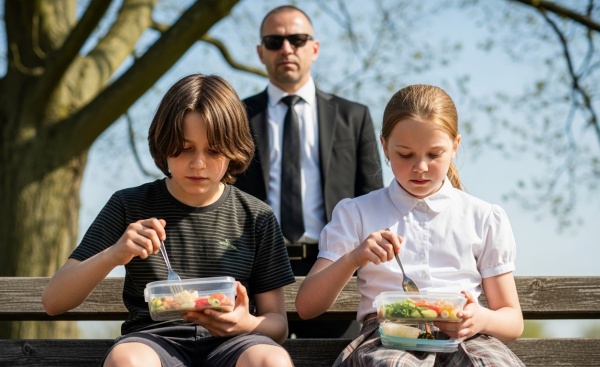
My 12-year-old son Ethan was coming home 75 minutes late every day with vague excuses. My 12-year-old son Ethan was coming home 75 minutes late every day with vague excuses. The school said he wasn’t staying for activities. I followed him, expecting trouble, and found him on a park bench with a girl in worn clothes….
Part 1: The Lies That Led to the Truth
My name is Daniel Carter, and I’m 42 years old, living in Scottsdale, Arizona. I’m the CEO of a commercial real estate development company that I built from the ground up, worth approximately $18 million personally, with annual revenues around $45 million. I have a beautiful home in the Silverleaf community worth $3.2 million, drive a Mercedes S-Class that cost $115,000, and by most measures, I’ve achieved the American dream. I’m also a single father to my twelve-year-old son, Ethan, after my wife Rebecca died from cancer four years ago. And three weeks ago, I thought my son was lying to me. What I discovered instead changed everything I thought I knew about him—and about myself.
It started with small inconsistencies. Ethan would come home from St. Augustine Academy—a prestigious private school that costs $28,000 a year in tuition—at 4:30 PM instead of his usual 3:15 PM. When I asked where he’d been, he’d give vague answers: “I had extra help in math,” or “There was a club meeting,” or “I stayed late to work on a project.” For the first week, I accepted these explanations. Ethan was a good kid—straight A’s, never in trouble, polite and responsible. If he said he was staying late for school activities, I believed him.
But then I noticed the pattern. Every single day, Monday through Friday, he was exactly 75 minutes late. Not sometimes. Not occasionally. Every day. And when I asked for details about these activities, his answers were vague and inconsistent. One day it was math help, the next day it was a science club, then it was working on a group project. Nothing added up. I’m a businessman—I notice patterns, inconsistencies, things that don’t make sense. And my son’s story wasn’t making sense.
I tried talking to him directly. “Ethan, is everything okay at school? You’ve been staying late a lot. Is there something going on?” He’d look at me with those serious brown eyes—so much like his mother’s—and say, “Everything’s fine, Dad. I’m just busy with school stuff. Don’t worry about it.” But I did worry. Because in the four years since Rebecca died, Ethan and I had become a team. We told each other everything. Or at least, I thought we did.
So I did what any concerned parent would do—I called the school. I spoke with Ethan’s homeroom teacher, Mrs. Patterson, and asked about the extra activities he’d been attending. There was a long pause on the other end of the line. “Mr. Carter, I’m not sure what you’re referring to. Ethan doesn’t stay late for any activities. He leaves right at 3:15 when school lets out, same as always. In fact, he’s usually one of the first students out the door.”
My stomach dropped. My son was lying to me. For three weeks, he’d been lying about where he was going after school. I thanked Mrs. Patterson, hung up, and sat in my office trying to figure out what to do. My mind went to all the worst-case scenarios. Was he being bullied and too ashamed to tell me? Was he getting into trouble with the wrong crowd? Was he experimenting with drugs or alcohol? At twelve years old, kids are vulnerable, easily influenced. I needed to know what was going on.
That’s when I made the decision to follow him. I’m not proud of it—it felt like a violation of trust, like I was spying on my own son. But I was his father, and it was my job to protect him, even if that meant doing something uncomfortable. So on Tuesday afternoon, I left work early, drove to St. Augustine Academy, and parked two blocks away where Ethan wouldn’t see my car. I put on dark sunglasses and a baseball cap—ridiculous, I know, like I was in some kind of spy movie—and waited.

At 3:15 PM, the school doors opened and students poured out in groups, laughing and talking, heading to the parent pickup line or the bus stop. I scanned the crowd until I spotted Ethan. He was alone, walking with his backpack slung over one shoulder, moving with a deliberate caution that immediately caught my attention. He looked around—checking to see if anyone was watching—and then instead of heading toward where our driver usually picked him up, he turned in the opposite direction and started walking down the street.
I followed him on foot, staying about half a block behind, ducking behind cars and buildings like some kind of amateur detective. Ethan walked for about fifteen minutes, through residential streets I’d never paid attention to, past small businesses and strip malls, into a part of Scottsdale that was decidedly less affluent than our neighborhood. Finally, he arrived at a small public park—just a few benches, some playground equipment, and a patch of grass surrounded by trees. It was the kind of place I’d driven past a thousand times without really seeing it.
Part 2: The Girl on the Bench
From behind a large oak tree, I watched as Ethan approached one of the park benches. And that’s when I saw her—a girl, probably around Ethan’s age, maybe a year younger, sitting alone on the bench. She was small for her age, with long dark hair pulled back in a ponytail, wearing jeans and a t-shirt that looked clean but faded, like they’d been washed too many times. Her shoes were worn sneakers with holes near the toes, and she clutched an old backpack on her lap like it contained everything she owned.
Ethan walked up to the bench without hesitation, like this was routine, like he’d done it a hundred times before. The girl looked up and smiled—a genuine, bright smile that transformed her whole face. Ethan sat down next to her, set his backpack on the ground, and pulled out his lunchbox. I watched, confused, as he opened it and began methodically dividing everything inside into two equal portions. The turkey sandwich our housekeeper had made that morning—he split it in half. The apple—cut in two with the small knife from his lunchbox. The bag of chips—divided carefully. The juice box—he pulled out a second one from his backpack that I hadn’t known he was carrying.
He handed half of everything to the girl, and they began eating together, talking quietly. I couldn’t hear what they were saying from my position behind the tree, but their body language was comfortable, familiar. This wasn’t the first time they’d done this. This was a routine, something that had been happening for weeks, maybe longer. I stood there, frozen, trying to process what I was seeing. This was why Ethan had been coming home late? To share his lunch with a girl in the park?
They ate slowly, taking their time, and I noticed the way the girl savored each bite, like she was truly hungry, like this meal mattered. Ethan talked while they ate, and occasionally the girl would laugh or nod, but mostly she just listened, eating her half of the sandwich with careful, deliberate bites. After about twenty minutes, they finished eating, and Ethan pulled out a notebook and what looked like homework. They bent over it together, and I realized he was helping her with schoolwork, explaining something and pointing at the pages.
Then came the moment that made my breath catch. Ethan reached into his pocket and pulled out some folded bills—I couldn’t see the denomination from where I stood, but it looked like maybe $20 or $30. He glanced around, checking to make sure no one was watching, and then discreetly pressed the money into the girl’s hand. She hesitated, shaking her head, clearly uncomfortable taking it. But Ethan insisted, closing her fingers around the bills and saying something that made her eyes fill with tears.
She accepted the money, tucking it carefully into her backpack. Then she did something that broke my heart—she threw her arms around Ethan in a tight hug, holding on like he was the most important person in her world. Ethan hugged her back, and even from a distance, I could see the protective way he held her, like he was trying to shield her from something. After a moment, they separated, the girl wiped her eyes, and they both stood up. She said something to Ethan, waved goodbye, and walked away in the opposite direction, her worn backpack bouncing against her shoulders.
Ethan watched her go, standing there on the sidewalk until she was out of sight. Then he picked up his own backpack, checked his watch, and started walking toward home. I stayed hidden behind the tree, unable to move, unable to process what I’d just witnessed. I’d followed my son expecting to find him getting into trouble, skipping school, doing something he shouldn’t. Instead, I’d found him doing something I’d never taught him, something I’d never asked him to do, something that revealed a depth of character I hadn’t known he possessed.
My twelve-year-old son was secretly helping a girl who was clearly struggling. He was sharing his food, helping with homework, and giving her money—money that I realized must be coming from his allowance, the $50 a week I gave him for doing chores and getting good grades. He wasn’t spending it on video games or candy or the things most kids his age wanted. He was giving it to someone who needed it more. And he’d been doing it in secret, not telling me or anyone else, not seeking praise or recognition. Just quietly, consistently helping someone in need.
Part 3: The Pattern That Revealed Everything
I followed Ethan again the next day. And the day after that. Each time, the same pattern repeated. He’d leave school at 3:15, walk to the park, meet the girl on the bench, and share his lunch with her. Sometimes they’d do homework together. Sometimes they’d just talk. And every time, before they parted ways, Ethan would give her money—never a lot, usually $20 or $30, but enough that over the course of three weeks, he must have given her several hundred dollars. Money that represented his entire allowance, money he could have spent on himself but chose to give away instead.
On Friday, I decided to stay longer, to see where the girl went after she left the park. I watched her walk about six blocks to a rundown apartment complex on the edge of a neighborhood I’d never been to. The building was old, with peeling paint and broken windows, the kind of place that probably charged $600 a month for a one-bedroom unit and still struggled to keep tenants. The girl disappeared inside, and I sat in my car, staring at that building, trying to understand the full picture of what was happening.
That evening, after Ethan came home at his usual 4:30 PM, I didn’t confront him. I wanted to, wanted to ask him about the girl and what he’d been doing, but something stopped me. This was Ethan’s secret, something he’d chosen to do on his own, and I wasn’t sure I had the right to intrude on it yet. So instead, I waited until he was asleep, then went into his room and looked through his things—another violation of privacy that made me feel guilty, but I needed to understand.
In his desk drawer, I found a composition notebook with handwriting I didn’t recognize. Inside were math problems, English assignments, and history notes—homework from someone who was clearly struggling with the material. There were corrections in Ethan’s handwriting, patient explanations, encouragement written in the margins: “You’re getting better at this!” and “Don’t give up, you can do it!” At the back of the notebook was a note in the same unfamiliar handwriting: “Thank you for helping me, Ethan. You’re the only person who’s been nice to me since we moved here. I don’t know what I’d do without you. —Sofia”
Sofia. The girl had a name. I closed the notebook and put it back exactly where I’d found it, then sat on the edge of Ethan’s bed, watching him sleep. He looked so young, so innocent, just a kid who should be worried about homework and video games and whether his friends liked him. But somehow, he’d taken on the responsibility of helping someone else, someone who clearly needed help desperately. And he’d done it without asking for anything in return, without even telling anyone about it.
The next Monday, I did something I probably shouldn’t have. I went to the apartment complex where I’d seen Sofia go, and I waited. Around 3:00 PM, she emerged from the building, wearing the same worn clothes, carrying the same old backpack. I watched her walk toward the park, and then I followed her. But this time, instead of staying hidden, I approached her before Ethan arrived.
“Excuse me,” I said gently, not wanting to scare her. “Are you Sofia?” She looked up at me with wide, frightened eyes, immediately defensive. “Who are you? I didn’t do anything wrong.” “I know you didn’t,” I said quickly. “I’m Ethan’s father. Daniel Carter. I… I know he’s been meeting you here. I know he’s been helping you. I’m not here to stop that or to get anyone in trouble. I just want to understand what’s going on.”
Sofia’s expression shifted from fear to suspicion. “Did Ethan tell you about me?” “No,” I admitted. “He’s been keeping it a secret. I followed him because I was worried. But now that I know what he’s been doing, I’m not worried anymore. I’m… I’m proud of him. And I want to help too, if you’ll let me.”
Part 4: The Story That Changed My Perspective
Sofia stared at me for a long moment, clearly trying to decide whether to trust me. Finally, she sat down on the park bench and gestured for me to sit too. “Ethan’s going to be mad that you know,” she said quietly. “He made me promise not to tell anyone. He said if adults found out, they’d try to fix things and it would just make everything worse.”
“Why would it make things worse?” I asked gently. Sofia took a deep breath. “Because my mom and I are… we’re not supposed to be here. We’re staying in that apartment illegally. The landlord doesn’t know we’re there—we’re subletting from someone who moved out but didn’t tell the landlord. We pay $400 a month in cash, and we don’t have a lease or anything official. If anyone reports us, we’ll get kicked out, and we have nowhere else to go.”
My heart sank. “What about your father? Other family?” “My dad left when I was little,” Sofia said matter-of-factly, like she’d told this story before. “My mom and I were living in California, but she lost her job six months ago. We couldn’t afford rent anymore, so we came here because my mom heard there were jobs. But it’s been hard. She works two jobs now—cleaning houses during the day and working at a gas station at night—but she still doesn’t make enough. We can barely afford food and rent, and there’s nothing left over for anything else.”
“What about school?” I asked. “Are you enrolled?” Sofia shook her head. “We tried, but they wanted proof of address and immunization records and all this stuff we don’t have. My mom’s afraid that if we give them too much information, someone will figure out we’re not supposed to be here and we’ll get in trouble. So I’ve just been… not going. I try to teach myself from books I find at the library, but it’s hard.”
I felt like I’d been punched in the gut. This twelve-year-old girl was living in poverty, not enrolled in school, essentially invisible to the system, and my son had somehow figured this out and decided to help her on his own. “How did you meet Ethan?” I asked.
“About a month ago, I was sitting here in the park, trying to do math problems from a library book,” Sofia said. “Ethan walked by and saw me struggling. He just sat down and started helping me, like it was the most natural thing in the world. He didn’t ask a lot of questions or make me feel bad. He just helped. And then the next day, he came back. And the day after that. He started bringing extra food from his lunch and sharing it with me. And then he started giving me money, even though I told him he didn’t have to. He said he wanted to help, that his mom would have wanted him to help.”
Tears stung my eyes at the mention of Rebecca. My wife had been the most compassionate person I’d ever known, always volunteering, always helping people in need. After she died, I’d been so focused on work, on providing financially for Ethan, on maintaining our lifestyle, that I’d forgotten to teach him the things Rebecca would have taught him—kindness, empathy, generosity. But somehow, he’d learned those lessons anyway. Somehow, Rebecca’s spirit had lived on in our son, guiding him to do the right thing even when no one was watching.
“Sofia,” I said carefully, “I want to help you and your mother. Really help. Not just with food and a little money, but with finding a real place to live, getting you enrolled in school, making sure you have what you need. Would you let me do that?” Sofia looked at me with a mixture of hope and fear. “Why would you help us? You don’t even know us.”
“Because my son saw someone who needed help, and instead of looking away, he did something about it,” I said. “He’s twelve years old, and he’s been more generous and compassionate than I’ve been in years. That’s not something I’m proud of. But I can change that. I can be better. And I want to start by helping you and your mother. Will you let me?”
Before Sofia could answer, I heard a familiar voice behind me. “Dad?” I turned to see Ethan standing a few feet away, his backpack on his shoulders, his face a mixture of shock and betrayal. “What are you doing here? How did you… did you follow me?”
Part 5: The Lesson My Son Taught Me
I stood up from the bench, facing my son, trying to find the right words. “Yes, I followed you. I’m sorry, Ethan. I was worried because you’d been coming home late and I didn’t know where you were going. I called the school and they said you weren’t staying for activities, so I thought… I thought you might be in trouble. I never expected to find this.”
Ethan’s face flushed with anger and embarrassment. “So you’ve been spying on me? For how long?” “Three days,” I admitted. “I watched you meet Sofia, share your lunch, help her with homework, give her money. And Ethan, I’m not angry. I’m the opposite of angry. I’m… I’m in awe of you. What you’ve been doing for Sofia, the way you’ve been helping her without asking for anything in return, without even telling anyone—that’s one of the most remarkable things I’ve ever seen.”
Ethan’s anger faltered, replaced by uncertainty. “You’re not mad?” “No,” I said firmly. “I’m proud. So incredibly proud. But I’m also concerned because this is a big responsibility for a twelve-year-old to carry alone. Sofia told me about her situation, and I want to help. Really help. Not just you giving her your allowance, but finding real solutions. Will you let me do that?”
Ethan looked at Sofia, who nodded slightly. Then he looked back at me. “You promise you won’t get her mom in trouble? You won’t report them or try to split them up?” “I promise,” I said. “I just want to help them find a safe place to live and get Sofia enrolled in school. That’s all.”
Over the next two weeks, I did exactly that. I hired an immigration attorney to help Sofia’s mother, Maria, navigate her legal situation. It turned out she’d been in the country legally years ago on a work visa that had expired, and with the right paperwork and legal help, we could get her status resolved. I also contacted a property manager I knew who had a vacant two-bedroom apartment in a safe neighborhood. I offered to pay the first six months of rent—$1,200 a month, which was $7,200 total—and to serve as a guarantor so Maria could sign a real lease.
I helped Maria find a better-paying job through my business connections—a position as an office administrator at one of my partner companies, making $42,000 a year with benefits. It wasn’t a fortune, but it was stable, legal work that would allow her to support herself and Sofia. And I worked with St. Augustine Academy to get Sofia enrolled on a full scholarship, covering the $28,000 annual tuition. The school was initially hesitant, but when I explained the situation and offered to make a substantial donation to their financial aid fund—$100,000—they agreed to take Sofia on immediately.
The day Sofia started at St. Augustine Academy, wearing a new uniform that I’d purchased and carrying a new backpack filled with supplies, Ethan was waiting for her at the entrance. I watched from my car as they walked into school together, and I saw the way other students looked at them—curious, maybe a little confused about this new girl who’d appeared out of nowhere. But Ethan stayed by her side, introducing her to his friends, making sure she felt welcome. He was still protecting her, still being her friend, but now he didn’t have to carry the burden alone.
That evening, after dinner, Ethan and I sat together in the living room. “Dad,” he said quietly, “can I ask you something?” “Of course,” I said. “Why did you help Sofia? I mean, I know you said you wanted to help, but you spent a lot of money and time on someone you don’t even know. Why?”
I thought about how to answer that. “Because you showed me something I’d forgotten,” I said finally. “After your mom died, I got so focused on work, on making money, on providing for you financially. I thought that was what being a good father meant—making sure you had everything you needed, the best school, the best house, the best opportunities. But I forgot about the other things your mom would have taught you. Compassion. Generosity. Seeing people who need help and actually doing something about it.”
I paused, feeling emotion rising in my throat. “You learned those lessons anyway, Ethan. Without me teaching you. You saw Sofia struggling, and instead of walking past her like most people would, you stopped. You helped. You gave her your food, your time, your money. You did what was right, even though it was hard, even though you had to keep it secret. And watching you do that made me realize I need to be better. I need to be the kind of person your mom would be proud of. The kind of person you already are.”
Ethan was quiet for a moment. Then he said, “Mom used to say that we’re blessed so we can be a blessing to others. I just… I saw Sofia and I remembered that. I remembered what Mom would do.” “Your mom would be so proud of you,” I said, pulling him into a hug. “And I’m proud of you too. You’re a better person at twelve than I am at forty-two. But I’m going to try to catch up.”
That was six months ago. Today, Sofia is thriving at St. Augustine Academy. She’s a straight-A student, has made friends, and is on the debate team. Her mother, Maria, is doing well at her new job and has been able to save money for the first time in years. They’re in the process of getting Maria’s immigration status fully resolved, and they have a real home, a real life, stability they haven’t had in years. And it all started because my son saw someone who needed help and decided to do something about it.
As for me, I’ve changed too. I’ve started volunteering at a local homeless shelter two Saturdays a month. I’ve set up a scholarship fund at St. Augustine Academy specifically for students from low-income families, contributing $50,000 a year. And I’ve made a conscious effort to be more present in Ethan’s life, not just as a provider but as a father who teaches by example. I want him to know that the compassion he showed Sofia isn’t just something to be proud of—it’s something to build a life around.
I followed my son expecting to catch him in a lie. Instead, I caught him in an act of extraordinary kindness. And in doing so, he taught me the most important lesson I’ve learned in years: that real wealth isn’t measured in dollars or houses or cars. It’s measured in the difference you make in someone else’s life. My twelve-year-old son understood that better than I did. But thanks to him, I’m finally learning.
