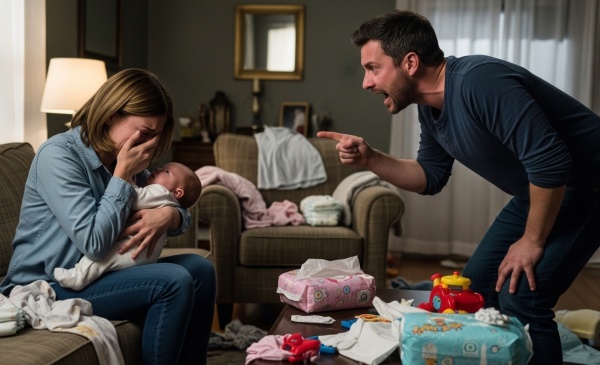
I Left My Toxic Marriage After One Slap—And Discovered I Was Worth 10,000 Times More Without Him… During the day, I’m constantly grinding at the office, and as soon as I get home, it’s a non-stop hustle of cooking and doing laundry for my husband and the kids. There were nights when the baby was crying and my husband would come home completely wasted, throwing up all over the floor. I would just sit there and cry my eyes out. Until that one day…
Part 1: The Charming Man Who Became a Stranger
My name is Rebecca Walsh, and I’m 32 years old, living in Portland, Oregon. I met my ex-husband, Derek Walsh, seven years ago at a mutual friend’s birthday party at a trendy bar in the Pearl District. Derek was 29 at the time, working as a sales manager at a tech startup, and he had that effortless charm that made everyone in the room gravitate toward him. He was tall, about 6’2″, with dark hair styled perfectly, a confident smile, and the kind of charisma that made you feel like you were the only person in the world when he talked to you.
I wasn’t the only woman at that party who noticed him. I watched as he worked the room, making people laugh, telling stories with animated gestures, buying rounds of drinks for strangers. But I’ve never been the type to chase after men, no matter how attractive they are. My mother raised me to believe that if a man is truly interested, he’ll make the effort. So I stayed back, chatting with my friends, pretending I wasn’t watching him out of the corner of my eye.
To my surprise and delight, Derek approached me about an hour into the party. “I’ve been trying to work up the courage to talk to you all night,” he said with that devastating smile. “I’m Derek. And you’re way too interesting-looking to be standing alone in a corner.” It was a cheesy line, but somehow when he said it, it worked. We talked for three hours straight that night, about everything—our jobs, our families, our dreams, our favorite movies and books.
Derek pursued me relentlessly after that party. He texted me good morning every day. He sent flowers to my office—I was working as a graphic designer at a marketing agency, making $58,000 a year. He planned elaborate dates—dinner at fancy restaurants, concerts, weekend trips to the coast. Six months later, he proposed on a hiking trip to Multnomah Falls, getting down on one knee at the top of the trail with a 1-carat diamond ring that cost him $4,500. I said yes without hesitation because I was completely in love with him.
We got married in a small ceremony at a vineyard in Willamette Valley, with about 80 guests. It was beautiful—string lights, wine barrels as tables, a sunset ceremony. I wore a $2,000 dress I’d found on sale, and Derek looked impossibly handsome in his navy suit. We honeymooned in Hawaii for a week, staying at a resort in Maui that cost $3,500 for the trip. Everything felt perfect, like I’d found my person, my partner for life.
For the first two years of our marriage, things were good. We bought a small three-bedroom house in Southeast Portland for $425,000—a stretch on our combined income of about $110,000, but we made it work. I got pregnant six months after the wedding, and our daughter Emma was born when I was 27. Derek seemed excited about being a father. He came to all the ultrasound appointments, helped me paint the nursery, read parenting books with me at night.
But somewhere around Emma’s first birthday, something shifted. Derek started coming home later and later from work. He stopped helping with household chores, leaving dishes in the sink, clothes on the floor, expecting me to clean up after him like I was his mother rather than his wife. He became obsessed with his appearance—spending $200 on haircuts, buying expensive cologne, working out at the gym for two hours every evening instead of coming home to help with Emma.
His job performance started to slip too. He’d been doing well at the tech startup, earning about $65,000 a year with bonuses, but his sales numbers dropped. His boss called him in for performance reviews. Instead of buckling down and working harder, Derek seemed to give up. He started going out drinking with his buddies three or four nights a week, coming home at 2 AM smelling like beer and cigarettes, stumbling through the door and passing out on the couch.
Part 2: The Slow Descent Into Hell
Meanwhile, I was drowning. I was still working full-time at the marketing agency, putting in 40-50 hours a week to keep my job and maintain our income. My salary had increased to $64,000, which was good, but it meant I was under constant pressure to perform, to meet deadlines, to keep clients happy. Every morning I’d wake up at 6 AM, get myself ready, get Emma ready—feeding her, changing her, packing her diaper bag—and drop her off at daycare that cost us $1,200 a month.
Then I’d work all day, dealing with demanding clients and tight deadlines, before rushing to pick Emma up by 5:30 PM. I’d bring her home and immediately start the second shift—making dinner, feeding Emma, giving her a bath, doing laundry, cleaning the kitchen, paying bills, trying to keep our house from falling into complete chaos. Derek would either not be home at all, or he’d be sitting on the couch watching TV, scrolling through his phone, completely oblivious to the fact that I was running myself into the ground.
Some nights were worse than others. I remember one particular Tuesday evening when Emma was about 18 months old. She’d been fussy all day at daycare—the teachers said she might be getting sick. I picked her up, brought her home, and she immediately started crying, that inconsolable wailing that babies do when they don’t feel well. I was trying to comfort her while also making dinner because we had nothing prepared and I knew if I didn’t cook, no one would eat.
Derek came home at 9 PM, drunk. I could smell the alcohol on him from across the room. His shirt was untucked, his tie was missing, and he had that glassy-eyed look of someone who’d had way too many beers. “Hey babe,” he slurred, stumbling toward the kitchen. “What’s for dinner?” I was holding a screaming Emma in one arm while stirring pasta with the other, exhausted and on the verge of tears myself.
“Derek, I need help,” I said, trying to keep my voice calm. “Can you please take Emma while I finish cooking?” He waved me off. “Nah, I’m tired. Had a long day at work.” Then he went to the living room and turned on the TV, cranking up the volume to drown out Emma’s crying.
That night, after I finally got Emma to sleep around 11 PM, I went downstairs to find Derek passed out on the couch, an empty beer bottle on the floor next to him, and vomit on the carpet. He’d thrown up and then just… fallen asleep in it. I stood there in the doorway of our living room, looking at this man I’d married, this man who was supposed to be my partner, and I just started crying. Silent tears at first, then full-body sobs that I had to muffle with my hand so I wouldn’t wake Emma.
After I finished crying, I cleaned up the vomit. I got towels and carpet cleaner and scrubbed the stain out of our beige carpet at midnight. I threw a blanket over Derek because even though I was furious with him, I didn’t want him to be cold. Then I went upstairs, checked on Emma, and lay in bed staring at the ceiling, wondering how my life had become this.
This became our pattern. Derek would go out drinking, come home late or not at all, contribute nothing to our household or our daughter’s care, while I worked myself to exhaustion trying to hold everything together. I tried talking to him—calmly, rationally, explaining that I needed help, that I couldn’t do everything alone, that we were supposed to be a team. He’d apologize, promise to do better, and for a few days he’d make an effort. He’d come home on time, do the dishes, play with Emma. But it never lasted. Within a week, he’d be back to his old habits, and I’d be back to drowning.
Part 3: The Night Everything Shattered
The breaking point came on a Friday night in March, about three and a half years into our marriage. Emma was two years old, finally sleeping through the night most nights, which should have made things easier. But Derek’s behavior had gotten even worse. He’d been fired from his job at the tech startup two months earlier for poor performance and showing up late too many times. Instead of immediately looking for new work, he’d been “taking a break” and “figuring out his next move,” which apparently meant sleeping until noon and playing video games all afternoon.
I was now the sole breadwinner for our family, my $64,000 salary stretched impossibly thin to cover our $2,400 mortgage, the $1,200 daycare, utilities, groceries, car payments, and everything else. I’d asked Derek repeatedly to at least take over the household responsibilities since he wasn’t working—do the laundry, clean the house, make dinner, pick up Emma from daycare. He’d agreed, but he never followed through. I’d come home to find him on the couch, the house a mess, no dinner prepared, Emma still at daycare waiting to be picked up.
That Friday, I’d had an especially brutal day at work. A major client had rejected our entire campaign proposal, my boss had blamed me, and I’d had to stay late scrambling to come up with new ideas. I didn’t leave the office until 7 PM, which meant I was late picking up Emma from daycare—they charged $1 per minute after 6 PM, so I owed them an extra $60. Emma was cranky and tired, the daycare workers were annoyed with me, and I felt like the world’s worst mother.
I got home at 7:45 PM to find Derek sitting on the couch with a beer, watching a basketball game. The house was a disaster—dishes piled in the sink from breakfast, toys scattered everywhere, laundry overflowing from the hamper. “Derek,” I said, trying to keep my voice level as I set Emma down and started picking up toys. “Why didn’t you clean today? You’ve been home all day.”
He didn’t even look away from the TV. “I was busy.” “Busy doing what?” I asked, my frustration rising. “Playing video games? Watching TV?” “Jesus, Rebecca, get off my back,” he snapped. “I’ll do it tomorrow.”
“You said that yesterday!” I was raising my voice now, too tired and stressed to stay calm. “And the day before that! I’m working 50 hours a week, taking care of Emma, doing everything around here, and you can’t even load the dishwasher?” Derek finally looked at me, his face flushed with anger and alcohol. “Maybe if you weren’t such a nag, I’d want to help you.”
Something inside me broke. All the months of exhaustion, of feeling unappreciated and unsupported, of watching this man I’d loved turn into a lazy, selfish stranger—it all came pouring out. “You’re pathetic!” I shouted. “What kind of man can’t even take care of his own family? You’re useless! You’re a coward!”
Derek’s face went dark. He stood up from the couch, swaying slightly, his hands clenched into fists. “What did you just call me?” His voice was low and dangerous. I should have backed down. I should have walked away. But I was too angry, too hurt, too done with all of it.
“I called you a coward,” I said, my voice shaking but defiant. “Because that’s what you are. A useless, pathetic coward who can’t even—”
I didn’t get to finish the sentence. Derek’s hand flew out and struck me across the face with a force that knocked me sideways. I stumbled, catching myself on the arm of the couch, my cheek exploding in pain. The room spun. My ears rang. I tasted blood in my mouth where my teeth had cut the inside of my cheek.
For a moment, everything was silent. Emma, who’d been playing with blocks in the corner, started crying. Derek stood there, his hand still raised, looking shocked at what he’d just done. And I stood there, holding my face, feeling the hot sting of the slap and the even hotter sting of tears.
Part 4: The Escape and the Awakening
Derek took a step toward me, and I flinched. “Rebecca, I—” he started, but I didn’t want to hear it. I scooped up Emma, grabbed my purse and car keys, and ran out of the house. I didn’t know where I was going. I just knew I had to get away from him.
I ended up at my neighbor’s house. Michael Chen lived three doors down in a small bungalow he’d bought a year ago. He was 35, a high school teacher who made about $55,000 a year, and we’d become friendly over the past year—waving hello when we saw each other, chatting about the neighborhood, occasionally borrowing tools or cups of sugar. He’d always been kind, asking how I was doing, offering to help if I needed anything.
I knocked on his door at 8:30 PM, holding a crying Emma, my face swollen and red from Derek’s slap. Michael opened the door, took one look at me, and immediately ushered me inside. “Oh my God, Rebecca, what happened? Are you okay?” I started crying again, the whole story pouring out—Derek’s drinking, his unemployment, the years of carrying everything alone, and finally, the slap.
Michael listened without interrupting, his face growing more concerned and angry as I talked. When I finished, he said firmly, “You can’t go back there tonight. You and Emma stay here. I’ll sleep on the couch. In the morning, we’ll figure out next steps.” I stayed at Michael’s house that night, sleeping in his guest room with Emma curled up next to me. I barely slept, my mind racing with fear and anger and a strange sense of relief. The next morning, Michael made us breakfast—scrambled eggs and toast, nothing fancy, but it was the first time in years someone had cooked for me.
“I’m calling the police,” Michael said as we ate. “What Derek did is assault. You need to file a report.” I was scared—scared of what Derek would do, scared of the legal process, scared of being a single mother. But Michael was right. So we called the police, I filed a report, and I got a restraining order against Derek that same day.
The next week, I filed for divorce. I hired a lawyer—Sharon Martinez, who specialized in domestic violence cases and worked with me on a payment plan since I couldn’t afford her $300-per-hour rate upfront. The divorce took four months to finalize. I got the house—it was in my name anyway since I’d put down the down payment with money from my savings. Derek got nothing except a court order to pay $800 a month in child support, which he rarely paid on time.
Part 5: The Life I Deserved All Along
During those four months of divorce proceedings, something unexpected happened. Michael and I grew closer. He’d check on me every day, asking how I was doing, if I needed anything. He’d come over after work to help with Emma, playing with her in the backyard while I made dinner. He’d fix things around my house that Derek had always been “too busy” to deal with—the leaky faucet, the broken porch step, the stuck window.
Michael never made me feel like I owed him anything. He never expected anything in return. He just… helped. Because he was a genuinely good person who cared about me and Emma. Slowly, I started to see him differently. I noticed how patient he was with Emma, how he’d get down on the floor to play with her dolls and never complained. I noticed how he’d ask about my day and actually listen to the answer. I noticed how he made me laugh, something I hadn’t done in years with Derek.
Six months after my divorce was finalized, Michael asked me out to dinner. “Just the two of us,” he said nervously. “I know you might not be ready, and that’s okay. But I really like you, Rebecca. I have for a while. And I’d like to take you on a proper date, if you’re interested.” I was interested. Very interested.
That first date turned into a second, then a third. Within a year, Michael and I were in a serious relationship. He was everything Derek wasn’t—responsible, kind, supportive, present. He had a stable job he loved, teaching history at a local high school. He was great with Emma, who started calling him “Mike” and asking when he’d come over. He split household chores with me without being asked. He cooked dinner, did laundry, helped with bedtime routines.
Two years after my divorce, Michael proposed. We got married in a small ceremony in my backyard, with just close friends and family. Emma, now five years old, was our flower girl. We didn’t have a lot of money—Michael’s teacher salary and my graphic designer income meant we lived modestly—but we had something infinitely more valuable. We had partnership. We had respect. We had love.
Today, I’m 32 years old, and I’ve been married to Michael for three years. We’re happy. Emma is thriving—she’s seven now, doing great in school, and she adores Michael. We still live in the same house I bought with Derek, but it feels completely different now. It’s filled with laughter and warmth instead of tension and resentment.
As for Derek, I heard through mutual friends that he’s still unemployed, still drinking, living in a cheap apartment and barely scraping by. He sees Emma once a month for supervised visits, and he’s usually late and unprepared. Emma doesn’t ask about him much anymore. Michael is her dad in every way that matters.
Sometimes I think about that night Derek slapped me, and I feel a strange sense of gratitude. Not for the violence—that was inexcusable and traumatic. But for the clarity it gave me. That slap was the wake-up call I needed to realize I deserved better. I deserved a partner who respected me, who supported me, who showed up for me and our daughter.
I’m worth so much more than Derek ever made me feel. And now, with Michael by my side, I finally know that. I’m not just surviving anymore—I’m thriving. And I would never, ever go back to the life I had before.
To any woman reading this who’s in a similar situation—married to someone who doesn’t appreciate you, who doesn’t contribute, who makes you feel small and worthless—please know that you deserve better. You deserve a partner who sees your value, who shares the load, who treats you with respect and love. Don’t wait for a slap to wake you up. Choose yourself. Choose your happiness. Choose to leave before it gets worse.
I did, and it was the best decision I ever made.
