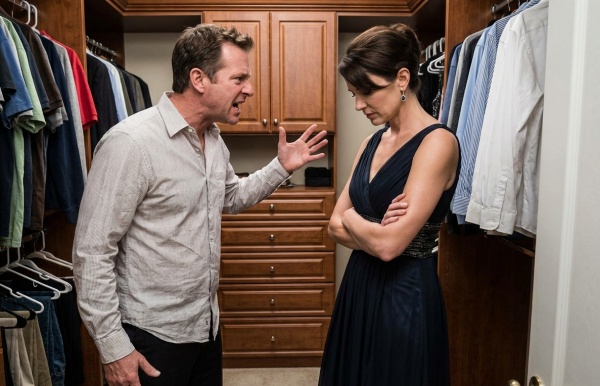
Every night, my husband disappeared into another woman’s bed… then came home asking why I suddenly cared about my hair, my makeup, and the dresses I wore to dinner. He never noticed the heartbreak behind my smile — until the night he stumbled through our front door at midnight and found my closet half empty, divorce papers on the table, and a note that began with four words he never expected to read: “You chose her. Reap.”
Part 1: The Questions He Had No Right to Ask
My name is Rachel Bennett, and for most of my adult life, I believed that marriage was not supposed to feel like a courtroom.
I was thirty-seven years old, a pediatric nurse practitioner in Columbus, Ohio, and I had been married to my husband, Ethan Bennett, for eleven years. We lived in a two-story house in Upper Arlington with a white kitchen, a fenced backyard, and a front porch where I used to drink coffee before early shifts at Nationwide Children’s Hospital. From the outside, we looked like the kind of couple people used as proof that steady love still existed.
Inside the house, things had become quieter than a hospital hallway at 3:00 a.m.
Ethan was forty, a regional operations manager for a logistics company, which sounded boring until you understood how often it gave him an excuse to be gone. He had client dinners, warehouse audits, overnight trips to Indianapolis, emergency meetings in Dayton, and “late calls” that somehow always required him to leave the house freshly showered and wearing the cologne I had bought him for our anniversary. At first, I believed him because believing your husband is easier than admitting your body has already started warning you.
The first time he asked who I was dressing up for, I laughed.
I was standing in our bedroom at 6:15 on a Tuesday morning, clipping on small gold hoops before work. I had on navy slacks, a cream blouse, and the clean white coat I wore at the clinic. My hair was pulled back because children cough directly into your face for a living, and perfume was out of the question because some of my patients had asthma.
“Who are you trying to impress?” Ethan asked from the doorway.
I turned around, still smiling because I thought he was joking. “The four-year-old with strep throat on my 8:00 schedule.”

He did not smile back.
“I’m serious,” he said. “You’ve been putting in effort lately.”
That sentence stayed with me for the rest of the day.
Not because it was true.
Because it was strange.
I had not changed much at all, except maybe I had started wearing lipstick again because my friend Megan from work had told me I looked like I had surrendered to fluorescent lighting. I bought two new blouses from Nordstrom Rack. I started walking at lunch instead of eating crackers at my desk. None of that should have made my husband suspicious unless suspicion was something he carried home from somewhere else and needed to set down on me.
By the third week, the questions were no longer occasional.
They were routine.
If I wore jeans that fit well, he asked where I was going after work. If I curled my hair on a Saturday, he asked whether Megan’s brunch was really “just women.” If I came home ten minutes late because a child needed stitches or a mother needed reassurance, Ethan asked why my phone had been on silent.
The irony was almost violent.
Because while he questioned me over earrings and lipstick, he was disappearing every night.
Sometimes he said he was at the office.
Sometimes he said traffic was bad on I-270.
Sometimes he said the new distribution contract had everyone working late.
And sometimes he did not bother with a reason at all.
He would come home after midnight smelling faintly of hotel soap and winter air, kiss the top of my head like a man checking a box, and go straight to the shower. I lay in bed pretending to sleep, listening to the water run, feeling my marriage turn into something I had to survive quietly. People think betrayal begins when you find proof. It does not. It begins when you start changing your behavior to avoid hearing another lie.
Her name was Vanessa Cole.
I found out by accident, which is usually how people find the truth when the liar gets comfortable.
Ethan’s Apple Watch was charging on the kitchen counter one Sunday morning while he was in the garage pretending to organize tools. A message flashed across the screen. I did not pick it up. I did not have to.
Last night was perfect. I hate watching you leave.
The contact name was just V.
My entire body went cold in the middle of my own kitchen, with coffee dripping into the pot and sunlight hitting the floor like nothing had happened.
That was the first proof.
It was not the last.
Part 2: The Woman Named V
Once you know where to look, the truth becomes rude.
It stops hiding politely.
I did not confront Ethan that Sunday because a part of me still wanted to be wrong. That is embarrassing to admit, but it is true. Even with the message glowing on his watch, even with months of late nights and defensive questions, some tired corner of my heart still hoped there was an explanation that would let me keep my life intact.
Instead, I started documenting.
Not obsessively.
Not illegally.
Just carefully.
I checked our joint Visa statements because my name was on the account. I reviewed the bank app because our mortgage, utilities, groceries, and savings all moved through shared accounts. I looked at the phone bill because we were on the same family plan and the call logs were available to both of us.
Vanessa Cole appeared everywhere once I knew the initial.
A restaurant in Dublin called The Pearl, $184.76 on a Wednesday night Ethan claimed he was eating pizza with the warehouse team. A boutique hotel near the Short North, $312.40, labeled in his calendar as “vendor review.” A jewelry purchase from Easton Town Center for $1,180, charged two days before he gave me a $35 candle for my birthday and said money was tight.
The candle had smelled like cedar and apology.
I had thanked him.
That memory made me sit down on the bathroom floor and breathe into my hands.
Vanessa worked in sales for one of Ethan’s vendors. I found her on LinkedIn first, then Instagram because people who live double lives often rely on other people being too polite to look. She was thirty-two, divorced, attractive in a polished corporate way, with smooth brown hair, expensive gym clothes, and captions about “choosing peace” under photos taken from rooftop bars.
There were no pictures of Ethan.
Of course there were not.
But there were photographs of hotel lobbies I recognized from credit card statements, cocktails with two glasses visible at the edge of the frame, and one picture from a Cincinnati restaurant where a man’s hand rested on the table beside hers. The hand wore a watch I had bought Ethan for Christmas three years earlier.
I stared at that hand for a long time.
Then I took a screenshot.
By then, his questioning of me had become almost theatrical.
One Friday night, he walked into our bedroom while I was getting ready for Megan’s birthday dinner. I was wearing a black wrap dress I had owned for four years, ankle boots, and the red lipstick I used once every six months when I wanted to remember I had a face and not just responsibilities. Ethan leaned against the doorframe and looked me up and down like he was inspecting evidence.
“That’s a lot for dinner with nurses,” he said.
I met his eyes in the mirror. “It’s Megan’s birthday.”
“At a restaurant?”
“Yes, Ethan. Birthdays often happen at restaurants.”
He did not like that.
“You’ve gotten mouthy lately.”
There it was.
The word men use when a woman stops shrinking her sentences.
I turned around slowly. “Mouthy?”
“You know what I mean.”
“No,” I said. “Explain it.”
He looked away first.
That small victory should have felt better than it did.
When I got home that night at 10:45, Ethan’s car was gone. He had texted at 8:17 that an urgent system failure required him to drive to the Grove City facility. The phone bill later showed a forty-two-minute call to Vanessa at 8:23. His car pulled into the driveway at 1:18 a.m.
I was awake when he came in.
He stood in the bedroom doorway, saw that my makeup was off and my pajamas were on, and asked, “Good night?”
I said, “Yes.”
He stared for a moment. “Who was there?”
I almost laughed.
Not because it was funny.
Because the man had come home from another woman’s bed and still needed me to account for a birthday dinner.
“Megan,” I said. “Priya. Lauren. Two women from cardiology. A server named Josh who brought the check.”
His jaw tightened.
“You don’t have to be sarcastic.”
“And you don’t have to interrogate me.”
His face changed then, not dramatically, but enough for me to recognize the thing beneath his questions. It was not jealousy, not really. It was projection. He was accusing me of carrying the secret he could not stand seeing in himself.
That night, after he fell asleep, I opened a folder on my laptop and named it simply: Bennett Records.
Into it went screenshots, statements, dates, charges, call logs, photos, and notes.
I was not ready to leave.
But I was done being unprepared.
Part 3: The Plan I Built in Silence
Leaving a marriage is not one decision.
It is a thousand small ones.
It is changing passwords at lunch. It is opening a separate checking account at Huntington Bank with your own paycheck direct deposit. It is calling a family law attorney from your car in the hospital parking garage and trying to sound normal while saying words like “marital assets” and “temporary orders.” It is realizing that grief does not make appointments, but attorneys do.
My attorney’s name was Lydia Grant, and her office was in downtown Columbus, on the eighth floor of a building that smelled faintly of carpet cleaner and old paper. She was in her fifties, calm, direct, and not easily impressed. When I spread my documents across her conference table, she put on reading glasses, reviewed them for fifteen minutes, and said, “You are not as powerless as he has made you feel.”
I did not cry until then.
Not at the Apple Watch.
Not at the hotel charges.
Not at the Instagram hand.
But when a woman I had known for less than an hour said that sentence in a steady voice, something in me finally loosened.
Ohio is a no-fault divorce state, Lydia explained, but that did not mean conduct never mattered. Infidelity alone would not automatically hand me the house or punish Ethan in some dramatic courtroom scene, despite what people in comment sections like to imagine. But marital funds spent on an affair could become relevant in property division, especially if there was clear documentation.
“You have documentation,” she said.
I nodded.
“You also have a pattern of controlling behavior,” she added. “The constant questioning, the accusations, the isolation pressure. That matters for strategy, even if not in the way people assume.”
I told her I did not want revenge.
She looked at me over her glasses.
“Good,” she said. “Revenge makes people sloppy. Protection makes people precise.”
So I became precise.
For six weeks, I moved carefully.
I rented a small two-bedroom apartment in Grandview under my own name. I told the leasing manager I was separating and needed discretion, and she nodded with the quiet competence of a woman who had clearly seen more than one life rearrange itself over a security deposit. I bought a mattress, towels, dishes, a coffee maker, and a gray couch from Facebook Marketplace that smelled faintly of someone else’s dog but looked decent after I cleaned it twice.
I packed slowly.
Not enough for Ethan to notice.
A winter coat here.
A box of books there.
Copies of my medical certifications, passport, birth certificate, tax records, and the silver bracelet my grandmother left me. I moved things to Megan’s garage first, then to the apartment once I got the keys.
Every night, Ethan kept disappearing.
Every morning, he kept questioning me.
One Tuesday, I wore a green dress to work because it was clean and had pockets. He stood in the kitchen holding coffee and asked, “Since when do you wear dresses on weekdays?” I looked at him and said, “Since women’s clothing companies discovered pockets.” He did not laugh.
Another night, he came home at 12:36 a.m. and found me reading in bed.
“You’re still awake?”
“Yes.”
“Waiting up for someone?”
I closed the book.
“Apparently not.”
He stared at me, trying to decide whether I knew.
By then, I had learned that silence can be more frightening than anger. Anger gives people something to argue with. Silence makes them hear themselves.
Lydia advised me not to confront Ethan alone if I believed he would escalate emotionally. Ethan had never been physically violent, and I want to be clear about that, but emotional volatility does not need bruises to matter. He slammed cabinets. He blocked doorways during arguments. He used questions as traps and apologies as reset buttons.
So I chose timing over drama.
I decided to leave on a Thursday night because Ethan had a standing “late inventory call” every Thursday, which I now knew meant he was usually at Vanessa’s townhouse near Polaris. Megan and her brother Aaron agreed to help me move the last of my things. Aaron owned a pickup truck and had the gentle, silent presence of a man who understood that sometimes the most helpful thing you can do is carry boxes without asking questions.
At 7:10 p.m. that Thursday, Ethan kissed my cheek and told me not to wait up.
“Big night?” I asked.
“Work,” he said.
“Of course.”
He paused, keys in hand. “Why did you say it like that?”
“Like what?”
“Never mind.”
He left wearing the navy shirt I used to love.
I watched his headlights disappear down the street, then stood in the quiet kitchen and let myself feel exactly one minute of sadness. Eleven years of marriage deserved at least that. Then I wiped my face, called Megan, and said, “Come now.”
By 11:42 p.m., half my closet was empty.
By 11:55, my essentials were gone.
By midnight, there was a note on the kitchen table.
Part 4: The Note on the Table
I wrote the note by hand because typed words felt too clean for something that had cost me so much.
Ethan had always said my handwriting was too neat, like I was taking notes for someone else to judge. That night, I wrote slowly, in blue ink, sitting at the kitchen table where we had eaten takeout, paid bills, argued about nothing, and avoided talking about everything. Megan waited in the living room with the last box. Aaron stood on the porch, giving me privacy.
The note began with one sentence.
Ethan, I know about Vanessa.
I sat with that line for a moment.
Then I continued.
I know about the hotel charges, the restaurant bills, the jewelry, the late-night calls, the Thursday “inventory meetings,” and the weekends you said were for work. I know because you left a trail through accounts that have my name on them too. I have copies of everything.
I did not call him names.
I did not write the words I wanted to write.
Words like coward.
Fraud.
Stranger.
Instead, I kept the note factual, because facts were harder for him to twist.
What made this worse was not only the affair. It was coming home from another woman and asking me who I was dressing up for. It was watching you question my clothes, my lipstick, my coworkers, my ten-minute delays, while you were spending our money and my trust on someone else.
My hand shook then.
I put the pen down.
Megan came to the doorway. “You okay?”
“No,” I said. “But I’m leaving anyway.”
She nodded. “That counts.”
I kept writing.
I have retained an attorney. You will receive communication from Lydia Grant’s office. Do not empty accounts, remove documents, or attempt to hide transactions. Do not come to my workplace. Do not contact my friends or family looking for me. If something is urgent and logistical, email me. Otherwise, speak to my attorney.
Then came the part I rewrote three times.
I am not leaving because I stopped loving you overnight. I am leaving because you trained me to doubt myself while giving me every reason to trust my instincts. I am leaving because I refuse to spend another morning defending a blouse to a man who spent the previous night lying to me.
That was the truest sentence in the letter.
I folded the paper once and placed it in the center of the kitchen table. Beside it, I put my house key. Not my wedding ring. I kept that, at least for the moment, because Lydia said not to make symbolic decisions that could create practical complications, and also because I was not ready to decide what it meant to me.
At 12:08 a.m., my phone buzzed.
Ethan.
You awake?
I stared at the message.
Then another came.
Heading home soon.
Then:
Why is the closet light on? I got a motion alert.
Of course.
The hallway camera.
The one he had installed after a package was stolen two years ago and then forgot could notify both of us.
I looked up at Megan.
“He knows something.”
“Then we go now,” she said.
We walked out through the garage. Aaron loaded the last box into his truck. I got into Megan’s car with my purse, laptop, and a duffel bag on my lap, and as we pulled away, I saw the house in the side mirror — warm lights, clean windows, hydrangeas along the walkway.
A beautiful house can hold an ugly truth for a long time.
We were five minutes away when Ethan called.
I did not answer.
He called again.
Then again.
Then came the texts.
Rachel?
Where are you?
Why is your stuff gone?
What the hell is happening?
At 12:27 a.m., he called Megan.
She declined.
At 12:31, he sent the message I had expected.
Are you with someone? Is that what this is?
I laughed then.
A short, broken sound that startled even me.
Megan kept driving.
“Do you want me to pull over?” she asked.
“No,” I said, wiping my eyes. “Keep going.”
At 12:44 a.m., Ethan left a voicemail.
I listened to it in Megan’s passenger seat while the Columbus skyline glowed ahead of us.
His voice was not angry at first.
It was confused.
Then irritated.
Then frightened.
“Rachel, I’m home. Your closet is half empty and there’s a note on the table. Call me. We need to talk. You can’t just leave like this. I don’t know what you think you know, but you’re overreacting. Please call me.”
There it was.
Not “I’m sorry.”
Not “I hurt you.”
Not “You were right.”
Just: You’re overreacting.
Even with half my closet empty, he was still trying to put the burden back in my hands.
I deleted the voicemail.
Then I turned off my phone.
For the first time in months, the silence felt like mine.
Part 5: The First Morning That Belonged to Me
The apartment smelled like lemon cleaner, cardboard, and new beginnings that had been assembled under stress.
It was not beautiful yet.
The couch was too low, the mattress sat on a basic metal frame, and the kitchen contained exactly one pan, two mugs, four plates, and a set of forks Megan had bought at Target because she said no woman should start over eating with plastic utensils. The bedroom window faced an alley and a brick wall, but in the morning, a line of sunlight came through the blinds and landed across the floor like a promise.
I woke at 6:30 a.m. after three hours of sleep and did not know where I was for one terrifying second.
Then I remembered.
I had left.
My body understood before my mind did. My shoulders were not tight. My jaw was not clenched. I did not listen for Ethan’s footsteps or check whether he was in one of his moods. I simply lay there under a cheap white comforter and realized that no one in that apartment was going to ask me who I was dressing up for.
At 7:15, I turned my phone back on.
There were thirty-eight missed calls.
Twelve voicemails.
Twenty-six texts.
Two emails.
One message from Vanessa.
That surprised me.
I opened it against my better judgment.
Rachel, I don’t know what Ethan told you, but things between us are complicated. He said your marriage was basically over. I never wanted to hurt anyone.
I read it twice.
Then I forwarded it to Lydia and did not respond.
Because that was the thing I was learning: not every message deserves access to you.
Ethan’s texts moved through stages.
First confusion.
Then anger.
Then accusation.
Then panic.
Then tenderness, or what he thought tenderness sounded like.
Baby, please.
Come home and we’ll talk.
You’re making this bigger than it has to be.
I never meant for you to find out this way.
That one almost made me laugh again.
Not because it was funny.
Because he had not written, I never meant to do this.
He had written, I never meant for you to find out.
At 9:00 a.m., Lydia’s office sent formal notice to Ethan’s email and his attorney, once he retained one. She advised him that I had initiated divorce proceedings, requested preservation of financial records, and would be seeking review of marital funds used in connection with the affair. She also advised that all communication should go through counsel unless it involved urgent shared property logistics.
Ethan did not like that.
Men who rely on emotional access do not like locked doors.
By noon, he had driven to the hospital and asked for me at the clinic reception desk. Security called me before letting him past the main lobby. I was not scheduled that day, but the fact that he came there was enough. Lydia documented it immediately and sent a second letter reminding him not to appear at my workplace.
That afternoon, I met Megan for coffee in Grandview.
I wore jeans, a white sweater, and the red lipstick.
No one questioned it.
No one asked who it was for.
Megan looked at me across the table and said, “How do you feel?”
I thought about lying.
Then I told the truth.
“Like I escaped a room I didn’t know was locked.”
The divorce process was not quick or cinematic. Real life rarely gives you the satisfaction of immediate justice with dramatic music underneath. There were disclosures, temporary arrangements, negotiations, appraisals, bank statements, attorney fees, and the dull exhaustion of explaining your life to strangers who reduce it to documents.
But documents mattered.
The hotel charges mattered.
The jewelry mattered.
The dinners mattered.
The money spent on Vanessa from accounts that had funded our mortgage and retirement savings mattered.
Lydia did not promise that a judge would punish Ethan for being unfaithful. She was too honest for that. But she did make sure every dollar was traced, every account was preserved, and every attempt Ethan made to rewrite the story met a paper trail.
At mediation, Ethan looked smaller than I remembered.
Not physically.
Emotionally.
He sat across the conference table in a navy blazer, twisting his wedding ring around his finger like it had suddenly become meaningful again. His attorney did most of the talking. Ethan avoided looking at me until the mediator asked whether there was any possibility of reconciliation.
He looked up then.
For one second, I saw the man I had married at twenty-six, the man who cried during our vows, the man who once drove through a snowstorm to bring me soup during a double shift. I missed that man with a suddenness that nearly knocked the breath out of me. Then I remembered that missing someone does not mean they are still there.
“No,” I said.
Ethan flinched.
“I made mistakes,” he said.
I nodded. “You made choices.”
He looked wounded by the distinction.
That was not my problem anymore.
The settlement was fair. Not perfect, because nothing about divorce feels perfect, but fair. I kept my retirement account intact, received reimbursement credit for a portion of marital funds spent on the affair, and we agreed to sell the house because neither of us could afford it comfortably alone without turning it into a battlefield.
The day I walked through that house for the final time, the hydrangeas were blooming.
My closet was completely empty by then.
The kitchen table was gone.
The bedroom echoed.
I stood in the doorway of the room where I had once defended earrings, lipstick, work clothes, and my own integrity to a man who had already given his away. I expected to feel devastated. Instead, I felt tired, grateful, and strangely gentle toward the woman I had been.
She had stayed too long.
But she had also gotten herself out.
That counts.
Six months later, I still live in the apartment in Grandview. I bought a real bed frame, replaced the couch, and added plants to the window ledge even though the view is still mostly brick. On Saturday mornings, I walk to a coffee shop two blocks away and order a vanilla latte I used to think was too expensive.
Sometimes I dress up for no reason.
Sometimes I wear lipstick to buy groceries.
Sometimes I put on the green dress with pockets and take myself to dinner.
No one asks who it is for.
And if anyone ever does again, I know the answer now.
It is for me.
Ethan spent every night with his mistress and came home questioning my reflection because he could not stand his own. He thought suspicion would keep me defensive. He thought I would be too busy proving my innocence to notice his guilt.
He was wrong.
The night he came home at midnight and found my closet half empty, he finally understood something I had been learning for weeks.
A woman does not have to scream to leave.
She does not have to announce the moment she stops believing you.
Sometimes she just stops explaining, starts packing, and writes one clear note on the table.
And by the time you read it, she is already gone.
