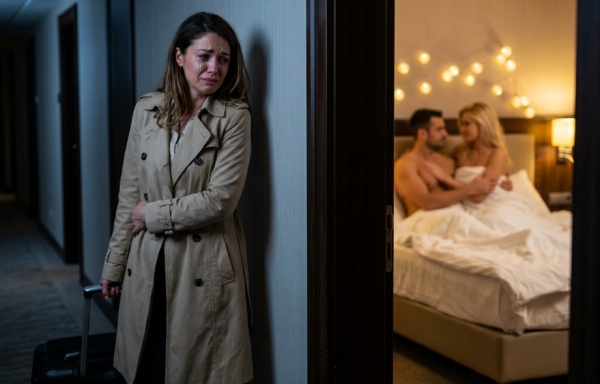
He thought his wife was out of town for their anniversary, so he brought another woman into the home they had built together. What he did not know was that Megan had come home early, carrying a pregnancy test that was supposed to change their lives. She heard enough to know there was nothing left to explain.
Before he ever realized she had been there, she removed her wedding ring, placed it beside the anniversary cake, and chose herself and her unborn child over another night of being lied to.
Part 1 — The Third Anniversary
I left my husband on our third anniversary with a positive pregnancy test in my coat pocket and the sound of another woman breathing in our bed.
He did not know I had come home early.
He did not know I was carrying his child.
And he did not hear the front door close behind me.
It was raining in Seattle that night, the kind of steady, cold rain that turns streetlights into blurry halos and makes every window look lonely. I had spent the afternoon at a clinic near Capitol Hill, sitting on a paper-covered exam table while a nurse smiled and said, “Congratulations, Mrs. Carter. You’re pregnant.”
For a moment, I forgot how to breathe.
Pregnant.
After eleven months of trying, three negative tests, two fertility consultations, and too many nights pretending I was fine, there it was. A tiny word that changed the shape of my whole future.
I cried in the clinic bathroom afterward, holding the test in both hands like it was made of glass. Then I laughed because I could already imagine Ethan’s face when I told him. My husband loved surprises when they made him feel chosen, and this was supposed to be the best one of our marriage.
It was our third anniversary.
I had planned everything.
I had told Ethan I would be stuck in Portland overnight for a vendor meeting related to my bakery business, but the meeting ended early. Instead of calling him, I bought a small pair of cream-colored baby booties from a boutique near Pike Place Market and tucked them into my purse beside the pregnancy test. I imagined walking into the house, lighting the candles I had ordered, and handing him the tiny box after dinner.
Maybe he would cry.
Maybe he would pick me up and spin me around the kitchen like he did when we first moved into the house.
Maybe he would finally stop looking so far away.
That was the thought I tried not to admit.
For months, Ethan had been distant in a way I could not name without sounding paranoid. He came home late from work, took calls in the garage, tilted his phone away from me at dinner, and said I was “reading too much into things” whenever I asked if we were okay.
I blamed stress.
He was a senior project manager at a construction firm in Bellevue, and his company had been bidding on a major waterfront development. He told me the pressure was brutal, that clients were impossible, that his boss expected miracles. I believed him because marriage requires trust, and trust sometimes looks like giving someone the benefit of the doubt until the doubt becomes evidence.
That night, I drove home through the rain with one hand resting on my stomach.
Our house sat in Ballard, a modest craftsman with blue-gray siding, white trim, and a maple tree that dropped leaves all over the front steps every October. We had bought it two years earlier with help from the money my grandmother left me and a loan I still sometimes woke up worrying about.
It was not a mansion.
It was not perfect.
But it was ours.
Or I thought it was.
The porch light was on when I pulled into the driveway. Ethan’s truck was parked outside. So was a white Audi I did not recognize.
For one foolish second, I smiled.
Maybe he had arranged a surprise too.
Maybe he had invited friends over. Maybe my sister had helped him plan something. Maybe the extra car belonged to a caterer, a florist, someone hired to make our anniversary feel special.
Then I stepped inside.
The house was warm and dim. A half-empty bottle of red wine sat on the entry table beside two glasses. One glass had lipstick on the rim.
Not mine.
I stood in the foyer with rain dripping from my coat onto the hardwood floor, listening.
At first, all I heard was music from upstairs. Soft, low, familiar. Ethan had put on the playlist we danced to at our wedding reception in Tacoma, the one with old soul songs and the acoustic cover of “Can’t Help Falling in Love.”
Then I heard her laugh.
Not loud.
Not careless.
Comfortable.
A woman laughing in a house where she had been welcomed.
My hand moved to my coat pocket, where the pregnancy test pressed against my palm. I should have called his name. I should have stormed upstairs. I should have demanded that whoever she was get out of my bed, my house, my life.
But my body did not move.
Maybe shock is merciful that way.
It stops you from stepping into a room where you will never be the same again.
I climbed the stairs slowly.
Our bedroom door was not fully closed. A narrow slice of light spilled into the hallway. I saw Ethan’s shirt on the floor first, then a pair of black heels near the dresser, then the gray silk scarf I had bought him for Christmas hanging over the chair like a flag of surrender.
I heard his voice.
“You worry too much,” he said softly. “She’s in Portland until tomorrow.”
The woman murmured something I could not make out.
Then he laughed.
“She won’t know.”
Those three words ended my marriage before I ever saw his face.
She won’t know.
Not “I’m sorry.”
Not “This is wrong.”
Not even guilt.
Just confidence.
I stepped back from the door.
My heel caught against the floorboard, and for one terrifying second I thought the sound would give me away. But the music covered it. Ethan kept talking, and the woman kept breathing softly in our bed.
I went downstairs.
In the kitchen, the anniversary cake I had ordered that morning sat in a white box on the counter. I had asked the bakery to write Three years down, forever to go in blue frosting. The words looked childish now, almost cruel.
I opened my purse and took out the baby booties.
Then I stopped.
I could not leave them there.
Not for him.
Not for her to find.
Not for that room.
Instead, I took off my wedding ring and placed it on the kitchen island beside the cake box. The diamond caught the light once, bright and useless. I stared at it for a moment, trying to feel something dramatic.
I felt only cold.
Then I zipped my coat, picked up my purse, and left.
The rain hit my face as I walked down the porch steps. I did not look back. If I had, I might have seen the bedroom window glowing above me, warm with the life I had just walked away from.
I got into my car and drove.
I did not know where I was going until I found myself outside my sister’s apartment in Queen Anne.
My older sister, Natalie, opened the door in pajama pants and an oversized University of Washington sweatshirt. She took one look at me and stepped aside without asking a single question.
That was how I finally broke.
I handed her the pregnancy test.
Then I whispered, “He doesn’t know.”
Natalie looked at the test, then at my face.
“About the baby?”
I shook my head.
“About me coming home.”
Her eyes hardened.
She locked the door behind me.
Part 2 — The Morning After
Ethan called at 7:16 the next morning.
I watched his name glow on my phone while sitting on Natalie’s couch under a fleece blanket, the pregnancy test and baby booties on the coffee table like evidence from two different lives. I had not slept. Every time I closed my eyes, I heard his voice.
She’s in Portland until tomorrow.
She won’t know.
Natalie stood in the kitchen making coffee she knew I could not drink anymore. She looked over when my phone buzzed again. “Do not answer.”
“I know.”
“Do you?”
I looked at her.
She softened slightly. “Megan, I love you. But you have spent three years explaining his behavior to yourself before he even had to try.”
That hurt because it was true.
Ethan had always been charming in a way that made people forgive him quickly. He could forget my birthday dinner reservation and somehow turn the apology into a story about how hard he was trying. He could snap at me, then show up with flowers and a guilty smile, and I would feel cruel for staying upset.
He knew how to make forgiveness feel like my responsibility.
At 7:23, he texted.
Happy anniversary, babe. Call me when you wake up. Miss you.
I stared at the words until they blurred.
Happy anniversary.
Miss you.
He had sent that message from the same house where another woman had slept in our bed.
Natalie read it over my shoulder and made a sound under her breath that would have offended our mother if she were still alive. Then she set a mug of peppermint tea in front of me and sat down.
“You need a lawyer.”
I laughed once, hollow and strange. “It’s been one night.”
“No,” she said. “It’s been however long he has been lying.”
I wanted to argue.
I wanted to say marriage deserved a conversation, that maybe there was an explanation, that perhaps I had misunderstood what I saw and heard. But even as the thought formed, I hated myself for it.
I had not misunderstood lipstick on a wineglass.
I had not misunderstood another woman’s shoes.
I had not misunderstood my husband saying I would not know.
By 9:00 a.m., Natalie had called her friend Rebecca Sloan, a family law attorney in Seattle who had handled divorces, separations, custody disputes, and financial misconduct cases for fifteen years. Rebecca agreed to see me that afternoon.
Before the meeting, Natalie drove me to my OB-GYN’s office.
I sat in the waiting room surrounded by women with round bellies, toddlers with snack cups, and fathers holding ultrasound photos. The sight of one man tying his pregnant wife’s shoe made my throat close.
Ethan should have been there.
Or maybe he should never have been there at all.
The doctor confirmed what the clinic already had. I was about five weeks pregnant. Very early. Too early for much more than bloodwork, caution, prenatal vitamins, and instructions to call if I had severe pain, bleeding, or dizziness.
“Do you have support at home?” the doctor asked.
I froze.
Natalie reached over and took my hand.
“I have support,” I said.
It was not the same answer.
The doctor noticed.
After the appointment, Natalie and I sat in the car without moving. Rain rolled down the windshield. I held the ultrasound appointment card in my lap, though there was no image yet, no heartbeat to hear, just numbers on a lab report and a future I was suddenly afraid to want.
“What if I can’t do this?” I whispered.
Natalie turned toward me. “You can.”
“What if I don’t want to do it without him?”
“Then you are allowed to grieve that,” she said. “But wanting the life you thought you had does not mean returning to the lie.”
That sentence stayed with me.
At Rebecca’s office, I told the story from the beginning.
The anniversary. The early return. The Audi. The wine. The bedroom door. The ring on the kitchen island. The pregnancy test in my coat pocket.
Rebecca listened without interruption, taking notes on a yellow legal pad.
When I finished, she asked, “Do you know who the woman is?”
“No.”
“Do you have access to joint financial accounts?”
“Yes.”
“Any prenuptial agreement?”
“No.”
“Any children?”
I placed one hand over my stomach.
“Not born yet.”
Rebecca’s expression softened, but her voice stayed professional. “Washington is a community property state. That does not mean everything is automatically split in half in every case, but marital property, debts, accounts, real estate, and business interests will need careful review.”
I nodded, though half the words floated past me.
She continued. “The pregnancy matters emotionally and practically, but legally, parenting arrangements cannot be fully established until the child is born. Still, we can prepare. We can also address financial protection, temporary orders if needed, and communication boundaries.”
Communication boundaries.
The phrase sounded almost absurd.
I had left my wedding ring next to an anniversary cake while my husband was upstairs with another woman, and now we were talking about communication boundaries.
But that was what legal reality looked like.
Not dramatic music.
Not revenge.
Forms, timelines, accounts, property, evidence.
Rebecca leaned forward. “Megan, I need to ask you something directly. Do you feel physically unsafe with Ethan?”
I thought about it.
Ethan had never hit me. He had never threatened me. But there were different ways to feel unsafe. There was the emotional vertigo of being lied to. The financial fear of not knowing what else he had hidden. The humiliation of walking around your own house like a guest in someone else’s story.
“Not physically,” I said. “But I don’t want to be alone with him right now.”
“That is reasonable.”
Reasonable.
I clung to that word.
That evening, Ethan called again.
This time, he left a voicemail.
“Hey, Meg. I got home from work and saw your ring on the counter. What the hell is going on? If this is about me missing dinner, I told you the schedule has been insane. Call me.”
Natalie and I listened to it twice.
“He thinks you came home after she left,” Natalie said.
“Yes.”
“He doesn’t know you know.”
“No.”
My phone buzzed again.
Seriously, Megan. The ring is not funny.
Then:
Are you trying to punish me?
Then:
Call me before this becomes something bigger than it needs to be.
I almost responded then.
My fingers hovered over the screen.
I wanted to type: I came home. I heard you. I know.
But Rebecca had told me not to engage while emotional.
So I did not.
Instead, I opened my laptop.
For the next three hours, Natalie and I reviewed joint credit card statements, bank records, phone logs, and calendar entries. At first, I felt sick doing it. It felt invasive, as if I were the one betraying privacy.
Then I found the hotel charge.
The Fairmont Olympic.
Three weeks earlier.
One night.
$624.18.
Ethan had told me he was in Spokane for a site visit.
I found dinner charges downtown on the same night. Two cocktails. Two entrées. Two desserts. A ride-share to an address in South Lake Union.
Then another hotel charge two months earlier.
Then flowers sent to an apartment building.
Then a jewelry purchase from Nordstrom that I had never received.
Natalie printed everything.
By midnight, there was a stack of paper on her dining table.
I looked at it and felt my grief change shape.
The woman in my bed was not a mistake.
She was a pattern.
At 12:41 a.m., Ethan texted:
If you don’t come home tomorrow, I’m calling your sister.
Natalie read it and smiled without humor.
“Please let him.”
Part 3 — The Woman in the Audi
I learned her name on the third day.
Not from Ethan.
From a parking ticket.
Natalie’s friend worked as a paralegal and knew how to search public municipal records legally. The white Audi had been ticketed outside our house that night for blocking part of the neighbor’s driveway. The plate was linked to a woman named Camille Porter.
Camille Porter.
Thirty-two years old.
Interior designer.
Recently divorced.
Owner of a small staging company in Bellevue that had worked on model units for Ethan’s construction firm.
I stared at her company website longer than I should have.
She had glossy auburn hair, perfect white teeth, and a professional photo that made her look warm, tasteful, and expensive. Her bio said she believed “homes should tell the truth about the people who live in them.”
I almost laughed until I couldn’t breathe.
Homes do tell the truth.
Mine certainly had.
Rebecca advised me not to contact Camille.
Natalie advised the same thing, but with more profanity.
I did not contact her.
Camille contacted me.
The message arrived through Instagram at 6:32 p.m. on Friday.
Megan, this is Camille. I know you probably hate me, but Ethan told me you two had been separated for months. I had no idea he was lying. I’m sorry.
I read the message in Natalie’s bathroom because it was the only place I could get five minutes alone.
Separated for months.
On our third anniversary.
While trying to have a baby.
While he smiled at Thanksgiving, posed for Christmas photos, kissed me at midnight on New Year’s Eve, and told my father over FaceTime that he was excited to start a family.
I did not reply.
Camille sent another message.
He said you were only staying in the house until you figured out finances. He said the marriage was over emotionally. I swear I didn’t know about the anniversary.
The anniversary.
So she knew about the marriage.
She just believed in a version that made her involvement more comfortable.
I took screenshots and sent them to Rebecca.
Rebecca replied:
Save everything. Do not respond.
That became the rhythm of my new life.
Evidence arrived.
I saved it.
Pain arrived.
I swallowed it until I had privacy.
Ethan finally showed up at Natalie’s apartment Saturday morning.
He called from the lobby first. Natalie’s building had security, and thank God for that.
“Megan, I know you’re here,” he said through the phone. “This is ridiculous. Come downstairs.”
I stood by the window, looking at his truck parked badly near the curb. He wore jeans, a black jacket, and the expression of a man who believed inconvenience was injustice.
Natalie stood beside me with her arms crossed.
“Do you want to see him?” she asked.
No.
Yes.
I wanted my husband.
I wanted the man I thought I married.
I wanted the version of Ethan who cried during our wedding vows, built my bakery shelves by hand, and danced with me barefoot in the kitchen when our first loan was approved.
But that man had become impossible to separate from the one who brought Camille into our bed.
“No,” I said.
So Natalie went downstairs instead.
I watched from the window.
They spoke near the entrance for six minutes. I could not hear them, but I saw Ethan’s hands moving, saw Natalie’s face remain perfectly still. Then he looked up at the windows, searching.
I stepped back.
When Natalie returned, she looked furious.
“He said you’re having an episode.”
My stomach turned.
“What?”
“He said fertility stress has made you unstable. He said you left your ring to scare him and that I’m enabling you.”
The room tilted.
That was the moment I understood what Rebecca had meant by narrative.
Ethan was already building one.
If I was emotional, unstable, overwhelmed, then his behavior became something else. Not betrayal. Not deception. Not a planned affair with a woman he told I was practically gone.
A reaction to me.
I sat down because my knees felt weak.
Natalie knelt in front of me. “Megan, listen to me. He is scared because he does not know how much you know.”
I touched my stomach.
“Should I tell him about the baby?”
Natalie’s face softened.
“That is your choice. But ask yourself why you want to tell him right now.”
Because I wanted him to stop.
Because I wanted the baby to matter enough to make him honest.
Because I wanted to see his face when he realized what he had risked.
Because part of me still believed a child could call a man back to decency.
I hated that part.
Rebecca helped me draft a short message that afternoon.
Ethan, I am safe. I need time and space. Please communicate through Rebecca Sloan regarding legal and financial matters. Do not come to Natalie’s building again without prior agreement.
He replied in less than one minute.
Legal matters? Are you serious?
Then:
You’re blowing up our marriage over nothing.
Nothing.
That word sat on my phone like a bruise.
Nothing was another woman breathing in my bed.
Nothing was three months of hotel charges.
Nothing was lying to my sister and calling me unstable.
Nothing was our anniversary cake on the counter beside my wedding ring.
I did not respond.
On Monday, Rebecca filed a petition for legal separation, not divorce.
At least not yet.
She explained that legal separation could address property, finances, temporary arrangements, and boundaries while giving me time to decide whether divorce was the next step. Washington’s no-fault system meant I did not have to prove adultery to end the marriage, but evidence could still matter when addressing finances, credibility, and potential misuse of marital assets.
I did not feel victorious.
I felt like someone had handed me a map after the bridge already collapsed.
Ethan was served at work on Tuesday.
He called me thirteen times.
Then he called Natalie.
Then he called my father.
My dad lived in Boise and had never liked Ethan as much as he pretended to. He called me afterward, voice shaking with controlled anger.
“Honey,” he said, “do you want me to come?”
I started crying before I could answer.
“Yes.”
He arrived the next morning in his old Ford pickup, wearing the same canvas jacket he had worn since I was in high school. When I saw him step out of the elevator at Natalie’s building, I became twelve years old inside.
He hugged me gently, then held me at arm’s length.
“Are you eating?”
“A little.”
“Sleeping?”
“No.”
He looked at Natalie. “Good thing I brought soup.”
That was my father.
A man could be furious enough to break his own heart and still remember soup.
I told him about the pregnancy that night.
He cried.
Not loudly.
My father had never been a loud crier. He sat at Natalie’s kitchen table, covered his eyes with one hand, and whispered, “Your mom would have lost her mind with joy.”
My mother had died when I was twenty-four, two years before I met Ethan. She had never seen me married. She would never meet this baby. The grief of that hit me so hard I had to leave the room.
Dad found me on the balcony wrapped in a blanket.
Rain misted the city below.
“You don’t have to decide everything tonight,” he said.
“I don’t know how to be pregnant and leave my husband at the same time.”
He leaned against the railing beside me.
“One breath at a time.”
“That’s not a plan.”
“No,” he said. “But it gets you to the next minute. Plans come after breathing.”
I leaned my head against his shoulder.
For the first time since the anniversary, I felt less alone.
Part 4 — When He Found Out
Ethan found out I was pregnant from a medical bill.
Not because I wanted it that way.
Because life is messy, insurance is slow, and secrets do not stay neatly in the containers we choose for them.
The lab work from my first appointment processed through our shared health insurance portal before Rebecca could advise how to manage medical privacy going forward. Ethan saw the claim code, Googled it, and called me within three minutes.
I did not answer.
Then he texted:
Are you pregnant?
I stared at the screen until my hands went numb.
Another text followed.
Megan. Answer me.
Then:
Is it mine?
That was the moment something inside me hardened permanently.
Not because the question was legally impossible or emotionally shocking. I understood why a guilty man might reach for suspicion like a shield. But he had brought another woman into our bed on our anniversary, lied for months, and still found a way to aim doubt at me first.
I handed the phone to my father.
He read the messages.
His face went still in a way I had never seen before.
“Do not answer that,” he said.
Rebecca called Ethan’s attorney within the hour.
From that point forward, pregnancy-related information would be shared through counsel only when necessary. I was advised to maintain medical privacy, document all communications, and avoid emotionally charged exchanges.
Ethan did not like that.
He sent flowers to Natalie’s apartment.
I refused delivery.
He sent an email.
Megan, I know I handled things badly, but this changes everything. We’re having a baby. You can’t shut me out. I deserve to be involved.
Handled things badly.
That phrase made me laugh so hard I scared Natalie.
Handled things badly was burning toast.
Handled things badly was forgetting to pay the electric bill.
Handled things badly was not months of deception and an anniversary night that turned my pregnancy announcement into a secret I had to protect.
Rebecca helped me respond.
I will share appropriate medical updates through counsel. I am focused on my health and the pregnancy. Please respect the boundaries currently in place.
Ethan replied:
Boundaries? I’m the father.
I did not answer.
The father.
He was right, biologically.
But fatherhood, I was learning, was not only biology. It was behavior. It was showing up. It was protecting the mother of your child from unnecessary stress, even if you were the reason she needed protection.
Ethan wanted the title before doing the work.
Two weeks later, we met in a conference room at Rebecca’s office.
Ethan came with his attorney, a polished man named Grant Ellison who kept saying “miscommunication” as if repeating it could make it true. My father sat beside me. Rebecca sat on my other side.
Ethan looked thinner.
He had shaved, worn a navy suit, and brought a leather folder as if the right accessories could restore respectability. When he saw me, his eyes went straight to my stomach, though there was nothing visible yet.
“Megan,” he said softly.
I looked at the table.
Not because I was weak.
Because if I looked at him too long, I might remember loving him before I remembered why I left.
The meeting was supposed to address temporary financial arrangements, access to the house, communication rules, and preservation of records. But Ethan kept trying to pull the conversation toward emotion.
“We need to talk about the baby,” he said.
Rebecca replied, “Medical updates will be handled as discussed.”
“I’m not a stranger.”
“No one said you were.”
“I have rights.”
Rebecca’s expression did not change. “And responsibilities.”
That quieted him.
For a minute.
Then his attorney suggested I had “left the marital home without notice,” creating unnecessary conflict. My father’s hand tightened on the table. Rebecca calmly opened the folder in front of her.
“We can address why Mrs. Carter left,” she said.
Grant hesitated.
Ethan looked at the folder.
He knew.
Not everything, but enough.
Rebecca placed hotel charges, Camille’s messages, and a timeline of events on the table. She did not dramatize. She did not call him names. She did not need to.
Paper has a dignity anger does not.
Ethan stared at the printed Instagram messages from Camille.
His face flushed.
“She contacted you?”
I looked at him for the first time. “That’s what bothers you?”
His mouth opened.
Closed.
Then he said, “I told her things were over between us because I thought they were.”
I felt the baby, or maybe just my own body shifting, low and strange.
“You came home to our bed,” I said. “You let me keep trying for a baby. You kissed me goodbye that morning. You texted me happy anniversary.”
His eyes shone.
“I was confused.”
“No,” I said. “You were comfortable.”
The room went quiet.
Ethan looked away first.
That was the first time I felt something like power, though it did not feel good. It felt heavy. It felt like holding a truth nobody wanted but everyone needed.
The financial review made things worse.
Over the next month, Rebecca discovered that Ethan had used marital funds for hotel stays, gifts, dinners, and a weekend trip to Leavenworth with Camille. He had also opened a separate credit card tied to a mailing address at his office. None of it was criminal by itself, but in the context of separation and marital accounting, it mattered.
Washington law did not punish adultery the way people imagine from movies.
There was no judge slamming a gavel because Ethan had cheated.
But spending community funds on an affair could affect the financial division. Lying could affect credibility. And the pattern mattered when negotiating temporary orders and future co-parenting trust.
I learned to care less about dramatic justice and more about practical protection.
That was harder than it sounds.
Rage wants spectacle.
Pregnancy wants stability.
I chose stability.
Ethan asked to attend the first ultrasound.
I said no.
He asked again through attorneys.
I still said no.
That decision kept me awake for three nights. I felt cruel, then angry at myself for feeling cruel. He had not cared about my body when he turned our anniversary into betrayal, but I was still worried about hurting his feelings.
At the ultrasound, Natalie held my hand.
The room was dim and warm. The technician moved the wand gently and then smiled.
“There,” she said. “That flicker is the heartbeat.”
I heard it.
Fast.
Tiny.
Unbelievably real.
I cried so hard Natalie cried too.
Afterward, I sat in the car holding the printed image.
For the first time, the baby felt less like a secret and more like a person calling me forward.
A daughter, I would learn later.
But that day, just a heartbeat.
I allowed Rebecca to send Ethan one sentence:
The ultrasound confirmed a viable intrauterine pregnancy with cardiac activity.
It sounded cold.
Legal.
Clinical.
But it was all I could give him.
He replied with one line:
Thank you.
No demand.
No guilt.
Just thank you.
It was the first decent thing he had written in weeks.
That did not change my decision.
But it reminded me grief is complicated.
Even when someone betrays you, there can be moments when you see the person they might have been if they had chosen better.
That is one of the cruelest parts of leaving.
Part 5 — Before He Knew I Was Home
I filed for divorce in February.
By then, I was fifteen weeks pregnant, exhausted, nauseated less often, and emotionally steadier than I had been on the night I left. The decision did not come all at once. It came in small confirmations.
Ethan called our betrayal a mistake.
Then a confusing period.
Then a symptom of loneliness.
Then something we could overcome if I would “stop letting lawyers define our marriage.”
He never called it what it was without being prompted.
That mattered.
Camille disappeared from the story after sending one final message through her attorney, stating she had ended contact with Ethan and had not known I was pregnant. I believed the second part. I did not care about the first.
She was not my marriage.
She was a door Ethan chose to open.
The divorce process was slow and deeply unromantic. We divided accounts, reviewed mortgage documents, cataloged furniture, calculated business interests, and documented what had been spent. My bakery, Maple & Rain, remained mine, though its growth during the marriage required valuation.
Ethan tried to claim he had helped build it.
Rebecca asked for examples.
He mentioned painting one wall, installing shelves, and “emotional support.”
My father laughed so hard in the hallway afterward that Rebecca had to tell him to lower his voice.
The truth was, Maple & Rain had been started before my marriage with my grandmother’s money, my mother’s recipes, and my own hands covered in flour at 4:30 a.m. Ethan liked the idea of being married to a woman who owned a charming neighborhood bakery. He liked posing with cinnamon rolls for social media.
He did not like payroll, ovens breaking, or the panic of a holiday rush.
Eventually, the bakery was protected through a settlement that recognized its separate-property foundation while accounting fairly for marital contributions. Ethan received part of the value growth in the broader asset division, but no ownership and no control.
I kept the house temporarily until after the baby’s birth.
That surprised people.
Some thought I would never step inside again after what happened. But houses are not guilty. People are. The house had held my pain, yes, but it had also held my mother’s recipe cards, my grandmother’s quilt, the nursery I slowly began painting pale yellow with Natalie on weekends.
I replaced the bed.
That was non-negotiable.
Ethan came by once with permission to collect belongings.
He stood in the doorway of the nursery, looking at the yellow walls, the white crib, and a framed print of the Puget Sound ferry boats.
“Do you know what we’re having?” he asked.
I was folding tiny cotton sleepers into a drawer.
“A girl.”
His face changed.
For a moment, the room filled with the life we might have had.
A daughter.
Our daughter.
He leaned against the doorframe as if the word had made him weak.
“Do you have a name?”
I hesitated.
“Yes.”
He waited.
“Lucy.”
His eyes filled. “Your mom’s name.”
I nodded.
He looked down.
“She would have loved that.”
The words surprised me.
Because they were true.
My mother would have loved the name. She would have loved the baby. She would have been furious at Ethan, then probably prayed for him anyway because she had a kinder heart than mine felt capable of having.
Ethan wiped his face quickly.
“I’m sorry,” he said.
I continued folding.
“You’ve said that.”
“I mean it.”
“I believe you mean it in this moment.”
He flinched.
That was the most honest thing I could offer.
People want forgiveness to be a bridge back to what existed before. But sometimes forgiveness, if it comes, is only a gate you close without slamming.
Lucy was born on a warm June morning after eighteen hours of labor and one emergency C-section scare that thankfully became unnecessary. Natalie was in the delivery room. My father was in the waiting area, wearing a pink shirt he had bought three sizes too large because he said grandfathers needed “room for emotion.”
Ethan was at the hospital.
Not in the room.
That was my choice, made after weeks of thought, therapy, and legal advice. He would meet Lucy after I was stable and ready. He would not be part of the birth itself.
When they placed her on my chest, she was purple-red, furious, and perfect.
Her fingers opened against my skin.
I whispered, “Hi, Lucy. I’m your mom.”
Everything else fell away.
The anniversary. The bedroom. Camille. The ring. The legal bills. The pain.
For one sacred second, my life was only her breath and mine.
Ethan met her four hours later.
He entered the hospital room quietly, almost carefully, as if sound itself might be a boundary he was afraid to cross. He washed his hands without being told. He stood near the foot of the bed and looked at Lucy in my arms.
“She’s beautiful,” he whispered.
“Yes,” I said.
I let him hold her.
Not for him.
For her.
He cried when she wrapped her tiny fingers around his.
I watched him and felt grief move through me, not sharp now, but deep. This was the man who had broken my heart. This was the father of my child. Both things were true, and neither canceled the other.
That is what adulthood teaches you.
Truth rarely arrives alone.
The divorce was finalized when Lucy was seven months old.
We agreed to a structured parenting plan that started slowly and expanded as she grew. Ethan had supervised visits at first, then short unsupervised daytime visits, then overnights later when Lucy was older. He paid child support according to Washington guidelines and contributed to medical expenses and childcare.
It was not the family I wanted.
But it was a framework.
Sometimes a framework is what keeps a broken thing from injuring everyone around it.
Ethan did become a better father than he had been a husband.
I will give him that.
He showed up on time. He learned Lucy’s feeding schedule. He kept extra diapers in his car and stopped pretending baby care was something women naturally knew and men heroically helped with. When she got her first ear infection, he called me before giving medicine, not because he had to, but because he wanted to get it right.
That did not undo what he did.
It only proved he had always been capable of more than he gave me.
That realization hurt in a different way.
On what would have been our fifth anniversary, I closed Maple & Rain early and took Lucy to Golden Gardens Park. She was eighteen months old, bundled in a pink jacket, toddling unsteadily across the sand while gulls complained overhead.
The water was gray-blue under the evening sky.
Seattle smelled like salt, rain, and woodsmoke.
I had brought a small box with me.
Inside was the wedding ring I had left on the kitchen island that night. Ethan had eventually returned it through Rebecca, wrapped in tissue paper, no note attached. I had kept it in a drawer because I did not know what else to do with it.
That evening, I held it in my palm.
Lucy sat beside me, trying to put sand in her boot.
I did not throw the ring into the water. That would have made a better scene, maybe, but I had learned not every ending needed drama. Instead, I placed it back in the box and decided I would sell it, then put the money into Lucy’s college account.
That felt better.
Practical.
Clean.
A future built from the remains of a promise that failed.
People sometimes ask if I regret leaving before Ethan knew I was home.
The answer is no.
If I had walked into that room, he would have performed. He would have apologized too early, explained too much, blamed stress, blamed confusion, blamed me, blamed the space between us. He would have turned my pain into a conversation he could manage.
Leaving silently gave me something he had taken for months.
Reality without interruption.
I knew what I heard.
I knew what I saw.
I knew what I carried in my coat pocket.
For a long time, I thought the most painful part was that Ethan did not know I was pregnant when he betrayed me. Later, I understood the deeper truth: he did not need to know I was pregnant to owe me loyalty. He did not need to know about Lucy to honor our marriage.
I had been enough before the test turned positive.
That realization saved me.
Not all at once.
Slowly.
In doctor’s offices, attorney meetings, bakery mornings, sleepless nights, therapy sessions, and quiet moments when Lucy’s tiny hand found mine.
The night I left, I thought I was walking away from my whole life.
I was not.
I was walking away from the lie that I had to be chosen by a man in order to be safe.
Ethan did not hear the front door close behind me.
But I did.
And in that soft click, beneath the rain and the music upstairs, I heard something I did not recognize yet.
Not an ending.
A beginning.
