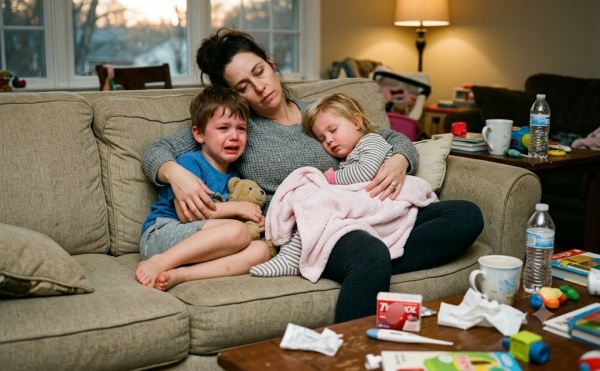
He Came Home Smiling After 7 Days With Another Woman in Miami—Until He Saw the Folder on the Coffee Table…
When Daniel left home, he told Claire he needed time to think about their marriage. While she packed lunches, cared for their sick daughter, and answered their son’s painful questions, he was staying in an oceanfront suite with another woman. What he forgot was that their joint accounts, travel emails, and bank alerts still told the truth. By the time he came home, Claire was no longer waiting for an apology….
Part 1 — The Smile at the Door
My husband came home smiling after seven days in Miami with another woman.
Not ashamed.
Not nervous.
Smiling.
He walked through our front door in suburban New Jersey with a tan on his face, a designer duffel bag over one shoulder, and the relaxed confidence of a man who believed the worst thing waiting for him was an emotional wife.
“Hey,” Daniel said, dropping his keys into the ceramic bowl beside the door. “You’re up.”
I was sitting on the living room couch with both feet tucked under me, wearing black leggings, an old Rutgers sweatshirt, and no expression at all. The house was quiet except for the dishwasher humming in the kitchen and the soft rain tapping against the front windows.
Our children were asleep upstairs.
Mason was nine. Lily was six.
They had stopped asking when Daddy was coming home three days earlier.
On the coffee table in front of me sat a blue folder.
Daniel noticed it only after he noticed I was not crying.
That was his first mistake.
For the past seven days, he had been expecting tears. Maybe yelling. Maybe a dramatic scene where I demanded to know where he had been, and he gave me the same tired speech about needing “space.” He had always been good at turning his choices into my emotional problem.
But I was done being the emotional problem.
He smiled again, softer this time, the way he did when he thought he could charm his way out of a room he had set on fire.
“Claire,” he said, “I know this week was hard.”
I looked at him.
This week.
As if I had misplaced a receipt, not spent seven nights alone with two children while their father sent them one recycled beach photo and claimed he was “clearing his head.”
He had told me he needed two weeks.
Two weeks to think. Two weeks to breathe. Two weeks to figure out whether he still wanted our marriage after twelve years, a mortgage, two kids, one aging golden retriever, and a life we had built out of school pickups, Costco runs, dental bills, and summer trips to Cape May.
He lasted seven days.
Not because he missed us.
Because the credit card froze.
Daniel had no idea I knew that yet.
He set his duffel bag down slowly. “Are the kids asleep?”
“Yes.”
“How are they?”
“Confused.”
His jaw tightened a little. He hated direct answers when they made him feel accountable.
“I told them I needed time,” he said.
“They’re children, Daniel. They don’t understand why their father needs time from them.”
He rubbed the back of his neck. “That’s not fair.”
I almost laughed.
Fair.
For seven days, I had packed lunches, signed permission slips, helped Mason finish a state capitals project, taken Lily to urgent care for an ear infection, walked the dog in freezing rain, and answered questions I had no gentle way to answer.
Where is Daddy sleeping?
Why doesn’t he call before bedtime?
Did we do something wrong?
Fair had left the house with Daniel’s passport and his secret hotel reservation.
He looked toward the coffee table again.
“What’s that?”
I did not answer immediately.
I wanted him to feel the silence.
For years, Daniel had filled our house with his voice. His explanations. His complaints. His reasons for coming home late, spending too much, snapping at the kids, forgetting anniversaries, and treating marriage like a subscription he could pause whenever it became inconvenient.
Now the quiet belonged to me.
“That,” I said, “is the reason you came home early.”
His smile faded.
He looked at the folder, then back at me. “What are you talking about?”
I pointed to it.
“Open it.”
He did not move.
That was how I knew he already suspected something.
Daniel was not stupid. Careless, arrogant, entitled, yes. But not stupid. He understood immediately that a calm wife, a quiet house, and a folder on the coffee table meant the story had slipped out of his hands.
He laughed once.
It sounded thin.
“Claire, if this is some kind of stunt—”
“Open the folder.”
His face hardened at my tone.
There he was.
The man beneath the vacation tan. The man who had spent years making my calm feel like disrespect. The man who could leave his family for another woman in Miami and still come home expecting softness.
He stepped forward, picked up the folder, and opened it.
The first page was a hotel confirmation.
The Setai Miami Beach.
Oceanfront suite.
Seven nights.
Two guests.
His name.
Her name.
Marissa Vale.
Daniel stopped breathing for half a second.
It was quick, but I saw it.
I had become very good at seeing what he tried to hide.
“Claire,” he said carefully, “this is not what you think.”
I leaned back against the couch.
“Then keep reading.”
The second page was a flight itinerary. Newark to Miami. Two first-class tickets. Booked six weeks earlier. Long before he told me he needed space. Long before he claimed our marriage had become “too heavy.” Long before he kissed Lily on the forehead and told her Daddy just needed to clear his mind.
The third page was a screenshot of the restaurant charge at Prime 112.
$486.72.
The fourth was a spa receipt.
Couples massage.
The fifth was a jewelry boutique charge from Bal Harbour Shops.
$3,850.
Daniel’s thumb paused on that one.
I saw his eyes flick toward the staircase.
Not because he was thinking of our children.
Because he was calculating whether they could hear us.
“Lower your voice,” he said, though I had not raised mine.
I smiled then.
It was not a happy smile.
“You still think volume is the problem.”
He closed the folder sharply. “You went through my private accounts?”
“No. I reviewed charges on our joint credit card, our shared travel rewards account, our family phone plan, and the bank alerts sent to my email because you never bothered to change the settings.”
His face flushed.
“Also,” I added, “Marissa tagged the hotel in a story and forgot her Venmo was public.”
For the first time, Daniel looked truly afraid.
Not sorry.
Afraid.
There is a difference, and wives learn it the hard way.
Marissa Vale was not a stranger.
She worked at Daniel’s firm, a commercial real estate company in Manhattan where everyone wore expensive watches and talked about “market shifts” like they were weather gods. She was thirty-one, recently divorced, and had once stood in my kitchen during a summer barbecue drinking my lemonade while telling me our kids were “adorable.”
Daniel had introduced her as a colleague.
He always introduced problems as colleagues first.
He placed the folder back on the table. “You don’t understand the context.”
I looked around the living room.
The family photos on the wall.
The basket of Legos near the fireplace.
The dog bed by the window.
The half-finished school fundraiser forms on the side table.
“What context makes abandoning your family for a planned vacation with another woman acceptable?”
He exhaled sharply. “I did not abandon my family.”
“Mason cried himself to sleep Tuesday.”
His face changed.
Just slightly.
“Don’t use the kids like that,” he said.
I felt something inside me go cold.
There it was.
He could use the word space to cover betrayal. He could use work stress to cover selfishness. He could use our children’s confusion as proof that I was being unfair by naming what he had done.
But I could not use the truth.
“You left them,” I said. “I just stayed to answer the questions.”
Daniel looked away.
Rain slid down the windows in silver lines. Upstairs, the house creaked softly the way houses do at night, holding everyone’s secrets in the walls.
Then he tried the voice.
The old voice.
The one that used to make me soften before I remembered what he had done.
“Claire, I made a mistake.”
“No,” I said. “A mistake is forgetting milk. You booked this six weeks ago.”
His mouth tightened.
“I was unhappy.”
“So was I. I didn’t fly to Miami with someone else.”
He flinched.
Good.
Not because I wanted to hurt him.
Because for once, pain had reached the correct address.
He sat in the armchair across from me, the one his father had given us when we bought the house. He looked tired now, less polished, a little older. But even then, he still believed this was a marriage crisis.
He did not understand it had become a legal one.
“There’s more,” I said.
He looked at the folder.
“What more could there be?”
I stood and walked to the coffee table. Then I opened the folder to the back section and turned it toward him.
His face went pale.
Because behind the hotel confirmations and restaurant charges were documents from our bank.
A home equity line of credit application.
A request to liquidate part of the kids’ 529 college savings.
And a copy of my signature.
A signature I had never given.
Part 2 — The Quiet Nights
The first night Daniel left, I believed him.
That is the part I hate admitting.
He stood in our kitchen with his overnight bag near the garage door and told me he needed space because he felt like he was “disappearing inside the marriage.” His voice shook just enough to sound wounded. His eyes were tired. He looked like a man asking for air, not a man hiding an itinerary.
I had cried.
Of course I had.
Mason and Lily were upstairs brushing their teeth, and the pasta I had made for dinner sat untouched on the stove. Daniel said he was going to stay at a hotel near Princeton for a few nights and think. He said he did not want to fight in front of the kids.
“I still love you,” he said.
That sentence kept me from asking better questions.
Love can be a sedative when you want to believe it badly enough.
So I let him leave.
I stood in the garage doorway and watched his SUV back down the driveway into the dark. He waved once. I waved back because I was still playing the part of a wife whose husband was troubled, not a wife whose husband had already packed linen shirts for Miami.
The next morning, the first alert came in.
CHASE SAPPHIRE RESERVE: United Airlines $2,842.60
I stared at the notification while pouring cereal for Lily.
At first, I thought it was a mistake. Daniel traveled for work sometimes, and his assistant usually booked flights through the company portal. But this charge was on our personal card, the one we used for groceries, gas, orthodontist payments, and family trips.
I texted him.
Did you book a flight?
He replied twenty minutes later.
Work thing. Last-minute. I’ll explain later.
That was the beginning of the quiet nights.
After the kids went to bed, I sat at the dining room table with my laptop open and started looking. Not wildly. Not like a person snooping for drama. Like a person doing household accounting because her husband had put a strange charge on a joint card.
Then the hotel confirmation appeared in his email archive.
Daniel had forgotten that years earlier, when we were planning a Disney trip, he had given me access to the family travel email so I could organize reservations. He never removed me. He never thought he needed to.
The confirmation had been forwarded there automatically.
Two guests.
Daniel Reed and Marissa Vale.
Check-in: Monday.
Check-out: Monday.
The Setai Miami Beach.
I remember the sound I made when I saw it.
Not a sob.
More like someone had opened a door inside my chest and let all the air out.
I closed the laptop quickly because Mason came downstairs asking for water.
“Mom?” he said. “Are you okay?”
“Yes, baby,” I said.
I was not okay.
But mothers become skilled liars when truth is too heavy for children.
That night, after both kids were asleep again, I reopened the laptop.
One discovery became another.
The restaurant reservation. The Uber charges. The spa. The room service. The boutique. The beach club. The upgraded return flight. A rental convertible.
Then I found the bank emails.
At first, I did not understand what I was seeing. There were messages from our mortgage lender referencing a home equity line of credit application I had never discussed. There was a document request. There was a note saying spousal acknowledgment was required.
I searched my name.
That was when I found the PDF.
My signature appeared on page six.
It was close enough to fool someone who did not know me. But it was wrong. Too round. Too clean. My actual signature always slants downward because I write too fast.
My hands started shaking so badly I had to put them under my thighs.
The application requested access to up to $250,000 in equity from our home.
Our home.
The house where Mason learned to ride a bike in the driveway. The house where Lily lost her first tooth. The house where I had painted the laundry room myself because Daniel said hiring someone for “a utility space” was ridiculous.
Then he tried to borrow against it without telling me.
The next email was worse.
A transfer request involving the children’s 529 college savings accounts.
Not completed.
But initiated.
Daniel had apparently requested information about withdrawal penalties and tax consequences, claiming “temporary liquidity needs.”
Temporary liquidity.
That phrase sat on my screen like a polite name for theft.
I did not confront him.
That was the smartest thing I did.
The old Claire would have called him immediately. She would have cried, demanded answers, begged him to explain, given him time to lie better. She would have let emotion warn the man who had already planned around her.
But the new Claire had two sleeping children upstairs and a mortgage lender email with a forged signature downstairs.
So I called my sister.
Rachel answered on the third ring, groggy and annoyed. She lived in Philadelphia, had three kids of her own, and once told Daniel at Thanksgiving that his confidence exceeded his usefulness. He had disliked her ever since.
“What’s wrong?” she asked immediately.
I tried to speak.
Nothing came out.
“Claire?”
I whispered, “Daniel is in Miami with another woman.”
Silence.
Then Rachel said, very calmly, “Are the kids safe?”
That question saved me.
It made everything clear.
“Yes.”
“Are you safe?”
“Yes.”
“Good. Do not call him. Do not warn him. Screenshot everything. Download everything. Tomorrow morning, you call a lawyer.”
I cried then.
Not because of Daniel.
Because my sister believed me without requiring proof first.
The next morning, I called Andrea Kaplan, a family law attorney in Montclair recommended by a neighbor who had gone through a difficult divorce. Andrea had a low voice, silver glasses, and the unnerving patience of someone who had seen charming husbands do ugly things before breakfast.
“Start from the beginning,” she said.
I did.
She listened.
Then she said, “Claire, I need you to understand something. Infidelity matters emotionally. Financial misconduct matters legally. The alleged forged signature and attempted use of home equity or college savings are serious.”
Alleged.
Attempted.
Potential.
Andrea used careful words, the kind lawyers use because precision protects people.
I learned quickly to use them too.
She told me to preserve evidence, contact the mortgage lender, freeze certain accounts where possible, review credit reports, and avoid direct confrontation. She also gave me the number for a forensic accountant named Peter Moss.
“Do you think he’s been hiding money?” I asked.
“I think we should not assume the Miami trip is the first lie,” Andrea said.
That sentence changed the shape of my week.
On Wednesday, I called the mortgage lender.
By Thursday, the home equity application had been flagged and paused pending verification.
By Friday, Peter had identified several unusual transfers from our joint savings to a business account Daniel controlled.
By Saturday, Rachel arrived with her teenage daughter to help with the kids so I could meet Andrea in person.
By Sunday, I had a folder.
Not a messy pile of rage.
A folder.
Divided into sections.
Travel.
Charges.
Communications.
Banking.
Mortgage.
College funds.
Timeline.
I printed everything because paper has weight.
Digital proof feels like something a liar can explain away. Paper sits on a table and stares back. Paper says, no, this happened.
I did not sleep much that week.
But I stopped crying after the third night.
There is a point in betrayal where grief becomes administration. You make lunches. You call lawyers. You reset passwords. You text the soccer coach. You highlight bank statements. You hold your daughter while her ear hurts and tell her Daddy loves her because you refuse to let his choices become her wound before she can understand them.
Daniel texted the kids twice.
A sunset photo.
A hotel pool photo.
A message that said: Daddy loves you. Be good for Mom.
Be good for Mom.
As if I were the babysitter covering his shift.
Mason stared at the phone and asked, “Why isn’t Dad calling?”
I said, “He’s having a hard week.”
Mason looked at me with eyes too old for nine. “We are too.”
I went into the laundry room and cried into a towel where he could not see me.
On the seventh day, the credit card declined at the hotel.
Peter had advised me to lower the available limit and move funds from our joint account into a protected account under attorney guidance, leaving enough for household expenses. Andrea said it was legal, documented, and necessary to prevent further depletion while we sorted things out.
At 4:12 p.m., Daniel texted:
Did you mess with the card?
I did not answer.
At 4:19 p.m.:
Claire, this is embarrassing.
I stared at that message for a long time.
Embarrassing.
Not abandoning your children.
Not vacationing with another woman.
Not forging your wife’s signature.
The card declining at a luxury hotel.
That embarrassed him.
By 8:30 p.m., his flight had been changed.
By 11:06 p.m., he walked through our door smiling.
And by 11:09, he saw the folder.
Part 3 — The Folder
Daniel sat across from me with the folder open on his lap, but he was no longer reading.
He was looking at the forged signature page.
The room had changed temperature. I do not mean literally. The thermostat still read 69 degrees. But the warm, familiar living room where we had watched movies, wrapped Christmas gifts, and assembled school projects now felt like a conference room before a deposition.
Daniel’s fingers pressed against the paper.
“Where did you get this?”
“The lender sent copies after I requested verification.”
His eyes snapped up. “You called the bank?”
“Yes.”
“Without talking to me?”
I stared at him.
That was the strange talent of men like Daniel. They could create the crisis and still sound offended that you called the fire department.
“You applied for a home equity line using my signature,” I said.
“I was exploring options.”
“With my forged signature?”
He winced at the word.
“Don’t say that.”
“Why? Is there a friendlier term you prefer?”
He stood abruptly and began pacing near the fireplace. The dog, Scout, lifted his head from the rug, watched him, then put his head back down. Even Scout seemed tired of Daniel.
“You don’t understand the pressure I’m under,” Daniel said.
There it was.
Pressure.
The universal solvent of selfish men.
“Then explain it,” I said. “But be careful. Andrea already has copies.”
He stopped pacing.
“Andrea?”
“My attorney.”
His face changed completely.
Not anger first.
Fear.
Then anger.
“You hired a divorce lawyer while I was gone?”
“I hired a lawyer after I found a hotel reservation with your girlfriend’s name on it and a financial document with my fake signature on it.”
He pointed at me. “Don’t call her that.”
“Girlfriend?”
His jaw tightened. “Marissa has nothing to do with this.”
“Her name is on the hotel confirmation.”
“That part is personal.”
“The $3,850 bracelet from Bal Harbour is on our marital credit card.”
He looked away.
I flipped to the next page. “And the rental convertible. And the spa. And the meals. And the flights. Personal became financial when you used family money.”
Daniel sat down again, slower this time.
He suddenly looked less like a man returning from vacation and more like one arriving at an interview he had not prepared for.
“I was going to pay it back,” he said.
“With what?”
He did not answer.
That silence brought Peter’s warning back to me.
Do not assume Miami is the first lie.
I opened a second folder from the side table and placed it beside the first.
Daniel stared at it.
“What is that?”
“The part I didn’t leave on the coffee table.”
His face went pale again.
The second folder contained what Peter had found in the business account. Daniel had started a side investment entity eighteen months earlier, supposedly for commercial real estate opportunities. Some transfers from our joint savings had gone there, labeled as short-term loans.
I had never approved them.
There were also payments to a credit line I did not recognize. Cash withdrawals before business trips. A wire to a Miami-based LLC. Venmo payments to Marissa marked with jokes that were not funny.
For sunshine.
For our secret dinner fund.
For next time.
Daniel closed his eyes.
“Claire,” he said, “I made some bad decisions.”
I almost smiled.
Bad decisions.
It sounded so small. Like ordering too much takeout. Like forgetting an anniversary. Like buying concert tickets without checking the calendar.
“You made a second life,” I said.
He opened his eyes.
“You made a second life and used our first one to fund it.”
The sentence landed.
I saw it.
He swallowed.
Upstairs, Lily coughed in her sleep. We both looked toward the ceiling. For one second, we were just parents again, listening for whether a child needed us.
Then Daniel looked back at me.
“What do you want?”
It was the first honest question he had asked.
But even then, he meant: what will it cost to make this go away?
“I want you to sleep in the guest room tonight,” I said. “Tomorrow morning, you will leave before the kids come downstairs.”
His eyes widened. “You’re kicking me out?”
“I’m setting a boundary.”
“This is my house too.”
“Yes,” I said. “And that will be addressed legally.”
He laughed in disbelief. “You’ve really been planning this.”
“No. I’ve been responding to what you planned.”
He rubbed both hands over his face. His tan made him look healthier than he had any right to look. I hated that. Betrayal should mark people visibly, but often it only exhausts the betrayed.
He leaned forward.
“Claire, listen to me. I was unhappy. I felt trapped. You became all about the kids, the house, schedules, rules. Marissa made me feel alive again.”
I sat very still.
There it was.
The speech.
Not about my pain. Not about our children. Not about forged documents or missing money.
About how another woman made him feel.
“Do you know what made me feel alive this week?” I asked.
He hesitated.
“What?”
“Nothing. I was too busy keeping your children’s lives from falling apart.”
His eyes dropped.
I continued.
“I packed lunches while you ordered room service. I took Lily to urgent care while you got a couples massage. I helped Mason build a cardboard map of the United States while you sat on a beach with a woman whose bracelet I apparently bought.”
“Claire—”
“No. You’re going to hear this once.”
He went quiet.
I had imagined this moment so many times during those seven nights. In some versions, I screamed. In others, I threw the folder at him. In one, I slapped him, though I knew I never would because the satisfaction would last three seconds and the consequences would last longer.
The real moment was smaller.
And colder.
“You thought I would miss it,” I said. “You thought I was too busy, too tired, too used to cleaning up after you to notice every charge. You thought if you called it space, I would respect it. You thought if you came home smiling, I would be grateful you came home at all.”
He said nothing.
“You were wrong.”
For the first time that night, his eyes filled with tears.
I did not move toward him.
I had spent too many years treating his tears like instructions.
“I don’t want to lose my family,” he said.
“You left your family.”
“I came back.”
“Because the card declined.”
He flinched as if I had struck him.
I stood.
The conversation was over. Not because everything had been said, but because enough had.
“Guest room,” I said. “If you wake the kids, I will tell them the truth in an age-appropriate way with guidance from a therapist. Do not make me do that tonight.”
His mouth opened.
Then closed.
He picked up his duffel bag and walked down the hall.
I sat alone in the living room after he left, listening to the rain, staring at the folders.
I expected to feel powerful.
I did not.
I felt tired.
But beneath the exhaustion was something new.
A line had appeared inside me, and for once, I was standing on my own side of it.
Part 4 — What He Tried to Take
Daniel left before breakfast.
He did not say goodbye to the kids.
That told me more than any apology could have.
Mason noticed first.
“Where’s Dad’s bag?” he asked, standing in the kitchen in pajama pants and a Mets T-shirt.
I poured milk into his cereal. “Daddy had to leave early.”
His face closed.
Children understand abandonment before they understand betrayal. They may not know the adult words, but they feel the empty chair. They feel the missing voice. They feel the parent who returns and disappears again before they can decide whether to trust the return.
Lily came in holding her stuffed rabbit.
“Is Daddy still sad?” she asked.
I knelt in front of her.
“Yes,” I said carefully. “Daddy is having some grown-up problems, but you and Mason did not cause them.”
She frowned. “Did you?”
The question was not cruel.
It was a child trying to locate the break.
“No,” I said. “I did not cause them either.”
She nodded, satisfied enough for six years old, and asked for waffles.
That morning, I called a family therapist Andrea recommended.
That afternoon, I met with Andrea and Peter.
By evening, temporary safeguards were in place.
Bank accounts monitored. Credit frozen. College savings protected. Mortgage lender notified in writing that I disputed any authorization connected to the HELOC. Daniel’s attorney contacted. Evidence preserved.
It sounds clean when listed that way.
It was not.
I cried in the car before walking into Andrea’s office. I threw up once in a parking lot from stress. I answered a call from the school nurse while reviewing bank statements because Lily’s ear infection had made her dizzy.
Life does not pause for betrayal.
Laundry still mildews.
Children still need snacks.
The dog still eats a sock.
On Thursday, Daniel’s attorney sent a letter claiming I had “overreacted to a marital disagreement” and had improperly restricted Daniel’s access to family funds. Andrea read it silently, then looked at me over her glasses.
“Marital disagreement,” she said.
I almost laughed.
“He also claims the Miami trip was personal and unrelated to marital assets.”
“The joint card paid for it.”
“Yes,” Andrea said. “That will be addressed.”
“What about the forged signature?”
“We do not use that word lightly in writing yet,” she said. “We will say unauthorized signature pending investigation.”
Lawyers have a way of making rage wear a seatbelt.
I needed that.
Peter’s work uncovered more.
Daniel’s side entity was in trouble. He had invested in a redevelopment project near Jersey City that stalled due to permitting problems and rising interest rates. He had borrowed money from a private lender at a terrible rate, then moved marital funds to cover payments.
The Miami trip had not happened because he felt free.
It happened because he was panicking.
Marissa had apparently believed Daniel was on the verge of a major payout. She posted photos from a yacht, a hotel balcony, and a candlelit dinner with the caption: Finally choosing happiness.
Choosing happiness.
I had started to hate how often selfish people used peaceful words for cruel behavior.
Daniel called me Friday night.
Andrea had said I could answer if I felt steady, but to keep it brief and avoid financial discussion without counsel. I put the phone on speaker while Rachel sat beside me at the kitchen table.
“What do you need?” I asked.
His voice was hoarse. “I want to talk to the kids.”
“They’re asleep.”
“It’s 8:15.”
“They had a hard week.”
Silence.
Then he said, “I miss them.”
Rachel’s face hardened.
I kept my voice even. “You can schedule a call tomorrow.”
“I miss you too.”
I closed my eyes.
There was a version of me, not even that old, who would have cracked at those words. She would have heard love. She would have confused longing with accountability.
This time, I heard strategy.
“Talk to Andrea,” I said.
“Claire, please. I know I messed up.”
“Messed up is not specific enough.”
He exhaled. “I should not have gone to Miami.”
“That’s one item.”
“I should not have taken Marissa.”
“That’s another.”
“I should not have used the card.”
“Keep going.”
His silence told me he did not want to.
So I helped him.
“You should not have applied for credit against our home without my knowledge. You should not have initiated withdrawals connected to our children’s college funds. You should not have moved joint savings into your business account. You should not have lied to our children. You should not have walked back into this house smiling.”
Rachel reached across the table and squeezed my hand.
Daniel whispered, “I was scared.”
That was new.
“Of what?” I asked.
“Losing everything.”
“You risked everything.”
“I thought I could fix it before you found out.”
That sentence was the closest thing to honesty he had given me.
Not I thought it was right.
Not I thought it would not hurt you.
I thought I could fix it before you found out.
I said, “That is not remorse. That is regret over timing.”
He started to cry.
I ended the call.
The next week, Marissa called me from an unknown number.
I almost did not answer, but something in me wanted to hear the voice of the woman who had smiled beside the ocean while my children asked where their father was.
“Claire?” she said.
“Yes.”
“This is Marissa.”
“I know.”
She seemed surprised by that.
“I wanted to apologize.”
“Then apologize.”
She inhaled. “Daniel told me you were separated. He said you knew he needed space and that the marriage had been over for a long time.”
I looked out the kitchen window at the backyard where Mason’s soccer ball sat in the wet grass.
“Did he also tell you to charge your couples massage to our family credit card?”
Silence.
“I didn’t know it was your card.”
“Did you ask?”
She did not answer.
I almost felt sorry for her then.
Almost.
Because I recognized something in her voice. The sound of a woman realizing she had not been chosen by a brave man, but used by a reckless one. Daniel had made her feel like an escape when she was really a witness.
“He said he was leaving you,” she whispered.
“He left for seven days,” I said. “There’s a difference.”
“I didn’t know about the kids’ college money.”
That made my stomach tighten.
So he had told her something.
“What did he say?”
“He said he had money tied up and needed liquidity until a deal closed. I thought it was business.”
Of course she did.
People believe the version that lets them keep the vacation.
“Marissa,” I said, “do not call me again. If you have information, send it through your attorney or mine.”
“I’m sorry.”
“I believe you’re sorry now.”
Then I hung up.
That was the thing about consequences.
They made everyone reflective.
By the end of the month, Daniel moved into a short-term rental near Hoboken. Temporary parenting time was arranged. Supervised financial restrictions were put in place. The divorce petition was filed quietly in Essex County.
Quietly did not mean painlessly.
Mason refused to speak to Daniel during the first video call.
Lily cried afterward because Daniel promised to take her for pancakes and then rescheduled due to “work.” Scout slept outside Daniel’s empty office for three nights and whined at the door.
A family is not only broken by one dramatic act.
It is broken in routines.
In missed breakfasts.
In empty hooks where coats used to hang.
In children learning that promises sometimes need calendars and court orders.
One Saturday, Mason found the blue folder.
I had moved it to my bedroom closet, but he saw it when looking for wrapping paper for a birthday party.
“Is this why Dad left?” he asked.
My heart stopped.
I sat on the edge of the bed and patted the space beside me.
He sat.
At nine, he was too old for fairy tales and too young for adult truth.
“Dad and I are having serious grown-up problems,” I said. “Some of them are about trust. Some are about money. None of them are because of you or Lily.”
His jaw trembled.
“Did he do something bad?”
I chose the words carefully.
“He made choices that hurt our family.”
Mason looked at the closet.
“Are you going to forgive him?”
I thought about lying.
Then I thought better of it.
“I don’t know what forgiveness will look like,” I said. “But I do know that forgiving someone doesn’t mean pretending nothing happened.”
He nodded slowly.
Then he leaned against me.
I held him while he cried silently, and I hated Daniel more in that moment than I had when I saw Marissa’s name on the hotel reservation.
Not because he hurt me.
Because he made our child ask questions with no painless answers.
Part 5 — The Price of Coming Home Smiling
The divorce took fourteen months.
People think evidence makes things simple.
It does not.
Evidence makes things possible.
There were appraisals, disclosures, motions, temporary orders, parenting evaluations, forensic reports, and more legal bills than I ever wanted to see again. Daniel fought some things and surrendered others. He admitted to the Miami trip, the charges, and the transfers, but insisted the unauthorized signature had been an “administrative misunderstanding.”
Andrea handled that phrase beautifully.
She made it sound exactly as ridiculous as it was.
The court did not treat him like a movie villain. Family court rarely does. It treated him like a spouse whose financial conduct required scrutiny, whose credibility had been damaged, and whose children needed stability more than either parent needed revenge.
That was enough.
The home equity application was withdrawn permanently.
The 529 accounts were preserved and placed under additional protections.
The marital funds Daniel moved into his side business were accounted for in the settlement.
The Miami expenses were treated as dissipation of marital assets.
That word became one of my favorites.
Dissipation.
A clean legal word for taking family resources and spending them on the destruction of the family.
Daniel did not like it.
I did.
Marissa disappeared from the story after giving a statement through counsel. She confirmed several things Daniel had told her about needing money for a deal, though she denied knowing he had used family funds. She moved to Austin before the divorce was final.
I wished her no harm.
I also wished her no access to my peace.
Daniel’s real estate project failed before winter.
The private lender sued him.
His firm placed him on leave after the financial dispute became known internally. He eventually resigned, though his LinkedIn called it “transitioning to independent advisory work.”
Men like Daniel love renaming consequences.
Our divorce was finalized on a cold March morning.
I wore a navy dress and low heels. Daniel wore a gray suit I had bought him years earlier for a promotion dinner. We sat on opposite sides of a courtroom that smelled faintly of dust, coffee, and old paper.
No one shouted.
No one cried dramatically.
The judge reviewed the agreement, asked questions, and confirmed we understood the terms. Shared legal custody with structured parenting time. Primary residence with me. Financial safeguards. Equal responsibility for certain child-related expenses. Division of assets adjusted for documented dissipation and unauthorized transfers.
When it was over, Daniel followed me into the hallway.
Andrea walked a few steps behind me, close enough to intervene if needed.
“Claire,” he said.
I stopped.
He looked different than he had that night he came home from Miami. Less golden. Less certain. The smile was gone, and without it, I could see the fear he had probably been carrying long before he left.
“I’m sorry,” he said.
I waited.
“For all of it,” he added quickly. “For Miami. For Marissa. For the money. For the kids. For walking in that night like I still had the right to be welcomed.”
That last sentence surprised me.
It sounded earned.
Too late, but earned.
I nodded.
“Thank you for saying that.”
His eyes filled. “Do you think they’ll hate me?”
The children.
Of course.
That was what finally scared him. Not losing me. Not losing money. Not losing the house. Losing the version of himself reflected in Mason and Lily’s eyes.
“I think they love you,” I said. “And I think they’re hurt. What you do consistently from now on matters more than what you say today.”
He looked down.
“I miss being home.”
I thought of that night.
The duffel bag.
The tan.
The folder.
The smile.
“You didn’t miss home when you thought it would always wait for you,” I said.
He closed his eyes.
“I know.”
Maybe he did.
Maybe he only knew because the door had finally closed.
Either way, it was no longer my job to teach him.
The first year after the divorce was not glamorous.
I did not become instantly happy. I did not start every morning with empowerment music and perfect coffee. I forgot trash day twice, cried during a car insurance commercial, and once sat in the grocery store parking lot for twenty minutes because I could not make myself go inside and buy chicken.
But slowly, the house changed.
Not the structure.
The feeling.
I painted Daniel’s office pale green and turned it into a homework room with bookshelves, a long desk, and a corkboard for the kids’ drawings. Mason started inviting friends over again. Lily stopped asking whether Daddy needed space from her.
Scout stopped sleeping outside the office door.
One Saturday in June, I took the kids to Cape May by myself.
I was terrified.
Daniel had always driven on family trips, not because I could not, but because he liked being in charge of direction. That morning, I packed the car, loaded snacks, checked the tire pressure, and drove south with Mason navigating from the back seat like a tiny air traffic controller.
We got lost once.
Lily spilled lemonade on herself.
Scout threw up near Exit 38.
It was not perfect.
It was ours.
At sunset, the kids ran toward the water while I stood barefoot in the sand, watching the Atlantic turn gold. My phone buzzed with a text from Daniel.
Hope they’re having fun. Tell them I love them.
I typed back:
They are. You can tell them on your call tomorrow.
Then I put the phone away.
Boundaries are not walls if you build them correctly.
They are doors with locks that work.
A year and a half after Daniel came home smiling, I found the blue folder again while cleaning my closet.
The papers were still there.
Hotel confirmation.
Receipts.
Bank documents.
Timeline.
Screenshots.
I sat on the floor and looked through them one last time.
The pages no longer made my hands shake.
That surprised me.
For months, that folder had felt like a weapon, then a shield, then a life raft. It had held the proof I needed when Daniel tried to make me doubt my own reality. It had been the thing on the coffee table that turned his smile into silence.
Now it felt like history.
Painful, yes.
But not alive.
Mason appeared in the doorway.
“What’s that?” he asked.
“Old paperwork,” I said.
He looked at me carefully. “Bad paperwork?”
I smiled a little. “Important paperwork.”
He nodded in the solemn way almost-eleven-year-olds do when they want to seem older than they are.
“Are you okay?”
The question nearly undid me.
Because for so long, I had been the one asking everyone else.
I looked at my son, who was taller now, steadier, still carrying some sadness but no longer drowning in it.
“Yes,” I said. “I really am.”
After he left, I took the folder downstairs.
I removed the essential legal copies and placed them in the fireproof safe. Then I shredded the duplicates. Page by page, the machine swallowed the receipts, the confirmations, the screenshots, the printed proof of a week that had nearly broken me.
I kept one page.
The timeline.
Not because I wanted to remember Daniel’s betrayal.
Because I wanted to remember my own clarity.
On the bottom, beneath the final entry, I wrote one sentence in pen:
The night he came home smiling was the night I stopped waiting for him to choose us and chose us myself.
Then I placed it in the safe.
That evening, Mason, Lily, and I ate pizza on the living room floor and watched a movie Scout had no interest in until popcorn appeared. Rain tapped against the windows, the same sound as the night Daniel walked in with his tan and his duffel bag and his ridiculous confidence.
But the house felt different now.
It did not feel like a place someone had left.
It felt like a place we had kept.
People sometimes ask what hurt the most.
The other woman?
The Miami trip?
The money?
The forged signature?
The truth is, it was the smile.
That smile told me he believed my love had made me blind. It told me he thought my work as a mother, wife, bill payer, scheduler, comforter, and keeper of our family made me too exhausted to notice what he was taking. It told me he expected a soft landing after making our home unsafe.
But he came home to a folder.
He came home to receipts.
He came home to a wife who had spent seven quiet nights becoming less afraid of the truth than of staying married to a lie.
Daniel thought he could leave our family for two weeks, call it space, and return whenever Miami stopped being convenient.
He thought the door would open because it always had.
He thought I would raise my voice, cry, beg, and give him the satisfaction of calling me unstable.
Instead, I pointed to the coffee table.
And in the silence that followed, he finally understood what I had learned while he was gone.
Proof does not need to scream.
A woman does not need to collapse to be devastated.
And sometimes the most powerful thing a wife can do is stop asking where her husband has been and start documenting exactly where the family’s future went.
