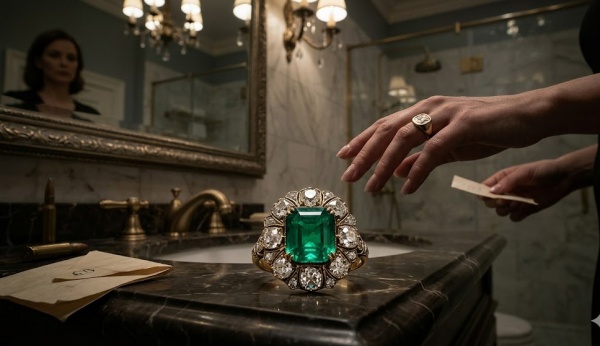
To test five women who dated her son, the mother of a mafia boss left a priceless heirloom ring on a bathroom sink. The ending is something no one could have ever imagined….
PART ONE: The Ring and the Women
Rosa Cabrelli had buried one husband, outlived two brothers, and raised four sons in a three-story brownstone on Carroll Street in Brooklyn, and she had done all of it without once asking anyone for help she didn’t trust completely. She was seventy-one years old, five feet two inches tall, and possessed of the particular authority that comes not from power itself but from being the person that all the powerful people in a room were quietly afraid of disappointing. Her hair was white. Her hands were strong. Her eyes were the specific dark brown of someone who had seen enough of the world to have stopped being surprised by it and started being strategic about it instead.
The ring had belonged to her mother-in-law, who had brought it from Palermo in 1952 inside a cloth pouch sewn into the lining of a coat. It was not a large ring — a cushion-cut diamond, just under two carats, set in yellow gold with a simple filigree band that had been repaired twice in seventy years and still held. It was not worth a great deal by the standards of the world her eldest son now occupied. But it was worth everything by the standards of the Cabrelli family, which were the only standards Rosa had ever recognized as binding.
Her eldest son was Dominic Cabrelli. Forty-four years old. Six feet one inch. The kind of man who filled a room not by being loud but by being the thing the room organized itself around. He ran import logistics across the northeastern seaboard in a way that kept a great many attorneys very employed and a great many federal investigators moderately frustrated, and he did it with the contained, deliberate manner of someone who had been trained from childhood to give nothing away unnecessarily. His mother had trained him. She had trained all four of her sons. Of the four, Dominic was the one who had learned the lesson most thoroughly.
He was also, at forty-four, still unmarried. And this was the thing that kept Rosa Cabrelli awake on certain Tuesday nights when the Carroll Street brownstone was quiet and Sullivan — her cat, named for no particular reason — was asleep on the radiator and there was nothing to do but think.
It was not that Dominic lacked for women. He had never lacked for women. That, in Rosa’s considered opinion, was part of the problem. When a man of Dominic’s position and appearance moved through the world, certain types of women materialized around him with the reliability of weather — beautiful, strategic, fluent in the language of ambition, and interested primarily in what proximity to the Cabrelli name could provide. Rosa had observed five of them over the past three years with the focused attention of a woman conducting a study, and she had found all five wanting in the specific way that mattered most to her.
Not wanting in beauty. Not wanting in intelligence, or charm, or the social skills required to sit at a dinner table with men who said very little and meant a great deal. Wanting in character. Wanting in the particular quality that Rosa, who had not gone past the tenth grade but had read more widely than most people with advanced degrees, called the thing underneath. The thing underneath was what you did when no one was watching and nothing was at stake — or rather, when you believed nothing was at stake.
Rosa had been watching very carefully for three years. And so she had devised the ring test.
She told no one she was doing it. Not Dominic, not his brothers, not her sister Carmela who lived two blocks away and knew most of her secrets. She simply began, on separate occasions over the course of four months, inviting each of the five women to the brownstone for Sunday dinner — a standing tradition in the Cabrelli household that functioned as the family’s primary social institution and its most reliable character assessment tool.
The ring would be left on the bathroom counter. Cleaned and polished and placed deliberately beside the soap dish, where it would be visible to anyone who used the first-floor powder room. Then Rosa would wait and see what happened.
PART TWO: The Five Tests
The first woman was Claudia Rinaldi. Thirty-eight years old. Real estate developer. She drove a silver Porsche Cayenne and had the posture of someone who had been told her whole life that posture communicated authority. She had been seeing Dominic for seven months and had, on three separate occasions, referred to herself as “basically family” at social events where Rosa was present. Rosa did not comment on this. She simply noted it.
Claudia used the powder room at 6:40 p.m., between the appetizers and the main course. She returned to the table looking exactly as she had left it — composed, pleasant, making conversation about a development project in Williamsburg she was pursuing. After dinner, when Rosa cleared the bathroom, the ring was gone. She found it, six days later, listed on a private jewelry appraisal website — submitted for valuation under a fake name that was, nonetheless, traceable to an email address Claudia had used for other correspondence. The estimated value listed was $18,400. The appraiser had noted it as “antique, Sicilian origin, excellent condition.”
Rosa removed the ring from the appraisal listing with a phone call she did not detail to anyone. She did not tell Dominic. She simply stopped inviting Claudia to Sunday dinner, and when Dominic mentioned that Claudia seemed to feel unwelcome, Rosa said only, “I haven’t changed anything,” which was technically true.
The second woman was a woman named Jade Park. Thirty-two years old. An attorney at a firm in Midtown Manhattan who specialized in corporate mergers and wore her intelligence lightly, the way people who are very good at something often do. Rosa liked her energy. She was direct without being aggressive, funny without being performing, and she looked at Dominic the way Rosa remembered looking at her husband in the early years — with the specific attention of someone who found the actual person interesting rather than just the position.
Jade used the powder room after the main course. She returned to the table without comment. When Rosa checked the bathroom, the ring was still on the counter. Rosa felt, briefly, hopeful. But when she went to retrieve it at the end of the evening, the ring was in her coat pocket — her own coat, hanging by the front door. She could not be certain how it had gotten there. She had her suspicion, but a suspicion is not evidence, and Rosa Cabrelli had not survived seventy-one years of the life she had lived by acting on suspicions instead of facts. She removed Jade from the rotation quietly and without explanation.
The third and fourth women — Bethany, a photographer from Park Slope, and a woman named Svetlana who had been introduced through mutual acquaintances and whose last name Rosa never fully retained — both used the powder room and both, in different ways, failed to return the ring. Bethany took it, Rosa believed, impulsively, without real intent — it appeared on her Instagram Stories two weeks later as part of a “vintage jewelry haul” she had assembled, attributed to an East Village flea market. Svetlana was more deliberate. She didn’t take the ring, but when Rosa asked her, casually and without accusation, whether she had noticed anything on the bathroom counter after dinner, Svetlana said, “No, I don’t think so,” with the particular smoothness of someone who had practiced that specific sentence.
Rosa thanked her for coming and did not invite her back.
PART THREE: The Laundry Girl
Her name was Marisol Vega. Twenty-nine years old. She had worked for three years at the industrial laundry service that handled linens for several of the restaurants and event spaces in the Carroll Gardens and Cobble Hill neighborhoods — including, for the past eighteen months, the private dining room that the Cabrelli family used for larger gatherings on the second floor of a social club on Union Street. She came twice a week, Tuesday and Friday mornings, in a white van with the company logo on the side, and she knew the side entrance and the linen closet and the particular way the French press in the kitchen back room worked, because Rosa had shown her once and she had never needed to be shown again.
Rosa had not introduced Marisol to Dominic. That had happened by accident — or what looked like accident from the outside, which Rosa had learned, over seven decades, was the way that the most important things usually happened. Dominic had come by the social club on a Tuesday morning to drop off documents for his brother Marco, who managed the space, and Marisol had been in the hallway outside the linen closet trying to manage a laundry cart with a stuck wheel with the focused competence of someone who was not going to let a piece of equipment win. Dominic had held the door. She had said thank you without looking up. He had looked at her with an expression Rosa, who had been watching from the kitchen doorway, recognized from thirty years of knowing his face.
It was the expression of a man who had just been surprised.
Rosa had not engineered what followed. Dominic had asked Marco, casually, who the woman with the laundry cart was. Marco had told him. Dominic had come by on a Friday morning two weeks later, which was not his usual schedule for the social club. By the third Friday, Marisol had noticed the pattern and said to him, with a directness that Rosa approved of entirely when she heard about it secondhand, “If you’re going to keep showing up on Fridays, you could at least help me with the cart.”
He had helped with the cart. He had also, eventually, asked for her number. And three months after that, Marisol Vega had come to Sunday dinner on Carroll Street for the first time, in a green dress that she had clearly pressed carefully and with her dark hair pulled back simply, and she had sat at Rosa’s table and eaten two helpings of the braciole and asked Rosa, with genuine curiosity, how the recipe had been developed, and listened to the full answer without checking her phone once.
Rosa liked her immediately. Which was precisely why she was the fifth test.
The Sunday Rosa used for the test was a quiet one in late November, with cold coming in hard off the harbor and the brownstone smelling of tomato sauce and the radiators working overtime. There were eight people at dinner — Dominic, two of his brothers, their wives, Rosa’s sister Carmela, and Marisol, who had been coming to Sunday dinner for six weeks by then and had begun, without fanfare, to simply help clear the table between courses.
The ring was placed on the bathroom counter at 5:15 p.m. Rosa went upstairs, sat in her chair by the window with Sullivan in her lap, and waited.
Marisol used the powder room at 6:30 p.m., between the salad and the pasta course. She was back at the table within four minutes. Rosa watched her face when she sat back down — nothing unusual, nothing guarded, just Marisol listening to something Marco’s wife was saying about their youngest son’s school play and responding with the easy warmth of someone who found other people genuinely interesting.
When dinner was finished, Marisol helped carry dishes to the kitchen. When the kitchen was clean, she went to find her coat from the rack by the front door. Rosa, who had positioned herself in the front hallway under the pretense of seeing Carmela out, watched.
Marisol put on her coat. Then she stopped. She reached into her coat pocket — and Rosa understood, in that moment, exactly what had happened. Somehow, the ring had moved. Someone had moved it. Rosa did not know how or when. But she watched Marisol’s face when she pulled the ring from her coat pocket, and what she saw was not the calculation of someone deciding what to do with something valuable. It was the simple, immediate reaction of someone who had found something that did not belong to them and was already deciding how to return it.
Marisol walked to Rosa directly. She held out her hand, ring in the center of her palm, and said, without drama or performance: “Mrs. Cabrelli, I found this in my coat pocket. I think it must have gotten there by accident. It looks important — is it yours?”
Rosa looked at the ring in Marisol’s palm. She looked at Marisol’s face. And she made, in that moment, the decision she had been building toward for four months.
“Yes,” she said. “It’s mine. Thank you for returning it.” She paused. “Come have coffee with me. Just us. The men can clean up.”
PART FOUR: The Coffee
They sat at the kitchen table after the others had moved to the front room, with the espresso machine making its particular sound and Sullivan having transferred his allegiance temporarily from the radiator to Marisol’s lap, which Rosa took as additional evidence.
Rosa set the espresso down and looked at the young woman across from her and decided to simply tell the truth. She was seventy-one years old. She had earned the right to spend her remaining time telling the truth.
“I need to tell you something,” she said, “and I need you to understand that I’m not telling you to embarrass you or to make a point. I’m telling you because I think you deserve to know what kind of house you’re considering walking into.”
Marisol wrapped both hands around her cup and said, “Okay.”
Rosa told her about the ring. All of it — the five tests, the four failures, the reasons. She was precise and unapologetic. She did not soften the part about the other women, or the calculation that had gone into the test, or the fact that she had spent four months assessing people without their knowledge. When she finished, Marisol was quiet for a moment.
“Why are you telling me?” she said finally.
“Because you passed,” Rosa said. “And passing shouldn’t be a secret. The others failed and didn’t know it. You passed and you should know it.” She set her espresso cup down. “But more than that — I want you to understand what I was looking for, so that you understand what this family actually is. Not what it looks like from the outside. What it actually is.”
Marisol was quiet again, for longer this time. Then she said, “The ring was in my coat pocket when I reached for my coat. I didn’t know how it got there, but I knew it wasn’t mine. That’s not a character test. That’s just — the minimum.”
Rosa felt something that she could only describe, privately, as relief. Not the relief of a problem solved, but the relief of a question answered. The minimum, Marisol had said. The minimum. As if returning something that didn’t belong to you was simply the floor of acceptable behavior, so obvious as to be barely worth noting.
Rosa had spent four months looking for someone who understood what the floor was. She had found her.
“I want to ask you something,” Rosa said. “And I want you to answer honestly, not carefully.”
“Okay,” Marisol said.
“My son is not an easy man to love. He is good — I believe that, and I would not say it if I didn’t — but he is not easy. The life around him is complicated in ways that will never fully simplify. There will be things you cannot ask about and things you will have to accept without explanation and people in this family who will test you in ways that are less kind than a ring on a bathroom counter.” She looked at Marisol steadily. “Knowing that — do you want this? Really want it?”
Marisol was quiet for a long moment. Sullivan purred in her lap.
“I want him,” she said. “I don’t know yet what all of that means. But yes. I want him.”
Rosa nodded once. She picked up her espresso cup. “Good,” she said. “Then I have some things to teach you.”
PART FIVE: What Came After
Dominic asked Marisol to marry him on a Thursday evening in April, at the kitchen table of her apartment in Sunset Park — not at a restaurant, not at a landmark, not with a photographer hired to document the moment. He had asked her, the week before, where she would want to be proposed to if someone were to propose to her, and she had said, after thinking about it genuinely, “Somewhere that feels like real life. Not a performance.” He had filed that information away with the precision he applied to everything that mattered to him and shown up the following Thursday with her grandmother’s favorite flowers — white carnations, which she had once mentioned almost in passing — and a ring that Rosa had chosen and that Marisol would later describe as the most beautiful thing she had ever worn.
The ring he gave her was not the test ring — that stayed on Rosa’s hand, where it had always belonged. The ring Dominic gave Marisol was a three-stone oval diamond in platinum, simple and clean and chosen, Rosa had told him when he asked for guidance, for someone whose taste was real rather than performed. He had understood immediately.
She said yes before he finished asking. He told her later that he had prepared a longer speech and was slightly annoyed he didn’t get to deliver it. She told him he could deliver it at the rehearsal dinner. He did — seven minutes long, handwritten, the only public speech anyone in the Cabrelli family could remember Dominic giving voluntarily since his father’s funeral fifteen years earlier. Marco cried. Dominic’s youngest brother Anthony, who had a professional reputation for stoicism, had to leave the room briefly. Rosa sat at the head of the table and did not cry, because she had already cried two months earlier, alone in her kitchen after the coffee conversation with Marisol, and she had given herself that one private moment and considered the account settled.
What people in the Carroll Gardens neighborhood would remember, in the years that followed, was not the wedding — though the wedding was beautiful, held in October at a restored event space in Red Hook with views of the harbor and a dinner that went until two in the morning and featured Rosa’s braciole as the main course, because Marisol had asked for it specifically and because there was no more direct way to communicate to two hundred and forty guests what kind of marriage this was going to be.
What people remembered was the way things shifted. Not dramatically, not all at once — but in the way that the presence of a genuinely good person in a complicated environment eventually, incrementally, changes the temperature of the room. Marisol asked questions that no one in Dominic’s world had thought to ask because they were too accustomed to the way things were. She noticed what people needed before they said so. She remembered the names of everyone’s children and their ages and their interests with the same effortless retention she had always applied to the details of the people around her — a quality that had served her well in the laundry business and served her even better here.
She also, within the first year, started a small nonprofit — formally organized, properly registered with New York State — that provided vocational training and job placement support for women in South Brooklyn who were coming out of difficult circumstances and needed, as Marisol described it, “a way back in.” It was funded modestly at first, then less modestly, and operated with the same practical efficiency that Marisol brought to everything she did. Rosa donated to it. So did Marco’s wife. So, eventually and without announcement, did Dominic — whose bookkeeper noted the contribution in the company’s charitable giving records without comment, because by that point there were many things about Dominic Cabrelli that required no comment.
Rosa gave Marisol the test ring on the morning of the wedding, before the ceremony, while they were sitting together in the bridal suite at the event space in Red Hook and Marisol’s cousin was doing her hair and the harbor was visible through the tall windows in the November gray morning light.
She did not make a speech about it. She simply took the ring from her finger — the finger it had been on for forty years — and placed it in Marisol’s palm and closed her hand around it.
“This goes to the woman who belongs in this family,” she said. “Not the woman with the right background, or the right look, or the right amount of money. The woman with the right character.” She held Marisol’s closed fist for a moment. “You understand what I mean.”
Marisol nodded. Her eyes were bright but she did not cry — a quality she and Rosa shared and that Rosa had identified, early on, as one of the more reliable signals of a certain kind of strength.
“I want to ask you something,” Marisol said, echoing back the phrase Rosa had used at the kitchen table four months earlier.
“Ask,” Rosa said.
“The ring in my coat pocket that night — did it fall in there by accident? Or did you put it there?”
Rosa looked at her for a long moment. Then she picked up her espresso — Marisol’s cousin had thoughtfully brought a small French press from the reception space — and said simply, “Does it matter?”
Marisol thought about it. “No,” she said. “I suppose it doesn’t.”
“Good,” Rosa said. “Then we understand each other.”
People ask, sometimes, why the ring test mattered. Why a small piece of gold and diamond on a bathroom counter could tell a seventy-one-year-old woman something that years of observation and conversation and Sunday dinners could not. And I think the honest answer is that it couldn’t — not by itself. The ring wasn’t the test. The ring was the last question in a longer examination that Rosa had been administering for four months, and what it measured was not honesty in isolation, but honesty under the specific conditions that life in that family required: when the value was real and the audience was absent and the practical option was to simply say nothing and keep walking.
Most people do not return things they could keep. Not because they are bad people — mostly they are not bad people — but because the inconvenience of returning something is real, and the guilt of keeping it is manageable, and the world is full of small moral frictions that people resolve in the direction of least resistance without ever thinking of themselves as the kind of person who would do that.
Marisol walked to Rosa directly. She held out her palm. She said, I found this, it doesn’t belong to me, is it yours?
Just that. No calculation. No hesitation. No assessment of what the ring might be worth or whether anyone would notice if it disappeared into a coat pocket on a November night in Brooklyn.
Just the minimum, she had said. The floor.
Rosa had been looking for someone who knew where the floor was and stood on it without being asked. In seventy-one years and five tests and four months of quiet patience, she had found exactly one.
She had found her on a Tuesday morning in a hallway with a laundry cart and a stuck wheel.
The world, Rosa had always believed, had a sense of humor that rewarded those who were paying close enough attention to notice the joke.
She was glad, on the morning of her son’s wedding, with the harbor gray and cold and beautiful through the windows of Red Hook and a French press of espresso and a young woman whose character she trusted completely, that she had been paying attention.
Sullivan, who had been relocated to Rosa’s apartment for the duration of the wedding weekend, was probably on the radiator.
Everything was exactly as it should be.
