Willow Creek Ranch — Season 1, Episode 1
She did not go to the creek the morning after Daniel died. She did not go the week after, nor the month after, nor the year after that. The creek had been his place — the cold bend of water that ran along the east edge of the property, where he used to sit on the flat rock before sunrise and drink his coffee and say nothing, just listen.
Grace had learned not to walk that way.
But on the morning everything changed, she woke before the alarm, before Lily stirred in the room down the hall, before even the barn cats began their low complaining outside the kitchen window. She woke with the strange, hollow feeling she sometimes got in early spring — not quite grief, not quite hope, something caught between the two like fog that hasn’t decided whether to lift.
She pulled on Daniel’s old flannel shirt over her pajamas, stepped into her boots without lacing them, and walked outside.
She told herself she was just checking on the horses.
She told herself she wasn’t going to the creek.
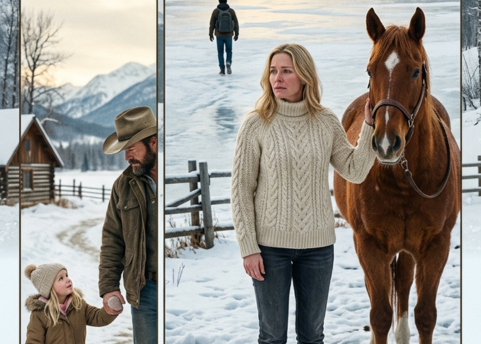
The Morning the Ranch Held Its Breath
The sky above Willow Creek Ranch was the color of ash and old roses. It was that brief, uncertain window before true sunrise when the world seems to be deciding what kind of day it will be. The grass was wet. The fence posts along the north pasture were dark with dew. Somewhere behind the red barn, one of the mares made a low, restless sound — not alarm, just restlessness.
Grace paused at the edge of the yard and pulled the flannel tighter across her chest.
The property was quiet in the way that only early Montana mornings could be — a silence so complete it had weight to it, like a held breath. She could see the outline of the mountains in the far distance, pale lavender and unmoving, and closer, the hills rising and falling in long green waves she’d known since childhood. Her father’s land. Then her husband’s. Now hers.
Hers alone.
She didn’t let herself finish the thought. She started walking toward the barn.
That was when she heard it.
Not a sound, exactly. More of a stillness that sharpened. A shift in the way the air moved near the creek line. She turned without deciding to, the way the body sometimes acts before the mind catches up, and looked east toward the water.
There was a horse at the creek.
Blue
She didn’t recognize him at first. The light was still thin, and the horse was standing at the water’s edge with his head lowered, perfectly still, like he’d grown there along with the willows. Dark coat. Broad chest. A calm, unhurried presence that didn’t match the alertness of a stray or a runaway.
Grace walked toward him slowly, the wet grass soaking through her boot laces.
She got close enough to see the white star.
A small one, just above the center of his forehead, shaped roughly like a four-pointed star but imperfect, tilted slightly left. She’d seen a horse with that marking before. Years ago. Not one of theirs — a horse Daniel had mentioned once, quietly, the way he mentioned things he wasn’t ready to explain.
She stopped ten feet away.
The horse raised his head and looked at her. His eyes were dark, liquid, and steady in a way that made her breath catch. There was no wildness in him. No fear. Just a patient, watchful intelligence that she found strangely difficult to look away from.
“Hey,” she said, and her voice came out rougher than she expected. “Where did you come from?”
He didn’t answer. Obviously. But he didn’t step back either. He stood there in the mist beside the creek, water still dripping from his muzzle, and regarded her with what she could only describe — absurdly, later, when she tried to tell her father about it — as recognition.
That was when she saw the bridle.
The Bridle
It was old. The leather had the soft, worn look of something that had been handled for years — not neglected, but lived in. The kind of wear that comes from real use, from real hands. The buckle on the left cheek piece was slightly bent, and there was a small repair on the noseband where someone had stitched it with dark thread, careful and clean.
Grace knew that repair.
She had done it herself. Three winters ago. Sitting at the kitchen table while Daniel watched from across the room, saying you’re better at that than I am, and she’d said you just don’t have the patience for it, and he’d laughed and said guilty.
She stood very still.
The horse — Blue, something in her was already calling him Blue, though she didn’t know why, didn’t yet understand — turned his head slightly, as if offering the bridle to her view. As if presenting evidence.
Grace’s hand came up slowly, the way it does when you’re afraid that what you’re reaching for isn’t real, that if you move too fast it will dissolve. Her fingers touched the noseband. Felt the stitching. Her own stitching — the small, even loops she’d made with brown waxed thread on a cold Tuesday night.
Her legs went strange beneath her.
She sat down in the wet grass without deciding to.
What Samuel Said
She didn’t know how long she stayed there. Long enough for the sky to shift from ash-rose to gold. Long enough for the horses in the pasture to start moving, their shapes drifting through the morning mist like slow thoughts.
Blue didn’t leave. He stood beside her — not hovering, not pressing in, just near — and dropped his head to graze the creek bank, utterly unhurried.
It was the sound of the back door that finally brought her back.
Her father, Samuel Hayes, stood on the porch in his work coat and hat, a coffee mug in each hand, squinting in her direction. He was sixty-eight years old and had spent those years becoming a man of very few unnecessary words, but he could read a field and a situation in the same unhurried glance, and he went still when he saw her sitting in the grass.
Then he saw the horse.
Grace watched something move through her father’s face — quick, almost controlled, but not quite. Something that wasn’t surprise. Or wasn’t only surprise.
He came down from the porch and crossed the yard without rushing. He stopped at the fence line and looked at Blue with an expression Grace couldn’t read.
“He just showed up,” she said.
“I can see that.”
“That’s Daniel’s bridle, Dad.”
A pause. Samuel took a slow sip of coffee. He did not look at Grace.
“Might be similar,” he said.
“It’s not similar.” Her voice came out steady, which surprised her. “I repaired it. I know my own work.”
Samuel was quiet for a long moment. In the pasture behind them, one of the mares nickered and tossed her head. Blue lifted his own head briefly, ears forward, then went back to grazing.
“Have you ever seen him before?” Grace asked.
Her father looked at her then, and his eyes were the careful eyes of a man choosing exactly what to say.
“Horses wander,” he said.
It was not an answer. They both knew it.
Lily and the Horse
Lily came flying out of the house forty minutes later with her boots on the wrong feet and her braid half-undone, because Grace had made the mistake of mentioning there’s a horse at the creek while pouring cereal, and Lily had interpreted this as drop everything immediately.
She was seven years old and had her father’s way of moving through the world — all forward momentum and open hands.
Grace caught her at the fence.
“Slow down,” she said. “He doesn’t know you yet.”
“Does he know you?” Lily asked.
“I’m not sure.”
Lily considered this with the seriousness she brought to most things. Then she said: “Can I go slow?”
“Very slow.”
She went very slow. Grace watched her daughter cross the damp grass toward the creek, each step deliberate, arms loose at her sides in the way Grace had taught her years ago — don’t reach for a horse before he’s ready, let him decide.
Blue raised his head when Lily was still six feet away.
He looked at the girl. Lily stopped. For a moment they just regarded each other, the child and the horse, and then Blue took two steps toward her — not away, toward — and dropped his head until his nose was level with Lily’s face.
Lily reached out one small hand and touched his star.
“He’s soft,” she said, without turning around.
“I know,” Grace said, though she hadn’t touched it yet herself.
“What’s his name?”
Grace looked at the horse. At the dark coat and the careful eyes and the small imperfect star. At the bridle she had stitched with her own hands on a winter night three years ago while her husband watched from across the kitchen table.
“Blue,” she said. “I think his name is Blue.”
Lily nodded as if this made complete sense. “Hi, Blue,” she said. “I’m Lily. This is our ranch.”
Blue breathed against her palm, a long slow exhale, and Lily giggled.
Grace pressed her hand flat against the fence post and held on.
The Fence He Wouldn’t Cross
After breakfast, Grace called Ethan Cole’s office — Ethan being the nearest large animal vet, thirty minutes out of Cedar Falls — and left a message about an unidentified horse on her property, possible stray, no visible injuries. Standard protocol. She did the things you do when a horse turns up uninvited on your land.
Then she spent the rest of the morning trying to figure out how to get Blue into the pasture.
He wouldn’t come through the gate.
Not because he was frightened. She was fairly certain now that Blue was not a horse easily frightened. He stood at the gate opening and looked through it, completely calm, and simply declined.
Grace tried grain. She tried patience. She walked through herself and turned and called him. She stood on the other side for ten full minutes while Blue regarded her with what she had begun privately to think of as his considering expression — a slight tilt of the head and a quality of attention that felt uncomfortably like being evaluated.
He would not cross the gate.
“He’ll come in when he’s ready,” her father said from behind her.
Grace turned around. Samuel was leaning on the fence post, hat low, studying the horse.
“Why wouldn’t he be ready?” she said.
Samuel was quiet.
“Dad.”
“I don’t know anything about this horse, Grace.”
“You made that face. When you saw him this morning. You made a face.”
“I make faces. I’m old.”
“You made a specific face.”
Samuel looked at her, and his jaw was set in the way that meant he had decided something. The way that meant the conversation was over, not because there was nothing to say, but because he had determined he wasn’t going to say it.
“He’ll come in when he’s ready,” he said again, and walked back toward the barn.
Grace turned back to Blue.
Blue was watching Samuel walk away.
What She Did That Night
After Lily was asleep, Grace sat at the kitchen table with a cup of tea she’d stopped drinking and looked at the window that faced east, toward the creek.
She’d left the barn light on. Old habit. Daniel had always said a horse new to a place needed a light to find its way back if it decided to wander in the night.
She thought about calling her brother — her half-brother, Matthew, who lived in Billings and came to the ranch approximately twice a year and understood it approximately not at all. She thought about calling her friend Rosa from Cedar Falls, who would listen and say Grace, honey, that’s just a horse in the kindest possible voice.
She didn’t call anyone.
She sat and thought about the bridle.
Because here was the thing she hadn’t said to her father, the thing she hadn’t said out loud to anyone: Daniel’s bridle hadn’t been in the barn when he died. She had looked for it. It wasn’t in the tack room, wasn’t hung on any of the usual pegs, wasn’t in the back of either truck.
She had assumed it was lost in the accident. Or left somewhere. She had stopped looking eventually, the way you stop looking for things that hurt to think about.
And now it was here.
On a horse she’d never seen before.
Appearing at the creek at sunrise like something out of a dream, or a memory, or a thing that had been waiting a very long time to come home.
Grace picked up her tea, realized it was cold, and set it back down.
Outside, through the window, the barn light burned soft and steady in the dark.
Blue was still at the creek. She could just make out his shape in the darkness — the slight movement of his head, the steady patient presence of him.
Why won’t you come through the gate?
She already knew, somehow, that the answer to that question was not a simple one. That Blue’s refusal was not stubbornness or fear but something closer to a decision. That he was waiting, as he had apparently been waiting all day, for something specific.
She just didn’t know what yet.
She got up, rinsed her cup, and went to bed.
In the morning, the barn light was still on. And when she looked out the window at first light, Blue was still there — standing exactly where she’d last seen him, in the mist at the edge of the creek.
Still waiting.
To be continued in Episode 2: The Bridle He Left Behind.
