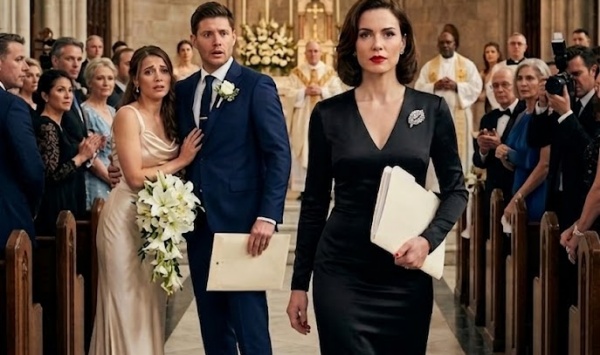
My Husband’s Mistress Planned to Have Their Affair Blessed in Church on My Wedding Anniversary… Marissa thought she could turn my wedding anniversary into her moment of victory. She stand in the same church where I once said my vows, and expect me to sit quietly while they blessed the relationship that broke my family.
But before she ever reached the chapel doors, I discovered one detail they had both ignored….
Part 1: The Invitation on Our Anniversary
My husband’s mistress sent the invitation three weeks before my wedding anniversary, as if cruelty became more elegant when printed on cream cardstock. The envelope arrived in our mailbox on a Tuesday afternoon, tucked between a grocery flyer and Ava’s orthodontist bill. At first, I thought it was a donation letter from St. Matthew’s, because the return address belonged to the church where Ben and I had once promised each other forever.
My name is Grace Whitmore, and for fourteen years, I was Grace Whitmore Keller. I lived in Charleston, South Carolina, in a white clapboard house with black shutters, a porch swing, and a magnolia tree that dropped waxy petals over the walkway every June. My husband, Benjamin Keller, was a civil litigation attorney with a smooth voice, expensive cufflinks, and the rare ability to make selfishness sound like strategy.
We had one daughter, Emma, who was eleven and old enough to notice everything adults tried to hide from her. She loved marine biology, blueberry pancakes, and correcting people who called dolphins fish. She had her father’s dark eyes and my stubborn chin, which meant she could look right through me whenever I tried to soften the truth too much.
Ben and I were married at St. Matthew’s Episcopal Church on King Street on September 18, under stained-glass windows and a ceiling that smelled faintly of old wood and candle wax. My father walked me down the aisle before his Parkinson’s became severe. My mother cried through most of the ceremony, though she insisted later it was only allergies.
The church mattered to my family long before Ben entered it. My grandmother had sung in the choir there. My parents had renewed their vows there after thirty years. When the education wing flooded during Hurricane Matthew, my family foundation paid nearly half of the restoration costs, including the new flooring, the sound system, and the refinishing of the small side chapel.
Ben knew all of that. Everyone knew all of that.
That was what made the invitation feel less like an accident and more like a hand reaching directly into my chest.
The card read:
“Benjamin Keller and Marissa Vale invite you to witness a private blessing of their relationship as they begin a new chapter in faith, honesty, and healing.”
Faith. Honesty. Healing.
I stood in my kitchen and read those words until the letters blurred.
Marissa Vale was not new to my pain. She was thirty-two, polished, and worked as a communications consultant for one of Ben’s corporate clients. She had glossy auburn hair, a laugh that carried across rooms, and the kind of confidence that made people describe her as “magnetic” when they meant “dangerous if underestimated.”
Ben introduced her to me at a fundraising dinner eighteen months before the invitation arrived. She wore a green satin dress and shook my hand with both of hers. She said, “Ben talks about you all the time,” in a voice so warm I almost believed her.
Looking back, I think that was the first lie she told me.
The affair revealed itself slowly, then all at once. There were late meetings that ended after midnight. Hotel charges Ben claimed were client-related. A second phone he said was for “trial prep security.” Then one evening, while folding laundry in our bedroom, I found a receipt in his jacket pocket from The Dewberry hotel: two cocktails, one bottle of champagne, and a room service breakfast for two.
When I confronted him, he did not crumble. Ben was too practiced for that. He leaned against our dresser, crossed his arms, and said, “Grace, we have both been unhappy for a long time.”
That was his opening argument. Not I’m sorry. Not I betrayed you. Not I put our daughter’s sense of safety at risk because I wanted attention and admiration from another woman.
We have both been unhappy.
It was amazing how quickly he tried to make his affair sound like a group project.
Within two months, he had moved into a furnished condo near the waterfront. Within four months, Marissa was staying there more often than not. Within six months, Ben began using phrases like “our new path” and “emotional truth,” as if language could baptize betrayal.
I filed for separation first, not because I wanted to destroy our marriage, but because Ben had already moved out of it and left me paying for the emotional repairs. South Carolina required a year of separation before a no-fault divorce, but fault-based grounds existed too, and my attorney, Diane Mercer, understood the difference between dignity and passivity.
Diane was in her late fifties, sharp as a paper cut, and had the calm posture of a woman who had watched too many charming men discover consequences. She told me early on, “Do not let him turn your silence into consent.”
So I stopped being silent where it mattered. I documented expenses. I kept records of missed custody exchanges. I forwarded emails to Diane. I did not post online, did not call Marissa names, and did not turn Emma into a messenger.
That last part was hardest.
Because Emma noticed everything.
She noticed when Ben stopped coming to Saturday breakfast. She noticed when his shirts disappeared from the laundry room. She noticed when Marissa’s name began appearing too often on his phone. One night, while I was packing her lunch for school, she asked, “Is Dad dating her?”
I remember holding a sandwich bag open and realizing there was no motherly way to make betrayal gentle enough for a child.
I said, “Dad has made choices that hurt our family. The grown-ups are working through it, and none of it is your fault.”
Emma looked at me for a long time. Then she said, “That’s not a no.”
No, it was not.
Ben wanted everyone to adjust quickly because quick adjustment made his choices look survivable. He wanted Sunday dinners with Emma and Marissa after three months. He wanted Christmas morning “shared gracefully.” He wanted me to attend events where Marissa stood beside him like a promotion.
When I refused to play along, he called me bitter.
Bitter is a word people use when they want the person they hurt to become responsible for the discomfort of being hurt.
Then came the church blessing.
I thought at first it had to be a mistake. No church would knowingly bless a relationship that began as an affair while the marriage still legally existed. No priest who had known my family for years would place sacred language over public humiliation and call it healing.
But the invitation had St. Matthew’s address. It had the date. September 18. My wedding anniversary.
Not the weekend after. Not the month after. The exact day.
I called the church office with hands that felt strangely cold. A woman named Patricia answered, the parish administrator. I had known her since she brought casseroles to my mother after my father’s funeral.
“Patricia,” I said carefully, “I received an invitation for a private blessing at St. Matthew’s on September eighteenth.”
There was a pause.
“Oh,” she said.
That one word told me enough to sit down.
She explained that Marissa had contacted the church about a “private pastoral blessing” for a couple seeking prayer as they began a serious commitment. She said the reservation was for the side chapel, not the main sanctuary. She said Father Andrew had agreed to meet with them beforehand.
“Did they tell him Ben is still married?” I asked.
Another pause.
“I don’t know what was discussed,” Patricia said softly.
I closed my eyes. “Patricia, September eighteenth is my wedding anniversary. Ben and I were married at St. Matthew’s.”
“I know,” she whispered.
That hurt more than if she had sounded defensive.
I thanked her and ended the call before my voice broke. Then I sat at the kitchen table beneath the light fixture Ben had once hated because he said it looked “too farmhouse,” and I stared at the invitation until the word healing began to look obscene.
That evening, Ben called.
I knew from his tone that he expected resistance and had prepared a speech. He used his courtroom voice, warm but firm, the one that made judges listen and me feel like I was being cross-examined in my own kitchen.
“Grace, I know you received the invitation.”
“You mean the invitation to watch your mistress wear ivory in the church where I married you?”
He exhaled. “That kind of language is exactly why this needs to happen.”
I almost laughed. “Your affair needs a church service because I’m using accurate nouns?”
“It’s not a wedding,” he said. “It’s a blessing. A private one. Father Andrew understands we’re trying to move forward in a healthy way.”
“Does Father Andrew understand you’re still legally married?”
Silence.
Then Ben said, “Our marriage is over in every way that matters.”
That sentence entered me quietly and stayed there.
“Our marriage mattered when my family donated to that chapel,” I said. “It mattered when my father walked me down that aisle. It mattered when you made vows in front of everyone who loved us.”
“Grace, this isn’t about punishing you.”
“No,” I said. “It’s about rewarding yourself.”
He lowered his voice. “Marissa wants peace. I want peace. Emma needs peace.”
The moment he said our daughter’s name, the last fragile part of my restraint hardened.
“Do not use Emma as decoration for this,” I said.
“She’s invited,” he replied.
I could not speak for a second.
Ben continued, “It would help her see that we’re all moving forward.”
All. As if Emma and I had volunteered for the journey.
I told him Emma would not attend. He said I was keeping her from healing. I said I was keeping her from being asked to sit in a church pew and watch adults bless the wound they gave her.
He called me dramatic. Of course he did.
After we hung up, I called Diane.
I explained everything: the invitation, the date, the side chapel, Marissa wearing ivory, Ben saying Emma should attend. Diane listened without interrupting. That was how I knew she was angry.
When I finished, she asked, “Who paid for the chapel restoration?”
“My family foundation,” I said.
“And who holds the donor agreement?”
“I think I do. Or the foundation office does.”
“Find it,” she said.
So I went upstairs to the old file cabinet in the guest room, the one Ben always said we should replace with something more modern. I opened the bottom drawer and pulled out a folder labeled “St. Matthew’s Restoration.” Inside were receipts, letters, tax acknowledgments, and a copy of the donor agreement signed six years earlier.
The side chapel had a formal dedication name.
The Whitmore Chapel.
My maiden name.
There was also a clause I had completely forgotten. For ten years following the restoration gift, private non-parish ceremonies in the Whitmore Chapel required donor family notification and approval if they were not standard church services open to the congregation.
I read it three times.
Then I sent a scan to Diane.
Her reply came twelve minutes later: “Do not contact Ben again tonight. I will handle the church in the morning.”
For the first time since opening the invitation, I smiled.
Not because I wanted revenge. Not really.
Because Ben had forgotten something important: he was used to walking into rooms under my family’s name and acting like he had built them himself.
Part 2: The Chapel With My Name on It
The next morning, Charleston woke under a heavy gray sky, the kind that made the whole city smell like rain and saltwater. I drove Emma to school while she reviewed vocabulary words in the passenger seat. She had a quiz on Greek roots, which felt almost funny, because my own life had become a study in meanings beneath meanings.
As she got out of the car, she paused and looked back at me.
“Mom,” she said, “is Dad doing something weird at church?”
My hands tightened on the steering wheel. “Why do you ask?”
“He texted me that he hoped I would come support him and Marissa for a special blessing.”
I felt heat rise behind my eyes, but I kept my voice steady. “You do not have to attend anything that makes you uncomfortable.”
“He said it would show maturity.”
Of course he did.
Maturity, in Ben’s vocabulary, meant other people swallowing his choices without complaint.
I looked at my daughter, standing there in her school polo with her backpack slipping off one shoulder. “Emma, being mature does not mean pretending something doesn’t hurt. It means being honest without being cruel.”
She nodded slowly. “I don’t want to go.”
“Then you won’t.”
Relief passed over her face so quickly it nearly broke me.
After drop-off, I drove to Diane’s office downtown. Her building overlooked Meeting Street, with windows facing old brick storefronts and oak trees draped in Spanish moss. She had already printed the donor agreement by the time I arrived.
“This is unusual,” she said, tapping the clause with one manicured nail. “But it’s clear enough to create a problem for them.”
“A problem for the church or for Ben?”
“For everyone who assumed you were decorative.”
That was Diane’s way of comforting people.
She had already called St. Matthew’s and requested a meeting with Father Andrew and the parish administrator. Not a confrontation. Not a threat. A meeting. Diane believed strongly in making people understand the paperwork before they felt the fire.
Father Andrew agreed to meet that afternoon.
I had known Andrew Holloway for nearly a decade. He was not the priest who married Ben and me; that priest had retired to North Carolina. Father Andrew arrived two years later, younger than most parishioners expected, with a gentle face and a habit of pausing before answering difficult questions.
He had baptized my friend Laura’s twins. He had presided over my father’s funeral. He had once sat with my mother for forty minutes after a Sunday service because grief had caught her unexpectedly beside the communion rail.
I did not believe he was cruel.
That made the situation worse.
Cruel people are easier to face than careless good people.
The meeting took place in a small conference room off the parish office. Patricia sat beside Father Andrew, hands folded tightly in front of her. Diane sat beside me with the donor agreement in a blue folder.
Father Andrew began with an apology.
“Grace, I am sorry you were hurt by the invitation,” he said.
Diane’s eyebrows moved half an inch. She hated apologies that focused on the recipient’s reaction instead of the action.
I said, “I was not hurt by paper. I was hurt that my still-husband and his affair partner reserved the chapel my family restored for a relationship blessing on my wedding anniversary.”
Father Andrew looked down. “I was not aware of the date’s significance.”
“Were you aware he is still married?”
He hesitated.
That hesitation hurt.
“He told me the marriage was legally unresolved but functionally over,” Father Andrew said.
Diane leaned forward slightly. “That is not a church category, Father.”
Patricia pressed her lips together.
Father Andrew looked genuinely uncomfortable. “I should have asked more questions.”
“Yes,” I said. “You should have.”
For a moment, the room held the weight of that simple truth.
Diane then opened the donor agreement. She explained the restoration gift, the dedication of the side chapel, and the approval clause for private non-parish ceremonies. She did not raise her voice. She did not accuse. She simply read the language aloud.
Patricia closed her eyes when she heard it.
Father Andrew asked to review the full document. Diane handed him a copy.
“This clause was created,” I said, “because my grandmother cared deeply about that chapel being used with integrity. She did not want it treated like a pretty rental space for private image management.”
Father Andrew flinched slightly at the phrase image management. Good. It was accurate.
He said, “Grace, I understand how this appears.”
“No,” I replied. “I need you to understand what it is.”
Diane said the scheduled event could not proceed in the Whitmore Chapel without my approval. She also noted that using church communication channels for a private ceremony involving a still-married parishioner and an extramarital partner could create reputational and pastoral concerns.
That was attorney language for: this is a disaster waiting for daylight.
Father Andrew said he would postpone the blessing immediately while the church reviewed the matter. I asked whether Ben and Marissa had been notified. He said not yet.
“I would like to be present when you tell them,” I said.
Diane turned toward me. “Grace.”
“I’m not going to argue,” I said. “I want to hear what they were told. I want to know whether my daughter was discussed.”
Father Andrew looked uneasy, but he did not say no.
The call was scheduled for 4:30 p.m. Ben and Marissa were invited to join by speakerphone. Diane remained with me. Patricia stayed in the room, looking like she would rather be anywhere else in South Carolina.
Ben answered first. “Father, is everything all right?”
Marissa’s voice came through a second later, bright and confident. “We’re just finalizing flowers, so I hope this won’t take long.”
Flowers.
For a church blessing of an affair on my anniversary, they had ordered flowers.
Father Andrew cleared his throat. “Benjamin, Marissa, I need to inform you that the September eighteenth blessing cannot proceed as scheduled in the Whitmore Chapel.”
There was a pause.
Ben said, “Why?”
Diane nodded once at me, giving me permission to remain silent.
Father Andrew continued, “There are donor restrictions related to private ceremonies in that chapel, and the required approval has not been granted.”
Marissa’s voice sharpened. “Donor restrictions? What donor?”
I spoke then. Calmly.
“My family.”
The silence that followed was almost beautiful.
Ben said my name like a warning. “Grace.”
“Benjamin,” I replied.
Marissa laughed once, but it sounded thin. “I’m sorry. Are you saying you control the church?”
“No,” I said. “I’m saying you tried to use a chapel restored under my family’s name for a private ceremony you did not have permission to hold.”
Ben cut in. “This is petty.”
Diane leaned toward the speaker. “Mr. Keller, this is Diane Mercer, Mrs. Keller’s attorney. I would advise against characterizing enforcement of a signed donor agreement as petty.”
Ben went quiet.
Marissa did not.
“This was supposed to be about healing,” she said. “Grace is making it about ownership.”
I looked at the window, where rain had begun tapping lightly against the glass. Then I said, “You chose my wedding anniversary.”
Another pause.
Marissa said, “Ben told me that date no longer mattered.”
There it was.
Not an apology. Not remorse. But a crack in the polished story.
Father Andrew interrupted before the conversation could turn into something uglier. He said the event would be postponed indefinitely and that he would need to meet separately with Ben before considering any future pastoral service. He also made clear that Emma should not be pressured to attend any church-related event connected to adult conflict.
That last sentence mattered most.
Ben said, “Grace is alienating my daughter from me.”
Diane smiled without warmth. “Your daughter is eleven. She can read a calendar.”
I almost loved her in that moment.
The call ended with Ben furious, Marissa humiliated, and Father Andrew looking as though he had just discovered a trapdoor beneath his own floor.
Afterward, he turned to me.
“I am sorry,” he said again. This time, it sounded different. Less polished. More honest. “I should have protected the pastoral integrity of this place better.”
I nodded. “Yes.”
He accepted that without defending himself.
That evening, Ben called me nine times. I did not answer. He texted instead.
“You had no right to ambush us.”
I replied with one sentence: “Do not contact Emma about the blessing again.”
He wrote back: “You are using the church to punish me.”
I stared at that message while standing in the hallway outside Emma’s room. She was inside playing music softly while doing homework. Our house smelled like tomato soup and grilled cheese because that was what she had asked for after school.
I typed slowly.
“You used the church to decorate your betrayal. I used a legal agreement to stop it.”
Then I put my phone on silent.
Part 3: Ivory, Flowers, and a Locked Chapel Door
The week before September eighteenth became a small war fought through emails, attorneys, and people pretending they were not taking sides. Ben insisted I had humiliated him. Marissa told mutual acquaintances that I had “blocked a prayer service out of spite.” Certain church ladies stopped making eye contact with me after Sunday service, which was almost impressive considering most of them had watched my marriage fall apart from the second pew.
Charleston gossip does not run. It strolls politely with a monogrammed tote bag.
By Monday, I heard three versions of the story. In one, I had threatened to sue the church. In another, I had demanded Marissa be banned from the property. In the most dramatic version, I had screamed at Father Andrew in the parish office and knocked over a vase.
None of that happened.
But people often prefer a dramatic woman to an accountable man because she is easier to dismiss.
Diane advised me to keep quiet publicly. “Let documents speak where documents matter,” she said. “Do not fight gossip with oxygen.”
So I went to work, packed Emma’s lunches, attended her science fair meeting, and answered only necessary messages. My life looked ordinary from the outside. Inside, I was bracing for the anniversary like a storm on the radar.
September eighteenth fell on a Friday.
I woke before dawn and lay still beside the empty half of my bed. For fourteen years, that date had belonged to flowers, dinner reservations, handwritten cards, or at least the memory of them. Now it belonged to a church reservation Ben had tried to turn into a public cleansing of his conscience.
At 7:15 a.m., Emma came into my room carrying two mugs of coffee. Mine had coffee. Hers had hot chocolate because she was eleven and believed mugs made beverages mature.
“Happy not-sad day,” she said.
I sat up, surprised. “What?”
She climbed onto the bed beside me. “I didn’t know what to call it. But I thought maybe we could make it not only sad.”
I put my arm around her and held on longer than usual.
Children should not have to help adults rename pain. But sometimes they do it with such grace that it humbles you.
We decided to have dinner that night at our favorite seafood place on Shem Creek. Emma wanted shrimp and hush puppies. I wanted to survive the day without crying in a grocery store.
At noon, Patricia from the church called me.
Her voice was tense. “Grace, I wanted you to know Marissa came by.”
I closed my office door. “For what?”
“She said she was dropping off floral arrangements that had already been paid for. She was wearing—” Patricia stopped.
“Ivory?” I asked.
“Yes.”
Of course she was.
Patricia said Marissa had arrived with two large arrangements of white roses and greenery, claiming there had been a misunderstanding and that Father Andrew had agreed to a “smaller private prayer.” Patricia refused access to the Whitmore Chapel. Marissa became upset and asked whether I had “personally locked the door.”
I almost laughed, but it would have come out too sharp.
“Did Ben come with her?” I asked.
“No. But he called while she was here.”
“What did he say?”
Patricia hesitated. “He said the church was letting bitterness win.”
There it was again. Bitterness. The word people use when boundaries have better paperwork than their entitlement.
I thanked Patricia for telling me. Then I called Diane.
Diane listened, sighed, and said, “Do nothing. The church handled it.”
“Marissa showed up in ivory with flowers.”
“Which proves judgment was not their strongest argument,” she replied.
That helped more than it should have.
At 2:30 p.m., Ben texted: “You’ve made your point. Call me.”
I did not.
At 3:05 p.m., he wrote: “Marissa is devastated.”
I stared at the screen.
Marissa was devastated because she could not stand in my family’s chapel wearing almost-white on my wedding anniversary while a priest prayed over the relationship that helped end my marriage. Devastation, apparently, had a generous range.
At 3:22 p.m., he wrote: “This could have helped everyone heal.”
I finally replied.
“Emma is healing because she was not forced to attend.”
He did not answer.
At 5:45 p.m., Emma and I drove to Shem Creek. The late afternoon sun turned the marsh grass gold, and pelicans skimmed low over the water. Restaurants along the creek were crowded with tourists in sandals and locals pretending not to be tourists.
Emma ordered fried shrimp, fries, and lemonade. I ordered grilled mahi-mahi and a glass of iced tea. We sat outside where we could watch shrimp boats rock gently in their slips.
Halfway through dinner, Emma said, “Dad asked me if I was disappointed I didn’t go.”
My fork paused.
“When?”
“Yesterday. He called when you were in the shower.”
I kept my face calm. “What did you say?”
“I said no.”
I waited.
“She said hi in the background.”
Marissa.
There are moments in motherhood when anger has to pass through your body without finding your voice. This was one of them.
I asked, “How did that make you feel?”
Emma shrugged, but her eyes went shiny. “Like they wanted me to say I was happy for them.”
I reached across the table and took her hand. “You do not owe adults fake happiness.”
She nodded, looking down.
Then she said, “I’m happy with you right now.”
That was the moment the anniversary changed.
Not completely. Not magically. But enough.
We finished dinner. We shared key lime pie. Emma made a face because it was tarter than she expected, then ate half anyway. On the drive home, she played songs from her favorite playlist and sang loudly off-key.
When we pulled into the driveway, Ben’s car was parked outside my house.
He was sitting on the porch.
Emma went quiet.
I told her to stay in the car for a moment. Then I stepped out and closed the door gently behind me.
Ben stood. He was still wearing a suit, though his tie was loosened. He looked tired, angry, and lost in equal measure.
“We need to talk,” he said.
“No,” I replied. “You need to leave.”
His eyes flicked toward the car. “I want to see my daughter.”
“You called her behind my back about an event she already said she didn’t want to attend.”
“She’s my daughter too.”
“Yes,” I said. “So start acting like her father instead of your own defense attorney.”
His mouth tightened. “You embarrassed Marissa today.”
“I did not invite Marissa to wear ivory to a locked chapel.”
“She was trying to make something beautiful out of something painful.”
I stared at him.
That sentence was so revealing I almost did not know where to begin.
“No, Ben. She was trying to make something painful look beautiful.”
He looked away first.
Emma opened the car door then. I turned, startled, but she was already stepping out. She stood beside me, small but steady.
“Dad,” she said, “I don’t want to talk about the church anymore.”
Ben’s face changed. For a second, the lawyer disappeared, and there was only a father looking at a daughter who had learned to set a boundary too young.
“Em,” he said softly.
“No,” she said. “Mom said I don’t owe adults fake happiness. I don’t.”
He swallowed.
I wanted to shield her from the moment, but I also knew she deserved to have her words heard.
Ben nodded slowly. “Okay.”
Emma went inside.
I waited until the door closed behind her. Then I said, “If you pressure her again, Diane will address it formally.”
He laughed bitterly. “Everything is formal with you now.”
“No,” I said. “Everything is documented now. There’s a difference.”
He stood there in the fading light, the magnolia tree behind him dropping petals onto the grass. I remembered our wedding day, Ben at the altar with tears in his eyes. I remembered believing those tears meant reverence.
Maybe they had once. Maybe people can mean a vow when they make it and still betray it later. That is one of the crueler truths of marriage.
Ben said, very quietly, “I didn’t think you would actually stop it.”
“I know.”
That was why it had worked.
Part 4: The Money Behind the Sanctuary
After the failed blessing, Ben became less theatrical and more dangerous in the way angry attorneys can be. He stopped sending emotional texts and started sending polished emails. He accused me of interfering with his relationship, damaging his reputation, and weaponizing religious institutions.
Diane enjoyed that last phrase so much she printed it.
“He weaponized your wedding anniversary,” she said. “But yes, let’s discuss the chapel.”
The donor agreement became part of a broader conversation neither Ben nor Marissa had expected. Once Diane began reviewing the church documents, she asked for more financial records related to the restoration gift. Not because the church had done anything wrong, but because Ben had handled several of the charitable transfers during our marriage for tax planning purposes.
That was when we found the second problem.
The Whitmore Family Foundation had pledged $480,000 toward the chapel and education wing restoration. My mother and I authorized the pledge after my father died. Ben, as my husband and an attorney, helped coordinate certain payments and advised on documentation.
Most of the money went exactly where it should have gone.
But one $75,000 transfer looked strange.
It had been routed through a donor-advised account Ben controlled for “administrative efficiency,” then disbursed later than the others. The church received the funds eventually, but the timing, interest, and related tax treatment raised questions. Diane brought in a forensic accountant named Laura Chen, who had the cheerful demeanor of a kindergarten teacher and the instincts of a bloodhound.
Within two weeks, Laura found that Ben had used the temporary positioning of charitable funds to offset a personal liquidity issue tied to a failed investment. It was not as simple as theft, and Diane warned me not to call it that. But it was self-serving, undisclosed, and financially relevant to our divorce.
More importantly, it proved something I had felt for years but never fully named.
Ben saw my family’s generosity as a resource he could manage for his own benefit.
That realization hurt differently than the affair. Marissa had taken emotional space that was not hers. Ben had taken trust from every part of my life: marriage, family, money, faith.
When Diane confronted his attorney with the findings, Ben called me within ten minutes.
I answered only because Diane told me to let him speak if he wanted to create more record.
“You’re trying to ruin me,” he said.
I stood in my pantry, because apparently every woman in a collapsing marriage eventually takes legal calls near cereal boxes and paper towels. “I’m trying to understand our finances.”
“You know what an allegation like this could do to my career?”
“You should have thought about that before moving money through accounts you controlled.”
He lowered his voice. “You don’t understand what happened.”
“Then explain it through your attorney.”
“You used to trust me,” he said.
That sentence almost got me. Not because it was persuasive, but because it carried the ghost of who we had been. I had trusted him. Completely. With money, with grief, with my family’s name, with my daughter’s heart.
“Yes,” I said. “That was before I learned what you did with trust.”
He hung up.
The next custody mediation was colder than the first. Ben sat across from me in a navy suit, no wedding ring, no visible trace of the man who once danced barefoot with me in our kitchen. His attorney argued that I was allowing personal anger to affect co-parenting.
Diane responded by laying out the timeline.
Ben began an affair. Ben moved out. Ben introduced Marissa too quickly. Ben proposed involving Emma in a church blessing on my wedding anniversary. Ben allowed Marissa to contact church staff and attempt access to the Whitmore Chapel after permission had been denied. Ben contacted Emma about the event despite being told not to pressure her.
The mediator, a retired family court judge named Harold Simmons, listened with his hands folded.
Then he asked Ben, “Why that date?”
Ben blinked. “What?”
“The blessing,” Judge Simmons said. “Why schedule it on your wedding anniversary?”
Ben’s attorney started to answer, but the judge raised one hand.
“I asked Mr. Keller.”
Ben looked at me, then down at the table. “Marissa chose it.”
“Did she know what it was?”
A pause.
“Yes.”
The room went still.
“And did you know?” the judge asked.
Ben’s jaw tightened. “Yes.”
There it was. No misunderstanding. No accident. No unfortunate scheduling conflict.
Choice.
Judge Simmons leaned back. “That was a profoundly poor decision.”
In legal settings, that is practically thunder.
Ben did not argue.
The custody arrangement became more structured after that. Emma would not be required to attend events involving Marissa. Any introduction or shared activity had to be age-appropriate, discussed in advance, and never tied to religious or emotional pressure. Communication with Emma during my parenting time would remain direct but not manipulative.
Ben hated the word manipulative, though no one had said it in the order.
He heard it anyway.
Marissa emailed me once after mediation. The subject line was: “For Emma’s sake.”
I did not want to open it. Diane told me to forward it unread, so I did.
Later, Diane summarized it in three sentences: Marissa claimed she wanted peace, said the blessing was misunderstood, and hoped I would stop “using sacred spaces as leverage.”
I stared at Diane across her desk. “She wore ivory.”
Diane removed her glasses. “Some people confess with wardrobe.”
That became one of the few lines from that year that made me laugh.
Father Andrew also requested to meet with me again. This time, I went alone. Not because I trusted easily, but because the church had been part of my life before Ben, and I did not want him to own that too.
We sat in the empty sanctuary on a Thursday afternoon. Sunlight moved through stained glass and scattered blue and red across the pews. The air smelled like lemon polish and old hymnals.
“I have owed you more than procedural apology,” Father Andrew said.
I looked toward the altar where Ben and I had once stood.
“I allowed myself to accept a version of the story that was convenient,” he continued. “Benjamin presented himself as a man seeking peace. I failed to consider who was being asked to pay for that peace.”
That sentence settled something in me.
“Thank you,” I said.
He told me the church had revised its policy on private blessings and pastoral ceremonies. More careful review. Clearer marital status questions. Better attention to family impact. He did not make excuses.
I appreciated that more than he knew.
Before I left, I walked into the side chapel.
The Whitmore Chapel was small, with twelve pews, a simple wooden altar, and a stained-glass window of a dove above the east wall. My grandmother’s name was on a brass plaque near the entrance. I touched it with two fingers.
For months, I had associated that room with Ben’s attempted humiliation. Standing there alone, I remembered something else.
My grandmother had paid for beauty after a storm. She had believed sacred places should shelter the wounded, not decorate the wounders.
The chapel was not Ben’s. It was not Marissa’s. It was not even mine, not really.
But the story attached to it did not belong to them anymore.
Part 5: The Anniversary I Took Back
A year after the canceled blessing, September eighteenth came again. By then, the divorce was almost final. The financial issues had been settled with terms more favorable than Ben first offered, partly because hidden complexity has a way of making arrogant people suddenly reasonable.
Ben agreed to a structured custody schedule. Emma lived primarily with me during the school week, with alternating weekends and one dinner visit with him. He contributed to her school expenses, therapy, and activities, including the marine science camp in North Carolina she had talked about for months.
Marissa was still in his life, though less publicly. She no longer posted soft-focus photos of coffee cups and courthouse-adjacent inspiration quotes. I did not check her social media anymore, which felt like healing in its most practical form.
Emma had adjusted, though I hated that children have to adjust to adult failures. She still saw her therapist twice a month. She still asked hard questions in the car, where children seem to know adults cannot escape.
One afternoon, she asked, “Do you hate Dad?”
I kept my eyes on the road. “No.”
“Do you hate Marissa?”
I thought longer about that one.
“No,” I said finally. “But I don’t trust her, and I don’t have to pretend I’m okay with what happened.”
Emma nodded. “That makes sense.”
Then she asked if we could stop for Chick-fil-A, because emotional intelligence apparently pairs well with waffle fries.
On the morning of September eighteenth, I expected to feel heavy. Instead, I felt careful. The date still carried memory, but it no longer belonged only to loss.
I took the day off work. I made coffee. I opened the windows, even though Charleston humidity immediately tried to move in like an uninvited relative. Then I drove to a florist and bought white hydrangeas, my mother’s favorite.
Not roses. Never again roses for that day.
At noon, I went to St. Matthew’s.
Father Andrew knew I was coming because I had asked to sit in the chapel alone for a few minutes. Patricia greeted me at the office door and squeezed my hand. Neither of us mentioned the year before.
The Whitmore Chapel was quiet. The brass plaque had been polished. The small altar held a plain linen cloth and a single candle.
I placed the hydrangeas beneath my grandmother’s plaque and sat in the second pew.
For a long time, I did not pray in words. I just breathed.
I thought about my wedding day, my father’s arm in mine, Ben’s face when he saw me, the way everyone clapped when we walked back down the aisle. I thought about how happy I had been. I let that happiness exist without trying to punish it for what came later.
That mattered.
Betrayal had made me question everything, even the good memories. For a while, I wanted to believe it had all been false because false things are easier to throw away. But the truth was more complicated. Some of it had been real. Some of it had changed. Some of it had been broken by choices made later.
I did not need to erase the beginning to survive the ending.
When I left the chapel, Father Andrew was waiting near the hallway, but he did not interrupt. He simply nodded. That was enough.
That evening, Emma and I hosted what she called “Not-Sad Day, Second Edition.” We invited my mother, my best friend Laura, and Laura’s twins. We ordered takeout from a Thai restaurant, ate on the porch, and let the kids chase fireflies in the yard.
At one point, Emma brought out a cake she had insisted on decorating herself. The frosting was uneven, and the blue letters said: “NEW TRADISHUN.”
Laura whispered, “Should we tell her?”
“No,” I said. “It’s perfect.”
Emma lit candles, though it was not anyone’s birthday. My mother asked what we were celebrating.
Emma looked at me. I looked back at her.
“We’re celebrating Mom keeping the house peaceful,” she said.
I had to turn away for a second.
Later that night, after everyone left and Emma went upstairs, I washed plates alone in the kitchen. My phone buzzed on the counter.
It was Ben.
“Thinking about what today used to be. I’m sorry for last year.”
I read the message twice.
There was a time when those words would have cracked me open. I would have searched them for hidden meaning, for regret, for proof that the man I married still existed somewhere inside the man who hurt me. That night, I only felt quiet.
I replied, “Thank you. Please confirm pickup time for Saturday.”
He confirmed.
That was all.
People sometimes think closure is a dramatic conversation where the person who hurt you finally understands everything and says exactly what you needed years ago. Maybe that happens for some people. For me, closure looked like refusing to turn an apology text into an invitation back into my emotional life.
Ben did not get to be the center of September eighteenth anymore.
Neither did Marissa.
Neither did the canceled blessing, the ivory dress, the flowers, the locked chapel door, or the donor agreement Diane kept in her files like a sword wrapped in legal paper.
The day became mine because I chose what to do with it.
The divorce was finalized in November. The hearing was brief. The judge reviewed the agreement, asked a few questions, and signed documents that turned a marriage into a history with rules attached.
Ben looked at me afterward in the courthouse hallway. For once, he did not seem angry. Just tired.
“I never meant for it to get this ugly,” he said.
I believed him, strangely enough. Not because his actions were harmless, but because many people create ugliness without intending to see themselves as the source of it.
“I know,” I said. “But intention didn’t protect us. Choices would have.”
He absorbed that quietly.
Marissa was not there.
Emma spent that weekend with me. We went to the aquarium, where she lectured me for calling a sea turtle “cute” instead of “critically important to marine ecosystems.” We ate ice cream near the harbor, and she got mint chocolate chip on her sleeve.
Life continued. Not the old life. A different one.
A better one in some ways. Harder in others.
The house felt lighter without Ben’s tension filling the rooms. I painted the dining room a soft blue he would have called impractical. I replaced our anniversary china, which I had never liked, with mismatched plates from a local market. I started running again along the Battery in the mornings, slow at first, then strong enough to feel my lungs open.
I went back to St. Matthew’s too.
Not every Sunday. Not performatively. But enough to reclaim the pews from memory.
The first time I took communion after the canceled blessing, my hands trembled. Father Andrew placed the bread in my palm and said the familiar words. I returned to my seat and cried quietly, not because I was broken, but because I was still there.
That is something people do not always understand about survival.
It is not always loud. It is not always a courtroom victory, a dramatic confrontation, or the perfect sentence delivered at the perfect time. Sometimes survival is walking back into a place someone tried to use against you and discovering your name was never theirs to take.
Marissa had wanted a blessing.
Ben had wanted healing without accountability.
They both wanted sacred words to cover an unsacred beginning.
But sacred places do not work like stage lighting. You cannot stand in one and become honorable by association. You cannot schedule grace on someone else’s wound and expect the calendar to obey you.
The date mattered.
The church reservation mattered.
The money behind that sanctuary mattered.
But what mattered most was that, for the first time in a long time, I stopped letting Ben define what peace was supposed to look like.
Peace was not me sitting quietly in a pew while a priest softened the edges of his betrayal.
Peace was Emma knowing she could say no.
Peace was Father Andrew admitting the church should have asked harder questions.
Peace was Diane sliding a donor agreement across a table and reminding everyone that paperwork can sometimes protect dignity when people will not.
Peace was me standing in the Whitmore Chapel one year later with white hydrangeas and no desire to prove anything to anyone.
I used to think the opposite of humiliation was revenge. It is not.
The opposite of humiliation is dignity.
Revenge still keeps your life organized around the person who hurt you. Dignity hands their choices back to them and walks away with clean hands. That was what I wanted Emma to learn from me, more than any speech I could give her.
One night, months after the divorce, Emma found our old wedding album in a storage bin. She brought it downstairs carefully, as if it might explode.
“Do you want me to put it back?” she asked.
I looked at the cover, ivory silk, slightly yellowed at the edges.
“No,” I said. “We can look.”
We sat on the couch and turned the pages together. There was my father, proud and fragile. My mother, crying. My grandmother, wearing pearls in the front row of St. Matthew’s. Ben and me, young and glowing under the stained glass.
Emma studied one photo of us leaving the church.
“You looked happy,” she said.
“I was.”
“Does that make it worse?”
I thought about it.
“Sometimes,” I said. “But it also means I don’t have to pretend my whole life was a mistake. Good things can be real even if they don’t last forever.”
She leaned her head against my shoulder. “I like that.”
I did too.
The album went back into the bin, not hidden, not displayed. Just part of the record. Part of a life that had contained love, betrayal, courage, paperwork, fried shrimp, therapy appointments, chapel doors, and a daughter who renamed an anniversary because she loved me.
Ben eventually married Marissa in a small civil ceremony two counties away. I heard about it through a mutual friend who immediately apologized for telling me. I surprised both of us by feeling almost nothing.
No church blessing. No ivory performance at St. Matthew’s. No attempt to involve Emma beyond what our custody agreement allowed.
Emma attended a lunch with them weeks later. She came home and said it was “fine,” which from an eleven-year-old meant either acceptable or emotionally exhausting. I did not interrogate her. I made spaghetti, and we watched a documentary about whales.
That night, as I locked the back door, I looked out at the magnolia tree in the yard. The porch swing moved slightly in the wind. For years, I had imagined growing old in that house with Ben. Now I imagined something else.
Morning coffee alone.
Emma’s science projects on the dining table.
Friends laughing on the porch.
A future not built around proving I was chosen.
That was enough.
More than enough.
The blessing they tried to hold on my wedding anniversary never happened. The ivory dress never walked down the aisle of the Whitmore Chapel. The priest never stood before my daughter and wrapped holy language around an affair.
And I did not have to scream to stop it.
I only had to remember what was still under my name.
Not just the donor agreement.
Not just the chapel.
My name was still on my life.
My dignity.
My motherhood.
My right to say no when someone asked me to call humiliation healing.
Ben thought I would sit quietly because I had done it for years. Marissa thought ivory could make her look innocent. They both thought the church would make their story look clean.
But they forgot that sacred places have memories.
They forgot that paperwork can outlast charm.
They forgot that the woman they expected to watch in silence was the same woman whose family had rebuilt the room they wanted to use.
And on the day they tried to bless what broke me, I finally understood something.
A new beginning does not need someone else’s anniversary.
It does not need stolen flowers, borrowed holiness, or a child forced to smile through confusion.
A real new beginning starts when you stop letting the people who hurt you decide what healing should look like.
Mine began with a locked chapel door.
